

By Judy Zhou, Founder
Key Takeaways
- The search engine optimization tools that actually work in 2026 track AI answer visibility alongside traditional rankings, build topical authority through entity-rich content, and gate AI-generated drafts behind quality controls before publishing.
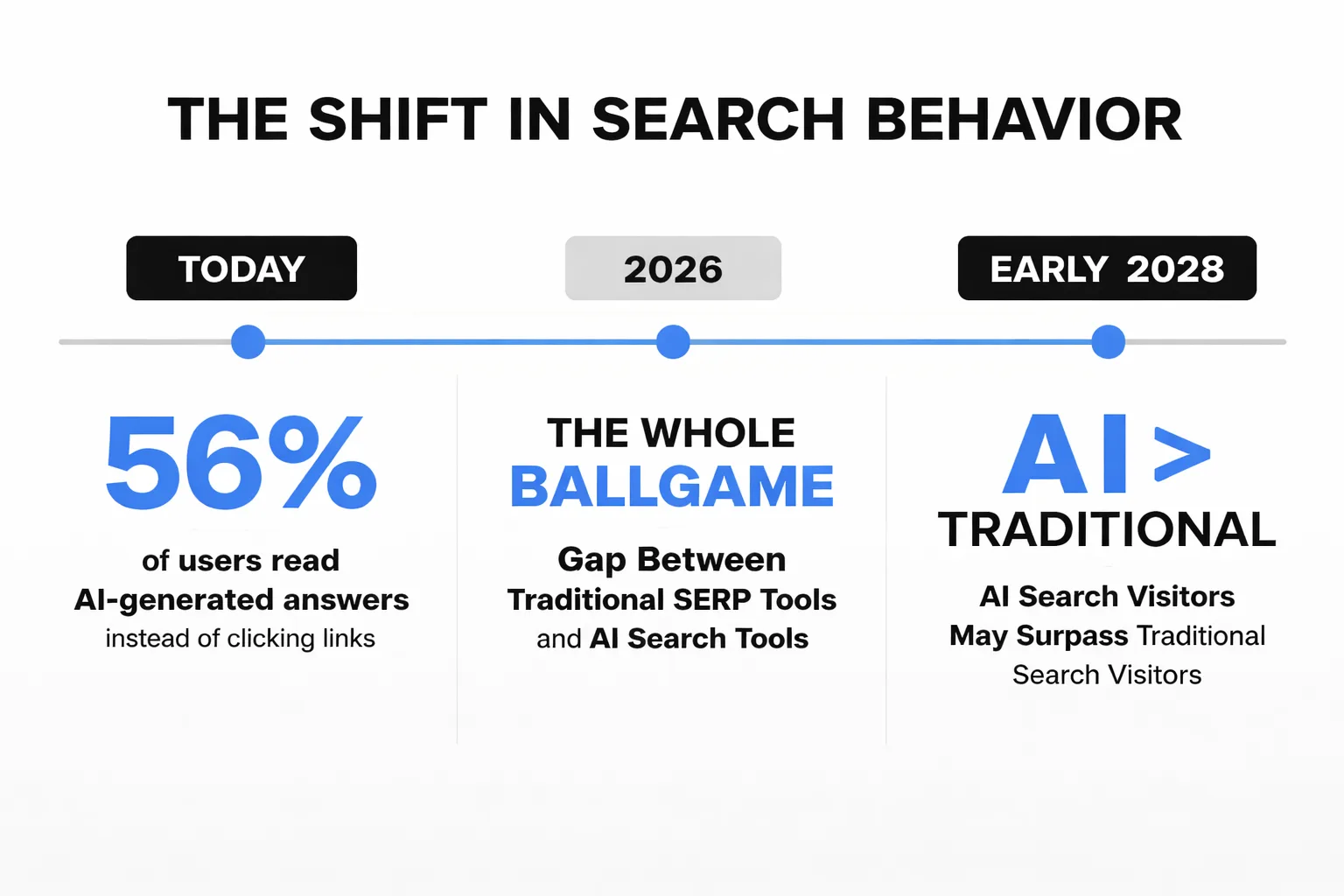
- AI search visitors may surpass traditional search visitors by early 2028, according to Semrush's AI search impact study.
- The SEO services market is projected to grow from $92.74 billion in 2025 to $108.28 billion in 2026 at a CAGR of 16.8%.
- 32% of Nasdaq companies see a strong correlation between search visibility and stock prices, according to Ahrefs research.
When was the last time you actually clicked a link on a search results page. Instead of reading the AI-generated answer at the top and moving on? If you're honest, it probably wasn't today. Now ask yourself whether the search engine optimization tools your team pays for every month even know that behavior is happening. In 2026, the gap between tools built for traditional SERP visibility and those built for AI search, answer engine optimization, and generative engine exposure isn't a minor product difference. It's the whole ballgame.
The search engine optimization tools that actually work in 2026 are the ones that track AI answer visibility alongside traditional rankings, build topical authority through entity-rich content, and gate AI-generated drafts behind quality controls before publishing. According to Semrush's AI search impact study, AI search visitors may surpass traditional search visitors by early 2028. The SEO services market is projected to grow from $92.74 billion in 2025 to $108.28 billion in 2026 at a CAGR of 16.8%. And Ahrefs found that 32% of Nasdaq companies see a strong correlation between search visibility and stock prices. If your tool stack hasn't adapted to these shifts, you're optimizing for a search experience that's already fading.
SERP trackers or AI visibility platforms?
Most SEO tool reviews in 2026 still organize themselves around the same categories they used five years ago: keyword research, rank tracking, technical audits, link building, content optimization. Those categories haven't disappeared. But they've been fundamentally reshaped by one fact: search results now include AI-generated answers that synthesize content from multiple sources, cite specific domains, and often satisfy user intent without a single click.
This changes what you need from your tools. A rank tracker that tells you you're in position 3 is still useful. But it's dangerously incomplete if position 3 sits below an AI Overview that cites your competitor and ignores you entirely. In my work auditing content operations, I've seen teams celebrate ranking improvements while their actual click-through rates flatlined or declined. The SERP feature they weren't tracking (the AI answer) was absorbing the clicks they thought they'd earned.
The divide I see in 2026 is between two categories of tools. First, traditional SEO platforms that have bolted on AI features as a checkbox. Second, platforms built from the ground up to track AI search visibility, measure citation frequency, and optimize content for answer engines. The first category will tell you where you rank. The second tells you whether you're actually visible to the person asking the question.
If you're evaluating search engine optimization tools this year, the single most important question isn't "does it track keywords" but "does it track where my brand appears in AI-generated answers across ChatGPT, Perplexity, Google AI Overviews, and Claude." If the answer is no, you're flying blind in the channels where search behavior is migrating fastest.
Why Does AI Search Change Which Tools Matter?
AI search engines don't rank pages. They synthesize answers from multiple sources, cite specific domains, and prioritize content that demonstrates topical depth and factual authority. This means the tools that matter most are the ones that help you understand which sources AI engines cite, how your brand appears (or doesn't) in those citations, and what content gaps exist between you and competitors who are getting cited.
The Princeton research paper on Generative Engine Optimization (GEO) laid the academic foundation for this shift. The core insight: generative engines reward different content signals than traditional SERP algorithms. Citation inclusion, factual density, and authoritative sourcing matter more than keyword density or meta tag optimization.
Here's what this means practically. If you're using a tool that only tracks blue-link rankings, you're measuring visibility in a format that's shrinking. Semrush's study analyzed over 500 high-value digital marketing and SEO-related topics and found that AI search is reshaping traffic patterns in ways traditional rank tracking can't capture. You need tools that show you both the classic SERP and the AI answer layer.
The tools I consider essential in 2026 fall into three buckets: visibility tracking (where am I cited across AI engines), content intelligence (what should I write to earn citations), and quality-controlled publishing (how do I produce content that meets the bar AI engines reward). Traditional tools handle pieces of this. AI-native platforms handle the full loop.
Are traditional SEO platforms still enough?
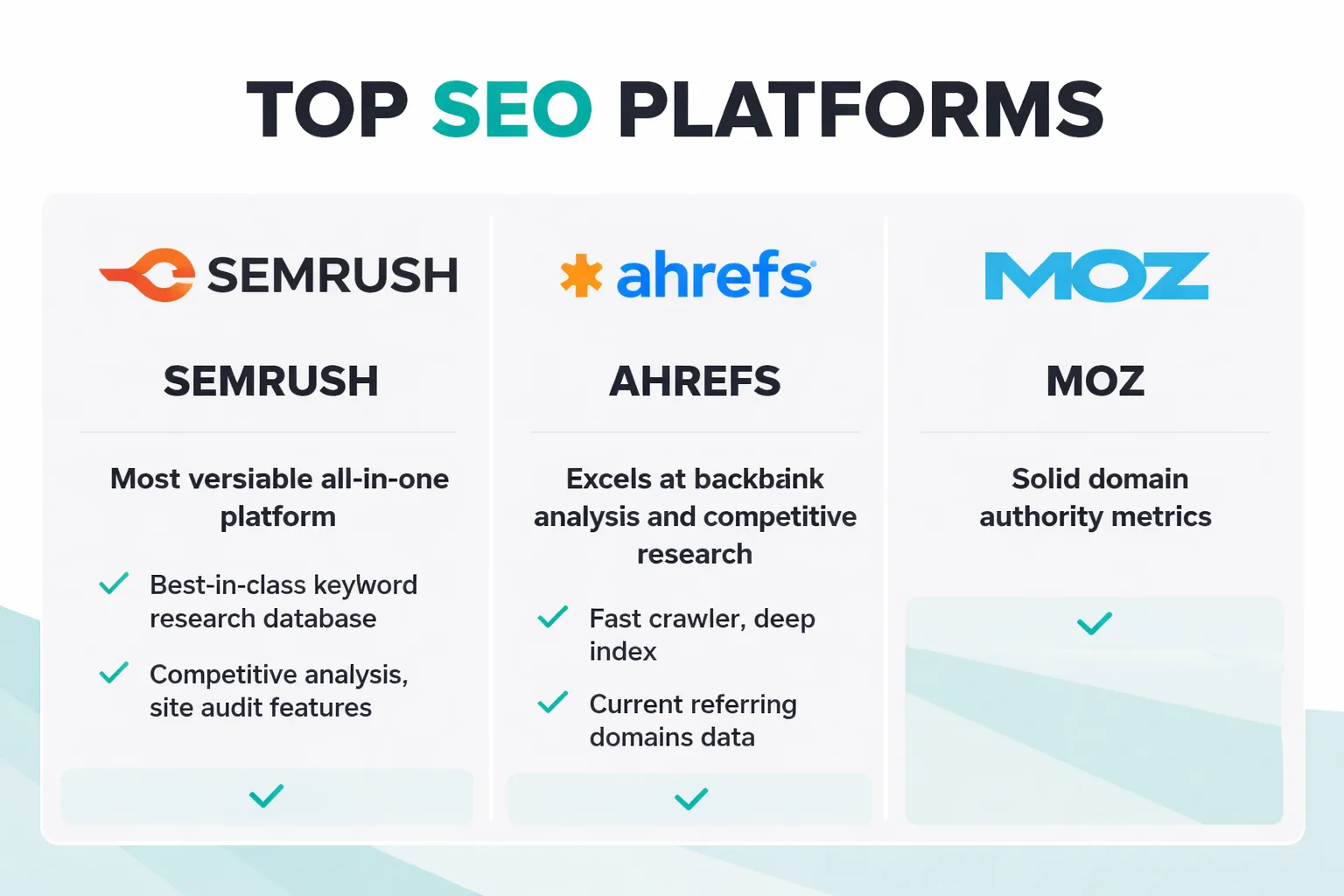
Let me be clear about something. Semrush, Ahrefs, and Moz are not obsolete. I use them. You should too. But their value proposition has shifted from "this is all you need" to "this is the foundation you build on."
Semrush remains the most versatile all-in-one platform. Its keyword research database, competitive analysis tools, and site audit features are genuinely best-in-class. The Semrush analysis of traditional SEO vs. AI SEO correctly positions AI SEO as an extension of traditional SEO, not a replacement. You still need keyword data, backlink analysis, and technical audits. Semrush delivers all three at scale.
Ahrefs excels at backlink analysis and competitive research. Their crawler is fast, their index is deep, and their data on referring domains is more current than most alternatives. For link-building campaigns and competitive gap analysis, Ahrefs remains my go-to recommendation.
Moz continues to offer solid domain authority metrics and local SEO tools. Their DA metric is still widely used as a shorthand for site credibility, even if the SEO community debates its precision.
Here's the problem. None of these platforms natively track your brand's visibility in ChatGPT responses. None show you when Claude cites your competitor instead of you. None alert you when Perplexity's answer to a high-intent query in your space omits your brand entirely. They're built for a SERP-first world. You need to pair them with AI-specific visibility tools to get the full picture.
How Do Free Google Tools Fit Into an AI SEO Stack?
Google's free tools are the backbone of any SEO operation, and that hasn't changed in 2026. What has changed is how you interpret their data in the context of AI search.
Google Search Console remains the single most important free tool for understanding how Google sees your site. It shows you impressions, clicks, CTR, and average position for your queries. In an AI search world, GSC data becomes a diagnostic for understanding which queries trigger AI Overviews and how those overviews affect your click-through rates. If you see impressions holding steady but clicks dropping on a query, check whether an AI Overview is now absorbing that SERP. GSC won't tell you that directly, but the pattern is unmistakable when you look for it.
Google Analytics 4 gives you the behavioral data to understand what happens after users arrive. It won't tell you whether they came from an AI answer or a blue link (Google's referral data doesn't distinguish AI Overview clicks from standard organic), but it shows you engagement patterns that help you evaluate content quality.
Google Keyword Planner still works for search volume data. But here's the contrarian take: search volume data from Google Keyword Planner is increasingly misleading for content planning in 2026. The volumes reflect searches that may now be satisfied by AI answers without clicks. A keyword showing 10,000 monthly searches might generate 3,000 actual website visits because the AI Overview satisfies 70% of searchers. Use Keyword Planner for directional signal, not for traffic forecasting.
If you want to understand how AI engines specifically perceive your content, you need tools designed for that purpose. Our AI Crawler Simulator shows you what AI crawlers see when they fetch your pages, and the LLMs.txt Validator checks whether your AI-specific crawling instructions are properly configured. These are the kinds of free tools that fill the gaps Google's own suite doesn't address.
AI SEO Tools Built for Answer Engine Optimization
This is where the tool landscape gets genuinely interesting. A new category of tools has emerged specifically to address visibility in AI-generated answers. These aren't traditional SEO platforms with AI bolted on. They're built to answer a different question: "Is my brand visible when someone asks ChatGPT, Perplexity, or Claude about my industry?"
In my work at Meev overseeing content strategy and AI-driven publishing, I've seen firsthand how this visibility gap plays out. A brand can rank in the top three organic results on Google and still be completely absent from the AI Overview for the same query. Another brand can be invisible in traditional rankings but consistently cited by Perplexity because their content structure and factual density align with what generative engines prefer.
The tools that matter in this category do three things. They track brand mentions across AI search surfaces (not just Google). They identify citation gaps where competitors are cited and you aren't. And they help you understand the content patterns that earn AI citations so you can replicate them.
For checking your current AI visibility, you can start with our ChatGPT AI Visibility Checker or the Perplexity AI Visibility Checker. These give you a snapshot of whether your brand appears in responses across those specific engines. For a broader view, the AI Visibility Checker covers multiple surfaces in one query.
The distinction between AEO (Answer Engine Optimization) and traditional SEO matters here. If you're unclear on the difference, our AEO vs. SEO breakdown covers it in detail. The short version: SEO optimizes for search engine results pages. AEO optimizes for AI-generated answers. They overlap but require different content strategies and different measurement tools.
Are your current SEO tools tracking your visibility in AI-generated answers, or just traditional rankings?
What Should You Look For in AI Powered SEO Tools?
The best AI powered SEO tools in 2026 combine visibility tracking, content intelligence, and quality-controlled publishing in a single workflow. They don't just tell you what's broken. They help you fix it.
Here's my checklist for evaluating any tool that claims to do AI SEO:
1. Does it track visibility across multiple AI engines? ChatGPT, Claude, Gemini, Perplexity, Grok, Google AI Overviews, and AI Mode all generate answers differently. A tool that only checks one is giving you a fraction of the picture. Look for platforms that track every major AI search surface, not just Google's.
2. Does it show you where in the AI answer you appear? Being mentioned first in an AI response is worth dramatically more than being mentioned last in a list of ten. Position tracking within AI answers is a feature most tools still lack. It matters enormously.
3. Does it identify citation gaps? The most actionable insight in AI SEO is knowing which prompts trigger citations of your competitors but not you. That's a content opportunity mapped directly to an AI visibility gap. Tools that surface these gaps give you a content roadmap that's grounded in actual AI behavior, not keyword volume estimates.
4. Does it gate content quality before publishing? This is the feature most teams overlook and the one I care about most. I've seen what happens when teams skip quality gates. Early adopters who went all-in on high-volume, unedited AI content generation saw their search visibility and rankings plummet. Google isn't rewarding sheer volume. The agent aspect of AI SEO needs to be about executing quality-controlled tasks, not autonomous content spraying.
At Meev, we built a 16-dimension quality firewall that blocks articles scoring below 70/100 from auto-publishing. No competitor in the auto-blog space has an equivalent gate. I'm not saying this because I want to pitch our product. I'm saying it because the absence of quality gates is the number one reason AI content strategies fail in 2026. If your tool publishes whatever the model produces, you're building a penalty risk, not a content asset.
The Topical Authority Problem Most Tools Ignore
Topical authority has been an SEO concept for years. In 2026, it's the single most important content signal for AI search visibility. Here's why: AI engines synthesize answers from multiple sources, but they weight sources that demonstrate deep, comprehensive coverage of a topic more heavily than sources that cover it superficially.
This means a site with 50 deeply researched articles on a specific topic cluster will earn more AI citations than a site with 200 shallow articles across unrelated topics. Depth beats breadth. Entity coverage beats keyword density.
Most search engine optimization tools don't help you build topical authority systematically. They'll show you keyword gaps and content opportunities, but they don't help you map the entity relationships, topic clusters, and content architecture that demonstrate authority to AI engines.
For building topical authority in an AI-driven search landscape, you need a structured approach. Our guide on how to build a topical authority map for AI search walks through the process. The key insight: topical authority in the AI era isn't about publishing more content. It's about publishing content that covers a topic's full entity graph, cites authoritative sources, and connects related concepts in ways that AI engines can parse and synthesize.
The tools that support this workflow are rare. Most content optimization tools focus on on-page elements (title tags, meta descriptions, heading structure). Those still matter. But AI engines also evaluate the semantic relationships between your articles, the consistency of your entity usage, and whether your content cluster covers the full scope of a topic. That requires a different kind of tooling.
Stop Treating AI SEO and Traditional SEO as Separate Things
Here's my contrarian take for this article. The debate about "AI SEO vs. traditional SEO" is a false dichotomy that's leading teams to waste budget on overlapping tools.
I see this constantly. A team has Semrush for traditional SEO. Then they buy a separate AI visibility tool. Then they add a content generation platform. Then they hire an AI SEO agency on top of all that. They've got four tools doing what should be one integrated workflow, and the data doesn't connect between them.
The reality is that AI search and traditional search share the same foundation. Both reward authoritative, well-structured, factually accurate content. Both penalize thin, generic, or manipulative content. The difference is in measurement and optimization focus. Traditional SEO measures rankings and clicks. AI SEO measures citations and mentions. But the content that earns both is the same: deep, entity-rich, well-sourced, and genuinely useful.
Semrush's analysis correctly positions AI SEO as an extension of traditional SEO, not a replacement. The problem is that most teams treat them as separate budgets, separate workflows, and separate tool stacks. This creates fragmentation. Your keyword research informs your content strategy, which informs your AI visibility, which informs your next round of keyword research. Break that loop by using disconnected tools and you lose the feedback that makes the system work.
The platforms winning in 2026 are the ones that close this loop. They take traditional SEO signals (rankings, search volume, technical health), combine them with AI-specific signals (citation frequency, mention position, share of voice across AI engines), and use both to inform content creation and optimization. One workflow, not four.
When Should You Hire an AI SEO Agency?
Not every team needs to manage their own tool stack. If you're a founder or marketing leader whose time is better spent on product and strategy, working with an AI SEO company or agency makes sense. But the landscape is full of providers who've rebranded overnight from "SEO agency" to "AI SEO agency" without changing their actual capabilities.
Here's how to tell the difference. A real AI SEO service tracks your visibility across AI search engines, not just Google rankings. They can show you citation data from ChatGPT and Perplexity, not just organic traffic reports. They understand the difference between AEO and SEO, and they have a content strategy that addresses both. If an agency pitches you "AI SEO" but their deliverables are keyword rankings and backlink reports, they haven't actually made the shift.
The SEO services market growing to $108.28 billion in 2026 means more providers are entering the space. More supply means more noise. When I evaluate AI SEO agencies, I look for three things: they track AI visibility (not just SERP positions), they gate content quality before publishing, and they can show me citation gap analysis for my specific industry. If they can't do all three, they're a traditional SEO agency with a new label.
For teams that want to handle this in-house, the right tools can replace what most agencies charge for. The tradeoff is time and expertise. Tools give you the data. You still need someone who can interpret it and execute on the insights.
Building Your 2026 SEO Tool Stack: A Practical Framework
Let me give you a concrete framework for assembling a tool stack that works in 2026. This isn't a list of every tool on the market. It's a structure for thinking about what you need and why.
Layer 1: Foundation (free, non-negotiable)
Google Search Console for ranking and CTR data. Google Analytics 4 for behavioral data. Google Keyword Planner for directional search volume. These three tools cost nothing and provide the baseline data every SEO strategy needs. Start here before spending a dollar.
Layer 2: Traditional SEO Intelligence (paid, essential)
One all-in-one platform for keyword research, competitive analysis, and technical audits. Semrush or Ahrefs. Not both. Pick one based on your primary need (Semrush for broader feature set, Ahrefs for backlink depth). This layer gives you the competitive intelligence and technical foundation to know what to create and how to optimize it.
Layer 3: AI Search Visibility (paid, the differentiator)
A platform that tracks your brand's presence in AI-generated answers across every major AI search surface. This is the layer most teams are missing in 2026. It tells you whether you're cited in the answers your potential customers actually read. Without this layer, you're optimizing for half the search landscape.
Layer 4: Content Production with Quality Gates (paid, the multiplier)
A content generation and publishing platform that produces AI-optimized content but gates it behind quality checks before anything goes live. This is where most teams fail. They either generate content without quality controls (and tank their SEO) or they rely entirely on manual writing (and can't scale). The right tool in this layer lets you scale without sacrificing the quality that both Google and AI engines reward.
Layer 5: Free Specialist Tools (free, supplementary)
Tools like our Meta Description Generator for on-page optimization, the Broken Link Checker for technical hygiene, and the CTA Generator for conversion elements. These handle specific tasks that don't justify a full platform subscription but still move the needle.
The total cost of this stack depends on your choices at Layers 2 and 3. A lean setup (one traditional platform, one AI visibility tool, free tools elsewhere) can run $300-500 per month. A comprehensive setup with enterprise-tier platforms and full content automation can exceed $2,000. The right spend depends on your traffic goals, content volume needs, and competitive landscape.
What About Generative Engine Optimization Specifically?
Generative Engine Optimization (GEO) deserves its own moment here because it's the term academics and practitioners use for the specific practice of optimizing content for AI-generated answers. The Princeton GEO paper I mentioned earlier established the research foundation. In 2026, GEO has moved from academic concept to practical discipline.
GEO differs from traditional SEO in several concrete ways. Traditional SEO optimizes for crawlability, keyword relevance, and link authority. GEO optimizes for citation inclusion, factual density, and content structure that generative engines can parse and synthesize. The two aren't in conflict. They're complementary. But they require different measurement frameworks.
If you want to understand the distinction between AEO and GEO specifically, our AEO vs. GEO comparison breaks down how they differ in scope and practice. The short version: AEO is the broader practice of optimizing for answer engines. GEO is the specific academic framework for optimizing content within generative engine outputs. Both matter. Most tools don't address either one explicitly.
The tools that support GEO share a few characteristics. They analyze which content patterns earn citations in generative answers. They help you structure content with clear factual claims, authoritative citations, and semantic clarity. And they measure your citation frequency over time so you can see whether your GEO efforts are working.
The Agentic SEO Trap: What I've Actually Seen
I need to address the elephant in the room. The term "AI SEO agent" gets thrown around in 2026 like "AI" got thrown around in 2023. Every tool claims to have one. Most don't.
A true agentic SEO system doesn't just generate content. It autonomously discovers topics, researches competitors, writes drafts, evaluates quality, publishes approved content, tracks results, and adjusts its strategy based on performance data. That's a closed loop. Very few tools actually close it.
What I've seen in practice is that most so-called "AI SEO agents" are just content generators with a scheduling feature. They discover topics (usually based on keyword volume) and generate articles. They don't track whether those articles earned AI citations. They don't adjust their content strategy based on visibility data. They don't gate quality. They're content sprinklers, not agents.
The pattern I keep seeing is that teams get excited about autonomous content creation, deploy it without quality controls, and then watch their visibility decline. I've been blunt about this with clients: trying to automate content at scale without human checks is a guaranteed way to trash your SEO. The agent aspect needs to be about executing quality-controlled tasks, not autonomous content spraying.
The platforms that get this right use AI to amplify quality, not just quantity. They generate drafts, but they block weak ones from publishing. They discover topics, but they prioritize based on AI citation gaps, not just search volume. They track results, and they feed those results back into the content planning cycle. That's what an agentic SEO system looks like. If your tool doesn't close that loop, it's not an agent. It's a content generator with better marketing.
Practical Workflow: Combining Tools for AI Search Visibility
Let me walk you through a concrete workflow that combines multiple tools for an AI-first SEO strategy. This is the kind of workflow I implement for brands at Meev, and it's what I'd recommend to any team building their 2026 stack.
Step 1: Baseline your AI visibility. Before you create any content, you need to know where you stand. Run your brand through an AI visibility checker across all major AI search surfaces. Document which engines cite you, which don't, and where competitors appear that you don't. This baseline becomes your benchmark for measuring progress.
Step 2: Identify citation gaps. Compare your AI visibility against competitors. Which prompts trigger competitor citations but not yours? Those are your highest-priority content opportunities. Each gap represents a topic where AI engines have decided your competitor is a credible source and you aren't. Yet.
Step 3: Map your topical authority gaps. Use your traditional SEO platform to identify the keyword and topic clusters where you have thin coverage. Cross-reference these with your AI citation gaps. The intersection is where you focus your content creation. These are topics where you're invisible to both traditional search and AI answers. Fixing them moves both needles.
Step 4: Create quality-gated content. Generate content targeting your identified gaps. Every piece should cite authoritative sources, cover the topic's entity graph comprehensively, and meet a quality bar before publishing. If your content tool doesn't gate quality, add a manual review step. This is non-negotiable. I've seen what happens when teams skip it, and the recovery is brutal.
Step 5: Submit for indexing and track results. Submit new content to Google Search Console and ping IndexNow for immediate crawl signals. Then track whether your AI visibility improves over the following weeks. If you're getting cited in AI answers where you previously weren't, your strategy is working. If not, revisit your content structure and factual density.
Step 6: Iterate monthly. AI search behavior changes fast. Re-run your visibility audit monthly. Look for new citation gaps. Check whether engines that previously ignored you have started citing your content. Adjust your content plan based on what's working. This is the feedback loop that makes the system self-improving.
What This Actually Means for Your 2026 Strategy
The search engine optimization tools that actually work in 2026 are the ones that bridge the gap between traditional SERP visibility and AI search visibility. No single tool does everything perfectly. But the platforms that come closest are the ones built with AI search as a core feature, not a bolt-on.
If I had to distill everything in this article into one actionable takeaway, it would be this: audit your current tool stack against the AI search reality. Ask whether your tools can tell you when ChatGPT cites your competitor instead of you. Ask whether they gate content quality before publishing. Ask whether they help you build topical authority, not just chase keywords. If the answer to any of these is no, you have a gap in your stack that's costing you visibility in the channels where your future customers are searching.
The teams that win in 2026 aren't the ones with the biggest tool budgets. They're the ones with the most integrated workflows. They pair traditional SEO intelligence with AI visibility tracking. They create content at scale but gate it behind quality controls. They build topical authority systematically, not accidentally. And they measure their results in AI citations and mention positions, not just blue-link rankings.
The tools exist to do all of this. The question is whether you're using them.
FAQ
What are the best free search engine optimization tools in 2026?
Google Search Console, Google Analytics 4, and Google Keyword Planner remain the essential free tools. They provide ranking data, behavioral analytics, and search volume estimates. For AI-specific needs, free tools like AI visibility checkers and LLMs.txt validators complement Google's suite by addressing gaps in AI search measurement.
How is AI changing which SEO tools I need?
AI search requires tools that track brand visibility in AI-generated answers, not just SERP rankings. You need platforms that monitor citations across ChatGPT, Perplexity, Claude, and Google AI Overviews. Traditional tools like Semrush and Ahrefs remain valuable for keyword research and backlink analysis, but they don't natively track AI answer visibility.
Should I use separate tools for SEO and AI SEO?
Ideally, no. The most effective approach is an integrated stack where traditional SEO data and AI visibility data inform the same content strategy. Using completely separate tools for each creates data silos and fragmented workflows. Look for platforms that bridge both, or ensure your separate tools can share data through integrations.
What is the difference between AEO and GEO?
AEO (Answer Engine Optimization) is the broader practice of optimizing content for AI-powered answer engines. GEO (Generative Engine Optimization) is the specific academic framework for optimizing content within generative engine outputs, based on research from Princeton. Both focus on earning citations in AI-generated answers, but GEO has a more specific focus on content structure and factual density.
How much should I spend on SEO tools in 2026?
A lean stack with one traditional SEO platform ($100-200/month) and one AI visibility tool ($50-270/month) can cost $150-470 monthly. Comprehensive setups with enterprise platforms and content automation can exceed $2,000 monthly. The right spend depends on your content volume needs, competitive landscape, and whether you're managing SEO in-house or through an agency.
Can AI SEO tools replace an SEO agency?
For small teams with clear strategies, the right tool stack can replace what most agencies charge for. The tradeoff is time and expertise. Tools provide data and automation, but you still need someone to interpret the data and execute on insights. If your team lacks SEO expertise, a knowledgeable AI SEO agency adds strategic value that tools alone can't provide.
About the Author
Judy Zhou, Founder
Judy Zhou leads content strategy at Meev, where she oversees AI-driven content research and publishing for hundreds of brands. With a background in SEO and editorial operations, she focuses on building content systems that rank on Google, get cited by AI search engines, and drive measurable business results.
Stop guessing whether AI search engines cite your brand. Run a free AI visibility audit today and see exactly where you stand across ChatGPT, Perplexity, Claude, and Google AI Overviews.