Free tool · No signup

Free LLMs.txt Generator

llms.txt is the markdown index file AI engines read to understand your site — what it is, which pages matter, and where to look. Enter your domain and we'll scan your homepage and sitemap, then write a ready-to-publish file in seconds.

Loading…

Free · 10 AI runs per day · No signup required

How it works

Step 1

Enter your domain

Add an optional brand name and one-line description for a sharper file.

Step 2

We scan your site

We read your homepage and sitemap to learn what you offer and which pages matter most.

Step 3

The file gets written

Your pages are grouped into clean markdown sections — only real URLs from your sitemap, never invented links.

Step 4

Publish at /llms.txt

Copy or download the file and upload it to your web root so AI engines can find it.

Why it matters

llms.txt is your site's front door for AI engines.

When an AI assistant wants to understand a website, raw HTML is a terrible format — navigation, cookie banners, and markup drown the signal. llms.txt is a proposed standard: one curated markdown file at your domain root that tells AI engines what your site is, what it offers, and which pages to read. It's the AI-search equivalent of a sitemap, written for language models instead of crawlers.

Curation beats crawling.

A crawler discovering your site sees every page with equal weight — your privacy policy gets the same attention as your flagship guide. An llms.txt file flips that: you decide which pages represent you, describe each one in a line, and hand AI engines the high-signal version of your site. Sites with a clear llms.txt make it easy to be understood, summarized, and cited correctly.

It costs nothing and the early movers win.

Publishing llms.txt takes five minutes and carries zero risk — engines that don't read it simply ignore it. Adoption among AI tools and crawlers is growing, and the sites that publish now establish how they're described before competitors do. There is no scenario where having a clean, accurate llms.txt hurts you.

With Meev

Meev keeps your AI-search presence working after the file is published.

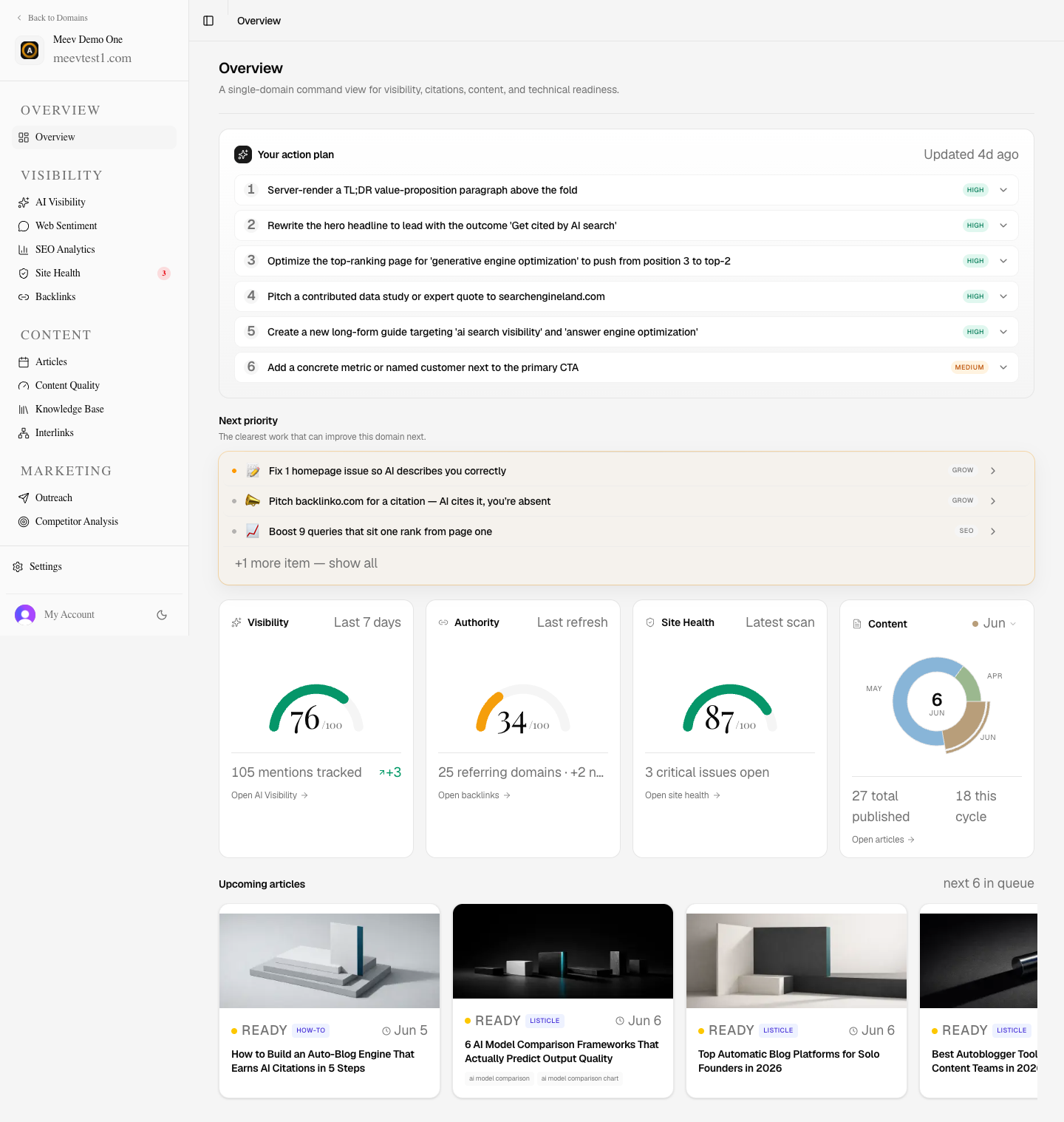
An llms.txt file helps AI engines find your pages — Meev gives them more pages worth finding. It plans, writes, and publishes quality-gated articles to your blog automatically, then tracks whether AI engines actually cite you for the queries that matter.

  • Articles auto-published with the structure AI engines extract from — schema, FAQs, answer-first intros
  • Visibility tracking across every major AI search surface, so you see what gets cited and where
  • Weekly topic planning tuned to the queries your domain can actually win

Frequently asked

What is llms.txt?

llms.txt is a proposed standard: a plain markdown file published at your domain root (like robots.txt) that gives AI engines a curated overview of your site. It typically contains your brand name, a one-line description, a short overview, and a grouped list of your most important pages with one-line descriptions. The goal is to help language models understand and cite your site accurately without crawling everything.

Where do I put the llms.txt file?

Upload it to your web root so it's reachable at https://yourdomain.com/llms.txt — the same location robots.txt and sitemap.xml live. On most platforms that means dropping it in your public or static folder. Verify it loads in a browser before considering it published.

Is llms.txt the same as robots.txt?

No — they're complements. robots.txt controls which crawlers may access which paths; llms.txt describes your content so AI engines understand it. robots.txt is about permission, llms.txt is about comprehension. A well-set-up site has both.

Do AI engines actually use llms.txt?

Adoption is growing rather than universal. A number of AI tools, crawlers, and answer engines already read llms.txt, and the standard has momentum because it solves a real problem — raw HTML is inefficient for language models. Since publishing the file costs nothing and carries no downside, the practical answer is: publish it now and benefit as adoption expands.

Why does the generator need my sitemap?

The sitemap supplies the real URLs your file links to. We follow a hard rule: never invent a URL — every link in your generated file comes from your sitemap or your homepage. If we can't find a sitemap, the file covers your homepage only; add a sitemap and regenerate for a fuller file.

How often should I regenerate the file?

Whenever you publish important new pages — a new product page, a flagship guide, a new content category. The file is a snapshot of your site's structure, so a stale one quietly under-sells what you offer. A monthly refresh is a good default for active sites.

Stop fixing pages one at a time.

Meev tracks your visibility across every major AI search surface and publishes quality-gated content that earns citations — automatically.

Card required, no charge until day 8. Cancel anytime.

More free tools

View all →