
Answer engine optimization for AI search citations

Answer engines like ChatGPT, Perplexity, and Google AI Overviews don't rank ten links — they extract one answer. AEO is how you make that answer yours. Meev tracks where you're cited, finds the gaps, and publishes the answer-first content that wins them.

Start free 7-day trial
Or try the free tools →
Judy Zhou

By Judy Zhou, Founder · Updated July 2026

What is answer engine optimization (AEO)?

Answer engine optimization (AEO) is the practice of structuring content so AI answer engines — ChatGPT, Perplexity, Google AI Overviews, and others — can extract and cite it directly. Instead of competing for a ranked link, AEO competes to be the answer: it leads with a direct, self-contained response, marks it up with FAQ and other schema, names entities clearly, and backs claims with stats an engine can quote.

What AEO is, and how it differs from classic SEO

Classic SEO optimizes to rank in a list of links a person then clicks. Answer engine optimization targets a different surface: the single synthesized answer an AI engine returns, with a handful of cited sources. The job changes from “rank in the top ten” to “be the sentence the engine quotes.” That means writing self-contained answers an engine can lift without context, structuring pages for machine extraction, and earning the topical trust that makes an engine choose you over a competitor. AEO is closely related to generative engine optimization; in practice the on-page work overlaps heavily.

New to the term? Start with the plain-language primer: what is AEO. For the full dimension-by-dimension breakdown against classic search, see AEO vs SEO.
The on-page signals that win AEO citations

  • Answer-first structure — lead each section with a direct, quotable answer, then elaborate. Engines extract the first self-contained statement.
  • FAQ and structured-data schema — mark up questions and answers so engines can map your content to the queries they're answering.
  • Clear entities — name products, people, and concepts explicitly instead of relying on pronouns, so the engine knows exactly what you mean.
  • Quotable statistics and specifics — concrete numbers and dates give an engine something citable that vague prose doesn't.

How to measure AEO

You can't improve AEO by guessing — you measure it with citation tracking. Pose the questions your buyers actually ask the major AI answer engines, then record whether your brand shows up in the answer and which page got cited. Tracked over time, that tells you which content earns citations, where competitors are quoted instead of you, and what to publish next. A free AI SEO tool can spot-check on-page readiness, but ongoing measurement is what turns AEO from a one-off audit into a compounding program.

AEO tools: what to look for

Answer engine optimization tools fall into a few capability categories, and the useful ones cover more than one. Whatever AEO tool you evaluate, check it against this list:

  • Citation tracking — runs your buyers' questions through the major answer engines and records whether you're cited, so you measure AEO instead of guessing.
  • Question research — surfaces the prompts and follow-up queries engines actually expand your topic into, so you write for real questions.
  • On-page optimization — audits answer-first structure, FAQ schema, and entity clarity on the pages you already have.
  • Content production — publishes new answer-first pages built for extraction, ideally behind a quality gate so volume never hurts you.

Most AEO tools stop at one category. Meev covers the loop end to end — it tracks citations, turns the gaps into a plan, and publishes the quality-gated, answer-first content that closes them.

Tracking AEO performance

An AEO tracker turns answer engine optimization into a number you can manage. It re-asks the same buyer questions across the major answer engines on a steady cadence and records three things: your mention rate (how often your brand appears in answers), your cited pages (which URLs engines actually pull from), and your competitor share(who gets quoted when you don't). Trended week over week, those numbers show whether new content is winning citations and which gaps to attack next. Meev includes a built-in AEO tracker that refreshes continuously across every major AI search surface —ChatGPT, Claude, Gemini, Perplexity, Grok, Google AI Overviews, AI Mode, and DeepSeek.

A worked example: rewriting a page to win the citation

Here is the whole game in one before-and-after. A buyer asks an answer engine “how long should a blog post be for SEO?” and two pages cover it. Only one gets cited:

Hard to extract

“There are many factors that influence ideal blog post length, and it really depends on your goals, your audience, and the competitive landscape you operate in…”

Answer-first, with schema

“For most SEO, aim for 1,000 to 2,000 words. Long-form pages past 2,000 words tend to rank for more queries; under 500 words rarely competes.” (marked up with FAQ schema)

Same facts, but only the second is a self-contained answer an engine can lift verbatim. The engine quotes the page it can extract cleanly, not the one it would have to summarize. That single move, an answer-first opening sentence plus schema, is what you repeat across every page you want cited. It pays off because AI answers are short: Google AI Overviews average just 119 words (Semrush, 200,000 Overviews), so the engine has room to lift one clean sentence, not a paragraph of hedging.

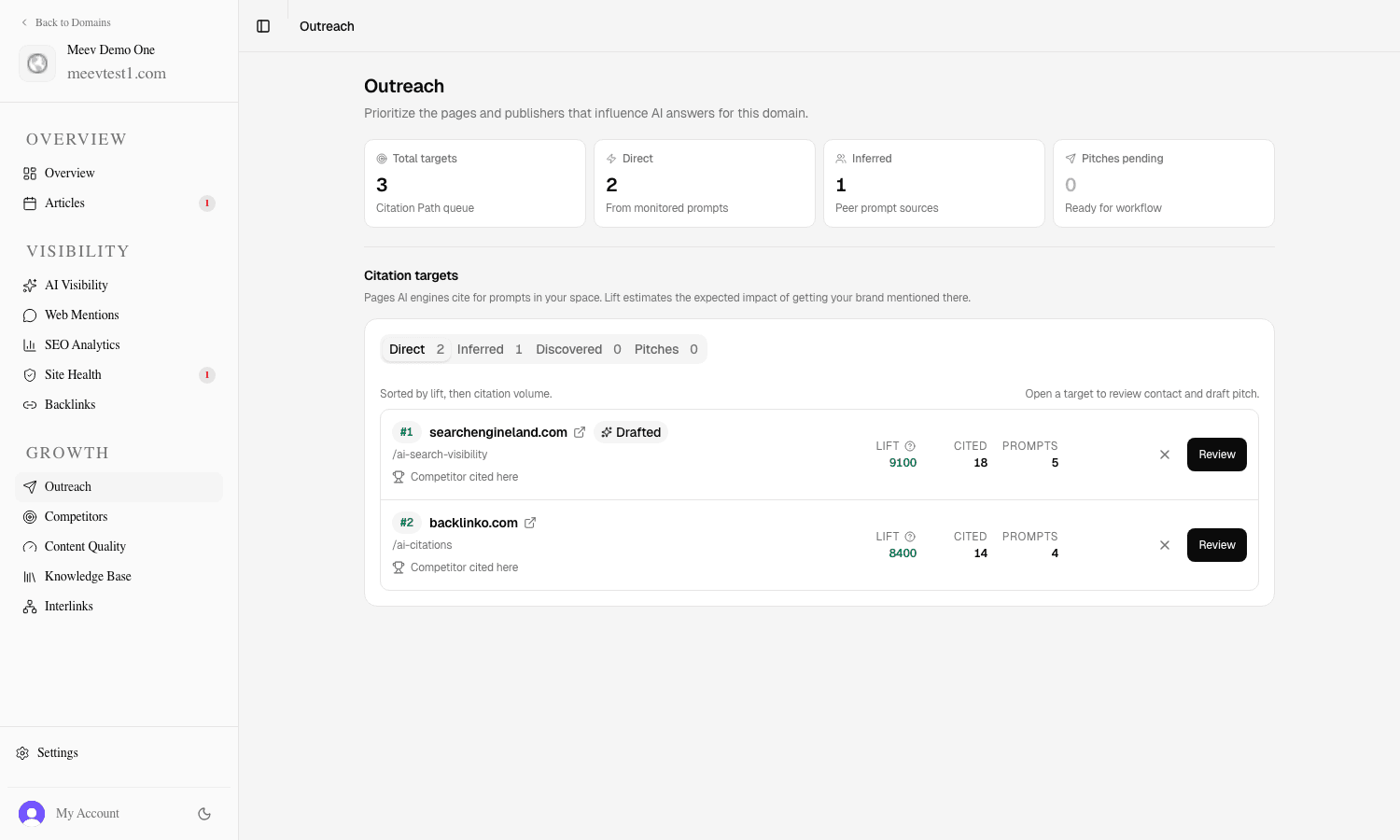
Meev tracking which pages answer engines cite for a set of buyer questions
Meev records which page each answer engine cites, and which competitor is quoted when you are not.

How Meev helps

Meev makes your pages the answer an engine extracts.

  • Finds the buyer questions where an engine answers without citing you, then names the exact page to fix
  • Publishes answer-first content with the FAQ and definition schema engines can lift cleanly
  • Re-checks after publishing so you can watch a fix move you into the cited set

Free tools to start with

All free tools →

Keep reading

Frequently asked questions about Answer Engine Optimization

What is answer engine optimization?

Answer engine optimization (AEO) structures content so AI answer engines return it as the answer, not just a ranked link. Concretely: instead of opening a section with 'When it comes to X, there are several things to consider,' you lead with the answer ('X is ...'), support it, and mark it up with FAQ or definition schema. That single change, an answer-first opening sentence plus schema, is what lets ChatGPT, Perplexity, or Google's AI Overview lift your page cleanly into its response.

AEO vs SEO — what's the difference?

Classic SEO optimizes to rank in a list of links a person clicks. AEO optimizes to be the single synthesized answer an AI engine returns with a few cited sources. SEO targets keywords and rankings; AEO targets extraction and citation — answer-first writing, schema, clear entities. The on-page work overlaps, but the success metric shifts from 'rank in the top ten' to 'be the sentence the engine quotes.'

Is there an AEO tool?

Yes. Meev is an answer engine optimization tool with a built-in AEO tracker: it re-asks your buyers' questions across the major answer engines, records your mention rate, which of your pages get cited, and which competitors are quoted instead, then publishes the answer-first content that closes the gaps. Free AEO tools (an AI SEO audit, llms.txt generator, crawler simulator, and query fan-out generator) are available with no signup.

What is the best AEO tool?

The best AEO tool covers the full loop rather than one slice of it: tracking where answer engines like ChatGPT, Perplexity, and Google AI Overviews cite you, turning the gaps into a prioritized plan, and publishing answer-first content built for extraction. Meev does all three — and includes free AEO tools (AI SEO audit, llms.txt generator, query fan-out generator) you can try with no signup.

What is an AEO tracker?

An AEO tracker monitors whether AI answer engines mention or cite your brand for the questions your buyers ask. It records your mention rate, which of your pages get cited, and which competitors are quoted instead, then trends those numbers over time so you can see whether your answer engine optimization is working. Meev's built-in AEO tracker refreshes continuously across every major AI search surface.

How do I measure AEO?

Measure AEO with citation tracking: ask the major AI answer engines the questions your buyers ask, then record whether your brand appears in the answer and which page is cited. Tracked over time, this reveals which content earns citations, where competitors are quoted instead, and what to publish next. Meev runs this tracking continuously across every major AI search surface.

Does AEO replace SEO?

No. An answer engine can only extract from pages it can already find, so AEO sits on top of the crawlability and indexing that SEO delivers. What AEO adds is the extraction layer: writing self-contained answers, marking them up so an engine can map them to a question, and earning the topical trust that decides which cited source gets quoted. You need both, SEO to be findable and AEO to be the sentence the engine lifts.

Get found in AI search, start today

Meev tracks your visibility across every major AI search surface and publishes quality-gated content that earns citations, automatically.

Start free 7-day trial
See pricing