Free tool · No signup to see your score
Free Claude Brand Visibility Checker
Paste your domain. We generate 5 buyer-discovery prompts in your category and ask Claude each one. Get a 0–100 visibility score plus position rank in under 20 seconds.
What Meev is
An AI search visibility platform that turns tracking into action.
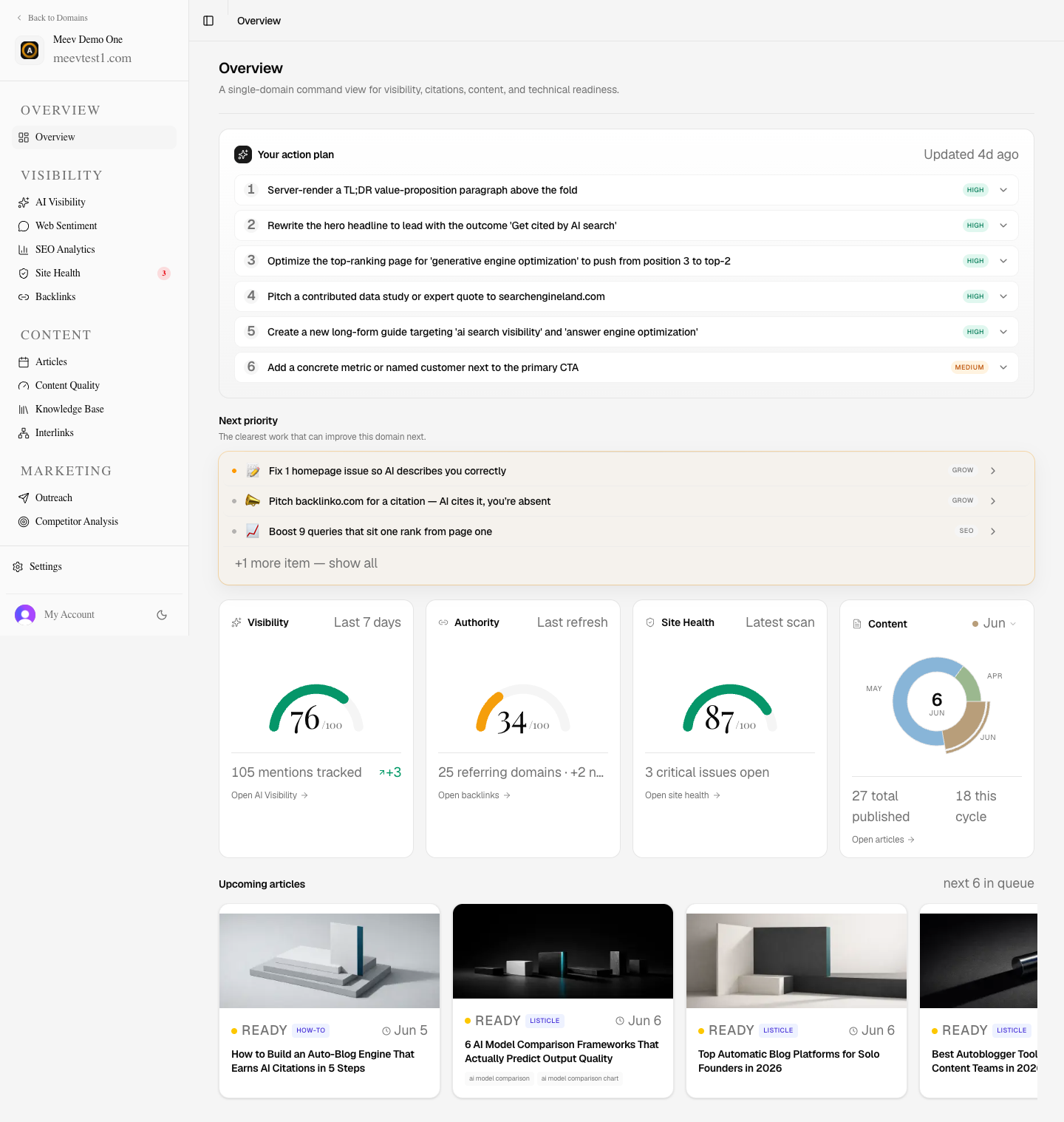
Meev tracks where your brand appears across ChatGPT, Claude, Gemini, Perplexity, Grok, DeepSeek, Google AI Overviews, and Google AI Mode, then shows what to fix, publish, or pitch next to improve AI visibility.


AI answers6%
The path to getting cited
From an unanswered prompt to a cited brand
01 · Your domain
Start by analyzing your site
Meev reads your existing pages, topics, and Google Search Console signals to learn what your site is about and already ranks for: the foundation for every gap, draft, and citation that follows.
Tracked across the AI engines that matter
ChatGPTClaudeGeminiPerplexityGrokGoogle AI OverviewsGoogle AI ModeDeepSeekChatGPTClaudeGeminiPerplexityGrokGoogle AI OverviewsGoogle AI ModeDeepSeekWhat this measures
Claude brand visibility means it names you in its answers.
Claude brand visibility is the chance Anthropic's Claude names your site when answering a relevant question in your category. Claude weighs training-data signals heavily and is conservative about citing thinly-sourced content — strong, well-attributed coverage beats keyword stuffing. A high score means Claude treats your brand as a known authority; a low score means you haven't earned that trust yet.
How it works
Three steps. One platform. Visibility loop.
How AI search visibility actually grows: measure where every major AI engine cites you, close the gap with quality-gated content that gets indexed fast, then pitch the publishers AI engines already cite. Most tools stop at the first number.
Measure
Every major AI surface · prioritized action plan
Paste your domain. See where ChatGPT, Claude, Gemini, Perplexity, Grok, DeepSeek, Google AI Overviews, and AI Mode mention you — and the prompts, competitors, and URLs that explain who wins the cite instead.
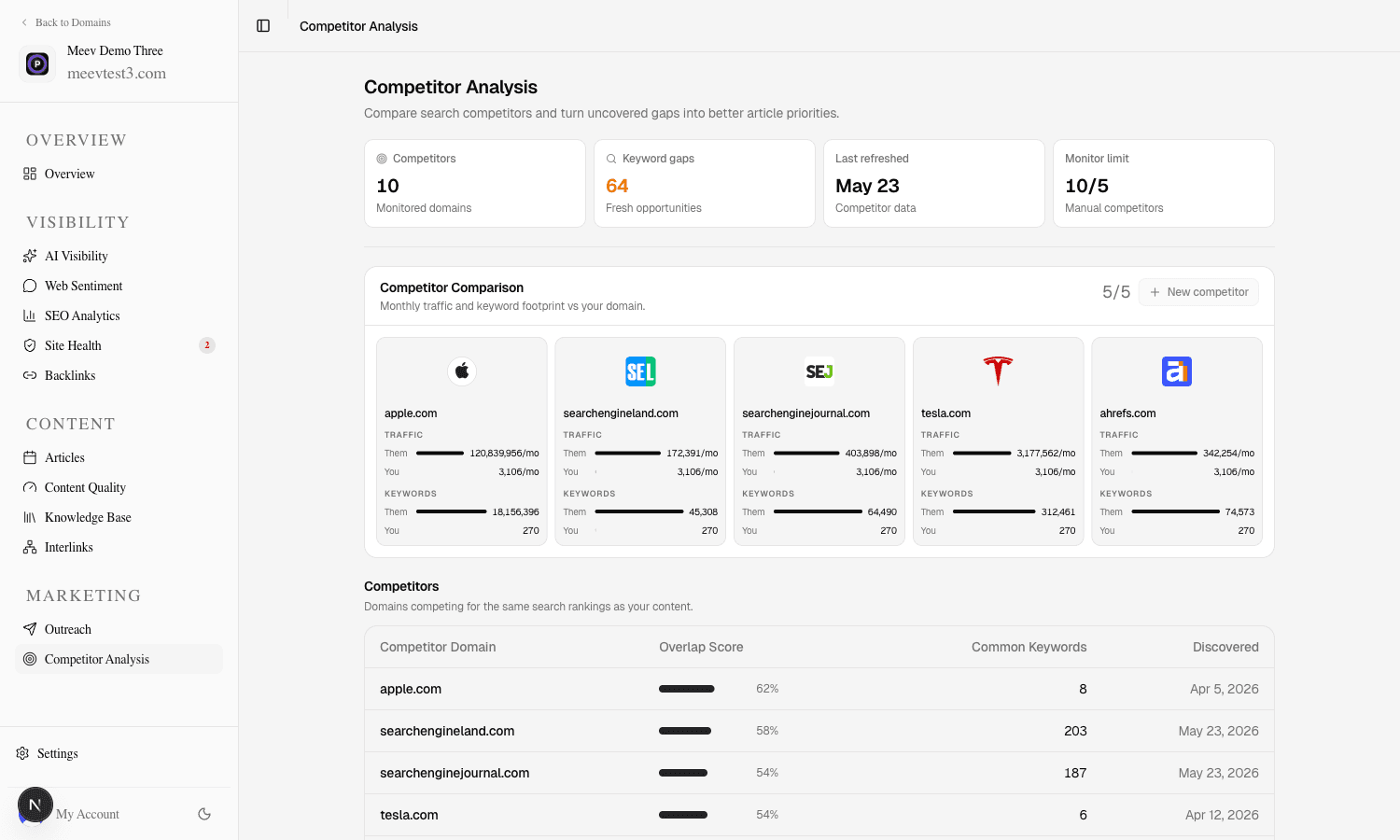
Visibility baseline plus your AI Action Plan: a prioritized, always-current list of exactly what to do next — which pages to create, which competitors to study, which sources to earn. It rewrites itself as your data changes. Most tools stop at the number.
Close the gap
Quality-gated drafts · fast indexing
Ship the quality-gated article that fills the gap. The moment it publishes, Meev submits it to search engines so crawlers find it in hours, not weeks.
Every article is checked on 16 dimensions before it goes live; risky drafts hold for review. Proactive indexing means new content earns its first AI citations in days, not the weeks it takes organic crawl to catch up.
Earn the citation
Verified contacts · KB-grounded pitches
Find the publishers AI engines already cite for prompts in your category, get verified editor contacts, and pitch with a draft grounded in your knowledge base.
Citation Path ranks every URL AI engines cite by expected lift, surfaces the editor's verified email, and drafts the pitch from your own data — outreach prep that used to take half a day, ready for one click of approval.
Loop
Repeat the sequence
AI visibility reveals the gap. Content closes it. Outreach pushes the proof into the sources AI engines cite.
Then the next visibility check shows what moved, what stalled, and which gap becomes the next priority.
Article pipeline
Every article earns its publish.
Most AI writers ship whatever you generate. Meev runs every draft through a multi-agent stack — research, writing, optimization, and a quality firewall — so only articles that move your visibility go live. Google grades quality site-wide; a single weak article drags down the rest.
Research Agent
Finds the gap worth writing about
Writer Agent
Writes something readers trust
Optimization Agent
Formats so AI engines cite you
Publish & Indexing
Ships the strong drafts
Research Agent
Finds the gap worth writing about
Writer Agent
Writes something readers trust
Optimization Agent
Formats so AI engines cite you
Publish & Indexing
Ships the strong drafts
Research Agent
Finds the gap worth writing about.
- Finds topics competitors rank for that you don't
- Every claim links to a real source (studies, reports, data)
- Cannibalization detection — no duplicate articles
- Pulls from your knowledge base — case studies, stats, brand data
- Every article credits the author and company you set at onboarding
Humanizer
Blocked
- Delve into the complexities
- Navigate the landscape
- Leveraging synergies
- Sentences broken with — dashes —
- May potentially be able to
Enforced
- Reads human, not AI
- Multiple article formats
- Your brand voice, not generic
Writer Agent
Writes something readers trust — and editors don't roll their eyes at.
- Humanizer — writes like a person, not like AI
- Multiple article formats: how-to, listicle, explainer, comparison, case study
- Matches your brand's tone and style
Layered onto every article
- Direct answer at the topAI engines quote it
- Summary + Q&Aevery article
- Author byline + companyreal attribution
- Links to your other articlesadded automatically
- Cover + body images + videoevery article
- Table of Contentsfor long reads
Optimization Agent
Gets articles cited by AI engines and ranked by Google.
- Article opens with the answer AI engines pull
- Summary and Q&A on every article
- Auto-links to your other articles where they fit
- Cover image, body images, and a YouTube video
- Built for Google and AI engines to read clearly
- Dead links removed before publishing
- Primary sources0
- Length640 words
- Helpful Content RiskHigh
- Internal links1
- Primary sources9
- Length3,240 words
- Helpful Content RiskLow
- Internal links11
Publish & Indexing
Ships the strong drafts. Holds the weak. Tells search engines it's live.
- Articles that don't pass quality never auto-publish
- Auto-publish to your site (WordPress, Ghost, Wix, or custom)
- Google and Bing notified the moment you publish
- Broken links to old pages fixed automatically
Why quality decides citation
Why article quality matters for Claude citation
Claude is the strictest of the major LLMs about citing low-quality content — Anthropic's training emphasizes factual reliability. Generic AI articles get filtered out; structured, primary-source-cited writing gets surfaced. Score one of your articles before you publish more.
Google's active crackdown · March 2024 → present
45%
less low-quality, unoriginal content in Google results once the March 2024 core update finished rolling out (per Google).
Core ranking
The Helpful Content System is now part of Google's core algorithm — no longer a separate periodic update, it runs continuously.
Every update since
Each subsequent core update has continued the pattern. AI volume without quality controls keeps getting hit, often catastrophically.
Claudesits inside the same quality regime. Content that fails Google's Helpful Content grade isn't the kind Claudecites either — both systems are scoring for original information, real authorship, and structured answers. A weak article doesn't just fail to rank; it teaches Claude to skip your domain on the next prompt.
Pillar 1 · Site-wide grade
Helpful Content System
Google grades your whole site, not individual pages. One weak article drags down the rest — and demotion compounds the more low-quality volume you publish.
Pillar 2 · Answer extraction
AEO structure
Claudeextracts answers from structured content — FAQ blocks, schema markup, definitional intros, clear authorship. Generic AI prose with no structure doesn't make the citation cut.
Pillar 3 · Original info
Content quality
Claudewon't cite a thin or AI-slop article. Real case studies, real stats, real points of view — the same signals that pass Google's grade win the citation here too.
Beyond the one-time check
Tracking brand citations in Claude: slow to earn, worth watching
Claude cites conservatively, so its answer sets shift more slowly than ChatGPT's, and that is exactly why the trend matters more than any single check. Being added to Claude's answers signals durable authority; being displaced usually means a competitor earned coverage you didn't. Tracking your prompts on a regular schedule turns those slow shifts into a visible line instead of an invisible leak.
Durable signal, low noise
Claude's conservatism means fewer random swings. When your tracked position changes, something real changed: coverage, content, or a model release.
High-intent prompts
Claude's audience skews professional and research-heavy. The prompts you track here represent buyers doing serious evaluation.
Displacement alerts
The most expensive change is silent: a competitor taking your slot in an answer. Tracking surfaces the swap the week it happens.
Tracking works the same way across every surface, one prompt set, every engine, one trend line. The AI visibility tracker page covers the metrics and how to read them.
Built in
Everything else, included.
Open-web mentions, authority signals, multi-language articles, and white-label reporting, all in the same workspace as your AI visibility tracking.
Open-web monitoring
Brand Mentions
Track where your brand is discussed outside AI answers, with source quality, sentiment, and low-signal filtering. Promote high-authority mentions into outreach.
Authority layer
Backlinks
Referring domains, anchor mix, spam risk, broken backlinks, and the backlink sources worth promoting, in the same workspace as your visibility.
Multi-language, native prompts
Multi-language
Quality-gated articles in English, Spanish, Chinese, French, German, Portuguese, and Japanese. Same firewall, native prompts per language.
White-label client reporting
Agency Reports
AgencyPackage visibility, content, outreach, mentions, backlinks, and site-health progress into client-ready reporting under your agency's brand.
Honest comparison
Meev vs the alternatives
Where each tool actually fits. We've also written individual deep-dives — see vs Profound, vs Peec AI, and vs Outrank.
| Capability | Meev | Profound | Peec AI | AIclicks |
|---|---|---|---|---|
| AI surfaces tracked | Core surfaces on Starter; full set on Pro+Core: ChatGPT, Gemini, Perplexity, DeepSeek, AI Overviews, AI Mode. Pro adds Claude + Grok. | ChatGPT only on Starter; full set on EnterpriseStarter ($99) is ChatGPT only; Growth ($399) covers 3 platforms; the full LLM list requires Enterprise. | 3 models on self-serve; Claude is Enterprise-onlySelf-serve tiers ship 3 models; extra models are paid add-ons (~€30–€140/mo each). Claude requires Enterprise. | 3 to 6 models by planStarter tracks 3, Pro 4, Business 6; full set on Enterprise. |
| Citation/source action loop | Verified contacts + KB-grounded pitchesCitation Path ranks the URLs AI engines cite for your prompts, surfaces the editor's verified email, and drafts pitches from your own knowledge base. | Reddit, directory, and source-pitch actionsAgents suggest content, directory listings, Reddit threads, and pitches to cited sources. | ||
| Quality firewall before publishing | 16-dimension quality matrixHelpful Content Risk, originality, extractability, author entity, structure, citations, and more before content ships. | |||
| CMS publishing outputs | WordPress, Ghost, Wix, webhookSchema, cover images, metadata, CTAs, and internal links included. | |||
| Web mentions + sentiment | Included on Pro+Open-web mentions, source quality, sentiment, and low-signal filtering. | Brand representation analyticsCitation-side brand monitoring at enterprise tiers. | Sentiment on AI citations onlySentiment scoring on AI-engine answers; no open-web mention layer. | Brand mention monitoringTracks mentions and citation sources across AI answers. |
| SEO + site health | Search movement + technical checksKeyword ranks, traffic value, SERP features, indexability, broken links, metadata, alt text, Lighthouse signals. | |||
| Authority + internal graph | Backlinks + interlinks (Pro+)Referring domains, anchors, spam risk, broken backlinks, internal-link opportunities, and page-priority signals. | |||
| Knowledge base / grounded claims | Built-in knowledge base (Starter+)Upload docs, case studies, internal stats, and brand rules so claims use approved proof. | |||
| Client reporting | White-label agency reports (Agency)Visibility, content, outreach, mentions, backlinks, and site-health progress in one client story. | |||
| Trial + post-trial behavior | 7-day trial, card requiredNo charge until day 7; cancel anytime before then. If you cancel, the account and data stay readable on the free fallback. | No trial — sales-led only | Free trial on self-serveSelf-serve tiers offer a trial; post-trial behavior not clearly stated publicly. | 3-day trial, no cardStarter and Pro promote a no-card 3-day trial. |
| Entry price | $49/mo LiteLite gets daily core-surface tracking and 10 articles. Starter ($99) adds backlinks + indexing acceleration. Pro ($269) unlocks Claude, Grok, and Citation Path with pitch generation. | $99/mo Starter (ChatGPT only)$399 Growth covers 3 platforms; full LLM set requires Enterprise. | €89/mo StarterExtra LLMs are paid add-ons; Claude requires Enterprise. | $59/mo Starter30 prompts, 3 tracked LLMs, 10 AI-optimized articles. |
Comparison data verified May 2026 from public pricing pages and current market reviews. "No" means the feature isn't visible on the competitor's public marketing or pricing pages — they may build it later. AI visibility tools change quickly; verify plan details before buying.
Founder proof
Built from the work of earning the mention.
Meev started with a practical question: what does it take for a business to become the answer when buyers ask Google or AI chat who to trust?
The answer became a loop: measure where you appear, understand who gets cited instead, publish the missing proof, and re-track until the market starts recommending you.
“I built Meev for my own real-estate business first. I needed buyers to find me through ChatGPT and AI search, not just Google. Once the loop worked for my brand, I packaged it for everyone trying to win the next AI mention.”

Judy Zhou
Founder · Meev
Local
search proof
AI
discovery channel
Repeat
the playbook
Lite
Solopreneurs getting started
$39
/moStarter
Solo founders, SMB
$79
/moPro
In-house marketing teams
$215
/moAgency
Marketing agencies
$479
/moEnterprise
Regulated / SOC 2 buyers
Custom
Common questions
Claude visibility, answered.
How do I check if Claude mentions my brand?⌄
Paste your domain above. We infer your category from your homepage, generate 5 buyer-discovery prompts a real prospect would ask Claude, and query Claude with each one. The score is the share of those 5 responses that named your brand, weighted by position. No signup required to see the score.
Is the Claude visibility checker free?⌄
Yes — the score, cited-count, and average position are free. Sign up to unlock the exact 5 prompts we tested. Start a 7-day trial to run your own custom prompts and track Claude alongside ChatGPT, Gemini, Perplexity, and Google AI Overviews.
Does Claude cite websites by URL or by brand name?⌄
Both, depending on the prompt. When asked for a structured list ("top tools for X"), Claude usually names brands. When asked a factual question, Claude often paraphrases a source without citing it explicitly. The free checker measures the brand-name path — does Claude name your site when answering a category question. The paid Meev product tracks the URL-citation path too.
How do I get Claude to cite my site?⌄
Three steps. (1) Earn coverage on sources Claude's training set includes — Wikipedia, industry roundups, well-known publishers. (2) Publish structured, source-cited content on your own site so Claude treats you as a primary source. (3) Add FAQPage and HowTo schema markup so Claude can extract clean answer chunks. Meev's auto-blog engine handles all three with a quality firewall that filters out generic AI output Claude would reject.
Why is Claude stricter than ChatGPT about citations?⌄
Anthropic's training process emphasizes factual reliability and conservative answering. In practice that means Claude is faster to say "I don't know" and slower to cite a brand it hasn't seen reinforced by multiple sources. If your brand is borderline in ChatGPT, you'll often be invisible in Claude. The flip side: when Claude does cite you, the prompt is usually serving high-intent buyers.
Does Claude refresh its training data often?⌄
Anthropic ships Claude updates several times a year; each new model has a refreshed knowledge cutoff. Between releases, what changes is whether the Claude product has live web-search access — Claude.ai gained web search in 2024, and the API exposes a `tool_use` web-search variant. The free Meev checker runs Claude with web search off (training-data awareness only); the paid product covers both modes.
What's the difference between Claude visibility and ChatGPT visibility?⌄
Same idea, different model. Both score how often the LLM names your brand in answers to buyer-discovery questions. In practice Claude tends to surface fewer brands per answer (it gives more conservative lists) and weighs training-source authority more heavily. A site can score 60 in ChatGPT and 30 in Claude, or vice versa — it's why tracking each one separately matters.
How do I track brand citations in Claude?⌄
Save the buyer prompts that matter and Meev re-asks Claude on a regular schedule, recording whether your brand is named, where it sits in the answer, and which competitors appear beside you. Because Claude's answer sets move slowly, the tracked trend line is the honest signal: a single check can't tell you whether you're rising, stable, or being displaced.
How fast does Claude visibility change?⌄
Slower than any other major surface. Claude leans on training-data authority and cites conservatively, so most brands see their Claude position move on model releases and after earning significant new coverage, not week to week. That makes a monthly trend more meaningful than a daily one, and it makes losses worth investigating immediately, because they rarely reverse on their own.
Does Claude visibility help with SEO?⌄
Indirectly. The same signals that lift Claude visibility — earned coverage on trusted publishers, structured content, schema markup, real authorship — also lift Google's Helpful Content score. The work compounds. Publishing low-quality AI content to chase Claude visibility specifically would backfire (Claude filters it out and Google demotes your whole domain).
Check other AI surfaces