Free tool · No signup

Free AI SEO Audit

Paste any URL and get an AI-search readiness score out of 100 — 14 checks across structured data, semantic HTML, content extractability, and AI-crawler access, with a plain-English verdict and the three fixes that matter most.

Loading…

Free · 10 AI runs per day · No signup required

How it works

Step 1

Paste a URL

Any public page — your homepage, a blog post, a product page.

Step 2

We run 14 checks

Metadata, headings, schema, image alts, content depth, llms.txt, and AI-crawler access in robots.txt.

Step 3

Get your score

Every check passes, warns, or fails, and rolls up into a 0–100 readiness score.

Step 4

Fix what matters

A written verdict ranks the three highest-impact fixes so you know exactly where to start.

Why it matters

AI search has its own technical bar.

Classic SEO asks whether Google can rank your page. AI search asks whether an engine can fetch your page, parse it without running JavaScript, and extract a quotable answer. Those are different tests — a page can rank well in classic search and still be invisible to ChatGPT, Perplexity, and Google AI Overviews because the content lives behind client-side rendering or unstructured markup.

Extraction beats ranking.

AI engines don't list ten blue links — they synthesize one answer and cite the pages they could extract from. Pages that earn citations share a profile: one clear H1, real section structure, FAQ or HowTo schema, healthy text-to-markup ratio, and self-contained passages an engine can lift verbatim. The audit measures exactly that profile, check by check.

Crawler access is the silent killer.

Many sites block GPTBot, ClaudeBot, or PerplexityBot in robots.txt — sometimes deliberately, often from a copy-pasted template nobody reviewed. A blocked crawler means that surface can never read your content, so it can never cite you, no matter how good the page is. The audit reads your robots.txt and tells you which AI crawlers are locked out.

With Meev

Meev publishes content that passes this audit by default.

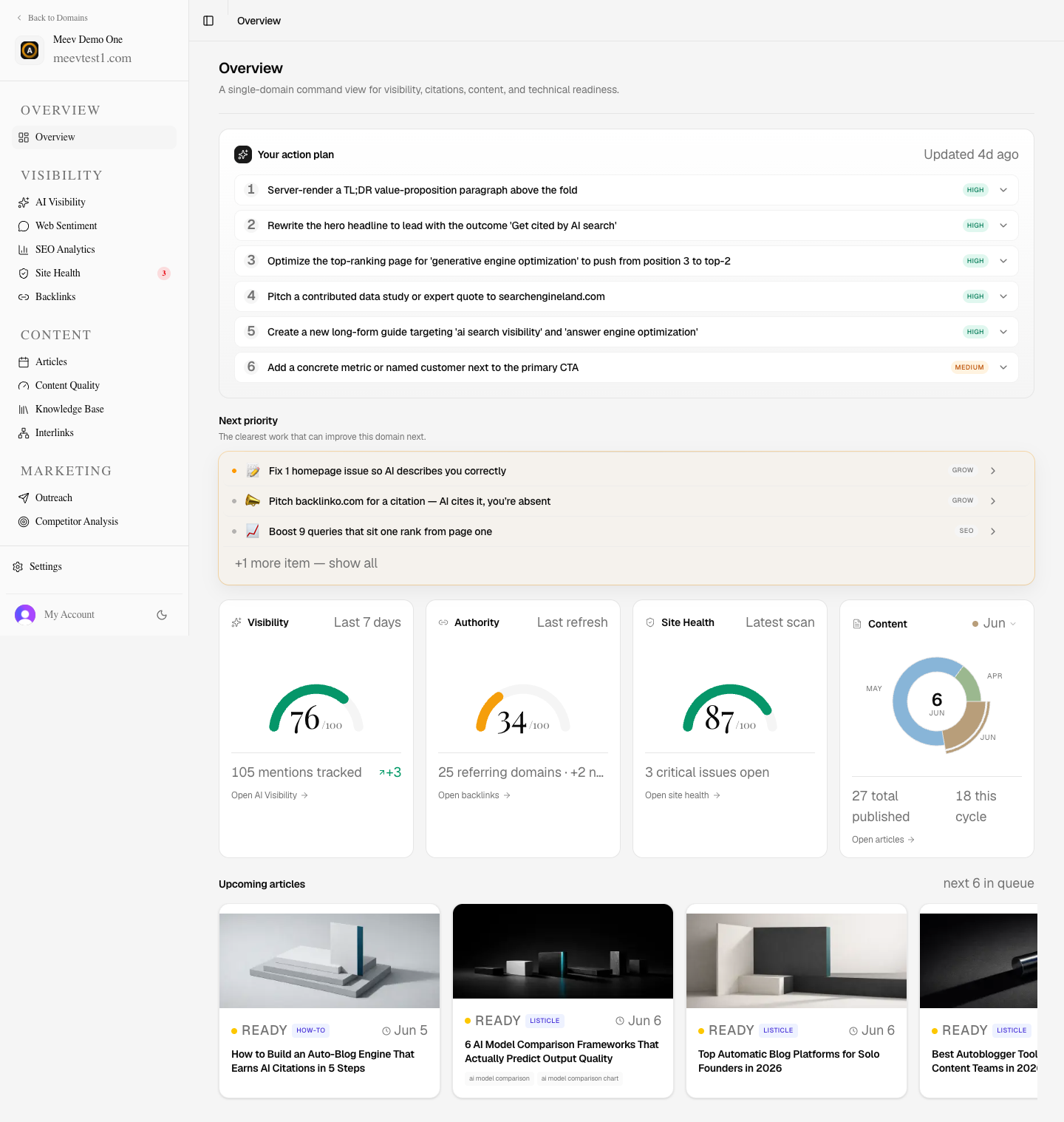
Running one audit shows you the gaps on one page. Every article Meev writes and publishes ships with the structure this audit checks for already built in — and visibility tracking shows whether AI engines actually cite it.

  • Articles auto-published with schema, semantic headings, FAQs, and answer-first structure built in
  • AI visibility tracking across every major AI search surface, query by query
  • Continuous monitoring of your AI-search presence — not one audit at a time

Frequently asked

What does the AI SEO audit check?

It runs 14 checks across four areas: metadata (title, description, canonical, Open Graph), semantic structure (H1, section headings, image alt text), content extractability (word count, text-to-HTML ratio, structured data, FAQ/HowTo schema), and AI access (robots noindex, llms.txt, and whether robots.txt blocks GPTBot, ClaudeBot, or PerplexityBot). Each check passes, warns, or fails, and the results roll up into a 0–100 score.

What's a good AI-search readiness score?

80 and above means the page is in strong shape — engines can fetch, parse, and extract from it. 50–79 means real but fixable gaps; the top-fixes list tells you where to start. Below 50 usually signals a structural problem, most often content that isn't visible without JavaScript or missing metadata across the board.

How is this different from a classic SEO audit?

There's overlap — titles, descriptions, and headings matter to both. The AI-specific layer is what most classic audits skip: whether your text is readable without executing JavaScript, whether FAQ/HowTo schema gives engines Q&A structure to extract, whether an llms.txt file exists, and whether AI crawlers are blocked in robots.txt. A page can pass a classic audit and fail every one of those.

Why does text-to-HTML ratio matter for AI search?

Many AI crawlers fetch your raw HTML and don't execute JavaScript. If your visible text is a tiny fraction of the markup — common with heavily client-rendered pages — those crawlers see a nearly empty page. A healthy ratio means the content actually ships in the HTML, which is the single most important precondition for being cited.

Does blocking GPTBot hurt my Google rankings?

No — Google ranking and GPTBot access are independent. But blocking GPTBot removes your content from ChatGPT's retrieval, so you can't be cited there; the same logic applies to ClaudeBot and PerplexityBot for their surfaces. Some publishers block deliberately as a licensing stance — the audit's job is making sure it's a decision, not an accident.

How often should I re-run the audit?

After any meaningful change to the page — a redesign, a new rendering setup, a schema change — and monthly as a baseline for important pages. Audit results for a given URL are cached for 24 hours, so re-checking the same page within a day returns the same report without using a run.

Stop fixing pages one at a time.

Meev tracks your visibility across every major AI search surface and publishes quality-gated content that earns citations — automatically.

Card required, no charge until day 8. Cancel anytime.

More free tools

View all →