Free · No sign-up required
Score any article on 16 dimensions.
Paste a blog post URL. We fetch it, run the same quality engine Meev uses to gate auto-publishing, and tell you whether it'll rank or get filtered. Honest scores, no sales-pitch fluff.
What Meev is
An AI search visibility platform that turns tracking into action.
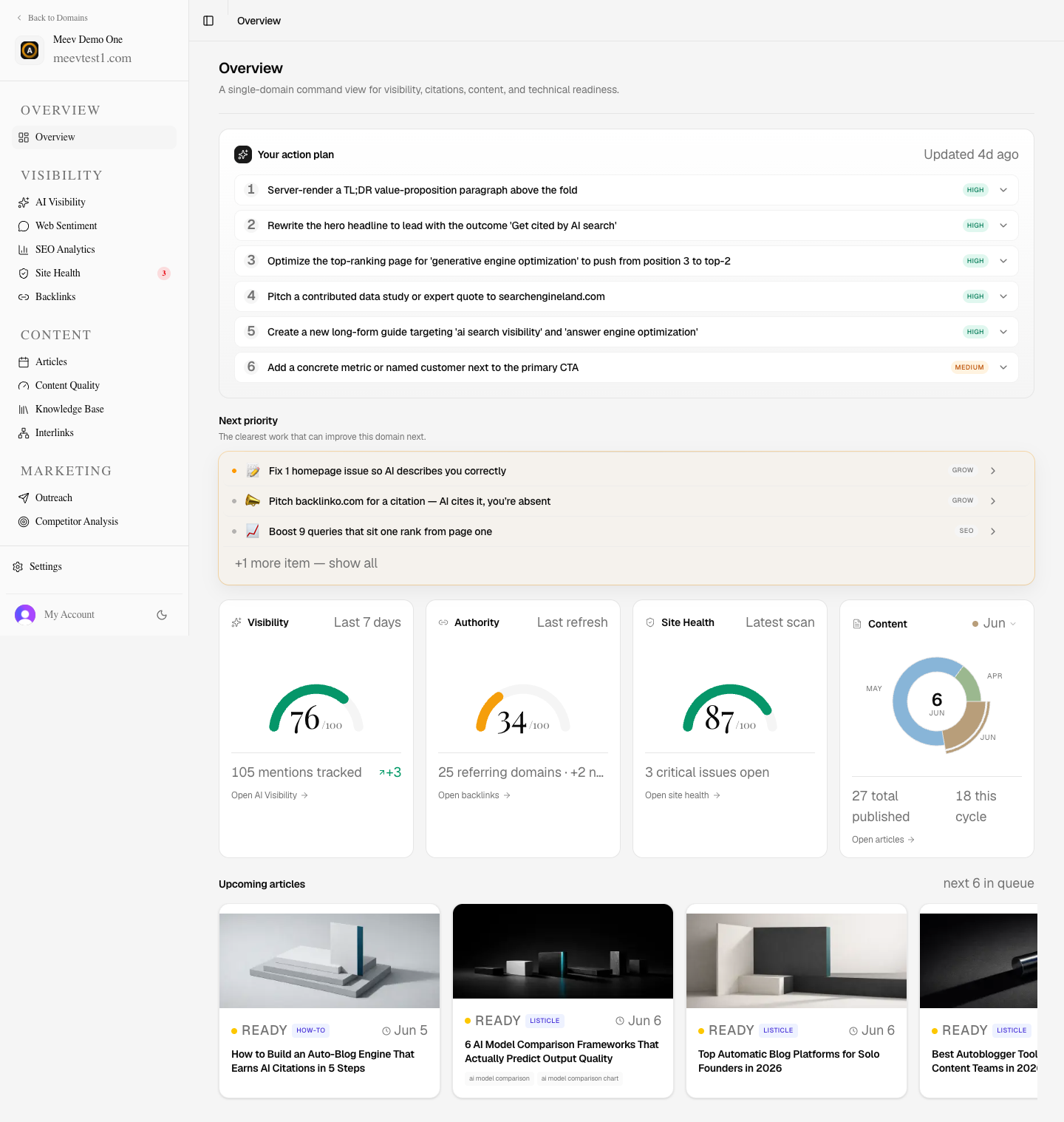
Meev tracks where your brand appears across ChatGPT, Claude, Gemini, Perplexity, Grok, DeepSeek, Google AI Overviews, and Google AI Mode, then shows what to fix, publish, or pitch next to improve AI visibility.


AI answers6%
The path to getting cited
From an unanswered prompt to a cited brand
01 · Your domain
Start by analyzing your site
Meev reads your existing pages, topics, and Google Search Console signals to learn what your site is about and already ranks for: the foundation for every gap, draft, and citation that follows.
Quality dashboard
The free checker uses the same quality bar as the production pipeline.
Paid workspaces roll article scores into the Content Quality dashboard, where Helpful Content Risk movement, pass rate, sampled articles, and review gates stay visible.
What changed
Why article quality matters more than ever in 2026
Three structural shifts in the last 24 months changed the math on content. First, Google's Helpful Content system became site-wide rather than page-level — a single cluster of thin, templated, AI-flavored articles can suppress your entire domain's rankings for months. Second, AI search engines (ChatGPT, Claude, Perplexity, Gemini) now cite a meaningful fraction of buyer queries; their selection logic preferentially rewards original data, named authors, and structured answers — and quietly drops content that pattern-matches as filler. Third, AI Overviews now sit above the SERP for a meaningful share of buyer queries, meaning your organic position 1 stops mattering once an Overview cites a different source.
The combined effect: the quality bar that lets you rank in 2026 is dramatically higher than what got you ranked in 2022. What used to be acceptable mid-tier content now sits in the zone that gets actively filtered out — by Google's ranking systems, by AI-engine retrieval, and by behavioral signal feedback loops.
The compounding cost
Spam content doesn't just underperform — it actively hurts your traffic
A common mental model: "low-quality content earns less traffic, but at least it doesn't cost me anything." That mental model is wrong in 2026. Three measurable mechanisms turn thin content into a net negative:
- Site-wide HCU suppression. Google's Helpful Content classifier evaluates patterns across your domain. Once enough articles match the "low-effort, AI-templated, unhelpful" profile, the entire domain gets demoted — including your good pages. Recovery typically takes 3-6 months of consistent quality output after the offending content is removed or substantially upgraded.
- AI-engine de-prioritization. When ChatGPT, Claude, Perplexity, and Gemini retrieve candidate sources for a query, the reranker drops content with low E-E-A-T signal, weak structure, or AI-template fingerprints. Your domain stops appearing in citations for the topic cluster — even on queries you'd otherwise win.
- Behavioral feedback loops. Short dwell time and high bounce rates feed back into Google's ranking systems. Thin content underperforms on these signals even when it ranks initially, which triggers further demotion. Over a year, a content strategy heavy on filler can lose traffic faster than a strategy that publishes a fraction of the articles at twice the depth.
The asymmetry is worth internalizing: one excellent article that earns repeat citations and long dwell time can outperform fiftytemplated articles measured by organic + AI-citation traffic 12 months later. Quality isn't a vanity metric — it's the lever with the highest compounding return.
The scoring rubric
The 16 dimensions we score on
The same rubric Meev uses internally to gate auto-publishing for paid customers. Each dimension scored 1-10 by an evaluator model running calibrated rubrics; the Helpful Content Risk composite weights the dimensions that map to Google's Helpful Content guidelines most heavily.

Article quality (×11)
- Content depth — concrete vs. surface-level
- Factual accuracy — sourced vs. unsourced
- Originality — unique vs. rehash
- Readability — flow + variety
- SEO optimization — semantic match, not keyword count
- AI extractability — quotable, snippet-ready
- E-E-A-T signals — author + experience surface
- Human voice — natural vs. AI tells
- Structure — hierarchy + skim-ability
- Actionability — reader can DO something
- Engagement — hook + pacing
Helpful Content Risk (×5)
- Information gain (×15)— does it add knowledge that's not in the top 10 results?
- Structural variety (×15) — does it follow the standard AI-content template, or break it?
- Citation authority (×10) — claims backed by named, linkable sources?
- Author entity (×10) — verifiable expertise behind the byline?
- Topic coherence (×10)— fits the domain's declared focus?
Helpful Content Risk = weighted sum out of 100. Articles below 70 hold for human review in Meev's pipeline.
FAQ
Frequently asked
What does the quality score actually measure?
16 dimensions: 11 article-quality signals (content depth, factual accuracy, originality, readability, SEO optimization, AI extractability, E-E-A-T, human voice, structure, actionability, engagement) and 5 Helpful Content Risk signals (information gain, structural variety, citation authority, author entity, topic coherence). The article quality score is the average of the 11 dims; the Helpful Content Risk score is a weighted combination calibrated against Google's Helpful Content guidelines.
Why does article quality matter more in 2026 than it used to?
Two compounding shifts: (1) Google's Helpful Content system now operates site-wide — one cluster of thin, templated, AI-flavored content can suppress an entire domain's rankings, not just the offending pages. (2) AI engines (ChatGPT, Claude, Perplexity, Gemini) preferentially cite content with named authors, original data, structured answers, and clean schema. Generic listicle output that was rankable in 2022 is increasingly invisible to both Google and AI-answer surfaces.
How does low-quality content actually hurt traffic?
Three measurable mechanisms: (1) Helpful Content suppression — Google's HCU classifier site-wide demotes domains with patterns of low-effort content; recovery takes 3-6+ months once flagged. (2) AI engine filtering — when ChatGPT/Claude/Perplexity rank candidate sources, content that scores low on E-E-A-T or shows AI-template patterns gets dropped from the citation pool. (3) Behavioral signals — short dwell time, high bounce, and low return visits feed back into ranking algorithms; thin content underperforms here even if it ranks initially.
What's a passing score?
Meev's auto-publish gate is a Helpful Content Risk score ≥ 70/100. Articles below that hold for human review. The internal goal for marketing-archetype articles is 76+ on listicles and 82+ on how-to tutorials — those are the calibrated baselines from running the scorer across our production pipeline. Article quality (the 11-dim avg) above 7.0/10 generally maps to a Helpful Content Risk score of 70+.
Does this check work on any site?
Yes — paste any public blog post URL. We fetch the page, extract the main article content, and score it. Paywalled content, JS-rendered SPAs that don't pre-render, and PDFs won't work. If you get a low word count error, paste the canonical article URL rather than a feed/preview link.
Will you store my URL or content?
We don't persist the article content or score by default. The fetch happens server-side and is discarded after the score returns. We hash the URL for telemetry only — to deduplicate repeated checks against the same article — and never associate it with a user identity unless you sign up.
Can I score every article on my domain automatically?
Yes — that's exactly what Meev does for paid plans. Connect your domain, point us at your blog, and every existing + new article gets the same 16-dimension score in your dashboard. The quality firewall blocks anything below 70 on the Helpful Content Risk from auto-publishing through your webhook/CMS, so risky drafts never go live.

Ship articles that actually rank.
Meev runs this 16-dimension score on every article in your blog automatically and blocks anything below 70 on the Helpful Content Risk from auto-publishing. Track citations across ChatGPT, Claude, Gemini, Perplexity, and Grok in the same workspace.
7-day free trial · cancel anytime