
Generative engine optimization for AI search visibility

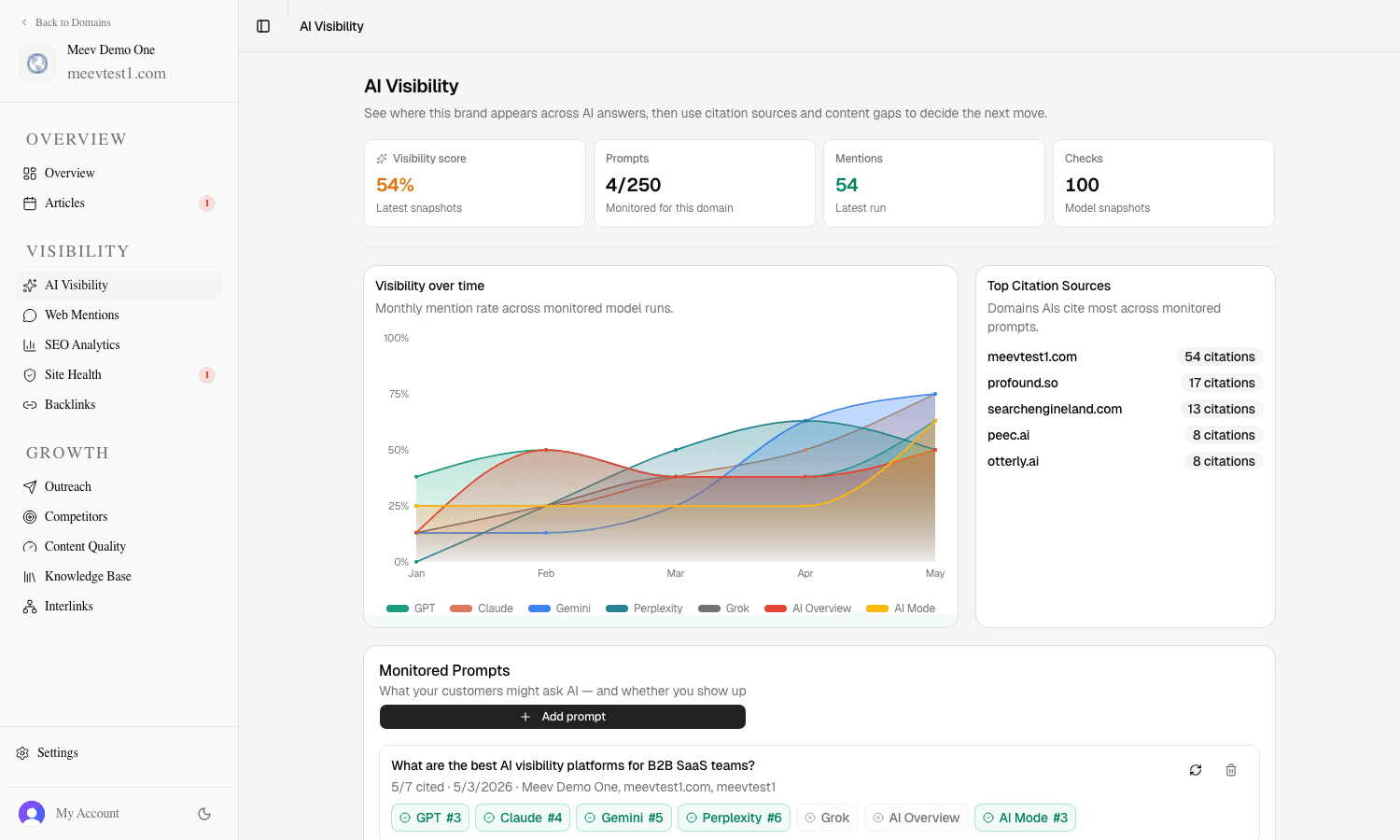
Generative AI search answers questions instead of listing links — and cites a small set of sources to back each answer. GEO is how you become one of them. Meev tracks where you're cited across ChatGPT, Gemini, Perplexity, and Google AI Overviews, then publishes the content that earns it.

Start free 7-day trial
Or try the free tools →

What is generative engine optimization (GEO)?

Generative engine optimization (GEO) is the practice of optimizing content so it gets surfaced and cited by generative AI search — ChatGPT, Gemini, Perplexity, and Google AI Overviews. These engines synthesize an answer from a few trusted sources rather than returning a ranked list, so GEO focuses on becoming a source worth quoting: answer-first content, quotable statistics, clear structure, and topical authority the engine can rely on.

What GEO is, and what the research says gets cited

Generative engine optimization targets the AI-synthesized answer, not the ranked link. Studies of what generative engines cite point to a consistent pattern: answer-first content the engine can lift cleanly, quotable statistics and citations that add credibility, and clear structure that maps content to a question. One important nuance: which signals matter most depends more on the query intent — a definition, a comparison, a how-to — than on your industry. A page tuned to the exact shape of the question it answers tends to get cited regardless of vertical.
GEO tactics that work

  • Lead with the answer — open each section with a direct, self-contained response, then elaborate, so the engine can extract it without surrounding context.
  • Add quotable evidence — concrete stats, dates, and named sources give the engine something citable that vague prose can't.
  • Match the query intent — shape the page to the kind of question it answers (definition, comparison, steps) rather than stuffing keywords.
  • Build topical authority — cover a topic comprehensively and consistently so engines learn to trust you as a source on it.

GEO vs AEO vs SEO — sorting out the overlapping terms

These terms overlap heavily and are often used interchangeably. SEO optimizes for ranked links in classic search. Answer engine optimization (AEO) focuses on being extracted as the direct answer to a question. GEO is the broader practice of being surfaced and cited by generative AI search across any query type. In day-to-day work the on-page tactics are nearly identical — answer-first writing, schema, entities, evidence — so treating GEO and AEO as one program built on solid SEO foundations is the practical move. If you want one umbrella, an AI SEO tool covers both classic rankings and AI citations.

How Meev helps

Meev is the generative engine optimization platform — track citations, close gaps, publish the content.

  • Tracks where you're cited across every major AI search surface — ChatGPT, Gemini, Perplexity, Grok, Google AI Overviews, and AI Mode
  • Turns citation gaps into a prioritized GEO action plan that updates as your data changes
  • Publishes quality-gated, answer-first content shaped to the query intent generative engines reward
  • Ships free GEO tools (SEO audit, llms.txt, crawler simulator, query fan-out, and more) you can use right now, no signup

Free tools to start with

All free tools →

Frequently asked questions about Generative Engine Optimization

What is generative engine optimization?

Generative engine optimization (GEO) is the practice of optimizing content so it gets surfaced and cited by generative AI search — ChatGPT, Gemini, Perplexity, and Google AI Overviews. These engines synthesize an answer from a few trusted sources instead of returning a ranked list, so GEO focuses on becoming a source worth quoting through answer-first content, quotable stats, clear structure, and topical authority.

Is there a generative engine optimization tool?

Yes. Meev is a generative engine optimization tool that tracks where you're cited across the major generative AI search engines, turns the gaps into a prioritized action plan, and publishes content shaped to be surfaced and quoted. It also includes free GEO tools — an AI SEO audit, llms.txt generator, crawler simulator, and query fan-out generator — with no signup required.

What's the difference between GEO and AEO?

The terms overlap heavily. AEO (answer engine optimization) focuses on being extracted as the direct answer to a question. GEO is the broader practice of being surfaced and cited by generative AI search across any query type. In practice the on-page tactics — answer-first writing, schema, entities, evidence — are nearly identical, so most teams run GEO and AEO as one program built on solid SEO foundations.

Does GEO matter more for some industries?

Research suggests query intent matters more than industry. Whether a generative engine cites you depends more on matching the shape of the question — a definition, a comparison, a how-to — than on your vertical. A page tuned to the exact intent of the query it answers tends to get cited regardless of industry, so the practical focus is intent-matching, not industry-specific tricks.

Does GEO replace SEO?

No. GEO complements SEO rather than replacing it. Classic search still drives substantial discovery, and the entities, topical authority, and quality signals that help you rank also help generative engines trust and cite you. GEO adds an AI-search layer on top of the SEO fundamentals you already need.

Get found in AI search — start today

Meev tracks your visibility across every major AI search surface and publishes quality-gated content that earns citations — automatically.

Start free 7-day trial
See pricing