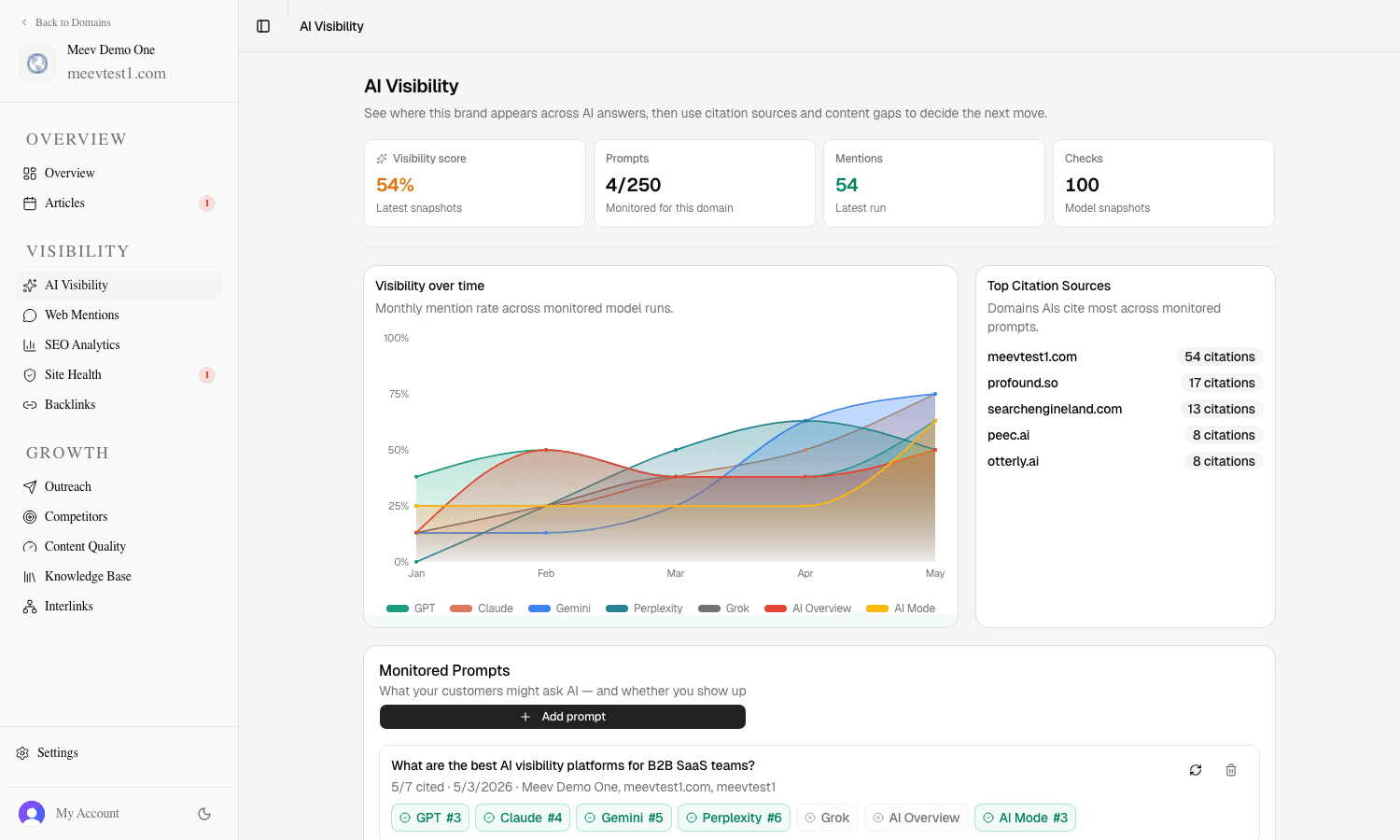
The AI search products built on large language models — ChatGPT, Gemini, Perplexity, Google AI Overviews — cite a small set of trusted sources. LLM SEO is how you become one. Meev tracks where you're cited, finds the gaps, and publishes the content that earns it.
LLM SEO is the practice of optimizing a website so large language models — and the AI search products built on them, like ChatGPT, Gemini, Perplexity, and Google AI Overviews — surface and cite it. It blends classic SEO fundamentals with AI-specific tactics: answer-first content engines can extract, clear entities and structure, quotable evidence, and the topical authority that earns an LLM's trust on a subject.
What LLM SEO is, and why it's distinct from classic SEO
Classic SEO optimizes to rank in a list of links a person scans and clicks. LLM SEO optimizes to be the source a language model quotes when it answers a question directly. The surface is different — a synthesized answer with a few citations, not ten blue links — and so is the unit of success: being extracted and cited rather than merely ranked. It overlaps with generative engine optimization and answer engine optimization; LLM SEO is the same goal framed around the language models doing the work.
How LLMs choose what to cite
Language models draw on two things: what they absorbed in training data, and what they retrieve and ground against at answer time (the live AI-search step). To be cited you need both: broadly referenced across the web so the model knows you, and cleanly retrievable so the engine can pull and quote you on demand. The data favors this over raw link authority. Ahrefs' analysis of 75,000 brands found off-site brand mentions correlate with AI-search visibility far more strongly than backlinks (about 0.66 vs 0.22), while its domain-authority metric sits near 0.33 and sheer content volume barely correlates at all (~0.19). In other words, topical depth and breadth of mention beat raw domain authority: a focused site that covers one subject thoroughly, and gets talked about, tends to get cited over a larger but more diffuse one.
The LLM-SEO playbook
Write answer-first — open with a direct, self-contained answer the model can extract, then elaborate below it.
Make the page machine-readable — clear headings, FAQ and structured-data schema, and named entities instead of pronouns.
Build topical depth — cover your subject comprehensively so models treat you as an authority, not a one-off page.
Measure citations — track whether the major AI search surfaces actually quote you, and feed the gaps back into what you publish next.
A worked example: the two ways a model can cite you
LLM SEO has two targets because a model reaches your content two ways. The same brand can show up through one and be missing from the other:
Training memory
Ask a model a question with live search off and it names you from what it absorbed during training. You earn this slowly, through broad and consistent references across the web, and it barely moves in the short term.
Live retrieval
Ask with search on and the model fetches pages in real time and cites what it can extract. You earn this the way you earn a Google citation: be indexed, answer-first, and machine-readable. This is the fast-moving lever.
The retrieval pathway is more winnable than most teams assume. Ahrefs looked at 15,000 prompts and found only about 12% of the pages ChatGPT, Gemini, and Copilot cite actually rank in Google's top 10 for that query, and roughly 80% don't rank in the top 100 at all. Chat assistants reward pages they can retrieve and extract, not just pages that already rank, and they lean fresh: 76% of ChatGPT's most-cited pages were updated within the last 30 days. Answer-first structure, clean machine-readable pages, and recent updates are the levers that move retrieval.
The fix depends on which pathway is failing. Absent from training memory means the work is authority and references over time; absent from retrieval means the work is on-page structure you can change this week. Knowing which one is missing is half the job, and it is the first thing an LLM-SEO tool should tell you.
Meev shows whether each model surfaces you from training memory or live retrieval, because the two need different fixes.
How Meev helps
Meev works both LLM layers: training memory and answer-time retrieval.
✓Tracks whether a model surfaces you from training memory or live retrieval, which need different fixes
✓Builds topical depth across a theme, since LLM citation tends to follow topical authority over raw domain authority
✓Shows where you are out-cited so you can earn the mentions models already trust
LLM SEO is the practice of optimizing a website so large language models — and the AI search products built on them, like ChatGPT, Gemini, Perplexity, and Google AI Overviews — surface and cite it. It blends classic SEO fundamentals with AI-specific tactics: answer-first content engines can extract, clear entities and structure, quotable evidence, and topical authority that earns the model's trust.
How is LLM SEO different from regular SEO?⌄
Regular SEO optimizes to rank in a list of links a person clicks. LLM SEO optimizes to be the source a language model quotes when it answers directly. The surface is a synthesized answer with a few citations, not ten blue links, and the success metric shifts from ranking to being extracted and cited. The fundamentals overlap, but LLM SEO adds answer-first structure and topical depth tuned for extraction.
LLM SEO vs GEO vs AEO: what's the difference?⌄
They describe one goal from three angles. LLM SEO frames it around the language models themselves: getting cited by the models behind AI search, through both training memory and live retrieval. Answer engine optimization (AEO) frames it around the extraction step: being the self-contained answer an engine lifts. Generative engine optimization (GEO) is the broadest umbrella: being surfaced and cited across any generative-search query. The on-page work overlaps heavily, so most teams run one program and use whichever term their audience searches for.
How do LLMs decide what to cite?⌄
Language models draw on two things: what they absorbed in training data, and what they retrieve and ground against at answer time. To be cited you need both — broad references across the web so the model knows you, and clean, machine-readable pages it can pull and quote. A recurring finding is that topical authority (deep, consistent coverage of one subject) often beats raw domain authority.
Is there an LLM SEO tool?⌄
Yes. Meev is an LLM-SEO platform that detects whether a model surfaces you from training memory or from live retrieval (the two need different fixes), builds the topical depth that LLM citation tends to follow, and shows where you're out-cited so you can earn the mentions models already trust. It also includes free LLM-SEO tools (an AI SEO audit, llms.txt generator, crawler simulator, and query fan-out generator) with no signup required.
What are the best LLM SEO tools?⌄
Evaluate an LLM SEO tool on three things: does it track whether AI products (ChatGPT, Gemini, Perplexity, Google AI Overviews) actually cite you, does it show where competitors are cited instead, and does it help you publish the answer-first content that earns citations. Tools that only do keyword research or only generate content cover one slice; the useful ones close the loop from measurement to a published fix. Meev is built around that full loop.
Does LLM SEO replace traditional SEO?⌄
No, though the relationship is looser than for Google. Language models reach your content two ways: what they absorbed during training and what they retrieve live at answer time. Crawlability and indexing still make you retrievable, but ranking #1 is not the gate it is in classic search: Ahrefs found only about 12% of the pages chat assistants cite rank in Google's top 10 for the query. LLM SEO adds answer-first structure, machine-readability, and freshness on top of the SEO fundamentals; it complements classic SEO rather than replacing it.
Get found in AI search, start today
Meev tracks your visibility across every major AI search surface and publishes quality-gated content that earns citations, automatically.