Free tool · No signup

Free Topical Map Generator

Enter a domain and get its content mapped into topic clusters: the themes it covers, the pages behind each one, and the orphan posts that belong to nowhere. Works on any site with a sitemap, including competitors.

What is a topical map?

A topical map is a visual of how a site's content groups into topics: the themes it covers deeply, the pages supporting each theme, and the orphan posts that belong to none. SEO teams use it to spot coverage gaps and plan topical authority. This tool builds one from any site's sitemap in about 30 seconds.

Free · 10 AI runs per day · No signup required

What Meev is

An AI search visibility platform that turns tracking into action.

Meev tracks where your brand appears across ChatGPT, Claude, Gemini, Perplexity, Grok, DeepSeek, Google AI Overviews, and Google AI Mode — then shows what to fix, publish, or pitch next to improve AI visibility.

🔒 app.meev.ai/domains/acme.com/overview
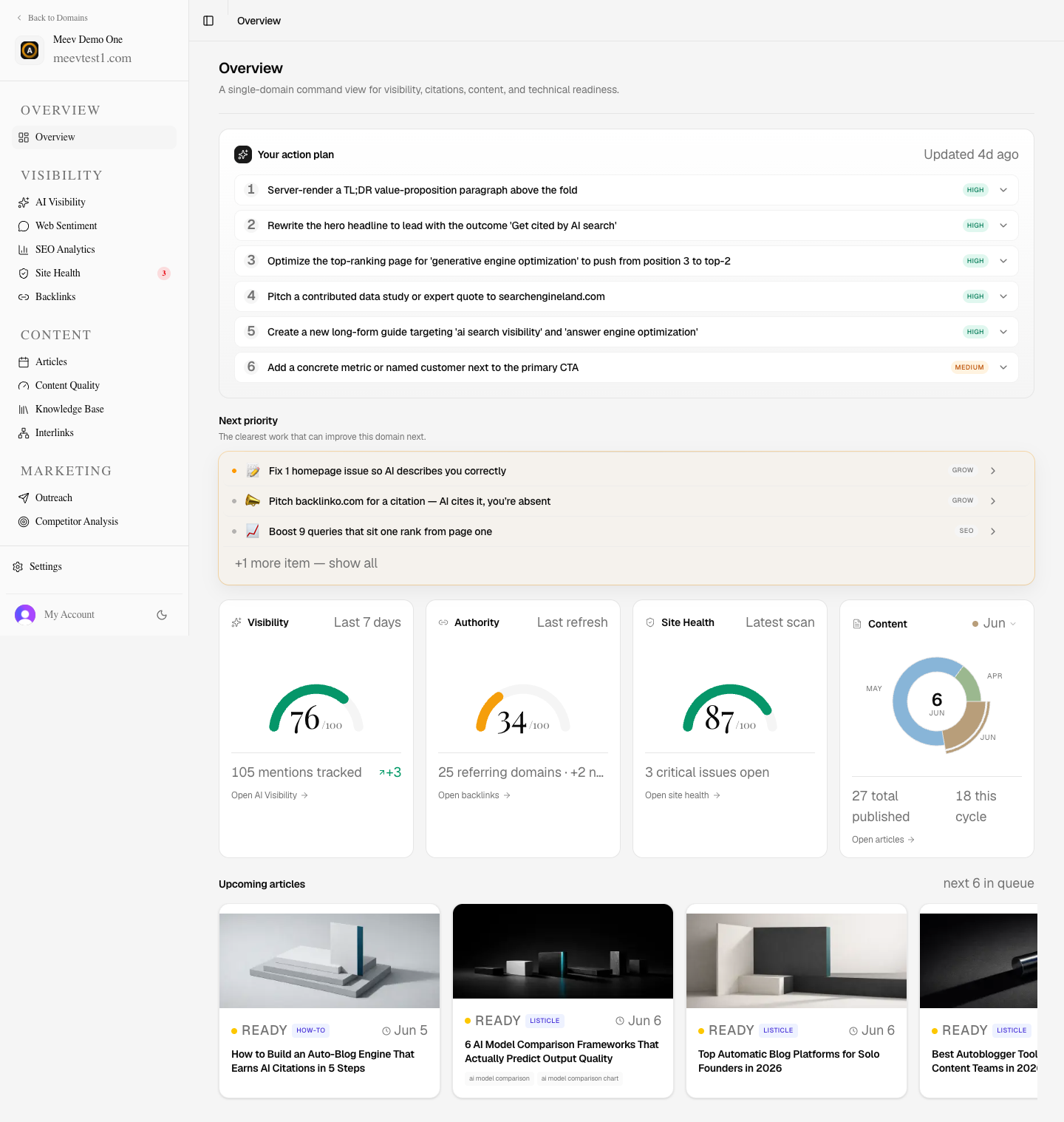
Overview
A walkthrough of the Meev dashboard. It shows an AI visibility score and per-engine mention counts across ChatGPT, Claude, Gemini, Perplexity, Grok, DeepSeek, and Google AI Overviews; a prioritized action plan of the next fixes to make; one-click article generation and publishing; and publisher outreach with auto-drafted pitches to earn AI citations.
Tracks every major AI search surfacePrioritizes next actionsPublishes quality-gated contentSupports WordPress, Ghost, Wix, and webhooks
Your domain
AI citation gaps
Competitor gaps
SERP openings
Trending signals
Topic planner
LISTICLETopic
HOW-TOTopic
EXPLAINERTopic
PROBLEMTopic
Real sources
Your knowledge
Links + schema
Writer
Draft
Draft
Draft
Draft
Quality gate
Passed
Passed
Passed
Held for review
WordPress
Ghost
Wix
Webhook
Sitemap → index
ChatGPT
Claude
Gemini
Perplexity
Grok
DeepSeek
AI Overviews
AI Mode
Citation Path
Theme map2 themes · 2 unlinked
Your published articles
Every major AI surface
Share of
AI answers
6%

The path to getting cited

From an unanswered prompt to a cited brand

01 · Your domain

Start by analyzing your site

Meev reads your existing pages, topics, and Google Search Console signals to learn what your site is about and already ranks for: the foundation for every gap, draft, and citation that follows.

How it works

Step 1

Read the sitemap

We fetch the site's public sitemap and collect up to 500 content URLs. We never crawl the pages themselves, so the map stays fast on any site.

Step 2

Group pages into themes

Page URLs are compared by meaning, not matching words, so debt-snowball-guide and payoff-calculator land in the same cluster.

Step 3

Name the themes

Each cluster gets a short, specific topic name, and pages that fit no cluster are flagged as outside every theme.

Step 4

Read the map

Bigger clusters mean deeper coverage. Grey pages are publishing effort that isn't compounding into any topic.

Why it matters

Topical authority starts with seeing your topics

Search engines and AI answer engines trust sites that cover a topic completely, not sites with one lucky post. A topical map shows which topics you're actually building, which are half-built, and which posts are building nothing at all.

Orphan pages are the silent budget leak

Most blogs accumulate one-off posts: a year in review here, a trend reaction there. Each one costs real effort, but pages outside every theme rarely rank and almost never earn AI citations. Seeing them listed in one place is usually the wake-up call.

Competitor maps read like strategy documents

Run the tool on a competitor's domain and their content strategy shows up in one picture: the topics they're betting on, how deep each cluster goes, and the themes they've left uncontested for you.

With Meev

From a map to owned topics

Meev runs the loop this tool can only sketch: it maps your themes from your live content, plans each week around the biggest gap, publishes quality-gated articles into the theme, and scores every theme on whether search actually rewards it.

  • Living theme map, rebuilt as you publish
  • Weekly plans that close the biggest gap first
  • Built vs Proven scoring from rankings and Search Console

Frequently asked questions about Topical Map Generator

What is a topical map generator?

A topical map generator groups a website's content into topic clusters so you can see the site's themes at a glance. This one reads the public sitemap, groups up to 500 pages by meaning, names each theme, and flags pages that belong to no theme.

Does it work on any website?

It works on any site with a public sitemap and descriptive URLs, like /blog/how-to-choose-running-shoes. Sites whose URLs are only IDs or dates can't be mapped from URLs alone.

Why does it stop at 500 pages?

500 pages covers the overwhelming majority of blogs while keeping the tool fast and free. If a site has more, the map covers the first 500 and says so. Meev's full product maps complete libraries continuously, with no cap.

Can I map a competitor's site?

Yes. Any public sitemap works, so you can read a competitor's content strategy in seconds: their deepest themes, their thin ones, and the gaps they've left open for you.

Is any of my data stored?

The tool reads only public sitemap URLs, nothing else. Results are cached for a day so repeat runs of the same domain are instant.

How is this different from keyword clustering?

Keyword clustering groups search queries you might target next. A topical map groups content you already published. Together they answer both questions: what have I built, and what should I build next.

Stop fixing pages one at a time.

Meev tracks your visibility across every major AI search surface and publishes quality-gated content that earns citations — automatically.

7-day free trial. Cancel anytime.

More free tools

View all →