Free tool · No signup

How visible is your brand in AI search?

We scan your site, generate 5 buyer-discovery prompts in your category, and run them through ChatGPT and Gemini. You get an AI Visibility Score in under 30 seconds.

Loading…

Powered by

ChatGPTChatGPT·GeminiGemini

Why the score matters

AI visibility is one of three things that decide whether you get found.

Optimizing for AI search without content quality (or vice versa) is a trap. Here's what every brand needs to understand in 2026.

Google's rule update · 2022 → present

The Helpful Content System grades your whole site, not just individual pages.

Google's Helpful Content System (launched 2022, made a default ranking signal in 2024) is the rule that changed how content quality affects search. Unlike the old SEO model where each page stood alone, the Helpful Content System judges your entire domain. One thin, low-quality article doesn't just fail to rank — it pulls down how well every other article on your site ranks. Publish more AI-generated filler to compensate and the demotion compounds. There is no “outrun the quality grade with volume” — that strategy actively hurts you now.

AI search engines · the same standard

AI engines won't cite content they can't trust.

ChatGPT, Claude, Perplexity, Gemini, and Google AI Overviews don't reach for every page on the open web. They filter for structure, authority, and original information. Generic AI content — boilerplate openings, hedging language, no primary sources — rarely makes the citation cut. Worse, AI engines learn at the domain level: a string of generic articles teaches them to weight your site lower for the next prompt. Publishing AI content without quality controls trains the engines to skip you.

The three-legged stool

SEO, AEO, and content quality compound — or compound the problem.

Each surface has its own optimization layer: SEO for Google's blue links, AEO (Answer Engine Optimization) for AI citations, and content quality for both the Helpful Content System and the AI citation filter. They reinforce each other. High-quality articles rank in Google, get cited by AI engines, and lift the rest of your domain at the same time. Low-quality articles do the opposite — they fail to rank, fail to get cited, and drag down your existing high-performers. The flywheel goes both ways.

Pillar 1

SEO

Show up in Google's blue links.

Pillar 2

AEO

Get cited in ChatGPT, Perplexity, AI Overviews.

Pillar 3

Content quality

Pass the Helpful Content grade site-wide.

Frequently asked

What is Google's Helpful Content System?

Google's Helpful Content System (HCS) is the ranking signal — launched in 2022 and made a default in 2024 — that judges the overall helpfulness of your site, not just individual pages. Sites with a lot of low-quality content get demoted across all pages, including the strong ones. It's why AI-generated volume without quality controls now hurts SEO instead of helping it.

Why doesn't just publishing more AI articles work anymore?

Two reasons. (1) Google's Helpful Content System grades your whole domain — adding more low-quality articles drags down how well your strong articles rank. (2) AI engines like ChatGPT, Perplexity, and Google AI Overviews learn at the domain level — a string of generic AI articles teaches them to skip your site for the next prompt. Volume without quality compounds in the wrong direction.

Why does AI search visibility require both AEO and content quality?

AEO (Answer Engine Optimization) is how you structure articles so AI engines can extract answers — definitional intros, FAQ blocks, schema markup, internal links. Content quality is whether the article has original information, real citations, and a real author. AEO without quality means your article is well-structured but won't pass the AI engine's citation filter. Quality without AEO means it's a good article that AI engines can't easily extract from. You need both.

How is this different from running the prompts in ChatGPT myself?

You can absolutely paste prompts into ChatGPT one at a time. The free checker generates 5 category-relevant prompts from your homepage, runs them through ChatGPT and Gemini in parallel, and scores the results — turning what would be 10 manual queries + scoring spreadsheet into a 20-second score. The paid Meev product extends this to every major AI search surface, web-grounded citations, and rolling cadence so you can track week-over-week.

Why don't you show me which prompts you tested or which LLM mentioned me?

The score gives you the headline number for free. The actionable detail — which specific prompts your brand surfaces in, which LLMs cite your competitors instead, and the URLs each engine pulled into its answer — is what the paid Meev product is for. Start a free trial to see all of it (and the outreach targets to fix the gaps).

Does the free check use web search?

No. The free check tests whether your brand is in the LLM's training data — which is the core question of AI visibility. The paid product runs the same prompts with live web search enabled to see which publisher URLs each LLM cites in real-time. Both signals matter; the free check covers the foundational one.

Is signing up for the trial free?

Yes — 7-day free trial of any paid plan. Card required at sign-up but no charge today. Trial caps at 7 articles + 10 tracked prompts regardless of plan; every other feature reflects the plan you pick. Cancel anytime before day 7 to avoid the bill.

How accurate is the score?

The score is computed from 10 LLM responses (5 prompts × 2 LLMs) using a weighted mention-rate formula. It's accurate as a single-snapshot read of your training-data presence. The paid product runs the same scoring with continuous rolling cadence, more surfaces, and live web grounding — so trend-line accuracy goes up significantly over time.

Will my domain show up in your public database?

No. Free checks are stored only for our internal 7-day cache (so you don't accidentally re-run and double-charge yourself). We don't publish, share, or leaderboard customer domains.

Want more detailed AI visibility analysis?

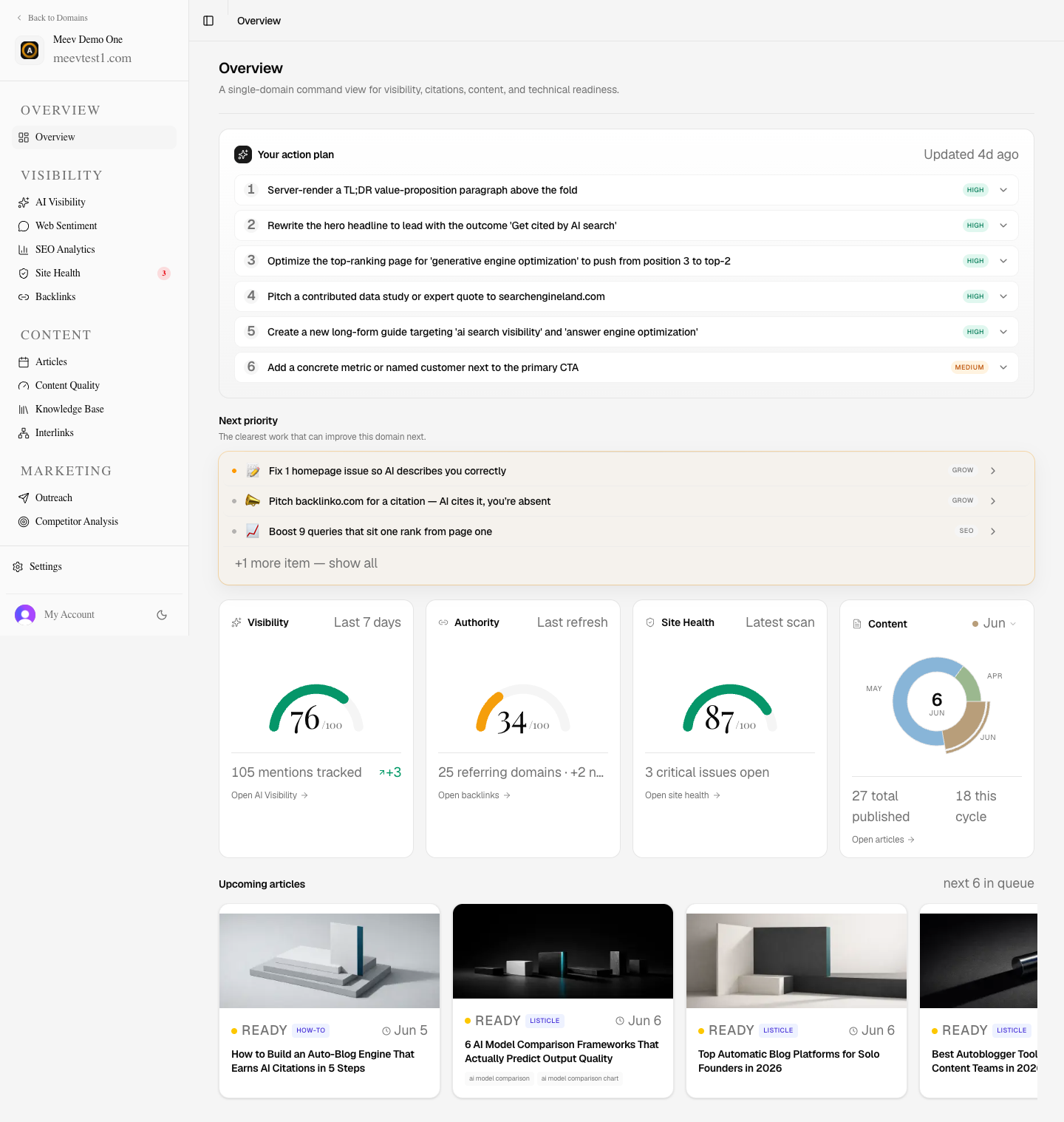
The full Meev dashboard tracks every major AI search surface — ChatGPT, Claude, Gemini, Perplexity, Grok, DeepSeek, Google AI Overviews, and Google AI Mode — with web-grounded citations, plus Citation Path outreach + auto-blog publishing.

Start free 7-day trial →

Card required, no charge until day 8. Cancel anytime. Trial limits.