One H1 title, the only required element
The file opens with a single markdown H1 naming your site or project: “# Your Site Name”. Everything else in the convention is optional; without the title, parsers can't tell whose file they're reading.
Free tool · No signup
Paste your llms.txt or enter your domain, and we fetch the file and check it against the llms.txt convention: title, summary, sections, link descriptions, format, and size. You get a scored pass/warn/fail checklist with the fix for every miss.
An llms.txt validator checks whether a site's llms.txt file follows the proposed standard: a markdown H1 title, an optional blockquote summary, and H2 sections of described links. It flags missing structure, HTML instead of markdown, empty sections, and raw URL dumps so AI engines can read the file as intended.
The llms.txt standard is deliberately small: a markdown file at your web root with a title, an optional summary, and sections of described links. The validator checks each of these rules. Here's what they are and why each one matters.
The file opens with a single markdown H1 naming your site or project: “# Your Site Name”. Everything else in the convention is optional; without the title, parsers can't tell whose file they're reading.
One line starting with “>” that says what the site is. Optional, but it's the sentence AI engines lift when they describe you, so write it yourself rather than letting them guess.
Sections like “## Docs”, “## Products”, or “## Guides” turn a pile of links into a navigable index. An “## Optional” section marks links an engine can skip when its reading budget is tight.
Each link is a list item in the form “- [Page name](url): one-line description”. The description is what makes the index useful. A raw URL dump tells an engine nothing about which page answers what.
The file must be served as raw markdown text. The most common failure we see is a CMS or single-page app returning its HTML fallback page at /llms.txt. It looks fine in a browser and is unreadable to a parser.
AI assistants read llms.txt inside a limited context budget. A short, high-signal list of your most important pages beats an exhaustive dump; past a few hundred kilobytes, most of the file never gets read.
Every rule above, in one short file: a single H1, a blockquote summary, a plain-prose intro, grouped sections, and a description on every link.
# Acme Analytics

> Product analytics for early-stage SaaS teams: event tracking, funnels, and retention reports without the enterprise price tag.

Acme Analytics helps founders understand user behavior from day one.

## Product

- [Features](https://acme.example/features): Event tracking, funnels, cohorts, and retention reporting
- [Pricing](https://acme.example/pricing): Plans from free to scale, billed monthly or annually

## Guides

- [Quickstart](https://acme.example/docs/quickstart): Install the snippet and see your first events in five minutes
- [Funnel analysis](https://acme.example/docs/funnels): Build and read conversion funnels step by step

## Optional

- [Changelog](https://acme.example/changelog): Weekly product updates
Don't have an llms.txt yet? Generate one from your sitemap in seconds, then validate it here before publishing.
Free · Unlimited checks · No signup required
What Meev is
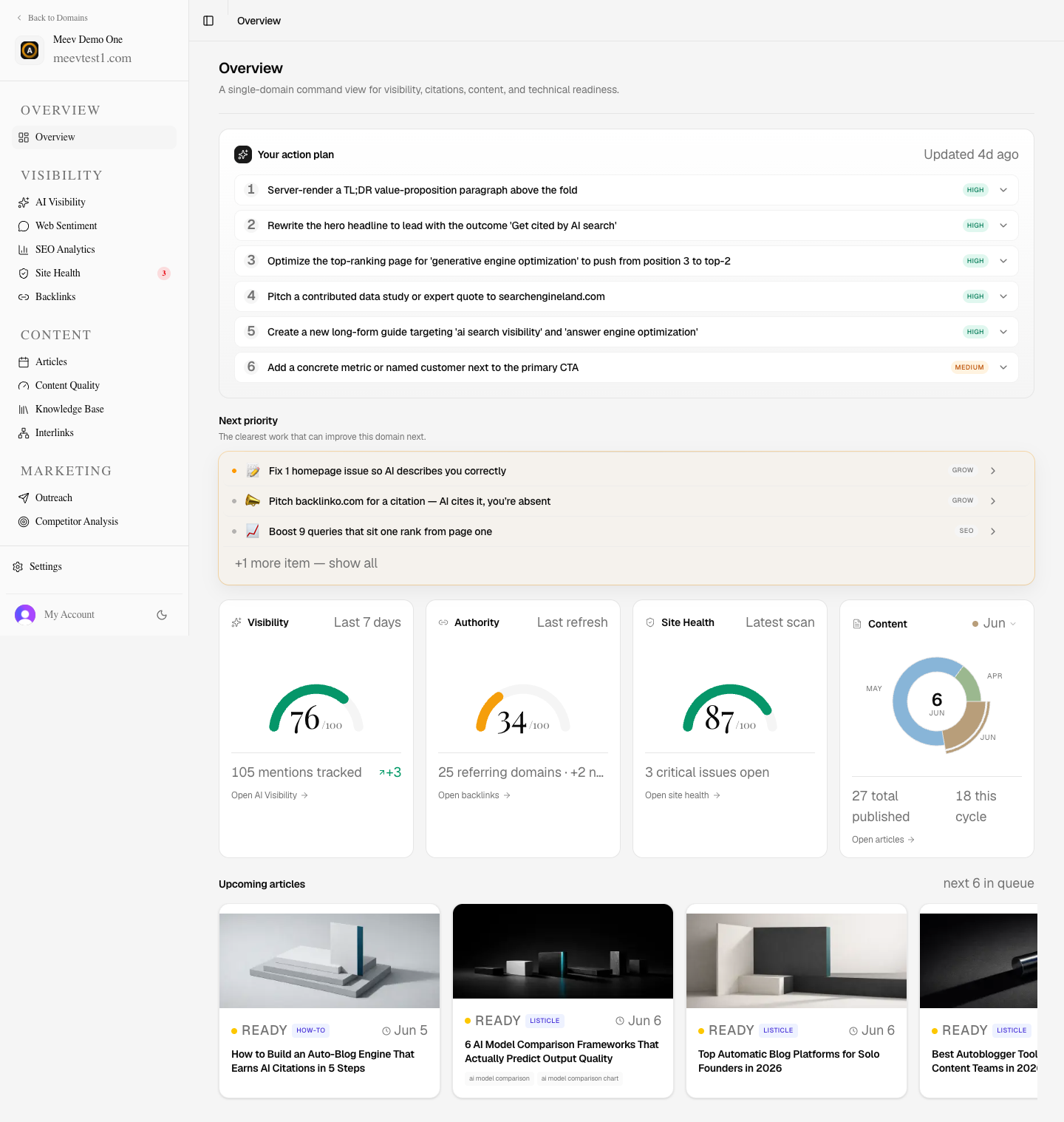
Meev tracks where your brand appears across ChatGPT, Claude, Gemini, Perplexity, Grok, DeepSeek, Google AI Overviews, and Google AI Mode, then shows what to fix, publish, or pitch next to improve AI visibility.


The path to getting cited
01 · Your domain
Meev reads your existing pages, topics, and Google Search Console signals to learn what your site is about and already ranks for: the foundation for every gap, draft, and citation that follows.
Step 1
Paste or fetch
Paste the file directly, or enter your domain and we fetch /llms.txt for you.
Step 2
We parse the structure
Title, summary, sections, links, and descriptions: the same structure AI engines parse.
Step 3
Scored checklist
Every rule gets a pass, warn, or fail verdict with a plain-English explanation.
Step 4
Fix and re-run
Each miss tells you exactly what to change. Republish, validate again, ship clean.
AI engines that read llms.txt parse it by structure: the H1 tells them whose file it is, the blockquote tells them what the site does, and the sections tell them which pages answer what. When that structure is broken (an HTML page served at the path, a missing title, links with no context), a parser either extracts the wrong picture of your site or gives up silently. Nothing errors; you just published a file that misrepresents you.
Because llms.txt is just markdown, almost anything looks plausible. The failures we see are mundane: a CMS returning its HTML 404-fallback at /llms.txt with a 200 status, a sitemap export pasted in as hundreds of raw URLs, section headings with nothing under them, or a second H1 splitting the file in two. Each looks fine in a browser and reads as broken to a parser, which is why checking against the actual convention beats eyeballing it.
The llms.txt proposal chose markdown headings, blockquotes, and link lists precisely because they map to a clean parse tree, so programmatic tools can split the file into title, summary, and sections without any natural-language guessing. Follow the structure and every llms.txt-aware tool reads your file identically; drift from it and every tool degrades differently. Conforming is the whole value of adopting a standard.
With Meev
A clean llms.txt helps AI engines find your pages. Meev gives them more pages worth finding. It plans, writes, and publishes quality-gated articles to your blog automatically, then tracks whether AI engines actually cite you for the queries that matter.
llms.txt is a proposed standard: a plain markdown file published at your domain root (like robots.txt) that gives AI engines a curated overview of your site. It contains an H1 title, an optional blockquote summary, and H2 sections listing your most important pages with one-line descriptions. The goal is to help language models understand and cite your site accurately without crawling everything.
It's a proposed standard: a public convention with a published specification, not something ratified by a standards body like the W3C or IETF. That's the same path robots.txt took: it ran on community convention for decades before formal standardization. Adoption among AI tools and crawlers is growing, and following the convention exactly is what maximizes compatibility with everything that reads it.
Adoption is growing rather than universal. A number of AI tools, crawlers, and answer engines already read llms.txt, and the standard has momentum because it solves a real problem: raw HTML is an inefficient format for language models. Publishing a well-formed file costs nothing and carries no downside, so the practical answer is: publish it, keep it valid, and benefit as adoption expands.
Structural rules drawn from the llms.txt convention: the file is markdown rather than HTML, a single H1 title opens it, a blockquote summary follows the title, H2 sections organize the links, no section is empty, links use markdown list format instead of raw URL dumps, links carry one-line descriptions, and the file stays concise enough for an AI assistant's reading budget. Each rule returns pass, warn, or fail with a plain-English fix.
Usually not entirely. Most parsers are lenient and will extract what they can. But structure determines how much they extract: a missing title or HTML-instead-of-markdown failure can make the whole file unreadable, while warnings like missing descriptions just lower its usefulness. Fix the fails first; they're the difference between a file that parses and one that doesn't.
llms.txt is the curated index: a short file of described links that points engines to your important pages. llms-full.txt is an optional companion that inlines the full content of those pages into one large markdown document, for tools that want everything in a single fetch. This validator checks the index file; if you publish both, the index is the one that needs to be structurally clean.
Meev tracks your visibility across every major AI search surface and publishes quality-gated content that earns citations, automatically.
7-day free trial. Cancel anytime.
AI Search
AI SEO Audit
Audit any page for AI-search readiness in 30 seconds
AI Search
AI Overview Checker
See which queries trigger Google AI Overviews, and whether you're cited
AI Search
Topical Map Generator
Map any site's content into topic clusters from its sitemap
AI Search
Googlebot and AI Crawler Simulator
See what Googlebot, GPTBot, and ClaudeBot see on your page
AI Search
Query Fan-Out Generator
Turn one query into 25+ AI-search variations, grouped by intent
AI Search
Token Counter
Count the tokens on any page, the way an AI engine reads it