

By Judy Zhou, Founder
Key Takeaways
- 58.5% of Google searches now end without a click, so keyword position gains no longer guarantee traffic.
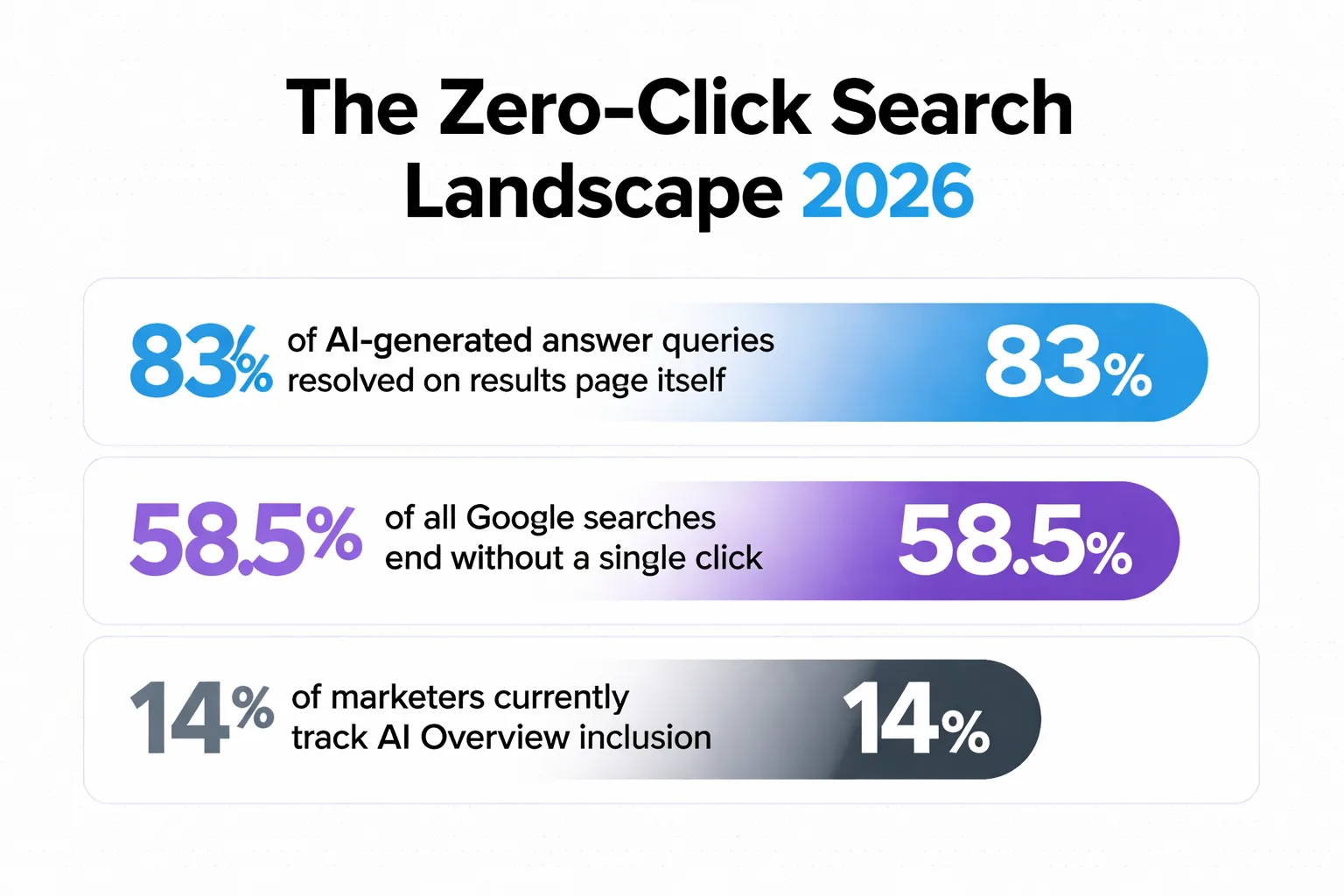
- 83% of AI-generated answers are resolved on the results page itself, rendering classic SERP reports incomplete.
- Only 14% of marketers track AI visibility, even though Ahrefs data on 75,000 brands shows AI Overview inclusion is a distinct ranking signal.
- Add LLM citation tracking and AI Overview metrics to every ranking report to measure full visibility instead of positions alone.
Maya pulled up the monthly ranking report on a Tuesday morning, same as always. Positions were up across the board. Seventeen keywords climbing into the top three, the CEO's pet terms finally cracking page one. She screenshot the table, dropped it into the Slack channel, and waited for the congratulations. They came. What nobody mentioned, because nobody had thought to measure it, was that organic clicks had fallen for the fourth consecutive month. The rankings were real. The visibility they implied was not.
This is the central problem with search engine ranking reports in 2026. The traditional definition. A snapshot of where your URLs appear in Google for a set of target keywords. Was built for a world where ranking meant traffic. That world is gone. According to Goodfirms' 2026 SEO statistics, 83% of AI-generated answer queries are now resolved on the results page itself, and 58.5% of all Google searches end without a single click. Meanwhile, only 14% of marketers currently track AI visibility alongside traditional rankings. And Ahrefs' analysis of 75,000 brands found that AI Overview inclusion has become a distinct visibility signal that standard rank trackers simply don't capture.
A ranking report that only shows keyword positions is no longer a visibility report. It's a partial one.
The Classic Definition. And Why It No Longer Covers Everything
A search engine ranking report, in its traditional form, answers one question: where does my content appear in Google's results for keyword X? The output is a table. Keywords down the left column, positions down the right. Maybe a trend arrow, maybe a competitor column. Tools like Google Search Console, Semrush, and Ahrefs have been generating versions of this report for years, and for a long time it was genuinely useful. Position 1 meant traffic. Position 11 meant almost none. The math was simple.
That simplicity is what makes the traditional report dangerous now. The assumption baked into every classic ranking report is that a high position produces proportional visibility. That assumption breaks down in at least three ways in 2026.
First, AI Overviews now appear above the organic blue links for a growing share of informational queries. If your content isn't included in the AI Overview, you can rank position 1 and still lose the click to the synthesized answer above you. Second, conversational AI engines. Perplexity, ChatGPT, Claude, Gemini. Are answering queries directly, often without showing a traditional SERP at all. A brand can be completely invisible in these answers while holding strong Google positions. Third, Position Digital's 2026 AI SEO statistics aggregate a clear pattern: citation rates in LLM-generated answers do not correlate cleanly with Google rank. The sources AI engines prefer are often not the sources ranking at position 1.
The classic ranking report was designed for a single-surface world. We now operate across multiple surfaces simultaneously, and most of them don't report back to your rank tracker.
This is not a minor gap to patch. It's a structural mismatch. If you're making content investment decisions based on keyword positions alone, you're optimizing for a metric that explains less and less of your actual search visibility every quarter. Understanding what AEO is and how it differs from traditional SEO is the first step toward fixing the measurement problem.
What a Modern Ranking Report Must Include in 2026
A complete search engine ranking report in 2026 needs five data layers. Each one answers a different question about visibility, and none of them is redundant.
| Data Layer | Question It Answers | Primary Source |
| Classic Google positions | Where do my URLs rank for target keywords? | Google Search Console, rank trackers |
| AI Overview inclusion | Does Google's AI answer cite my content? | Ahrefs AI Citations Report, Semrush |
| LLM citation rate | How often do ChatGPT, Perplexity, Claude, Gemini cite my brand? | AI visibility platforms (Meev, etc.) |
| Brand mention frequency | How often does my brand appear across AI engine answers, cited or not? | Brand monitoring + AI surface tracking |
| Answer-engine share of voice | What percentage of relevant AI answers mention me vs. competitors? | AI visibility platforms |
The first layer. Classic Google positions. Still matters. Google processes billions of queries daily, and a significant portion of them still produce clicks. Dropping from position 3 to position 12 for a high-volume commercial keyword is still a real business problem worth fixing. Don't let the AI visibility conversation convince you that traditional rank tracking is dead. It isn't. It's just incomplete.
The second layer is where most teams are currently blind. Google AI Overviews now appear for a substantial share of informational queries, and inclusion in that overview is not guaranteed by ranking position 1. Ahrefs analyzed 75,000 brands to identify the factors correlating with AI Overview inclusion, and the findings make clear that it's a separate optimization target from classic ranking. Chris Long has noted that Ahrefs' AI Citations Report functions as a quick competitive analysis tool for gauging AI visibility across AI Overviews, ChatGPT, and Perplexity without requiring a dedicated tracking tool. A useful shortcut, though it doesn't replace continuous monitoring.
The third and fourth layers are where generative engine optimization becomes concrete. LLM citation rate measures how often AI engines actually pull from your content when generating answers. Brand mention frequency is broader. It captures whether your brand name appears in AI answers even when a specific URL isn't cited. Both matter for brand protection. A competitor who appears in every Perplexity answer for your category is building awareness you can't see in a standard rank report.
The fifth layer, answer-engine share of voice, is the metric most analogous to traditional share of voice in SEO. It asks: of all the AI-generated answers for queries relevant to my business, what fraction mention me? This is the number that tells you whether your AI search visibility is growing or eroding relative to the competitive field.
A reporting framework that covers all five layers gives you a genuine picture of visibility. Four layers gives you a partial picture. Three or fewer and you're flying mostly blind.
Is your ranking report showing positions but missing AI visibility — the layer that now drives most zero-click searches?
How to Read and Act on a Ranking Report
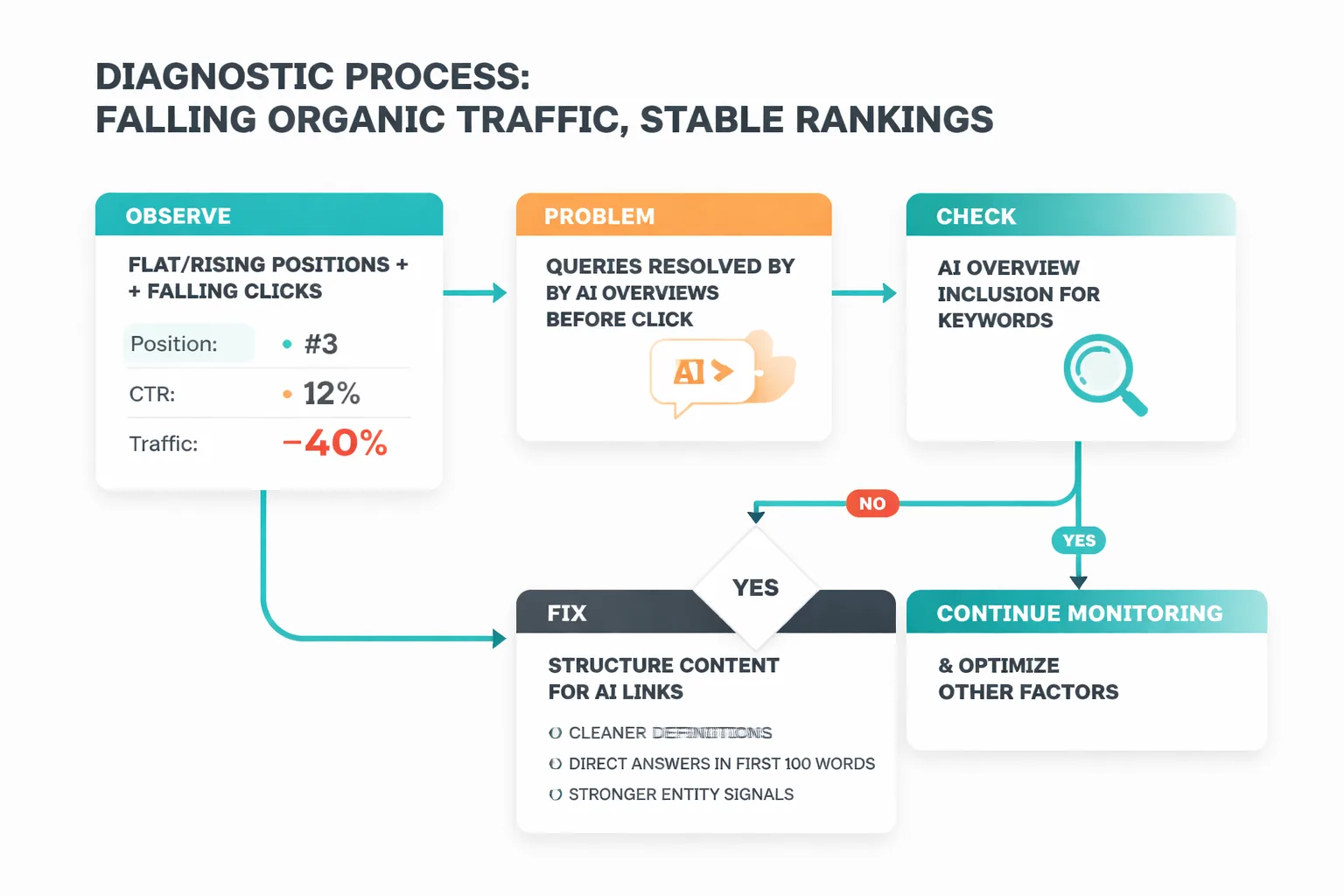
The most disorienting pattern I keep seeing is this: a brand's Google positions are stable or improving, but organic traffic is falling. Teams panic, audit the site, check for penalties, and find nothing wrong. The problem isn't on-page. The problem is that the queries driving their impressions are increasingly being resolved by AI Overviews before the click happens.
When you see flat or rising positions alongside falling clicks, the first thing to check is AI Overview inclusion for those specific keywords. If your content is being summarized in the AI Overview but not linked, you're getting zero-click impressions. The fix isn't to rank higher. The fix is to structure your content so the AI Overview links to you rather than just paraphrasing you. Which means cleaner definitions, more direct answers in the first 100 words, and stronger entity signals. This is the core of AEO versus SEO strategy, and it requires a different content intervention than classic on-page optimization.
The inverse pattern is equally important. When LLM citation rate rises while Google positions drop, that's not necessarily a crisis.
I've watched this play out with informational content in particular. A piece loses its position 2 ranking as Google reshuffles, but Perplexity keeps citing it because the content is structured clearly and cites authoritative sources. The Google traffic drops, but AI-driven referral traffic holds or grows. In this case, the right response is to protect the content's citability. Keep the structure clean, update the data, don't strip the citations. Rather than chasing the Google position back up through aggressive on-page optimization that might actually hurt the content's AI citability.
Prioritizing fixes from a modern ranking report comes down to where the query intent lives. Commercial intent queries (product comparisons, pricing, vendor evaluations) still live primarily in Google. Users with buying intent click through. Informational intent queries (how-to, definitions, explanations) are increasingly resolved in AI engines without a click. Map your keyword set by intent first, then look at which data layer is underperforming for each segment. That mapping tells you whether to invest in classic ranking work, AI Overview optimization, or LLM citation building.
Tools That Generate AI-Aware Ranking Reports
The tooling landscape for search engine ranking reports splits into three categories in 2026, and understanding what each category actually measures is more useful than any feature comparison list.
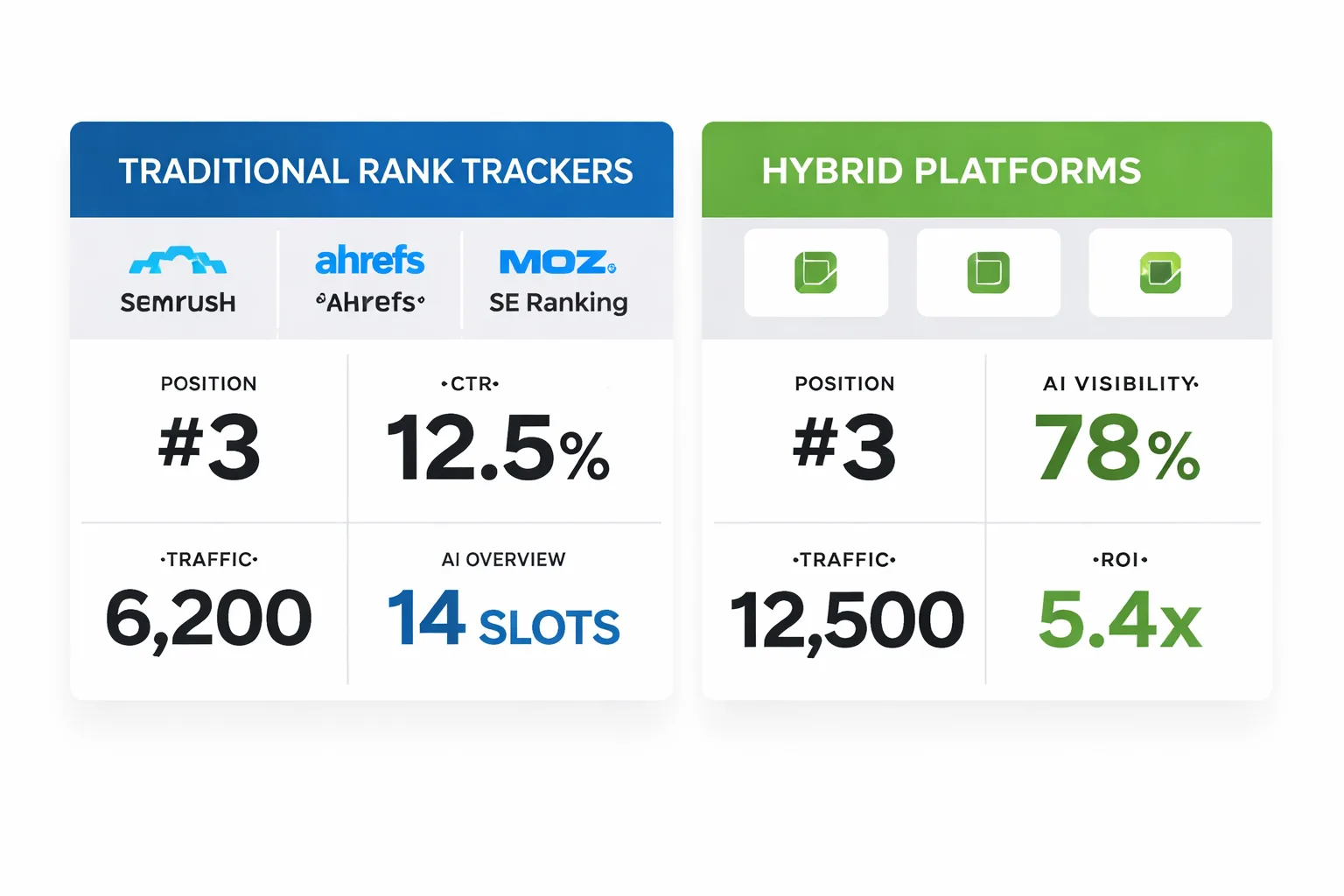
Traditional rank trackers — Semrush, Ahrefs, Moz, SE Ranking. Are strong on classic Google positions and have added some AI Overview detection. Ahrefs' AI Citations Report is genuinely useful for a quick competitive snapshot, as Chris Long noted. But these tools were architected around keyword-position data, and their AI visibility features are addons rather than core infrastructure. They'll tell you whether your URL appears in AI Overviews for tracked keywords, but they don't track LLM citation rates across ChatGPT, Claude, Perplexity, or Grok on a rolling basis. For teams whose primary concern is still Google ranking with AI Overview as a secondary signal, traditional rank trackers remain the right anchor tool.
Hybrid platforms add an AI visibility layer on top of traditional rank tracking. These typically query AI engines at intervals and report whether your brand appears in the answers. The gap I've seen consistently in this category is that they track mentions without connecting them to content actions. You get an alert that your brand appeared in 34% of Perplexity answers this week, down from 41% last week. What you don't get is a clear path to understanding why the drop happened or what content change would reverse it. The monitoring is real. The actionability is limited.
All-in-one platforms like Meev close that loop by combining visibility tracking with content generation and citation gap analysis in a single workflow. Meev tracks brand mentions and citation rates across every major AI search surface. ChatGPT, Claude, Gemini, Perplexity, Grok, Google AI Overviews, and AI Mode. With daily refresh on SERP-driven surfaces and rolling refresh on LLM-driven surfaces. The per-LLM drill-down dashboards show not just whether your brand appeared, but where in the answer it appeared (first mention, buried in a list, last) and what the actual response text looked like. That's a meaningful difference from a binary mentioned/not-mentioned flag.
What makes the all-in-one category worth considering for content teams specifically is the connection between the visibility data and the content pipeline. Meev's Content Opportunities feature identifies prompts where competitors are being cited but your brand isn't. Which is a direct brief for your next article. The Citation Path feature finds which publishers AI engines cite most often for your topics, surfaces verified contacts, and drafts outreach pitches grounded in your knowledge base. That's a closed loop from gap identification to content creation to citation building, which is what most hybrid platforms stop short of.
For SEO tools for agencies managing multiple clients, the multi-domain architecture matters too. Traditional rank trackers handle multiple domains, but AI visibility tracking at scale. With per-client share-of-voice reporting across AI engines. Is something most platforms don't yet support cleanly. Meev's Agency tier covers 15 domains with white-label reporting, which is the kind of infrastructure that makes AI-aware ranking reports deliverable to clients rather than just internally useful.
The honest gap across all three categories: predictive analytics. None of the current tools reliably forecast where AI citation rates are heading based on content trajectory or competitor moves. That's the next frontier for search engine ranking reports, and I'd expect to see it emerge in the next 12-18 months as the AI visibility data matures.
Building Topical Authority Into Your Report
Topical authority is the metric that ranking reports have historically gestured at without measuring directly. You could infer it from a cluster of strong positions across related keywords, but you couldn't see it as a number. In 2026, topical authority has become more measurable. And more consequential. Because AI engines weight it heavily when deciding what to cite.
The pattern I keep seeing is that brands with strong topical authority get cited across AI engines even for queries where their specific content isn't the best individual answer. The AI engine has learned that this brand is a reliable source on this topic, and that trust generalizes. Brands that rank for scattered keywords without topical depth get cited inconsistently, even when they have strong individual pieces.
A modern ranking report should include a topical coverage map: which subtopics within your core domain have strong content coverage, which have thin coverage, and which have none. This is different from a keyword gap analysis. A keyword gap tells you which individual terms competitors rank for that you don't. A topical gap tells you which subject areas your content doesn't address at all. Which is the information AI engines use to decide whether you're a topical authority or a one-off source.
The Medill/ANA analysis of GEO strategies found that some agencies are creating 70+ customized pages specifically to appear in AI platform answers. I find this approach misaligned. List-stuffing pages to game AI citation patterns is the GEO equivalent of keyword stuffing. It might produce short-term citation gains, but it doesn't build the genuine topical authority that makes AI engines reliably cite you over time. The brands I've seen sustain strong AI citation rates are the ones building real content depth on their core topics, not the ones manufacturing pages to trigger specific prompts.
Content marketing automation, when it's done well, accelerates topical coverage without sacrificing depth. The key word is "done well." Automated content that's generic and fact-light hurts topical authority by diluting the quality signal across your domain. Automated content that's fact-verified, archetype-aware, and grounded in a real knowledge base builds coverage efficiently. That distinction is what Meev's 16-dimension quality firewall is designed to enforce. Blocking drafts that score below 70/100 before they reach your CMS, because publishing weak content at scale is worse than publishing nothing.
FAQ
What is a search engine ranking report, in plain terms?
A search engine ranking report shows where your website's pages appear in search results for a set of target keywords. In 2026, a complete report covers five data layers: classic Google positions, AI Overview inclusion, LLM citation rate across engines like ChatGPT and Perplexity, brand mention frequency in AI answers, and answer-engine share of voice compared to competitors. A report covering only Google positions is now a partial visibility picture.
How often should I pull a ranking report?
For Google positions, weekly tracking is standard. Daily for high-competition terms in active campaigns. For AI visibility metrics, daily refresh on SERP-driven surfaces (Google AI Overviews) and rolling refresh on LLM-driven surfaces (ChatGPT, Perplexity, Claude) is the right cadence. Monthly snapshots of AI citation rates miss the volatility that matters for content decisions.
Why are my rankings up but my traffic down?
This is the most common disconnect teams encounter in 2026. The most likely cause is AI Overview cannibalization. Your content is being summarized in Google's AI answer, generating impressions without clicks. Check AI Overview inclusion for your top-traffic keywords. If you're appearing in the overview but not being linked, restructure your content to include cleaner direct answers in the opening section and stronger entity signals throughout.
Do I still need to track keyword positions if I'm focused on AI visibility?
Yes. Google still drives the majority of commercial-intent search traffic, and keyword positions remain predictive of clicks for transactional and navigational queries. The right approach is additive: track both classic positions and AI visibility metrics, then segment your keyword set by intent to determine which layer matters most for each query type. Dropping traditional rank tracking entirely in favor of AI visibility monitoring is as incomplete as the reverse.
What's the difference between AI Overview inclusion and LLM citation rate?
AI Overview inclusion is specific to Google. It measures whether your content appears in the AI-generated summary at the top of Google's results page. LLM citation rate is broader. It measures how often AI engines like ChatGPT, Perplexity, Claude, and Gemini reference your content or brand when generating answers to relevant prompts. Both matter, but they require different optimization approaches and different tracking infrastructure.
How does topical authority show up in a ranking report?
Indirectly, through patterns. Strong topical authority typically produces consistent positions across a cluster of related keywords, high AI citation rates across multiple subtopics, and rising answer-engine share of voice over time. A topical coverage map. Showing which subject areas your content addresses deeply versus thinly. Is the most direct way to make topical authority visible in a report, though most current tools don't generate this automatically.
About the Author
Judy Zhou, Founder
Judy Zhou leads content strategy at Meev, where she oversees AI-driven content research and publishing for hundreds of brands. With a background in SEO and editorial operations, she focuses on building content systems that rank on Google, get cited by AI search engines, and drive measurable business results.
Track your brand across every major AI search surface and see exactly where your citations are winning or falling behind — without stitching together five separate tools.