

By Judy Zhou, Founder at Meev
When a prospective client asks how you'll get them cited in ChatGPT, ranked inside Google AI Overviews, and sourced by Perplexity. Not just ranked on page one. Can your current tool stack actually answer that question? For most agencies, the honest answer is no. The seo tools for agencies that dominated workflows for the last decade were engineered for a search landscape that no longer exists. Scaling an agency in 2026 means auditing not just clients' SEO, but the fundamental architecture of how your team measures visibility.
The stakes are concrete. According to Cloudflare's AI crawler analysis, AI crawlers consume content at rates 38,000 times higher than they refer traffic back to sources. Your clients are being crawled constantly and referred almost never. A Nature Communications study found that between 50% and 90% of LLM-generated citations don't fully support the claims they're attached to — which tells you something important about how AI engines make citation decisions and why monitoring them matters. The gap between AI mention and actual traffic capture is structural, not fixable with better keyword targeting. Understanding that gap is now a core agency deliverable, and the seo monitoring software you choose either surfaces it or hides it.
Why Most Agency SEO Stacks Break at Scale
The failure mode isn't a tool being bad at what it does. It's a tool being excellent at what it was designed for in 2019 and completely silent on what agencies need to answer in 2026. When you're managing 20 clients, the cracks show up in predictable places.
Reporting is the first thing that breaks. Most enterprise SEO platforms give you per-domain dashboards that require manual navigation. Fine for an in-house team, brutal for an account manager prepping 15 client reports on a Friday. White-label gaps compound this: many platforms let you export PDFs with a logo swap, but the underlying data architecture isn't built for portfolio-level analysis. You can't answer "across all my clients, which ones have the worst AI Overview presence?" because the tool never imagined that question. That's not a feature gap. It's a design philosophy mismatch.
Per-seat pricing is the second killer. Semrush and Ahrefs are genuinely excellent tools, but their agency pricing structures can push a mid-size shop past $1,500 per month before adding a single AI visibility layer. When you're also paying for a rank tracker, a technical audit tool, a content optimizer, and now an AI citation monitor, the stack cost per client becomes a margin conversation your finance team is having without you.
The third failure point is the AI SERP blind spot. Traditional rank trackers tell you where a URL sits in the ten blue links. They don't tell you whether a client's brand appears in the AI Overview at the top of the page, whether Perplexity is citing a competitor instead, or whether ChatGPT is recommending a different product entirely when a user asks the exact query a client is targeting. For many informational and commercial queries, the AI Overview is capturing intent before a user ever scrolls to organic results. That's not a minor gap. It's a reporting failure.
The 2026 Agency SEO Stack: What's Changed
Three years ago, a solid agency stack looked like this: Ahrefs or Semrush for keywords and backlinks, Screaming Frog for technical audits, a rank tracker, and maybe a content optimizer. That stack still works for traditional Google rankings. It's just incomplete in a way that clients are starting to notice.
The shift happening right now is clients asking questions their agencies can't answer. "Why does ChatGPT recommend our competitor when someone asks about our category?" "Are we appearing in Google AI Overviews for our target queries?" "What sources is Perplexity citing when someone researches our product?" These aren't hypothetical future concerns. They're questions marketing directors are asking today, and the honest answer from most agencies is some version of "we're working on adding that capability."
AI search visibility has become a client deliverable, not a research project. The agencies winning new business in 2026 are the ones who can show a prospect their current AI citation share versus competitors in the first demo call. That requires a fundamentally different measurement layer than anything Semrush or Ahrefs natively provides.
The other structural change is content quality accountability. Google's Helpful Content System has made thin, scaled content genuinely dangerous. The pattern is discrete and fast: a quality-gate failure in an auto-blog pipeline, a batch of weak articles published at volume, and a manual action that moves a client from page one to page seven in days. Recovery is slow and unforgiving. Agencies running content at scale for clients now need a quality scoring layer that gates publication, not just a style guide that writers can ignore.
Core Criteria for Evaluating SEO Tools for Agencies
When evaluating seo tools for agencies, six criteria separate tools built for scale from tools that simply have an "agency" pricing tier bolted on.
Multi-client dashboards with portfolio-level views. The question isn't whether you can manage multiple domains. Every serious tool does that. The question is whether you can surface cross-client insights without clicking into each account individually. An agency managing 30 clients needs to see which five have the worst AI citation share this week, not navigate 30 separate dashboards to find out.
White-label reporting that doesn't feel like an afterthought. True white-label means the client never sees the tool's branding, the report structure matches your agency's narrative, and the data is exportable in formats clients can actually read. PDF exports with a logo swap are not white-label reporting.
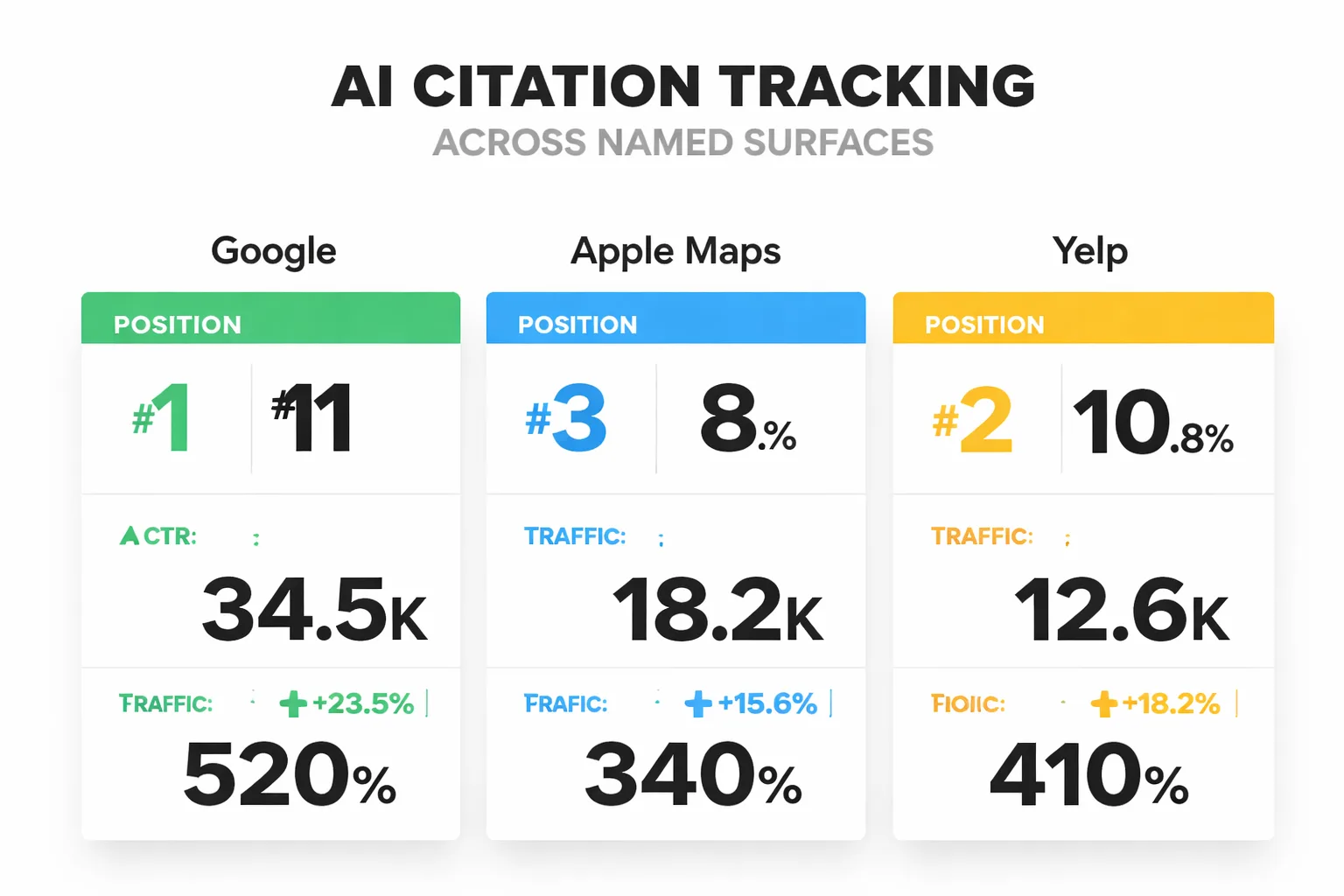
AI citation tracking across named surfaces. This criterion eliminates most traditional platforms immediately. You need visibility into ChatGPT, Claude, Gemini, Perplexity, Grok, Google AI Overviews, and Google AI Mode at minimum. Tracking only Google rankings in 2026 is like tracking only desktop traffic in 2015: technically accurate and strategically incomplete.
Bulk keyword and prompt management. At agency scale, you're managing hundreds of target queries across dozens of clients. Tools that require manual query entry per domain, or that limit prompt volumes in ways that make multi-client tracking impractical, create operational overhead that kills the efficiency gains you're paying for.
Pricing that doesn't punish growth. Calculate the per-client cost at your current client count and at 2x your current count. If the pricing structure creates a margin cliff as you scale, that's a structural problem, not a negotiation point.
Content quality gates, not just content generation. Any tool can generate articles at volume. What separates scalable agency tools from liability generators is whether there's a quality firewall that blocks weak drafts before they reach a client's CMS. This is non-negotiable if you're running content programs for clients.
How Does AI Search Visibility Change Agency Reporting?
AI search visibility changes agency reporting by adding a citation-share metric alongside traditional rank position. And for many commercial queries in 2026, the citation-share number matters more than the rank position because AI Overviews capture user intent before organic results are ever seen.
The mechanics are worth understanding precisely. When a user types a query into Google and an AI Overview appears, that overview is generated from a set of source documents the model chose to cite. The user reads the AI answer, sometimes clicks a cited source, and often doesn't scroll further. If your client isn't in that cited set, they're invisible to that user regardless of their organic rank. Traditional rank tracking doesn't capture this. It reports a position that the user may never see.
Perplexity and ChatGPT operate similarly but with different citation logic. Perplexity runs live web searches and cites sources inline, which means a client appearing in Perplexity answers is getting a form of referral traffic. ChatGPT's browsing mode cites sources when it searches the web; its base model draws on training data with no live citation. Each surface has different mechanics, different refresh cycles, and different levers for optimization. An ai search visibility tool that tracks all of them in one dashboard isn't a luxury for agencies in 2026. It's the minimum viable measurement layer.
The reporting implication is concrete. A client might rank position 4 for a high-value query but appear in zero AI Overviews for that same query, while a competitor at position 8 is cited in the AI Overview for 60% of that query's impressions. The rank tracker shows your client winning. The AI visibility tracker shows them losing. Without both, you're giving clients an incomplete picture and making optimization decisions based on partial data.
What Is an AI Visibility Tracker SEO Tool. And Why Do Agencies Need One?
An AI visibility tracker SEO tool measures how often a brand, product, or domain is mentioned and cited across AI-generated answers on surfaces like ChatGPT, Perplexity, Google AI Overviews, Claude, and Grok. It's the SEO monitoring software equivalent of rank tracking, but for AI answers instead of the ten blue links.
Traditional seo monitoring software tracks keyword positions, crawl errors, backlink changes, and Core Web Vitals. That data is still essential. What it doesn't capture is the growing share of search interactions that never produce a list of blue links at all. When a user asks Perplexity "what's the best project management tool for remote teams?" and Perplexity generates a four-paragraph answer citing three specific products, your client either appears in that answer or they don't. A traditional rank tracker has no visibility into that interaction.
An AI visibility tracker fills that gap by running structured prompts across AI surfaces on a scheduled basis, recording which brands appear, where they appear in the answer (first mention, list item, or closing recommendation), and which sources the AI cited to support its answer. Over time, that data builds a citation share-of-voice metric that agencies can report alongside traditional rankings.
The source-citation layer is particularly valuable for agencies. When an AI engine cites a specific publisher or domain as the basis for a recommendation, that citation pattern is a direct signal about which content sources carry authority with that engine. Meev's cited-source leaderboard surfaces exactly this: for any client's target topics, it shows which domains AI engines cite most frequently. That tells you where to pursue editorial placements to move the needle on AI visibility. A concrete, actionable output that traditional seo monitoring software doesn't produce.
For agencies evaluating whether to add this layer, the threshold question is simple. Can your current stack tell you, right now, whether a named competitor is being cited in ChatGPT for your client's target query? If not, you have a monitoring gap that clients will eventually notice.
How to Optimize for AI Search Engines: GEO Explained
Optimizing for AI search engines. The practice called Generative Engine Optimization, or GEO. Means structuring content so that AI models can extract, attribute, and cite it accurately. The core mechanics differ from traditional SEO, and agencies that conflate them are optimizing for the wrong signals.
Traditional SEO optimization focuses on signals that influence a crawler's ranking algorithm: keyword placement, backlink authority, page speed, schema markup. GEO focuses on signals that influence a generative model's citation decision: factual specificity, source credibility, passage self-containment, and entity clarity.
The practical difference shows up in how content is written. A passage optimized for traditional SEO might read: "Our project management software helps teams collaborate more effectively and complete projects on time." A passage optimized for AI citation reads: "Teams using structured task-assignment workflows complete projects 23% faster than those using unstructured collaboration, according to a 2025 McKinsey analysis of 400 organizations." The second passage is extractable. An AI engine can lift it, attribute it, and cite it without surrounding context. The first passage is not.
Four GEO principles matter most for agency content programs:
1. Write in self-contained claim blocks. Every key assertion should make sense as a standalone sentence. AI engines extract passages, not full articles. 2. Name sources explicitly. "Research shows" is not citable. "A 2025 Stanford HAI report found" is citable. Specificity is the difference. 3. Answer the question in the first sentence. AI Overview extraction heavily favors passages that open with a direct answer before elaborating. This mirrors the FAQ answer format but applies throughout the article body. 4. Build entity clarity. AI engines need to know who or what you're talking about. First use of any product, company, or concept should be fully named and described, not assumed.
One thing worth flagging about the GEO space specifically: there's a lot of vendor noise right now about "dense claim block" optimization and schema-heavy restructuring as the path to AI citation. What actually moves AI visibility is the same thing that moves Google's Helpful Content System. Authentic, specific, user-first content written the way a knowledgeable person actually explains something. Reddit gets cited by major LLMs at roughly 40% frequency. It has zero structured SEO optimization. That's not a coincidence.
For a deeper comparison of how these approaches interact, the AEO vs SEO breakdown is worth reading before structuring client deliverables around either framework.
Best AI SEO Agent Platforms in 2026: What the Category Actually Covers
The "best AI SEO agent platforms 2026" search is generating a lot of vendor content and very little useful signal. Here's an honest map of what the category covers and where the actual capability gaps are.
"AI SEO agent" is being used to describe at least four distinct product types, and conflating them leads to bad purchasing decisions.
Type 1: AI-assisted keyword and content research tools. These use AI to cluster keywords, identify content gaps, and generate content briefs. Examples include Semrush's AI features and Ahrefs' content explorer. Useful. Not agents in any meaningful sense. They don't execute tasks autonomously.
Type 2: AI writing and optimization tools. These generate article drafts optimized for target keywords. SEOWriting.ai falls here. Fast, useful for volume, not built for AI citation tracking or multi-client knowledge base management.
Type 3: AI visibility monitoring platforms. These track brand mentions and citations across AI search surfaces, measure share-of-voice against competitors, and surface which publishers AI engines cite for a given topic. Meev is in this category. The output is measurement and diagnosis, not content generation.
Type 4: End-to-end AI content and visibility platforms. These combine research, drafting, quality scoring, publishing, and citation tracking in one workflow. The distinguishing feature is that content performance connects back to AI visibility outcomes. You can see whether a published article earned citations over time.
For agencies evaluating the best AI SEO agents in 2026, the right question isn't "which platform has the most AI features?" It's "which type of platform closes the specific gap in my current stack?" An agency that already has strong keyword research and backlink tools needs Type 3 or Type 4, not another Type 1 or Type 2 tool.
The platforms worth evaluating in each category:
- AI visibility monitoring: Meev (multi-surface citation tracking, cited-source leaderboard, portfolio-level dashboards), plus a small number of newer entrants that track Google AI Overviews specifically but not the full surface set. - AI writing with SEO optimization: SEOWriting.ai (fast, WordPress-integrated, bulk generation), Jasper (enterprise-focused, brand voice management), and several others. All solve the production problem; none solve the citation measurement problem. - Traditional SEO with AI features layered in: Semrush (AI Overviews indicator, AI-assisted keyword clustering), Ahrefs (content gap analysis, AI-generated briefs). Best-in-class for their core functions; AI features are supplementary, not primary.
No single platform in 2026 is best-in-class across all four types. The agencies building the most effective stacks are combining a traditional SEO platform (for backlinks, keywords, technical audits) with a dedicated AI visibility platform (for citation tracking and GEO optimization). The combination covers the full scope of what clients are now asking about.
The Tools Worth Testing and Why
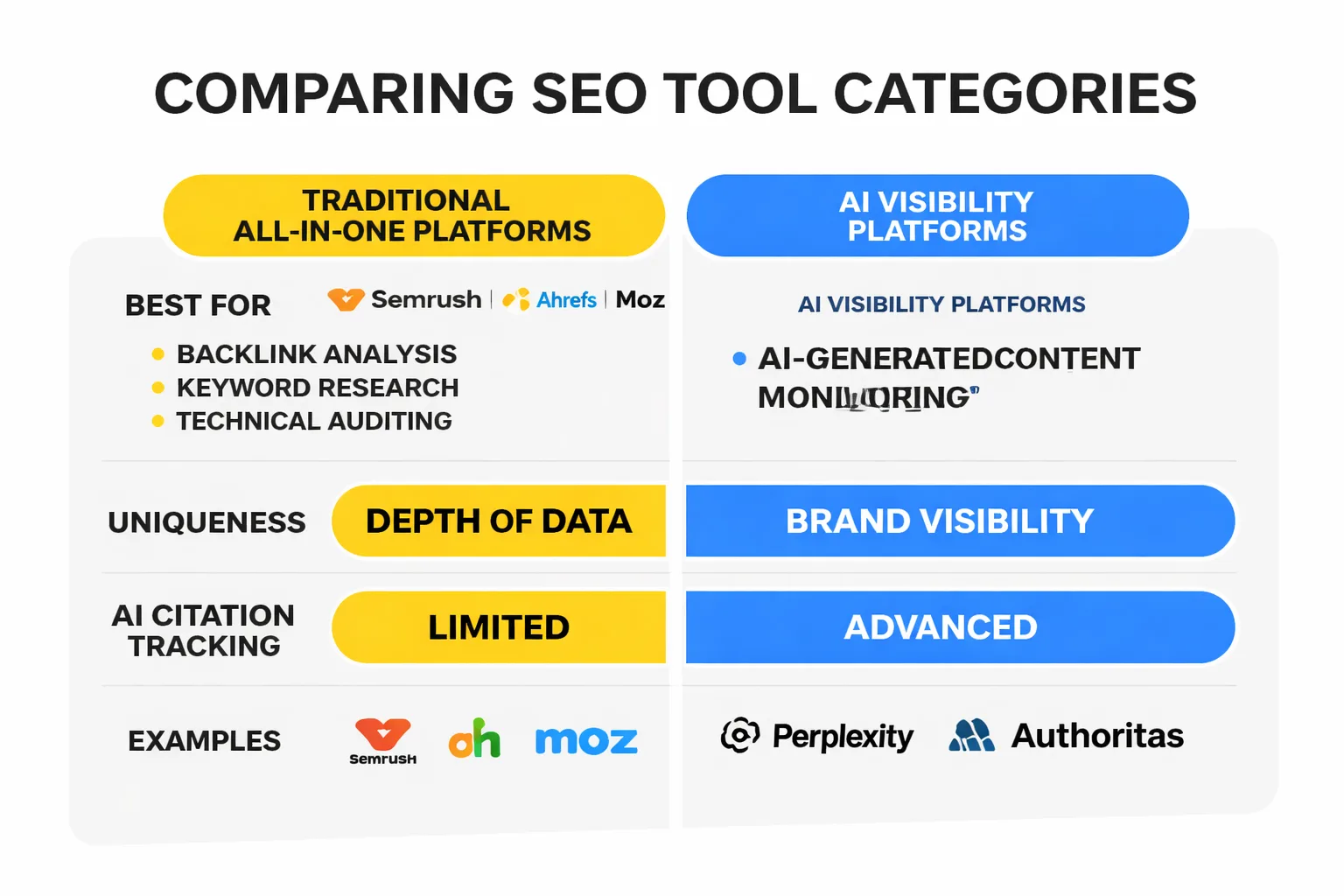
Traditional all-in-one platforms (Semrush, Ahrefs, Moz) remain the best options for backlink analysis, keyword research depth, and technical auditing. Semrush's agency reporting has improved, and Ahrefs' data freshness is genuinely best-in-class for link intelligence. Neither platform has a meaningful AI citation tracking layer as of 2026. Semrush has added an AI Overviews presence indicator for some queries, but it's not the multi-engine citation monitoring that agencies need to answer client questions about Perplexity or ChatGPT visibility. Use these tools for what they're excellent at. Don't expect them to cover the AI visibility gap.
AI visibility platforms are the fastest-growing category in the agency tool market. The core function is tracking where a brand appears in AI-generated answers across multiple engines, measuring mention position (first, in a list, last), and quantifying share-of-voice against competitors. Meev tracks brand mentions across every major AI search surface with daily refresh on SERP-driven surfaces and rolling refresh on LLM-driven surfaces, and includes a cited-source leaderboard that shows which domains AI engines cite most often for a client's topics. That last feature is particularly useful for agencies: it tells you exactly which publishers you need to get clients mentioned on to move the needle in AI answers. The free Perplexity brand visibility checker is worth running for any client in a competitive category before a pitch.
Content quality scorers and AI-powered content platforms have become essential as agencies scale content programs. The risk profile has changed: Google's manual actions for scaled content abuse can be faster and more severe than a gradual ranking decline, and the recovery timeline is genuinely punishing. A quality firewall that scores drafts across multiple dimensions before publication isn't overhead. It's insurance. Meev's 16-dimension Portfolio Quality Metric blocks articles below 70/100 from auto-publishing, which is the kind of hard gate that prevents a single bad batch from creating a client crisis.
It's worth addressing seowriting.ai specifically, since it comes up in agency tool evaluations. SEOWriting.ai is an AI writing tool focused on generating SEO-optimized articles quickly, with WordPress integration and bulk generation features. It's a content generation tool, not an AI visibility platform. It doesn't track whether the content it generates is being cited by AI engines, doesn't monitor brand mentions across ChatGPT or Perplexity, and doesn't include a quality gate that prevents weak drafts from publishing. For agencies evaluating their stack, the distinction matters: seowriting.ai solves the content production problem; it doesn't solve the AI citation measurement problem. You'd still need a separate AI visibility layer to answer the questions clients are actually asking in 2026.
Citation trackers and outreach tools are the newest category and the least mature. The core workflow is: identify which publishers AI engines cite for a client's target topics, find verified contacts at those publishers, and pitch placement. Most agencies are doing this manually or not at all. The Nature Communications study on LLM citation accuracy makes the case for why this matters: AI engines are already making citation decisions based on source signals, and getting clients' content onto the right publishers is a direct lever on AI visibility. Meev's Citation Path feature closes this loop in one workflow: find the publisher, verify the contact, draft the pitch grounded in the client's knowledge base.
Why the SEO Writer Role Is Changing at Agencies
The job description for an seo writer at an agency has shifted more in the last 18 months than in the previous decade. Writing for traditional Google rankings meant understanding keyword intent, matching search intent to content format, and building topical authority through internal linking. That skill set still matters. It's just no longer sufficient.
An seo writer in 2026 also needs to understand how AI engines extract and cite information. That means writing in a way that produces self-contained, quotable claims rather than flowing prose that requires surrounding context to make sense. It means structuring answers so that a 40-word passage can be lifted by an AI Overview without losing its meaning. It means understanding the difference between a passage that ranks well in Google and a passage that gets cited by Perplexity. These are related but distinct skills, and most content briefs written by agencies today don't account for the distinction.
The practical implication for agency content operations is that quality review needs to evaluate two things simultaneously: does this article satisfy the user's search intent in a way Google will reward, and does it contain the kind of specific, attributable, self-contained claims that AI engines prefer to cite? A draft that passes one test and fails the other is only half-optimized. An ai-powered content platform that scores both dimensions before publication is no longer a nice-to-have for agencies running content at volume. It's the difference between content that earns AI visibility and content that earns neither.
How Should Agencies Evaluate SEO Software for Agencies at Scale?
Agencies evaluating seo software for agencies at scale should apply a three-layer test: does the platform handle traditional ranking data, does it measure AI citation share across multiple surfaces, and does it include a quality gate that prevents scaled content from creating penalty risk? A platform that passes two of three is incomplete for 2026 agency work.
The "seo software for agencies" category has expanded significantly in 2026, and the marketing language has expanded faster than the actual capabilities. Several platforms now advertise "AI SEO" features that amount to AI-assisted keyword clustering or AI-generated meta descriptions. Those are useful features. They're not AI visibility measurement. The distinction to press vendors on: can your platform tell me, right now, whether my client's brand appears in a ChatGPT response to their target query, and how that compares to three named competitors? If the answer involves a workaround, a manual process, or a roadmap item, it's not a current capability.
Pricing structure is a genuine differentiator in the seo software for agencies category, not just a procurement detail. The platforms that were built for enterprise clients first and agencies second tend to have per-seat pricing that creates a cost cliff as an agency adds junior team members or client-facing logins. Platforms built for agencies first tend to have domain-based or client-based pricing that scales more predictably. At 30 clients, the difference between per-seat and per-domain pricing can be $800 to $1,200 per month in stack cost. That's a margin conversation worth having before signing an annual contract.
API access matters more than most agencies account for at the evaluation stage. At 10 clients, you can live without it. At 40 clients, not having API access means your team is manually assembling reports that should be automated. The agencies that have built internal dashboards pulling from multiple tool APIs are running reporting workflows that take hours per week instead of hours per client. That operational leverage compounds as the client base grows.
SEO Monitoring Software: The Missing Layer in Most Agency Stacks
SEO monitoring software has been a staple of agency workflows for years. The category covers rank tracking, backlink monitoring, crawl error alerts, Core Web Vitals dashboards, and site health scoring. Every serious agency has at least one tool in this category. The problem is that the definition of "monitoring" has expanded, and most tools haven't kept up.
In 2026, complete seo monitoring software needs to cover three layers simultaneously.
Layer 1: Traditional search monitoring. Keyword rank positions, organic traffic trends, backlink changes, technical crawl errors, page speed regressions. This is table stakes. Semrush, Ahrefs, and Moz all cover it well. Screaming Frog handles deep technical audits. Google Search Console covers the first-party data layer. This layer is solved.
Layer 2: AI citation monitoring. Which queries trigger AI Overviews? Is the client's brand cited in those overviews? Which competitors are being cited when the client isn't? What does the client's mention position look like across ChatGPT, Perplexity, Claude, Gemini, and Grok? This layer is not covered by traditional seo monitoring software. It requires a dedicated AI visibility platform. Most agencies have a gap here and don't know it until a client asks the question directly.
Layer 3: Content performance monitoring. Are published articles earning AI citations over time? Which articles are being cited by AI engines, and which are being ignored? Is content quality stable across a high-volume publishing program, or is there drift that creates penalty risk? This layer connects content output to AI visibility outcomes, which is the feedback loop agencies need to optimize content programs intelligently rather than by volume alone.
The agencies that are winning new business in 2026 on AI visibility are not doing anything exotic. They're running all three monitoring layers and reporting them together. A client dashboard that shows rank position, AI citation share, and content quality score in the same view is a materially stronger deliverable than a rank tracking report alone. The tool stack to build that dashboard exists today. The gap is adoption, not technology.
For agencies evaluating seo monitoring software specifically, the evaluation question to add to the standard checklist is: does this platform have an AI citation monitoring layer, or will I need a separate tool to cover that? If the answer is a separate tool, factor that into the total stack cost before signing. The tools that cover all three layers in one platform are fewer, but they exist, and the operational simplicity of fewer platforms compounds over time.
Building a Lean Agency Stack That Wins AI Search
The goal is coverage without redundancy. Here's how to configure stacks at three different agency sizes.
Small agency (1-10 clients): At this scale, depth over breadth. One all-in-one platform (Ahrefs or Semrush) for keyword research, backlinks, and technical audits. One AI visibility platform that covers citation tracking and content quality. Meev's Pro plan at $269/month covers 5 domains, 3 seats, 80 articles/month, and full AI visibility tracking across major surfaces including premium LLMs. For most small agencies, that's the entire content and AI visibility layer in one tool. The combination of Ahrefs (for link intelligence) plus Meev (for AI visibility and content) runs well under $600/month total and covers the full scope of what clients are now asking about.
Mid-size agency (10-50 clients): At this scale, reporting automation and white-label become critical. You need a platform that can generate client-ready reports without manual assembly. Semrush's Agency Growth Kit adds white-label reporting to their existing keyword and audit data. Layer in an AI visibility platform with portfolio-level dashboards. The AEO vs SEO question becomes a real client conversation at this scale. You need tools that can show clients both their traditional ranking performance and their AI citation share in the same reporting cadence. Meev's Agency plan at $599/month covers 15 domains and 10 seats, which handles most mid-size agency portfolios.
Large agency (50+ clients): At this scale, API access and custom integrations are non-negotiable. You're building internal dashboards, automating report generation, and likely running content programs at volume for multiple clients simultaneously. The stack needs to include: a primary SEO platform with API access (Semrush or Ahrefs), an AI visibility layer with multi-domain management and white-label reporting, a content quality gate that prevents scaled content from creating Google penalty risk, and a citation outreach workflow that can operate across dozens of client knowledge bases simultaneously. The content quality gate is not optional at this scale. The upside of 150 articles per month across 15 client domains is real. The downside of a quality failure at that volume is faster than the upside, and it doesn't negotiate.
For agencies evaluating GEO vs AEO as a strategic framing for clients, the practical answer is that they're not competing approaches. They're complementary layers of the same AI visibility strategy. Traditional SEO handles the ten blue links. AEO handles the AI-generated answers. GEO handles the generative experience within those answers. You need measurement and optimization across all three layers, which is exactly why single-platform tools that cover only one are structurally incomplete for 2026 agency work.
Tracking DeepSeek visibility or Grok citations might have felt optional twelve months ago. In 2026, with AI search surfaces fragmenting and each engine applying different citation logic, not tracking them means you have blind spots in client reporting that competitors will exploit.
The agencies that will win the next three years are not the ones with the most tools. They're the ones who can answer the AI visibility question with data on the first call. A cited-source leaderboard showing which publishers AI engines favor for a client's category, combined with a share-of-voice comparison against three competitors, is worth more in a new business pitch than any rank tracking report. That's the conversation clients want to have, and right now, most agencies can't have it because their stack doesn't support it.
When Should Agencies Add an AI-Powered Content Platform?
Agencies should add an ai-powered content platform when content production volume exceeds what human writers can research and draft without quality drift. Typically around 20 or more articles per month across a client portfolio. Or when clients start asking about AI citation share and the current stack can't answer that question.
The "ai-powered content platform" category covers a wide range of capabilities, and the range matters for agency evaluation. At the low end, it means an AI writing assistant that speeds up drafting. At the high end, it means a platform that researches topics, generates structured briefs, drafts articles, scores quality across multiple dimensions, publishes directly to a CMS, and tracks whether the published content earns AI citations over time. The gap between those two definitions is enormous, and most vendor marketing doesn't help agencies locate themselves on that spectrum.
For agencies specifically, the capabilities that matter most in an ai-powered content platform are: multi-client knowledge base management (so the AI writes in a client's voice and with their specific product knowledge, not generic industry content), a quality scoring layer that operates before publication rather than after, direct CMS integration that removes the manual copy-paste step from the workflow, and citation tracking that connects content performance to AI visibility outcomes. A platform that generates articles but doesn't track whether those articles earn AI citations is optimizing for output, not for the outcomes clients actually care about. The distinction is worth pressing vendors on during evaluation.
The Answer Engine Optimization category specifically has attracted a lot of vendor noise about "dense claim block" optimization and schema-heavy restructuring as the path to AI citation. What actually moves AI visibility is the same thing that moves Google's Helpful Content System: authentic, specific, user-first content written the way a knowledgeable person actually explains something. An ai-powered content platform that enforces this discipline through quality scoring. Rather than just generating volume. Is the version worth paying for.
Frequently Asked Questions
Do traditional SEO tools like Semrush and Ahrefs still matter in 2026?
Yes, and they're still best-in-class for what they were built to do: backlink analysis, keyword research, and technical auditing. The issue isn't that they've gotten worse. It's that the scope of what agencies need to measure has expanded. Neither platform has a mature AI citation tracking layer, which means you'll need a supplementary tool to cover AI search visibility. Think of them as the foundation, not the full stack.
How do I explain AI search visibility to a client who only cares about Google rankings?
Start with the traffic data. According to an Ahrefs panel of roughly 75,000 websites, AI search tools gained minimal traffic share over 10 months while Google's paid search captured 3.2 percentage points. The story is: AI engines are creating brand awareness without sending traffic, which means clients are paying for ads to recapture demand their AI mentions created. Framing AI visibility as a demand-generation channel that requires a paid capture backstop usually lands better than a technical explanation of citation mechanics.
What's the minimum viable AI visibility setup for a small agency?
At minimum, you need a tool that tracks brand mentions across ChatGPT, Perplexity, and Google AI Overviews for each client, and shows you which competitors are being cited when your client isn't. The free Perplexity brand visibility checker is a reasonable starting point for a single-client audit. For ongoing multi-client monitoring, you need a platform with multi-domain support and weekly refresh.
Is content quality scoring really necessary if I'm using good writers?
At low volume, no. At scale, yes. The failure mode in auto-blog or high-volume content pipelines isn't gradual quality drift. It's a discrete event. A single bad batch published at volume can trigger a Google manual action that moves a client from page one to page seven in days. Recovery is slow. A quality gate that blocks drafts below a scoring threshold is the difference between a recoverable mistake and a client relationship-ending event.
How should agencies price AI visibility services for clients?
Most agencies are treating AI visibility monitoring as a line item in their monthly retainer rather than a standalone service. The data argument is straightforward: if a client's competitor is being cited in ChatGPT for the client's target queries, that's a measurable competitive disadvantage with a measurable remediation path. Pricing it as part of a "modern SEO" retainer rather than a separate "AI SEO" add-on tends to reduce client friction while still covering the tool cost.
What's the difference between AEO and GEO for agency reporting purposes?
Answer Engine Optimization focuses on getting content structured so AI engines can extract and cite it accurately. Generative Engine Optimization focuses on the broader experience within AI-generated responses. For agency reporting, the practical distinction is measurement: AEO performance shows up in citation frequency and mention position across AI engines; GEO performance is harder to isolate but shows up in brand share-of-voice within AI answers over time. Most agencies report both under a single "AI visibility" metric to keep client dashboards readable.
How does seowriting.ai compare to a full AI-powered content platform for agencies?
SEOWriting.ai is a content generation tool designed for speed and SEO optimization of individual articles. It's useful for producing drafts quickly. It's not built for multi-client knowledge base management, doesn't track whether published content earns AI citations, and doesn't include a quality gate that prevents weak content from reaching a client's CMS. For agencies managing content programs across multiple clients with AI visibility as a deliverable, a full ai-powered content platform that covers generation, quality scoring, publishing, and citation tracking in one workflow is a materially different product.
What should I look for in seo monitoring software in 2026?
The three-layer test: traditional rank and backlink monitoring (covered by Semrush, Ahrefs, Google Search Console), AI citation monitoring across every major AI search surface (requires a dedicated platform like Meev), and content performance monitoring that connects published articles to AI visibility outcomes over time. Any seo monitoring software that only covers layer one is incomplete for 2026 agency reporting. The evaluation question to ask every vendor is whether they cover AI citation tracking natively or require a separate integration.
About the Author
Judy Zhou, Founder
Judy Zhou leads content strategy at Meev, where she oversees AI-driven content research and publishing for hundreds of brands. With a background in SEO and editorial operations, she focuses on building content systems that rank on Google, get cited by AI search engines, and drive measurable business results.