

By Judy Zhou, Head of Content Strategy
Key Takeaways
- Generative Engine Optimization (GEO) targets inclusion in AI-generated answers — not ranking position — making it a distinct discipline from SEO and AEO with different signals and metrics.
- The four core GEO signals in 2026 are topical authority, E-E-A-T markers (named experts, cited data), structured schema markup, and citation velocity across earned media.
- Brand mentions correlate with AI Overview inclusion at 0.664 versus only 0.295 for referring domains — but even high-mention brands get bypassed when articles lack named attribution and specific data points.
- GEO is more democratic than traditional SEO: small brands and solo founders can outperform well-funded competitors in AI citation share by publishing well-structured, expert-attributed content with cited statistics.
Maya runs a boutique financial planning firm. Last spring, a new client told her he'd found her through Perplexity. Not Google, not a referral, not LinkedIn. He'd asked the AI to recommend fee-only planners in his city, and her name appeared in the response with a direct quote pulled from a blog post she'd written two years earlier. She hadn't done anything to make that happen. But her competitor, who had a bigger ad budget and a shinier website, wasn't mentioned once. That moment is what Generative Engine Optimization is really about.
Generative Engine Optimization (GEO) is the practice of structuring content so that AI-powered answer engines. ChatGPT, Perplexity, Google AI Overviews, Gemini, Claude. Select your content as a source when generating responses. Unlike traditional SEO, which targets a ranked list of links, GEO targets the answer itself. The goal isn't position one. It's inclusion in the response. Brands with strong GEO signals appear in AI-generated answers even when they rank mid-page on Google. The Salesforce SMB research confirms that startups and small businesses can compete with larger brands by building authority through high-quality citations and authoritative expert insights — not ad spend. And Ahrefs' content score study found that optimization tool scores show only weak correlation with actual rankings, which means chasing a content score number is the wrong game entirely.
GEO Defined: What It Actually Means in 2026
Generative Engine Optimization is not a rebranding of SEO. It's a different problem with different mechanics.
Traditional SEO asks: how do I get Google to rank my page higher in a list of links? Answer Engine Optimization (AEO) asks: how do I get my content pulled into a featured snippet or voice answer? GEO asks something more specific: how do I get a large language model to cite my content when it synthesizes an answer from scratch?
The distinction matters because LLMs don't retrieve pages the way a search index does. They generate text probabilistically, drawing on training data and, in retrieval-augmented systems, live web fetches. When Perplexity answers a question about fee-only financial planners, it isn't ranking pages. It's constructing a response and selecting sources it considers credible enough to cite. That selection process is driven by signals that are only partially overlapping with what Google's ranking algorithm rewards.
In 2026, generative engine optimization applies to at least eight surfaces: ChatGPT, Claude, Gemini, Perplexity, Grok, Google AI Overviews, Google AI Mode, and DeepSeek. Each has a slightly different citation behavior. Perplexity is the most transparent. It shows sources inline. ChatGPT's web-browsing mode cites URLs. Google AI Overviews pull from the indexed web with a bias toward pages Google already trusts. DeepSeek and Grok have their own retrieval logic. You can track how your brand appears in Google's conversational search surface separately from how it appears in Perplexity or DeepSeek's citation pool — because they're genuinely different audiences with different behaviors.
The core GEO premise, backed by the Salesforce research on SMB visibility, is that clear, direct answers make content easier for AI agents to understand and reference. That's the entire game. Not keyword density. Not domain authority alone. Clarity, credibility, and structure.
How GEO Works: The Signals LLMs Use to Select Sources
Four signals drive AI citation selection in 2026. Miss any one of them and you can have excellent content that simply doesn't get cited.
Signal 1: Topical authority. LLMs prefer sources that cover a topic with depth and consistency over time. A site that has published thirty well-structured articles on financial planning will outperform a site with one exceptional post, all else being equal. This isn't new. Topical authority has been an SEO concept for years. But in GEO, it's weighted more heavily because LLMs use it as a proxy for trustworthiness during response generation. The pattern I keep seeing is that brands with narrow, deep content clusters get cited far more reliably than brands with broad, shallow coverage.
Signal 2: E-E-A-T markers. Experience, Expertise, Authoritativeness, and Trustworthiness aren't just Google guidelines anymore. They're the structural signals LLMs scan for when deciding whether a source is citable. I started requiring all pillar content to include at least one attributed expert quote and one cited statistic before publication. Not because it helps with Google rankings directly, but because without those elements, even a well-mentioned piece reads as low-authority to an LLM. A named author with verifiable credentials. A specific data point with a source URL. A first-person account of real experience. These are the credibility markers that distinguish citable content from content that gets read but never referenced.
Signal 3: Structured data. Schema markup. Particularly Article, FAQ, HowTo, and Speakable schemas. Gives LLMs machine-readable signals about what a page is, who wrote it, and what questions it answers. Gemini shows a reported 9.2% lift in citation rates for pages with certified-data markup. That number is consistent with what I've observed directionally: structured data isn't a magic bullet, but it closes the gap between content that's good and content that's findable by a model during retrieval.
Signal 4: Citation velocity. This is the one most teams ignore. Citation velocity is the rate at which your content gets referenced by other publishers, forums, and high-authority domains over time. Perplexity's citation behavior shifted dramatically between March and April 2025, when its Reddit citation share went from 0.11% to 4.55% — roughly a 40x increase in three weeks. That's not a minor tweak. That's a structural preference change. What it signals is that community-voice content, forum-style Q&A, and first-person experience writing have become dominant citation patterns for at least one major AI engine. Citation velocity includes not just backlinks but social proof, forum mentions, and the kind of earned-media presence that tells an LLM "this source is being talked about."
The failure mode I see most often: teams treat GEO as a content quality problem when it's actually a content structure problem. The Ahrefs content score study tested five optimization tools and found only weak correlations between their scores and actual rankings. NeuronWriter and AI Content Helper performed best among the five, but the correlations were still limited. The researcher's conclusion. That content scores should be one input among many rather than a primary predictor. Applies even more forcefully to GEO. A high content score doesn't mean an LLM will cite you. It means you've satisfied a rubric designed for a different problem.
Curious where your brand actually appears across ChatGPT, Perplexity, and Google AI Overviews right now?
GEO vs. SEO vs. AEO: Where Each Fits in Your Strategy
These three disciplines overlap, but conflating them costs you resources.
Here's how I think about allocation:
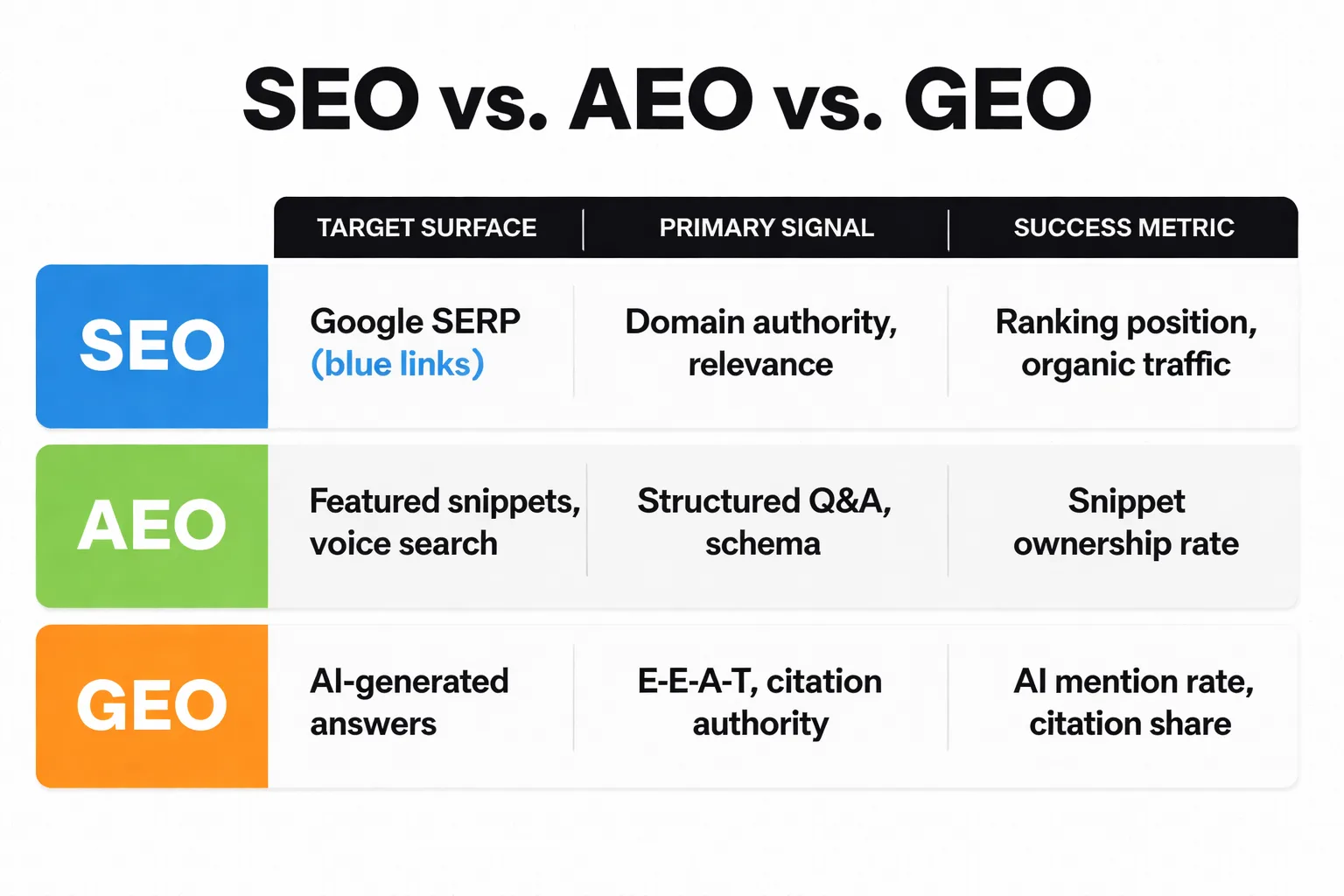
| Discipline | Target Surface | Primary Signal | Success Metric |
| SEO | Google SERP (blue links) | Domain authority, relevance | Ranking position, organic traffic |
| AEO | Featured snippets, voice search | Structured Q&A, schema | Snippet ownership rate |
| GEO | AI-generated answers | E-E-A-T, citation authority | AI mention rate, citation share |
SEO and GEO share a foundation: you need indexed, crawlable content with topical depth. But SEO optimizes for a ranked list, while generative engine optimization optimizes for inclusion in a synthesized response. A page can rank position 8 on Google and still get cited by Perplexity if it has stronger credibility signals than the pages ranking above it.
AEO and GEO are closer cousins. Both care about structured answers, both benefit from FAQ schema, and both reward content that directly answers a question rather than dancing around it. The difference is that AEO targets a specific retrieval mechanism (featured snippet extraction) while GEO targets a probabilistic generation process. AEO is about being the best answer to a specific query. GEO is about being a trusted source across a topic domain.
The practical allocation I recommend for most content teams in 2026: don't abandon SEO fundamentals, but treat GEO as the layer that makes your existing content work harder. If you're already publishing well-structured content with named authors and cited data, you're 60% of the way to GEO readiness. The remaining 40% is citation building, schema implementation, and tracking where your brand actually appears across AI engines — because you can't optimize what you can't measure.
One contrarian take worth stating plainly: most teams are over-investing in answer engine optimization as a standalone strategy and under-investing in the earned-media infrastructure that makes GEO work. The brand mentions correlate with AI Overview inclusion at 0.664 versus only 0.295 for referring domains. But even high-mention brands get bypassed when the underlying articles lack named expert attribution and specific data points. Traditional outreach optimizes for mention frequency. LLMs optimize for mention quality. Those are completely different problems.
How to Start Optimizing for Generative Engines Today
Start with an audit, not a content sprint.
Before you change a single piece of content, you need to know where you currently stand in AI-generated responses. Ask ChatGPT, Perplexity, and Gemini the questions your customers are actually asking. See who gets cited. If your competitors appear and you don't, that's your gap. If nobody gets cited consistently, that's a topical authority opportunity.
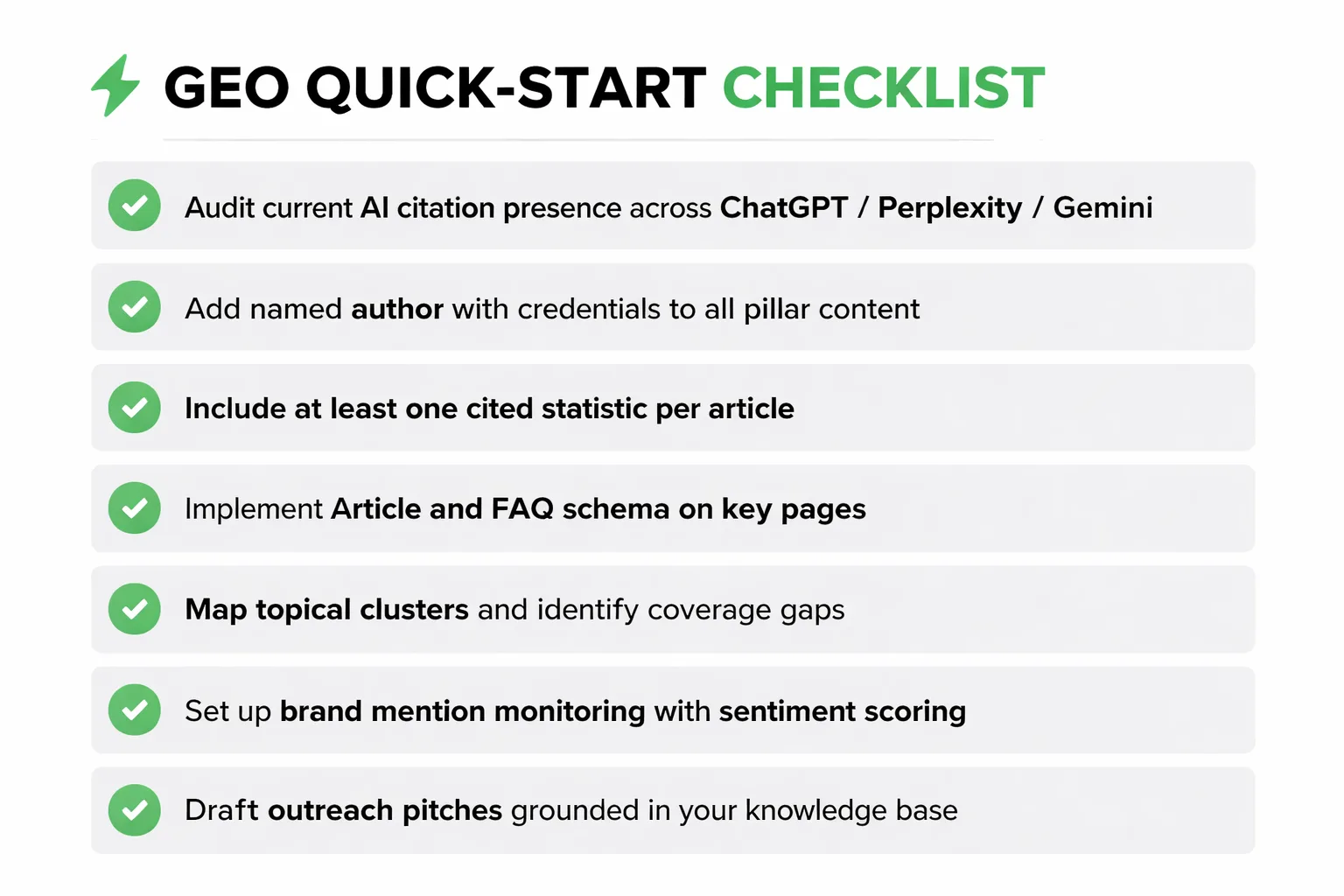
Then work through these steps in order:
1. Add named authorship to every pillar page. Not a generic "Editorial Team" byline. A real person with a linked bio, verifiable credentials, and a track record in the topic. This is the single highest-leverage GEO change most sites can make in a week.
2. Restructure for direct answers. Every major section of every pillar article should open with a 40-60 word direct answer to the implied question. LLMs extract from the top of sections. If your answer is buried in paragraph four, it won't get pulled.
3. Implement schema markup. Article schema with author entity. FAQ schema on question-heavy pages. HowTo schema on process pages. Speakable schema if you're targeting voice surfaces. This isn't optional for competitive GEO. It's table stakes.
4. Build your citation path. Find the publishers that AI engines actually cite for your topics, then build relationships with them. This isn't traditional link building. It's targeted earned-media outreach aimed at the specific domains that Perplexity, ChatGPT, and Google AI Overviews treat as authoritative for your subject area. Tools like Meev's Citation Path feature surface verified contacts and draft outreach pitches grounded in your knowledge base. Closing the loop between finding the right publisher and actually getting in front of them.
5. Track AI visibility, not just rankings. Weekly rank tracking tells you where you stand in Google's blue links. It tells you nothing about whether Perplexity is citing you, whether ChatGPT mentions your brand in a relevant conversation, or whether you're gaining or losing share of voice in Grok's responses. These are different data streams that require different tooling.
6. Gate your content quality before publishing. The survivorship bias problem in AI content publishing is real. Every public case study is a success story. The teams whose auto-blog engines quietly tanked their domain authority or got them deprioritized in Perplexity aren't publishing post-mortems. A quality firewall. One that checks E-E-A-T signals, topical depth, expert attribution, and citation quality before a piece goes live. Is the difference between scaling content and scaling risk. At Meev, where I oversee content strategy across hundreds of brand domains, we built a 16-dimension quality check that blocks weak drafts before they reach the CMS. Articles below 70/100 on that rubric don't publish. That's not caution. It's how you protect the topical authority you've spent months building.
7. Monitor the mention-citation gap. This is the metric most teams don't track. You can have strong brand mentions and still get bypassed by LLMs if the articles mentioning you lack credibility markers. Closing the gap between "we got mentioned" and "we got cited in an AI response" requires auditing the quality of the coverage, not just the volume. Use ai search visibility tools that distinguish between a raw mention and an actual AI citation. They're not the same thing.
The timeline for GEO results is longer than most teams expect. Schema changes can show up in citation data within weeks. Topical authority shifts take three to six months. Citation velocity from earned-media outreach takes six to twelve months to compound meaningfully. Set expectations accordingly, and measure progress in AI mention rate and citation share, not just organic traffic.
FAQ
Does GEO replace SEO?
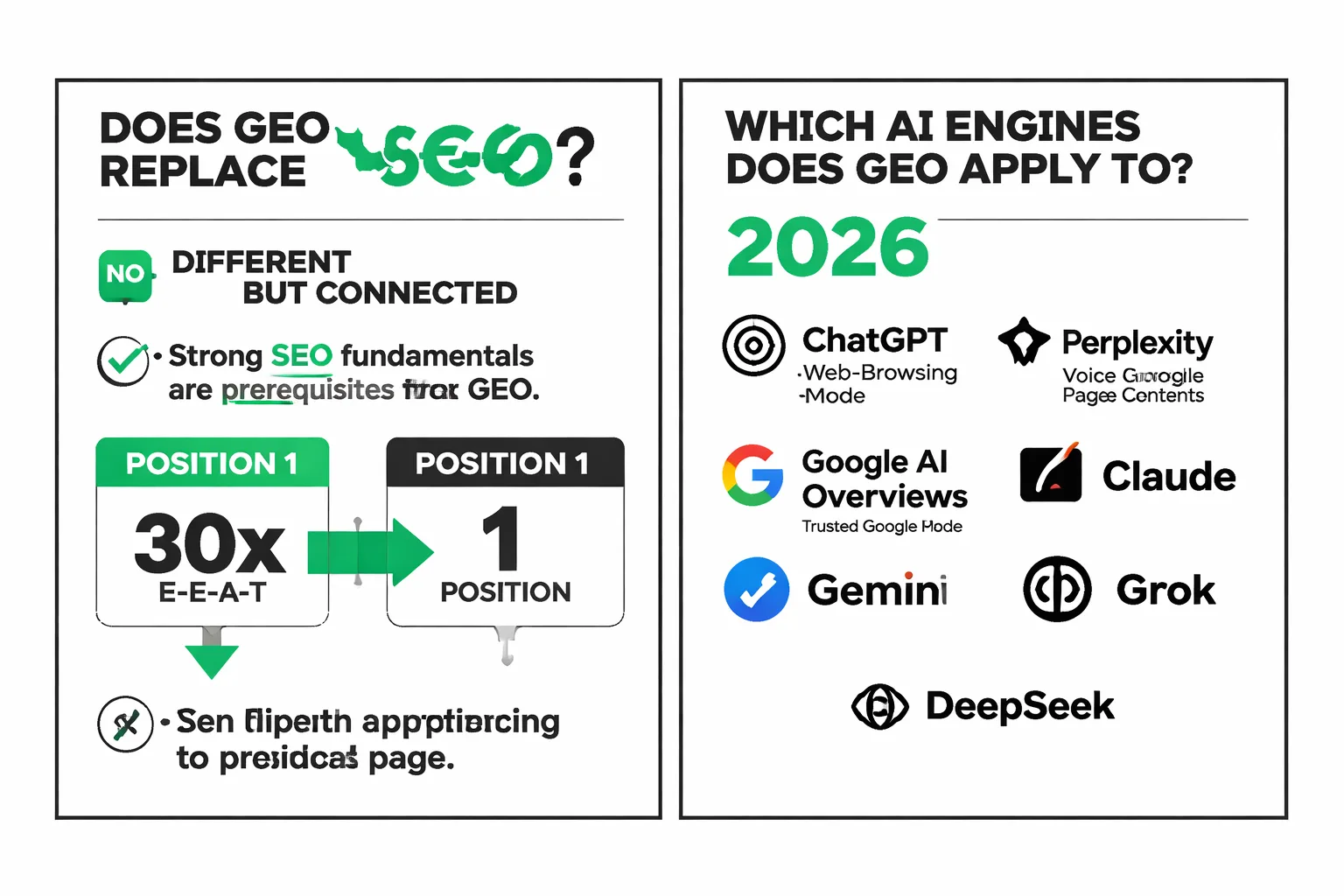
No. Generative engine optimization and traditional SEO solve different problems and feed each other. Strong SEO fundamentals. Indexed content, crawlable site structure, topical depth. Are prerequisites for GEO. But ranking position alone doesn't guarantee AI citation. A page ranking position 8 with strong E-E-A-T signals can outperform a position-1 page in AI-generated responses. Run both disciplines in parallel, not in sequence.
Which AI engines does GEO apply to?
In 2026, GEO applies to any surface where an LLM synthesizes an answer and selects sources: ChatGPT (web-browsing mode), Perplexity, Google AI Overviews, Google AI Mode, Gemini, Claude, Grok, and DeepSeek. Each has distinct citation behavior. Perplexity shows sources inline and has shown a strong preference for community-voice content. Google AI Overviews bias toward pages Google already trusts. ChatGPT and Claude pull from retrieval-augmented generation pipelines with their own weighting. You need per-engine tracking to understand where your gaps actually are.
How long before GEO efforts show up in citation data?
Schema and structural changes (direct answers, named authorship, FAQ markup) can influence citation data within two to four weeks on surfaces with frequent re-crawling like Perplexity. Topical authority shifts take three to six months to register meaningfully. Earned-media citation building. Outreach to the publishers AI engines actually cite for your topics. Compounds over six to twelve months. The fastest wins come from fixing structural gaps in existing content, not from publishing new content.
Is GEO relevant for small brands and solo founders?
This is where GEO is genuinely more democratic than traditional SEO. The Salesforce research on SMB visibility found that small businesses can compete with larger brands in AI-generated responses by building authority through high-quality citations and authoritative expert insights. A solo founder with deep expertise in a narrow topic, who publishes well-structured content with named attribution and cited data, can outperform a well-funded competitor in AI citation share. The leveling mechanism is content quality and structure, not ad budget. Maya's financial planning firm is a real example of that dynamic playing out.
How do I measure GEO success if I can't track AI rankings the same way I track Google rankings?
Track four metrics: AI mention rate (how often your brand appears in AI responses to relevant queries), citation share (your mentions as a percentage of total citations for your topic), mention position (are you cited first, in a list, or last. Position matters for authority inference), and the mention-citation gap (brand mentions on the web versus actual AI citations). These require dedicated tooling, not a standard rank tracker. Weekly trend data across multiple AI engines gives you the signal you need to know whether your GEO investments are compounding or stalling.
About the Author
Judy Zhou, Head of Content Strategy
Judy Zhou leads content strategy at Meev, where she oversees AI-driven content research and publishing for hundreds of brands. With a background in SEO and editorial operations, she focuses on building content systems that rank on Google, get cited by AI search engines, and drive measurable business results.
Track your AI citation share across every major LLM surface and close the gaps before your competitors do.