Comparison
Meev vs Frase
Frase helps you research and write. Meev researches, writes, optimizes, and publishes for you — on autopilot.

Judy Zhou
Founder · Updated April 2026

If you're searching for a Frase alternative, you've probably hit the same wall many content teams reach: Frase is a capable SEO research tool, but it still requires you to initiate every article, review every brief, edit every draft, and manually push content to your blog. The $35/mo AI add-on makes the true cost higher than it first appears, and the workflow stays firmly human-driven.
Meev takes a different approach. It's a fully automated content enginethat handles the entire pipeline — from trending topic discovery and deep research to writing, SEO optimization, image generation, and auto-publishing to your CMS. You set your schedule, define your topics, and Meev does the rest. No add-ons, no manual initiation, no publishing bottleneck.
This guide breaks down how Meev vs Frase compare across pricing, automation, AI search optimization, content workflows, fact verification, and publishing — so you can decide which tool actually fits your workflow.
Quick verdict
Pick Frase if you already have a writing team and want best-in-class SERP briefs plus GEO monitoring to audit how your existing content performs in AI search engines. Frase is a research-first tool that assumes a human is doing the writing.
Pick Meevif you want the entire content pipeline handled for you — research, writing, optimization, images, and publishing — without a human in the loop. Meev is an automation-first engine built for teams that need consistent output without the operational overhead.
What does Frase do?
Frase is an SEO research and content optimization platform. It excels at analyzing search engine results pages (SERPs), generating content briefs based on what's already ranking, and scoring your drafts against top competitors. In 2026, Frase added GEO (Generative Engine Optimization) tracking that monitors your brand's visibility across eight AI platforms.
The core workflow is straightforward: enter a keyword, Frase pulls the top results, creates a brief with recommended headings and topics, and provides an AI writing assistant to help you draft content. You can upload knowledge base documents for context, and Frase scores your article in real time against the competition.
Pricing runs $49 to $129/monthfor the base plans. However, Frase's AI writing capabilities are limited without the Pro AI Add-on at $35/month. The Starter plan ($49/mo) gives you 10 articles per month, while the Professional plan ($129/mo) bumps that to 40 articles. In both cases, the AI writing you get without the add-on is basic — short-form assists, paragraph rewrites, and template fills rather than full-length article generation. This means the effective starting price for meaningful AI content generation is $84/month, not the $49 that appears on the pricing page.
Frase does offer a one-click WordPress publish feature, but it's human-initiated — you still decide when and what to publish. There's no scheduling, no content calendar, and no support for platforms beyond WordPress. Every article requires your direct involvement from start to finish.
What does Meev do differently?
Meev is a hands-free content engine. Where Frase gives you tools and expects you to drive, Meev handles the entire content lifecycle autonomously.
Here's what that looks like in practice: you connect your blog (WordPress, Ghost, Wix, or via webhook), define your target topics and audience, and set a publishing schedule. Meev then automatically discovers high-potential topics in your niche, conducts deep research with fact verification, writes long-form articles optimized for both traditional search and AI engines, generates custom images, embeds relevant YouTube videos, builds internal links, and publishes directly to your CMS on schedule.
No briefs to review. No drafts to edit. No publish button to click. The content goes from idea to live article without manual intervention. You can still review and edit anything through Meev's dashboard — the automation doesn't remove control, it removes the bottleneck.
There are no hidden add-ons. Every plan includes full AI generation, image creation, and publishing capabilities. Pricing starts with a 7-day Starter trial. After the trial, services pause until you subscribe — your account and data stay open. Paid plans begin at $99/month for 30 articles, scaling up to $599/month for 150 articles on the Agency plan.
Content workflow: step by step
The difference between Frase and Meev becomes clearest when you trace a single article from idea to published post.
With Frase, you start by entering a target keyword. Frase analyzes the top-ranking pages and generates a content brief with suggested headings, questions to answer, and topic coverage scores. You then open the AI editor, draft your article section by section (using the AI assistant if you have the $35/mo add-on), and manually check your content score against competitors. Once you're satisfied, you click the WordPress publish button or copy-paste into your CMS. Total human time per article: 45 minutes to 2 hours, depending on the topic complexity and how much editing the AI draft needs.
With Meev, the process is different. You set up your domain once: connect your CMS, define your niche and audience, set a publishing frequency, and optionally upload knowledge base documents. From that point forward, Meev handles every step automatically. It identifies high-potential topics, conducts multi-source research, writes the full article with proper structure and citations, generates custom images, builds internal links to your existing content, and publishes on schedule. Total human time per article: zero, unless you choose to review it.
For a team publishing 80 articles per month on Meev's Pro plan, that's roughly 30–60 hours of human time saved compared to an equivalent Frase workflow. At roughly $50/hour for a content manager (based on Glassdoor median salary data), the operational savings alone exceed the cost of the tool.
How does pricing really compare?
Pricing is where the Meev vs Frase comparison gets interesting. At first glance, Frase's $49/month Starter plan looks competitive. But dig deeper and the picture changes.
Frase's Starter plan includes 10 articles per month at $49/mo. The Professional plan offers 40 articles at $129/mo. If you want the AI to actually write full articles rather than just assist — which most content teams need — you add the $35/month Pro AI Add-on. That brings your effective cost to $84/month minimum. The Professional plan plus the add-on hits $164/month.
What makes this particularly painful is how the costs compound over time. Content marketing is a long game — according to Search Engine Land, most pages take 3–6 months to reach Google's first page. That means you are paying $84+/month for half a year before your content starts generating meaningful organic traffic.
12-month cost comparison
Frase totals include the $35/mo AI writing add-on. Meev prices include all features — no add-ons exist.
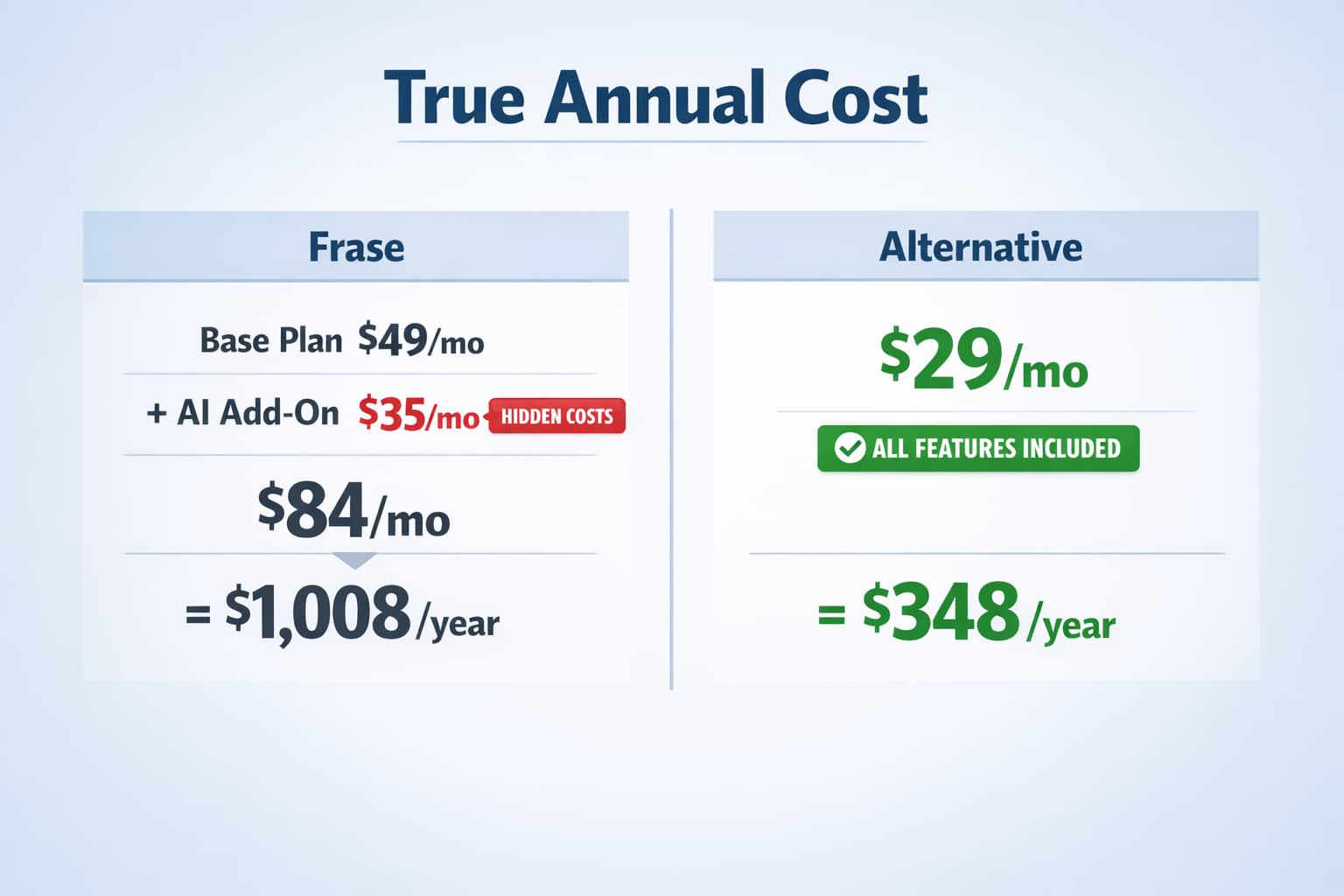
During that ramp-up period, you are also spending your own time initiating every article, reviewing briefs, editing drafts, and manually publishing. With Frase, you are paying a premium not just in dollars but in hours. With Meev, you pay one transparent price ($99/mo and up), the pipeline runs itself, and every hour you would have spent in Frase is freed for other work.
Meev's pricing is fully transparent. Every signup starts with a 7-day free trial (30 articles, auto-publishing, core AI surfaces tracked). Paid plans start at $99/month for Starter and go up to $599/month for 150 articles on the Agency tier. Every plan includes AI generation, image creation, fact verification, and multi-platform publishing. No add-ons, no per-article charges, no surprises.
Meev
Free / $99–$599/mo
Everything included. No add-ons.
Frase
$49–$129/mo
+ $35/mo AI add-on (effective $84+/mo)
GEO and AEO: which tool optimizes for AI search better?
This is one of Frase's strongest areas. Their 2026 GEO update introduced a GEO score that tracks how your content appears across eight AI platforms, including ChatGPT, Perplexity, Google AI Overviews, Gemini, Copilot, Claude, Meta AI, and You.com. It's a useful monitoring tool that shows you where AI engines are citing — or ignoring — your content.
However, Frase's GEO capability is primarily diagnostic. It tells you how you're performing after you've published. The workflow looks like this: you publish an article, wait for AI platforms to index it, check your GEO scores, identify gaps, manually rewrite sections to improve coverage, republish, and check again. Each optimization cycle takes days or weeks because AI platforms don't re-index instantly.
Meev takes a proactive approach. AEO (Answer Engine Optimization) and GEO signals are built into every article at generation time. This means each article is structured with clear question-and-answer patterns that AI engines extract for featured responses, authoritative sourcing with inline citations that AI crawlers can verify, concise definitions and structured data that map to knowledge graphs, and the semantic markup that AI search engines look for. Instead of scoring content after the fact, Meev ensures every piece is optimized for AI discovery from the moment it's written.
The practical difference matters. With Frase, you publish first and optimize later — a reactive cycle that can stretch over weeks per article. With Meev, every article ships pre-optimized for both traditional search engines and AI-powered answer engines. There's no second pass needed because the optimization happens during generation, not after. For a deeper look at how AEO changes content strategy, see our guide on how AEO vs SEO actually changes content strategy.
The trade-off is clear: Frase gives you better monitoring of existing content across AI platforms. Meev gives you better optimizationat the point of creation. If you already have hundreds of published articles and want to track their AI visibility, Frase's GEO dashboard is valuable. If you're producing new content and want it optimized from day one, Meev handles that automatically.
Does Frase verify facts?
No. Frase generates content using AI models, but it does not independently verify the claims, statistics, or data points in the articles it produces. Like most AI writing assistants, the content may contain fabricated statistics, outdated information, or unsourced claims. The responsibility for fact-checking falls entirely on you.
Meev includes built-in fact verificationas part of its content pipeline. Every factual claim is cross-referenced against authoritative sources, and source links are embedded directly in the article. This means readers — and search engines — can trace claims back to their origins, which builds trust and improves E-E-A-T signals.
For businesses publishing content at scale, fact verification isn't optional. A single inaccurate statistic can damage credibility, and manually fact-checking AI-generated content defeats the purpose of using AI in the first place. Frase leaves this responsibility to your team; Meev handles it before the article ever reaches your blog. Fact verification also pairs with technical SEO audit steps that most guides overlook.
Can Frase run your blog on autopilot?
No. Frase is designed as an assistant, not an automation engine. Every article requires human initiation: you enter a keyword, review the brief, generate or write the draft, edit it, and then manually publish. There's no content calendar, no scheduling system, and no way to set up recurring article generation.
Frase's 2026 “AI Wizard” streamlined the workflow into fewer steps, but the fundamental model hasn't changed — a human must be present at the keyboard for every piece of content. For a solo blogger producing two articles a week, this is manageable. For a business running multiple blogs or managing content across several domains, it becomes a bottleneck.
Meev was built for autopilot from day one. Set your topics, define your publishing schedule, connect your CMS, and walk away. Articles are researched, written, optimized, illustrated, and published automatically. You receive notifications when new content goes live, and you can review or edit anything through the dashboard — but you don't have to.
This distinction matters most at scale. On Meev's Agency plan, you can publish up to 150 articles per month across 15 domains with zero manual effort. Achieving equivalent output with Frase would require a dedicated content team working full-time.
Publishing and multi-domain support
Frase supports one-click publishing to WordPress, but that's where its publishing capabilities end. If you run a Ghost blog or a custom CMS, you're copying and pasting. There's no multi-domain management — managing three sites means running three separate workflows.
Meev supports auto-publishing to WordPress, Ghost, Wix, and any platform with webhook support. Each domain gets its own schedule, topic configuration, and brand voice settings. On the Pro plan, you can manage up to 5 domains from a single dashboard. The Agency plan supports 15 domains, making Meev a natural fit for marketing agencies managing client portfolios.
Feature comparison
When should you choose Frase?
Frase is a strong tool in specific scenarios. It makes sense when:
- •You want detailed SERP research briefsto guide a human writing team. Frase's content briefs pull data from the top 20 SERP results, giving you a clear picture of what competitors cover.
- •You need GEO monitoringacross multiple AI platforms. Frase's tracking dashboard shows your visibility on ChatGPT, Perplexity, Gemini, and five other engines — useful for auditing existing content.
- •Your team prefers a writing assistant over full automation. Some content managers want AI suggestions while maintaining hands-on editorial control over every paragraph.
- •You have a large library of existing contentthat needs optimization. Frase's scoring and brief tools can help you systematically improve what you've already published.
If any of these describe your workflow, Frase is worth evaluating. But if you want content that publishes itself — researched, verified, optimized, and live without your involvement — Meev is built for that.
What real users say
User sentiment on third-party review sites paints a consistent picture. On G2, Frase reviewers frequently praise the SERP analysis and content brief features as useful for understanding what competitors cover. The most common complaints center on the AI writing quality feeling generic without heavy editing, the add-on pricing structure catching users off guard, and the lack of direct publishing options beyond WordPress.
On Trustpilot, Frase reviews tend to be more polarized. Satisfied users highlight the research workflow as a time-saver, while negative reviews often mention billing confusion around the AI add-on and difficulty canceling subscriptions. Several reviewers note that Frase works best as a research companion rather than a standalone writing tool.
Meev is newer to market and has fewer reviews, but early feedback highlights the hands-free automation and transparent pricing as differentiators. Users who switched from research-focused tools like Frase report spending less time per article because the manual steps are eliminated entirely.
Frequently asked questions
Is Meev a good alternative to Frase IO?
Yes. If you want a fully automated blog engine that researches, writes, optimizes, and publishes without manual intervention, Meev replaces the need for Frase entirely. Meev handles SERP research, AEO/GEO optimization, fact verification, and auto-publishing in one workflow — no add-ons required.
Does Meev have a GEO score like Frase?
Meev takes a different approach. Instead of scoring content after you write it, Meev builds AI search optimization (AEO and GEO) directly into every article during generation. Every piece of content is structured from the start to perform well in AI-powered search engines like ChatGPT, Perplexity, and Google AI Overviews.
Can I switch from Frase to Meev easily?
Yes. Sign up for Meev’s 7-day Starter trial, connect your blog, set your topics and schedule, and Meev starts producing optimized articles automatically. There’s no content migration required — Meev generates fresh, fact-verified articles from day one. After the trial, services pause until you subscribe — your account stays open and your data stays readable.
Does Meev support SERP research like Frase?
Meev includes SERP analysis as part of its automated research pipeline. Every article benefits from competitive analysis, trending topic discovery, and search intent matching — all without you having to manually review SERP data or create briefs.
Why is Meev cheaper than Frase when you factor in the AI add-on?
Frase’s base plans ($49–$129/mo) don’t include unlimited AI generation — that requires a separate $35/mo add-on, making the effective cost $84+/mo. Meev includes everything in one transparent price starting at $99/mo, with a 7-day free trial to test before you commit.
Does Meev support multi-domain publishing?
Yes. Meev’s Pro plan supports up to 5 domains, and the Agency plan covers 15 domains. Frase has no multi-domain management — each site requires a separate workflow and manual publishing.
How does Meev handle content quality at scale?
Every article passes through a multi-stage quality pipeline that includes deep research, fact verification against authoritative sources, SEO optimization, and readability scoring. The pipeline catches inaccuracies, thin content, and off-topic drift before anything reaches your blog.
Ready to automate your blog?
7-day free trial. No add-ons.