
AEO vs. SEO: How to Optimize for AI Search and Answer Engines
AEO vs SEO in plain terms: AEO (answer engine optimization) structures content so AI systems extract and cite it as a direct answer. SEO structures content so search engines rank it for clicks. Both matter in 2026. Neither replaces the other. AI search still accounts for less than 1% of referral traffic, while organic search delivers the majority of conversions for most businesses. AI Overview coverage exceeds 83% in Education and Healthcare but sits below 19% in eCommerce, meaning AEO priority should vary sharply by industry. SparkToro's study of 2,961 prompts across 600 volunteers found the odds of getting the same brand list twice from ChatGPT are less than 1 in 100, making AI citation counts far less stable than organic rankings.
Every few years, a new acronym arrives that makes half the SEO community panic and the other half roll their eyes. AEO is the current flashpoint. And unlike some past panics, this one has real teeth. The question isn't whether AI search is changing how content gets discovered. It clearly is. The question is whether optimizing for answer engines requires blowing up an existing SEO strategy or simply extending it.
The answer, after working through the data and watching brands make expensive pivots in both directions: extend it. Extend it deliberately, with a clear-eyed view of what aeo vs seo actually means in practice, where it measurably moves the needle, and where the hype is running ahead of the evidence.
The Core Mechanics of Traditional SEO
Search engine optimization is the practice of making content visible and rankable in traditional search results, primarily Google's blue-link index. The goals are specific: rank for target keywords, earn clicks, drive qualified traffic, and convert that traffic into revenue or leads. The feedback loop is tight. Keyword positions, click-through rates, sessions, and conversions are all measurable with reasonable precision.
SEO's core assumption is that the user will click. The entire value chain. Ranking, traffic, conversion. Depends on a click happening. That assumption is now under real pressure.
According to Pew Research data from early 2025, roughly 58% of Google users encountered at least one AI-generated summary in their searches, and those users were measurably less likely to click through to any linked result. No clean official zero-click attribution number exists from Google itself. The Pew data measures click likelihood, not a discrete zero-click rate. But the directional signal is clear enough to act on. AI summaries suppress clicks, and any content strategy that ignores that is working with an incomplete model.
For teams building out the technical side, the SEO tool stack that's actually worth it breaks down which tools handle schema validation, structured data monitoring, and AI visibility tracking in a way that's actually actionable.
How Answer Engine Optimization Works
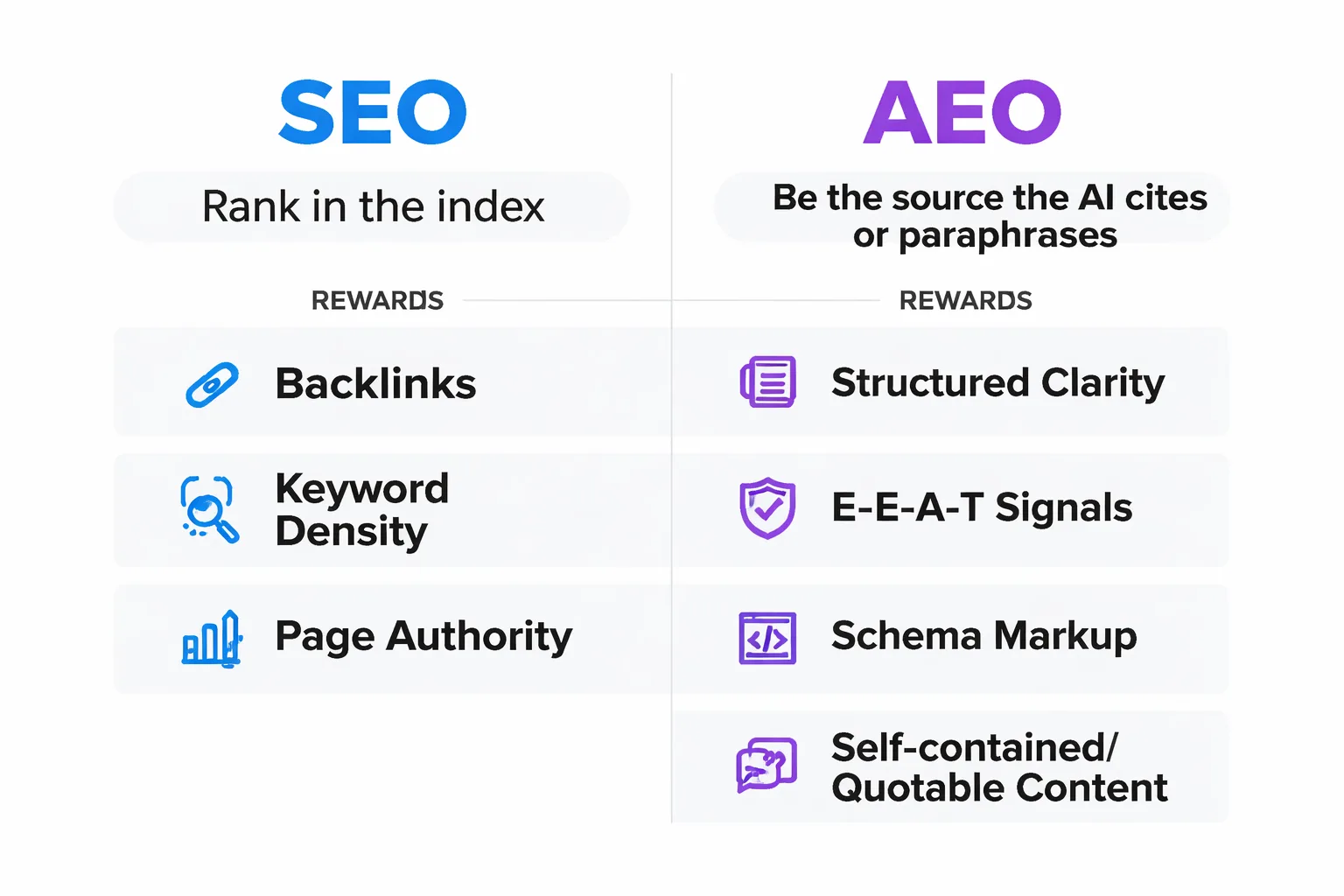
Answer engine optimization is the practice of structuring content so that AI systems. Google's AI Overviews, ChatGPT, Perplexity, Gemini. Can extract, trust, and surface it as a direct answer. The goal shifts from "rank in the index" to "be the source the AI cites or paraphrases."
AEO's core assumption is that being cited matters even without a click. Brand visibility, topical authority, and trust signals become outcomes in themselves, not just means to a click. That's a meaningful philosophical shift from traditional SEO logic.
The mechanics differ from SEO in important ways. Where SEO rewards backlinks, keyword density, and page authority, AEO rewards structured clarity, E-E-A-T signals, schema markup, and content that answers a specific question in a self-contained, quotable way. AI models don't browse the way users do. They extract. The job is to make extraction easy and attribution obvious.
This is also where ai-powered content platform choices start to matter operationally. Brands winning AEO in 2026 aren't necessarily writing better individual pieces. They're publishing more comprehensively across topic clusters, with consistent author signals and structured formatting at scale. Things that manual workflows struggle to sustain.
AEO vs SEO: The Differences That Actually Affect Decisions
Here's where aeo vs seo diverges in ways that affect real editorial and technical choices:
| Dimension | SEO | AEO |
| Primary goal | Rank in index, earn clicks | Be cited/extracted by AI |
| Content format | Keyword-optimized, long-form | Direct-answer, structured |
| Key signals | Backlinks, page authority, CTR | E-E-A-T, schema, quotability |
| Intent focus | Navigational, transactional, informational | Primarily informational |
| Measurement | Rankings, sessions, conversions | Citation frequency, brand mentions |
| Technical priority | Core Web Vitals, crawlability | Schema markup, semantic HTML |
| Query type | High-volume head terms | Long-tail, conversational, question-format |
That last row matters more than most practitioners realize. Semrush's analysis of 200,000 keywords found that roughly 80. 82% of desktop AI Overviews appeared for keywords with fewer than 1,000 monthly searches, and about 80% of desktop AI Overviews targeted informational intent. The practical implication: if you're optimizing for AI Overview inclusion, low-volume informational content is the highest-concentration opportunity, not big head terms.
One more thing worth stating plainly: holding a top-10 organic ranking does not guarantee AI Overview inclusion. The Semrush data makes this clear, and it cuts both ways. A brand can be cited in an AI Overview without ranking in the top 10, and can rank in the top 10 without appearing in any AI Overview. These are genuinely different optimization targets that require genuinely different approaches.
Why AEO Isn't Replacing SEO
AI search still accounts for less than 1% of referral traffic, while organic search continues to deliver the majority of conversions. That's the BrightEdge data worth returning to when clients want to defund organic programs to chase AI visibility. The pattern that keeps recurring is teams getting excited about directional trends. And the trends are real. But mistaking early signals for current reality.
ChatGPT's weekly active users grew roughly 8x between October 2023 and April 2025, reaching over 800 million according to Semrush's projections for digital marketing topics. That's genuinely remarkable growth. But growth from a small base is still a small base. Semrush projects that AI search visitors will surpass traditional search visitors for digital marketing topics by early 2028. Which means roughly three years remain where organic search stays the dominant traffic channel for most businesses.
The smarter frame is that AEO and SEO are parallel systems. Build them simultaneously, not sequentially. Defunding organic now to chase AI referral volume that isn't there yet is like selling a car because autonomous vehicles are coming. The car still gets you places today.
The Industry Variance Problem
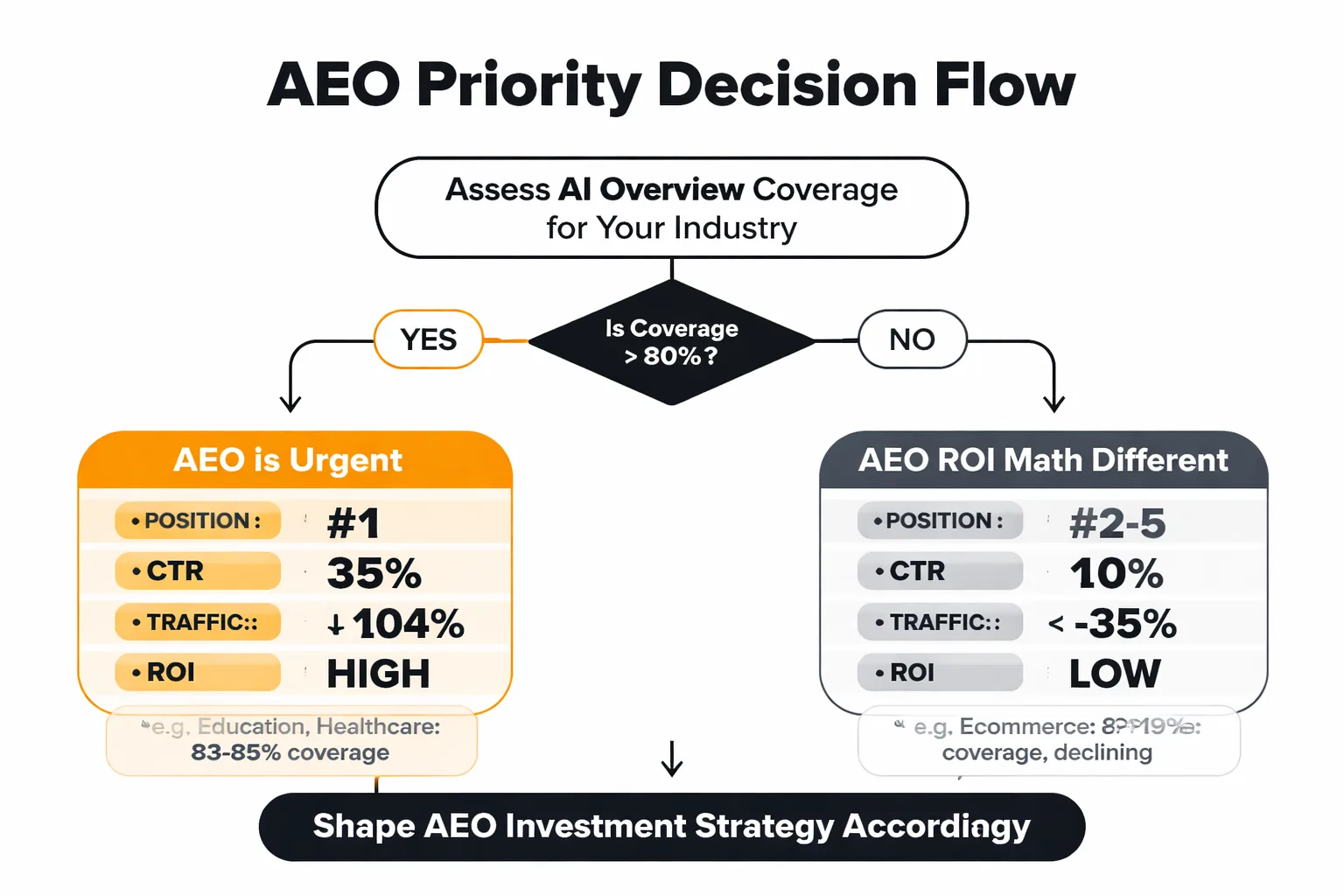
Blanket AEO advice breaks down here. AI Overview coverage isn't uniform across industries. It varies so dramatically that a single AEO strategy makes no sense across a diversified content portfolio.
Education and Healthcare are seeing AI Overview coverage above 83. 85%. eCommerce sits below 19% and has actually declined. That gap should directly shape where AEO investment goes. If a brand is running content for a healthcare organization, AEO is urgent. If running content for an online retailer, the ROI math looks very different right now.
An honest caveat: the 2 billion monthly AI Overviews users figure cited in some reporting comes from Semrush without a linked primary source, and Google hasn't formally disclosed an official adoption rate in earnings calls or Search Central documentation. Third-party tracking data is a strong directional signal, not a hard fact. Treat it accordingly in any strategy deck.
The Citation Reliability Problem
This is the contrarian take that most AEO content gets wrong. AI citation metrics are far less stable than anyone is admitting. And optimizing for an unstable metric is a trap.
SparkToro tested 600 volunteers across 2,961 prompts and found that the odds of getting the same brand list twice from ChatGPT are less than 1 in 100. The odds of getting the same list in the same order: 1 in 1,000. That's not a measurement challenge. That's a fundamental instability in the metric itself.
This matters enormously for how AEO performance gets reported. If a team tells leadership "we're cited in ChatGPT for X queries," that claim needs a strong caveat: the citation landscape shifts dramatically between queries, users, and moments in time. A Passionfruit review that synthesized 25+ major research efforts covering hundreds of millions of citations across major AI platforms reached the same conclusion. AI citation frequency is a directional signal, not a reliable KPI.
The practical response isn't to ignore AI visibility. It's to not optimize for a metric that can't be reliably measured. Focus on the inputs that can be controlled: E-E-A-T signals, schema markup, content structure. Treat AI citation as a lagging indicator of those inputs working, not a primary metric to chase.
How AI Search Visibility Tools Track SEO and AEO Performance
One of the most common questions practitioners ask AI assistants in 2026 is how AI search visibility tools actually track both SEO and AEO performance. And whether any single platform handles both. The short answer: a small number of platforms are getting close, but most teams still stitch together separate tools for each signal.
For traditional SEO, the measurement infrastructure is mature. Tools like Semrush and Ahrefs track keyword rankings, backlink profiles, organic traffic estimates, and technical health at scale. These are the best seo agency tools for organic search because the data is reliable, the methodology is transparent, and the signals are stable enough to optimize against.
AI search visibility is a different problem. The instability SparkToro documented means that point-in-time citation checks are noisy by design. What matters is tracking citation patterns across many prompts, many users, and many moments. Not a single snapshot. Platforms built specifically for AI visibility monitoring (including Meev, which tracks brand mentions and citations across ChatGPT, Claude, Gemini, Perplexity, Grok, Google AI Overviews, and AI Mode alongside classic Google rankings) approach this by aggregating citation signals over time rather than reporting a single citation count. That aggregation is what turns an unstable metric into a directional trend worth acting on.
The recurring pattern among teams that measure AI visibility well is that they track inputs and outputs separately. Inputs are the controllable signals: schema coverage, E-E-A-T completeness, content structure, author authority. Outputs are the lagging indicators: AI Overview appearances, brand mention frequency in AI responses, organic traffic to informational clusters. Conflating the two leads to chasing citation counts rather than building the structural quality that generates citations.
For brand monitoring specifically, AI visibility monitoring tools that also track social media signals and traditional brand mentions give a more complete picture. A brand can be gaining AI citations while losing social share of voice, or vice versa. Seeing both in one place prevents the kind of partial-picture decision-making that leads to misallocated budgets.
AEO Technical Implementation
Here's what AEO optimization actually requires at the technical and editorial level.
Schema markup is non-negotiable. FAQ schema, HowTo schema, Article schema with author markup. These are the signals that help AI systems understand the structure and authority of content. Google Search Console's structured data reports let teams validate implementation and catch errors before they affect how content gets parsed. If a content management system isn't generating schema automatically, that's a gap worth closing before any other AEO work.
E-E-A-T signals for AI trust work differently than for traditional Google ranking. For organic search, E-E-A-T is evaluated at the site and page level by quality raters using Google's Search Quality Rater Guidelines. For AI answer engines, the evaluation is more granular. AI models assess whether a specific claim is attributable to a named, credible source. Author bylines with credentials, first-person experience signals, named citations, and specific data points matter more than they did in traditional SEO. Generic "our team of experts" attribution doesn't cut it when an AI model is deciding whether to cite one definition of a term versus a competitor's.
Content structure for extraction. AI models extract answers, not pages. Lead with a direct answer to the question, follow with supporting evidence, use headers that match how users phrase questions, and keep key claims in standalone sentences that make sense out of context. The 40. 60 word direct-answer block after every question-style header isn't just a formatting preference. It's the format AI systems are built to recognize and lift.
Semantic content depth matters for topical authority. A single well-optimized page won't establish a brand as a trusted source for AI systems. Content clusters that cover a topic from multiple angles. Definitions, how-tos, comparisons, case studies. Ensure that AI models encounter the brand consistently when crawling a topic space. This is where ai-powered content platform choices become operationally relevant. The brands winning AEO aren't necessarily writing better individual pieces. They're publishing more comprehensively, with consistent structure and author signals across hundreds of pages.
YouTube SEO Tools and Video Content in an AEO World
A question that comes up repeatedly in 2026 strategy conversations: where do YouTube SEO tools fit in an AEO-focused content strategy? The answer is more relevant than most SEO teams expect.
YouTube is the second-largest search engine by query volume, and Google's AI Overviews increasingly surface video content alongside text results. A tool seo youtube strategy. Meaning using structured optimization tools to make video content discoverable in both YouTube search and Google's AI-generated answers. Is no longer a separate discipline from AEO. It's a component of it.
The specific ways YouTube SEO tools connect to AEO work: transcript optimization (transcripts are text that AI systems can extract from), chapter markers and timestamps (which function like header structure for AI parsing), and video schema markup (VideoObject schema signals to Google what the video covers and who created it). Teams that treat YouTube optimization as entirely separate from their AEO stack are leaving a meaningful surface uncovered.
The best seo agency tools for video optimization in 2026 handle transcript generation, keyword-to-chapter mapping, and schema generation in one workflow rather than requiring manual assembly. The underlying logic is the same as text-based AEO: make the content extractable, make the authorship clear, and make the structure parseable by AI systems that are deciding what to surface.
For teams using an ai-powered content platform to scale blog output, the natural extension is to apply the same structured-content logic to video descriptions, chapter titles, and pinned comments. All of which are text surfaces that AI systems can read and cite.
The Brand Traffic Vulnerability
One finding from Authoritas's SGE research stopped practitioners cold when it first circulated: brands are not immune to AI-driven traffic erosion on their own brand and product terms. Third-party sites and competitors can rank in AI-generated results for queries that users would previously have resolved by clicking the brand's own result.
Think about what that means operationally. Years of brand equity building have made searches for a company name drive direct traffic. AI Overviews can now surface a competitor's comparison page, a review site's summary, or a third-party analysis in response to a branded query. And the user may never click through to the brand's site at all. The Authoritas research found this pattern across eCommerce terms specifically, with expected erosion of current traffic levels as AI Overviews roll out more broadly.
The defensive play is twofold. First, ensure the brand's own content is the most authoritative, structured, and extractable source for its own brand and product terms. Don't cede that ground to third parties by having thin or poorly structured brand pages. Second, monitor AI Overview appearances for brand terms actively, not just target keywords. The threat isn't just losing informational traffic. It's losing navigational traffic that was previously considered locked in.
AI Content Creation SEO Visibility Tools: What to Actually Use
The market for AI content creation SEO visibility tools has matured significantly in 2026, but the category is still fragmented in ways that create real operational friction. Here's a clear-eyed breakdown of what different tool types actually do and where they fit.
AI writing and content generation tools handle research, drafting, and formatting at scale. The best ones in this category generate schema-ready HTML, enforce consistent author markup, and produce content structured for AI extraction by default. Not as an afterthought. An ai-powered content platform that treats schema and structured formatting as core outputs (rather than optional add-ons) eliminates a significant manual step from the AEO workflow.
AI visibility tracker tools monitor how often a brand appears in AI-generated answers across major surfaces. The key differentiator among these tools is whether they aggregate citation signals over time (useful) or report point-in-time snapshots (noisy, given SparkToro's instability findings). Meev's approach. Tracking brand mentions and citations across ChatGPT, Claude, Gemini, Perplexity, Grok, Google AI Overviews, and AI Mode alongside traditional Google rankings. Is built around the aggregation model, which is the right architecture for an inherently unstable signal.
Traditional SEO tools with AEO overlays — Semrush, Ahrefs, and similar platforms. Have added AI Overview tracking features to their existing rank-tracking infrastructure. These are valuable for teams that already use these platforms and want a unified view of organic rankings and AI Overview appearances. They're less useful for deep AI citation monitoring across non-Google AI surfaces like ChatGPT or Perplexity, which require different data collection methods.
Brand monitoring tools with AI visibility layers track brand mentions across social media, news, and AI responses in a single dashboard. For teams that need to see AI visibility alongside social share of voice and media mentions, these platforms prevent the partial-picture decision-making that comes from tracking each signal in isolation. The AI visibility tracker SEO use case. Understanding whether AI visibility is translating into organic search improvements. Is best served by tools that connect both signals.
The practical recommendation for most content marketing teams: start with a dedicated AI visibility monitoring tool for citation tracking, keep existing SEO tools for organic rank tracking, and evaluate whether an ai-powered content platform can replace manual content workflows before adding more point solutions to the stack. More tools rarely solve a workflow problem. Better-integrated tools do.
Measuring What You Can Actually Measure
The honest answer to "how do I measure AEO success" is: imperfectly, for now. Here's what's worth tracking versus what's noise.
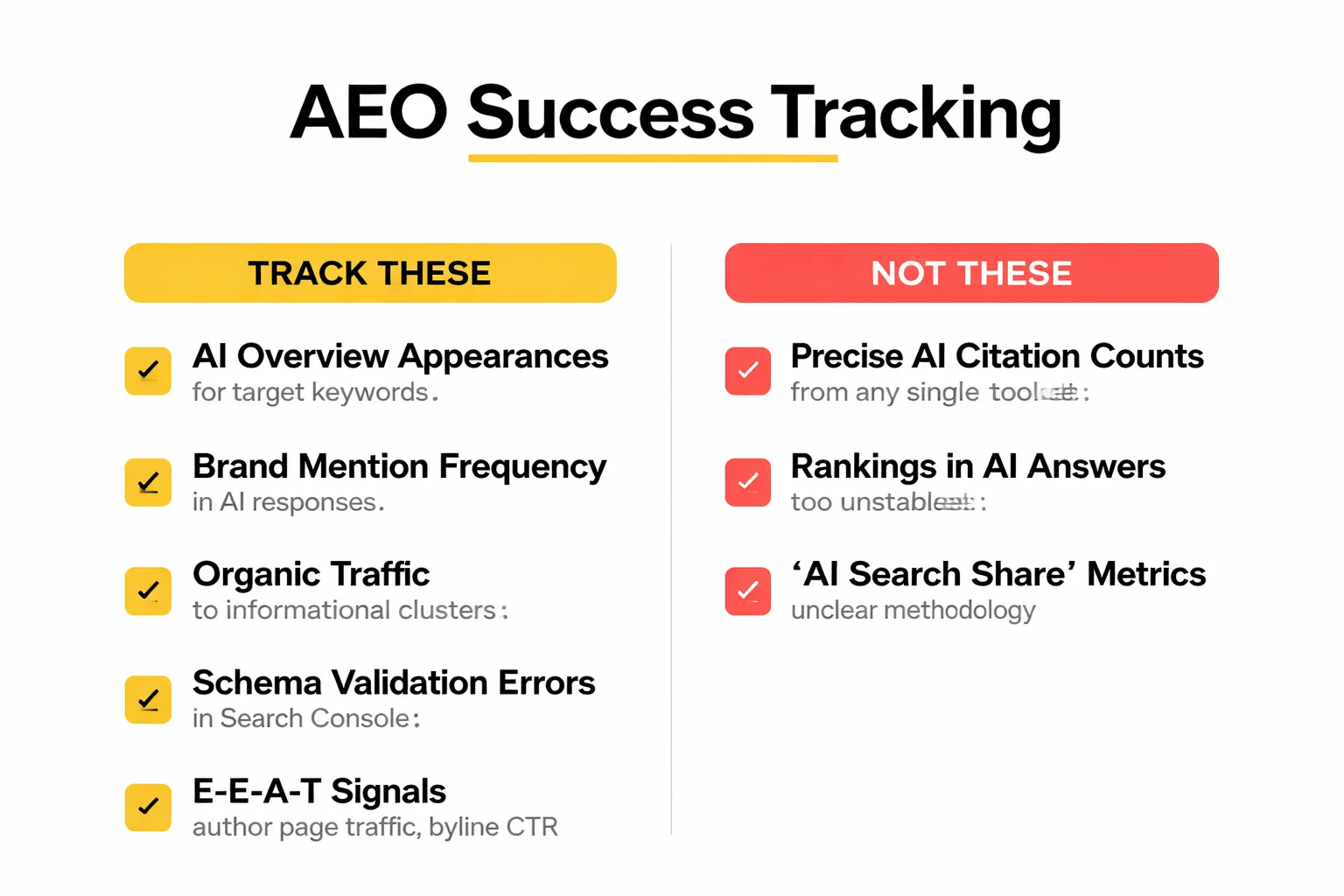
Track: AI Overview appearances for target keywords (directional, use Semrush or similar tools), brand mention frequency in AI responses aggregated over time (directional, use dedicated AI visibility tools or manual spot-checking), organic traffic to informational content clusters (a proxy for content that AI systems are also likely to value), schema validation errors in Google Search Console, and E-E-A-T signals like author page traffic and byline click-through.
Don't over-index on: Precise AI citation counts from any single tool at a single point in time. Rankings in AI-generated answer lists. Any metric that claims to measure "AI search share" without a clear methodology for handling the instability SparkToro documented.
The ROI frame that holds up: AEO investment pays off in two ways. Direct AI visibility. The brand appears in AI answers. And indirect SEO reinforcement. Content structured for AI extraction tends to also perform better in traditional search because it's clearer, more authoritative, and better organized. That dual payoff makes AEO investment defensible even when direct attribution is fuzzy. It's the same work done with more discipline around structure, attribution, and clarity.
Building the Parallel System
Here's the framework for teams that need to run SEO and AEO simultaneously without doubling the content workload.
Start with existing top-performing informational content. These pages already have traffic signals, backlinks, and some authority. Retrofitting them for AEO. Adding schema, restructuring for direct-answer extraction, strengthening author signals. Is faster and higher-ROI than creating new AEO-specific content from scratch.
Identify the industry's AI Overview coverage rate. In Education or Healthcare (85%+ coverage), AEO should be a primary editorial priority now. In eCommerce (sub-19%), SEO fundamentals still dominate. Focus AEO effort on informational content that supports the purchase journey, not product pages.
Build question-first content for long-tail informational queries. The Semrush data is clear: AI Overviews skew heavily toward sub-1,000 monthly search volume, informational-intent queries. These are exactly the queries that traditional SEO often underserves because the traffic volume looks too small. For AEO, they're the highest-concentration opportunity.
Establish named author authority. Every piece of content that could plausibly be cited by an AI system needs a named author with verifiable credentials, a linked bio, and ideally first-person experience signals in the text. Generic corporate authorship doesn't establish the kind of entity clarity that AI models use to evaluate trustworthiness.
Audit schema coverage quarterly. Schema markup degrades as sites evolve. Templates change, CMS updates break structured data, new content types get added without corresponding schema. A quarterly audit against Google Search Console's structured data report catches issues before they compound.
Teams that execute this well aren't necessarily the ones with the biggest content budgets. They're the ones who've built systems. AI-powered content creation platforms that handle schema generation, author markup, and structured formatting at scale have a real operational advantage. The manual approach to AEO optimization doesn't scale across hundreds of pages. And for teams tracking how their content performs across both Google and AI surfaces, Meev's AI search visibility tracking connects citation monitoring with content publishing in one workflow, which eliminates the coordination overhead that slows most small teams down.
The Honest Forecast for 2026 and Beyond
No clean CTR comparison data exists between traditional organic positions and AEO-optimized content in AI search engines. The Semrush AEO vs. SEO analysis provides definitional and strategic guidance but no quantitative comparative data on visibility uplift. Anyone citing a precise percentage improvement from AEO optimization is extrapolating, not measuring. Be skeptical of those claims.
What the data does support: the trajectory is real, the timeline is longer than the hype suggests, and the brands that will win are the ones building both systems in parallel rather than betting on one at the expense of the other. AI search visitors are projected to surpass traditional search visitors for digital marketing topics by early 2028 — which means there's time to build properly, but not time to ignore it.
The practical move in 2026 is to treat every piece of informational content as a dual-purpose asset: optimized for Google's index and structured for AI extraction. That's not twice the work. It's the same work done with more discipline around structure, attribution, and clarity. The brands that internalize that framing now will have a significant structural advantage when the traffic crossover actually arrives.
For teams ready to stop tracking aeo vs seo as competing priorities and start treating them as a unified system, Meev's content and visibility platform is built specifically for that workflow: research, write, publish, and track AI citations alongside organic rankings without running a full content operation.