

The average content team is paying for 6. 8 SEO tools and extracting unique, non-duplicated insight from maybe 3 of them. That's not a tool problem. It's a stack discipline problem. And it's costing teams $800–$2,000/month for capabilities they already own in a cheaper subscription.
The search engine optimization tool landscape in 2026 has a specific failure mode: teams add tools reactively (after a conference, after a competitor audit, after a new hire insists on their old stack) and never subtract. The result is overlapping coverage in rank tracking, site auditing, keyword research, and content optimization. The four categories where every major platform has built features, and where most teams end up paying for the same deliverable twice.
A lean four-tool core covers 90% of what content-first operations actually need, at $283–$323/month. AI-native tools are now replacing legacy software for specific workflows: keyword clustering, AEO content structuring, and tracking brand mentions inside AI models like ChatGPT and Perplexity. And the 30-minute stack audit framework below has eliminated an average of $600–$740/month in redundant subscriptions for every team that's run it.
The fix isn't finding better tools. It's forcing every tool to justify its seat with a unique deliverable it owns exclusively.
Why Most SEO Tool Stacks Are Bloated and Redundant
Here's the overlap pattern that appears constantly across audited stacks. A team runs Semrush for keyword research and rank tracking. They also run Ahrefs because someone trusts its backlink index more. They added Screaming Frog for technical crawls, but they're also running Semrush's site audit. They brought in Clearscope or Surfer for content optimization, but Semrush's Writing Assistant is already sitting unused in the same subscription. That's four tools doing the work of two. And the billing reflects all four.
The four categories where overlap kills ROI are predictable: rank tracking, site auditing, keyword research, and content optimization. Every major platform. Semrush, Ahrefs, Moz. Has built features across all four. Most teams pick one platform for its strongest feature, then add a second platform for a different strength, and end up with full redundancy across the other three. The calculating-SEO-ROI problem compounds this. According to the CMO Survey, 65% of marketers can't quantitatively demonstrate the impact of their marketing. Which means most teams can't tell you whether their $600/month Ahrefs subscription is generating more pipeline than a $99/month alternative would. If you can't measure the tool's contribution to revenue, you can't justify the cost.
The problem compounds further in 2026 because the category has expanded. There are now dedicated ai seo tool products, AI visibility trackers, AEO platforms, and AI humanizer add-ons sitting on top of legacy stacks that were already redundant. Teams are adding new subscriptions without auditing the old ones. The bloat is structural, not accidental.
The Minimum Viable Search Engine Optimization Tool Stack
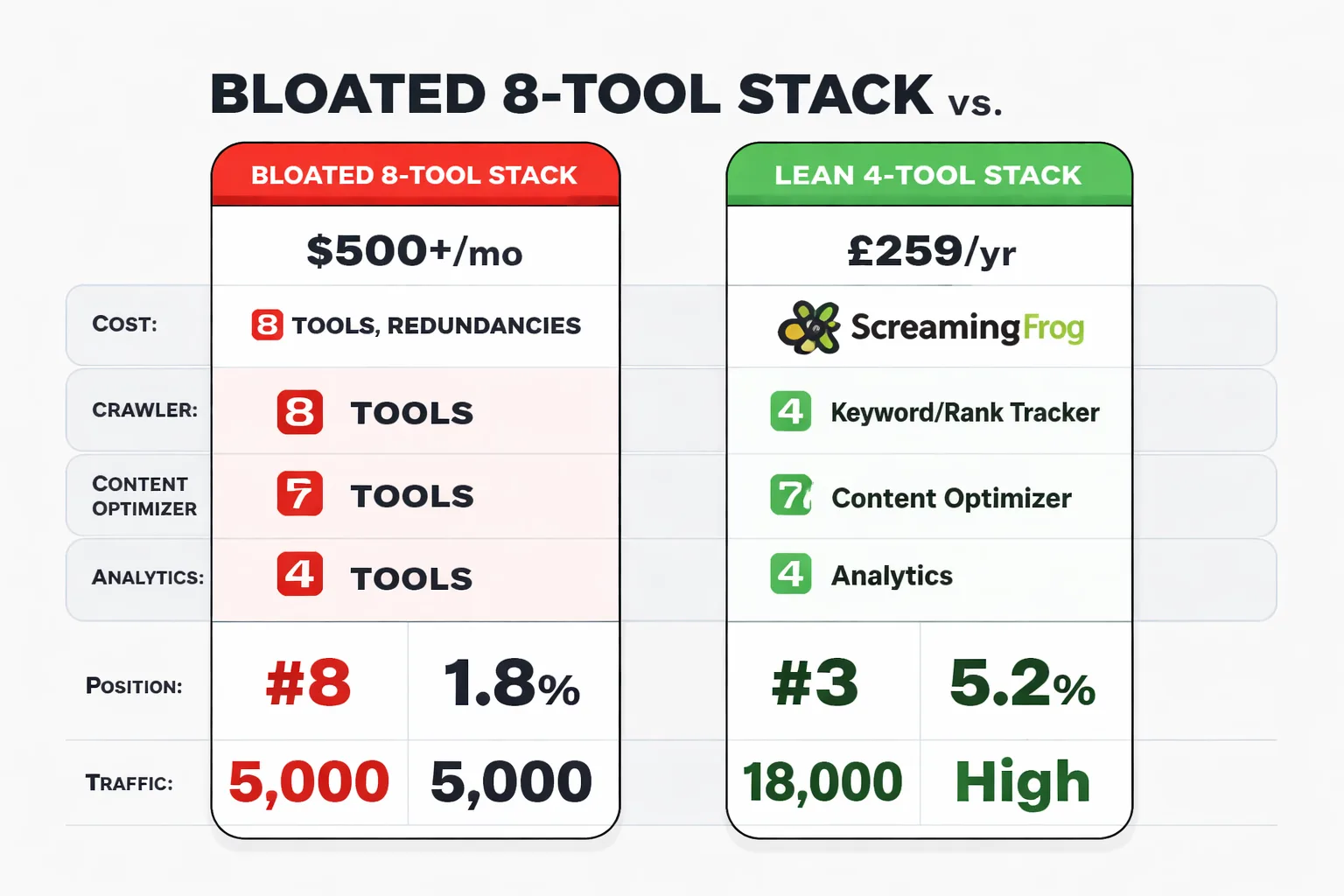
A content-first operation. One where the primary growth lever is organic search driven by editorial output. Needs exactly four tool categories. Not eight. Four. Here's how to build it from scratch in 2026:
Layer 1. Crawler: Screaming Frog (free up to 500 URLs, £259/year for unlimited) Nothing in this price range touches Screaming Frog for technical SEO. It surfaces crawl errors, redirect chains, duplicate content, missing meta tags, and structured data issues faster than any cloud-based alternative. The trade-off: it's desktop software, not a shared dashboard. For most content-first operations, that's a non-issue. Crawls happen monthly, not daily. Export reports to a shared drive and move on.
Layer 2. Keyword Research + Rank Tracking: Semrush Pro ($139/month) OR Ahrefs Lite ($99/month) Semrush wins on keyword database breadth and topic clustering. Ahrefs wins on backlink index accuracy. For content-first teams that care more about finding topical gaps than obsessing over link metrics, Semrush's keyword clustering and topic research tools are more immediately useful. For teams doing active link building, Ahrefs' link data is worth the premium. Pick one. Do not run both. If you want a deeper breakdown of how domain authority scores differ between the two, this comparison of Moz vs Ahrefs domain authority is worth reading before you commit.
Layer 3. Content Optimizer: Frase ($45/month) or NeuronWriter This is the layer most teams skip or overbuy. Frase earns its seat by combining SERP research, content briefing, and optimization scoring in one workflow. Keyword to publishable brief in under 20 minutes. The AI writing output is mediocre; use it for structure and NLP scoring, not draft generation. If your team is already using a dedicated AI writing tool, Frase's brief-building alone justifies the cost.
Layer 4. Analytics: Google Search Console (free) + GA4 (free) Most teams underuse what they already have here. Google Search Console's Query report. Filtered by CTR under 2%, sorted by impressions descending. Gives you a prioritized list of optimization targets that most $300/month rank trackers can't match for actionability. GA4's content grouping, when set up correctly, lets you track content ROI at the cluster level, not just the page level. The tool isn't the problem. The setup is.
Total cost for this stack: $283–$323/month. Everything else is overhead until you've maxed out what these four layers can tell you.
Where AI-Native Tools Are Replacing Legacy Software
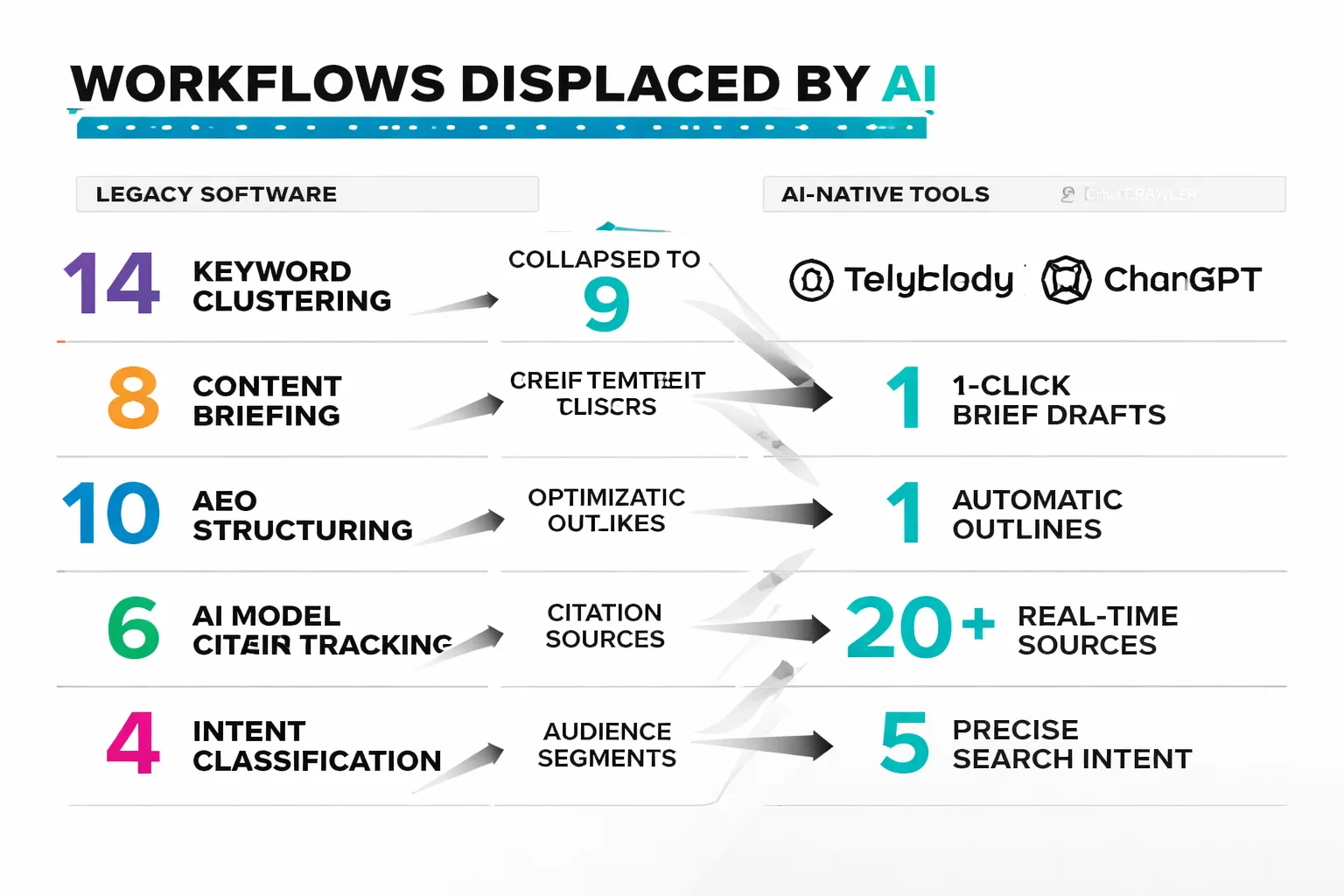
The shift happening in 2026 isn't that AI tools are replacing Semrush or Ahrefs wholesale. It's more surgical. AI-native tools are taking over specific workflows where legacy platforms were always mediocre.
Keyword clustering is the clearest example. Running a 200-keyword seed list through Semrush's keyword grouping tool versus a manual intent-classification pass using an AI workflow consistently reveals the same gap: Semrush produces more clusters, but the AI intent pass collapses several into fewer, more defensible groups and flags cannibalization risks. Keywords that look topically related but serve different user intents. If a team builds content around all of Semrush's clusters without that intent pass, they create internal competition before they ever compete externally. That's the core limitation of volume-based clustering: it groups by semantic similarity, not by what the searcher is actually trying to accomplish.
The other workflow where AI-native tools are winning is Answer Engine Optimization (AEO) content structuring. As AI chatbot content creation becomes a primary discovery channel. With ChatGPT, Perplexity, and Google's AI Overviews now synthesizing answers rather than just ranking pages. The structural requirements for content have changed. Legacy content optimization tools score against top-10 SERP competitors. They don't tell you whether your content is structured to be extracted and cited by an LLM. The signals that matter for AI extraction are different: direct answer paragraphs, structured data markup, named entity density, and topical completeness over keyword density.
For teams building toward topical authority with AI content, this matters enormously. A content cluster optimized for traditional rank tracking but ignoring AEO structuring is leaving citation traffic on the table. And that traffic doesn't show up in your rank tracker at all.
The honest caveat: AI-native tools for SEO are still maturing. The volume data for primary keyword research isn't there yet in pure AI workflows. But for intent classification, content structuring, and tracking how your content performs inside AI models rather than just on traditional SERPs, the AI-native layer is no longer optional. It's the gap in every legacy stack audited in 2026.
How Does Web Indexing Change with AI Search in 2026?
Web indexing has always been the foundation of search visibility. Googlebot crawls, indexes, and ranks. That model still applies. But in 2026, there's a second indexing layer that most search engine optimization tool stacks aren't measuring at all.
AI search surfaces (ChatGPT's web browsing, Perplexity's real-time retrieval, Google's AI Overviews) have their own crawling and retrieval behaviors. Perplexity uses its own crawler (PerplexityBot) alongside licensed data. Google's AI Overviews draw from the existing index but weight content differently than the standard ranking algorithm. Favoring structured, answer-dense pages over pages optimized purely for keyword density. ChatGPT's browsing feature pulls live web content via Bing's index for many queries.
The practical implication: a page can rank on page two of Google and still get cited frequently in AI Overviews if it's structured correctly. Conversely, a page ranking position one for a query may never appear in an AI-generated answer if it lacks direct answer paragraphs, proper schema markup, or named entity clarity. Traditional rank trackers measure one layer of indexing. AI visibility trackers measure the second. Most stacks in 2026 are still only measuring the first.
One pattern worth flagging: the rise of selective AI crawler blocking as a signal. Teams are starting to block AI crawlers (Google-Extended, PerplexityBot, GPTBot) from scraping their content while simultaneously trying to appear in AI-generated answers. A direct conflict. If your robots.txt blocks Google-Extended, your content won't appear in AI Overviews. Decide on a position and configure accordingly.
AI Search Visibility Tools. What They Track and Why It Matters
The question "do AI search visibility tools track SEO" comes up constantly in 2026 because the category is new and the terminology is inconsistent. Here's a clear answer.
Traditional SEO tools track: keyword rankings on Google/Bing, backlink profiles, technical crawl health, and on-page optimization scores. They measure visibility on classic search engine results pages.
AI search visibility tools track something different: how often a brand, product, or piece of content is mentioned, cited, or recommended when users ask questions to AI assistants. The surfaces being tracked include ChatGPT, Claude, Gemini, Perplexity, Grok, Google AI Overviews, and AI Mode. The metric isn't a keyword ranking. It's citation frequency and answer inclusion rate across AI-generated responses.
These are complementary, not competing, measurement systems. A brand can have strong Google rankings and zero AI citation presence, or strong AI citation presence driven by earned media and structured content while rankings are mediocre. In 2026, the teams winning organic and AI-driven traffic are measuring both.
Meev tracks brand mentions and citations across every major AI search surface alongside classic Google rankings, then identifies the content gaps and structural issues preventing AI citation. It's built specifically for small teams that want AI search visibility without running a full content operation. The platform automatically researches, writes, and publishes SEO and AEO-optimized articles based on what the visibility data shows is missing. If your current stack has no answer for "how often does ChatGPT recommend us," that's the gap Meev fills. You can explore how AI visibility tracking works in detail, or see how Meev compares to traditional SEO platforms for teams making the transition.
Do You Actually Need AI SEO Services?
The "ai seo services" category in 2026 covers a wide range of things: agencies that use AI tools to deliver SEO work, platforms that automate content production and optimization, and hybrid models where AI handles research and structure while humans handle strategy and editing.
The honest answer is that most small-to-mid teams don't need a full-service AI SEO agency. They need a tighter stack with an AI-native layer added to their existing workflow. The distinction matters because agency retainers for AI SEO services run $2,000–$8,000/month. Significantly more than the $283–$323/month lean stack described above, and often with less visibility into what's actually being done.
Where AI SEO services do earn their cost: teams with no internal SEO capacity, brands launching into new markets quickly, and operations where content volume requirements exceed what an internal team can produce without quality degradation. In those cases, a platform that combines AI content production with SEO and AEO optimization. And tracks results across both Google and AI surfaces. Is more efficient than hiring an agency that uses the same tools you could license directly.
The question to ask any AI SEO service provider: "What does your reporting cover. Classic Google rankings, AI citation frequency, or both?" If the answer is only Google rankings, you're buying a 2023 service at 2026 prices.
What the Surfer SEO AI Humanizer and Content Detector Actually Do
Two specific tools come up frequently in stack conversations in 2026: the Surfer SEO AI humanizer and the Surfer SEO AI content detector. Both deserve a direct explanation because they're often misunderstood.
Surfer SEO's AI humanizer is a post-generation editing tool designed to rewrite AI-generated content to reduce detectable AI patterns. Sentence uniformity, overused transitional phrases, hedging language. That content detectors flag. The use case is teams generating content at scale with AI writing tools who want to reduce detection risk before publishing.
The Surfer SEO AI content detector is the companion tool: it scans content and scores the likelihood that it was AI-generated, using pattern recognition across sentence structure, vocabulary distribution, and phrasing consistency.
Here's the contrarian take most people won't say plainly: optimizing for AI content detectors is the wrong problem to solve. Google's own public guidance (confirmed in their spam policies documentation) states that the issue isn't whether content was AI-generated. It's whether the content is helpful, accurate, and demonstrates expertise. An AI humanizer that makes mediocre content harder to detect doesn't make it more useful to readers or more likely to rank. The teams winning with AI content in 2026 are the ones editing for quality and accuracy, not the ones running humanizer passes to fool detectors.
If your content strategy depends on making AI content undetectable rather than making it genuinely good, the tool stack isn't the problem. The content strategy is.
That said, for teams publishing at high volume where human editing time is limited, Surfer's humanizer does catch the most egregious AI writing patterns. The stacked transitional phrases, the uniform paragraph lengths, the hedged conclusions. Used as a quality-pass tool rather than a detection-evasion tool, it has legitimate utility. Just don't mistake it for a substitute for editorial judgment.
How to Audit Your Current SEO Tool Stack in 30 Minutes
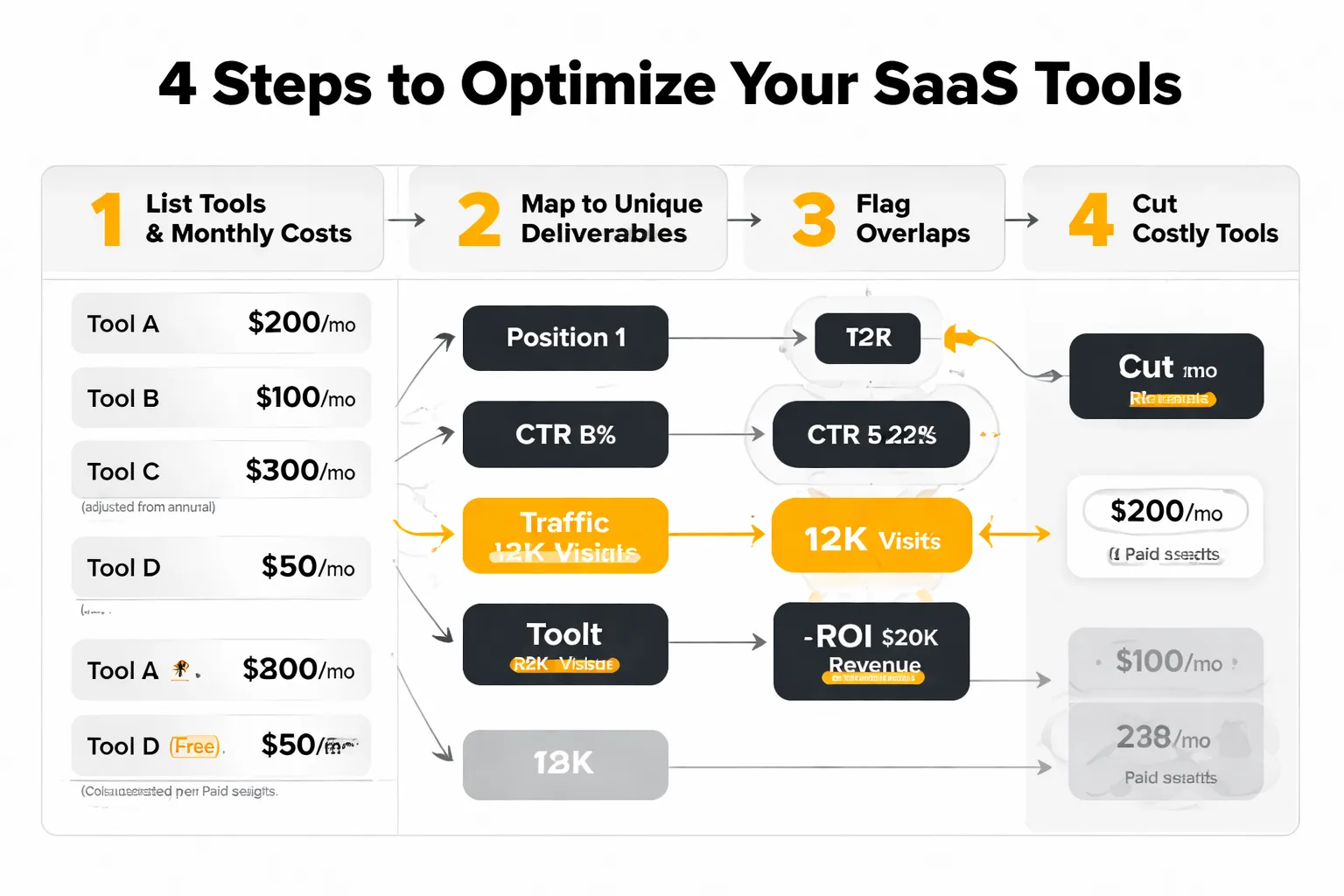
This is the framework to run in team meetings when the goal is cutting tool costs without losing capability. It takes 30 minutes if you come prepared with your current tool list and monthly costs.
Step 1: List every tool and its monthly cost. Include annual subscriptions converted to monthly. Include tools that are technically "free" but require paid team seats. Include tools that haven't been logged into in 90 days. Be exhaustive.
Step 2: Assign each tool ONE unique deliverable it owns. Not a feature. A deliverable. A specific output that someone on the team uses to make a decision or produce work. "Rank tracking" is not specific enough. "Weekly rank movement report for our 50 target keywords, reviewed in Monday standup" is a deliverable. If two tools produce the same deliverable, you're paying for the same insight twice.
Step 3: Flag every tool that can't claim a unique deliverable. These are your cut candidates. Don't cancel them yet. First ask whether the deliverable they were supposed to own is actually being produced by another tool, or whether it's just not being produced at all. Sometimes a "redundant" tool is covering a workflow gap nobody noticed was important until they tried to remove it.
Step 4: Calculate cost-per-insight for your remaining tools. Divide the monthly cost by the number of times per month a specific decision or piece of work is produced from that tool's output. A $200/month tool that drives 4 decisions per month costs $50 per insight. A $50/month tool that drives 1 decision per month costs the same. But a $200/month tool that drives 1 decision per month. Or zero. Is the problem.
The teams that run this consistently find the same pattern: 2. 3 tools survive the audit cleanly, 1. 2 tools need workflow fixes to justify their cost, and 1. 3 tools get cut immediately with no operational impact. In one audit of an eight-person content team, $740/month in subscriptions was eliminated in 45 minutes. None of which required replacing with anything else, because the deliverables those tools were supposed to own were already being produced by tools that stayed.
The SEO keyword cannibalization check belongs in this audit too. Pull your top 20 target keywords in Google Search Console and check which pages are ranking for each. If two pages from your own domain are competing for the same query, you have a tool problem and a content problem. And adding another search engine optimization tool won't fix either one. The audit reveals the overlap; the fix is consolidation.
For teams building out their content operation alongside the stack audit, understanding the cost of AI blog writing tools is a useful parallel exercise. The same cost-per-insight logic applies to content production tools as to SEO tools.
One more thing worth saying plainly: the best search engine optimization tool stack is the one your team actually uses consistently. Technical SEO improvements, content optimization, and rank tracking only compound when the data flows into actual decisions. A lean stack that gets used beats a bloated stack that gets ignored.