
Moz vs Ahrefs: DA and DR Explained (And Why Neither Score Should Be Your North Star)
You've spent months building backlinks, publishing content, and watching your Moz DA creep from 18 to 31. Then a prospect asks why your Ahrefs DR is only 24. Suddenly you're explaining the difference between two proprietary metrics that neither Google nor any other search engine actually uses — and you can feel the conversation slipping away. I've watched this exact scenario play out with content teams I've worked with, and honestly, the confusion is completely understandable, because the SEO industry has done a terrible job explaining what these scores actually measure, what they don't, and when chasing them becomes a distraction from real ranking work.
Moz vs Ahrefs: DA and DR are third-party approximations of link authority — not Google ranking signals — and treating them as gospel is one of the most common mistakes content teams make in 2026.
TLDR
- Moz DA and Ahrefs DR are both proprietary metrics — neither is used by Google, and they often diverge significantly for the same domain. - Ahrefs DR is generally more reliable for link prospecting because it's built on a keyword database of 28.7 billion keywords vs. Moz's 1.25 billion, giving it broader crawl coverage. - Both metrics become vanity scores without pairing them with modern strategies like topical authority, AEO (Answer Engine Optimization), and Google Search Console structured data analysis. - Use DR for link building outreach and DA for quick competitive benchmarking — but never use either as your primary KPI.Domain Authority vs Domain Rating: What DA and DR Actually Measure
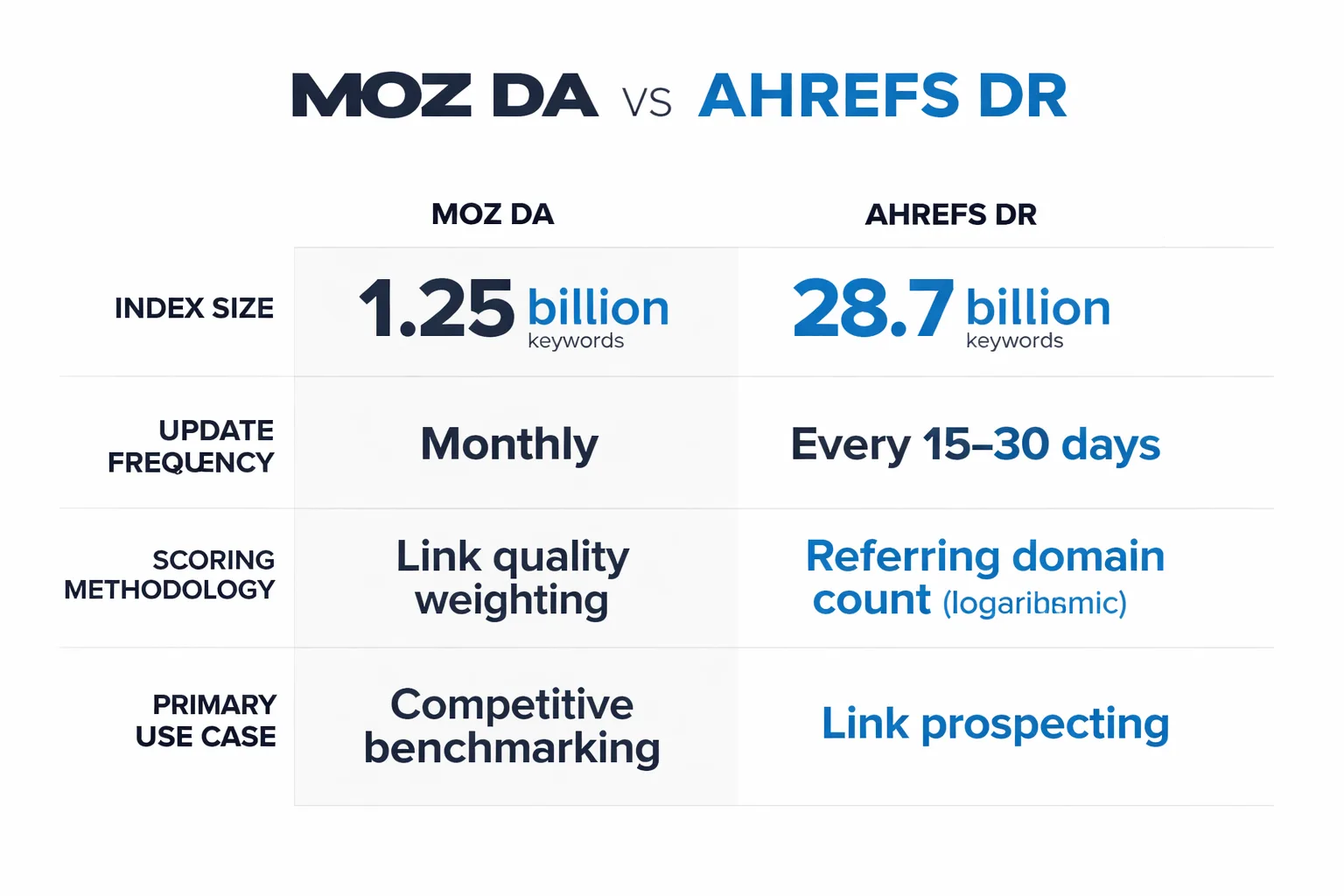
Moz Domain Authority (DA) is a score from 0–100 that predicts how likely a domain is to rank in search results, based primarily on the quantity and quality of inbound links. Ahrefs Domain Rating (DR) is also a 0–100 score, but it's calculated differently — it weights the number of unique referring domains linking to a site and applies a logarithmic scale, meaning the jump from DR 70 to DR 80 is exponentially harder than from DR 20 to DR 30.
Here's where it gets interesting.
These two scores are not measuring the same thing with different tools. They're measuring overlapping-but-distinct interpretations of link authority, using different crawlers, different index sizes, and different weighting algorithms. That's why you'll routinely see a site with DA 45 and DR 28, or vice versa. Neither is wrong — they're just different models.
The Moz vs Ahrefs Index Size Problem Nobody Talks About
This is the part that actually matters for day-to-day SEO decisions, and in my experience it's rarely discussed in standard Moz vs Ahrefs comparisons. According to eesel AI's detailed breakdown of Moz vs Ahrefs, Ahrefs maintains a keyword database of 28.7 billion keywords compared to Moz's 1.25 billion. That's not a minor gap — that's a 23x difference in crawl coverage.
What does that mean practically? When I'm doing link prospecting and pulling a site's DR in Ahrefs, that score is informed by a vastly larger picture of the web. Moz's DA score is calculated from a smaller slice. So for the same domain, Ahrefs sees more of the actual link graph — which means DR is a more accurate reflection of a site's true link footprint, especially for smaller or newer domains that haven't accumulated the high-authority links that would show up in both indexes.
In my work leading content strategy at Meev, I've run side-by-side audits that surfaced cases where a site showed DA 38 in Moz but DR 19 in Ahrefs. The Ahrefs number proved more accurate — it was catching a pattern of low-quality referring domains that Moz's index was partially missing. After cleaning up those links, the DR recovered faster than DA did, indicating Ahrefs was tracking the change more responsively.
Still, Moz has real advantages. Its interface is more approachable for beginners, its keyword difficulty scores are often more conservative (which I prefer for realistic content planning), and its local SEO tools — particularly for citation tracking — are genuinely strong. For teams doing high-volume local SEO work, Moz Pro is hard to beat.
How These Metrics Hold Up Against Google's AI-Heavy SERPs
Here's the uncomfortable truth that most SEO tool comparisons won't tell you: both DA and DR were designed for a search world that no longer fully exists.
Google's Helpful Content system, SpamBrain, and the broader shift toward evaluating topical authority and E-E-A-T have fundamentally changed what "authority" means in practice. A site with a high DR that publishes thin, AI-generated content across numerous unrelated topics is getting hammered in 2026. A site with DR 28 that owns a tight content cluster around one specific niche is outranking it. I've seen this pattern repeatedly across the data at Meev.
The sites winning in Google's current AI-heavy SERPs aren't the ones with the highest DA or DR — they're the ones with the deepest, most coherent topical coverage.
This is why I always pair link metric analysis with topical authority mapping. When building a content cluster strategy, DR matters less than whether a cluster actually covers the semantic territory Google expects from an authoritative source on that topic. In my work with content teams, a DR 35 site with 40 tightly interlinked articles on B2B SaaS pricing will outperform a DR 55 site with scattered coverage every time — and the data bears that out.
The searchatlas.com analysis of DA vs topical authority makes this point well: domain-level metrics are increasingly a lagging indicator of ranking potential, while topical authority is a leading one. Build the topical depth first. The DR will follow.
Pricing and Scalability: The Real Decision Factor
I'll be direct about this — because most comparisons dance around it — for most small businesses and solo content marketers, there's no need for both tools. The question is which one to prioritize given budget and use case.
| Use Case | Better Tool | Why |
| Link prospecting at scale | Ahrefs | Larger index, more accurate DR, better backlink data |
| Local SEO and citation tracking | Moz | Superior local tools, Moz Local integration |
| Keyword research for content | Ahrefs | 28.7B keyword database vs 1.25B |
| Beginner-friendly interface | Moz | Cleaner UX, better onboarding |
| Enterprise-level crawling | Ahrefs | Site Audit tool is stronger |
| Budget-constrained teams | Moz | Lower entry-level pricing |
Ahrefs starts at $129/month for the Lite plan. Moz Pro starts at $99/month. For a solo operator or small agency, that $30/month difference isn't the deciding factor — the deciding factor is what the tool will actually be used for daily.
If the primary workflow is content creation and keyword research, Ahrefs wins on data depth. For local SEO campaigns serving brick-and-mortar clients, Moz's local suite is worth the trade-off in index size. For enterprise-level link building at volume, both tools are likely necessary — and I recommend running Google Search Console structured data analysis alongside both to understand which pages are actually earning rich results.
The Vanity Score Trap
Most people think a rising DA or DR means their SEO is working. In my experience, they're wrong — or at least, they're measuring the wrong thing.
I've worked with content teams that spent six months on link building campaigns, watched their DR climb from 22 to 41, and saw zero movement in organic traffic. The reason is consistent: links were being built to the homepage and a handful of top-level pages, while the actual content — the blog posts and landing pages targeting high-potential keywords — had no link equity flowing to them. The domain-level score went up. The page-level authority that actually drives rankings stayed flat.
This is the black box problem with both metrics. DA and DR are domain-level aggregates. Google ranks pages, not domains. A DR 60 domain with a poorly optimized page will lose to a DR 30 domain with a page that perfectly answers the query, has strong internal linking, loads fast (page speed optimization for SEO is still a real factor in 2026), and demonstrates genuine first-hand expertise.
Here's how I recommend approaching these metrics: treat DR and DA as filters, not goals. In my link prospecting work, DR functions as a minimum threshold to exclude obvious spam — anything under DR 15 with suspicious anchor text patterns gets cut. But chasing a target DR number for a domain's own sake misses the point. The metrics that tell me whether SEO is actually working are organic clicks in Google Search Console, not a third-party score that updates monthly and can swing 5 points based on algorithm changes at Moz or Ahrefs.
"Domain Authority and Domain Rating are useful as filters and benchmarks — the moment you make them a KPI, you've optimized for the tool, not for Google."
How to Use Both Metrics Without Getting Played
Here's a practical framework I use for applying these metrics effectively, because "don't obsess over DA/DR" isn't actionable advice on its own.
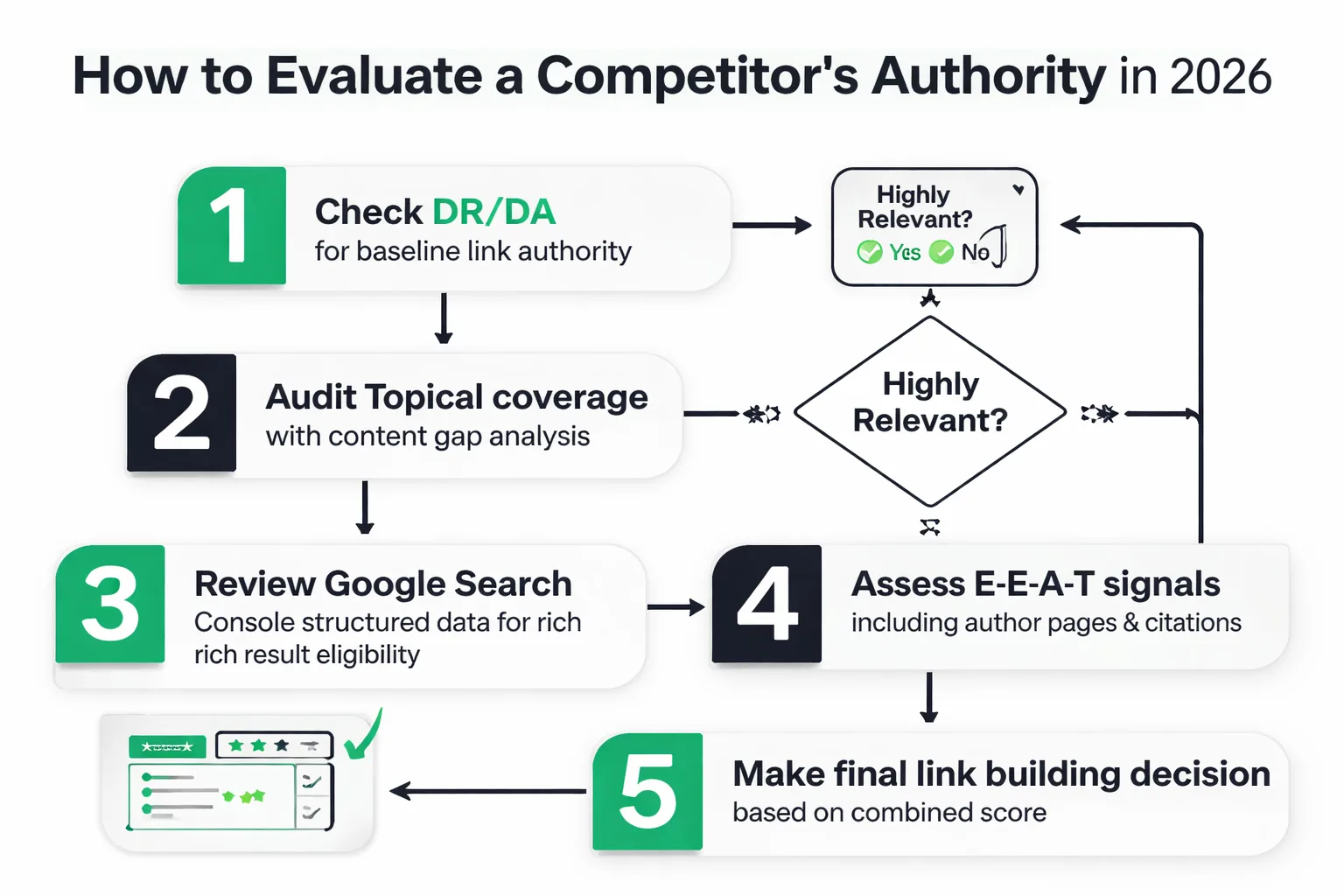
For competitor analysis: 1. Pull DR for your top 10 competitors in Ahrefs. Note the range — this is your competitive landscape baseline. 2. Filter their backlink profiles by referring domain DR 30+ to find quality link sources. 3. Cross-reference with Moz DA to flag any sites where the two scores diverge significantly (10+ point gap often signals a link profile issue worth investigating). 4. Run a content gap analysis — what topics are they ranking for that you're not? This matters more than their DR.
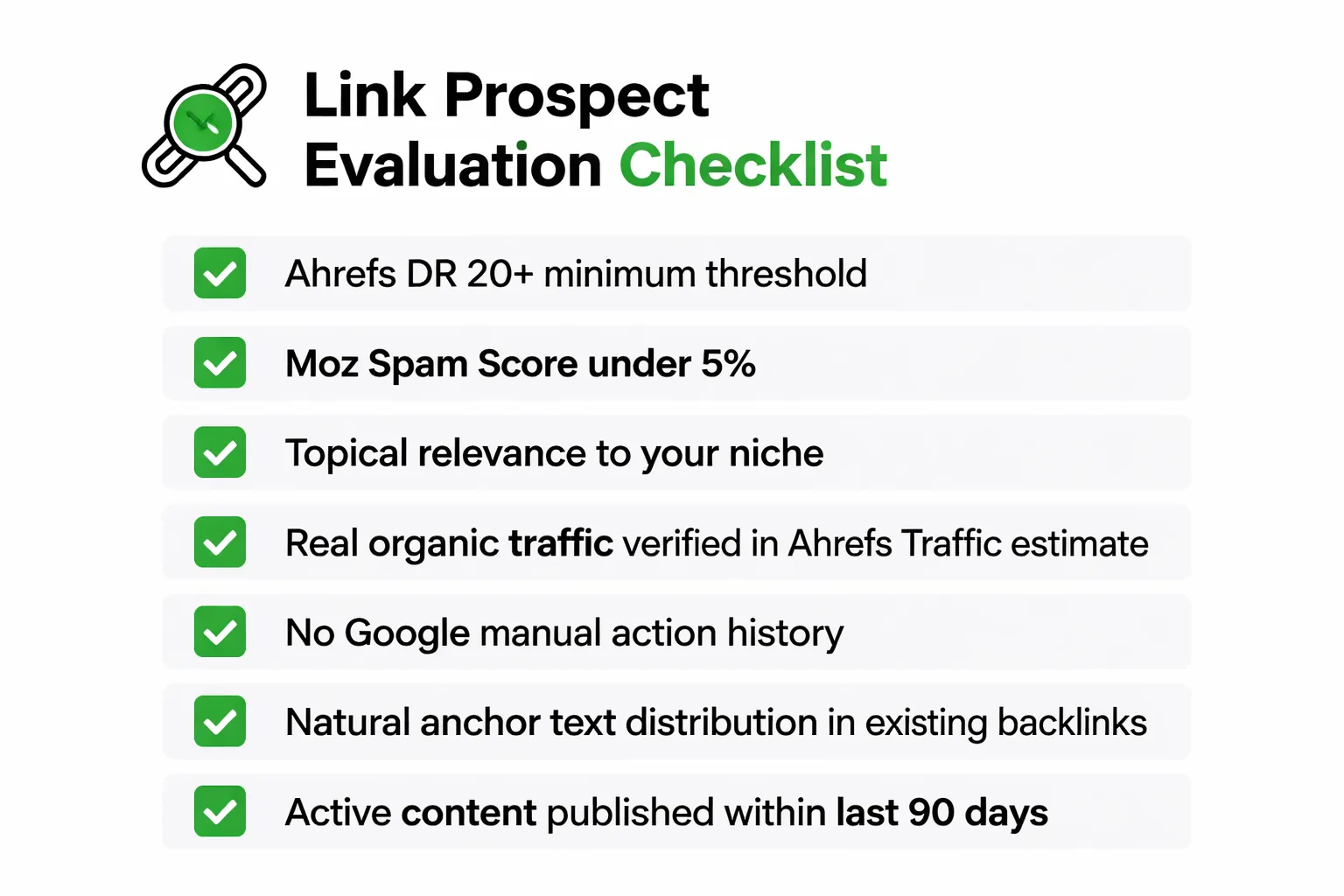
For link building outreach: 1. Use Ahrefs DR as your primary filter (minimum DR 20 for most niches, DR 30+ for competitive verticals). 2. Check Moz Spam Score alongside DR — a site with DR 40 and Spam Score 8%+ is a red flag. 3. Prioritize topical relevance over raw score. A DR 25 site in your exact niche is worth more than a DR 50 general news site. 4. Track page-level metrics in Google Search Console, not just domain-level scores.
For reporting to stakeholders: Stop reporting DA/DR as primary KPIs. Report organic traffic, keyword rankings, and conversion rate. If a link metric must be included, use it as context — "Our DR grew from 28 to 35 this quarter, which reflects the link building work, but here's the traffic impact that actually matters."
What's Next for These Metrics in an AI Search World
The relevance of DA and DR as standalone metrics is likely to continue declining as AI-driven search evolves. Google's AI Overviews are pulling answers from sources based on E-E-A-T signals, structured data, and topical authority — not from sites with the highest third-party link scores. Perplexity, ChatGPT, and other AI answer engines are citing sources based on content quality and specificity, not DR.
The SEO teams I've seen positioned to win in this environment are the ones treating AEO (Answer Engine Optimization) as a first-class strategy alongside traditional link building. That means writing content that directly answers specific questions, implementing Google Search Console structured data correctly, and building the kind of topical depth that signals genuine expertise to both human readers and AI crawlers.
According to the LinkedIn analysis of SEO ranking factors in 2026, the shift toward AI-mediated search is accelerating the importance of content quality signals over raw link metrics. DA and DR will still matter for link prospecting — they're useful filters and they're not going away. But they're becoming one input among many, not the north star metric they were in 2018.
At Meev, we've watched this trajectory clearly: within two years, the most sophisticated SEO teams will likely be using DA/DR the way they currently use PageRank — as a background signal checked occasionally, not a metric optimized for directly. The foreground will be topical authority, AEO optimization, and structured data implementation.
Use both tools. Understand what they measure. Just don't let either score become the thing you're actually working toward.