

By Judy Zhou, Head of Content Strategy
Key Takeaways
- Automatic article writing tools succeed in 2026 only when they generate at volume, enforce a 70/100 quality gate, publish to CMS platforms, and close the loop by tracking AI citations.
- ChatGPT referral traffic grew 206% in 2025, but more than 30% of it reaches just 10 domains, so volume without quality scoring produces invisible output.
- Skip the content treadmill: tools that lack a quality firewall turn 400 articles in six months into zero ChatGPT citations, as Marcus discovered.
- Route citation data back into topic planning to convert AI engines from black boxes into measurable referral sources.
Marcus had published 400 articles in six months. His automatic article writing software hummed through briefs every morning before he finished his coffee, and his CMS filled up like a library no one visited. Then a prospect asked him a simple question: 'Can you show me one time ChatGPT cited your client?' He opened three different prompts. Scrolled. Nothing. The content existed. The citations didn't. That moment. Somewhere between embarrassment and clarity. Is exactly where most content teams find themselves at the start of 2026.
Automatic article writing software has matured from a curiosity into a genuine operational layer for agencies, solo founders, and SMBs — and today's autoblogging reflects that same evolution. The tools that work in 2026 do four things: generate at volume, gate on quality, publish across CMS platforms, and feed a citation-building loop that gets your content seen by AI engines. Tools that only do the first thing. Generate at volume. Are how Marcus ended up with 400 invisible articles.
Here's what the data says about the gap. ChatGPT's outbound referral traffic grew 206% in 2025, per Semrush's clickstream analysis. But more than 30% of that referral traffic flows to just 10 domains. If your content isn't clearing the quality bar those AI engines apply when selecting sources, the volume doesn't matter. Automated article writing software without a quality firewall is a content treadmill, not a content strategy.
This guide covers how the technology actually works in 2026, where it fails, how to avoid the traps, and what a sustainable AI content system looks like for teams that need results. Not just output.
The Mechanics of Automated Article Writing Software
At its core, an AI article generator takes a topic or keyword input, retrieves relevant context (either from the web, a knowledge base, or both), and produces structured text using a large language model. That's the skeleton. What separates tools in 2026 is everything built around that skeleton.
The retrieval layer matters more than most buyers realize. A tool that pulls from a static training cutoff produces different output than one using retrieval-augmented generation (RAG), which fetches live sources before drafting. RAG-based systems tend to produce more accurate, more citable content because the claims trace back to real documents rather than model memory. For SEO and AI visibility purposes, fact-traceability is increasingly non-negotiable. Google AI Overviews optimization rewards content that can be verified against authoritative sources. And so do the LLMs that power Perplexity, ChatGPT, and Claude when they select what to cite.
The model underneath also shapes output quality in ways that matter for different use cases. GPT-4-class models handle nuanced, long-form argumentation better than smaller models. Claude-class models tend toward cleaner prose with less hallucination on factual claims. Custom fine-tuned LLMs can match brand voice with precision but require significant investment to maintain. For most teams using automated article writing software in 2026, the practical answer is a hybrid: a frontier model for drafting, with post-generation quality scoring to catch what the model gets wrong.
Archetype awareness is the feature most buyers overlook entirely. A listicle, a how-to guide, and an explainer article have structurally different requirements. Different heading hierarchies, different internal linking patterns, different citation densities. Generic AI writers treat every topic the same way and produce content that reads like every other piece on the SERP. Tools that encode archetype-specific logic produce output that's structurally differentiated from the start.
Why Volume Alone Destroys Topical Authority
This is the failure mode nobody in the vendor space wants to talk about.
SEO practitioner Jessica Bowman documented a case on LinkedIn where an agency produced 100 posts per hour using AI with zero human editing. The result wasn't a traffic surge. The content quality was so poor it actively damaged SEO performance. Bowman's conclusion was direct: AI is not ready to write full articles at the quality levels needed to rank, and large volumes of low-quality content harm the sites they're published on.
I've seen the same pattern from the other side. The promise of automated article writing software is scale. The risk is that scale without quality gates compounds your problems faster than it compounds your wins. Every weak article you publish is a signal to Google's Helpful Content System that your site prioritizes output over usefulness. Once that signal accumulates, it's slow to reverse.
Google's scaled content abuse policies specifically target sites that use automation to produce large volumes of content that provides little to no original value — and the enforcement is algorithmic, not manual, which means it can hit without warning and recover slowly. The teams I've seen avoid this problem share one practice: they treat the quality gate as non-negotiable before publishing, not as a post-hoc audit.
The math on this is uncomfortable. Publishing 50 articles that clear a quality threshold beats publishing 500 that don't, every time. Not because 50 is the magic number, but because topical authority for AI search is built on signal density, not content density. AI engines cite sources that have demonstrated consistent accuracy and depth on a topic. A site with 50 well-sourced, structurally differentiated articles on a niche is more citable than a site with 500 thin variations on the same queries.
How Does a Quality Firewall Actually Work?
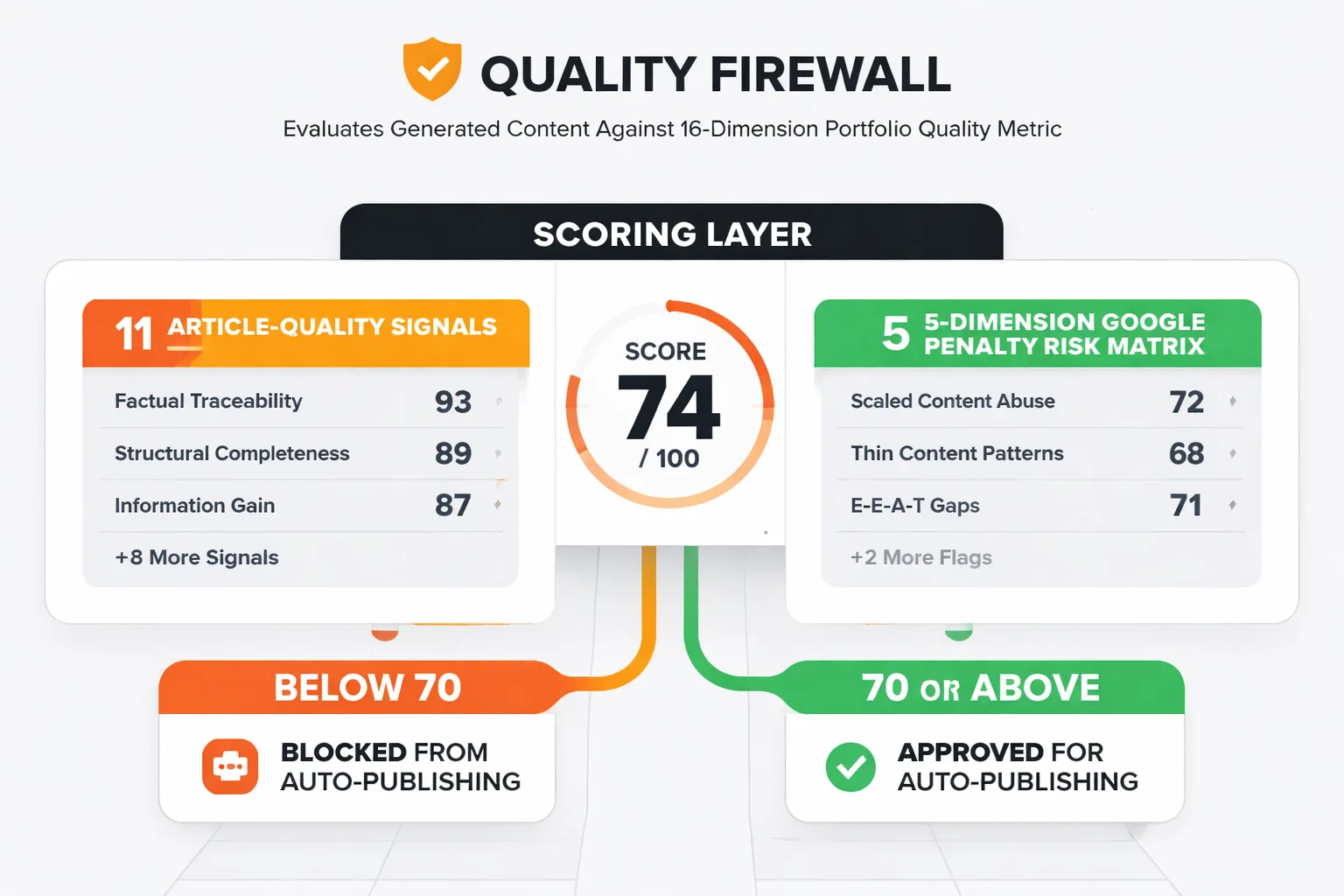
A quality firewall is a scoring layer that evaluates generated content against a set of defined criteria before allowing it to publish. The concept is simple. The implementation is where most tools fall short.
At Meev, where I lead content strategy, the quality gate runs on a 16-dimension Portfolio Quality Metric: 11 article-quality signals covering things like factual traceability, structural completeness, and information gain, plus a 5-dimension Google Penalty Risk Matrix that flags scaled content abuse signals, thin content patterns, and E-E-A-T gaps. Articles scoring below 70 out of 100 are blocked from auto-publishing. That threshold isn't arbitrary. It reflects the minimum score at which content has historically cleared Google's quality assessments in our testing.
The penalty risk matrix component is the part most platforms skip. It's not enough to know that an article is well-written. You need to know whether publishing it at scale, alongside your existing content, creates a pattern that looks like abuse. That's a portfolio-level signal, not an article-level one. Cannibalization detection at the planning stage, before a brief is even written, prevents the compounding damage of publishing 15 near-identical articles on adjacent queries.
For teams evaluating automated article writing software in 2026, the question to ask any vendor is specific: what happens to an article that fails your quality check? If the answer is "it publishes anyway with a warning flag," the gate isn't a gate. It's a dashboard.
When Automatic Article Writing Software Actually Performs
The Title Nine case study is the clearest public evidence I've seen of what the right system looks like at scale. Using Conductor's auto-publishing workflow, Title Nine achieved +1,000% growth in AI-driven sessions, +134% growth in non-branded impressions year-over-year, and +30% growth in organic traffic year-over-year — alongside a +400% increase in content production. Their team attributed the results to embracing AI search early, moving fast, and staying data-driven as a lean eCommerce operation.
That outcome is real. It's also not typical for teams that skip the strategic layer.
The use cases where automatic article generation consistently performs well are: product-adjacent content at scale (category pages, comparison articles, feature explainers), news-adjacent content where speed matters more than depth, and topical cluster expansion where a core pillar exists and supporting articles need to be built out systematically. The use cases where it consistently underperforms are: thought leadership that requires genuine original insight, investigative content that depends on primary reporting, and any content where the author's personal experience is the core value proposition.
For agencies managing content across multiple clients, the multi-CMS publishing capability is where the ROI concentrates. Tools that can publish directly to WordPress, Ghost, Shopify, and Wix from a single workflow eliminate the copy-paste tax that eats hours every week. Combined with calendar-based scheduling and IndexNow submission on publish, the operational leverage is real. If you're evaluating platforms, Meev's comparison with Jasper AI breaks down how these publishing workflows differ in practice.
Want to see how your automatically published content scores against the 16-dimension quality firewall before it reaches your CMS?
How Does AI Citation Tracking Connect to Content Strategy?
This is the part of the automatic article writing conversation that almost nobody covers, and it's where the biggest strategic gap lives in 2026.
Publishing content is necessary but not sufficient for AI visibility. Semrush's analysis of the most-cited domains in AI found that citation concentration is extreme. A small number of domains capture a disproportionate share of AI-generated citations. Getting into that cited set requires more than good content. It requires that your content exists on platforms and in formats that AI engines have already decided to trust.
The pattern I keep seeing: teams invest in automated article writing software, build out topical coverage, and then wonder why their AI-driven session counts stay flat. The missing piece is almost always the citation loop. Your content needs to be cited by the publishers that AI engines already trust, not just published on your own domain.
This is what I'd call the mention-citation gap. A brand can have 400 articles on a topic and still not appear in a single AI-generated answer, because the AI engines aren't crawling your site for every query. They're pulling from sources they've weighted as authoritative. Closing that gap requires identifying which publishers AI engines cite for your topics, building relationships with those publishers, and getting your content or brand mentioned in their coverage. That's a separate workflow from content generation, and it's one that most automated article writing tools don't touch.
For teams tracking where their brand appears across ChatGPT, Perplexity, Gemini, and other surfaces, DeepSeek visibility tracking and Gemini visibility tracking give you the surface-level data. But the actionable layer is Citation Path: finding the specific publishers AI engines cite for your topics, resolving verified contacts, and drafting outreach grounded in your knowledge base. That closed loop is what separates AI search visibility as a strategy from AI search visibility as a vanity metric.
The Contrarian Take on AI Search Traffic Right Now
I want to be honest about something the vendor ecosystem won't tell you.
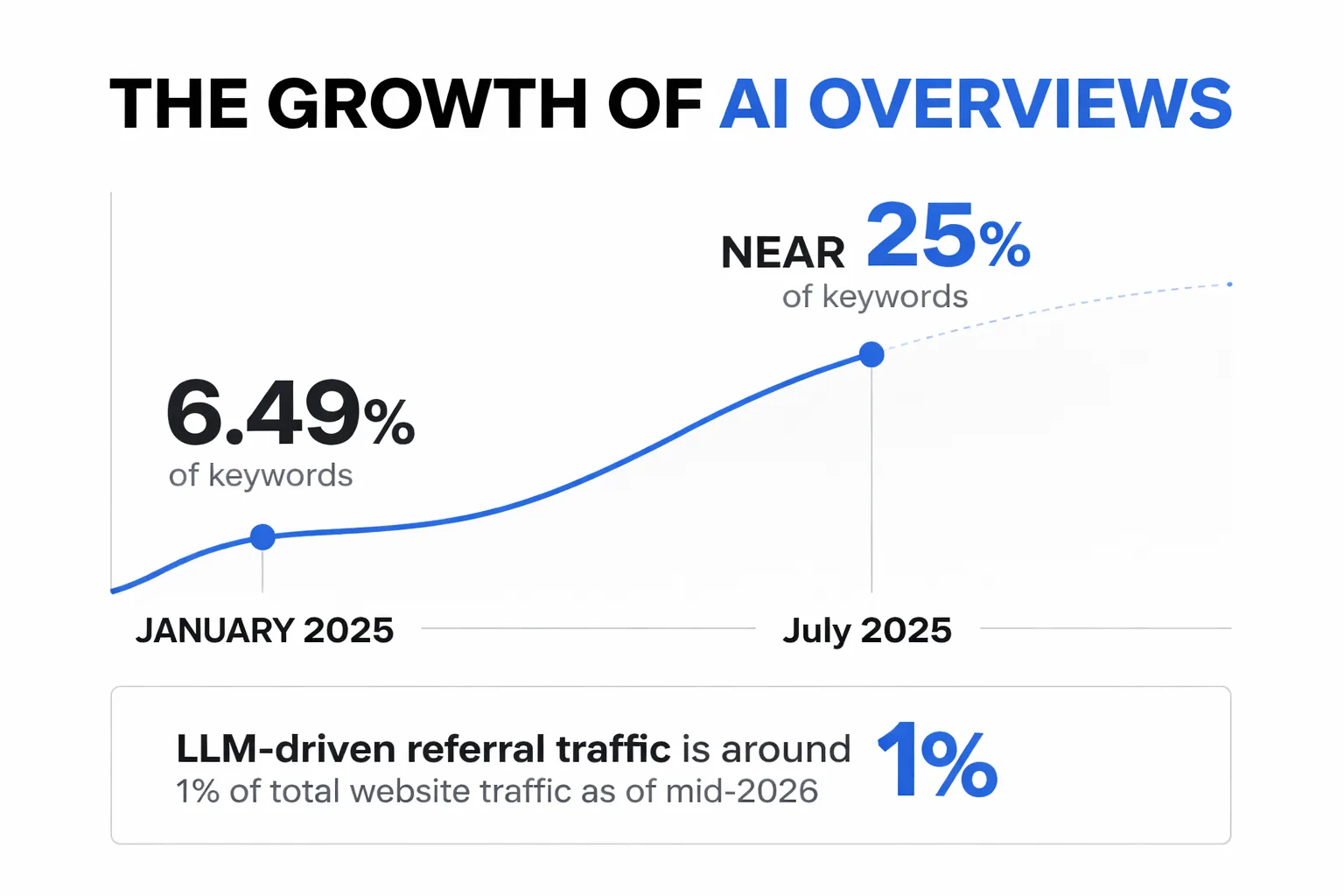
LLM-driven referral traffic is sitting around 1% of total website traffic as of mid-2026, per Statista. I track AI-sourced sessions in our own analytics, and yes, they're measurable. But measurable isn't the same as meaningful. For most content teams, the ROI case for chasing AI citations over conversion-focused content isn't there yet. I haven't seen a single controlled study connecting citation gains to actual revenue outcomes.
The reasonable argument for investing in AI visibility now is that you're building the habit before the traffic share shifts. AI search is growing. AI Overviews appeared for roughly 6.49% of keywords in January 2025 and peaked near 25% by July, per Semrush's analysis of 200,000 queries. That trajectory is real. But the teams making the best decisions in 2026 are the ones who treat AI visibility as a parallel investment, not a replacement for the content fundamentals that drive conversions today.
Automatic article writing software is a tool for building content at scale. It becomes a strategy when it's connected to quality gates, citation tracking, and a publisher outreach loop. Without those connections, it's just Marcus's library. Full and unvisited.
Choosing the Right Automatic Article Writing Tool in 2026
The market has fragmented into three categories, and knowing which one you're buying matters.
Content-only tools (RightBlogger, Copymatic, most one-click generators) produce drafts. They don't gate on quality, don't track citations, and don't close the loop between what you publish and where you appear in AI answers. For teams that have their own editorial review process and just need drafting throughput, these work. For teams that want to auto-publish without human review, they're the 100-posts-per-hour failure case waiting to happen.
Workflow automation platforms (Make.com, n8n) let you build your own pipeline connecting AI models to CMS platforms. The flexibility is real. The quality gating is whatever you build yourself, which for most teams means none. These are powerful for technical operators who want custom logic, and risky for teams that want a turnkey solution.
Quality-gated publishing platforms combine content generation, quality scoring, CMS publishing, and (in the best cases) AI visibility tracking in one system. This is where the market is heading. The differentiation between platforms in this category comes down to: how rigorous is the quality gate, how deep is the CMS integration, and does the platform close the loop back to AI citation data.
For agencies evaluating options, Meev's comparison with Outranking and the comparison with Profound cover how these platforms differ on the dimensions that matter most for multi-client operations: quality scoring depth, citation tracking, and multi-domain management.
One feature worth specifically asking about when evaluating any platform: does the tool track your AI search visibility across multiple surfaces, including Grok and DeepSeek, not just ChatGPT and Google? Citation patterns differ meaningfully across engines. A platform that only tracks one surface gives you an incomplete picture of where your content is and isn't being cited.
FAQ
Is automatic article writing software safe to use for SEO in 2026?
Yes, with conditions. Google's guidance has consistently been that the quality and usefulness of content matters, not the method of production. The risk isn't using AI to generate articles. It's publishing low-quality content at scale without editorial review or a quality gate. Tools that include a quality firewall and fact-verification before publishing are materially safer than tools that auto-publish whatever the model produces. The agency case documented by Jessica Bowman (100 posts per hour, zero human review) is the failure mode to avoid.
What's the difference between an AI article generator and automated article writing software?
The terms are often used interchangeably, but there's a meaningful distinction in 2026. An AI article generator typically refers to a single-step tool: input a topic, get a draft. Automated article writing software implies a fuller workflow: topic discovery, drafting, quality scoring, CMS publishing, and sometimes citation tracking. For teams that want to run content at scale without manual intervention at every step, the workflow layer is where the real value lives.
How do I avoid Google's scaled content abuse penalties when using automation?
Three practices matter most. First, gate on quality before publishing. Every article should clear a minimum score on factual accuracy, structural completeness, and originality. Second, run cannibalization checks before generating new content to avoid publishing near-duplicate articles on adjacent queries. Third, monitor your Google Search Console for impressions and CTR drops at the domain level, not just the article level. Penalty signals often appear as portfolio-level drops before they show up on individual pages.
Does automatically generated content get cited by AI engines like ChatGPT or Perplexity?
It can, but content quality is only one factor. AI engines weight platform authority heavily. Which is why Reddit (around 40% of sourced content across major models) and Wikipedia (around 26%) dominate citations despite inconsistent formatting. For brand-owned content to get cited, it typically needs to be referenced by publishers that AI engines already trust, not just published on your own domain. That's the citation-building loop that most automated content tools ignore entirely, even as AI citations become 2026's new ad space.
What should I look for in an automatic article writing tool for an agency with multiple clients?
Four things: multi-domain management (so you're not logging in and out of separate accounts), quality gating that operates at the portfolio level (not just per-article), multi-CMS publishing support, and AI citation tracking tools that cover multiple surfaces. The operational leverage of a tool that handles all four is significant for agencies. The alternative is stitching together four separate tools. Content generator, quality checker, publishing scheduler, and visibility tracker. Which creates coordination overhead that erodes the efficiency gains from automation.
About the Author
Judy Zhou, Head of Content Strategy
Judy Zhou leads content strategy at Meev, where she oversees AI-driven content research and publishing for hundreds of brands. With a background in SEO and editorial operations, she focuses on building content systems that rank on Google, get cited by AI search engines, and drive measurable business results.
Stop publishing into the void. Run your content through a quality gate that blocks weak drafts, tracks AI citations, and closes the loop between what you publish and where you appear in AI answers.