

By Judy Zhou, Head of Content Strategy
Key Takeaways
- Brands cited in Google AI Overviews earn 35% more organic clicks — making AI citation tracking a non-negotiable feature for any serious SEO writing tool in 2026.
- 40% of LLM citations point to Reddit and 26% to Wikipedia, not polished brand content — the best tools help you structure content the way AI engines actually extract it.
- The single biggest risk of scaled AI content publishing is Google's Helpful Content System penalty; only tools with real quality gates (like Meev's 16-dimension firewall) reliably prevent it.
- Cost per published article — not monthly plan price — is the right metric for comparing SEO writing AI tools across different team sizes and publishing volumes.
In 2016, when MarketMuse first introduced AI-assisted content briefs to the SEO industry, the promise was simple: use machine learning to tell writers what topics to cover and watch rankings follow. It worked. For a while. Nearly a decade later, the category those early tools created has exploded into dozens of competing platforms, but the underlying problem has shape-shifted entirely. Ranking in a blue-link SERP is no longer the only game. Today, SEO writing AI tools are being evaluated on a harder question: can they help your content get cited by the AI systems that increasingly answer queries before a user ever clicks a link?
The best seo writing ai tools in 2026 do more than generate keyword-optimized drafts. Brands cited in Google AI Overviews earn 35% more organic clicks than uncited competitors on the same page. 58% of U.S. Google users conducted at least one search producing an AI summary in early 2026. Ahrefs' analysis of 76 million AI Overviews found brand mentions are the single most correlated factor (0.664) with AI Overview inclusion. Reddit accounts for roughly 40% of LLM citations, Wikipedia for 26% — not polished brand content. The tools that survive this shift are the ones built for both worlds.
Why SEO Writing AI Tools Matter in 2026
The shift isn't subtle anymore. When organic CTR drops 61% in the presence of AI Overviews (from 1.76% to 0.61%), the content team that keeps publishing the same way it did in 2022 is running a losing operation. I lead content strategy across hundreds of brand publishing programs at Meev, and the teams I see struggling most right now aren't the ones with bad writers. They're the ones using tools that were architected for a world where ranking in position one was the finish line.
The seo writer ai category has split into two camps. The first camp builds tools that optimize for traditional SERP performance: keyword density, NLP term coverage, heading structure, readability scores. These tools work. They still matter. But they're solving yesterday's problem with increasing precision. The second camp is building for Generative Engine Optimization (GEO) — the emerging discipline of structuring content so AI systems extract, cite, and attribute it correctly. The best tools in this list operate in both camps simultaneously. The ones that don't are depreciating assets.
What changed the calculus for me personally was pulling citation data and finding that the structural properties LLMs favor. Direct answers, conversational register, visible sourcing. Are almost the opposite of what most brand content teams produce. Polished, formally structured long-form content gets cited less reliably than a 2017 Reddit thread where practitioners argued in the comments. That's not an argument to stop publishing. It's an argument to change how you build the tools and workflows behind your publishing.
How We Ranked These Tools
I evaluated each tool across six dimensions that matter for content teams operating in 2026, not 2022.
Output quality and citation-readiness. Does the tool produce content that AI search engines are likely to extract? That means answer-dense structure, inline sourcing, and direct claim formatting. Not just keyword coverage.
SEO feature depth. Real-time SERP analysis, NLP term suggestions, schema generation, internal linking support, and cannibalization detection. Tools that only do keyword stuffing guidance didn't make the cut.
AI visibility tracking. Can the tool tell you whether your published content is being cited by ChatGPT, Perplexity, Google AI Overviews, or other LLM surfaces? This is the feature that separates 2026-ready tools from legacy optimization platforms.
CMS and workflow integration. WordPress, Ghost, Shopify, Wix, Google Docs. Publishing friction kills content velocity. Tools that require copy-paste into every CMS lose points.
Pricing transparency. I've seen too many tools with opaque credit systems that make true cost-per-article impossible to calculate. Clear tier pricing wins.
Scaled content quality controls. Google's Helpful Content System penalizes low-quality scaled content. Tools that ship whatever the model produces without a quality gate are a liability at volume.
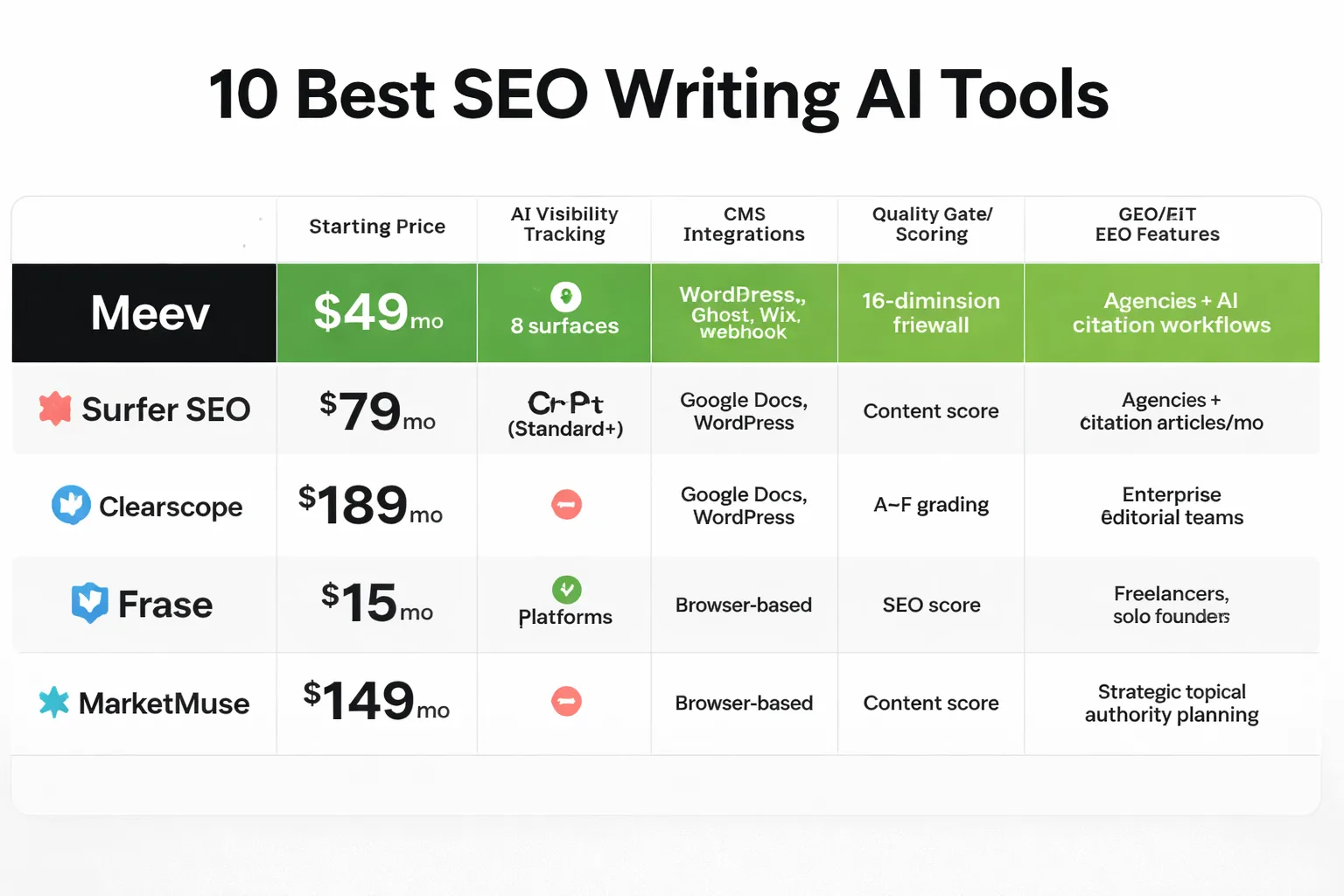
Comparison Table
(https://seranking.com) at bottom]
| Tool | Starting Price | AI Visibility Tracking | CMS Publishing | Quality Gate | Best For |
| Meev | $49/mo | ✅ 8 surfaces | WordPress, Ghost, Shopify, Wix, webhook | 16-dimension firewall | Agencies + AI citation workflows |
| Surfer SEO | $79/mo | ✅ ChatGPT (Standard+) | Google Docs, WordPress | Content score | Content teams, 10+ articles/mo |
| Clearscope | $189/mo | ❌ | Google Docs, WordPress | A. F grading | Enterprise editorial teams |
| Frase | $15/mo | ✅ 8 platforms | Browser-based | SEO score | Freelancers, solo founders |
| MarketMuse | $149/mo | ❌ | Browser-based | Content score | Strategic content planning |
| Writesonic | $49/mo | ✅ ChatGPT, AIO, Perplexity | Browser-based | Basic QA | Startups, all-in-one teams |
| Semrush | $139.95/mo | ✅ AI Overviews | Browser-based | Readability/SEO score | Full-suite marketing teams |
| Jasper AI | $49/mo/seat | ❌ (needs Surfer) | Browser-based | Brand voice controls | Brand marketing teams |
| NeuronWriter | $19/mo | ❌ | Browser-based | NLP content score | Budget solo SEOs |
| Scalenut | $39/mo | ❌ | Browser-based | NLP content score | SMB content lifecycle |
| SE Ranking | $65/mo | ✅ AI Overviews | Browser-based | Basic QA | SMB agencies, rank tracking |
1. Meev — Best for agencies and teams tracking AI citation gaps
Best for: Content teams and agencies that need to publish quality-gated articles at scale AND track where their brand appears across every major AI search surface. From ChatGPT to Google AI Mode.
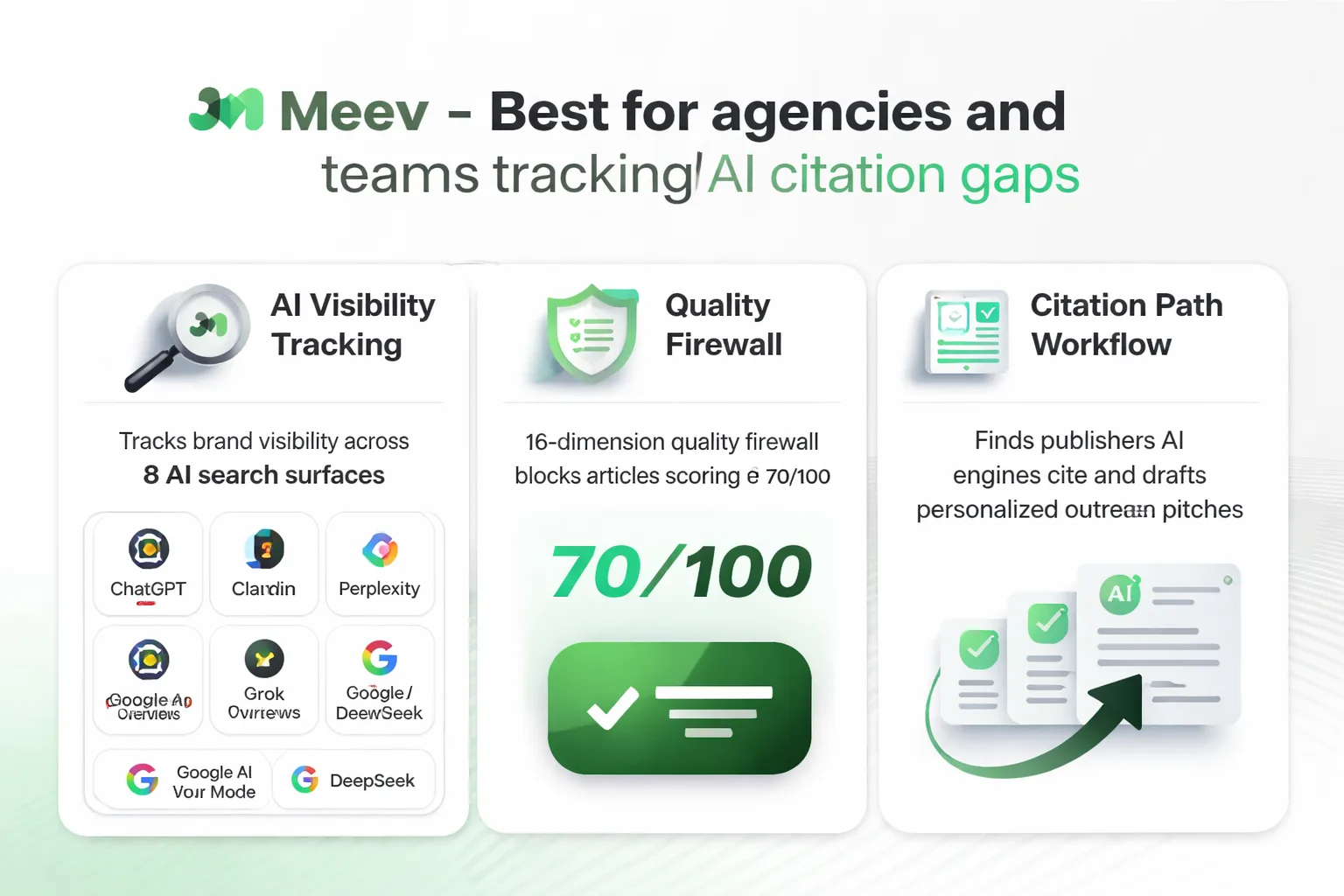
Meev does three things most tools force you to stitch together: it tracks brand visibility across eight AI search surfaces (ChatGPT, Claude, Gemini, Perplexity, Grok, Google AI Overviews, Google AI Mode, DeepSeek), generates and publishes archetype-aware articles directly to your CMS, and closes citation gaps by finding the publishers AI engines actually cite, then drafting personalized outreach pitches grounded in your knowledge base.
Key features: - 16-dimension quality firewall blocks articles scoring below 70/100 before they reach your CMS. No other auto-blog platform has an equivalent gate. AI visibility tracking with daily refresh on SERP surfaces and per-LLM drill-down dashboards showing actual response text and citations. Citation Path workflow: find the publishers AI engines cite for your topics, resolve verified contacts, draft outreach pitches in one closed loop. Multi-platform publishing to WordPress, Ghost, Shopify, Wix, and custom webhooks with IndexNow and Google Search Console sitemap submission on every publish
Pricing: Lite $49/mo (10 articles, 1 domain); Starter $99/mo (30 articles); Pro $269/mo (80 articles, 5 domains, premium LLMs); Agency $599/mo (150 articles, 15 domains, white-label reporting). Annual billing saves 20%.
The feature that stands out most to me is the quality firewall. Every other auto-publishing tool I've evaluated ships whatever the model produces. Meev's 16-dimension Portfolio Quality Metric. Covering 11 article-quality signals plus a 5-dimension Google Penalty Risk Matrix. Blocks weak drafts before they ever touch your CMS. For teams worried about scaled content abuse under Google's Helpful Content System, that gate is the difference between a content program that compounds and one that gets torched in a core update. The Citation Path feature is genuinely novel: it's the only workflow I've seen that connects AI visibility tracking directly to publisher outreach in a single interface.
2. Surfer SEO — Best for content teams publishing 10+ articles per month
Best for: Content teams and SEO agencies publishing 10+ articles per month who need a proven, workflow-integrated optimization engine for both traditional Google rankings and AI search results.
Surfer SEO built its reputation on one thing: reverse-engineering what the top-ranking pages for any keyword actually have in common, then giving you a real-time score as you write. That core loop is still the tightest in the category. The addition of Surfy (the built-in AI writer) and ChatGPT visibility tracking on the Standard plan makes it a credible 2026 option for teams that want traditional SERP optimization with a layer of AI search awareness.
Key features: - Real-time Content Editor with NLP term suggestions, word count, and heading structure guidance. Surfy AI writer generates full drafts optimized against SERP data from the first word. SERP Analyzer reverse-engineers top-ranking pages for any keyword. AI search tracking for ChatGPT and other generative engines on Standard plan and above
Pricing: Starts at $79/month (billed annually) on the Essential plan; Scale plan at $175/month; AI writing (Surfy) included on paid plans.
One thing to know: the entry-level Essential plan at $79/month includes zero AI visibility tracking. ChatGPT monitoring requires the Standard tier at $99/month. That's not a dealbreaker, but it's a detail that catches teams off guard when they're budgeting. Surfy produces competent drafts, though in my experience the prose quality is more functional than engaging. You'll want a human editor pass before publishing anything where voice matters.
3. Clearscope — Best for enterprise teams prioritizing optimization accuracy
Best for: Large enterprise content teams and agencies that prioritize optimization accuracy and editorial quality over speed, and can justify a premium price for a polished, writer-friendly experience.
Clearscope's A++ to F grading system is the most writer-friendly optimization interface in the category. It doesn't try to write for you. It tells your writers exactly which terms are missing, how your content compares to top competitors, and what readability improvements would move the needle. Without getting in the way of the editorial process. The unlimited user seats on the Essentials plan is a genuine differentiator for large teams.
Key features: - A. F content grading system with precise keyword and related-term suggestions. Content Inventory feature tracks existing page performance over time. Google Docs and WordPress integrations for seamless editorial workflows. Readability analysis, word count guidance, and competitor content gap insights
Pricing: Essentials plan starts at $189/month (includes unlimited user seats); higher-volume Business and Enterprise tiers available; no free plan, demo available.
The honest limitation here: Clearscope has no GEO scoring, no AI search tracking, and no generative engine visibility features as of 2026. If your team's primary concern is Google AI Overviews optimization or LLM citation tracking, Clearscope is not the right primary tool. It's excellent at what it does. Traditional content optimization. But it's solving a narrower problem than most teams now face.
4. Frase — Best for budget-conscious freelancers and solo founders
Best for: Budget-conscious freelancers, solo founders, and small content teams who need a fast research-to-draft workflow with solid brief generation without paying enterprise-level prices.
Frase packs a surprising amount of capability into its entry pricing. The $15/month Solo plan is the lowest barrier to entry in this list for a tool with genuine SEO functionality. The dual SEO and GEO scoring. Tracking AI search visibility across eight platforms. Is a feature set you'd expect to find only in tools costing three to five times more.
Key features: - Automated content brief generation from live SERP data. Dual SEO + GEO scoring with AI search tracking across 8 platforms. Autonomous content decay recovery to keep existing articles competitive. Read-write MCP server for AI agent workflow integrations
Pricing: Solo plan starts at $15/month; standard paid plan at $45/month; 5-day trial for $1; annual billing available.
The tradeoff is precision. Frase's keyword recommendations are less granular than Surfer SEO or Clearscope, and the AI-generated content typically needs meaningful editing before it's publish-ready. For a solo founder or freelancer who wants Perplexity citation tracking awareness at a price point that doesn't require a business case, Frase is the most accessible entry point in the category.
5. MarketMuse — Best for strategic topical authority planning
Best for: Content strategists and SEO professionals at mid-to-large organizations who need to plan comprehensive topical authority programs across hundreds of interconnected pages.
MarketMuse's patented topic modeling is genuinely different from what other tools do. Instead of scoring a single article against competitor pages, it maps your entire domain's content coverage and tells you where your topical authority gaps are relative to competitors. The Personalized Difficulty score. Which adjusts keyword difficulty based on your specific domain's existing authority. Is one of the more intellectually honest metrics in the category.
Key features: - Patented AI topic modeling with Personalized Difficulty scoring based on your domain's existing authority. Content inventory and audit system for large-scale site analysis. Competitive gap analysis and topical cluster planning. Content briefs with NLP-driven keyword and subtopic recommendations
Pricing: Free plan available (35 queries/month); paid plans start at $149/month; Enterprise pricing on request.
MarketMuse is a strategy tool, not an execution tool. It's best used to answer "what should we publish next and in what order" rather than "help me write this article today." Teams that need day-to-day writing support will find it frustrating as a primary platform. Pair it with a writing-focused tool and it earns its price. Use it alone and you'll feel like you're paying for a roadmap with no vehicle.
6. Writesonic — Best for startups centralizing SEO and AI visibility
Best for: Startups, growing content teams, and agencies that want to centralize SEO writing, optimization, and AI visibility monitoring in a single platform without juggling multiple subscriptions.
Writesonic's GEO Tool is one of the more complete AI visibility dashboards available at its price point, tracking brand and content appearances across ChatGPT, Google AI Overviews, Perplexity, and other LLMs. The SEO AI Agent. Which handles keyword clustering, internal linking, content briefs, and competitor analysis via natural language prompts. Reduces the tool-switching that kills content team velocity.
Key features: - GEO Tool tracks brand and content appearances across ChatGPT, Google AI Overviews, Perplexity, and other LLMs. SEO AI Agent handles keyword clustering, internal linking, content briefs, and competitor analysis via natural prompts. AI Article Writer generates long-form content optimized for both traditional SEO and generative engines. Multi-model AI support (GPT-4, Claude, Gemini) with live Google Search Console and Ahrefs integrations
Pricing: Free plan available; paid plans start at $49/month; Professional plan at $249/month bundles SEO tools, content creation, and AI search tracking; 7-day free trial.
The feature density is Writesonic's strength and its weakness. New users face a real learning curve navigating the platform, and the AI-generated output at lower tiers can trend generic without careful prompt engineering. For teams that have outgrown single-purpose tools and want one platform covering the full workflow, Writesonic is worth a trial. For solo operators, it may be more tool than you need.
Wondering which SEO writing AI tool fits your team's publishing volume and AI visibility goals?
7. Semrush (Writing Assistant + AI Toolkit) — Best for full-suite marketing teams
Best for: Marketing teams and agencies that want a single SEO command center covering keyword research, technical audits, content QA, and AI visibility reporting without stitching together separate tools.
Semrush's position in this list is a bit unusual. It's not primarily a content writing tool. It's a full SEO suite that happens to include an AI Writing Assistant and Copilot layer. Semrush's analysis of AI Overviews found that AI Overviews appeared for roughly 6.49% of keywords in January 2025, rising to approximately 25% by July 2025. Data that makes a strong case for why their AI Overviews tracking feature matters for any serious content team.
Key features: - AI Writing Assistant with readability, tone, and SEO recommendations inside the editor. Copilot AI highlights priority fixes, content gaps, and quick wins across all your projects. AI Overviews tracking to monitor brand presence in Google's generative answers. Broad toolkit covering keyword research, site audits, competitor analysis, and rank tracking
Pricing: Pro plan starts at $139.95/month; Writing Assistant included in paid plans; AI Overviews and brand tracking features available on higher tiers.
If you're already paying for Semrush as your primary SEO platform, the Writing Assistant and AI Overviews tracking are meaningful additions that don't require a separate subscription. If you're evaluating Semrush specifically as a content writing tool, it's not purpose-built for that job and the price-to-writing-feature ratio isn't competitive with Surfer or Clearscope.
8. Jasper AI — Best for brand marketing teams at scale
Best for: Brand marketing teams and content agencies that publish high volumes across multiple formats and channels and need AI-assisted drafts that stay on-brand without heavy manual editing.
Jasper's Brand Voice controls are the best in the category for teams where tonal consistency across dozens of writers is a real operational problem. The ability to train the platform on your specific brand examples and have that voice carry through blog posts, ads, emails, and social copy is genuinely useful at scale. Something most pure-SEO tools don't attempt.
Key features: - Brand Voice and style controls to standardize tone across all content assets and writers. Marketing Editor with templates for blogs, ads, emails, and social formats. Team workflows and collaboration features for multi-writer content operations. Surfer SEO native integration for pairing AI drafts with real-time content scoring
Pricing: Creator plan starts at $49/month per seat; Pro plan at $69/month per seat; Business plan with custom pricing; 7-day free trial.
Jasper is not an SEO optimization tool. It requires pairing with Surfer SEO or Clearscope for content scoring and SERP analysis, which adds cost and workflow steps. For teams where brand voice consistency is the primary pain point and SEO optimization is handled elsewhere, Jasper earns its place. For teams that need an all-in-one seo writer ai solution, it's only half the stack. See how it compares directly as an auto-blogging alternative if you're evaluating it for publishing workflows.
9. NeuronWriter — Best for budget solo SEO writers
Best for: Budget-conscious solo SEO writers, bloggers, and small teams who need solid NLP-driven content optimization without paying for premium platforms like Surfer or Clearscope.
NeuronWriter delivers the core content optimization loop. NLP term suggestions from SERP competitor data, real-time content scoring, AI draft generation. At a price point that's hard to argue with. The $19/month entry tier (or lifetime deal from $89) makes it the most accessible NLP-powered editor in the category for solo operators.
Key features: - NLP term suggestions drawn from Google SERP competitor data for precise on-page optimization. Built-in GPT-powered AI article draft generator with outline creation. Real-time content score measuring usage of suggested SEO terms as you write. User intent analysis and competitor keyword gap discovery
Pricing: Starts at $19/month (annual billing); lifetime deal available from $89; no free plan but trial available.
NeuronWriter has no AI visibility tracking, no GEO scoring, and no strategic site-wide planning features. It's a focused tool for a focused job: optimize the article you're writing right now against what's currently ranking. For solo writers who don't need AI citation tracking or topical authority for AI search planning, it punches above its price.
10. Scalenut — Best for SMB content lifecycle management
Best for: Individual marketers and SMB content teams who want a single platform to handle the entire content lifecycle from topic discovery to optimized draft without switching between multiple tools.
Scalenut's Cruise Mode. Which takes you from keyword to complete optimized article in a single automated flow. Is the platform's headline feature. The SERP-based topic cluster builder adds strategic depth that most tools at this price point don't offer. For an SMB content team that needs to go from zero to published without a dedicated SEO specialist, Scalenut reduces the expertise barrier meaningfully.
Key features: - Cruise Mode for fast AI-assisted first-draft generation from keyword to complete article. SERP-based topic clusters and one-click content planner for topical authority building. NLP keyword and content score system for real-time optimization guidance. Integrated keyword research, competitor analysis, and content brief builder
Pricing: Essential plan starts at $39/month (annual); Growth plan at $79/month; Pro plan at $149/month; 7-day free trial.
Scalenut's optimization precision is lighter than Surfer or Clearscope, and it has limited AI visibility or GEO tracking features. It's a solid all-in-one for SMBs that need speed and simplicity over depth. Teams that eventually want to track their content's performance in AI search surfaces will outgrow it.
11. SE Ranking — Best for small-to-mid agencies needing rank tracking plus content
Best for: Small-to-mid-sized agencies that need accurate rank tracking, AI Overview monitoring, white-label client reporting, and content creation capabilities without the complexity or cost of Semrush or Ahrefs.
SE Ranking's AI Overviews Tracker is the feature that separates it from generic rank trackers. Knowing which keywords trigger Google AI Overviews. And whether your client's site appears as a cited source. Is now a standard deliverable in agency reporting. The white-label reporting with predictable pricing (no confusing credit systems) makes it operationally clean for client-facing work.
Key features: - AI Overviews Tracker monitors which keywords trigger Google AI Overviews and whether your site appears as a source. AI Writer generates high-quality text drafts in one click with SERP Analyzer for competitor content benchmarking. White-label reporting with predictable pricing and no confusing credit systems. Comprehensive site audits, rank tracking, and competitive research alongside content tools
Pricing: Essential plan starts at $65/month; Pro plan at $119/month; Business plan at $259/month; 14-day free trial; AI visibility tracking on higher tiers.
SE Ranking's AI content features are less mature than purpose-built writing platforms. There's no real-time content optimization scoring as you write. The kind of live feedback loop that Surfer and Clearscope built their reputations on. It's best positioned as a tracking and reporting platform that happens to include content creation, not the other way around.
Making the Right Choice for Your Team
The wrong way to pick a tool from this list: find the one with the most features and assume it's the best fit. I've watched teams at well-funded companies pay for Clearscope and Semrush simultaneously, use neither to its potential, and still miss the AI citation tracking that would have told them their content wasn't surfacing in Perplexity responses.
Here's the framework I actually use.
If you're a solo founder or freelancer: Your constraint is budget and time, not team coordination. Frase at $15/month or NeuronWriter at $19/month covers the optimization fundamentals. If AI visibility matters to you. And it should. Frase's dual SEO and GEO scoring at that price point is the better pick. If you're evaluating whether a more integrated platform makes sense as you scale, the Meev vs Outranking comparison walks through how auto-blog workflows differ from optimization-only tools.
If you're an SMB content team (2-10 people): You need workflow efficiency more than feature depth. Scalenut handles the full lifecycle at $39-79/month. Writesonic is worth considering if AI visibility tracking across multiple LLM surfaces is a priority. Surfer SEO is the right call if your primary goal is traditional SERP ranking with a solid optimization workflow.
If you're an agency or in-house team at scale: The question shifts from "what can this tool do" to "what can this tool do without breaking." Quality controls matter enormously here. A tool that ships low-quality scaled content will eventually trigger a Helpful Content System penalty that undoes months of work. Meev's 16-dimension quality firewall is the most serious answer to that problem I've seen in the market. The Citation Path feature and multi-domain dashboards (up to 15 domains on the Agency plan) are built for the operational reality of managing multiple client content programs simultaneously. For a direct comparison on AI visibility depth, the Meev vs Profound comparison is worth reading.
One contrarian take I'll leave you with: the mention-citation gap is real, but the solution isn't what most tools are selling. I've looked hard for documented cases where a brand mention outreach campaign demonstrably caused an LLM to start attributing content to a specific brand. I haven't found one. What I have found is that the structural properties of content. How directly it answers questions, how it's formatted, where it's published. Correlate far more reliably with LLM citation than outreach volume does. Pick tools that make your content structurally citable. The outreach layer is secondary.
For teams evaluating the Claude visibility tracking angle specifically, that surface behaves differently from ChatGPT and Perplexity in ways that matter for content format decisions.
FAQ
Can AI writing tools hurt your Google rankings?
They can, if you use them without quality controls. Google's Helpful Content System targets content that exists primarily to rank rather than genuinely help readers. And low-effort AI output is exactly what that system was designed to catch. The risk isn't AI authorship per se; it's publishing at volume without editorial review or a quality gate. Tools with built-in scoring systems (Surfer, Clearscope, Meev's 16-dimension firewall) reduce this risk by blocking weak drafts before they publish. Tools that auto-publish whatever the model produces with no gate are a liability at scale. The distinction matters more as you increase publishing frequency.
What's the difference between an seo writer ai and a general AI writer?
A general AI writer (ChatGPT, Claude used directly) produces text based on your prompt. An seo writer ai layers real-time SERP data on top of that. Analyzing what's currently ranking for your target keyword, identifying which NLP terms and topics are present in top-ranking pages, and scoring your draft against those benchmarks as you write. The output quality from a dedicated seo writer ai tool is typically more structurally aligned with ranking requirements, though the prose quality of general LLMs used directly is often higher. The best workflows combine both: use a general LLM for first-draft quality, then run it through an SEO optimization layer.
How do these tools handle E-E-A-T signals?
Most tools address E-E-A-T (Experience, Expertise, Authoritativeness, Trustworthiness) superficially. They'll flag missing author bios or suggest adding citations, but they can't manufacture genuine expertise. The more meaningful E-E-A-T signals come from your knowledge base inputs: first-person experience claims, named sources, specific data points, and author entity profiles. Meev's Author Entity profiles and Knowledge Base retrieval are the most structured approach I've seen to injecting real E-E-A-T signals into AI-generated content. That said, E-E-A-T for traditional Google rankings and E-E-A-T for AI search are not the same problem. LLMs weight community-validated, platform-distributed content heavily. Reddit's 40% citation share is the clearest evidence of that.
Do these tools support Answer Engine Optimization (AEO)?
Answer Engine Optimization. Structuring content so AI systems extract and cite it directly. Is supported explicitly by very few tools. Meev's archetype-aware writing and auto-generated FAQ and Speakable schema come closest to a systematic AEO approach. Frase's dual GEO scoring tracks whether your content is appearing in AI search surfaces. Most other tools in this list optimize for traditional SERP performance and leave AEO as an afterthought. If AEO is a priority, look for tools that generate FAQ schema automatically, support answer-dense content structures, and track AI citation appearances. Not just keyword rankings.
How should I evaluate pricing across these tools?
The number that matters isn't the monthly plan price. It's cost per published article at your target volume. A $189/month Clearscope plan for a team publishing 5 articles per month is $37.80 per article. Meev's Starter plan at $99/month for 30 articles is $3.30 per article. The tradeoff is feature depth and quality control overhead. Calculate your realistic monthly article volume, divide the plan cost by that number, and compare that figure across tools at equivalent quality gates. Also factor in tool consolidation: if one platform replaces three separate subscriptions (writing, optimization, AI tracking), the true cost comparison changes significantly.
About the Author
Judy Zhou, Head of Content Strategy
Judy Zhou leads content strategy at Meev, where she oversees AI-driven content research and publishing for hundreds of brands. With a background in SEO and editorial operations, she focuses on building content systems that rank on Google, get cited by AI search engines, and drive measurable business results.
See how Meev's quality-gated publishing and AI citation tracking compares to the tools on this list — start a 7-day trial and publish your first article today.