

By Judy Zhou, Founder
Key Takeaways
- 58% of U.S. Google users encountered an AI Overview in March 2025, and Ahrefs found these summaries reduce clicks to top-ranking content by 34.5% — visibility and traffic have structurally decoupled.
- Pages with properly implemented FAQ schema get cited 40% more often than pages without structured data, making schema the single highest-leverage technical fix for AI Overview eligibility.
- 38% of AI Overview citations pull from the top 10 organic results, so ranking is a necessary baseline — but content structure (direct answers, self-contained paragraphs, explicit sourcing) determines whether you're selected.
- Semrush's analysis of 230,000+ prompts found non-traditional domains dominating AI citation leaderboards, meaning topical depth and answer quality outperform raw domain authority for AI Overview placement.
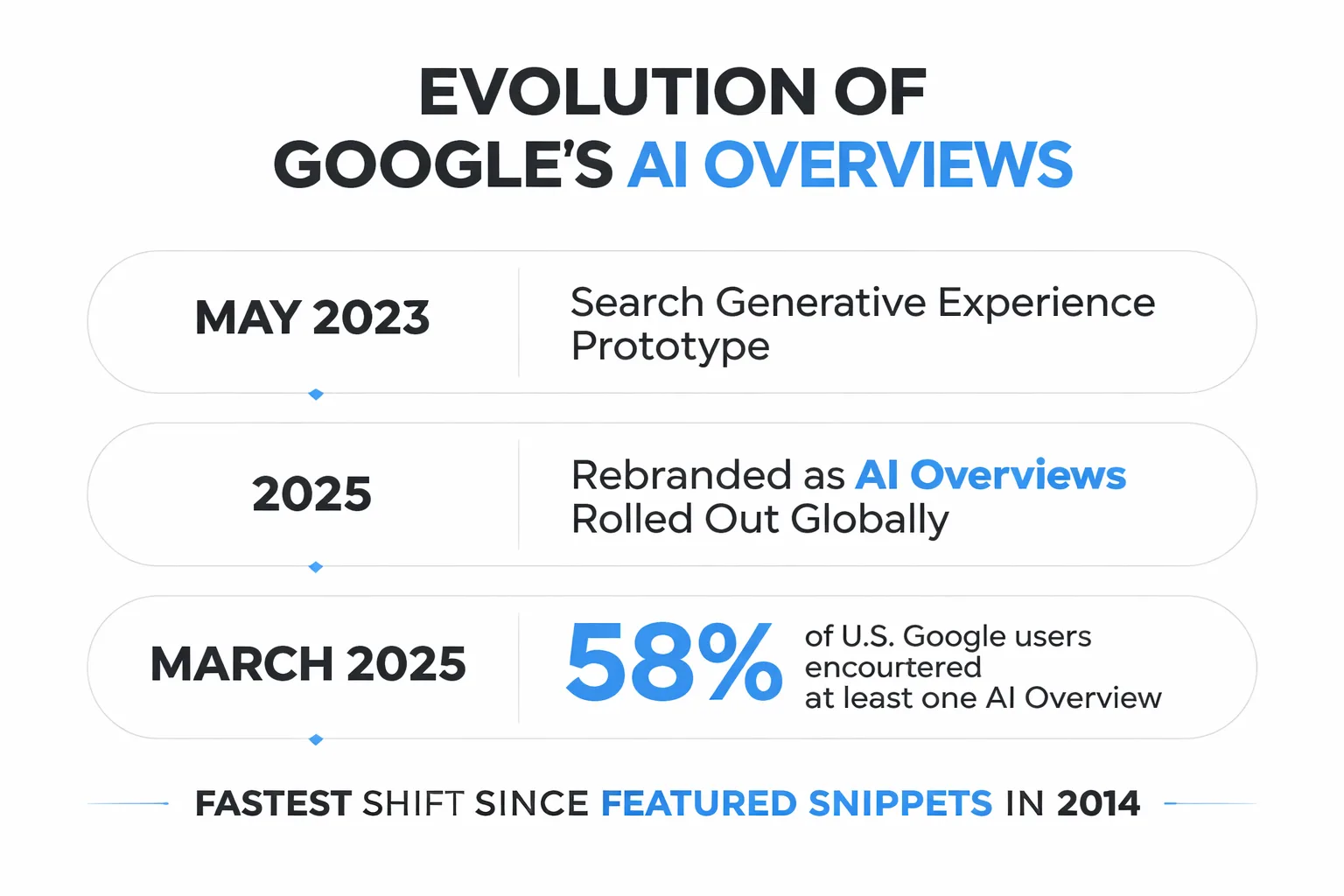
In May 2023, Google demonstrated a prototype called Search Generative Experience to a small group of testers, and most observers dismissed it as an experimental feature that would quietly disappear. It didn't. By 2025 it had been rebranded as AI Overviews, rolled out globally, and embedded into billions of queries per month. That three-year arc from cautious demo to default search behavior is the fastest structural shift Google has made to its results page since the introduction of Featured Snippets in 2014. And it demands an equally fast strategic response.
Google AI overviews optimization is no longer optional for any brand that depends on organic search. According to Pew Research Center analysis of real browsing data, 58% of U.S. Google users encountered at least one AI Overview in March 2025 — and that figure has only climbed since. Ahrefs found that AI Overviews reduce clicks to top-ranking content by 34.5%. Pages with FAQ schema get cited 40% more often than pages without structured data, per Frase's study of AI search citation patterns. And Semrush's multi-platform analysis of 230,000+ prompts found that citation dominance belongs to non-traditional SEO players. Not the domains you'd expect.
This is a battle plan for agencies, solo founders, and SMBs who want to show up in AI answers, not just traditional rankings.
The Citation Reality Nobody Talks About
Before you touch a single piece of content, you need to understand what AI Overviews actually pull from. According to Frase's analysis of AI search citation behavior, 38% of AI Overview citations come from the top 10 organic search results. That means ranking still matters. But it's a necessary condition, not a sufficient one. I've watched brands sit at position 3 for a valuable keyword and get completely excluded from the AI Overview above them, while a thinner page from a niche publisher gets cited instead. The difference wasn't domain authority. It was answer structure.
Semrush's study, which tracked over 100 million citations across ChatGPT, Google AI Mode, and Perplexity, found that citation distribution skews toward domains that are not traditional SEO powerhouses. The implication is uncomfortable: the signals that got you to page one are not the same signals that get you into the AI answer box.
That's the structural realignment you're up against.
Phase 1. Fix the Technical Floor First
No generative engine optimization strategy survives a crawlability problem. Googlebot still needs to access your pages before Gemini can summarize them. Run a site audit before anything else. Check for blocked resources in robots.txt, orphaned pages, and Core Web Vitals failures that signal poor page experience.
Three technical items that directly affect AI Overview eligibility:
1. Schema markup. The Frase FAQ schema study found a 40% citation lift for pages with properly implemented FAQ schema. That is not a marginal gain. Implement Article, FAQ, HowTo, and Speakable schema on every content page that targets informational queries. Google's own documentation confirms that structured data helps its systems understand page content. And AI Overviews are now powered by Gemini 3 as of January 2026, which means the model doing the summarizing is the same model reading your schema.
2. IndexNow + Search Console integration. New content that isn't indexed can't be cited. Auto-submitting your sitemap to Google Search Console and pinging IndexNow on every publish cuts the lag between publication and eligibility. This is something Meev handles automatically on every article publish. It's a small thing that compounds over a large content library.
3. Mobile and page experience. AI Overviews appear disproportionately on mobile queries. A page that loads in 4.2 seconds on a mid-range Android is not getting cited when a faster competitor covers the same topic.
If you want a fast diagnostic, Meev's free AI SEO audit tool will surface the on-page issues most likely to block AI Overview eligibility without requiring a full technical engagement.
How Does Content Structure Affect AI Overview Citation?
This is where most teams get it wrong. They write for human readers and assume the AI will extract the good parts. It doesn't work that way.
AI models extract from content that is already pre-formatted as an answer. The pattern I keep seeing: pages that open with a direct 40-60 word response to the implied query, then elaborate, get cited far more consistently than pages that bury the answer in paragraph three after two paragraphs of preamble. Google's Gemini is doing retrieval-augmented generation. It's looking for the passage that most directly answers the query, not the article that most comprehensively covers the topic.
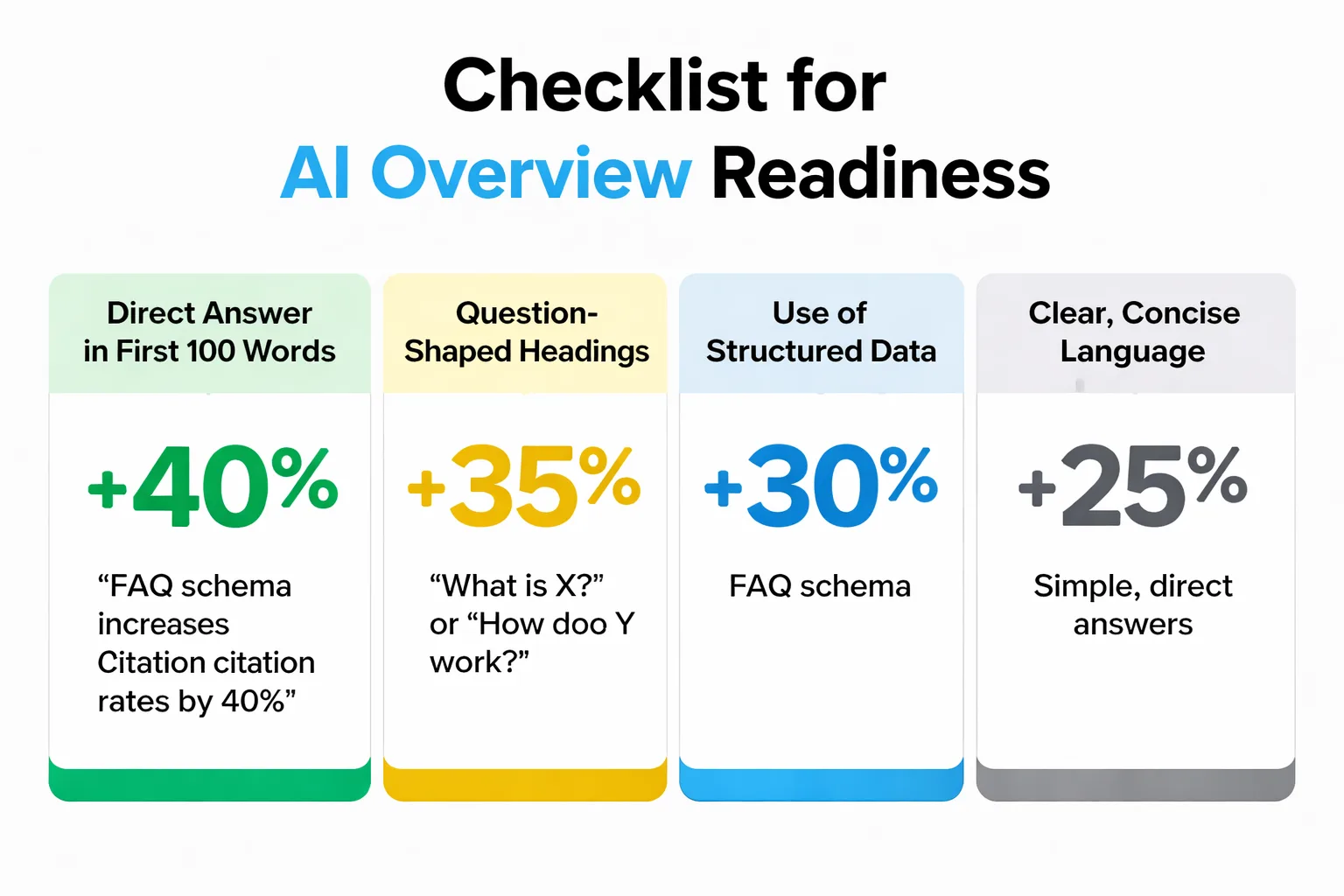
Here's the structural checklist I use when auditing content for AI Overview readiness:
- Direct answer in the first 100 words. State the answer before you explain it. "FAQ schema increases AI Overview citation rates by 40%" is extractable. "In this article, we'll explore the relationship between structured data and AI visibility" is not. - Question-shaped H2s that match conversational queries. AI Overviews trigger heavily on long-tail, question-format searches. Your headings should mirror how someone would type the question into ChatGPT. - Self-contained paragraphs. Each paragraph should make sense if extracted without the surrounding context. This is the Reddit principle: a good Reddit comment stands alone. Most brand content doesn't. - Explicit sourcing language within the body. Phrases like "according to [named study]" and "[Source] found that" are citation anchors. LLMs pattern-match to sourced claims because they're training on content where attribution signals credibility. - FAQ blocks with schema. Not just for the 40% citation lift. FAQ blocks force you to write in the question-answer format that AI engines are optimized to extract from.
The voice and structure of user-generated content is what LLMs are pattern-matching to. I rewrote two pillar pages in a more conversational, problem-first structure and saw citation pickup improve noticeably in Perplexity within weeks. The lesson isn't "write like Reddit." It's that your content needs to sound like a real person worked through a real problem. Not like a content brief got executed.
Why E-E-A-T Signals Matter (and Where They Don't)
I spent months in early 2026 chasing E-E-A-T signals. Building author bios, adding expert quotes, tightening structured data. Because that was the dominant advice for showing up in AI Overviews. It moved the needle, but not the way I expected.
Here's what actually works for E-E-A-T in the context of AI search:
Author entity profiles are real signals. Google's systems can associate content with a named author who has a verifiable web presence. Create dedicated author pages, link them to LinkedIn and published work, and use the author property in your Article schema. Meev's Author Entity profiles do this automatically, which matters at scale when you're publishing across dozens of domains.
First-hand experience language is extractable. Phrases like "in my testing," "I've seen this pattern across," and "when I audited" are signals that the content reflects genuine experience. Google's guidance on AI-generated content is explicit: it rewards content that demonstrates experience, regardless of production method. The method isn't the issue. The evidence of experience is.
Authoritative citations within your content matter. Every article should cite primary sources inline. Named studies, official documentation, research papers. This isn't just for human readers. It's a trust signal that AI models use when deciding whether your content is worth citing.
What doesn't move the needle as much as advertised: generic "About the Author" boxes with no linked credentials, expert quotes from people with no verifiable web presence, and schema markup without the content quality to back it up. Schema tells Gemini what your content is. Quality determines whether it gets cited.
For a deeper comparison of how answer engine optimization differs from traditional SEO signals, the AEO vs SEO breakdown at Meev is worth reading before you restructure your content strategy.
How Does Topical Authority Influence AI Overviews?
Topical authority for AI search works differently than topical authority for traditional SEO. In traditional SEO, you build a cluster of content around a topic and internal links signal depth to Google's crawler. In AI search, the model is asking a different question: "Does this domain consistently produce accurate, specific answers on this topic?"
Breadth without depth is penalized. A site that publishes 50 articles on "content marketing" that each cover the same surface-level points will not build topical authority with AI engines. A site that publishes 20 articles that each go one level deeper than the last. Covering specific mechanics, named case studies, and original data. Will.
The content opportunities feature I rely on most in Meev is the cited-source leaderboard: it shows which domains AI engines cite most often for your specific topics. When I see a domain consistently appearing in AI answers for queries I'm targeting, I don't just analyze their backlink profile. I read their content structure. Nine times out of ten, the cited pages have three things in common: direct answer formatting, explicit sourcing, and a level of specificity that makes them the best available answer for that exact query.
For solo founders and SMBs, the implication is counterintuitive: you don't need to out-publish large competitors. You need to out-answer them on a narrower set of topics. Pick 5-8 core topics where you can genuinely be the most specific, most sourced, most experience-backed resource. That's a winnable topical authority strategy for AI search.
If you're still calibrating your understanding of what answer engine optimization actually requires, Meev's guide on what AEO is covers the fundamentals without the fluff.
Want to see where your brand is (and isn't) showing up in AI Overviews right now?
Scaling Content Without Triggering Spam Filters
This is the tension every agency and SMB faces: AI Overviews reward fresh, specific, frequently updated content. But Google's spam policies now explicitly include "attempts to manipulate generative AI responses in Google Search." Scaled content abuse is a real penalty trigger, and it's enforced through both automated systems and human review.
The pattern that gets sites penalized isn't volume. It's undifferentiated volume. Publishing 30 articles a month that each cover the same topic from a slightly different angle, with no original data, no genuine experience signals, and no structural variation, is what Google's systems are trained to detect. Google's own guidance is consistent: production method is irrelevant; quality and originality are what matter.
The practical standard I apply: every published article needs to contain at least one thing that couldn't have been generated from a generic prompt. That could be a specific data point from your own work, a named observation from a client engagement, a structured comparison that required original research, or a direct answer to a question that existing content doesn't address well. This is what "information gain" means in practice. Not just covering a topic, but adding something to the existing conversation.
Meev's 16-dimension quality firewall blocks articles that score below 70/100 before they reach your CMS. That gate exists specifically to prevent the undifferentiated volume problem. An article that passes the quality firewall has, by definition, cleared checks for originality, sourcing, structural completeness, and E-E-A-T signals. No competitor in the auto-blog space has an equivalent gate. Most ship whatever the model produces.
For agencies managing content across multiple client domains, the AI-powered content creation platforms comparison for 2026 shows how quality-gated publishing compares to raw output approaches across the tools currently in market.
How to Track AI Visibility and Measure What's Working
This is where most teams are flying blind. You can't optimize for google ai overviews optimization if you don't know when you're appearing in them, where in the answer your brand shows up, or which competitors are getting cited instead of you.
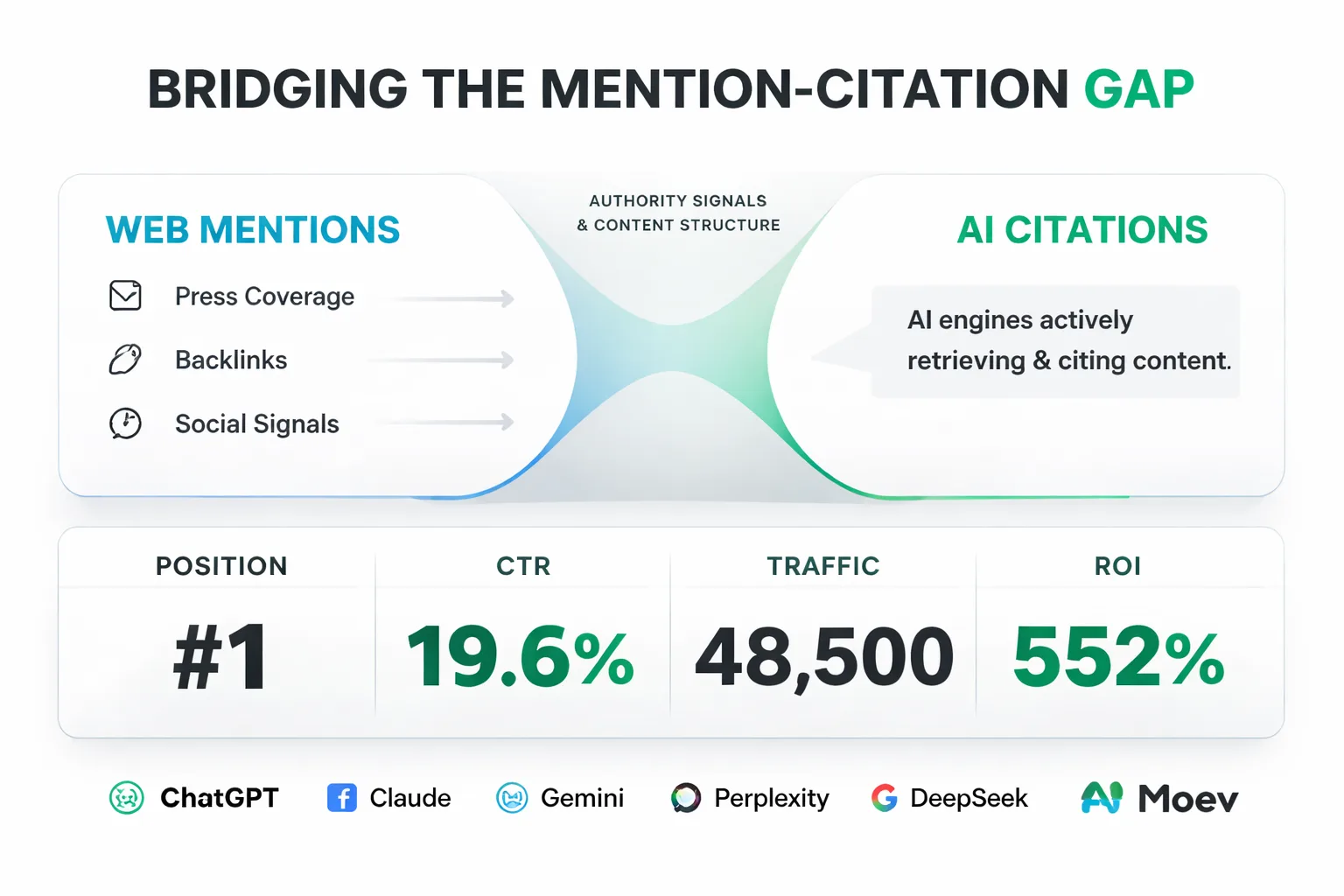
The mention-citation gap is the metric I care about most. Your brand might be mentioned across the web. Press coverage, backlinks, social signals. But that doesn't mean AI engines are citing you. The gap between web mentions and actual AI citations tells you whether your content structure and authority signals are converting passive presence into active retrieval.
Meev tracks brand mentions across every major AI search surface. ChatGPT, Claude, Gemini, Perplexity, Grok, Google AI Overviews, AI Mode, DeepSeek. With daily refresh on SERP-driven surfaces. The per-LLM drill-down dashboards show where in each AI answer your brand appears (first, in a list, last), which matters because position within an AI answer correlates with click-through on the citations. You can also see the actual response text and citations behind every mention, which is the only way to understand why you're being cited. Or why you're not.
For Perplexity specifically, Meev's Perplexity AI visibility checker gives you a direct read on citation frequency without requiring a full platform subscription. Perplexity is worth tracking separately because its citation behavior differs meaningfully from Google AI Overviews. It pulls more aggressively from niche publishers and real-time sources.
The AI visibility tool overview walks through the full tracking architecture if you want to understand what a complete measurement setup looks like before committing to a platform.
Where This Strategy Breaks Down
I want to be honest about the limits of this playbook, because most how-to guides on AI Overview optimization don't acknowledge them.
It doesn't work for brand-new domains. AI Overviews draw heavily from the top 10 organic results, and 38% of citations come from pages that already rank. If your domain has no ranking history, no backlink profile, and no indexed content, the content structure and schema optimizations in this guide will not produce citations in the near term. You need the organic foundation first. This is a 6-12 month build, not a 30-day sprint.
Citation building is less reliable than it sounds. The Tow Center ran 1,600 test queries and found AI search engines returned inaccurate or missing citations over 60% of the time, even for content that was correctly indexed and attributed. I tried publisher placement as a primary AI visibility lever and the results were inconsistent in a way that SEO link building never was. You can verify a backlink exists. You cannot verify an LLM will surface it. Publisher outreach has brand value, but positioning it as a guaranteed AI visibility tactic is overselling what the technology can deliver.
Topical authority takes time to register. The self-learning engine and content depth signals that drive AI citation accumulate over months of consistent publishing. Teams that publish 10 articles and expect AI Overview citations within a month will be disappointed. The compound effect is real. But it requires patience that most campaign timelines don't accommodate.
Frequently Asked Questions
Does organic ranking position still affect AI Overview citation in 2026?
Yes, but it's not deterministic. Frase's analysis found 38% of AI Overview citations come from the top 10 organic results, which means ranking matters as a baseline. But pages at position 3 regularly get excluded while position 8 pages with better answer structure get cited. Ranking gets you eligible. Content structure determines whether you're selected.
How often does Google update which sources appear in AI Overviews?
AI Overviews are generated dynamically for each query, so there's no fixed update cycle. The sources cited can change query-by-query based on freshness, relevance, and the specific phrasing of the search. This is why daily tracking across AI surfaces matters. A citation you had last week may not be there today, and a competitor may have entered the answer set without any change to their ranking.
Is AI-generated content penalized in AI Overviews?
Not inherently. Google's guidance is explicit that production method is not the determining factor. Quality and originality are. What gets penalized is scaled content that lacks original information, genuine experience signals, and differentiation from existing content. A quality-gated AI article that contains original data, explicit sourcing, and direct answer formatting is eligible for AI Overview citation. A generic AI article that rehashes existing content is not.
How is generative engine optimization different from traditional SEO?
Traditional SEO optimizes for crawler signals: keyword placement, backlink authority, page experience. Generative engine optimization optimizes for extraction signals: direct answer formatting, entity clarity, self-contained paragraphs, and sourcing language that AI models use to assess credibility. The overlap is real. You need to rank to be eligible. But the content-level tactics are meaningfully different. The AEO vs GEO comparison covers the distinction in detail.
What's the fastest way to audit my current AI Overview visibility?
Start with a prompt-by-prompt check: take your 10 most important target queries, run them in Google, and record whether an AI Overview appears and whether your domain is cited. Then cross-reference with a tool that tracks AI citations at scale. Meev's free AI SEO audit will identify the structural gaps most likely to be blocking citation eligibility. Schema issues, answer formatting problems, and E-E-A-T signal gaps. Without requiring a full platform setup.
Can small sites compete with large publishers for AI Overview citations?
Yes, on specific queries. AI Overviews don't exclusively cite high-DA domains. Semrush's multi-platform study found non-traditional domains dominating citation leaderboards for specific topic clusters. The strategy for smaller sites is narrower topical focus: pick 5-8 topics where you can be genuinely more specific and experience-backed than larger competitors. On those queries, content quality and answer structure will outperform domain authority.
About the Author
Judy Zhou, Founder
Judy Zhou leads content strategy at Meev, where she oversees AI-driven content research and publishing for hundreds of brands. With a background in SEO and editorial operations, she focuses on building content systems that rank on Google, get cited by AI search engines, and drive measurable business results.
Run a free AI SEO audit on your site and find the exact schema gaps, answer-formatting issues, and E-E-A-T signals blocking your AI Overview citations — before your competitors fix theirs.