

By Judy Zhou, Head of Content Strategy
Key Takeaways
- Keyword competitive analysis reveals four outputs most teams ignore: gap keywords, difficulty benchmarks specific to your niche, SERP intent patterns, and AI citation gaps where competitors are cited by LLMs but you aren't.
- Use an opportunity score (volume divided by keyword difficulty) with a difficulty ceiling based on your domain rating — keywords above difficulty 60 are rarely worth targeting for domains under DR 50.
- Ahrefs' study of 75,000+ brands found that topical depth — multiple interconnected pieces on a subject — drives AI citation frequency more reliably than domain authority or backlink count alone.
- Publishing at volume without quality controls backfires: one documented case of 100 AI-generated posts per hour with zero human editing resulted in ranking declines, not traffic gains.
"The brands that win in AI search aren't necessarily the ones with the most backlinks. They're the ones with the clearest topical authority signals," Rand Fishkin noted in a 2024 SparkToro analysis on zero-click search trends. It's a distinction that cuts to the heart of why keyword competitive analysis has become so much harder. And so much more important. In the past eighteen months. Understanding which competitors own a topic in the eyes of an LLM requires a different methodology than traditional rank-gap analysis. This guide gives you that methodology.
In my work overseeing content strategy across hundreds of brands at Meev, the single most common reason a content program stalls isn't bad writing or slow publishing. It's that the team skipped a real keyword competitive analysis before building their editorial calendar. They picked topics based on intuition, published into crowded SERPs without understanding why competitors ranked, and wondered why nothing moved. The five-step process below fixes that. And it extends the analysis into AI search visibility, because in 2026, ranking on Google and getting cited by ChatGPT or Perplexity are two different problems that require two different lenses.
What a Keyword Competitive Analysis Actually Tells You
Keyword competitive analysis is the process of identifying which search terms your competitors rank for, which ones you don't, and why the gap exists. So you can close it strategically. It goes well beyond finding "keywords to target." Done properly, it reveals difficulty benchmarks specific to your niche (not generic tool scores), content format patterns that dominate your SERPs, and the mention-citation gap between what AI engines discuss and what they attribute to you.
Most practitioners treat this as a one-time export from Ahrefs or Semrush. That's wrong. The analysis has four distinct outputs that each inform a different decision:
1. Gap keywords — terms competitors rank for that you don't appear for at all 2. Difficulty benchmarks — what DR/DA range is actually winning in your niche, not the tool's abstract score 3. Intent mapping — whether the SERP for a given keyword rewards informational content, product pages, or comparison pieces 4. AI citation patterns — which of your competitors are being cited by ChatGPT, Perplexity, and Google AI Overviews for the same topics, and what those citations link to
That fourth output is the one most teams ignore entirely. Generative Engine Optimization (GEO) and traditional SEO aren't the same workflow, but the competitive research that feeds them overlaps significantly. If a competitor ranks #3 for "project management software for agencies" AND gets cited in Perplexity's answer to that query, you need to understand both facts before you decide whether to compete.
Step 1. 2: Identify Your Real Competitors and Pull Their Keyword Data
Your business competitors and your search competitors are often different companies. A well-funded direct competitor with a weak blog may rank for nothing relevant. A niche publisher you've never heard of may dominate every informational query in your space. Start with search competitors, not CRM contacts.
How to find your actual search competitors: Enter your 3-5 core product or service keywords into Google Keyword Planner and note which domains appear consistently in the top 10. Run the same terms through Ahrefs or Semrush and use the "Competing Domains" or "Organic Competitors" report. Export the top 10 domains by keyword overlap. That list is your real competitive set for this analysis.
Once you have your competitor list, pull keyword data for each domain. The specific data points you need per competitor:
- All keywords ranking positions 1-20 (not just page 1) - Monthly search volume per keyword. Keyword difficulty score (treat this as relative, not absolute) - SERP features present (AI Overviews, featured snippets, People Also Ask boxes) - Estimated organic traffic per keyword. URL that ranks (to understand content format)
For the AI search layer, this is where tools diverge significantly. Standard SEO platforms don't track LLM citations. To understand which of your competitors are being cited in ChatGPT or Perplexity responses for competition keywords, you need a dedicated AI search visibility tool that monitors citation patterns across AI engines. The gap between what ranks on Google and what gets cited by an LLM is real and often significant.
Export everything to a spreadsheet. Don't filter yet. The filtering happens in steps 3 and 4.
Step 3. 4: Find the Gaps and Score Opportunities
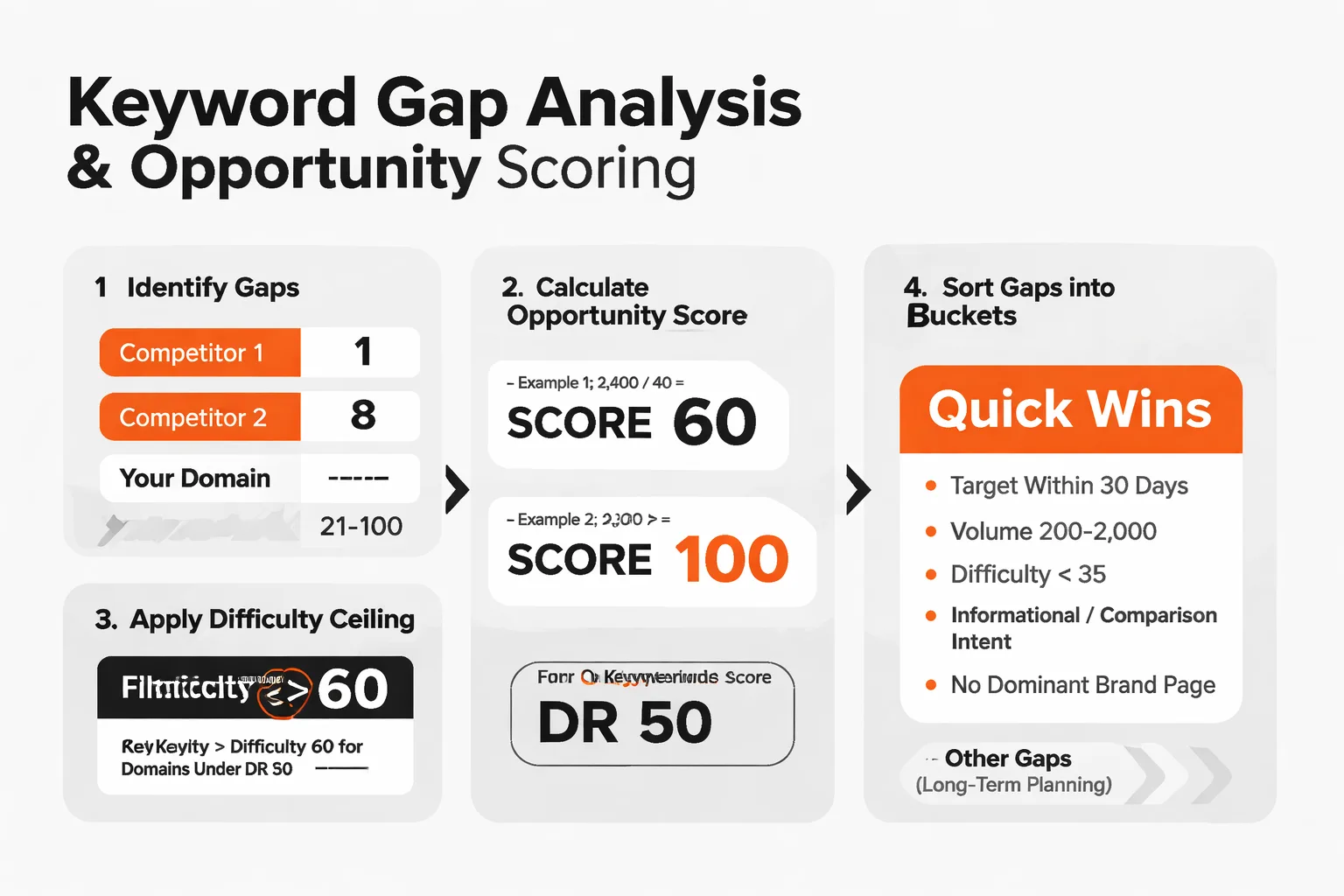
This is where the analysis earns its keep. You're looking for keywords where one or more competitors rank in positions 1-20 and your domain doesn't appear at all. That's a gap. Not every gap is worth pursuing.
The opportunity score formula I use: divide monthly search volume by keyword difficulty score. A keyword with 2,400 monthly searches and a difficulty of 40 scores 60. A keyword with 8,000 monthly searches and a difficulty of 80 scores 100. But the second one requires significantly more authority to compete for, so the raw score is misleading without a difficulty ceiling. I filter out any keyword with difficulty above 60 for domains under DR 50. Above that threshold, you're competing on authority you don't have yet, and the analysis becomes wishful thinking.
After applying the difficulty ceiling, sort your remaining gaps into two buckets:
Quick wins (target within 30 days): Volume 200-2,000, difficulty under 35, informational or comparison intent, no dominant brand pages in the top 5. These are the keywords where a well-structured piece from a mid-authority domain can rank within 60-90 days. They're also often the keywords that appear in AI Overviews, because Google pulls from informational content for those features.
Long-term plays (target in 90-180 days): Volume 2,000+, difficulty 35-60, mixed or commercial intent, top 5 dominated by high-DR domains but with content that's 2+ years old. These require more investment. Longer content, more internal linking, external citation building. But they're where the compounding traffic lives.
Now add the AI citation layer. For each gap keyword, run it through a tool that tracks ChatGPT visibility and Perplexity source selection. Which domains are being cited in AI answers for this query? If a competitor ranks #4 on Google AND gets cited in 70% of Perplexity responses for the same term, that's a different level of competitive moat than a competitor who ranks #4 but never appears in LLM outputs. The mention-citation gap. The difference between who ranks and who gets cited by AI. Is one of the most underanalyzed dimensions in SEO competitor research right now.
A specific finding that changed how I prioritize gaps: Ahrefs studied 75,000+ brands and millions of AI citations across ChatGPT, Google AI Overviews, Perplexity, and Gemini to understand topical authority and citation patterns. The consistent signal wasn't domain authority or backlink count. It was topical depth. Domains that covered a subject area with multiple interconnected pieces were cited more reliably than domains with one strong post on a topic. That means your gap analysis should cluster keywords by topic, not treat each keyword as an isolated opportunity.
Step 5: Turn Gap Keywords Into a Publishing Plan
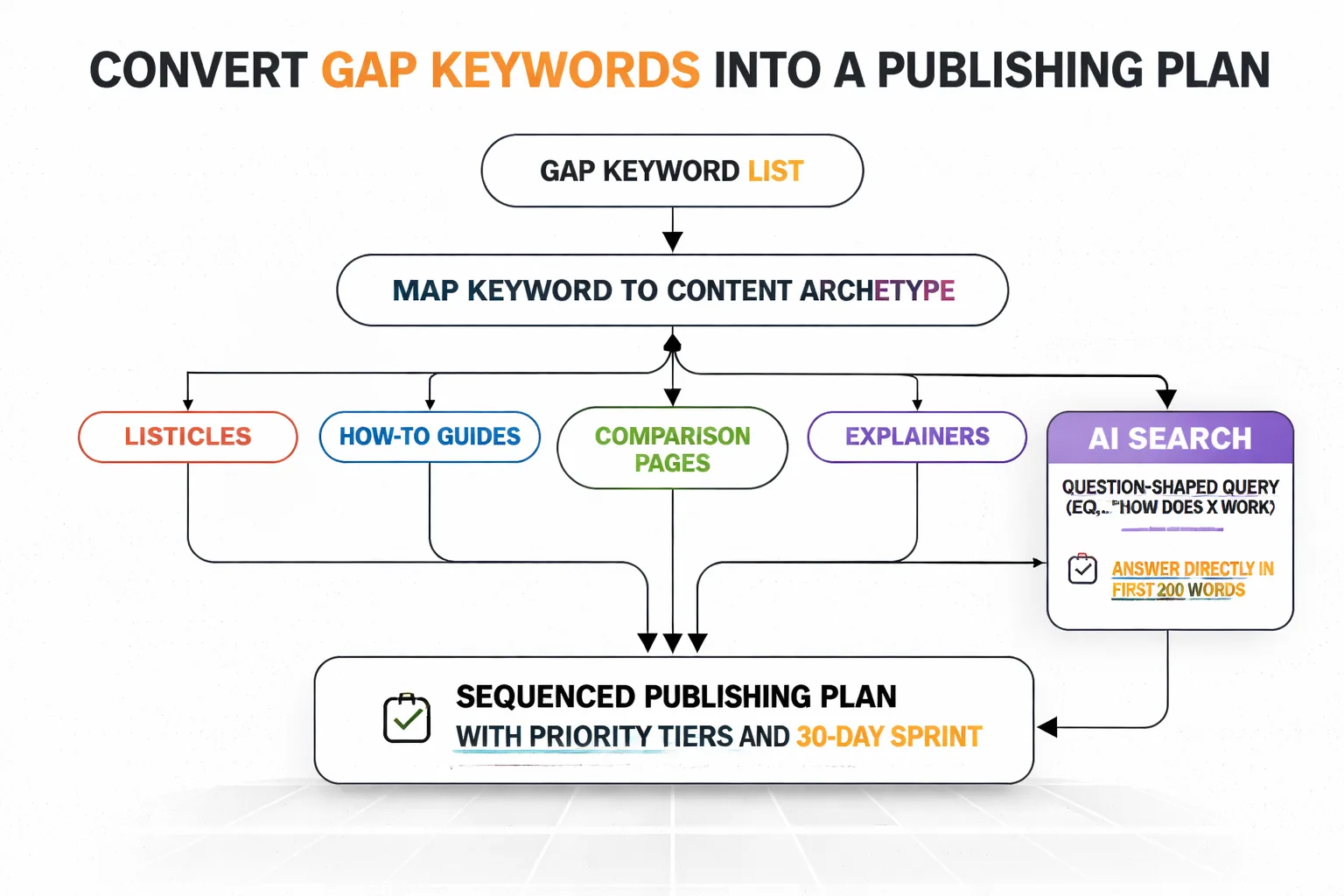
A spreadsheet full of gap keywords isn't a strategy. The final step is converting that list into a sequenced publishing plan with assigned content archetypes, priority tiers, and a realistic 30-day sprint.
Map each gap keyword to a content archetype first. The archetype is determined by SERP intent, not by your preference. Look at the top 5 results for each keyword and ask: are these listicles, how-to guides, comparison pages, or definition-first explainers? Whatever format dominates the top 5 is the format Google has decided satisfies that query's intent. Publishing a 3,000-word how-to guide into a SERP where the top 5 are all listicles is a structural mismatch, and it rarely works.
For AI search specifically, the archetype question matters differently. Perplexity and ChatGPT tend to cite sources that answer a specific question directly in the first 200 words. If your gap keyword maps to a question-shaped query ("how does X work," "what is the best Y for Z"), the content that wins AI citations usually leads with a direct answer, then elaborates. That's not a coincidence. It's how retrieval-augmented generation (RAG) systems pull source material.
Once archetypes are assigned, tier your keywords:
- Tier 1 (publish weeks 1-2): Quick wins with clear informational intent, difficulty under 30, no strong brand competitors in top 5 - Tier 2 (publish weeks 3-4): Quick wins with slightly higher difficulty or comparison intent that require a more structured brief - Tier 3 (plan for month 2+): Long-term plays that need internal link support before publishing will be effective
For the actual publishing workflow, this is where a quality-gated auto-publishing system earns its keep. Meev's content generation pipeline includes a 16-dimension quality firewall that blocks articles scoring below 70/100 before they reach your CMS. Which means you can run a 30-day sprint without manually reviewing every draft for basic quality signals. The system also handles internal linking with archetype-aware anchor placement, which matters for the topical clustering that drives AI citation frequency.
One thing I've learned the hard way: don't publish all your Tier 1 keywords in week 1. Stagger them across the sprint so you can monitor early performance signals (impressions, click-through rate in Search Console) before committing the same format to week 2. If your first three pieces show strong impressions but weak CTR, that's a title and meta description problem you can fix before scaling.
Want to see which competitors are getting cited by ChatGPT and Perplexity for your target keywords — before you build your publishing plan?
Common Mistakes That Waste the Whole Analysis
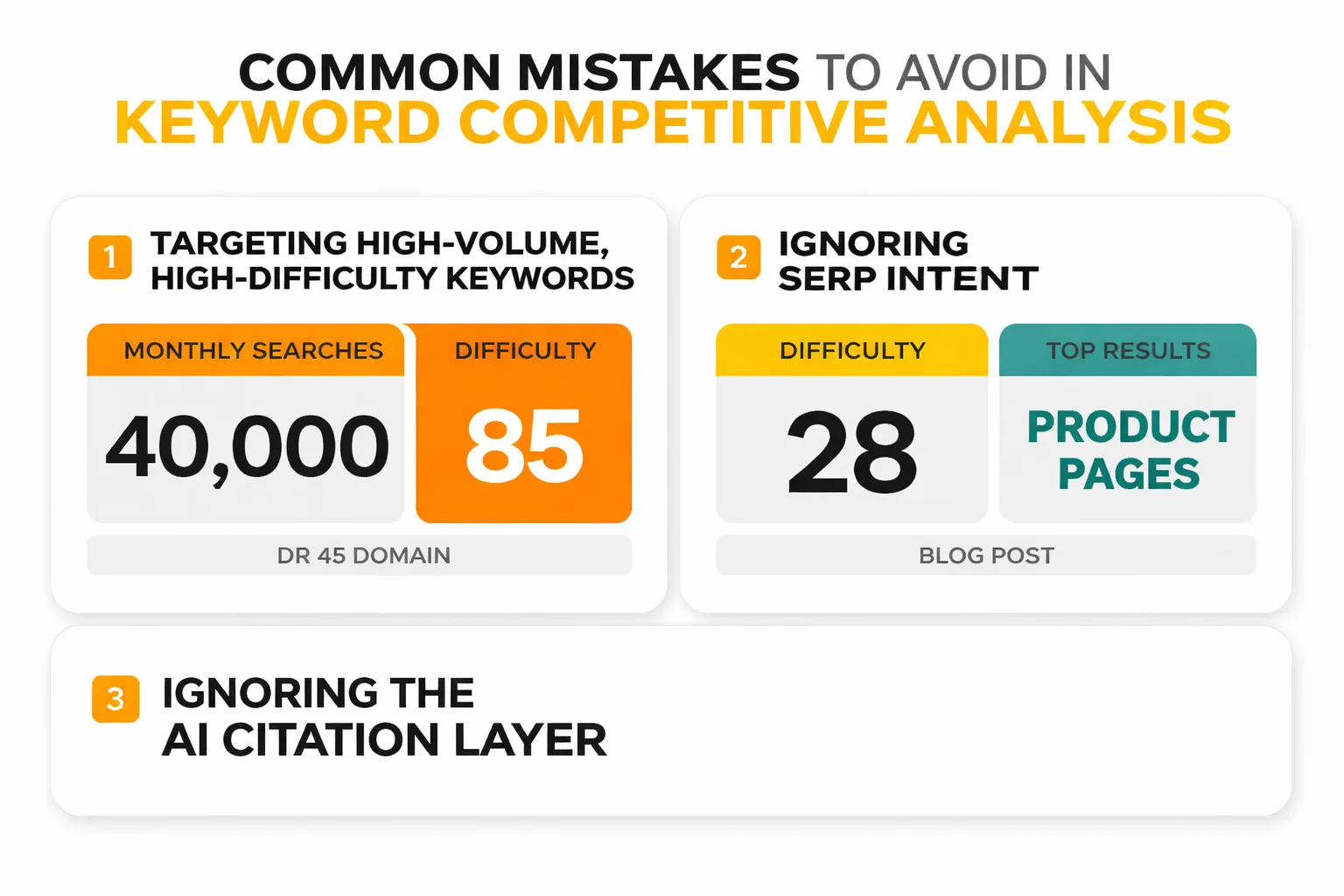
The most expensive mistake is targeting high-volume, high-difficulty keywords because they look impressive in a report. A keyword with 40,000 monthly searches and a difficulty of 85 is not an opportunity for a DR 45 domain. It's a distraction. I've watched content teams spend six months producing content for terms they had no realistic path to ranking for, while ignoring 200-volume keywords with difficulty scores under 25 that would have driven qualified traffic within 60 days.
The second mistake is ignoring SERP intent. Keyword difficulty scores from tools like Ahrefs' Keyword Difficulty Checker measure competition, not fit. A keyword might have a difficulty of 28, but if the top 5 results are all product pages from e-commerce giants and you're publishing a blog post, you're not competing on an even playing field regardless of the score. Always look at the actual SERP before assigning a keyword to your plan.
The third mistake is the one most teams aren't even aware they're making: failing to account for AI search visibility alongside traditional rankings. In 2026, a competitor who ranks #6 on Google but gets cited in 80% of Perplexity answers for a query has a different competitive position than their Google rank suggests. If your keyword competitive analysis only looks at Google positions, you're missing a significant portion of the competitive picture. Tools that track Claude visibility and other LLM citation patterns alongside traditional rankings give you the full picture.
There's also the scale-without-quality trap. Jessica Bowman documented a case where a team attempted to publish 100 posts per hour using AI with zero human editing or quality benchmarking. The result wasn't a traffic surge. It was a ranking decline. The decision-makers assumed volume would compensate for quality until the data proved otherwise. Competitor analysis without a quality gate on your publishing output is like mapping a route and then driving with flat tires.
Finally: doing the analysis once and treating it as permanent. Competitive keyword landscapes shift. A competitor that ranked nowhere for your target terms six months ago may have published a content cluster that now dominates the SERP. Run a fresh competitor keyword pull at minimum every quarter, and check AI citation patterns monthly. LLM source selection changes faster than Google rankings do.
Why Most Teams Skip the AI Citation Layer
Here's the contrarian take: most practitioners skip AI citation analysis in their keyword competitive analysis not because they don't know it matters, but because the data is genuinely hard to get at scale. Traditional SEO tools give you a clean export. AI citation data requires querying multiple LLMs, logging responses, and tracking which sources appear. A workflow that doesn't exist in most SEO platforms.
But skipping it has real costs. The Previsible State of AI study analyzed 1.96 million LLM sessions and found that AI traffic, while representing less than 1% of total organic sessions, disproportionately lands on high-value pages: pricing pages, industry comparison pages, tool evaluation pages. Those are the pages where a competitor being cited instead of you has direct pipeline implications, not just traffic implications.
The practical fix isn't to build a custom tracking system. It's to run your top 20 gap keywords through a dedicated AI search visibility platform that logs citation patterns across ChatGPT, Perplexity, Google AI Overviews, and other surfaces. Do this once as part of your competitive analysis, then set up monitoring for the keywords you decide to target. You don't need to track everything. You need to track the terms where AI citation would actually move the needle for your business.
For teams comparing platforms to handle this, the feature set varies significantly. Some tools track mentions but not citation position. Others track Google AI Overviews but not Perplexity or ChatGPT. A full-picture competitive analysis in 2026 requires citation tracking across at least three AI surfaces to be meaningful.
Frequently Asked Questions
How often should I run a keyword competitive analysis?
For most content programs, quarterly is the right cadence for a full competitive keyword pull. Monthly is appropriate if you're in a fast-moving niche (AI tools, fintech, health) or if a competitor has recently published aggressively. AI citation patterns change faster than Google rankings, so check those monthly even if you only refresh the full keyword analysis quarterly.
What's the minimum number of competitors I should analyze?
Analyze at least 5 search competitors, not business competitors. Use the "Competing Domains" report in Ahrefs or Semrush to find domains with the highest keyword overlap with your site. Three is too few to identify reliable patterns. More than 10 creates noise without adding insight. Five to seven is the practical range for most content programs.
Does keyword difficulty score mean the same thing across different tools?
No. Ahrefs, Semrush, and Moz each calculate keyword difficulty differently, and the scores aren't interchangeable. Ahrefs weights the backlink profiles of ranking pages heavily. Semrush factors in more on-page signals. The scores are useful for relative comparison within a single tool, not for cross-tool benchmarking. Pick one tool and use it consistently across your analysis.
How do I know if a gap keyword is worth targeting for AI citations specifically?
Look at the query shape. Question-format queries ("what is," "how does," "best X for Y") are cited by AI engines at higher rates than navigational or transactional queries. If a gap keyword is question-shaped, has informational intent, and your competitor's ranking content is more than 18 months old, it's a strong candidate for both traditional ranking and AI citation. Check the actual AI response for that query in Perplexity or ChatGPT to see which sources currently appear.
Can I do a keyword competitive analysis without paid tools?
Partially. Google Search Console shows you which queries your own site ranks for, and Google Keyword Planner provides volume data. But identifying what competitors rank for requires a tool with a crawled keyword index. You can't do that reliably with free tools alone. Most paid platforms offer trial access. Running a full competitive analysis during a trial period, exporting the data, and then canceling is a legitimate approach for teams with tight budgets.
How does topical authority affect which gap keywords I should prioritize?
Topical authority means covering a subject area with depth and interconnection, not just publishing one strong post. When you identify gap keywords, cluster them by topic before assigning priority. If you have 12 gap keywords that all relate to "email marketing automation," publishing 4-5 interconnected pieces on that cluster will build more topical authority than publishing 12 isolated posts across 12 different topics. This clustering approach also improves AI citation frequency, since LLMs are more likely to cite domains that demonstrate consistent depth on a subject.
About the Author
Judy Zhou, Head of Content Strategy
Judy Zhou leads content strategy at Meev, where she oversees AI-driven content research and publishing for hundreds of brands. With a background in SEO and editorial operations, she focuses on building content systems that rank on Google, get cited by AI search engines, and drive measurable business results.
Run your first AI citation competitive analysis with Meev and find the mention-citation gaps your traditional SEO tools are missing.