
By Judy Zhou, Head of Content Strategy
Key Takeaways
- HubSpot's AEO case study shows a 1,850% increase in qualified leads from AI answer engines, converting at 3x the rate of other sources with 433% citation growth.
- Semrush research confirms top AI SEO tools save significant hours on research, content creation, and reporting, varying by platform and workflow.
- Prioritize 2026 AI visibility tools with deep LLM citation tracking, built-in content creation, and AEO/GEO features to drive measurable visibility lifts.
- Account for trending signals like Google-Extended blocking and forum structured data, as LLM inputs evolve rapidly.
Your brand is invisible to AI search — and you don't even know it.
The best ai visibility tools in 2026 aren't just dashboards that tell you whether ChatGPT mentioned your brand last Tuesday. They're systems that close the loop between citation tracking, content creation, and measurable visibility lift. AI engines now influence a significant share of purchase research, and the brands winning those citations didn't get there by accident. HubSpot's AEO case study documents a 1,850% increase in qualified leads from AI answer engines — with those leads converting at 3x the rate of other sources and citations rising 433%. Semrush's research confirms that AI SEO tools save meaningful hours on research, content, and reporting — though the actual time savings vary widely by platform and workflow. Google-Extended blocking and structured data for forums are both trending signals that AI visibility platforms now need to account for, because the inputs feeding LLMs are changing fast.
If you want to understand the strategic difference between optimizing for AI answer engines versus traditional search, AEO vs. SEO is worth reading first — it frames why these tools exist at all. Below, I've evaluated 10 platforms across the features that actually matter for 2026: citation depth, content integration, pricing accessibility, and whether the tool helps you act on data or just stare at it.
The Feature Matrix — 10 Tools Side by Side
| Tool | LLMs Tracked | Content Creation | Starting Price | Free Tier/Trial | Best For |
| Meev | 5 + Google AI Overviews | ✅ Yes (gated publish) | $59/mo | ✅ Free forever | Teams wanting tracking + publishing |
| Profound | 10+ | ❌ No | Custom | ❌ No | Enterprise / regulated industries |
| Semrush AI Toolkit | 7+ | ✅ ContentShake AI | $99/mo add-on | ❌ No | Existing Semrush users |
| Peec AI | 5 | ❌ No | €89/mo | ❌ No | Growth-stage teams |
| OtterlyAI | 3 | ❌ No | $29/mo | ❌ No | SMBs and freelancers |
| Scrunch | 6 | ✅ Optimize layer | $250/mo | ❌ No | Mid-market / agencies |
| AIclicks | 6 | ✅ AI agents | On request | ❌ No | End-to-end AEO workflow |
| AthenaHQ | Multi-engine | ❌ No | Custom | ❌ No | Enterprise demand-gen |
| Writesonic | Major platforms | ✅ Yes (primary feature) | $16/mo | ❌ No | High-volume content + GEO |
| Ahrefs Brand Radar | 4 (full coverage add-on) | ❌ No | $129/mo (Lite) | ❌ No | Existing Ahrefs users |
1. Meev — Best for Teams That Want Tracking and Publishing in One Place
Best for: Teams that want AI citation tracking plus a content engine they can trust to publish — not just a dashboard that surfaces problems. Differentiated by the 12-dimension Quality Matrix and Google Penalty Risk Matrix that gate every article before it ships.
Meev is the only platform in this list that treats citation tracking and content creation as one closed loop rather than two separate problems. The core proposition: know exactly where you're invisible to AI engines, then ship the content that fixes it — with quality gates that prevent the slow-bleed indexation problem I've seen kill otherwise solid content programs.
Key features: - Citation tracking across ChatGPT, Claude, Gemini, Perplexity, and Grok with hybrid daily / 2×-week cadence - 12-dimension Quality Matrix plus Google Penalty Risk Matrix — 70/100 publish gate on both - Knowledge Base enforcement — articles grounded in your approved claims, not AI hallucination - Closed-loop Citation Path (roadmap) — each article mapped to the citation-rate delta it drove - Autopilot topic pool with gap detection from competitor citation patterns
Pricing: Free forever tier. Starter $59/mo, Pro $199/mo, Agency $549/mo. 20% annual discount. 30-day money back guarantee on paid plans.
The quality gate is what separates Meev from tools that just publish AI output and hope for the best. SE Ranking ran a 16-month experiment publishing 2,000 AI-generated pages and found that while 71% indexed within the first month, authority quietly eroded over the following year — the failure mode isn't a penalty, it's a slow bleed. Meev's 70/100 publish gate exists specifically to prevent that. For teams managing content at scale, that's not a nice-to-have.
2. Profound — Best for Enterprise Teams in Regulated Industries
Best for: Enterprise marketing and SEO teams in regulated industries (healthcare, finance, e-commerce) that need the deepest, most secure multi-engine AI visibility data available.
Profound is the category leader for raw citation depth. It processes 5M+ citations daily via direct consumer-interface monitoring — not API samples — which means the data reflects how real users actually encounter your brand in AI-generated answers, not how a test query in a controlled environment behaves. That distinction matters more than it sounds.
Key features: - Processes 5M+ citations daily via direct consumer-interface monitoring (not API samples) - Conversation Explorer with 400M+ real user prompts for demand intelligence - SOC 2 Type II and HIPAA compliance with dedicated strategist support - Profound Workflows automation layer for AI-era content operations at scale
Pricing: Custom enterprise pricing; contact sales for multi-brand and agency plans. No free trial available.
The tradeoff is accessibility. No free trial, a full sales process before you see the product, and a steep learning curve that can slow onboarding for agencies needing fast client-facing dashboards. If you're a 5-person content team, Profound is almost certainly overkill. If you're a healthcare brand managing compliance risk while trying to win AI citations, it's probably the right call.
3. Semrush AI Visibility Toolkit — Best for Existing Semrush Users
Best for: Marketing teams and agencies already using Semrush for traditional SEO who want to add AI visibility tracking without adopting a new vendor or data pipeline.
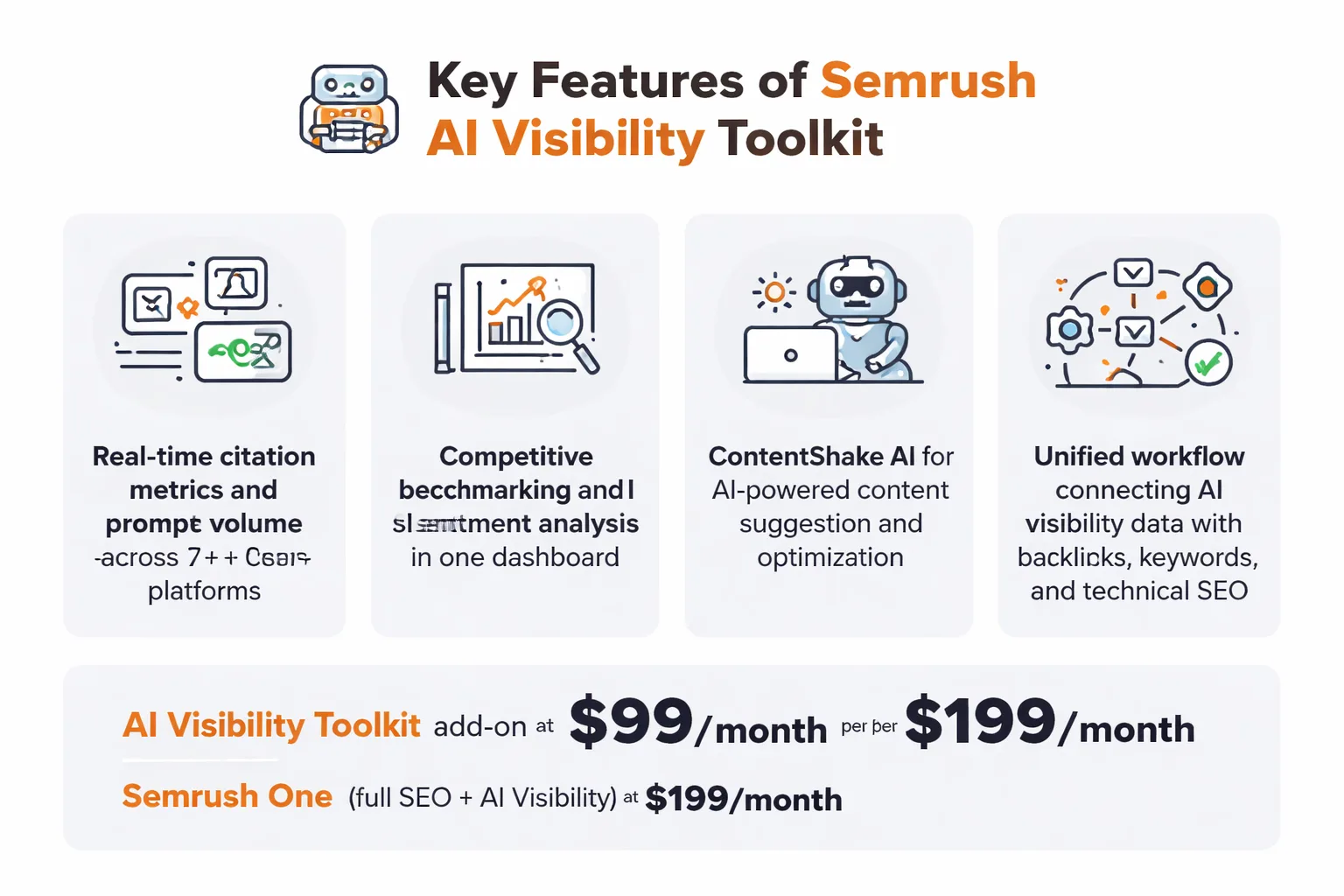
Semrush added AI visibility as a layer on top of its existing SEO infrastructure, and for teams already inside that ecosystem, the unified workflow is genuinely useful. You get citation metrics, competitive benchmarking, and ContentShake AI for content suggestions — all in one dashboard alongside backlinks, keywords, and technical SEO data.
Key features: - Real-time citation metrics and prompt volume analysis across 7+ AI platforms - Competitive benchmarking and AI sentiment analysis in one dashboard - ContentShake AI for AI-powered content suggestion and optimization - Unified workflow connecting AI visibility data with backlinks, keywords, and technical SEO
Pricing: AI Visibility Toolkit add-on starts at $99/month per domain; Semrush One (full SEO + AI Visibility) starts at $199/month; Enterprise AIO is custom pricing.
The honest limitation: full AI model coverage (Claude, Grok) requires more expensive add-ons, and the AI visibility features feel bolted onto the SEO platform rather than purpose-built for GEO/AEO. If your primary need is traditional SEO with AI visibility as a secondary signal, Semrush is the obvious choice. If AI citation tracking is your core problem, a purpose-built tool will serve you better.
4. Peec AI — Best for Growth-Stage Marketing Teams
Best for: Growth-stage marketing teams and agencies that want metrics-driven AI visibility decision support without the complexity or cost of an enterprise stack.
Peec AI is clean, fast, and focused. It tracks brand mentions, citations, sentiment, and competitor share of voice across major LLMs, and it surfaces that data in shareable dashboards that don't require a 30-minute onboarding call to interpret. The MCP and API integrations are a genuine differentiator for teams that want to pipe visibility data into existing workflows.
Key features: - Multi-engine AI visibility tracking across ChatGPT, Gemini, Claude, Perplexity, and Copilot - Competitor rankings and market share analysis with citation delta tracking over time - MCP and API integrations to connect with Claude, Cursor, n8n, and custom workflows - Shareable client-ready dashboards and clean CSV exports for flexible reporting
Pricing: Starter plan from €89/month (up to 25 prompts, ~2,250 answers/month, unlimited seats); Pro plan at €199/month (up to 100 prompts, ~9,000 answers/month, Slack support).
The prompt volume caps on lower tiers are a real constraint for brands with large keyword footprints — if you're tracking 50+ topics, you'll hit the ceiling fast. And Peec is monitoring-only: there's no built-in content creation or optimization to act on what you find. Treat it as a strong analytics layer that feeds into a separate content workflow.
5. OtterlyAI — Best for SMBs and Freelancers
Best for: Small-to-mid-sized agencies, startups, and freelancers that need straightforward LLM monitoring with actionable alerts at an accessible price point.
At $29/month, OtterlyAI is the most accessible entry point in the category. It monitors brand mentions daily across ChatGPT, Google AI Overviews, and Perplexity, flags visibility drops, and surfaces competitive share-of-voice data in a dashboard that doesn't require a data analyst to interpret.
Key features: - Daily brand mention monitoring across ChatGPT, Google AI Overviews, and Perplexity - Brand mention frequency, positioning data, and competitive share-of-voice tracking - Clean, accessible multi-brand dashboard suited to agency account management - Actionable flagging system that highlights visibility drops and citation opportunities
Pricing: Plans start at $29/month, making it one of the most accessible entry points in the category; higher tiers available for agencies and larger teams.
The tradeoff at this price point is coverage breadth. OtterlyAI tracks three AI platforms versus the six or more you get with enterprise tools, and the citation attribution and sentiment analysis are less granular than what Profound or Semrush deliver. For a freelancer or early-stage startup that just needs to know whether AI engines are mentioning them at all, it's the right tool. For a brand managing multi-market visibility, you'll outgrow it.
6. Scrunch — Best for Mid-Market Brands and Agencies
Best for: Mid-market and enterprise brands, and agencies managing multiple clients, that need rigorous AI visibility analysis combined with AI-native content delivery capabilities.
Scrunch sits at an interesting position in the market: it has the monitoring depth of an enterprise tool and an "Optimize" layer designed specifically for AI content delivery, but its pricing is accessible enough that mid-market brands can justify it without a procurement process.
Key features: - AI visibility monitoring across ChatGPT, Google AI Overviews, Gemini, Perplexity, Claude, and Grok - Competitive benchmarking with share-of-voice analysis across AI platforms - Content delivery system optimized specifically for AI consumption ("Optimize" layer) - Dedicated agency plans with multi-brand management and client reporting workflows
Pricing: Brand Core at $250/month; Brand Enterprise is custom. Agency Core at $500/month; Agency Enterprise is custom.
One honest caveat: AI-generated content creation is on the 2026 roadmap but not yet live. The Optimize layer helps structure existing content for AI consumption, but if you need the platform to also generate that content, you'll need to pair it with a separate tool for now. Agency Core at $500/month may also stretch smaller agencies — worth evaluating against OtterlyAI or Peec AI if budget is the primary constraint.
7. AIclicks — Best for End-to-End AEO Workflow
Best for: Marketers, agencies, and brand teams that want an end-to-end AEO workflow — from audit and competitor gap analysis through to AI-assisted content creation — in a single platform.
AIclicks is one of the few platforms in this category that connects citation gap analysis directly to content production through built-in AI agents. The Prompt Cluster Mapping feature — which ties AI visibility gaps to revenue-driving keyword topics — is a particularly useful bridge between the monitoring and action sides of the workflow.
Key features: - AI visibility audit mapping brand and competitor presence across 6 major AI platforms - Prompt Cluster Mapping that ties AI visibility to revenue-driving keyword topics - Citation Intelligence identifying which source domains AI engines trust and why - Built-in AI agents that draft, optimize, and publish content based on audit findings
Pricing: Pricing available on request via the AIclicks website; no publicly listed flat rate (contact for current plans).
The lack of public pricing is a friction point — it means you can't self-serve your way to a decision, which slows evaluation cycles for smaller teams. As a newer entrant, AIclicks also has a shorter track record than Profound or Semrush in enterprise environments. But if you're a mid-sized agency that wants the full audit-to-publish loop without stitching together multiple tools, it's worth a demo call.
Not sure which AI visibility tool fits your content workflow and budget?
8. AthenaHQ — Best for Enterprise Demand-Gen Teams
Best for: Enterprise marketing and demand-generation teams that need a purpose-built GEO/AEO platform with deep competitive intelligence and scalable reporting.
AthenaHQ is built specifically for enterprise scale — multi-engine tracking, competitive share-of-voice dashboards, and content optimization recommendations grounded in citation gap analysis. It's a purpose-built GEO/AEO platform rather than an SEO tool with AI visibility bolted on.
Key features: - Multi-engine AI visibility tracking with brand mention rate, citation rate, and share-of-voice metrics - Competitive intelligence dashboards showing AI share of voice versus named rivals - Content optimization recommendations grounded in citation gap analysis - Enterprise-grade reporting and workflow integrations for large marketing organizations
Pricing: Custom enterprise pricing; contact AthenaHQ sales for details.
Custom-only pricing with no self-serve or free trial option limits accessibility for teams below enterprise scale. AthenaHQ is also a newer platform — shorter track record than Semrush or Ahrefs in the broader market. If you're evaluating enterprise AI visibility tools, it belongs on the shortlist alongside Profound; if you need a quick self-serve evaluation, look elsewhere.
9. Writesonic — Best for High-Volume Content Teams
Best for: Content marketing teams and growth-stage companies that want to combine high-volume AI content creation with GEO optimization in a single, affordable platform.
Writesonic entered the AI visibility space by adding GEO/AEO features to an already-established content creation platform. The AI Visibility Tracking dashboard monitors brand mentions across major AI platforms, and the GEO/AEO content scoring evaluates how well content is likely to appear in AI answers — all at a price point that's hard to argue with at the individual tier.
Key features: - AI Visibility Tracking and Monitoring dashboard for brand mentions across major AI platforms - GEO/AEO content scoring that evaluates how well content is likely to appear in AI answers - High-volume AI content generation with brand voice controls and factual grounding - SEO + GEO unified workflow combining keyword research with AI answer optimization
Pricing: Individual plan starts at $16/month; Team plan starts at $199/month; Enterprise is custom pricing.
The honest framing: Writesonic is primarily a content creation tool that added visibility monitoring, not the other way around. If citation analytics is your core need, dedicated platforms like Profound offer significantly deeper data. For teams that want to produce a lot of AI-assisted content and want basic GEO scoring on top, Writesonic is a cost-effective starting point — though content quality still requires human review, especially for YMYL topics.
10. Ahrefs Brand Radar — Best for Existing Ahrefs Users
Best for: SEO professionals and content teams already using Ahrefs who want to extend their existing workflow with AI visibility data without adopting a separate tool.
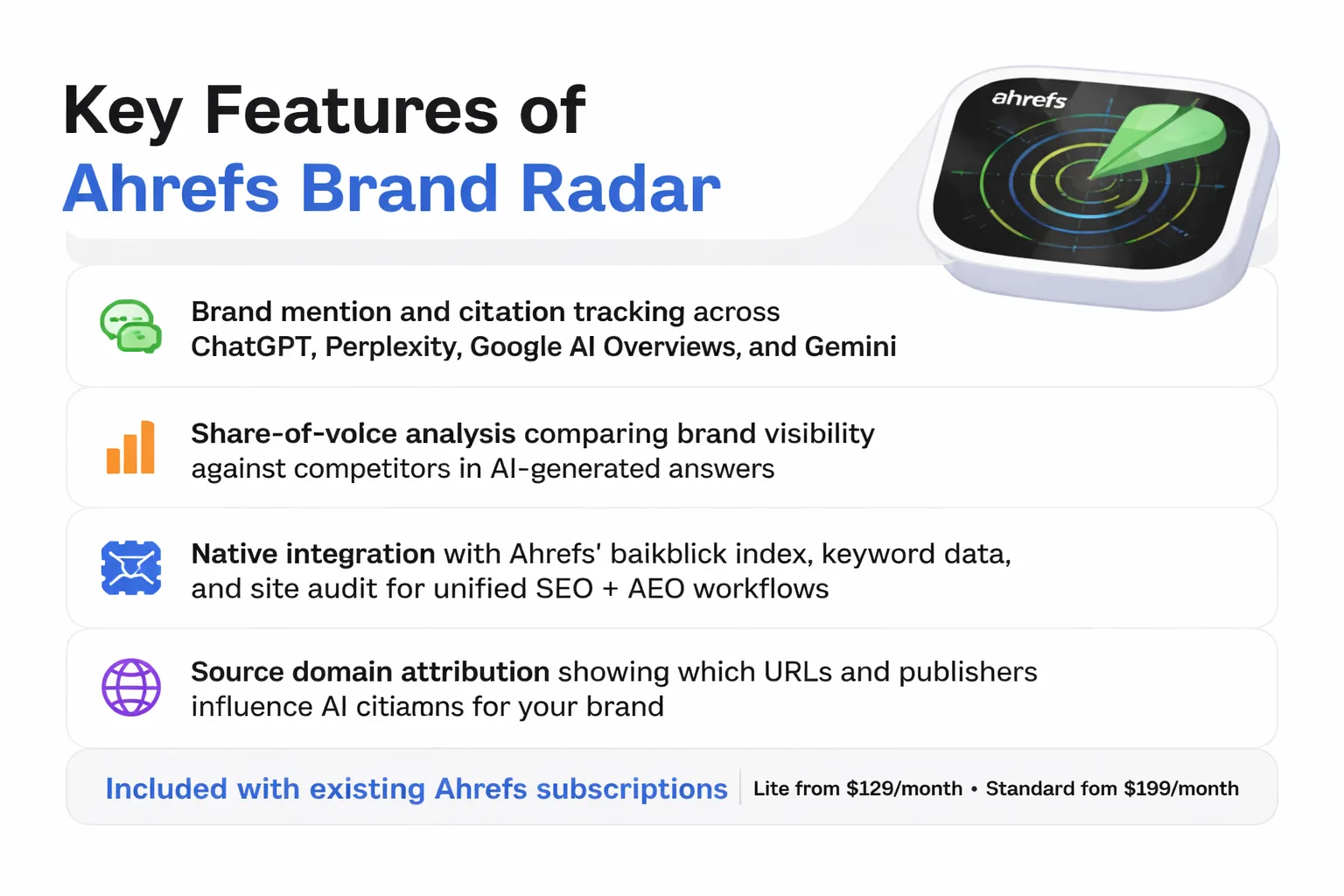
Ahrefs added Brand Radar to its existing suite as a natural extension for SEO teams that already live inside the platform. The integration with Ahrefs' backlink index, keyword data, and site audit is genuinely useful — you can see citation patterns alongside the traditional SEO signals that influence them.
Key features: - Brand mention and citation tracking across ChatGPT, Perplexity, Google AI Overviews, and Gemini - Share-of-voice analysis comparing brand visibility against competitors in AI-generated answers - Native integration with Ahrefs' backlink index, keyword data, and site audit for unified SEO + AEO workflows - Source domain attribution showing which URLs and publishers influence AI citations for your brand
Pricing: Included with existing Ahrefs subscriptions (Lite from $129/month, Standard from $249/month); full AI model coverage including Claude and Grok requires higher-tier add-ons at up to $699/month.
Full coverage costs more than it should. Getting Claude and Grok data requires expensive add-ons that push the total well above what purpose-built tools charge for the same coverage. And like Semrush, Brand Radar is monitoring-only — there's no built-in optimization guidance or content creation for closing the gaps it identifies. If you're already paying for Ahrefs, it's a logical first step. If you're evaluating from scratch, a purpose-built tool likely gives you more per dollar.
How Do You Actually Act on This Data?
This is the question the SE Ranking blog on AI visibility tools doesn't answer — and it's the one that matters most. Most teams buy a monitoring tool, watch their citation rate for a few weeks, and then aren't sure what to do next.
The pattern I keep seeing is that teams treat AI visibility data the same way they treat keyword rankings: as a score to watch, not a diagnostic to act on. That's the wrong frame. A citation gap isn't a number to track — it's a content brief waiting to be written. When a competitor is consistently cited on a topic where you're invisible, the fix is almost always structural: you either don't have content covering that topic in a format AI engines extract from, or your existing content lacks the specificity and attribution signals that make it citable.
The practical workflow I'd recommend: export your citation gap data weekly, map each gap to a specific content type (FAQ, definition, comparison, how-to), and prioritize by the overlap between citation volume and your commercial intent. Topics where AI engines are actively citing sources AND where those citations influence purchase decisions are the highest-leverage targets. If you're building this workflow from scratch, understanding how to optimize content for Google AI Overviews is a useful tactical layer to add on top of whatever tracking tool you choose.
One more thing: don't conflate AI visibility for content creators (ensuring your content gets extracted by AI engines) with brand monitoring (tracking where your brand is mentioned in AI answers). They're related but distinct problems. A content creator optimizing for AI extraction needs structured data, clear entity signals, and citable sentence structures. A brand manager monitoring AI mentions needs sentiment analysis, share-of-voice trends, and competitive benchmarking. Most tools in this list do both — but they do one better than the other, and knowing which problem you're primarily solving should drive your tool selection.
For teams thinking about how this fits into a broader content strategy, Meev vs. Surfer SEO and Meev vs. Frase both cover how AI visibility workflows differ from traditional SEO writing tools — worth reading if you're evaluating where AI visibility tracking fits in your existing stack.
Why AI Visibility Matters More in 2026
The shift isn't subtle anymore. HubSpot's documented AEO strategy produced a 433% increase in citations and leads that converted at 3x the rate of other sources — that's not a marginal improvement, it's a channel-level result. The brands that treated AI visibility as a 2025 experiment are now treating it as a core acquisition channel.
What changed structurally: Google AI Overviews and AI Mode now appear on a significant share of informational queries, Perplexity and ChatGPT are actively used for product research, and the LLMs themselves are being updated with new training data and retrieval patterns on an accelerating cadence. Google-Extended blocking decisions made in 2024 are now showing up in citation patterns — brands that blocked crawlers to protect their content inadvertently removed themselves from the training and retrieval pipelines that feed AI answers.
The tools in this list exist because the old SEO playbook — rank on page one, capture organic clicks — is no longer the complete picture. AI engines don't send clicks the same way Google does. They synthesize answers, cite sources selectively, and often don't surface the brand at all even when the brand has the best content on the topic. Tracking that invisibility, and systematically closing the gaps, is what these tools are built to do.
Frequently Asked Questions
What's the difference between AI visibility tracking and traditional SEO rank tracking? Traditional rank tracking tells you where your pages appear in Google's blue-link results for specific keywords. AI visibility tracking tells you whether your brand is cited, mentioned, or recommended when users ask AI engines like ChatGPT, Perplexity, or Google AI Overviews a question related to your category. The two signals are related but distinct — a page can rank #1 on Google and still be invisible in AI-generated answers, which increasingly influence purchase decisions before a user ever clicks a search result.
Do I need a separate AI visibility tool if I already use Semrush or Ahrefs? Depends on how central AI citation tracking is to your strategy. Both Semrush and Ahrefs have added AI visibility features, and if you're already paying for those platforms, starting there makes sense. But their AI visibility features are add-ons built on top of SEO infrastructure — purpose-built tools like Profound, Peec AI, or Meev offer deeper citation analytics and, in some cases, integrated content workflows that the SEO incumbents don't match yet.
How many LLMs should my AI visibility tool track? At minimum, ChatGPT, Perplexity, and Google AI Overviews — those three drive the largest share of AI-influenced research behavior right now. Adding Claude, Gemini, and Grok gives you a more complete picture, especially as Claude and Gemini gain traction in enterprise and consumer search respectively. DeepSeek is worth monitoring if you have significant international exposure. Most mid-tier tools cover 5-6 engines; enterprise tools like Profound cover 10+.
Can AI visibility tools help with Google E-E-A-T? Indirectly, yes. The signals that make content citable by AI engines — clear authorship, specific claims with named sources, structured entity signals, demonstrable expertise — overlap significantly with what Google's Search Quality Rater Guidelines reward under E-E-A-T. Optimizing for AI citation often improves E-E-A-T signals as a byproduct, though they're not identical frameworks.
How long does it take to see results from AI visibility optimization? The HubSpot case study documented meaningful citation increases within months of launching a systematic AEO strategy. In practice, the timeline depends on your starting point, content velocity, and how competitive your category is in AI-generated answers. Tracking tools give you a baseline immediately; content changes typically take 4-8 weeks to show up in citation patterns, similar to the lag you'd expect from traditional SEO.
Is there a free way to start tracking AI visibility before committing to a paid tool? Meev offers a free forever tier that includes citation tracking across major LLMs — it's the only tool in this list with a no-cost entry point. OtterlyAI's $29/month plan is the next most accessible option. For a manual baseline before any tool investment, you can run your target queries directly in ChatGPT, Perplexity, and Google AI Overviews and note whether your brand appears — it's time-intensive at scale, but it gives you a directional read before committing budget.
About the Author
Judy Zhou, Head of Content Strategy
Judy Zhou leads content strategy at Meev, where she oversees AI-driven content research and publishing for hundreds of brands. With a background in SEO and editorial operations, she focuses on building content systems that rank on Google, get cited by AI search engines, and drive measurable business results.
Meev's free tier lets you start tracking AI citations across 5 LLMs today — with a built-in content engine to close the gaps you find.