

By Judy Zhou, Head of Content Strategy
Key Takeaways
- AI platforms generate an estimated 10 billion responses per month, yet most SEO dashboards track zero of them — the LLM visibility gap is real and growing.
- Brand-controlled properties captured 47% of Google AI Overview sources (Spiegel Research Center), making owned media strategy directly tied to AI citation share.
- AI search engines systematically favor earned media over brand-owned content (arXiv GEO research), which means publisher pitching and citation outreach are the primary optimization lever — not formatting tweaks.
- Tool selection should match team size: solo founders start at $27-$29/month for authentic multi-engine data, SMB in-house teams get the best value in the $99-$269/month range, and agencies need multi-domain dashboards with white-label reporting.
In November 2022, when OpenAI released ChatGPT to the public, most SEO professionals treated it as a content-generation curiosity. A faster way to draft meta descriptions. Few recognized it as a distribution channel that would, within two years, begin intercepting the very queries they had spent careers optimizing for. That inflection point gave rise to an entirely new category of software: the LLM visibility tool, purpose-built to track whether AI models cite your brand, surface your content, or route trust to a competitor instead.
The best llm visibility tool for your team depends on three things: which AI engines your audience actually uses, whether you need monitoring alone or a closed-loop workflow that goes from citation gap to outreach pitch, and how much budget you can justify before the ROI is proven. AI platforms now generate an estimated 10 billion responses every month, yet most SEO dashboards still show zero data from any of them. A Pew Research Center study from May 2025 found that 58% of U.S. Google users conducted at least one search producing an AI summary. And those users were measurably less likely to click through to linked results. The Spiegel Research Center found that brand-controlled properties captured 47% of sources cited in Google AI Overviews, which means owned media strategy now has a direct line to AI citation share. An arXiv paper on generative engine optimization confirmed that AI search engines exhibit a systematic bias toward earned media over brand-owned content, which is the single most important structural fact shaping citation building strategy in 2026.
The LLM Visibility Gap Most SEO Teams Are Missing
Traditional rank tracking measures one thing: where your URL lands in a list of blue links. That model worked when Google returned ten results and users scanned them. It breaks completely when the answer engine reads your content, synthesizes it, and returns a paragraph that never links back to you at all.
Semrush and Ahrefs are exceptional tools. I use both. But neither was built to answer the question "does ChatGPT mention my brand when someone asks which project management tool is best for remote teams?" That question requires a different measurement architecture entirely. It requires prompt simulation: sending a query to an LLM, capturing the response, parsing whether your brand appears, and tracking whether that appearance is a citation with a source link or just a passing mention. Those are two different things, and the gap between them is what I call the mention-citation gap. A tool can surface your brand name in an AI answer without ever linking to your site. That mention may build brand awareness, but it sends no traffic and provides no authority signal. Closing that gap is the actual job.
What makes this harder is that different LLMs source content differently. The Peec AI study of 30 million LLM citations found that Reddit and YouTube drive significant AI visibility, and that Google AI favors local and Yelp-style content while ChatGPT skews toward authoritative editorial sources. If you're optimizing for ChatGPT citation patterns without knowing that ChatGPT's sourcing logic differs from Gemini's, you're flying blind. An llm visibility tool worth using should surface those per-engine differences, not aggregate them into a single vanity score.
The other thing traditional SEO tools miss entirely: which publishers AI engines actually trust for your topic category. That's not a keyword gap. That's a citation network problem, and solving it requires knowing which third-party domains get cited most often in AI answers about your space, then building a strategy to earn mentions on those properties.
How We Evaluated Each Tool
Scoring this category is harder than it looks. Every vendor claims to track "all major AI engines," but the implementation details matter enormously.
I evaluated each tool across five dimensions. First, LLM engine coverage: does it track ChatGPT, Perplexity, Gemini, Claude, Google AI Overviews, Google AI Mode, Grok, and DeepSeek, or just the first two? Second, mention versus citation tracking: can it distinguish between an AI answer that names your brand and one that actually links to your domain? Third, prompt simulation depth: does it run real UI-scraped queries against live LLM interfaces, or does it hit a synthetic API endpoint that may not reflect what users actually see? Fourth, integration options: does it connect to GA4, Google Search Console, or your CMS, or does it live in its own reporting silo? Fifth, pricing relative to what you actually get at each tier.
I also looked at whether each platform does anything beyond monitoring. Tracking that you're not being cited is useful. Knowing which publisher to pitch, having a verified contact email, and generating a personalized outreach draft is the difference between a dashboard and a workflow.
One honest caveat: the independent benchmark data for this category is thin. A ranking by Nick Lafferty assigned Profound an AEO Score of 92/100, but that score is proprietary and not backed by published precision/recall methodology. I'm not dismissing the ranking, but I'm noting the limitation. No independent third-party has published a controlled test comparing mention-detection accuracy across platforms. Until that exists, treat any "accuracy" claim from vendors with appropriate skepticism.
Comparison Table
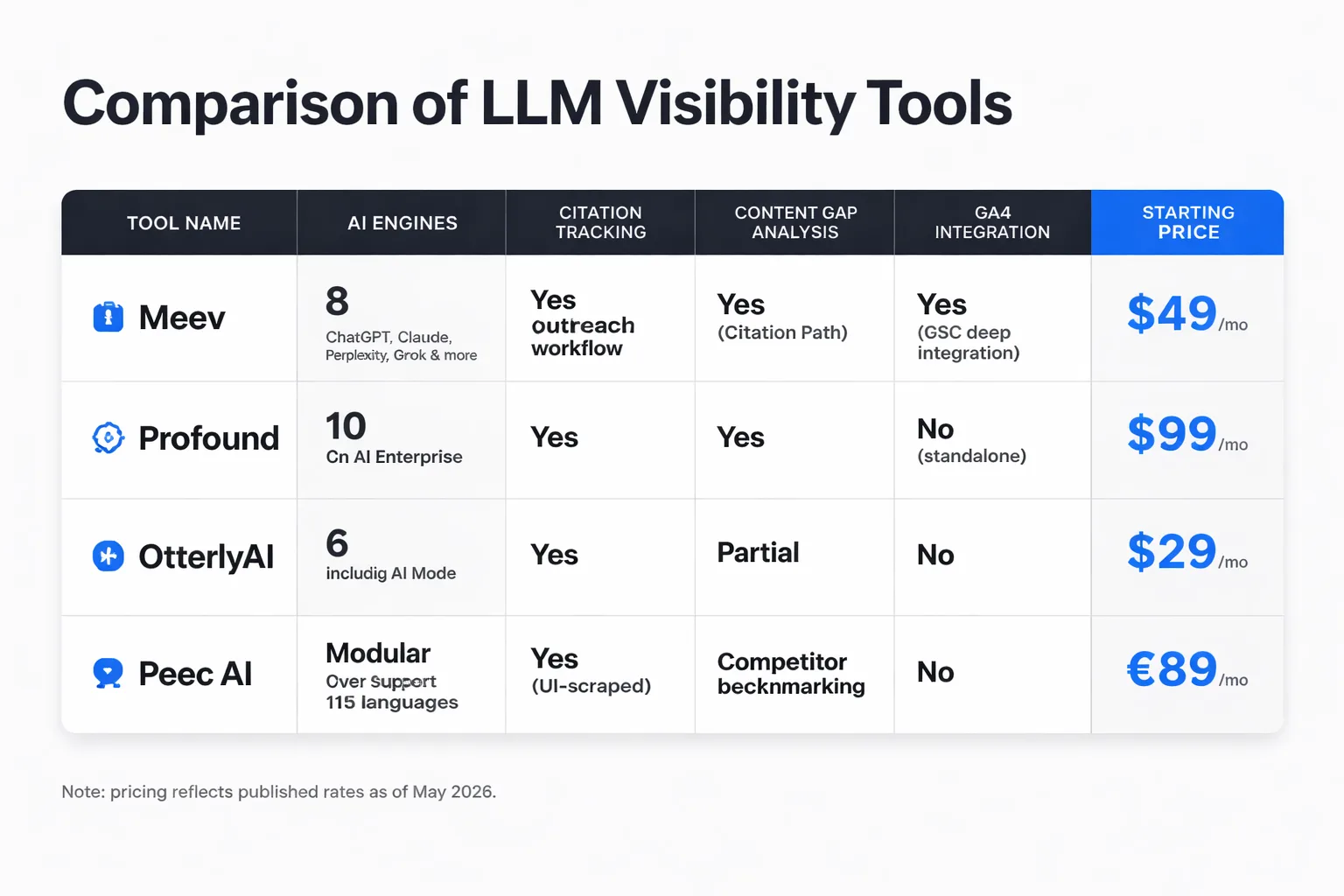
The table below covers the eight tools ranked in detail below, plus the two ecosystem add-ons (Semrush and Ahrefs). Pricing reflects published rates as of May 2026.
| Tool | AI Engines | Citation Tracking | Content Gap Analysis | GA4 Integration | Starting Price |
| Meev | 8 (ChatGPT, Claude, Gemini, Perplexity, Grok, AIO, AI Mode, DeepSeek) | Yes + outreach workflow | Yes (Citation Path) | Yes (GSC deep integration) | $49/mo |
| Profound | 10 on Enterprise | Yes | Yes | No (standalone) | $99/mo |
| OtterlyAI | 6 (incl. AI Mode) | Yes | Partial | No | $29/mo |
| Peec AI | Modular, 115+ languages | Yes (UI-scraped) | Competitor benchmarking | No | €89/mo |
| AthenaHQ | 8 | Yes + pre-publish prediction | Yes | Yes (GA4 + Shopify) | Self-serve (site) |
| Semrush AI Toolkit | 4 (ChatGPT, AIO, Gemini, Perplexity) | Yes | Yes (keyword correlation) | Yes (native) | $99/mo add-on |
| Ahrefs Brand Radar | 6 (incl. Claude) | Yes | Yes (link-building) | No | $355/mo |
| Scrunch AI | 6 + Meta AI | Yes (persona-segmented) | Yes | No | ~$300/mo |
| AIclicks | 3 (ChatGPT, Perplexity, Gemini) | Yes + fix recommendations | Yes | No | $83/mo |
| SE Ranking + SE Visible | 5 (AIO, AI Mode, ChatGPT, Gemini, Perplexity) | Yes | Yes | Yes (GA4) | $65/mo |
| Trackerly | 7 (incl. Claude, DeepSeek) | Yes (UI-scraped) | No | No | $27/mo |
Which Tool Fits Your Team Size
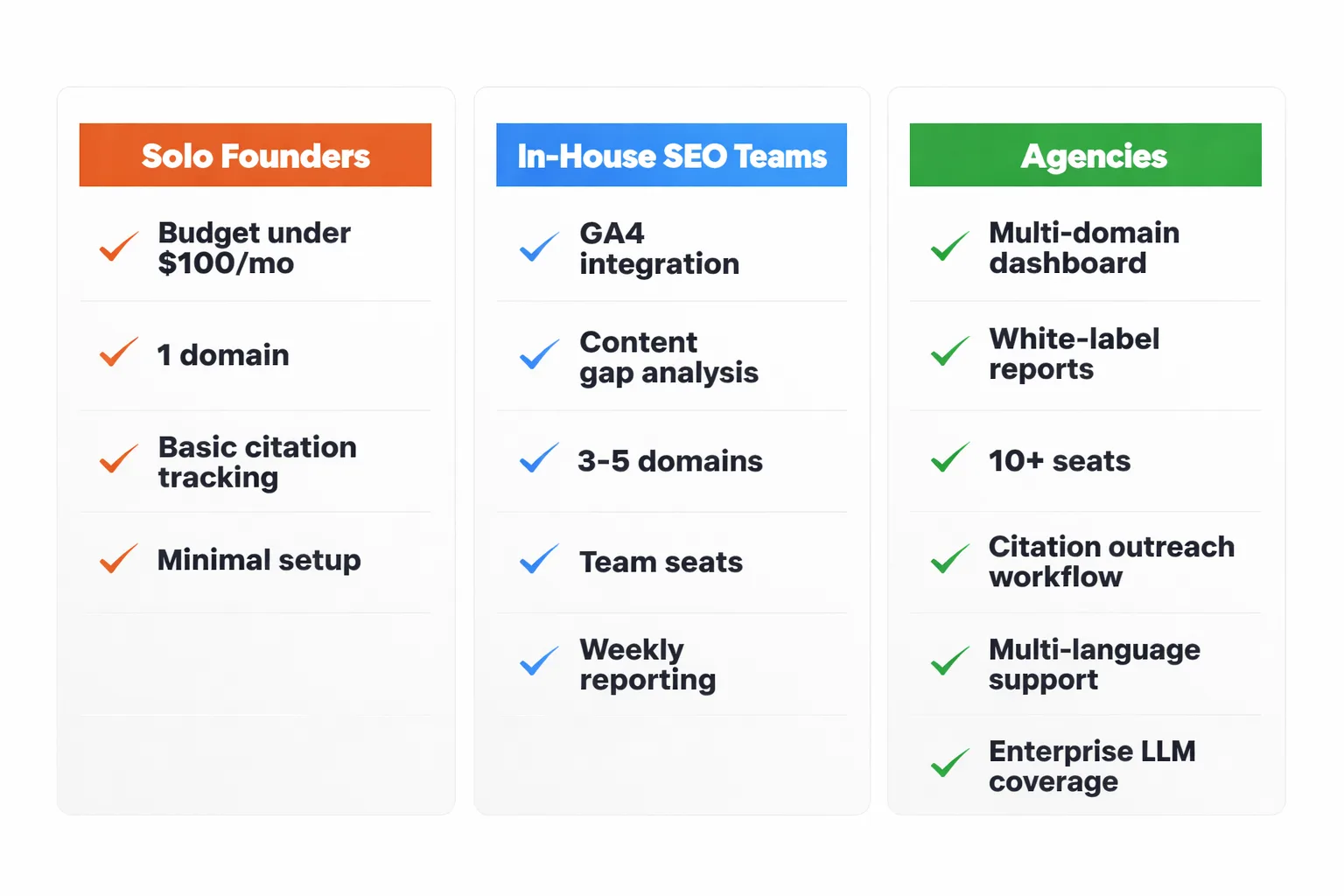
The honest answer is that team size should drive your decision more than feature lists. A solo founder who buys Profound's $399/month Growth plan to track 100 prompts across three engines is almost certainly over-buying. An agency managing 15 client domains that buys OtterlyAI's $29/month Lite plan will hit the 15-prompt ceiling before the first client kickoff call.
Solo founders and lean content teams: Start with Trackerly at $27/month or OtterlyAI's Lite at $29/month. Both give you authentic UI-scraped data across multiple engines at a price point where the ROI math works even if you're only generating modest traffic gains. The goal at this stage isn't exhaustive coverage. It's learning which prompts your brand appears in, which ones it doesn't, and which competitors are being cited instead. That intelligence costs under $30/month and will inform your content priorities better than any keyword tool.
In-house SEO teams at SMBs: The $99-$269/month range is where the real value concentration is. Meev's Pro plan at $269/month covers 8 engines, includes Citation Path for finding which publishers to target, integrates with Google Search Console, and generates content with a quality firewall that blocks weak drafts before they reach your CMS. If your team's bottleneck is both tracking and execution, that closed-loop workflow matters. If you're already inside the Semrush ecosystem, the AI Visibility Toolkit add-on at $99/month is the lowest-friction option because your team already knows how to read the dashboards. For teams prioritizing Google AI Overviews tracking specifically, both Semrush and SE Ranking have strong AIO-specific coverage.
Agencies managing multiple clients: You need multi-domain dashboards, team seats, and ideally white-label reporting. Meev's Agency plan at $599/month covers 15 domains and 10 seats with white-label client reports. Scrunch AI at ~$300/month offers the most granular prompt segmentation by buyer persona and funnel stage, which is genuinely useful when you're presenting AI visibility data to clients who want to understand it by product line or audience segment. AthenaHQ's GA4 and Shopify integrations are the right call if your clients are DTC brands who need to connect AI citation data to revenue, not just share of voice.
One thing I'd push back on: the instinct to buy the most expensive tool as a proxy for seriousness. I've watched teams spend $500/month on enterprise AI visibility platforms and then not act on the data because nobody owned the citation-building workflow. A $29/month tool you actually use to inform your content calendar beats a $499/month dashboard that generates weekly reports nobody reads.
Wondering which AI engines are citing your competitors but not you?
1. Meev — Best for SEO teams that need tracking AND execution in one platform
Best for: Content and SEO teams at SMBs and agencies that need AI visibility tracking, quality-gated content publishing, and citation outreach in a single workflow.
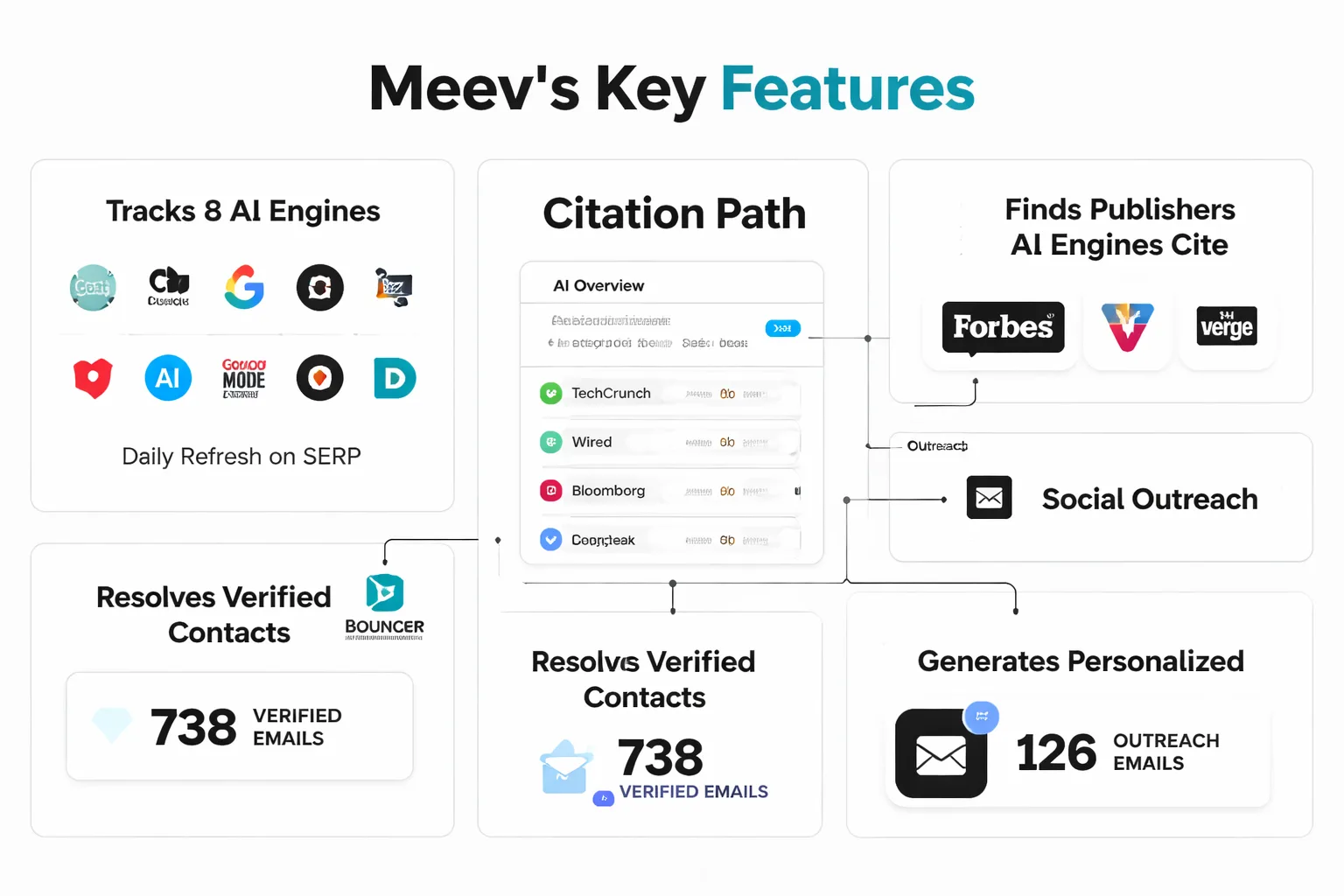
Meev does something no other tool in this list does: it connects the monitoring output directly to a content and outreach execution layer. Most platforms tell you that a competitor is being cited for a prompt you should own. Meev tells you that, then finds which publishers AI engines cite for that topic, resolves a verified contact email, and drafts a personalized outreach pitch grounded in your knowledge base. That's Citation Path, and it's the closest thing to a closed-loop LLM optimization workflow I've seen in a single product.
Key features: - Tracks 8 AI engines (ChatGPT, Claude, Gemini, Perplexity, Grok, Google AI Overviews, AI Mode, DeepSeek) with daily refresh on SERP-driven surfaces. Citation Path finds publishers AI engines cite for your topics, resolves verified contacts via Bouncer, and generates personalized outreach pitches. 16-dimension quality firewall blocks articles scoring below 70/100 from auto-publishing to WordPress, Ghost, Shopify, Wix, or custom webhook. Industry share-of-voice across AI engines with per-LLM drill-down and the actual response text behind every mention
Pricing: Lite at $49/month (10 prompts, 1 domain); Starter at $99/month (25 prompts); Pro at $269/month (100 prompts, 5 domains, Citation Path, Premium LLMs); Agency at $599/month (250 prompts, 15 domains, 10 seats, white-label reports). 7-day trial available.
The quality firewall deserves more attention than it typically gets in tool comparisons. The documented case of a publisher producing 100 AI-generated posts per hour with zero human editing resulted in ranking collapse, not growth. Meev's 16-dimension gate addresses exactly that failure mode. For teams scaling content output, having an automated quality checkpoint that blocks weak drafts before they reach your CMS is the difference between building topical authority and triggering a manual review. The platform also supports Claude visibility tracking and Perplexity citation tracking as distinct surfaces, which matters because, as the Peec AI citation research shows, those engines source content through different mechanisms.
2. Profound — Best for enterprise SEO teams needing deep multi-engine intelligence
Best for: Enterprise SEO and content teams at B2B SaaS or large brands that need the deepest multi-engine citation intelligence and can justify a $399–$499+/month investment.
Profound is the benchmark platform for enterprise AI visibility, tracking up to 10 LLMs on its top tier including DeepSeek, Grok, and Meta AI. The real-time AI user-agent crawl analytics, which show how LLM bots interact with your site, is a feature no other tool in this list offers at the same depth.
Key features: - Tracks up to 10 AI answer engines including DeepSeek, Grok, and Meta AI on enterprise plans. Real-time AI user-agent crawl analytics showing how LLM bots interact with your site. Prompt search volume estimation to prioritize high-traffic AI queries. LLM-optimized content creation tools integrated directly into the monitoring workflow
Pricing: Starter at $99/month (50 prompts, ChatGPT only); Growth at $399/month (100 prompts, ChatGPT + Perplexity + AIO); Enterprise custom pricing up to 10 engines.
The Starter plan's ChatGPT-only coverage is a real limitation. If you're paying $99/month to track a single engine while your audience is actively using Perplexity and Gemini, you're getting a partial picture. The Growth tier at $399/month is where the platform becomes genuinely useful, but that price point requires a budget conversation most SMBs won't win. For enterprises with the budget and the need for the deepest possible citation intelligence, Profound is the right call.
3. OtterlyAI — Best for startups and SMBs new to AEO/GEO monitoring
Best for: Startups, SMBs, solo founders, and agency teams new to AEO/GEO who need credible multi-engine tracking at the lowest verified entry price in the category.
OtterlyAI is the most accessible entry point in the category. Six platforms tracked, a GEO URL audit covering 25+ on-page factors, and a 14-day free trial with no credit card required. For teams that are just starting to measure AI search visibility and need to build the business case internally, this is the right starting point.
Key features: - 6-platform tracking across ChatGPT, AI Overviews, AI Mode, Perplexity, Gemini, and Copilot. GEO Audit analyzing 25+ on-page factors including structured data, page speed, and llms.txt readiness. AI Keyword Research that converts a brand URL into audience-relevant prompt sets. Unlimited brand reports and unlimited user seats across all plans
Pricing: Lite at $29/month (15 prompts); Standard at $189/month (100 prompts, 5,000 GEO URL audits); Premium at $489/month (400 prompts). 14-day free trial, no credit card required.
The 15-prompt limit on the Lite plan is a sampling exercise, not systematic measurement. You'll get a directional signal, but you won't have enough prompt coverage to make confident strategic decisions. The jump to $189/month for Standard is significant. If you're between Lite and Standard, I'd run the free trial at full Standard capacity and see whether the data changes your content priorities before committing.
4. Peec AI — Best for global brands with multilingual content needs
Best for: Global brands and multilingual content teams that need accurate per-country AI visibility data across multiple languages and markets.
Peec AI's 115+ language support is the broadest in the category, and the UI-scraping methodology (capturing actual user-facing LLM results rather than synthetic API outputs) means you're measuring what users actually see. For brands operating across multiple countries where AI search behavior differs by market, that methodological distinction matters.
Key features: - UI-scraping methodology captures actual user-facing LLM results including source citations, not synthetic API responses. 115+ language support, the broadest multilingual coverage in the AEO category. Modular LLM add-ons so teams pay only for the engines relevant to their audience. Competitor benchmarking with regional and per-country breakdowns for global brand tracking
Pricing: Starter at €89/month (25 prompts, ~2,250 answers/month, 3-country coverage); Pro at €199/month (100 prompts, ~9,000 answers/month).
Peec AI is monitoring and diagnostics only. There's no content writing layer, no outreach tooling, and no direct CMS integration. If you're a global brand that needs accurate per-country citation data and you have separate tools for content execution and outreach, Peec AI fits cleanly into that stack. If you need an all-in-one workflow, you'll need to pair it with something else. For a direct comparison of how Peec AI stacks up against a platform with execution capabilities, Meev vs Peec AI covers the tradeoffs in detail.
5. AthenaHQ — Best for DTC brands connecting AI citations to revenue
Best for: DTC and B2B brands that need AI citation data flowing into existing GA4 and Shopify attribution stacks to prove revenue impact, not just visibility scores.
AthenaHQ is Y Combinator-backed and built by ex-Google and DeepMind engineers. The Athena Citation Engine (ACE) predicts citation probability before content is published, which is a genuinely different capability than retroactive monitoring. If you can predict which content is likely to get cited before you publish it, you can prioritize production resources accordingly.
Key features: - Athena Citation Engine (ACE) predicts citation probability before content is published, enabling proactive optimization. Olympus Dashboard unifies GEO Score across citation count, sentiment, traffic impact, and query type in one view. Native Shopify, Webflow, GA4, and Google Search Console integrations to tie AI citations to actual revenue. Tracks 8 major LLMs: ChatGPT, Perplexity, Google AI Overviews, Google AI Mode, Gemini, Claude, Copilot, and Grok
Pricing: Self-Serve plan available (pricing confirmed on site); Enterprise plan with custom pricing. Annual plans include a one-month trial.
The revenue attribution story is the strongest in the category for e-commerce teams. The absence of a monthly trial on the Lite tier (annual commitment required) is a real friction point for teams that want to validate the platform before committing. The credit-based tracking system also makes cost forecasting less predictable at high prompt volumes, which is worth modeling out before signing an annual contract.
6. Semrush AI Visibility Toolkit — Best for teams already in the Semrush ecosystem
Best for: SEO teams already invested in the Semrush ecosystem who want to add AI search visibility tracking without introducing a separate tool or splitting their reporting workflow.
Semrush's AI Visibility Toolkit monitors 100M+ relevant LLM prompts globally, including a 29M+ ChatGPT-specific prompt database. That scale is meaningful. The value proposition is consolidation: if your team already lives in Semrush for keyword research, backlink analysis, and site audits, adding AI visibility tracking in the same interface reduces context-switching and makes it easier to correlate traditional ranking shifts with AI citation changes.
Key features: - Monitors 100M+ relevant LLM prompts globally including a 29M+ ChatGPT-specific prompt database. Tracks brand mentions inside ChatGPT, Google AI Overviews, Gemini, and Perplexity with keyword ranking correlation. Consolidates AI visibility with keyword research, backlink intelligence, site audits, and content optimization in one workflow. Competitive intelligence layer translates AI visibility shifts into language stakeholders already understand from traditional SEO reporting
Pricing: AI Visibility Toolkit add-on starts at $99/month per domain. Semrush One starts at $199/month.
For teams whose primary use case is AI search visibility as a standalone discipline, a dedicated LLM-first platform will deliver richer prompt-level data. But for SEO teams where AI visibility is one of five things on the dashboard, Semrush's consolidation play is genuinely practical.
7. Ahrefs Brand Radar — Best for existing Ahrefs Enterprise customers
Best for: Existing Ahrefs Enterprise customers who want AEO data layered into their current SEO dashboard without switching platforms.
Ahrefs Brand Radar scans six prompt indexes including ChatGPT, Google AIO, Claude, and Gemini, processing billions of queries automatically. The AI citation analysis identifying which URLs are most frequently cited by LLMs is directly actionable for link-building prioritization, which is a natural extension of how Ahrefs users already think.
Key features: - Searches six prompt indexes including ChatGPT, Google AIO, Claude, and Gemini processing billions of queries automatically. Brand mention tracking with location, sentiment, and context for every AI-generated response. AI citation analysis identifying which URLs are most frequently cited by LLMs to inform link-building priorities. Competitive benchmarking comparing your AI share of voice against rivals across all tracked engines
Pricing: Plus plan at $355/month (1,000 prompts, 10 brands); Max plan at $519/month (1,500 prompts, 15 brands). 10-day free trial. Requires an existing Ahrefs subscription.
The $355/month floor makes this one of the most expensive entry points in the category. Multiple user reviews flag the ChatGPT and Perplexity modules as underreporting mentions compared to dedicated LLM-first tools. If you're an Ahrefs power user who wants AI visibility baked into your existing workflow, the integration value may justify the price. If you're not already on Ahrefs, there are better-value options.
8. Scrunch AI — Best for granular persona-level prompt segmentation
Best for: Mid-market and enterprise SEO teams that need the most granular prompt-level segmentation architecture and want to go beyond monitoring into actively serving AI-optimized content to crawlers.
Scrunch AI's Agent Experience Platform (AXP) is the most technically ambitious feature in this category. It serves machine-readable content versions directly to AI crawlers at the CDN level, which means you're not just measuring what AI engines do with your existing content. You're actively shaping what they receive.
Key features: - Prompt-level tracking segmented by buyer persona, location, and sales funnel stage for granular share-of-voice analysis. Sentiment and SOV analysis reporting whether AI presents your brand positively or negatively versus competitors for every prompt. Agent Experience Platform (AXP) serves machine-readable content versions directly to AI crawlers at the CDN level. Covers all major LLM platforms: ChatGPT, Claude, Perplexity, Gemini, Google AI Overviews/Mode, and Meta AI
Pricing: Typically starts around $300/month; enterprise pricing available on request.
The persona and funnel-stage segmentation is genuinely useful for enterprise teams that need to present AI visibility data by product line or audience segment. The ~$300/month starting price puts it above SMB budgets, and the reporting layer is less mature than some enterprise-focused alternatives. But for mid-market teams that want the most granular segmentation architecture available, Scrunch AI is the right choice.
9. AIclicks — Best for guided, action-oriented GEO workflows
Best for: Content and SEO teams that want a guided, action-oriented GEO workflow rather than a raw data dashboard.
AIclicks builds actionable fix recommendations directly into the monitoring dashboard. You don't just see that a competitor is being cited more than you. You see what to do about it. That workflow orientation makes it a strong choice for teams that are new to generative engine optimization and need structured guidance rather than raw data.
Key features: - Prompt-level visibility tracking across ChatGPT, Perplexity, and Gemini with source domain and URL attribution. Actionable GEO fix recommendations built directly into the monitoring dashboard, not just raw data. Competitor citation benchmarking showing which domains and URLs drive competitor mentions in AI answers. Designed for day-to-day GEO operating loops connecting what you see in AI answers to concrete content priorities
Pricing: Explorer at $83/month (billed annually); Growth at $417/month (billed annually); Enterprise at custom pricing.
The engine coverage (ChatGPT, Perplexity, Gemini) is narrower than platforms tracking 8-10 LLMs. If you need Grok visibility tracking or DeepSeek coverage, AIclicks isn't the right fit. But for teams focused on the three highest-traffic AI engines and who want a workflow that tells them what to fix, not just what's broken, it's a strong choice.
10. SE Ranking — Best for agencies on unlimited-user SEO plans
Best for: SEO teams already using SE Ranking for traditional search who want to add AI visibility tracking without platform switching, especially agencies managing multiple clients.
SE Ranking's 13+ years of SEO historical data provides ranking context that AI-native platforms built in 2024-2025 cannot replicate. The MCP server integration that pipes AI visibility data directly into AI assistants for automated reporting is a forward-looking feature that will matter more as teams build AI-assisted reporting workflows.
Key features: - UI-based tracking of citations and mentions across Google AI Overview, AI Mode, ChatGPT, Gemini, and Perplexity. MCP server integration pipes AI visibility data directly into AI assistants for automated reporting. GA4 integration for AI referral traffic attribution closes the measurement gap between AI citations and actual site traffic. 13+ years of SEO historical data provides ranking context AI-native platforms cannot replicate
Pricing: SE Ranking plans start from $65/month. SE Visible companion product: Plus at $355/month (1,000 prompts, 10 brands); Max at $519/month. 10-day free trial available.
Full multi-LLM depth requires the separate SE Visible subscription, which means the cost picture is more complex than the $65/month headline suggests. For agencies already on SE Ranking who want to add AI visibility tracking for clients without switching platforms, the integrated workflow is a real advantage.
11. Trackerly — Best for budget-conscious teams needing authentic LLM data
Best for: Solo founders, lean SEO teams, and budget-conscious SMBs that need authentic, UI-scraped LLM citation data across multiple engines without paying $99-$300+/month entry fees.
Trackerly scrapes real LLM user interfaces rather than hitting third-party API endpoints, which means the citations you see are the citations users actually see. At $27/month, it's the lowest verified entry price in the category for multi-engine coverage.
Key features: - Scrapes real LLM user interfaces rather than third-party API calls, capturing the exact citations users actually see. Tracks model version for every response so teams know precisely which model version generated each answer. Live citation tracking for all models with native web search enabled, reflecting real-world citation behavior. Virtually all languages supported with multi-region request handling for global brand monitoring
Pricing: Starts at $27/month with a 7-day free trial. Credit-based pricing scales with prompt volume and run frequency.
The credit-based pricing model can make monthly cost forecasting less predictable as prompt volume scales. The reporting and analytics layer is less mature than enterprise platforms. But for a solo founder or lean team that needs to know whether they're being cited in ChatGPT, Perplexity, Gemini, Claude, and DeepSeek for under $30/month, Trackerly delivers.
Which Tool Fits Your Team Size
The pattern I keep seeing in this space is teams buying tools at the wrong tier for their actual situation, then either under-using enterprise features or hitting limits on starter plans before they've generated any useful data.
Solo founders: Trackerly ($27/month) or OtterlyAI Lite ($29/month). Pick based on whether you need the GEO audit feature (OtterlyAI) or the model-version tracking (Trackerly). Either gives you enough signal to inform content priorities without a significant budget commitment.
In-house SMB teams: The $99-$269/month range covers your needs. Meev Pro at $269/month is the right choice if you need tracking plus content generation plus citation outreach in one platform. Semrush AI Toolkit at $99/month is right if you're already a Semrush customer and want consolidation. SE Ranking at $65/month plus SE Visible is right if you need the historical SEO context alongside AI visibility data.
Agencies: Meev Agency at $599/month for the combination of 15 domains, 10 seats, white-label reports, and the Citation Path outreach workflow. Scrunch AI at ~$300/month if persona-level segmentation is the primary client deliverable. AthenaHQ if your clients are DTC brands who need revenue attribution from AI citations.
One more thing worth saying directly: I've been watching the GEO consulting space closely, and I'll note that nobody has published controlled data proving that structured content formatting reliably increases citation rates. The arXiv GEO research confirms that AI engines systematically favor earned media over brand-owned content. That finding has real strategic implications. It means publisher pitching and AI citation outreach are not optional tactics. They're the primary lever. A visibility tool that only monitors and doesn't help you build earned citations is solving half the problem.
FAQ
How is an LLM visibility tool different from an AI overview tracker?
An AI overview tracker (like the AIO-specific features in SE Ranking or Semrush) focuses on Google's AI Overviews feature within Google Search. An LLM visibility tool tracks brand citations across multiple AI platforms including ChatGPT, Perplexity, Claude, Gemini, and others that operate completely outside Google's search results. The distinction matters because your audience may be using Perplexity or ChatGPT for research queries that never touch Google at all. You need both types of tracking to get a complete picture of your AI search presence.
How many prompts should I monitor to get meaningful data?
For a focused niche, 25-50 well-chosen prompts will give you more actionable data than 200 generic ones. The goal is to cover the specific questions your target audience asks at each stage of the buying journey: awareness queries ("what is X"), comparison queries ("X vs Y"), and decision queries ("best X for [use case]"). Start narrow, validate which prompts your competitors appear in, and expand from there. The 15-prompt Lite plans are genuinely useful for this initial mapping exercise.
What's a realistic citation rate benchmark for a mid-size brand?
There is no verified industry benchmark yet. The honest answer is that this category is too new for reliable baselines. What I can say is that the Spiegel Research Center study found brand-controlled properties captured 47% of Google AI Overview sources, which suggests owned media investment has a direct line to citation share. Track your citation rate over 90-day periods and measure improvement relative to your own baseline, not against a published industry number that doesn't exist.
Do these tools integrate with Google Search Console or GA4?
Some do, some don't. Meev, AthenaHQ, SE Ranking, and Semrush all offer GA4 or GSC integration. Peec AI, OtterlyAI, Ahrefs Brand Radar, and Trackerly are standalone monitoring platforms without direct attribution integrations. If connecting AI citation data to traffic and revenue attribution is a priority, filter your shortlist to tools with native GA4 integration before evaluating other features.
Can I use an LLM visibility tool to improve my E-E-A-T signals?
Indirectly, yes. The most valuable output from these tools for E-E-A-T purposes is identifying which third-party publishers AI engines trust for your topic area. That intelligence should drive your citation outreach strategy: earning mentions on those specific domains builds the kind of third-party validation that both Google's quality raters and AI engines treat as authority signals. The arXiv GEO research confirms that AI search engines systematically favor earned media, which aligns directly with E-E-A-T's emphasis on external validation over self-promotion. Tools with a Citation Path or publisher discovery feature (like Meev) make that outreach workflow operational rather than theoretical.
Is AI content at scale safe to publish in 2026?
The documented failure mode isn't AI involvement. It's velocity without editorial checkpoints. A publisher producing 100 AI-generated posts per hour with zero human editing saw ranking collapse, not growth. The pattern Google's enforcement teams have documented is the combination of speed, no review, and no demonstrable expertise on the page. Quality-gated publishing, where a 16-dimension quality firewall blocks weak drafts before they reach your CMS, is the operational answer to that risk. Named authors, specific examples that couldn't come from a generic prompt, and at least one editorial pass before publish are non-negotiable for any scaled content program in 2026.
About the Author
Judy Zhou, Head of Content Strategy
Judy Zhou leads content strategy at Meev, where she oversees AI-driven content research and publishing for hundreds of brands. With a background in SEO and editorial operations, she focuses on building content systems that rank on Google, get cited by AI search engines, and drive measurable business results.
Track your brand across 8 AI engines, find the publishers driving citations in your space, and launch outreach campaigns — all from one platform. Start your 7-day Meev trial today.