

By Judy Zhou, Head of Content Strategy
Key Takeaways
- 50–90% of LLM-generated citations don't fully support their attached claims (Nature Communications, 2025) — meaning structural quality, not volume, determines whether AI engines cite your content.
- Reddit accounts for just 0.34% of AI answer citations despite widespread agency promotion; Wikipedia leads at 17.02%, making publisher outreach to high-weight domains the highest-leverage citation strategy.
- AI crawlers consume content at a 38,000:1 ratio vs. traffic referred back (Cloudflare, 2025), so citation tracking after each publishing batch is the only way to know if your auto-blog engine is actually working.
- A quality gate scoring posts on factual density, author entity signals, information gain, and schema markup — blocking anything below 70/100 — is the single most important safeguard against scaled content penalties and AI citation invisibility.
Maya had published 340 blog posts over eighteen months. Her editorial calendar was meticulous, her keyword research obsessive, her internal linking pristine. Then a client forwarded a screenshot: Perplexity had answered their core product question by citing three competitors. None of which had half her domain authority. Maya stared at the screenshot for a long moment, then opened a new tab and started Googling what, exactly, makes an AI model choose one source over another. That search led her to rebuild everything around what she now calls her auto-blog engine workflow.
The hard truth about auto-blog engine workflows in 2026 is that volume alone stopped working. A Nature Communications study (Wu et al., 2025) analyzing 366,000+ citations across ChatGPT, Perplexity, Google AI Overviews, and Claude found that 50. 90% of LLM-generated citations don't fully support the claims they're attached to. That's not a content quality problem. That's a structural problem. AI engines are pulling from sources that look authoritative, not sources that are authoritative. Cloudflare's 2025 crawler analysis found that AI bots consume content at a 38,000:1 ratio compared to the traffic they refer back. ClaudeBot's crawl-to-refer ratio was 38,065:1. Your content feeds the model. The model doesn't necessarily feed your traffic. Wikipedia accounts for 17.02% of AI answer citations, while Reddit. Despite years of agency hype. Represents just 0.34%, ranking ninth overall. And the scaled-content penalty data is blunt: 54% of websites using AI-generated content at scale lost 30% or more of their peak organic traffic. The auto-blog engine that earns AI citations is built differently from the start.
The Problem With Most Auto-Blog Setups
Most auto-blog engines are publishing pipelines with no quality membrane. Content goes in, content comes out, posts go live. The assumption is that more content means more surface area, and more surface area means more citations. That logic worked for traditional SEO in 2019. It's actively harmful now.
As someone who leads content strategy across hundreds of brand publishing operations at Meev, the pattern I keep seeing is this: teams build the automation first and bolt on quality checks later. Or never. They optimize for output speed and then wonder why their AI search visibility flatlines while competitors with half their post volume get cited constantly. The answer is almost always structural. The content doesn't give AI engines anything extractable. No named claims. No cited statistics. No clear author entity. No schema. The posts exist; they just don't signal anything a language model can confidently attribute.
This five-step framework fixes that. It's not about publishing less. It's about publishing in a way that AI engines can parse, trust, and cite.
Step 1. Define Your Quality Gate Before You Automate Anything
Every auto-blog engine needs a rejection layer. Not a "we'll fix it later" layer. A hard gate that blocks posts from publishing if they fall below minimum thresholds. Before a single URL goes live.
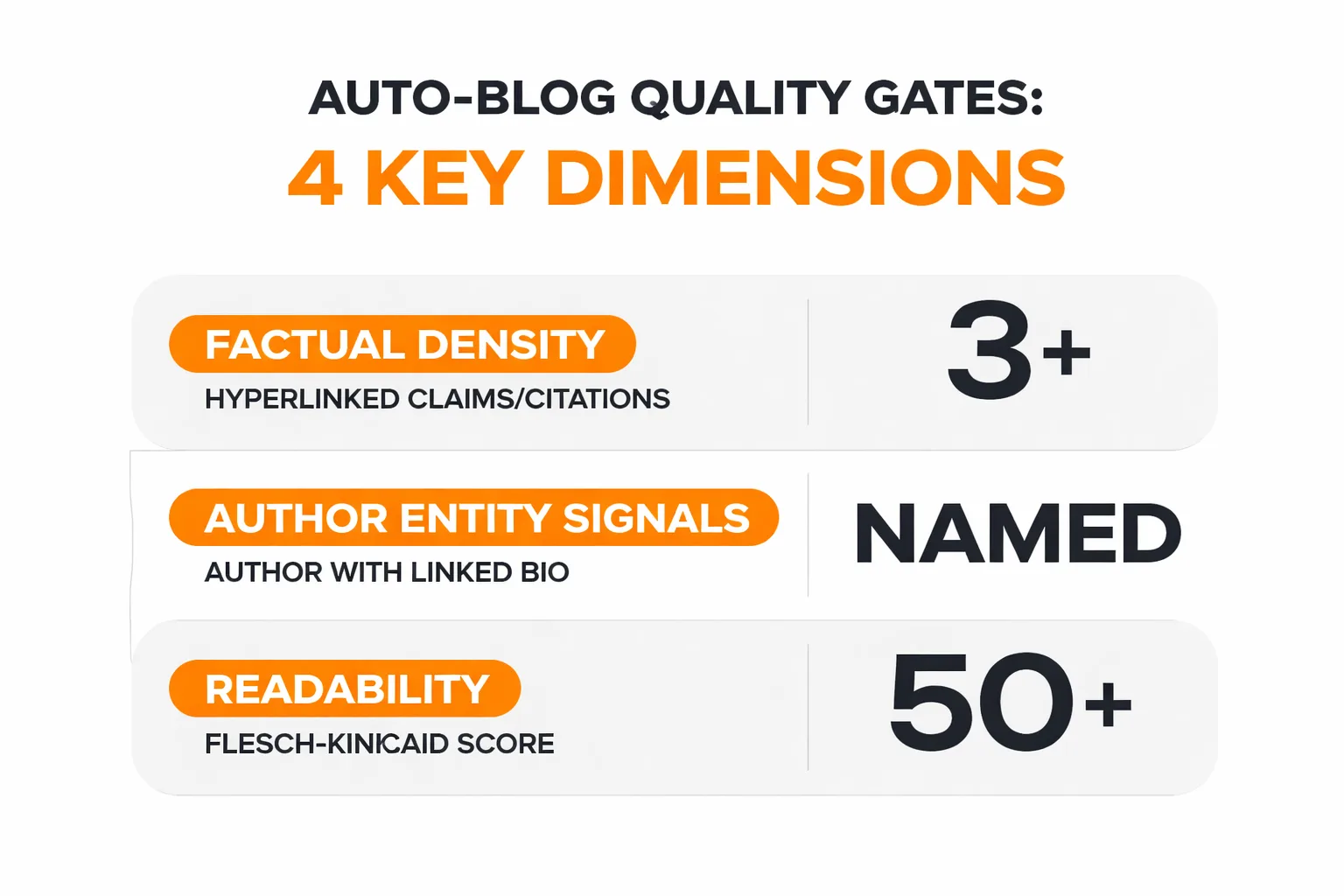
The thresholds I recommend teams start with cover four dimensions. First, factual density: every post should contain at least three externally sourced, hyperlinked claims. Not paraphrases. Linked citations to primary sources. AI engines extract from content that cites other authoritative content. And a post with zero outbound citations reads as unverifiable to both Googlebot and LLM crawlers. Second, author entity signals: every post needs a named author with a linked bio, ideally with schema markup connecting that author to other published work. This is the E-E-A-T signal most auto-blog setups skip entirely because it requires a real person's name on machine-generated content. Third, readability: a Flesch-Kincaid reading ease score above 50 for most niches, with sentence length variation that signals human editing. Fourth, information gain: the post must contain at least one claim, data point, or synthesis that doesn't appear in the top five Google results for the target keyword. Rephrasing existing content is the fastest path to the Google Helpful Content penalty.
For scoring, Meev's quality firewall evaluates articles across 16 dimensions. 11 article-quality signals plus a 5-dimension Google Penalty Risk Matrix. And blocks any draft scoring below 70/100 from auto-publishing. That's a concrete floor. If you're building your own scoring rubric outside a platform, weight factual density and author attribution highest. Those two signals correlate most directly with LLM citation selection in my experience.
The contrarian point here: most teams treat the quality gate as a content problem. It's actually a data architecture problem. You're not editing posts manually. You're defining rules that the pipeline enforces at scale. Build the rubric before you write a single prompt template.
Step 2. Build Your Content Pipeline With Citation-Ready Structure
AI engines don't cite content because it's well-written. They cite content because it's parseable. There's a meaningful difference.
Parseable content has a specific anatomy. It opens with a bolded, direct answer to the implied question in the title. 40 to 60 words, self-contained, extractable without surrounding context. This is what Perplexity's source selection algorithm rewards: content that answers the query in the first paragraph without requiring the reader (or the model) to scroll. It uses numbered or bulleted lists for genuinely sequential information, not as a formatting default. It names its sources explicitly — "According to the Ahrefs study of 11.8M results" — rather than vague attribution like "research shows." And it uses FAQ schema markup on every post, which creates structured extraction targets for Google AI Overviews specifically.
Here's the template structure I've seen work consistently across niches:
1. Opening answer block (40. 60 words, bolded, direct response to the title question) 2. Named statistic with hyperlinked source in the first 100 words 3. H2 headings as questions (minimum three per post, answering the question in the first sentence of each section) 4. Author byline with schema markup connecting the author entity to the domain 5. FAQ block with 4. 6 questions matching natural language query patterns 6. Outbound citations to at least three authoritative sources, linked inline
The overlap between ChatGPT and Perplexity citations is only 11%, according to the Ekamoira research synthesis of LLM citation tracking data. That means optimizing for one platform's extraction patterns doesn't automatically transfer. The FAQ schema approach covers both because it creates discrete, labeled answer units that any LLM can extract regardless of its specific retrieval architecture.
For generative engine optimization at scale, the Ahrefs blog on GEO growth strategies documents how topical authority. Consistent, deep coverage of a specific subject area. Correlates with citation frequency across AI engines. One post on a topic rarely earns citations. A cluster of 8. 12 posts covering the topic from different angles, all linking to each other and citing shared authoritative sources, builds the kind of topical signal that gets a domain added to an LLM's implicit source list for that subject.
Want to see which of your published posts are actually being cited by ChatGPT, Perplexity, and Google AI Overviews right now?
Step 3. Configure Multi-CMS Publishing With Abuse Safeguards
Publishing frequency is where most auto-blog engines get flagged. Not because AI-generated content is inherently penalized, but because the behavioral pattern of sudden, high-frequency publishing from a domain with no prior velocity is a scaled content abuse signal.
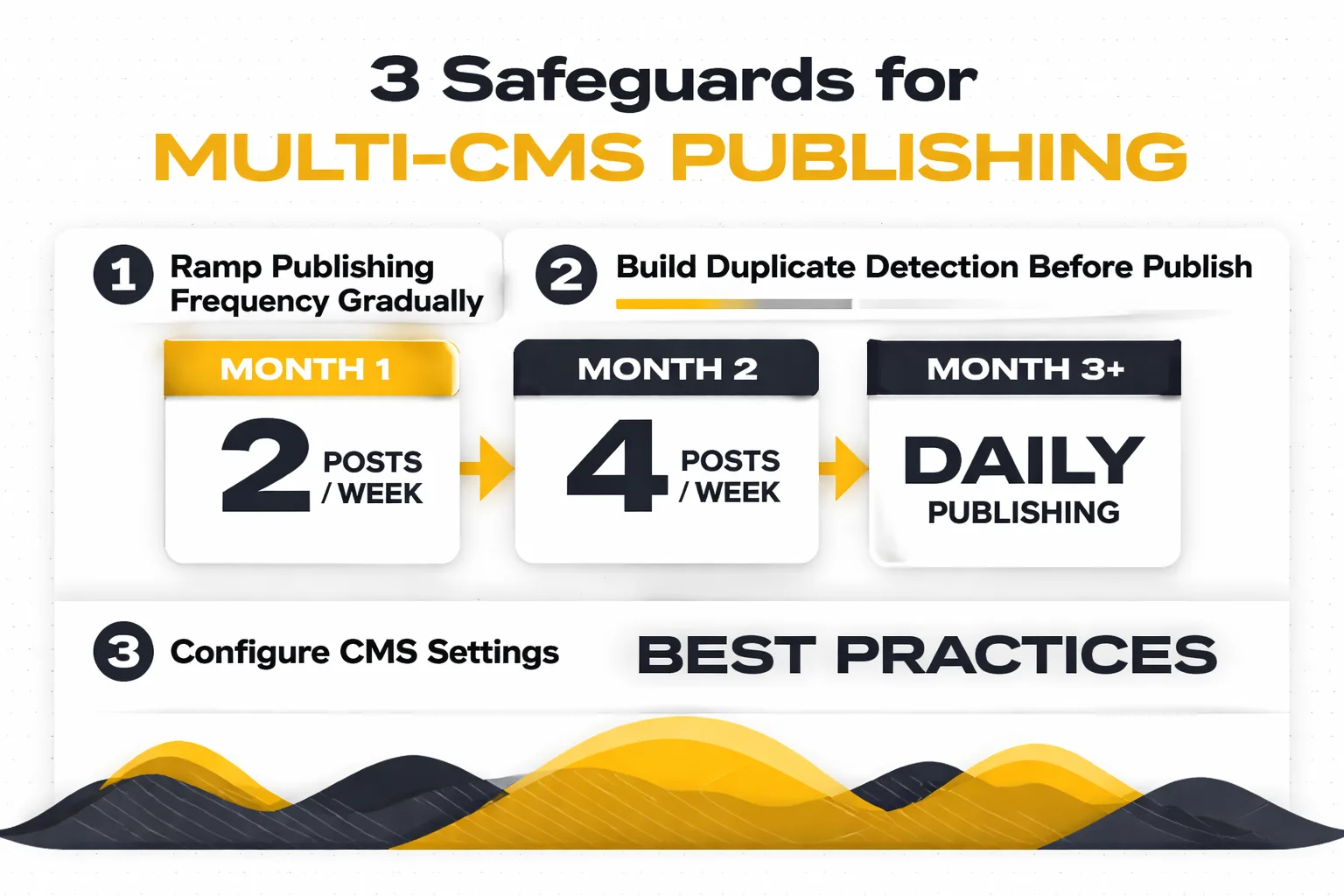
The safeguards I recommend are specific. First, ramp publishing frequency gradually: start at two posts per week for the first month, move to four in month two, and only increase to daily publishing after the domain has established a crawl pattern with the bots. Sudden jumps from zero to twenty posts per week trigger manual review queues at Google, regardless of content quality. Second, build duplicate detection into the pipeline before publish, not after. Semantic similarity checks against your existing post library catch near-duplicates that keyword matching misses. A post on "best project management tools" and "top project management software" can be functionally identical even with different titles. Third, configure CMS-specific canonicalization rules. If you're publishing to multiple CMSes simultaneously. WordPress, Ghost, Shopify, or a headless setup via webhook. Every piece of content needs a canonical URL pointing to the primary domain. Without it, you're creating duplicate content across your own properties.
For WordPress specifically, the combination of IndexNow pinging and Google Search Console sitemap submission on every publish accelerates indexing without the spam signal of manual submission bursts. Meev handles both automatically on publish, which removes a step most auto-blog setups forget entirely.
The platform choice matters for AI visibility too. Ghost's clean HTML output and minimal JavaScript render better for AI crawler parsing than heavily-plugin-loaded WordPress installs. If your WordPress setup has 40+ active plugins and a JavaScript-heavy theme, AI crawlers may be timing out before they reach your content. Run a Lighthouse crawl on your key posts and check Time to Interactive. Anything above 5 seconds is a crawl risk for LLM bots, which have shorter timeout windows than Googlebot.
For teams managing multiple client domains, the Meev vs Frase comparison breaks down how multi-CMS auto-publishing differs from single-site SEO research tools. The operational gap is larger than most agencies realize before they're mid-implementation.
Step 4. Run LLM Citation Tracking After Each Publishing Batch
Publishing without citation tracking is flying blind. You need to know which posts are getting picked up by ChatGPT, Perplexity, and Google AI Overviews. And which are being ignored entirely. Within days of publishing, not months.
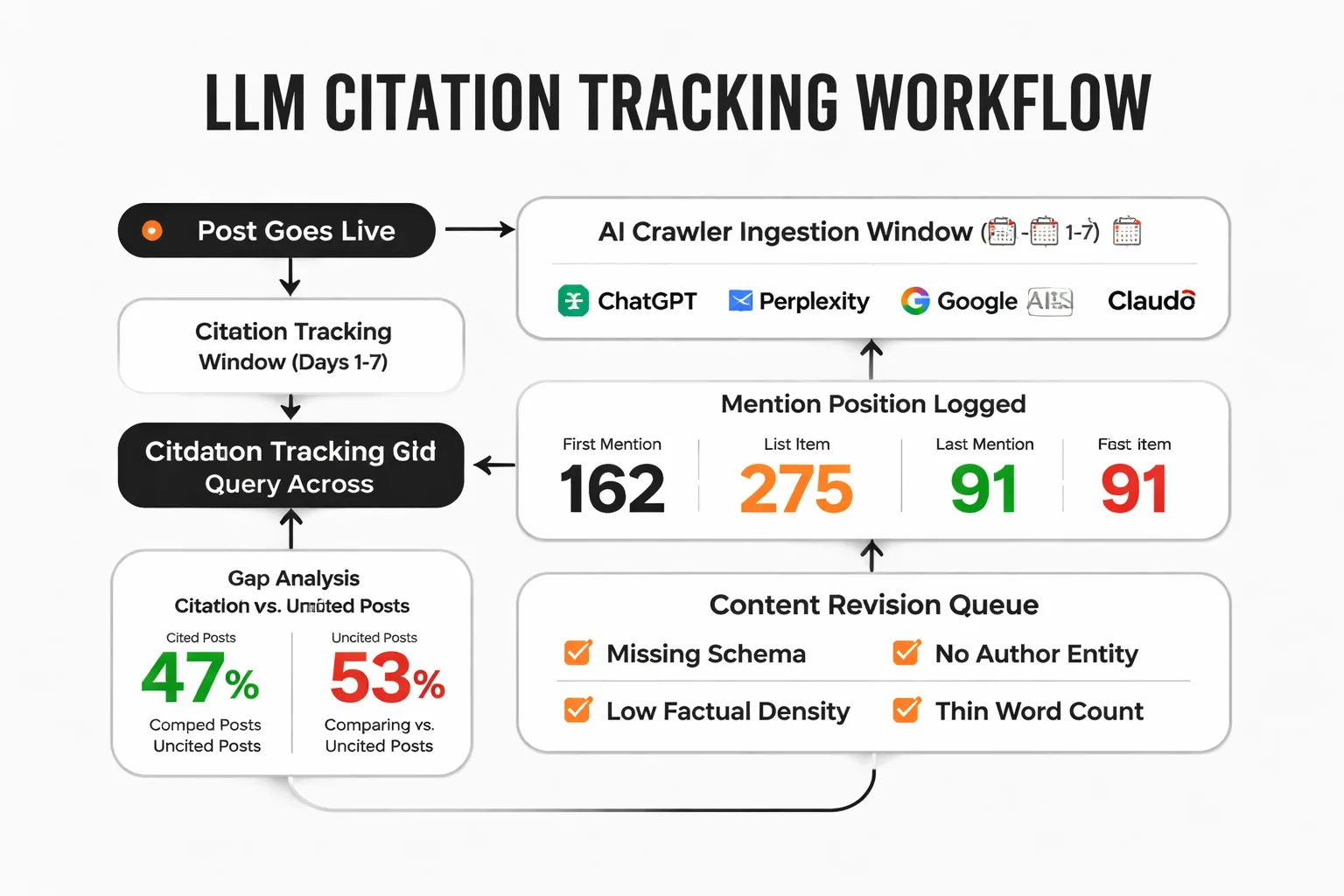
The tracking methodology matters. You're not checking whether your domain appears in AI answers generally. You're checking whether specific posts are cited for specific queries. The workflow is: for each published post, identify the three to five queries it was written to answer, then run those queries through each major AI engine and check whether your post appears in the citations. Log the position (first mention, list item, buried at the end) and the platform. Do this within seven days of publishing, because 65% of AI citations come from content published within the past year, and the citation window for new content is front-loaded.
What the data tells you to fix is usually one of four things. Missing schema markup: posts without FAQ or Article schema are consistently underrepresented in Google AI Overviews. Low factual density: posts with fewer than three cited statistics get deprioritized in Perplexity's source selection, which weights authoritative external citations heavily. No author entity: Claude and ChatGPT both show preference for content with verifiable author attribution. Anonymous posts from generic "staff writer" bylines underperform consistently. And thin information gain: if your post's core claim appears verbatim in the top three Google results, AI engines have no reason to cite you specifically over those established sources.
Meev's LLM citation tracking covers ChatGPT, Claude, Gemini, Perplexity, Grok, Google AI Overviews, Google AI Mode, and DeepSeek. With daily refresh on SERP-driven surfaces and rolling refresh on LLM-driven surfaces. For teams who want to track DeepSeek visibility specifically, that's a surface most citation tracking tools don't cover yet, and it's growing in citation share faster than any other non-Google AI engine in 2026.
The per-LLM drill-down matters because citation patterns diverge sharply by platform. The overlap between ChatGPT and Perplexity citations is only 11%. A post that earns a Perplexity citation may be completely absent from ChatGPT responses. And the fix for each gap is different. Perplexity rewards recency and cited statistics. ChatGPT, running through Bing's index, rewards Bing-indexed authority and OAI-SearchBot accessibility. If your robots.txt blocks GPTBot or OAI-SearchBot, you're invisible to ChatGPT regardless of your Google rankings.
Step 5. Close the Mention-Citation Gap With Targeted Outreach
Here's the part most auto-blog guides skip entirely: AI engines don't just cite content they crawl directly. They cite content that other authoritative sources have cited first. The citation graph matters.
The mention-citation gap is the delta between how often AI engines consume your content and how often they attribute it. Cloudflare's data puts ClaudeBot's crawl-to-refer ratio at 38,065:1. Your content is being read. It's not being cited. The gap closes through outreach, not through more publishing.
The outreach sequence I've seen work has three stages. First, identify which publishers AI engines actually cite for your topic cluster. This is the Citation Path workflow: find the domains that appear in AI answers for your target queries, verify contact information, and prioritize outreach to those specific publishers over generic link-building targets. A citation from a domain that AI engines already trust is worth exponentially more for AI visibility than a citation from a high-DA domain that AI engines don't pull from. For AI search visibility tracking, the cited-source leaderboard by topic is the most actionable output. It shows you exactly which domains you need relationships with.
Second, pitch content contributions that include your original data or named claims. Publishers are far more likely to cite a piece that contains a unique statistic or proprietary finding than one that synthesizes existing information. If your auto-blog engine generates posts with original survey data, case study numbers, or tool-specific benchmarks, those become citation magnets. Generic "best practices" posts do not.
Third, monitor brand mentions across the open web and convert unlinked mentions to citations. When a publisher references your brand or a claim from your content without linking to it, that's a conversion opportunity. A polite outreach email noting the mention and requesting attribution converts at a surprisingly high rate. In my experience, somewhere between 15% and 30% of unlinked mention outreach results in a link or citation addition. Meev's brand mention monitoring with sentiment scoring surfaces these opportunities automatically, which removes the manual crawl work that makes most teams skip this step.
One thing I want to be direct about: the documented failure modes for citation-building outreach right now are not what most teams fear. I've seen concerns about spam filter triggers and burned publisher relationships, but the Admind Agency hallucination roundup from 2025 documented something more unsettling. AI engines attributing fabricated government reports to real brands unprompted. That's a passive risk, not an outreach-triggered one. The aggressive outreach failure case is largely hypothetical as of mid-2026. The passive misattribution risk is documented and real. Build your citation footprint deliberately, because the alternative is letting AI engines build it for you. Incorrectly.
Where This Workflow Breaks Down
This framework works for most content operations. It doesn't work for all of them, and I'd rather name the failure cases than let you discover them mid-implementation.
First, brand-new domains. The quality gate and citation-ready structure won't help a domain with zero crawl history and no existing authority signals. AI engines weight established domains heavily. A domain less than six months old publishing technically perfect content will still be outcompeted for citations by older domains with weaker content. The framework accelerates citation earning. It doesn't shortcut the authority-building timeline.
Second, highly regulated niches. YMYL topics (health, finance, legal) have citation patterns that differ from general content. AI engines apply stricter sourcing standards in these categories, and a named author with a linked bio isn't sufficient. The author needs verifiable professional credentials in the field. A generic "content strategist" byline on a medical post will not earn citations regardless of structural quality.
Third, single-language operations targeting multilingual AI engines. If your content is English-only and your target audience queries AI engines in Spanish or Chinese, you're invisible to a significant portion of the citation surface. This is solvable with multi-language publishing, but it requires native-tuned prompt templates, not machine translation of English posts.
Frequently Asked Questions
How long does it take for a new auto-blog post to earn AI citations?
The citation window for new content is front-loaded. Based on LLM citation tracking data, 65% of AI citations come from content published within the past year, but the initial pickup typically happens within two to four weeks of indexing. Assuming the post has proper schema markup, author attribution, and at least three cited statistics. Posts without these signals may never earn citations regardless of how long they've been live.
Does publishing frequency affect AI citation rates?
Frequency matters less than topical depth. A domain publishing two posts per week on a tightly defined topic cluster consistently outperforms a domain publishing daily across broad, unrelated subjects. AI engines reward topical authority. Consistent, deep coverage of a specific area. More than raw volume. Rapid publishing ramps also risk scaled content abuse flags, which suppress citation potential across the entire domain.
What's the difference between a Google AI Overview citation and a ChatGPT citation?
They come from entirely separate infrastructure. Google AI Overviews runs through Gemini's evaluation of content Googlebot already trusts. ChatGPT retrieves through Bing's index and OAI-SearchBot crawls. Strong Google rankings don't transfer to ChatGPT visibility. If your robots.txt blocks GPTBot or your domain has never been optimized for Bing, you're invisible to ChatGPT regardless of your Google performance. Check both crawler access and Bing Webmaster data separately.
Is Reddit worth targeting for AI citation building?
The data says no, at least not as a primary strategy. Analysis of 2M+ actual AI answer citations found Reddit accounts for just 0.34% of citations, ranking ninth overall. Wikipedia represents 17.02%. Tech publications like TechRadar and Wired account for roughly 2%. Invest in getting cited by those high-weight sources before building a Reddit presence. Reddit is a distribution channel, not a citation engine.
How do I know if my content has an information gain problem?
Search your target keyword and read the top three results. If your post's primary claim, key statistic, or main recommendation appears in those results without attribution to you, you have an information gain problem. AI engines have no reason to cite a fourth source saying the same thing. Fix it by adding original data, a unique synthesis, a proprietary benchmark, or a named case study that doesn't exist in the existing top results. The bar isn't originality for its own sake. It's giving the model something it can't get from the sources it already cites.
Can I use the same content across multiple CMS platforms without a citation penalty?
Only with proper canonicalization. If you're publishing identical or near-identical content to WordPress, Ghost, and Shopify simultaneously without canonical tags pointing to a primary URL, you're creating duplicate content across your own properties. AI engines may cite the wrong version, split authority signals, or deprioritize all versions. Set canonical URLs at the CMS level before multi-platform publishing goes live, not after.
About the Author
Judy Zhou, Head of Content Strategy
Judy Zhou leads content strategy at Meev, where she oversees AI-driven content research and publishing for hundreds of brands. With a background in SEO and editorial operations, she focuses on building content systems that rank on Google, get cited by AI search engines, and drive measurable business results.
Meev tracks your AI citation footprint across 8 engines, gates your content with a 16-dimension quality firewall, and surfaces outreach targets to close your mention-citation gap — all in one platform.