

By Judy Zhou, Head of Content Strategy
Key Takeaways
- 72% of B2B buyers encounter AI Overviews during research, and 90% click the cited sources to verify information.
- Brand mentions correlate with AI Overview inclusion at 0.664, the strongest predictor according to Ahrefs data.
- Only 38% of AI Overview citations now come from top-10 ranking positions, down from 76% in July 2024, with 62% pulled from positions 11 and beyond.
- AI citation tracking tools answer whether your brand appears when buyers query ChatGPT, Perplexity, or Google AI Overviews about your category.
When OpenAI released ChatGPT to the public in November 2022, most B2B marketers watched with curiosity but kept their attention fixed on Google. Within eighteen months, that posture had become a liability. By mid-2024, Perplexity was processing hundreds of millions of queries a month, Google had embedded AI Overviews into its core results, and enterprise buyers had quietly begun using generative AI as their first research step. From that inflection point forward, the question of which brands get cited inside AI answers became a legitimate marketing discipline. And a measurable one.
AI citation tracking tools exist to answer one specific question: when a buyer asks ChatGPT, Perplexity, or Google AI Overviews about your category, does your brand appear? According to TrustRadius, 72% of B2B buyers now encounter AI Overviews during their research process, and 90% of those buyers click cited sources to verify information. That's not a vanity metric. That's the top of your funnel. An Ahrefs study found that brand mentions correlate with AI Overview inclusion at 0.664. The single strongest predictor in their dataset. And Ahrefs' updated citation analysis of 863,000 keywords found that only 38% of AI Overview citations now come from top-10 ranking positions, down from 76% in July 2024. The remaining 62% come from positions 11 and beyond. Meaning ranking alone no longer predicts citation. This is the environment B2B marketers are operating in, and the right ai citation tracking tools are what make it measurable.
The Mention-Citation Gap Nobody Talks About
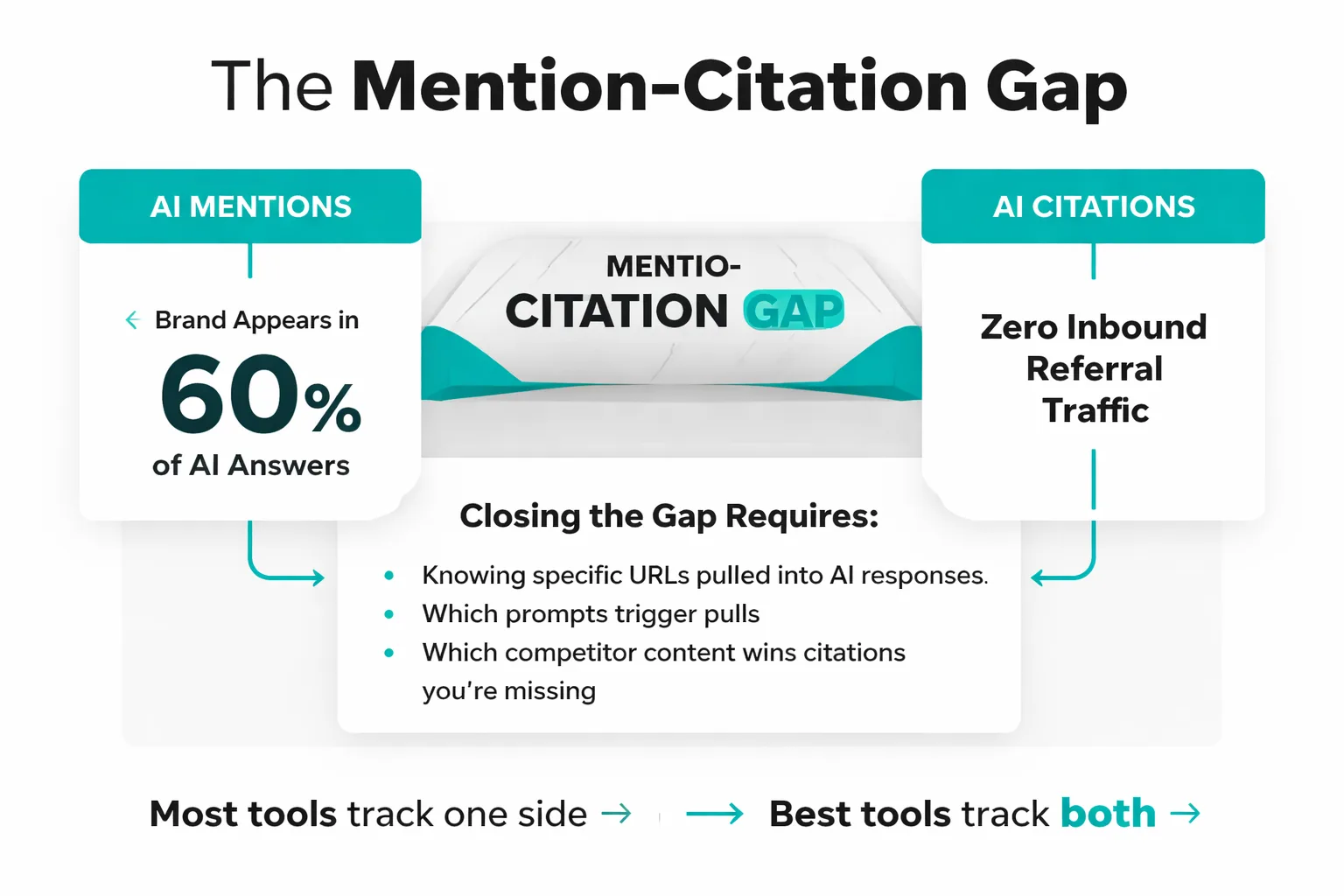
Before comparing tools, it's worth naming the problem most platforms don't fully solve. There's a meaningful difference between an AI mentioning your brand and an AI citing your content as a source. Peec AI calls this the "Used vs. Cited" distinction, and it matters enormously for strategy. A brand can appear in 60% of AI answers about its category and still have zero inbound referral traffic if the AI is summarizing its reputation without linking to its pages.
The pattern I keep seeing is teams celebrating high mention rates while their citation-sourced traffic stays flat. That's the mention-citation gap. Closing it requires knowing which specific URLs are being pulled into AI responses, which prompts trigger those pulls, and which competitor content is winning the citations you're missing. Most tools in this space track one side of that equation. The best ones track both.
I should note something uncomfortable here: even when you close the citation gap, the traffic question remains open. As of mid-2026, I have not seen a single public analysis that rigorously measures what a Perplexity citation is worth in actual referral visitors. The honest answer is we're all optimizing for a proxy metric while the conversion data matures. That said, the proxy still matters. Brands cited in AI answers are the brands enterprise buyers investigate next. Tracking citations is how you know whether you're in that consideration set.
How AI Citation Tracking Tools Actually Work
Every platform in this category runs some version of the same core loop: submit prompts to AI engines, record the responses, parse which sources are cited, and surface patterns over time. The differences show up in four dimensions.
Prompt coverage. How many queries does the tool run, and does it use prompts that match how real buyers research? A tool running 50 generic prompts will miss the long-tail commercial queries where citation battles actually happen. The best platforms let you define custom buyer-intent prompts like "best enterprise CRM for manufacturing" rather than just monitoring your brand name.
Engine breadth. ChatGPT, Perplexity, Google AI Overviews, Gemini, Claude, Grok, DeepSeek, Copilot, and AI Mode are all distinct citation surfaces with different source-selection behaviors. ChatGPT citation patterns differ meaningfully from Perplexity's source selection — Perplexity is more aggressive about linking to sources, while ChatGPT tends to synthesize without explicit attribution unless pressed. A tool covering only two or three engines gives you a partial picture.
Citation depth. Some tools tell you whether your domain appeared. Better tools tell you which specific URL appeared, in response to which prompt, with what surrounding context. That page-level granularity is what allows you to reverse-engineer what made a piece of content citation-worthy.
Action layer. Tracking without recommendations is a dashboard, not a strategy. The tools that genuinely move the needle connect citation gaps to content actions: which topics to write, which pages to update, which third-party publishers to pitch for coverage.
According to Ahrefs' analysis of 863,000 keywords, 31% of AI Overview citations come from pages ranked beyond position 100. That number stopped me cold. It means the AI citation game is not the SEO game with a different name. It has its own logic, and you need tools built for that logic.
Comparing the Best AI Citation Tracking Tools
The table below covers the tools reviewed in this article. Pricing reflects published rates as of May 2026.
| Tool | Best For | Engine Coverage | Starting Price | Content Actions? |
| Meev | Teams wanting citation tracking + content engine | ChatGPT, Claude, Gemini, Perplexity, Grok, AI Overviews, AI Mode | $49/mo | Yes (12-dimension Quality Matrix) |
| OtterlyAI | Agencies, solopreneurs needing affordable monitoring | ChatGPT, Perplexity, AI Overviews, AI Mode, Gemini, Copilot | $29/mo | Yes (GEO recommendations) |
| Peec AI | Mid-market SaaS needing multi-market tracking | ChatGPT, Perplexity, AI Overviews | €89/mo | Yes (content groupings) |
| Profound | Enterprise B2B with compliance requirements | Multiple (SOC 2 compliant) | $499/mo | Limited |
| Scrunch AI | Brands needing hallucination monitoring | ChatGPT, Claude, Perplexity, Meta AI, AI Mode, AI Overviews, Gemini | $300/mo | Yes (AXP) |
| Semrush AI Toolkit | SEO teams wanting unified workflow | Multiple | $99/mo | Yes (integrated) |
| Ahrefs Brand Radar | Ahrefs users extending into AI monitoring | Multiple | $199/mo | Limited |
| AIclicks | SaaS growth teams wanting GEO actions | ChatGPT, Perplexity, Gemini | On request | Yes |
| Answer Socrates LLM Tracker | Solo founders, bootstrapped startups | ChatGPT, Gemini, Grok, Claude, Perplexity, DeepSeek | Free / $15/mo | No |
| Siftly | B2B teams wanting daily automated monitoring | ChatGPT, Claude, Perplexity, AI Overviews | On request | Limited |
| LLM Pulse | Growth-stage brands wanting low-friction monitoring | ChatGPT, Perplexity, AI Mode, AI Overviews | On request | No |
Wondering which AI engines are actually citing your brand right now?
1. Meev — Best for Teams That Want Tracking and Publishing
Best for: Teams that want AI citation tracking plus a content engine they can trust to publish. Not just a dashboard that surfaces problems. Differentiated by the 12-dimension Quality Matrix and Helpful Content Risk score that gate every article before it ships.
Meev is the only platform in this category that closes the loop between citation data and content production. Most tools tell you where you're missing citations. Meev tells you that and then writes quality-gated content designed to earn them. The citation tracking covers ChatGPT, Claude, Gemini, Perplexity, and Grok on a rolling cadence, with Google AI Overviews and AI Mode refreshing daily. The Gemini visibility tracking and Claude citation monitoring run alongside the other surfaces, so you're not building a fragmented picture from five separate dashboards.
Key features: - Citation tracking across ChatGPT, Claude, Gemini, Perplexity, and Grok on a rolling cadence; Google AI Overviews and AI Mode refresh daily. 12-dimension Quality Matrix plus Helpful Content Risk score with a 70/100 publish gate on both. Knowledge Base enforcement. Articles grounded in your approved claims, not AI hallucination. Closed-loop Citation Path (roadmap) — each article mapped to the citation-rate delta it drove. Autopilot topic pool with gap detection from competitor citation patterns
Pricing: 7-day free trial. After the trial, services pause unless you subscribe. Lite $49/mo, Starter $99/mo, Pro $269/mo, Agency $599/mo. 20% annual discount. Cancel anytime; hard-cap quotas with no overage fees.
The 70/100 publish gate is the detail that separates Meev from every other tool here. In my work overseeing AI-driven content research and publishing, the single biggest failure mode I've seen is teams generating content at velocity without any quality checkpoint. The June 2025 enforcement wave documented exactly that pattern as a manual action trigger. Meev's gate is a structural fix, not a best-practice reminder.
2. OtterlyAI — Best for Agencies and Solopreneurs
Best for: Marketing teams, solopreneurs, and agencies needing affordable, multi-platform AI search monitoring with built-in GEO recommendations.
OtterlyAI has built one of the more complete entry-level platforms in this space, covering six AI platforms and packaging the data into a single Brand Visibility Index that gives you a unified KPI instead of six disconnected metrics. The GEO Crawlability and Content Audits with predictive citation-readiness scoring are genuinely useful for teams that want to know not just where they're cited today but which content has the structural properties to earn citations tomorrow.
Key features: - Search Prompt Monitoring across 6 AI platforms (ChatGPT, Perplexity, Google AI Overviews, AI Mode, Gemini, Copilot) - Brand Visibility Index as a single unified KPI for AI share of voice. GEO Crawlability and Content Audits with predictive citation-readiness scoring. AI Keyword Research Tool that auto-converts traditional keywords into AI-native prompts
Pricing: Starts at $29/month; multiple tiers available up to enterprise; free trial offered.
At $29/month, OtterlyAI is the most accessible serious option in this list. The platform serves 20,000+ users, which means the prompt library and benchmarking data are informed by a large base. For agencies managing multiple brands, the multi-platform coverage at this price point is hard to argue with.
3. Peec AI — Best for Multi-Market SaaS Teams
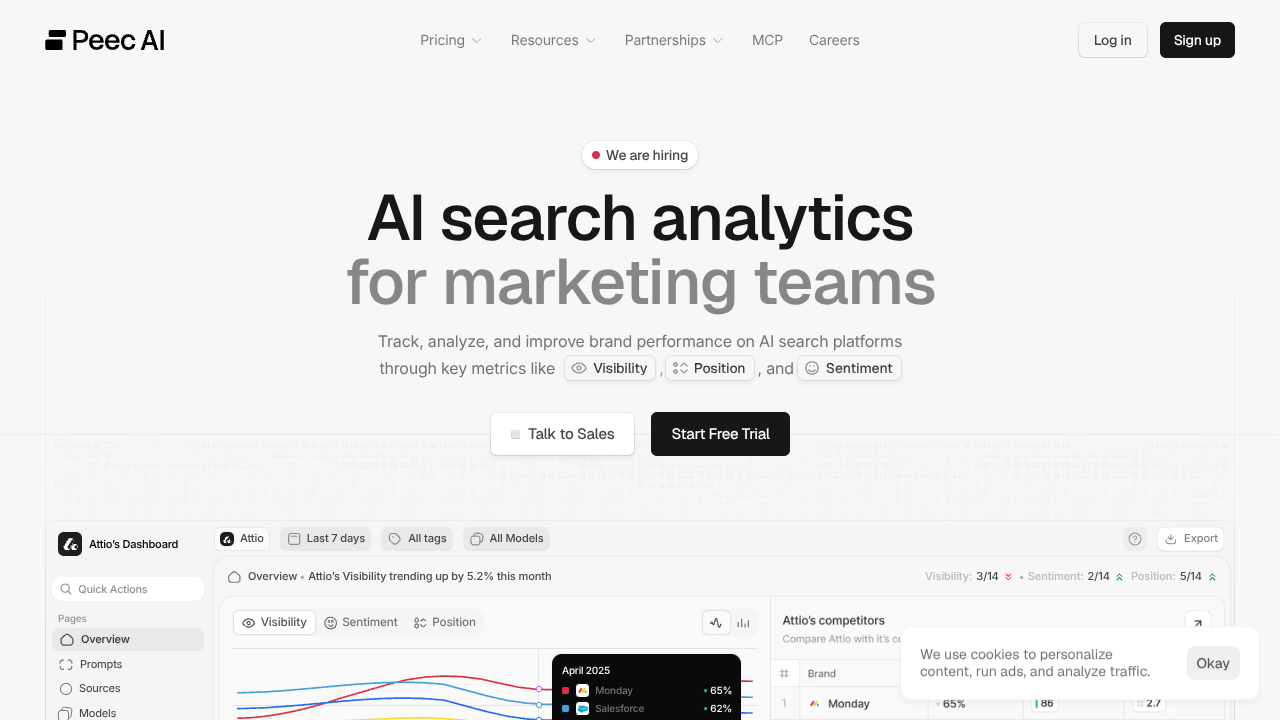
Best for: Mid-market SaaS and agency teams that need daily AI visibility tracking with prioritized, actionable content recommendations across multiple markets.
Peec AI's defining feature is the Used vs. Cited distinction. Most tools collapse these into a single "mention" metric, which obscures the real problem. Peec separates content that informed an AI answer from content explicitly linked as a source. And that distinction is exactly what the mention-citation gap analysis requires. The 115+ language support makes it the strongest option for B2B teams running campaigns across multiple geographies.
Key features: - Used vs. Cited distinction separating content that informed an AI answer from content explicitly linked as a source. Source Gap Analysis identifying domains where competitors are cited but your brand is absent. Unlimited country and language tracking (115+ languages) for global brand monitoring. Actionable content groupings (editorial listicles, UGC, reference pages) tied directly to citation gaps
Pricing: Starter €89/month; Pro €245/month; Advanced €495/month.
Peec raised €7M within five months of launch, which signals strong early traction but also means the platform is still maturing. For teams comparing options, the Meev vs Peec AI comparison breaks down where the two platforms diverge on citation tracking depth versus content production capability.
4. Profound — Best for Enterprise B2B
Best for: Enterprise B2B marketing and demand-gen teams at brands like Ramp and US Bank that need compliance-grade AI intelligence tied directly to revenue attribution.
Profound processes over 5 million citations daily and surfaces what it calls "dark query" data. The actual AI conversation volume happening around your brand and category that you'd never see through traditional keyword research. The Conversation Explorer is the feature that justifies the price for large teams: it shows you what buyers are actually asking AI engines about your category, not just what you think they're asking.
Key features: - Conversation Explorer surfacing dark query data. Real AI conversation volume by topic cluster. Page-level citation tracking showing exactly which URLs are referenced in AI-generated answers. Behavioral analytics connecting AI mentions to downstream conversion data. Enterprise-grade access controls including SSO and SOC 2 Type II compliance
Pricing: Starts at $499/month; enterprise and custom tiers available on request; SOC 2 Type II compliant.
At $499/month, Profound is an intelligence layer, not an execution platform. If your team needs to know what's happening and then act on it separately, Profound is exceptional. If you need the tracking and the content production in one workflow, it's not designed for that.
5. Scrunch AI — Best for Narrative Control
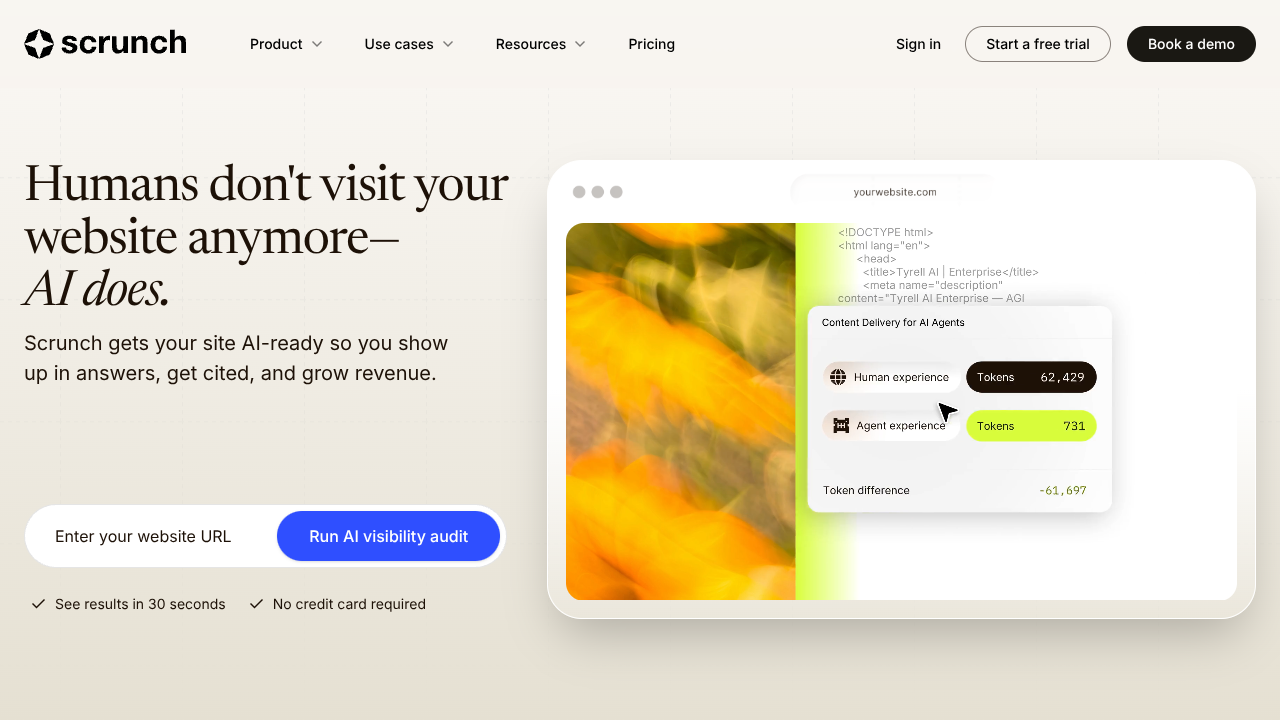
Best for: B2B SaaS, healthcare, fintech, and legal-adjacent brands that need narrative control, hallucination monitoring, and compliance-safe AI visibility management.
Scrunch AI solves a problem the other tools mostly ignore: what happens when AI engines describe your product incorrectly? Its hallucination detection flags AI answers that contain wrong features, outdated pricing, or misattributed comparisons. For regulated industries where a misrepresented claim creates legal exposure, this isn't a nice-to-have. The Agent Experience Platform (AXP) then lets you serve AI-readable content that shapes how your brand is represented in real time.
Key features: - Prompt-level tracking across 7 platforms: ChatGPT, Claude, Perplexity, Meta AI, Google AI Mode, Google AI Overviews, and Gemini. Hallucination detection flagging AI answers with incorrect features, outdated pricing, or misattributed comparisons. Agent Experience Platform (AXP) for serving AI-readable content that shapes real-time brand representation. Source-level citation view revealing competitor citations and content refresh opportunities
Pricing: Starts at $300/month for 350 custom prompts and 3 personas; enterprise and AXP pricing on request.
The $300/month entry point is steep for small teams, and the AXP setup requires technical resources to implement fully. But for brands where a hallucinated claim about pricing or a compliance attribute creates real risk, Scrunch is the only tool in this list built specifically for that problem.
6. Semrush AI Toolkit — Best for SEO Teams
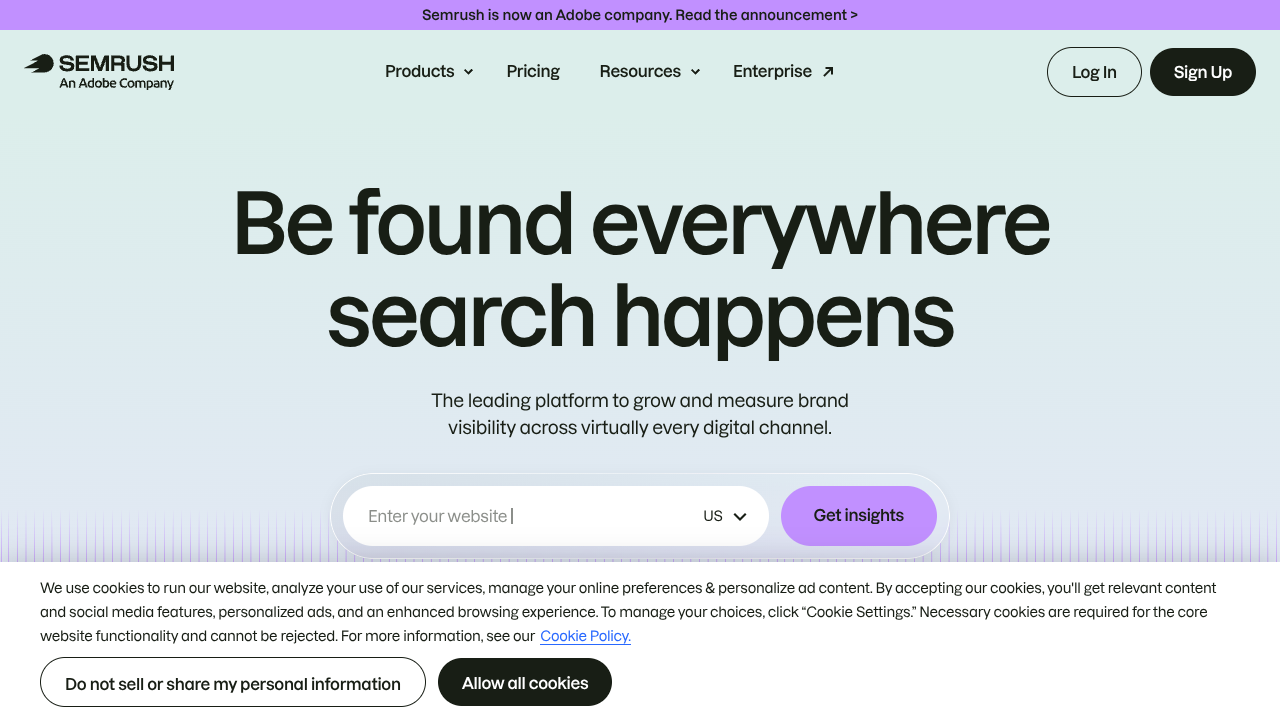
Best for: In-house SEO leads and agencies that want AI citation tracking consolidated with traditional rank tracking, audits, and competitor research in a single platform.
Semrush's AI Toolkit is the path-of-least-resistance option for teams already running their SEO workflow inside Semrush. The AI Visibility Score broken down by region and competitor is genuinely useful for benchmarking, and the Prompt Research feature adds intent data that helps prioritize which AI queries to target. The unified platform argument is real: not having to export data between an AI monitoring tool and an SEO tool saves meaningful time.
Key features: - AI Visibility Score broken down by region and competitor for cross-market benchmarking. Prompt Research with volume, difficulty, and intent data to prioritize high-value AI queries. Competitor Citation Research showing which prompts and topics rivals are winning in AI answers. Unified platform combining AI visibility, technical SEO audits, and content production workflows
Pricing: Base AI Visibility from $99/month per domain; Starter $199/month; Pro+ $299/month; Advanced $549/month; 7-day free trial available.
The AI visibility features are newer additions and still maturing compared to dedicated AI-only trackers. Full feature access requires higher-tier plans. But if you're already paying for Semrush, the incremental cost to activate AI visibility monitoring is worth evaluating before adding a separate tool to your stack.
7. Ahrefs Brand Radar — Best for Existing Ahrefs Users
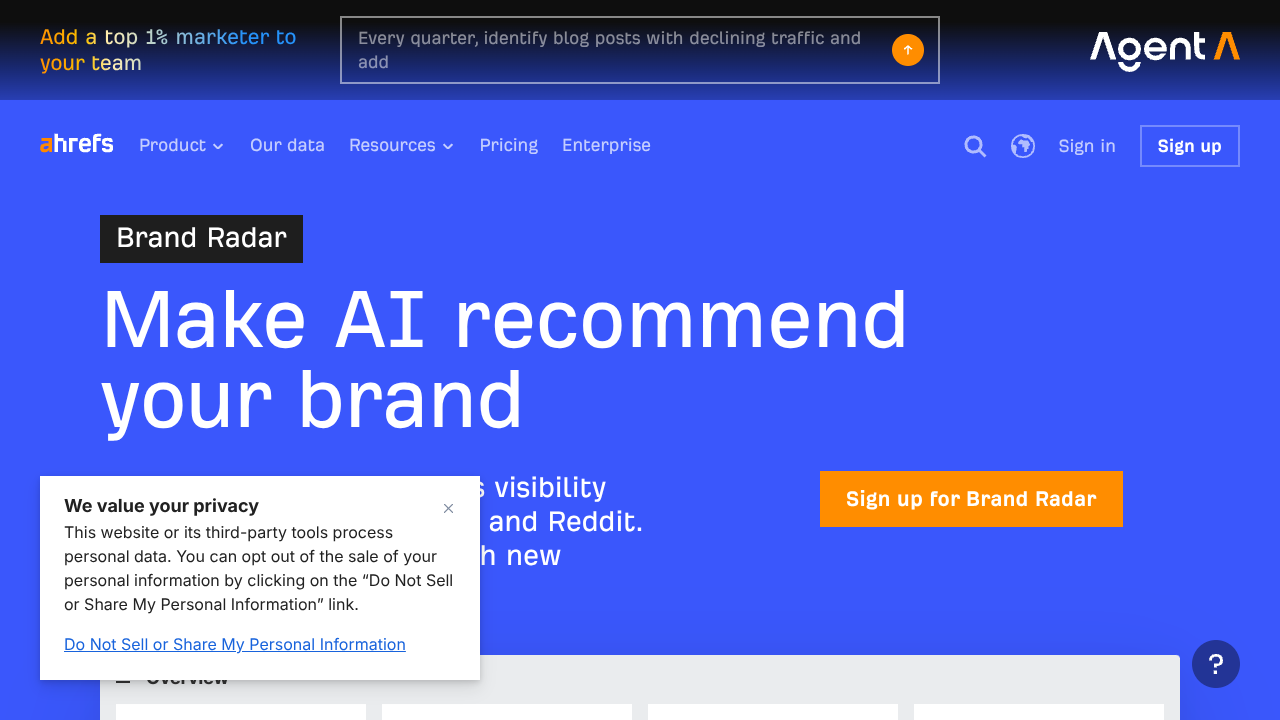
Best for: SEO-led teams already on Ahrefs who want to extend their existing workflow into AI visibility monitoring without adopting a separate platform.
Ahrefs Brand Radar is a brand-monitoring layer, not a dedicated AI answer tracker. The pre-built prompt datasets remove the setup friction that kills adoption of new tools, and the third-party source identification. Showing which external domains shape AI perception of your brand. Is directly actionable for publisher outreach. The native integration with Ahrefs' backlink and content explorer data means you can connect citation gaps to link-building opportunities in one place.
Key features: - Pre-built prompt datasets so teams don't need to build a prompt library from scratch. Share of presence trending over time to benchmark brand visibility shifts against competitors. Third-party source identification revealing which external domains shape AI perception of your brand. Native integration with Ahrefs backlink, keyword, and content explorer data
Pricing: From $199/month for one platform (included within Ahrefs plans); no standalone pricing published.
Brand Radar is less granular at the prompt-citation level than purpose-built tools. If you need to know exactly which URL appeared in which AI response to which query, you'll want a dedicated tracker. If you need directional AI visibility data inside a workflow you already trust, Brand Radar is a reasonable extension.
8. AIclicks — Best for SaaS Growth Teams
Best for: SaaS marketers and growth teams who want AI visibility data paired with clear, prioritized content and GEO actions rather than raw dashboards.
AIclicks differentiates on the action layer. The buyer-prompt tracking uses real commercial queries like "best X tools" and "[tool] alternatives" — the exact prompts where citation battles are won or lost for SaaS brands. The GEO content recommendations are tied directly to citation gaps rather than generic content suggestions, which makes the output more immediately usable for content teams.
Key features: - Buyer-prompt tracking using real commercial queries like 'best X tools' and '[tool] alternatives' - GEO content recommendations tied directly to citation gaps and competitor share-of-voice data. Competitor visibility comparison showing who is ahead and which content changes can close the gap. Continuous AI engine querying across ChatGPT, Perplexity, and Gemini with mention and citation logging
Pricing: Pricing available on the AIclicks website; free trial or demo available on request.
AIclicks is a smaller platform with less public third-party review coverage than Semrush or Ahrefs. Engine coverage is narrower than enterprise tools covering six or seven platforms simultaneously. For SaaS teams focused specifically on ChatGPT, Perplexity, and Gemini, that may be sufficient. For teams that need full engine breadth, it's a limitation worth noting.
9. Answer Socrates LLM Brand Tracker — Best for Solo Founders
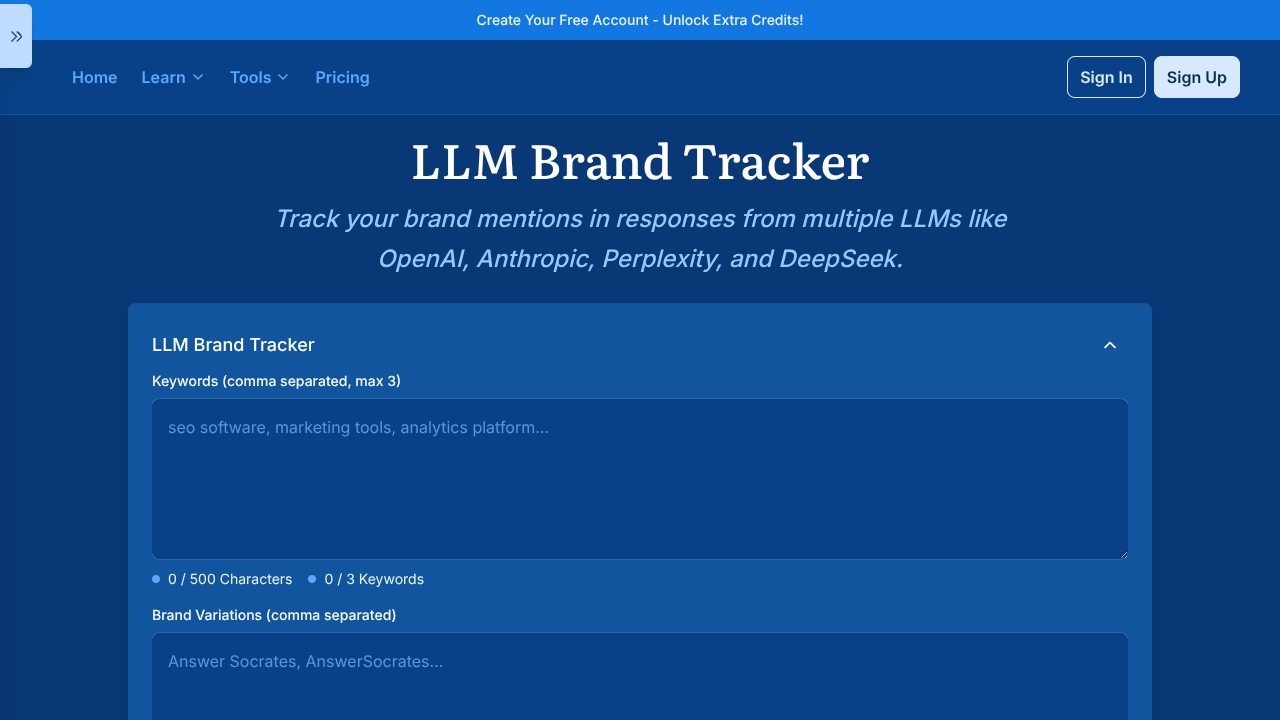
Best for: Solo founders, bootstrapped startups, and small B2B teams that need an affordable entry point into LLM brand monitoring before committing to a full-featured platform.
The free tier for ChatGPT and Gemini monitoring with no credit card required is genuinely useful for teams that need to establish a baseline before making a budget case for a paid tool. The six-model coverage including Grok and DeepSeek at $15/month is broader LLM reach than most entry-level options. This is the right starting point for a solo founder who wants to know whether they're showing up in AI answers at all before investing in a full tracking stack.
Key features: - Free monitoring for ChatGPT and Gemini with no credit card required. 6-model coverage including Grok and DeepSeek. Broader LLM reach than most entry-level tools. Citation source tracking showing which domains and URLs LLMs use to justify brand inclusion. Share-of-voice benchmarking against competitors with week-over-week mention rate tracking
Pricing: Free tier for ChatGPT and Gemini monitoring; paid plans starting at $15/month to unlock Grok, Claude, Perplexity, and DeepSeek tracking.
The analytics depth is lighter than enterprise tools. There's no advanced sentiment scoring or GEO recommendations. But at $15/month, you're buying visibility into a signal, not a full strategy platform. Use it to validate the problem exists, then graduate to a more capable tool once you have internal buy-in.
10. Siftly — Best for Daily Automated Monitoring
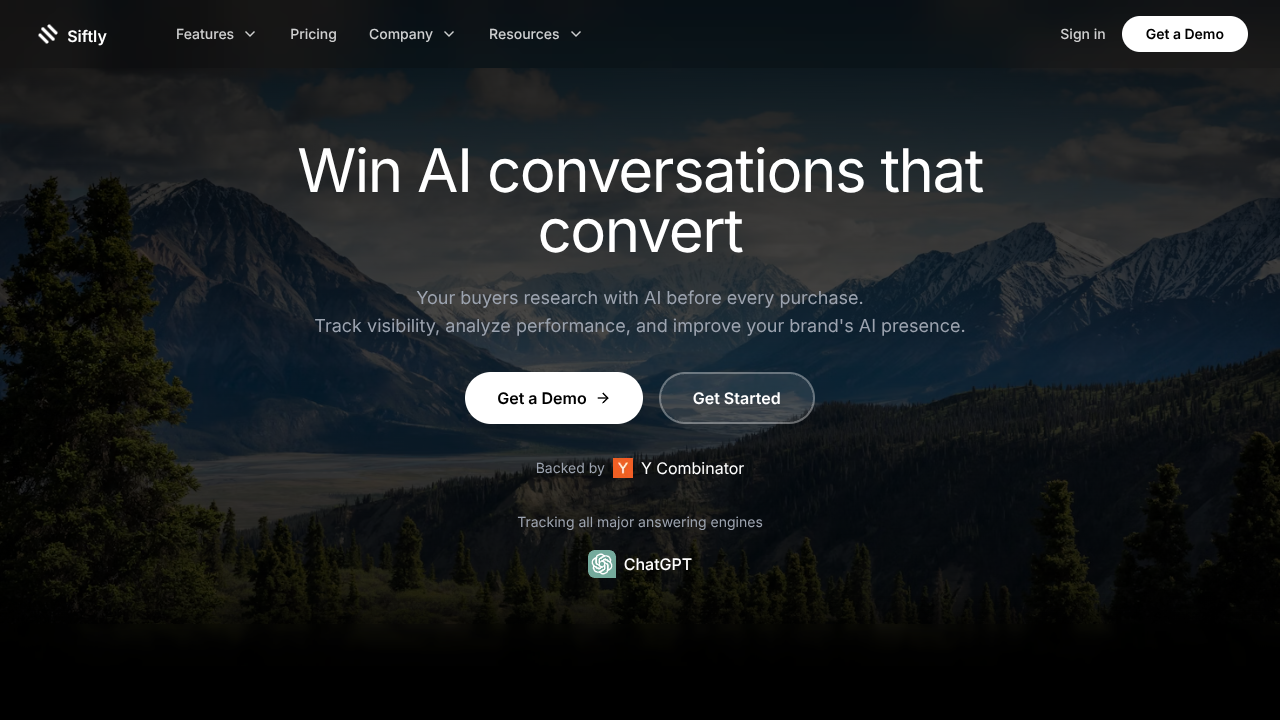
Best for: B2B marketing and brand teams that want a clean, automated daily monitoring workflow with competitive benchmarking and brand-accuracy alerts across major AI platforms.
Siftly's daily automated prompt pipeline is its core differentiator. Most tools run queries on a schedule you configure. Siftly runs continuously and surfaces changes in your competitive leaderboard position as they happen. The hallucination and misrepresentation alerts are a practical feature for any B2B brand where AI engines might describe outdated pricing or discontinued features.
Key features: - Daily automated monitoring cadence across ChatGPT, Claude, Perplexity, and Google AI Overviews. Competitive leaderboard showing visibility percentage, mention count, and share of voice per platform. Hallucination and misrepresentation alerts flagging when AI describes your pricing or features incorrectly. Topic-level drill-down identifying where your brand dominates and where competitors are winning specific query clusters
Pricing: Pricing available on the Siftly website; free trial available; tiered plans based on prompt volume and competitor seats.
Siftly is positioned as a complement to traditional social monitoring tools rather than a replacement, which means running parallel stacks. It's a newer entrant with less public case study data than established players. For teams already using Brandwatch or Mention for social monitoring, Siftly adds the AI channel without requiring a full platform migration.
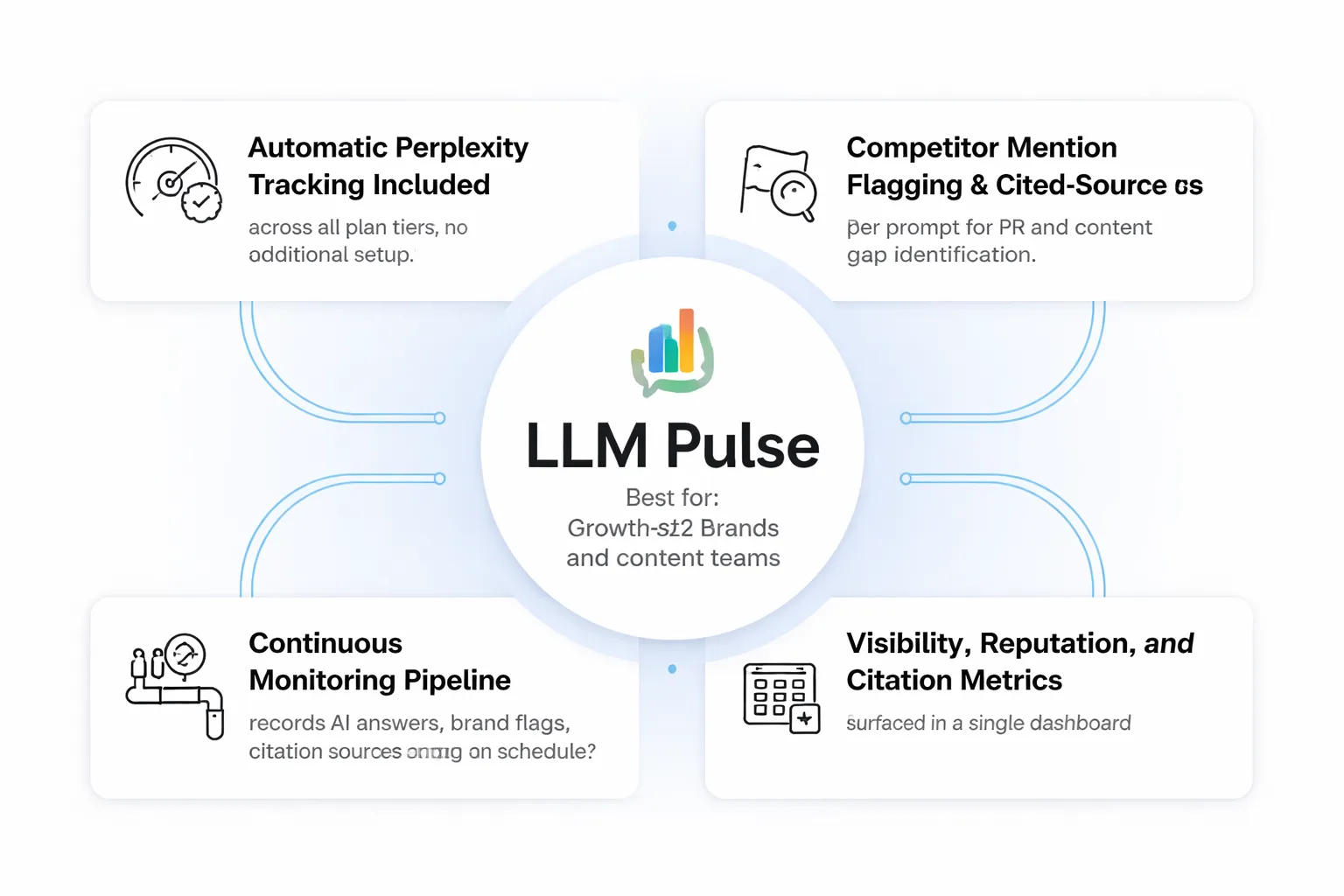
11. LLM Pulse — Best for Low-Friction Entry
Best for: Growth-stage B2B brands and content teams that want always-on, low-friction AI visibility monitoring across ChatGPT, Perplexity, and Google AI without complex onboarding.
LLM Pulse's main selling point is zero-configuration Perplexity tracking included in every plan. For teams where Perplexity is a priority channel, not having to set up and configure that integration separately removes meaningful friction. The continuous monitoring pipeline records AI answers, brand flags, and citation sources on an ongoing schedule without requiring manual prompt management.
Key features: - Automatic Perplexity tracking included across all plan tiers with no additional setup required. Competitor mention flagging and cited-source listing per prompt for PR and content gap identification. Continuous monitoring pipeline that records AI answers, brand flags, and citation sources on an ongoing schedule. Visibility, reputation, and citation metrics surfaced in a single dashboard across 4 major AI platforms
Pricing: Perplexity tracking included in all plans at no extra cost; full pricing tiers available on the LLM Pulse website.
Engine coverage is narrower than category leaders at four platforms. GEO recommendation features are less mature than purpose-built tools. LLM Pulse works best as a monitoring layer for teams that have a content strategy already and need ongoing signal data rather than strategic recommendations.
How to Use Citation Data Beyond the Dashboard
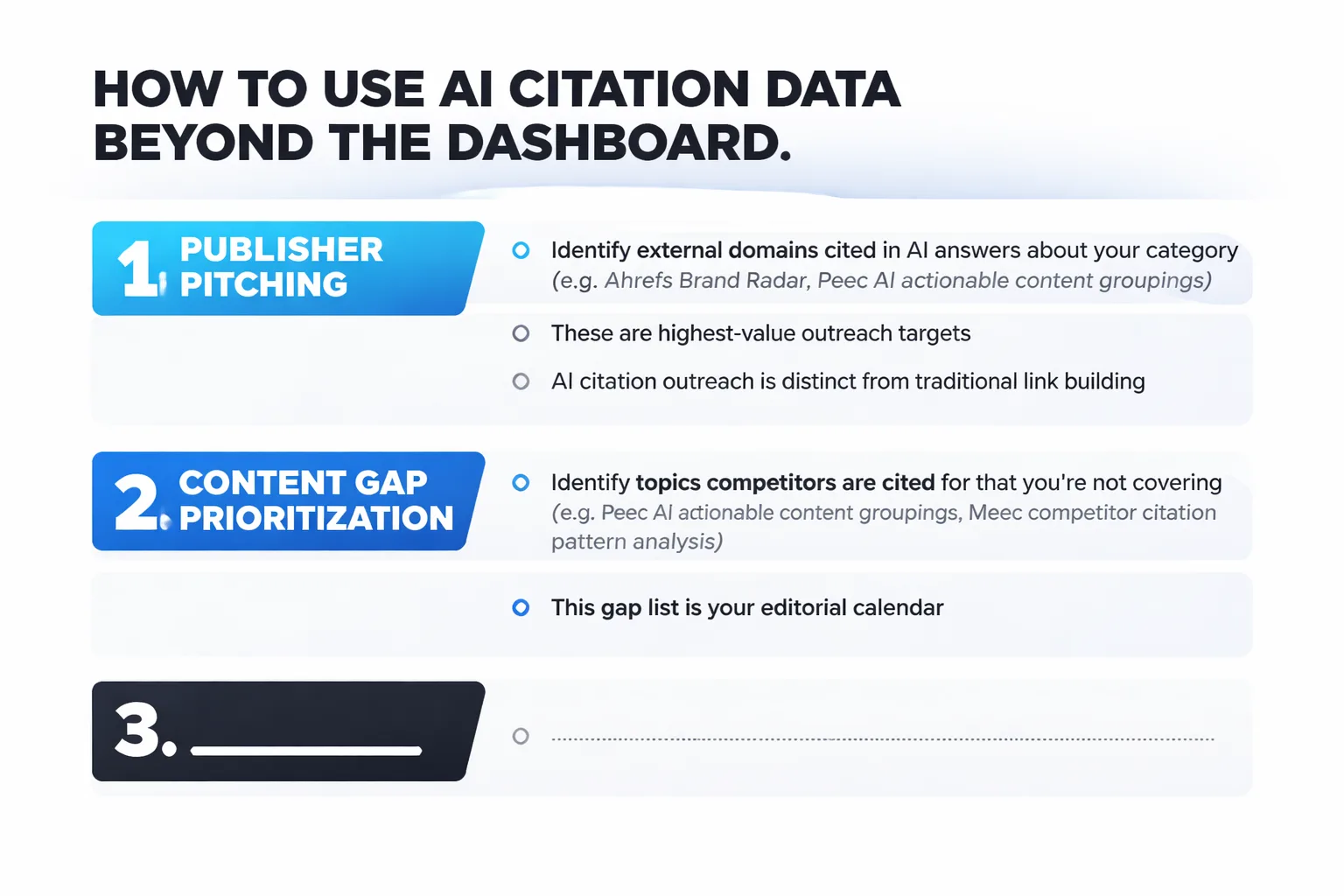
Tracking is step one. The B2B teams getting real value from ai citation tracking tools are using the data in three specific ways that most teams skip.
Publisher pitching. The third-party source identification features in tools like Ahrefs Brand Radar and Peec AI's Source Gap Analysis tell you which external domains are being cited in AI answers about your category. Those are your highest-value outreach targets. A guest post or product mention on a domain that AI engines already trust for your category is worth more than a link from a high-DA site that AI engines ignore. This is AI citation outreach as a discipline, and it's distinct from traditional link building.
Content gap prioritization. Peec AI's actionable content groupings and Meev's competitor citation pattern analysis both surface the same insight: which topics are your competitors being cited for that you're not covering? That gap list is your editorial calendar. It's more defensible than keyword volume data because it's grounded in what AI engines are actually pulling when buyers ask questions.
E-E-A-T signal strengthening. The Ahrefs study found that citation sources increasingly come from positions 11 and beyond, which means topical authority and content depth matter more than ranking position alone. When I look at what actually differentiates cited content from non-cited content in my work, it's not formatting. It's whether the piece contains something that couldn't have been written from a generic prompt. Named examples. Specific numbers. A perspective grounded in actual experience. That's what earns the citation, and no tracking tool manufactures it for you. The tool shows you where to aim. The content quality is still yours to deliver.
For teams tracking Google AI Overviews specifically, the daily refresh cadence matters. AI Overviews change faster than traditional rankings, and a citation you earned last week can disappear this week if a competitor publishes something more authoritative. Continuous monitoring isn't a luxury in that environment.
Making the Right Choice
The right ai citation tracking tool depends almost entirely on what you need to do with the data once you have it.
If you're a solo founder or bootstrapped team, start with Answer Socrates. The free tier for ChatGPT and Gemini monitoring costs nothing and tells you whether the problem is real for your brand before you spend anything else.
If you're an agency or SMB running multiple brands, OtterlyAI at $29/month covers six platforms and gives you the GEO recommendations that make the data actionable. The Brand Visibility Index as a single KPI also makes client reporting cleaner.
If you're a mid-market SaaS team operating across multiple markets, Peec AI's Used vs. Cited distinction and 115-language support are the features that matter. The Meev vs Peec AI comparison is worth reading if you're also evaluating whether to bring content production into the same workflow.
If you're an enterprise B2B team with compliance requirements, Profound is the only SOC 2 Type II compliant option in this list and the only one processing citations at the volume required to surface meaningful dark query data.
If you need tracking and content production in one platform, Meev is the only tool here that closes that loop. The 12-dimension Quality Matrix and Helpful Content Risk score aren't just features. They're the structural answer to the enforcement patterns I've seen play out when teams publish at scale without quality gates. The Grok visibility tracking alongside the other surfaces means you're not assembling a fragmented monitoring picture from multiple tools.
One last thing. The Gartner projection that search engine volume will drop 25% as users shift to AI chatbots isn't a reason to panic. It's a reason to know exactly which AI surfaces are citing you, which ones aren't, and what content changes would move that number. That's what these tools are for.
Frequently Asked Questions
What is the difference between AI citation tracking and traditional rank tracking?
Traditional rank tracking measures where your pages appear in search engine results pages for specific keywords. AI citation tracking measures whether your brand or content is referenced inside AI-generated answers from engines like ChatGPT, Perplexity, and Google AI Overviews. The two metrics are increasingly independent: Ahrefs found that 62% of AI Overview citations now come from pages ranked below position 10, meaning strong rankings no longer guarantee citation inclusion.
How often should B2B teams audit their AI citation data?
For Google AI Overviews, daily monitoring is worth running because the citation sources change frequently. For ChatGPT and Perplexity, weekly or bi-weekly cadences are sufficient for most teams. The key is establishing a baseline first, then tracking changes relative to content you publish or competitor moves you observe. Tools like Siftly and Meev automate this cadence so you're not running manual queries.
What is the mention-citation gap and why does it matter for B2B marketing?
The mention-citation gap is the difference between an AI engine referencing your brand by name and an AI engine linking to your content as a source. A brand can have high mention rates and zero citation-sourced traffic if AI engines are summarizing its reputation without pulling its pages. For B2B buyers who click cited sources to verify information (90% do, according to TrustRadius), the citation matters more than the mention for driving actual pipeline.
Can AI citation tracking tools tell me why a competitor is cited more than my brand?
The better tools can tell you which specific URLs your competitors are getting cited for and on which prompts. Peec AI's Source Gap Analysis and Profound's Conversation Explorer both surface this data. What they can't tell you definitively is the causal reason. Whether it's domain authority, content depth, topical authority, or third-party mentions driving the citation. That interpretation still requires human analysis.
Is structured content formatting proven to improve AI citation rates?
Honestly, no. There's a widespread consulting assumption that FAQ schema, definition blocks, and direct-answer formatting increase citation rates in ChatGPT or Perplexity. I've gone looking for controlled evidence of this and haven't found it. What the Ahrefs data does show is that content depth and topical authority correlate with citation inclusion. Format may matter. The mechanism isn't verified. Invest in content quality first, and use citation tracking data to measure what actually changes.
What should solo founders prioritize when starting AI citation tracking?
Start with the free tier of Answer Socrates to establish whether your brand appears in AI answers at all. Then identify the two or three commercial prompts most relevant to your category ("best [your category] tools", "[your category] for [your buyer persona]") and track those specifically. Once you have a baseline, use the gap data to identify which third-party domains are being cited for your category and pitch those for coverage. That publisher outreach is often more effective than content production alone for early-stage brands.
About the Author
Judy Zhou, Head of Content Strategy
Judy Zhou leads content strategy at Meev, where she oversees AI-driven content research and publishing for hundreds of brands. With a background in SEO and editorial operations, she focuses on building content systems that rank on Google, get cited by AI search engines, and drive measurable business results.
Start tracking your AI citations across ChatGPT, Perplexity, Gemini, and Google AI Overviews — and see exactly which content gaps your competitors are winning.