

By Judy Zhou, Founder
Key Takeaways
- AI brand mentions and AI citations are different metrics: a mention is your brand name in an answer; a citation is your domain linked as a source — and only citations reliably drive traffic.
- Google AI Overviews are triggered in 98% of informational queries, but Pew Research found users click through less when AI summaries appear, meaning citation volume alone doesn't guarantee traffic gains.
- BrightEdge found wide discrepancy in which domains each AI engine cites across ChatGPT, Perplexity, Google AI Overviews, Gemini, and Google AI Mode — monitoring one surface gives you a distorted picture of your true AI visibility.
- Comparative content (X vs. Y pages, alternatives listicles, opinionated category guides) consistently outperforms FAQ schemas and concise answer blocks for earning AI citations — optimize for the format that actually gets cited.
In 2012, when Google rolled out Knowledge Graph, SEOs scrambled to understand why branded search results were suddenly pulling information from sources they hadn't controlled or even noticed. It was the first major signal that the search engine wanted to answer questions, not just return links. A decade later, the shift is far more radical. Since late 2022, large language models have been synthesizing information across billions of documents to generate direct answers. Citing some brands by name, ignoring others entirely. AI brand mentions are the Knowledge Graph moment of this decade, and the window to act early is still open.
Tracking ai brand mentions has become one of the most urgent tasks in content strategy, and most teams are doing it wrong. They're running manual spot-checks on ChatGPT, celebrating when their brand appears once in a Perplexity answer, and calling it a monitoring program. That's not a program. That's luck dressed up as process.
The Mention-Citation Gap Nobody Talks About
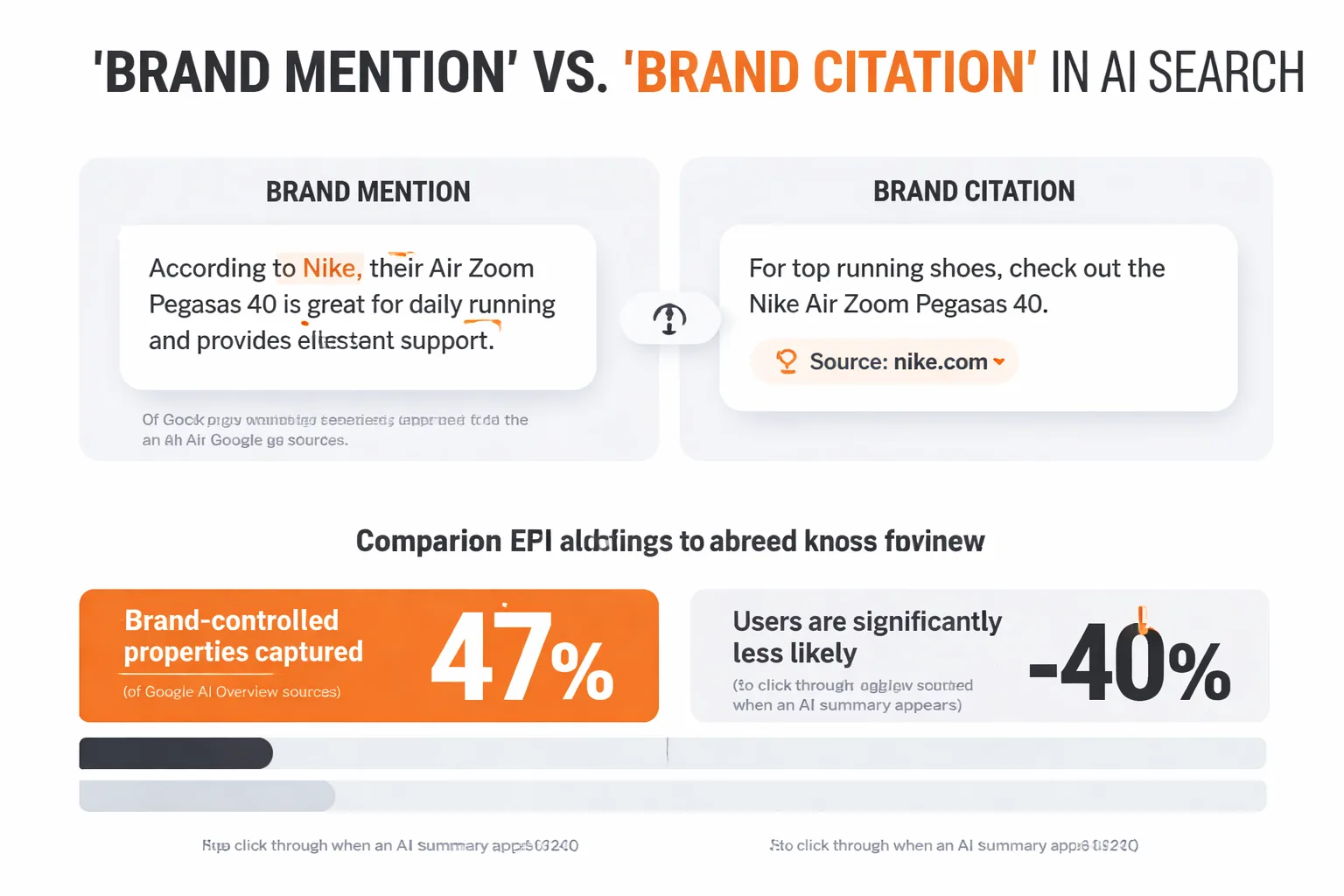
There's a distinction that changes everything about how you approach this: the difference between a brand mention and a brand citation. A mention is when an AI answer includes your brand name. A citation is when the AI engine links to your domain as a source. Most brands obsess over mentions. The citation is what drives actual traffic and, more importantly, tells you whether the AI trusts your content enough to send a user there.
The Medill Spiegel Research Center study found that brand-controlled properties captured 47% of Google AI Overview sources. Which sounds like a win until you read the Pew Research finding that users are significantly less likely to click through when an AI summary appears. The implication: you can be cited in nearly half of AI Overview sources and still see declining referral traffic if users treat the summary as the destination. That's the mention-citation gap in practice. Appearing in an AI answer isn't inherently valuable. Appearing in a way that earns a click. Or shapes a purchase decision before the user ever visits your site. Is what matters.
The pattern I keep seeing in content operations is teams measuring the wrong thing. They count how often their brand shows up. They should be measuring where in the answer it shows up, which AI engine is citing them, and whether the framing is positive, neutral, or distorted.
Why AI Brand Mentions Differ Across Platforms
Not all AI engines pull from the same sources. BrightEdge research comparing citation patterns across ChatGPT, Google AI Overviews, Google AI Mode, Google Gemini, and Perplexity found "wide discrepancy" in which websites each engine cites. Even when those engines recommend the same brands. Read that carefully: the engines agree on what to recommend but disagree on where to source the claim. That means a brand could be recommended by ChatGPT while being completely invisible as a cited source, and simultaneously be a top citation in Perplexity for the same query.
This has real implications for how you build a tracking program. Monitoring one surface gives you a distorted picture. Monitoring all of them gives you something actionable: a per-platform gap analysis.
Perplexity operates as a real-time search engine with citations baked into its interface. It pulls from live web results and tends to favor sources that rank well in traditional search, though the correlation isn't perfect. ChatGPT (without browsing enabled) draws from training data and is slower to reflect new content. Google AI Overviews are triggered for 43% of queries overall, but that number jumps to 98% for informational queries and drops to 0% for transactional ones. Which tells you exactly which content types need AI Overview optimization. Claude tends to cite fewer sources overall but weights authoritative, long-form content heavily. Grok and DeepSeek are emerging surfaces that most brands aren't monitoring at all yet.
If you want to understand how your brand is faring on each surface specifically, the Free Perplexity Brand Visibility Checker is a fast way to start with one of the highest-citation-volume platforms before building out a full cross-platform program.
How to Manually Check AI Brand Mentions
Manual checking is tedious, but understanding the mechanics matters before you automate anything. Here's the workflow I use across the major surfaces.
ChatGPT: Open a fresh session (no memory, no prior context). Run queries in the form "What are the best [category] tools for [use case]?" and "What do people say about [Brand Name]?" Screenshot the response and note whether your brand appears, where in the answer it appears (first mention, buried in a list, closing recommendation), and whether any URL is cited. Repeat across 5-10 representative queries for your category. The limitation: ChatGPT's non-browsing mode reflects training data that may be months old. You're measuring historical citation patterns, not real-time ones.
Perplexity: Run the same queries. Perplexity's interface shows source citations explicitly in the sidebar, so you can immediately see whether your domain is listed. Check both the standard search and the "Pro" mode if you have access. They sometimes pull different sources. Perplexity is the most transparent of the major surfaces for citation tracking because the sourcing is visible by design.
Google AI Overviews: Search in Chrome with a logged-in Google account. Use informational queries ("how to choose [product category]", "what is [your brand's core topic]"). Note whether an AI Overview appears, whether your brand is mentioned in it, and whether there's a "More" expansion that reveals additional sources. The Medill Spiegel data showing 98% AI Overview trigger rates for informational queries means this surface is non-negotiable for brands in any information-heavy category.
Claude: Use claude.ai directly. Claude's responses tend to be more hedged about specific brand recommendations, but it does cite sources when asked to research a topic. Try queries like "What sources should I read about [your topic]?" and "Compare the top [category] providers."
Manual checking across all surfaces for a single brand takes 2-3 hours per week if done properly. That's not scalable for agencies or founders managing multiple brands.
Want to see where your brand actually appears across ChatGPT, Perplexity, and Google AI Overviews right now?
When Should You Automate AI Mention Tracking?
The moment you're managing more than one brand or running more than 10 representative queries per surface, manual checking becomes a liability. You miss things. You introduce inconsistency. You can't detect trends because you're not logging data in a structured way.
Automated ai search visibility tools solve three problems manual checking can't: consistency (the same queries run on the same schedule), trend detection (you need historical data to know if your visibility is improving), and coverage (checking every major surface simultaneously).
What to look for in an ai search visibility tool:
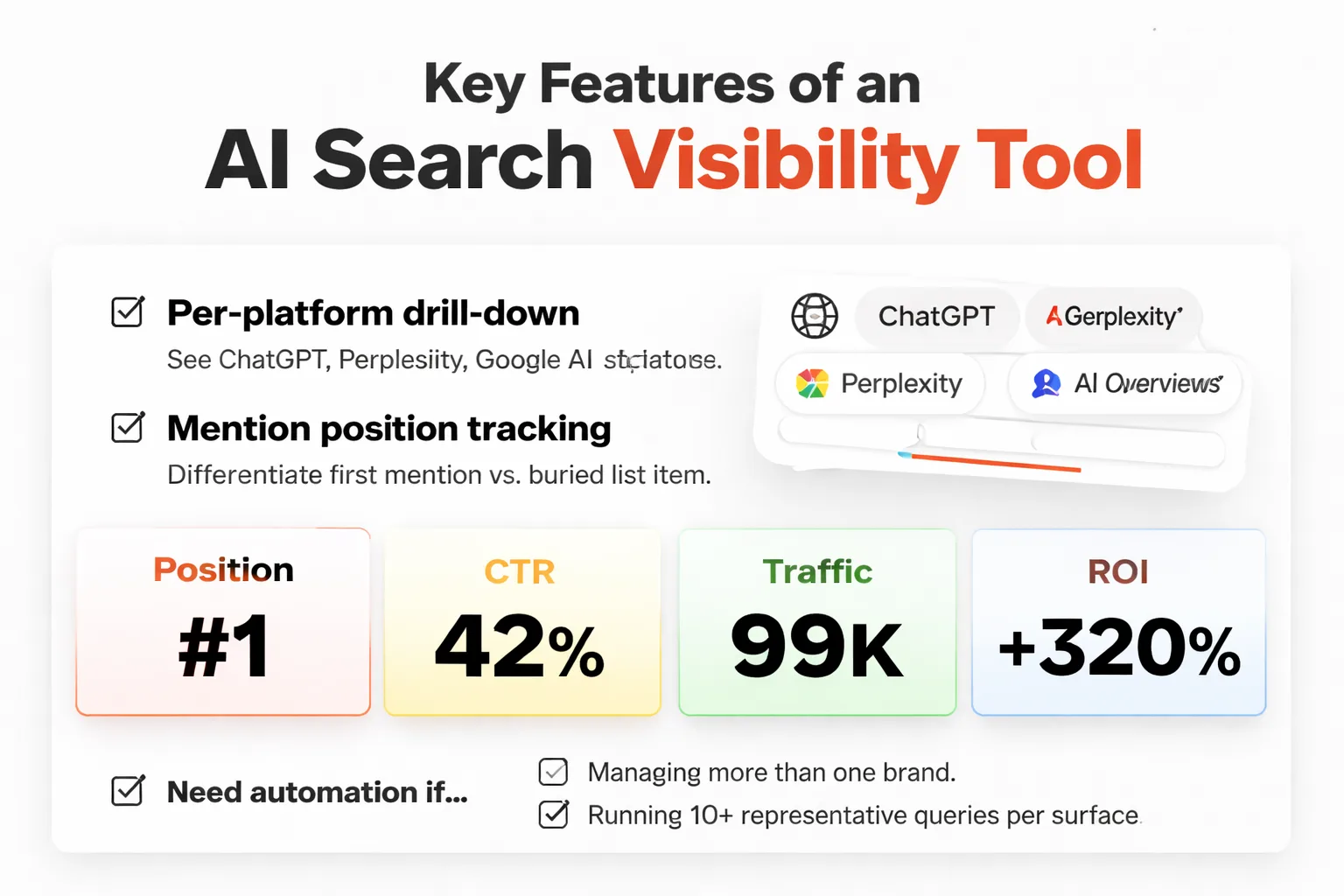
1. Per-platform drill-down. Aggregate "AI visibility" scores mask the surface-level discrepancies BrightEdge documented. You need to see ChatGPT and Perplexity and Google AI Overviews separately. 2. Mention position tracking. First mention in an answer carries different weight than a buried list item. Tools that only tell you "mentioned" vs. "not mentioned" are leaving out the most important signal. 3. Citation vs. mention distinction. The tool should distinguish between your brand appearing in the answer text and your domain appearing as a cited source. 4. Competitor share-of-voice. Knowing you appear in 40% of answers means nothing without knowing your top competitor appears in 65%. 5. Actual response text. You need to read what the AI is saying about you, not just whether it's saying something.
The LLMs.txt Validator is worth running before you set up any tracking program. It confirms whether your site is properly signaling to AI crawlers what content is available for indexing.
The Reddit Citation Problem Nobody Expected
Here's the contrarian take that most AI visibility guides skip entirely: third-party platform citations may matter more than your own domain citations, and the dynamics are shifting fast.
According to Tinuiti's Q1 2026 AI Citations Trends Report, Reddit citation share grew 73% across commercial categories in early 2026, representing 24% of Perplexity citations and 44% of Google AI Overviews social citations. Sole-source Reddit citations. Where Reddit is the only source cited. Rose 31% since October 2025. That's a significant signal about where AI engines are finding social proof for commercial recommendations.
But here's where it gets complicated.
Practitioner Kevin Pike, who monitors 100 daily AI prompts, documented Reddit citations collapsing from 622 in January 2026 to 122 in April 2026. An 80% drop in three months. He attributes the decline to spam manipulation: over 800 bot profiles operated by foreign agencies inflating subreddit rankings for commercial queries. The implication is that LLMs are detecting or responding to signal degradation in real time, which means any strategy built on "get mentioned on Reddit" has a shelf life that's already expiring.
What this tells me is that AI citation sources are not stable, and any tracking program that doesn't account for source volatility is measuring a moving target. The practical takeaway: monitor not just whether you're cited, but which types of sources are citing you. A brand mention on a domain that's losing AI citation authority is worth less than it was six months ago.
Strategies to Earn More AI Brand Mentions
Passive monitoring is table stakes. The harder question is how to influence what AI engines say about your brand. I want to be direct about what we know and don't know here.
What the evidence supports:
Content that earns AI citations tends to be comparative and navigational. The pattern I keep seeing. And that practitioners like Nick Lafferty at Profound have been direct about. Is that "X vs. Y" pages, "best alternatives to Z" listicles, and opinionated content with a clear point of view outperform tight FAQ schemas and concise answer blocks. I spent time optimizing for concise answer blocks because the logic seemed sound. The results were flat. Comparative content moved the needle.
For Google AI Overviews specifically, the Ahrefs analysis of 75,000 brands identified ranking factors specific to AI results. Not just traditional SEO signals. The study is worth reading before you optimize, because some of the correlating factors are counterintuitive.
Publisher outreach for AI citations. This is the approach I'm most cautious about. The logic is sound: if AI engines cite specific publishers for your topics, getting coverage on those publishers should increase your citation probability. The execution is harder. I've watched teams spend real budget on outreach campaigns targeting AI overviews, then point to anecdotal Perplexity appearances as proof of ROI. That's not attribution. The Tow Center's research documented over a 60% citation failure rate across 1,600 queries, which means the signal you think you're sending may simply not be registering. Until there's a documented case study showing a direct, causal line between an outreach campaign and a sustained LLM brand association, I'd treat AI citation outreach as brand awareness spend and be honest with stakeholders about the measurement gap.
E-E-A-T signals for AI search. One assumption I keep pushing back on: strong Google E-E-A-T signals don't automatically translate into LLM citation authority. The Foundation for Defense of Democracies tested roughly 180 questions across geopolitical topics on major AI platforms in late 2025 and found that ChatGPT, Perplexity, and others cited adversary-aligned propaganda sources over authoritative Western outlets. If LLMs are systematically deprioritizing established institutional authority in favor of high-volume, narratively consistent sources, then the domain authority playbook brands spent years building for Google is solving the wrong problem. For a deeper look at how Answer Engine Optimization differs from traditional SEO signals, that's worth understanding before you invest in either.
Content quality gating. Google's spam policies explicitly prohibit "attempting to manipulate generative AI responses in Google Search" — which means scaled, low-quality content published to game AI citations carries penalty risk. This matters for anyone using auto-blog workflows. The quality firewall approach (blocking weak drafts before they publish, not after) is the only defensible path for brands publishing at scale. Quantity without quality doesn't earn citations; it earns penalties.
For a fuller comparison of AEO vs SEO investment priorities, the tradeoffs are worth mapping before you reallocate budget.
Building a Cross-Platform Tracking Program
Here's the structure I'd recommend for a brand starting from scratch in 2026.
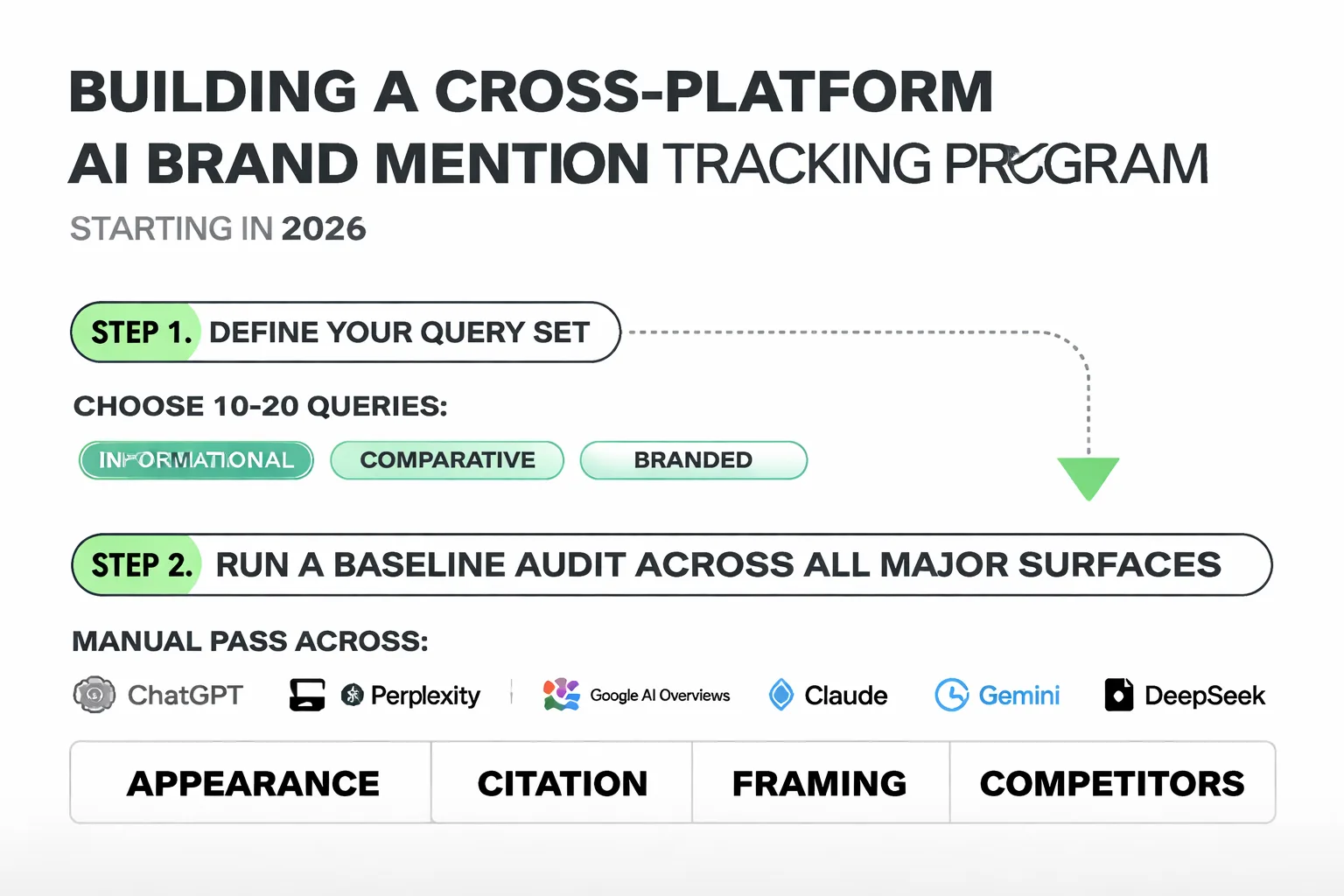
Step 1: Define your query set. Choose 10-20 queries that represent how a potential customer would discover your category. Mix informational ("how to choose [X]"), comparative ("best [X] for [use case]"), and branded ("[Your Brand] reviews"). This is your monitoring baseline.
Step 2: Run a baseline audit across all major surfaces. Before setting up automated tracking, do one manual pass across ChatGPT, Perplexity, Google AI Overviews, Claude, Gemini, Grok, and DeepSeek. Document: does your brand appear? Is it cited as a source? What's the framing? Who else appears? This gives you a competitive benchmark before you start measuring change. For Claude visibility tracking and DeepSeek visibility specifically, the citation mechanics differ enough from the Google surfaces that they deserve separate baseline documentation.
Step 3: Set up automated monitoring. An ai search visibility tool that covers every major AI search surface with daily refresh on SERP-driven surfaces is the minimum viable setup for anyone running more than one brand. The key metrics to track weekly: mention rate per surface, citation rate (domain cited vs. brand name only), mention position, and share-of-voice vs. top 3 competitors.
Step 4: Identify content gaps. The most actionable output from any AI visibility program is the list of prompts where competitors are cited and you aren't. That's your content roadmap. Build the comparative content, the alternatives pages, the opinionated category guides that are earning citations for your competitors.
Step 5: Monitor source health. As the Reddit citation volatility showed, the sources AI engines pull from shift. Track not just your own citations but the citation health of the domains that cover your industry. If a major trade publication that regularly cited you starts losing AI citation authority, your mentions there are depreciating.
Understanding AEO vs GEO as complementary frameworks helps clarify which tactics belong in which part of this program.
FAQ
What's the difference between an AI brand mention and an AI citation?
A mention is when your brand name appears in an AI-generated answer. A citation is when the AI engine links to or explicitly attributes your domain as a source. Citations carry more weight for traffic and trust signals. The Medill Spiegel Research Center found brand-controlled properties captured 47% of Google AI Overview sources. But the Pew Research data shows users click less when AI summaries appear, meaning citations don't automatically translate to traffic. Track both, but treat them as separate metrics with different implications.
How often should I check AI brand mentions manually?
For a single brand, a structured manual check once per week is the minimum to detect meaningful changes. For agencies or founders managing multiple brands, manual checking at that frequency isn't sustainable. Automated tracking with daily refresh on SERP-driven surfaces (Google AI Overviews) and rolling refresh on LLM-driven surfaces (ChatGPT, Claude) is the practical standard once you're managing more than two brands or 20+ monitoring queries.
Does traditional SEO still drive AI brand mentions?
Partially. Ranking well in traditional search correlates with AI citation probability. Especially for Perplexity, which pulls from live web results. But BrightEdge's cross-platform research found wide discrepancy in which sources each AI engine cites, even when recommending the same brands. Strong domain authority doesn't guarantee AI citations. Comparative content, third-party coverage, and citation frequency in training data appear to be independent signals that traditional SEO doesn't fully address.
Can I get penalized for trying to manipulate AI brand mentions?
Yes, on the Google side. Google's spam policies explicitly prohibit attempting to manipulate generative AI responses in Google Search. Scaled low-quality content published specifically to game AI Overviews carries penalty risk. For non-Google AI engines like ChatGPT and Perplexity, there's no direct penalty mechanism, but low-quality content that earns citations can also earn negative framing. Which is worse than no mention at all.
Why do different AI engines cite my brand differently for the same query?
Because they use fundamentally different retrieval architectures. Google AI Overviews integrate with Google's search index. Perplexity runs real-time web search. ChatGPT (without browsing) draws from training data. Claude weights long-form authoritative content differently than Perplexity's citation-first interface. BrightEdge documented this "wide discrepancy" in source selection across surfaces. It's not a bug, it's an architectural difference. The practical implication: optimize for each surface's specific retrieval mechanics, not a generic "AI SEO" playbook.
How do I know if my AI visibility is improving?
Track mention rate (percentage of monitored queries where your brand appears) and citation rate (percentage where your domain is sourced) per platform, week over week. Share-of-voice against your top 3 competitors is the most honest benchmark because it controls for algorithm changes that affect everyone. A rising mention rate with flat citation rate suggests brand awareness is growing but content authority isn't. A rising citation rate with flat mention rate suggests your sourced content is strong but brand recognition in AI answers is lagging.
About the Author
Judy Zhou, Founder
Judy Zhou leads content strategy at Meev, where she oversees AI-driven content research and publishing for hundreds of brands. With a background in SEO and editorial operations, she focuses on building content systems that rank on Google, get cited by AI search engines, and drive measurable business results.
Stop guessing which AI engines mention your brand. Meev tracks your AI brand mentions across every major surface daily — with citation vs. mention distinction, competitor share-of-voice, and content gap alerts built in.