
By Judy Zhou, Head of Content Strategy
Key Takeaways
- A Nature Communications 2025 study found that 50–90% of LLM-generated citations don't fully support their claims, with the best platform reaching only ~66% accuracy — treat AI search output as a research starting point, not a final source.
- Perplexity and ChatGPT share only about 11% citation overlap, meaning a GEO strategy that targets one engine while ignoring the other misses roughly half the available citation surface.
- Google AI Overviews now appear in 47% of search results, but the August 2025 Spam Update (27-day rollout) penalized scaled content abuse — quality-gated publishing is now a prerequisite for AI visibility, not just a best practice.
- The mention-citation gap is the core diagnostic problem for marketers in 2026: thousands of web mentions mean nothing if the citing domains aren't trusted by AI engines — monitor citation position, not just mention count.
In the spring of 2023, Perplexity AI launched to a modest audience of power users and tech enthusiasts who were tired of sifting through SEO-bloated search results. Few marketers paid attention. By early 2024, ChatGPT had added web browsing and citations. By late 2025, Google had folded AI Overviews into the default search experience for over a billion users. What began as a fringe experiment in answer-engine design has, in less than three years, restructured the entire architecture of how researchers and marketers find. And get found by. Information.
The best AI search engines in 2026 are no longer just research tools. They are citation machines, brand visibility arbiters, and answer engine optimization battlegrounds. Perplexity source selection now directly influences which brands appear in AI-generated answers. A 5.17 million domain-citation analysis across OpenAI, Gemini, and Perplexity found that LLMs rely primarily on commercial domains while academic and government sources remain underrepresented. A Nature Communications study found that 50. 90% of LLM-generated citations don't fully support the claims they're attached to, with the best platform hitting ~66% accuracy. Google AI Overviews now appear in 47% of search results, making generative engine optimization a non-optional discipline for any content team in 2026.
As someone who leads content strategy at Meev, where we track brand citations across AI engines daily, I've watched this shift play out in real time. This guide is my honest, use-case-driven breakdown of which engines actually serve researchers and marketers. And which ones you should be optimizing for.
What Makes an AI Search Engine Worth Using in 2026
Traditional search returns a ranked list of URLs. AI search engines synthesize those URLs into an answer, often without requiring the user to click through at all. That distinction matters enormously for two reasons: first, the user experience is fundamentally different; second, the visibility mechanics are entirely different for the brands and publishers whose content gets consumed.
For researchers, the key question is citation quality. Can you trust the sources? Are the citations real and do they actually support the claims made? The Nature Communications study by Wu et al. should be required reading for anyone relying on AI search for professional research. The finding that citation accuracy tops out around 66% on the best platforms is sobering. It means even the most rigorous AI-powered answer engine is wrong about its own sources roughly one-third of the time. That's not a reason to avoid these tools. It's a reason to treat them the way you'd treat a research assistant: useful for synthesis and direction, requiring verification before you stake a claim on the output.
For marketers, the key question flips entirely. You're not just consuming answers. You're trying to appear inside them. That means the engine's source selection logic, crawl frequency, and citation weighting are things you need to understand operationally. Perplexity source selection, for instance, favors freshness and domain authority in ways that differ meaningfully from how Google's traditional ranking algorithm works. A brand that ranks well in organic search may be invisible in Perplexity answers if it hasn't been cited by the publishers Perplexity trusts.
The pattern I keep seeing is that teams treat these two concerns as separate. They're not. The same citation mechanics that determine whether a researcher sees accurate information are the ones that determine whether a marketer's brand gets mentioned. Understanding both sides of that equation is what separates a mature AI search strategy from a reactive one.
How We Evaluated These Engines
I evaluated each engine across six dimensions that matter specifically to professional users, not casual searchers.
Citation transparency measures whether the engine shows you exactly which sources informed each claim, and whether those citations actually link to the content they reference. This is the single most important dimension for researchers and the most overlooked one for marketers.
Source diversity asks whether the engine draws from a broad range of publishers or concentrates citations among a handful of high-authority domains. The Cloudflare 2025 crawler analysis found that AI crawlers consume content at rates 38,000 times higher than they refer traffic back to sources. That asymmetry means source concentration isn't just a research quality issue. It's a brand visibility crisis for any publisher not already in the top citation tier.
Answer accuracy and freshness covers how current the data is and how often the engine refreshes its index. For competitive intelligence and fast-moving markets, a 48-hour lag versus a 30-day lag is the difference between useful and dangerous.
API and integration availability matters for teams building workflows. An engine you can only use through a browser interface has a ceiling. One with a documented API can be woven into your content operations, your citation tracking, and your reporting stack.
Relevance to AEO and GEO workflows is the dimension most listicles skip entirely. I specifically evaluated whether each engine's citation behavior creates tractable opportunities for answer engine optimization. If the engine is a black box with no discernible source selection pattern, it's harder to optimize for. If its citation logic is at least partially legible, it becomes a target for a real generative engine optimization strategy.
Pricing and access tiers rounds out the evaluation, because the right tool for a solo founder doing competitive research is not the same as the right tool for a Fortune 100 brand team with a dedicated GEO budget.
Comparison Table
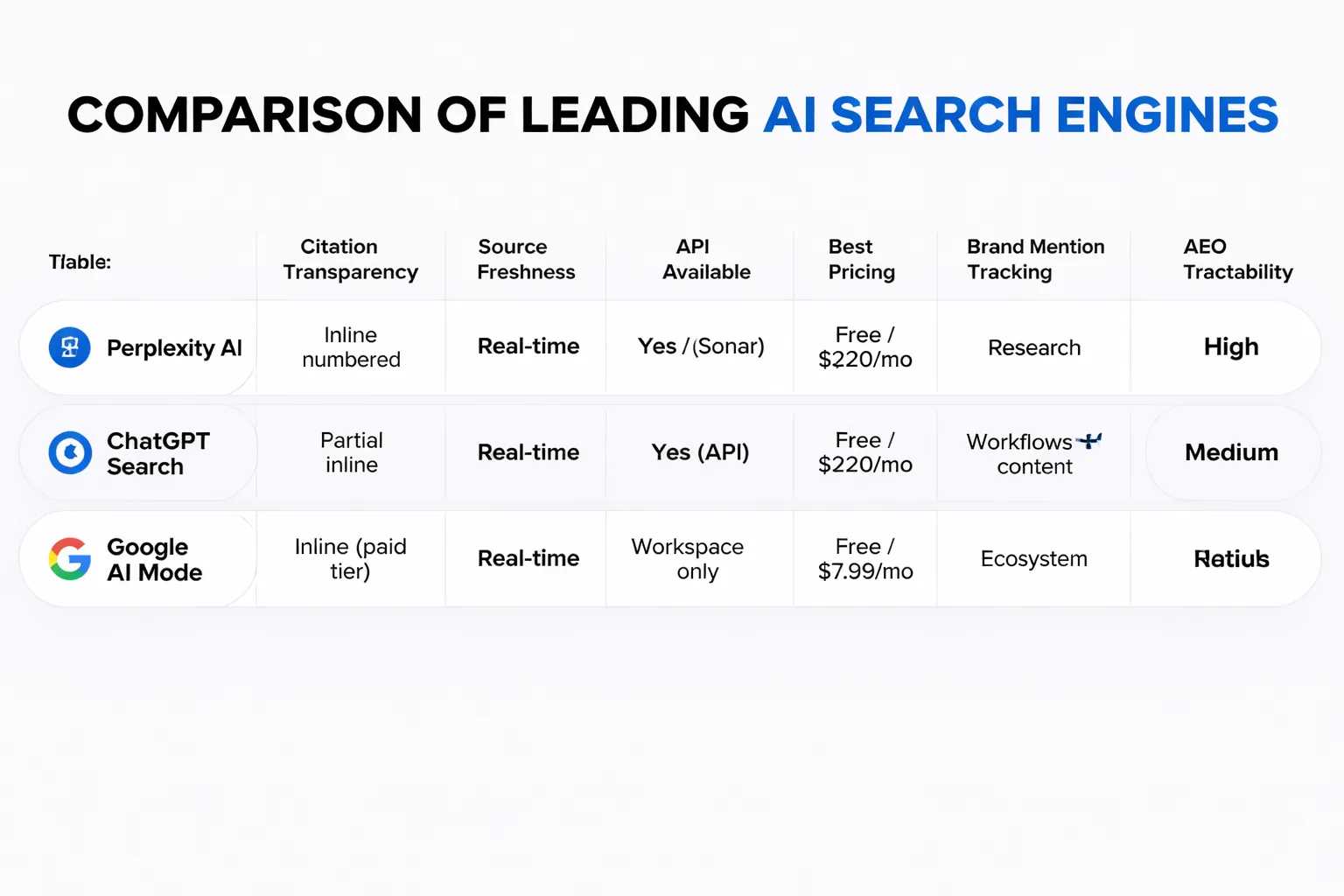
The table below covers the engines reviewed in this guide across the dimensions that matter most for professional users.
| Engine | Citation Transparency | Source Freshness | API Available | Entry Pricing | Best For | Brand Mention Tracking | AEO Tractability |
| Perplexity AI | Inline numbered | Real-time | Yes (Sonar) | Free / $20/mo | Research + GEO | Partial | High |
| ChatGPT Search | Partial inline | Real-time | Yes (API) | Free / $20/mo | Workflows + content | No native | Medium |
| Google AI Mode | Inline (paid tier) | Real-time | Workspace only | Free / $7.99/mo | Ecosystem users | Via Search Console | High |
| Profound | N/A (monitoring) | Daily | Enterprise only | $99/mo | Enterprise GEO | Yes | Very High |
| Peec AI | N/A (monitoring) | Daily | Growth+ | €89/mo | GEO action plans | Yes | High |
| AIclicks | N/A (monitoring) | Daily | — | $59/mo | SMB GEO tracking | Yes | High |
| Nightwatch | N/A (monitoring) | Daily | — | $32/mo | Budget SEO+GEO | Yes | Medium |
| OtterlyAI | N/A (monitoring) | Daily | — | €89/mo | Startup monitoring | Yes | Medium |
| Elicit | Full citation | Static (papers) | Yes | Free / $10/mo | Academic research | No | Low |
| Kagi Search | Partial | Real-time | No | $5/mo | Privacy research | No | Low |
1. Perplexity AI. Best for researchers who need cited, real-time answers
Best for: Researchers, analysts, journalists, and marketers who need fast, citation-backed answers on current events and competitive topics without clicking through dozens of links.
Perplexity is the original ai-powered answer engine that made the citation-first model mainstream. Every answer comes with inline numbered citations, and Pro Search mode breaks complex queries into sub-queries before synthesizing 30+ sources. That's not a marketing claim. It's the mechanic that makes Perplexity the most useful single tool for competitive research in 2026.
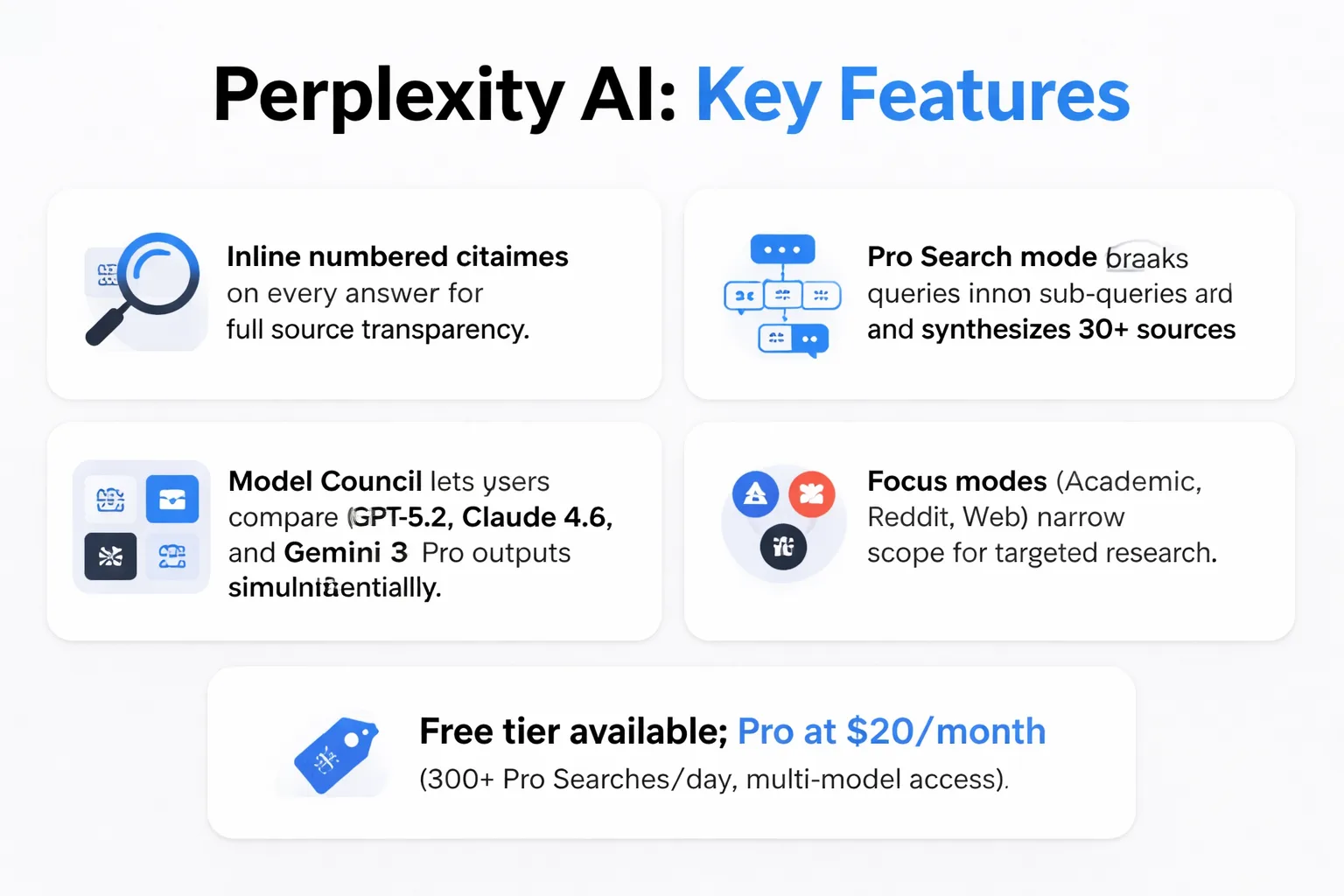
Key features: - Inline numbered citations on every answer for full source transparency. Pro Search mode breaks queries into sub-queries and synthesizes 30+ sources. Model Council lets users compare GPT-5.2, Claude 4.6, and Gemini 3 Pro outputs simultaneously. Focus modes (Academic, Reddit, Web) narrow search scope for targeted research
Pricing: Free tier available; Pro at $20/month (300+ Pro Searches/day, multi-model access); Max at $200/month for power users and teams; Enterprise pricing available via Sonar API.
For marketers, perplexity source selection is the most legible citation logic of any major AI engine. The sources it cites follow a discernible pattern: freshness, domain authority, and topical specificity weighted together. That tractability is what makes Perplexity the highest-priority target for any serious Perplexity citation tracking strategy. The caveat worth naming: a 2025 Nature Communications study found that even the most accurate AI citation platform sits around 66% citation accuracy. Perplexity is arguably the best in class here, but "best" still means verifying before you stake a professional claim on the output.
2. ChatGPT Search. Best for marketers building multi-step research workflows
Best for: Marketers, content strategists, and product teams who need a versatile AI platform for research, creative writing, coding, and multi-step workflow automation in one interface.
ChatGPT is not primarily a search engine. It's a platform that happens to include search, and that distinction matters when you're evaluating it for professional research. With 800 million weekly active users, it's the most widely used AI assistant globally, and its Deep Research mode now produces multi-source reports that rival paid research tools.
Key features: - Deep Research mode synthesizes multi-source reports comparable to paid research tools. 800 million weekly active users making it the most widely used AI assistant globally. Supports coding, image generation, memory, and agentic workflows beyond pure search. ChatGPT Shopping tracking enables product visibility research in AI-powered commerce
Pricing: Free tier with limited access; Plus at $20/month; Pro at $200/month; Team at $30/user/month; Enterprise pricing available. GPT-5 family powers all paid tiers.
For ChatGPT citation patterns, the picture is more opaque than Perplexity. Source attribution is less granular, which makes it harder to reverse-engineer why your brand does or doesn't appear in a given answer. The 11% overlap between ChatGPT and Perplexity citations (per Ekamoira's synthesis research) tells you these engines are drawing from meaningfully different source pools. If you're only optimizing for one, you're missing half the picture.
3. Google AI Mode — Best for marketers already in the Google ecosystem
Best for: Everyday researchers and marketers already embedded in the Google ecosystem who want AI-synthesized answers alongside traditional search results without switching tools.
Google AI Mode is the answer to the question nobody asked in 2023: what if Google search results were replaced by a Gemini-powered conversation? The answer, it turns out, is complicated. Deep Search runs 20+ source synthesis with citation chains, which is genuinely useful. But the quality track record is uneven.
Key features: - Deep Search runs 20+ source synthesis with citation chains for multi-step research. Inline integration with classic search results lets users verify AI summaries against original sources. Gemini Canvas transforms search into an interactive workspace for planning, writing, and building. Powered by Gemini 3 as the default model for AI Overviews globally since January 2026
Pricing: Free for basic AI Mode access; Google AI Plus at $7.99/month adds higher caps and Deep Search; Google AI Pro at $19.99/month adds the most capable Gemini models and highest Deep Search quotas; Workspace integration via Google Workspace plans.
The failure cases here are documented and serious. The Guardian investigated AI Overviews providing inaccurate health information on blood tests, putting users at real risk. The New York Times covered the glue-in-pizza and eat-rocks errors that caused a public furor. Google has since tightened its answer policies in sensitive categories, but the underlying tension between scale and accuracy hasn't been resolved. For Google AI Overviews optimization, the strategic implication is clear: being cited in AI Mode is high-value precisely because of its reach, but the citation environment is more volatile than Perplexity's.
4. Profound — Best for enterprise GEO teams needing SOC 2-certified data
Best for: Fortune 100 brand marketers, enterprise SEO teams, and agencies that need SOC 2 Type II-certified, GDPR-compliant AI visibility data backed by real consumer panels rather than synthetic API estimates.
Profound is not a search engine you use to find information. It's an enterprise platform you use to understand how AI search engines are representing your brand. That distinction is important. Profound belongs on this list because any serious evaluation of the best AI search engines for marketers has to include the tools that help you measure and optimize your presence across them.
Key features: - Answer Engine Insights track how and where AI mentions your brand across ChatGPT, Perplexity, Gemini, Claude, Grok, DeepSeek, and more. Agent Analytics analyzes 30 billion crawler visits and 1 billion citations daily. Dedicated ChatGPT Shopping tracking for product visibility in AI-powered commerce. CMS-connected agents can brief, draft, and publish AI-optimized content automatically
Pricing: Starter at $99/month (50 prompts, 3 answer engines, 1 seat); Lite at $499/month (2-month data history); Agency at $1,499/month; Custom enterprise pricing available. No free trial.
For teams comparing enterprise options, the Meev vs Profound comparison breaks down where each platform's citation tracking architecture differs. Profound's strength is the depth of its data and its compliance posture. The constraint is price: the entry tier at $99/month is limited to 1 seat and 3 answer engines, which means meaningful coverage requires a significant budget commitment before you've validated the workflow.
5. Peec AI — Best for SEO teams transitioning to GEO
Best for: SEO teams and agencies transitioning from traditional SEO to GEO who need actionable, prioritized recommendations rather than raw data dashboards.
The problem with most AI visibility platforms is that they give you data and leave you to figure out what to do with it. Peec AI's differentiator is the Actions feature, which converts visibility gaps into a prioritized to-do list with priority scores. That's a meaningful UX decision for teams that are already stretched.
Key features: - Daily tracking across ChatGPT, Google AI Mode, Google AI Overviews, Perplexity, Gemini, Grok, Claude, Meta AI, Copilot, and DeepSeek. Actions feature turns visibility data into a prioritized to-do list with priority scores, eliminating manual URL hunting. Multi-country and multi-language tracking for global brand monitoring. Designed to bridge the gap between knowing what is wrong with AI visibility and knowing how to fix it
Pricing: Starts at €89/month (Starter: 1 seat, 3 AI engines of choice); Growth plan for multi-seat use; Enterprise plan adds SSO/SAML. Additional AI models can be added to any plan.
For a head-to-head on capabilities and pricing, the Meev vs Peec AI comparison is worth reviewing before committing. The Starter plan's cap at 1 language and 3 answer engines is a real constraint for global brands, but for a regional SEO team making the GEO transition, it's a reasonable entry point.
6. AIclicks — Best for SMBs wanting broad engine coverage affordably
Best for: Data-driven marketers and SMB teams who want the broadest AI engine coverage at an accessible price point without committing to enterprise-level contracts.
AIclicks covers 10 AI engines at its Business tier, which is the broadest coverage in this price range. Built by a team with 100+ brands of SEO experience, it's purpose-built for the GEO category rather than retrofitted from a traditional SEO tool.
Key features: - Tracks mentions across 10 AI engines: ChatGPT, Perplexity, Gemini, Google AI Overviews, Google AI Mode, Copilot, Claude, Grok, DeepSeek, and Meta AI. Built by a team with 100+ brands of SEO experience, purpose-built for the GEO category. Prompt volume data reveals what millions of users are asking AI about topics relevant to your brand. Competitive share-of-voice tracking across all monitored AI platforms
Pricing: Starter at $59/month (30 prompts, 3 AI engines); Pro at $189/month (150 prompts, 4 AI engines); Business at $499/month (300+ prompts, 5 AI engines).
The prompt volume data is the feature I find most interesting here. Understanding what users are actually asking AI engines about your category is foundational to any answer engine optimization strategy. Most platforms track whether you appear in answers. AIclicks also tells you whether you're targeting the right questions in the first place.
Want to see where your brand actually appears across ChatGPT, Perplexity, and Google AI Mode right now?
7. Nightwatch — Best for budget-conscious teams combining SEO and GEO
Best for: Budget-conscious SEO teams and solo founders who need comprehensive AI and traditional search visibility monitoring without paying enterprise prices or juggling multiple tools.
Nightwatch starts at $32/month and covers LLM monitoring, traditional rank tracking, prompt research, and citation-level sentiment analysis in one dashboard. For a solo founder doing competitive research, that's a genuinely compelling stack at a price that doesn't require a budget approval chain.
Key features: - Combines LLM monitoring, search engine tracking, prompt research, and citation-level sentiment analysis with traditional SEO rank tracking. Historical data tracking shows visibility trends over time, not just point-in-time snapshots. Includes keyword research, site audits, local rank tracking, and an SEO AI agent for automating complex tasks. Covers the full pipeline from search engine queries through citation-level sentiment analysis
Pricing: Starts at $32/month covering LLM monitoring, search engine tracking, prompt research, citation-level sentiment analysis, and traditional SEO rank tracking. Higher tiers available for scale.
The honest tradeoff: Nightwatch is less specialized for pure GEO optimization than Profound or Peec AI. If LLM citation tracking is your primary workflow, you'll hit its ceiling. But if you're running a lean operation that still needs traditional SEO coverage alongside AI visibility, it's the most cost-efficient option on this list.
8. OtterlyAI — Best for startups wanting credible monitoring fast
Best for: Startups, agencies, and budget-conscious marketing teams that want accessible AI visibility monitoring with strong customer support and industry-recognized credibility.
OtterlyAI was recognized as a Gartner Cool Vendor for AI in Marketing in 2025, which matters for teams that need to justify new tooling to stakeholders who haven't heard of GEO yet. With 20,000+ marketing professionals using it and a G2 rating of 4.9/5, the social proof is real.
Key features: - Tracks brand mentions across Google AI Overviews, ChatGPT, Perplexity, AI Mode, Gemini, and Claude. Recognized as a Gartner Cool Vendor for AI in Marketing 2025 and G2 High Performer Winter 2026. Used by 20,000+ marketing professionals with a G2 rating of 4.9/5. Available through Semrush App Center starting from $27/month as an alternative entry point
Pricing: Starts at €89/month for 25 prompts and 3 AI search engines; higher tiers available for more prompts and engine coverage. Recognized as a Gartner Cool Vendor for AI in Marketing (2025).
The gap worth noting: OtterlyAI doesn't include search engine tracking or a prompt research module. You'll know if you're being mentioned in AI answers. You won't know why competitors are being mentioned instead, or what queries are driving those mentions. For teams that need the full diagnostic picture, that's a meaningful limitation.
9. Elicit — Best for academic researchers doing literature reviews
Best for: Academic researchers, scientists, policy analysts, and evidence-based marketers who need rigorous, peer-reviewed source attribution rather than general web synthesis.
Elicit is the only tool on this list purpose-built for academic research. Its database of 125 million papers, combined with systematic review workflows and methodology quality assessment, makes it a fundamentally different product from every other engine here.
Key features: - Searches and synthesizes from a database of 125 million academic papers with full citation attribution. Identifies relevant studies, extracts key findings, and assesses methodology quality for literature reviews. Systematic review workflows purpose-built for academic and scientific research tasks. Understands study design and methodology, not just keyword matching
Pricing: Free tier available with limited usage; Plus plan at $10/month; Professional plan at $42/month for power researchers needing systematic review workflows and higher usage caps.
For evidence-based marketers who need to cite peer-reviewed research in their content, Elicit is the fastest path from "I need a study on X" to "here are five credible papers with methodology summaries." It's not a GEO tool. It's not a brand visibility tool. It's a research tool that does one thing exceptionally well, and the $10/month Plus tier is a bargain for what it delivers.
10. Kagi Search — Best for privacy-first researchers avoiding algorithmic bias
Best for: Privacy-conscious researchers, journalists, and marketers who want ad-free, unbiased search results and are willing to pay a subscription to avoid algorithmic manipulation.
Kagi's premise is simple and genuinely contrarian: search results should not be influenced by advertiser spend. No ads, no tracking, no client-side telemetry. The Universal Summarizer works on any URL including PDFs and videos, and the Lenses feature lets you restrict searches to curated subsets of the web.
Key features: - No ads, no tracking, and no client-side telemetry. Results are never influenced by advertiser spend. Universal Summarizer works on any URL including web pages, PDFs, and videos with source attribution. Lenses feature lets users restrict searches to curated subsets of the web (e.g., academic, programming, news) - User-controlled result ranking lets individuals boost or block specific domains permanently
Pricing: Starter at $5/month (100 searches/month); Professional at $10/month (unlimited searches); Ultimate at $25/month adds access to the most powerful AI models including the Universal Summarizer and Assistant.
For marketers, Kagi has essentially zero relevance to GEO strategy. Its user base is small and self-selected, and there's no API or citation tracking infrastructure to optimize for. But for researchers who need to trust that their results aren't shaped by ad budgets, it's the cleanest signal available. I use it occasionally when I want a second opinion on a query that feels like it might be returning SEO-optimized noise.
Which AI Search Engine Fits Your Workflow
Different personas need different tools. Here's how I'd think through the decision.
Solo founder doing competitive research. Your constraint is time and budget, not features. Start with Perplexity Pro at $20/month. Use it for competitive landscape queries, product positioning research, and understanding how AI engines are framing your category. Supplement with Nightwatch at $32/month if you want to track your own brand's AI visibility without a separate tool. Total: $52/month for a research and monitoring stack that would have cost ten times that two years ago.
SEO specialist tracking AI visibility. You already understand search mechanics, and you need a tool that maps onto that mental model while extending it to AI surfaces. Peec AI's Actions feature is genuinely useful here because it translates visibility gaps into prioritized tasks rather than raw data you have to interpret yourself. If your clients are larger brands with compliance requirements, Profound is the more defensible choice. For a head-to-head on which fits your agency's workflow, the Meev vs Profound comparison and the Meev vs Peec AI comparison both break down the architecture differences clearly.
Content marketer optimizing for AEO. This is where the tool selection gets most strategic. You need to understand both what you're publishing and where it's landing in AI answers. The mention-citation gap, where your brand is mentioned on the web but not cited by AI engines, is the core diagnostic problem you're trying to solve. For this workflow, I'd combine a content generation platform that builds citation-worthy depth (answer blocks up top, original analysis below) with a dedicated AI visibility monitor that tracks citation position, not just mention count. Claude visibility tracking and ChatGPT visibility tracking are worth running in parallel, because the citation overlap between these engines is only about 11% according to Ekamoira's research synthesis. Optimizing for one and ignoring the other means you're leaving roughly half your potential citation surface unmonitored.
Academic researcher. Elicit. Full stop. Nothing else on this list was built for systematic literature review, and using Perplexity for academic research when Elicit exists is like using Google Maps for topographic survey work. It'll get you somewhere, but it's the wrong tool.
One contrarian take worth stating plainly: the teams I see getting the most out of AI search in 2026 are not the ones with the most sophisticated monitoring stacks. They're the ones who've internalized that the content you publish is the upstream variable that determines everything downstream. A 16-dimension quality firewall blocking weak drafts before they reach your CMS is more valuable than a 10-engine monitoring dashboard tracking the absence of citations from content that never deserved them. Monitoring tells you where you stand. Quality-gated content publishing determines where you can go.
The August 2025 Spam Update (which ran for 27 days, August 26 through September 22, 2025) targeted scaled content abuse, expired domain abuse, and site reputation abuse. Sites that saw Search Console impression drops weren't just penalized by Google's algorithm. They were signaling to every AI engine that their content doesn't meet the bar for citation. The two problems are the same problem.
FAQ
Is Perplexity better than ChatGPT for research?
For pure research tasks where citation transparency matters, Perplexity has a structural advantage. Its inline numbered citations and Pro Search mode's multi-source synthesis make it easier to verify claims and trace sources. ChatGPT's Deep Research mode produces more comprehensive reports for complex multi-step questions, but source attribution is less granular. The practical answer: use Perplexity when you need to verify individual claims quickly, use ChatGPT Deep Research when you need a synthesized briefing document. They're complementary, not competing.
Do AI search engines use the same sources as Google?
No, and the gap is larger than most marketers expect. The 5.17 million domain-citation analysis by Search Atlas found that LLMs rely primarily on commercial domains while academic and government sources remain underrepresented. The overlap between ChatGPT and Perplexity citations is only about 11%, according to Ekamoira's research synthesis. Google AI Overviews draws from Google's own index, which correlates with traditional rankings but isn't identical. The practical implication: ranking well in Google does not guarantee citation in AI answers, and being cited in Perplexity doesn't mean you'll appear in ChatGPT.
How does Perplexity source selection affect my brand's AI visibility?
Perplexity source selection is driven by a combination of domain authority, topical relevance, and content freshness. Brands that appear in Perplexity answers tend to be cited by other high-authority publishers in the same topic area. This is why publisher pitching for AI citations is becoming a real discipline: getting cited by the domains Perplexity already trusts is a faster path to AI visibility than trying to optimize your own content in isolation. Tracking your Perplexity citation patterns over time is the only way to know whether your content strategy is actually moving the needle.
What is the mention-citation gap and why does it matter?
The mention-citation gap is the distance between how often your brand appears somewhere on the web and how often AI engines actually cite it in answers. A brand can have thousands of web mentions and near-zero AI citations if those mentions are on low-authority sites that AI engines don't trust. Closing this gap requires two things: getting cited by the publishers AI engines already reference, and publishing content with enough epistemic density (specific claims, named examples, original data) that AI engines have something quotable to extract. Monitoring tools that track citation position rather than just mention count are the right instrument for measuring this gap.
Should I use multiple AI search engines or focus on one?
For research workflows, using two or three engines in parallel is worth the overhead. Perplexity for citation-backed quick answers, ChatGPT for complex synthesis, and Elicit for academic sources covers most professional research needs without significant redundancy. For visibility optimization, the answer is clearer: you need to monitor all major surfaces because citation behavior differs significantly across engines. A generative engine optimization strategy that focuses only on Perplexity while ignoring Google AI Overviews and ChatGPT is leaving substantial visibility on the table. The Cloudflare 2025 data showing AI crawlers consuming content at 38,000x the rate they refer traffic back makes the stakes clear. These engines are using your content. The question is whether they're crediting you for it.
About the Author
Judy Zhou, Head of Content Strategy
Judy Zhou leads content strategy at Meev, where she oversees AI-driven content research and publishing for hundreds of brands. With a background in SEO and editorial operations, she focuses on building content systems that rank on Google, get cited by AI search engines, and drive measurable business results.
Track your AI citation position across 8 major engines, find the publishers driving citations in your category, and close the mention-citation gap — all in one platform.