
By Judy Zhou, Founder at Meev
In November 2022, OpenAI released ChatGPT to the public and, almost accidentally, launched a quiet crisis for the entire search marketing industry. Within eighteen months, Perplexity had surpassed ten million daily active users, Google rushed its own AI Overviews into production, and analysts began reporting measurable declines in click-through rates from traditional SERPs. Marketers who had spent years mastering keyword rankings suddenly found themselves invisible inside the answers their buyers were receiving. That chain of events is why ai search visibility — the discipline of earning citations inside generative AI responses. Now has its own strategy playbook, its own measurement tools, and its own optimization logic that diverges sharply from classic SEO.
AI search visibility is the metric that tells you whether your brand exists in the answers AI engines give your buyers. Not whether you rank on page one. Whether you get named. And in 2026, those are two completely different outcomes.
The four numbers that define where a brand stands: citation rate (what share of relevant prompts produce a response naming your brand), mention-citation gap (named but not linked vs. named and linked), share of model voice (your citation rate vs. competitors across AI engines), and prompt coverage (how many of the queries your buyers actually ask are you tracking). Every section of this guide connects back to one of those four numbers.
AI Search Visibility. A Working Definition
AI search visibility measures the degree to which a brand is cited, mentioned, or paraphrased by AI engines. ChatGPT, Perplexity, Gemini, Claude, Google AI Overviews, AI Mode. When users ask questions relevant to that brand's category. It is a fundamentally different signal from organic search rankings, and conflating the two is the most common mistake in content audits right now.
Traditional organic visibility answers one question: does your URL appear in a list of ten blue links? AI search visibility answers a harder question: does your brand get named when a buyer asks an AI to recommend, explain, or compare something in your space? The mechanics are different. Google's ranking algorithm weighs backlinks, on-page signals, and engagement data. LLMs like ChatGPT and Claude draw from training data, retrieval-augmented generation (RAG) pipelines, and real-time web indexes. And they don't surface a list of links. They synthesize an answer. If your brand isn't woven into that synthesis, you don't exist in that buyer's decision process, regardless of where you rank on traditional SERPs.
The practical implication is stark: a brand can hold the number-one organic ranking for a high-intent keyword and still receive zero AI citations for that same query. The content ranks because it has strong backlinks and click-through rates. It doesn't get cited because it's structured for keyword density, not for the answer-extraction patterns that LLMs favor. These are solvable problems. But only once you're measuring the right thing.
Why AI Search Visibility Matters More Than Rankings in 2026
AI search traffic grew 527% year-over-year according to Semrush's study of 10M+ keywords.
That number should stop you cold.
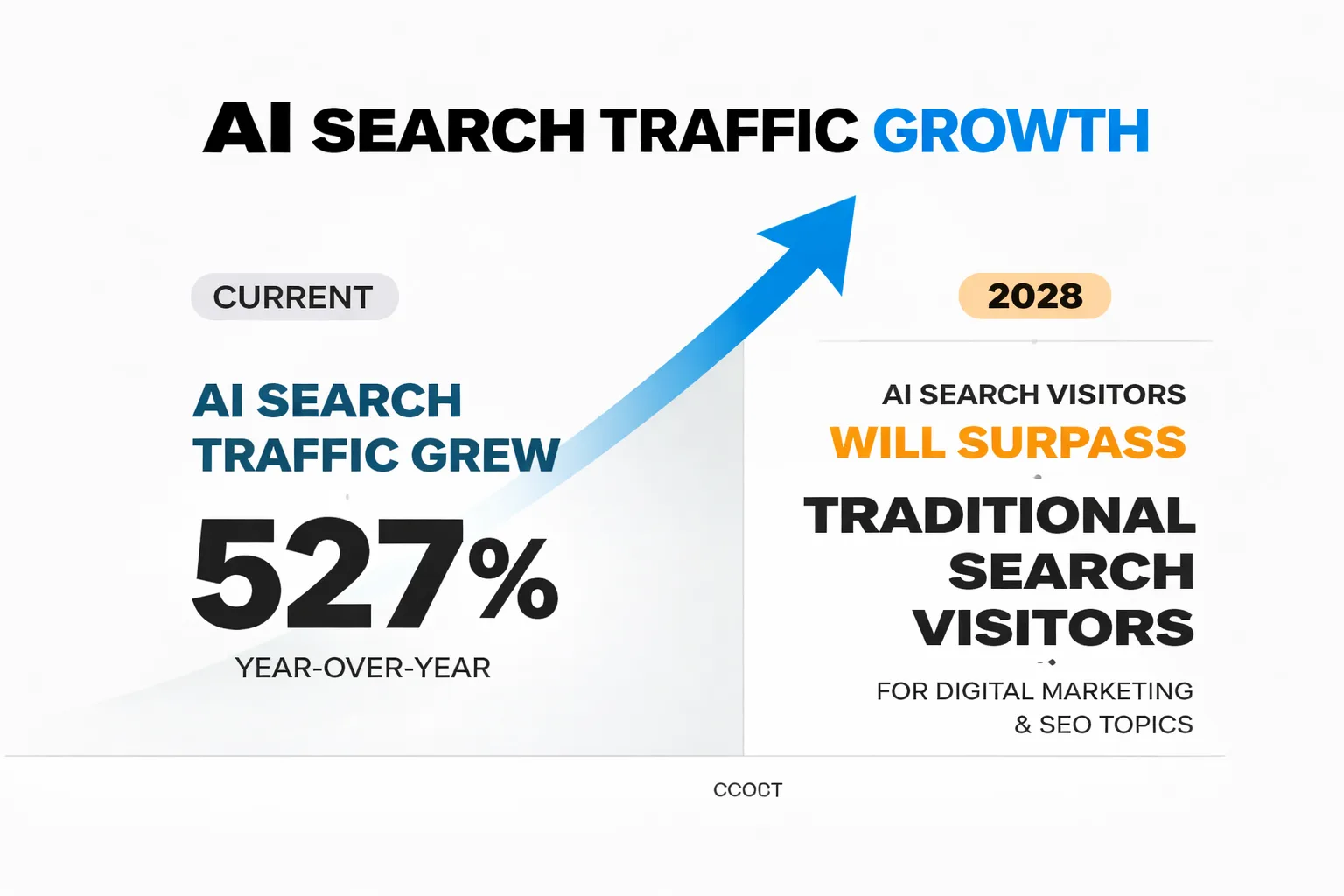
Semrush's research also projects that for digital marketing and SEO topics, AI search visitors will surpass traditional search visitors by 2028. The transition isn't coming. For a growing share of high-intent queries, it's already here. Brands that aren't measuring their presence in AI-generated answers are flying blind in the channel that now shapes buyer decisions before a single click happens.
The behavioral shift compounds the traffic shift. When a buyer types a question into Perplexity or uses Google's AI Mode, they're not scanning a list of results and clicking through to compare options. They're receiving a synthesized answer that names two or three sources, maybe links to one or two, and sends them directly to a decision. That's decision compression. The funnel collapses from awareness through consideration into a single AI-mediated moment. If your brand isn't in that moment, you don't get a second chance from a position-three organic ranking.
Zero-click behavior makes this worse. Google AI Overviews now appear for nearly 25% of keywords as of mid-2025, up from 6.49% in January 2025. When an AI Overview answers a query, click-through rates to organic results drop sharply. Your ranking still exists. Your traffic doesn't.
The brands losing ground right now share one trait: they're optimizing for a metric (keyword rankings) that measures visibility in a channel (traditional SERPs) that is shrinking in influence for the queries that matter most. That's not a small strategic miscalculation. It's a category-level risk.
The Core Components of AI Search Visibility
AI search visibility isn't a single number. It's a framework with four measurable components, and each one tells you something different about where you stand and what to fix.
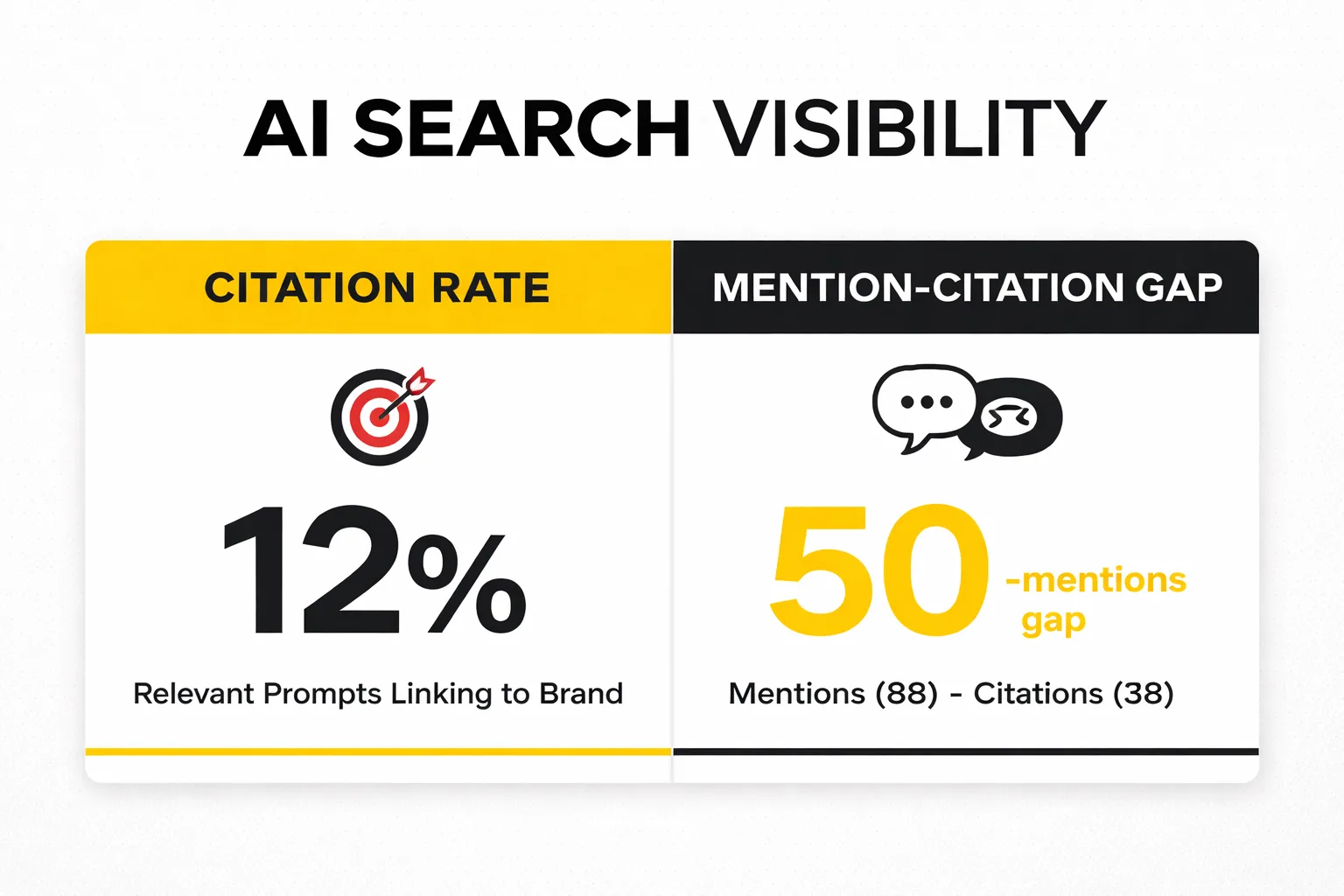
Citation rate is the foundational metric: out of all the prompts relevant to your category, what percentage produce an AI response that names or links to your brand? If you track 100 prompts and your brand appears in 12 responses, your citation rate is 12%. That baseline number, tracked weekly, tells you whether your content investments are actually moving the needle inside AI engines.
Mention-citation gap is the metric most teams ignore, and it's often the most diagnostic. A mention is when an AI response names your brand in prose without linking to a specific URL. A citation is when the response links directly to one of your pages. The gap between these two numbers reveals a specific problem: AI engines know your brand exists, but they're not pulling from your content as a source. That gap usually points to a retrieval problem, not a brand awareness problem. Your content isn't structured for extraction, or the pages AI engines are finding aren't the ones you'd want cited.
Share of model voice measures your citation rate relative to competitors across AI engines. If you appear in 12% of relevant prompts and your top competitor appears in 34%, that delta is your competitive gap. This metric matters because AI engines don't operate in a vacuum. When a buyer asks Perplexity to recommend a tool in your category, the engine typically names two or three options. Share of model voice tells you whether you're one of them.
Prompt coverage is the scope question: how many of the queries your buyers actually ask are you tracking? Most teams start with 10 or 15 prompts and think they have a complete picture. They don't. Buyers phrase the same underlying question dozens of different ways, and AI engines can return completely different citations for semantically similar prompts. Broad prompt coverage is what separates a real measurement program from a vanity dashboard.
How AI Search Visibility Differs From GEO, AEO, and LLMO
The terminology in this space is genuinely confusing, and the confusion isn't accidental. Every new acronym creates consulting surface area. Here's how to actually think about these terms.
Generative Engine Optimization (GEO) is the practice of structuring content so that generative AI engines are more likely to surface it in responses. GEO is an optimization discipline. It's about what you do to your content: adding structured data, writing answer-dense paragraphs, building topical authority clusters, ensuring your pages are crawlable by AI indexing bots. You can learn more about how AEO and GEO relate to each other if you want a deeper breakdown of where the two strategies diverge.
Answer Engine Optimization (AEO) focuses specifically on engines that function as answer machines rather than link directories. Perplexity is the canonical example. AEO vs SEO is a comparison worth understanding because the ranking signals are genuinely different: AEO rewards direct, citable answers over long-form content optimized for dwell time. If you want the full definition, what is AEO covers the mechanics in detail.
LLM Optimization (LLMO) is the narrowest of the three. It focuses specifically on how large language models select and weight sources during generation, as distinct from retrieval-augmented systems that pull live web results. LLMO tactics include training data presence, entity salience, and co-citation patterns with authoritative sources.
AI search visibility sits above all three. GEO, AEO, and LLMO are optimization strategies. AI search visibility is the measurement layer that tells you whether those strategies are working. You can execute a technically correct GEO playbook and still have a citation rate of zero if your content isn't reaching the right retrieval contexts. AI search visibility is how you know.
One concrete illustration: research from ZipTie.dev found that only 11% of domains are cited by both ChatGPT and Perplexity for the same query, and 71% of all cited sources appear on only one platform. That means a GEO strategy optimized for one engine could be completely invisible on another. Without measuring AI search visibility across multiple platforms, you'd never see that gap. Google AI Overviews favor YouTube at 23.3% of top citations, Perplexity favors Reddit at 46.7%, and ChatGPT favors Wikipedia at 47.9% — which means the content format and distribution channel that wins on one platform actively loses on another.
This platform divergence is the strongest argument for treating AI search visibility as its own discipline rather than a subset of GEO or AEO.
How Does Platform Divergence Affect Your Strategy?
The 11% cross-platform citation overlap isn't a curiosity. It's a strategic forcing function.
If you're a B2B SaaS brand optimizing for Perplexity source selection, you need content that performs in conversational, community-validated formats. The kind of content Reddit dominates. But if your buyers are using Google AI Overviews, you need video content (YouTube's 23.3% citation share) and structured long-form pages that Google's retrieval system favors. These are not the same content investments.
The pattern that keeps appearing is teams picking one AI engine to optimize for. Usually Perplexity because it's the most visible in the practitioner community. And treating that as a complete AI search strategy. It isn't. Your buyers are distributed across ChatGPT, Gemini, Perplexity, Claude, Google AI Overviews, and AI Mode. A Perplexity AI visibility checker tells you your Perplexity citation rate. It doesn't tell you whether you're invisible on the platform your highest-value buyers actually use.
The practical answer isn't to optimize for every platform simultaneously from day one. It's to measure first, then prioritize. Find the two or three AI engines where your buyers are most concentrated, establish your baseline citation rate on each, and build your optimization roadmap from that data rather than from which platform gets the most industry coverage.
Search Visibility Tools. Traditional SEO vs. AI-Era Measurement
Most marketers already use some form of search visibility tool. Ahrefs, Semrush, Moz, and Google Search Console are the standard stack for tracking organic rankings, domain authority, and keyword positions. These are excellent SEO rank checking tools for what they were built to do: measure performance in traditional search results.
The gap opens when you try to use those same tools to answer AI-era questions.
Traditional SEO rank checking tools measure position in a SERP. They tell you that you rank third for "best project management software" on Google.com in the US. What they cannot tell you is whether ChatGPT names your product when a buyer asks "what's the best project management tool for a 10-person team?" Those are related questions with completely different measurement requirements. One is a URL position in a list. The other is a citation inside a synthesized answer that may not surface any links at all.
The practical consequence: teams that rely exclusively on traditional SEO rank checking tools are measuring the right thing for the wrong channel. They see stable keyword rankings and assume visibility is stable. Meanwhile, AI engines are routing buyers past those rankings entirely, and the brand has no data on whether it's being cited or ignored in those AI-mediated moments.
This isn't an argument to abandon traditional search visibility tools. Organic rankings still matter. Google still processes billions of queries that don't trigger AI Overviews. A complete search visibility stack in 2026 includes both: traditional SEO rank checking tools for SERP position tracking, and a purpose-built AI visibility tracking tool for citation rate measurement across AI engines. They answer different questions. Running only one is a measurement blind spot.
The specific features that distinguish an AI-era search visibility tool from a traditional rank tracker: prompt-based querying (running natural-language questions rather than keyword lookups), multi-engine coverage (not just Google), citation-level reporting (which specific pages are being pulled as sources), and mention-citation gap analysis (named vs. linked). None of those capabilities exist in standard SEO rank checking tools, and they can't be retrofitted because the underlying data architecture is different.
What Is the Best AI Optimization Tool for Visibility?
This is the question every founder and SEO lead asks once they accept that AI search visibility is real and measurable. The honest answer: the best ai optimization tool for visibility is the one that measures citation rate across the specific AI engines your buyers use, not the one with the most features or the highest price tag.
That said, there are meaningful differences in how tools approach the problem, and those differences have real consequences for the quality of data you get.
Per-platform citation tracking is non-negotiable. Aggregate citation rates that blend results across AI engines hide the platform divergence that drives your actual strategy. If a tool tells you your citation rate is 15% without breaking that down by ChatGPT, Perplexity, Gemini, and Google AI Overviews separately, you don't know whether you're strong on one platform and invisible on others. Which is the most common pattern.
Mention-citation gap reporting separates diagnostic tools from vanity dashboards. Knowing that you're mentioned in 22% of responses but cited (linked) in only 4% tells you something specific: AI engines know your brand but aren't pulling from your content as a source. That's a retrieval structure problem you can fix. A tool that only reports aggregate mentions won't surface it.
Competitor share of voice is what turns your citation rate from an abstract number into a strategic signal. If your citation rate is 12% and your top competitor's is 38%, you have a 26-point gap and a roadmap priority. Without competitor benchmarking, you're optimizing without a reference point.
Response text access. The actual AI-generated answer behind each citation. Is what makes diagnosis possible. You need to see what the AI said, not just whether it named you. Was your brand cited as the recommended option or as a cautionary example? Was the citation accurate? Was a competitor cited in the same response? That context is where optimization decisions come from.
Meev's AI visibility tool is built around exactly this diagnostic stack: per-platform citation tracking across every major AI search surface, mention-citation gap reporting, competitor share of voice, and the full response text behind every mention. For small teams that need to be found and cited by AI answers without running a full content operation, that combination is what makes measurement actionable rather than decorative.
For agencies managing multiple client domains, the measurement challenge multiplies. You need per-domain citation tracking because citation patterns vary significantly by industry vertical, brand authority, and content maturity. The top AI-powered content creation platforms for 2026 article covers how different platforms handle multi-domain workflows if you're evaluating options at scale.
AI Visibility Tracking Tools. What the Market Looks Like in 2026
The ai visibility tracking tools category didn't exist as a defined market segment three years ago. In 2026, it's crowded, inconsistent in methodology, and genuinely confusing to evaluate. Here's the honest landscape.
Most tools in this space fall into one of three categories. The first is standalone citation trackers: tools built specifically to measure AI citation rates, typically covering a handful of AI engines and returning either a yes/no citation signal or a basic mention count. These are useful for getting a baseline but rarely provide the diagnostic depth needed to act on the data. The mention-citation gap, competitor share of voice, and response text access are usually missing or require manual extraction.
The second is SEO platforms adding AI monitoring as a feature: established tools that track traditional organic rankings and have bolted on AI citation tracking as a module. The coverage is often limited to Google AI Overviews because that's the surface closest to traditional search data, and the AI-specific reporting tends to be shallow. If you already use one of these platforms for rank tracking, the AI module is worth checking. But treat it as a supplement, not a primary measurement source.
The third is integrated AI search visibility platforms: tools designed from the ground up to measure, diagnose, and improve AI citation performance across multiple engines. This is where Meev sits. The distinction isn't just feature depth. It's the underlying methodology. A purpose-built AI search visibility platform runs prompts at consistent cadences, normalizes results across AI engines with different response formats, and structures data for diagnosis rather than reporting.
The recurring pattern across teams that switch tools: they start with a standalone tracker or an SEO platform module, get citation rate data, and then hit a wall because the data doesn't tell them what to do. They know their citation rate is low. They don't know which content to fix, which prompts to target, or whether competitors are winning on specific platforms. That's the gap a search visibility tool built for AI diagnosis closes.
One practical note on evaluation: when assessing any ai visibility tracking tool, run the same prompt manually on three AI engines and compare the results to what the tool reports. Discrepancies are common, and they reveal a lot about the tool's prompt methodology, refresh cadence, and normalization approach. A tool that can't accurately capture what you can verify manually with your own eyes isn't a reliable measurement source.
AI Content Detection, Monitoring, and Visibility Tools
A category of questions that comes up repeatedly in AI search: how do AI content detection and monitoring tools relate to AI visibility tracking? They're solving different problems, but teams often conflate them. And that confusion leads to buying the wrong tool.
AI content detection tools are designed to identify whether a piece of text was generated by an AI model. Tools like GPTZero and Originality.ai analyze linguistic patterns to flag AI-generated content. These are primarily used by publishers, educators, and compliance teams who need to verify content provenance. They don't measure whether your brand is cited by AI engines. They're not search visibility tools.
AI content monitoring tools track where your brand is mentioned across AI-generated content on the web. Think brand monitoring for the AI era. Some tools in this category alert you when your brand appears in AI-generated articles, summaries, or social content. Useful for reputation management, but again, not the same as tracking your citation rate inside AI search engines responding to buyer queries.
AI visibility tracking tools (what this article is about) measure whether and how your brand is cited when users ask AI search engines questions relevant to your category. The measurement happens at the prompt level: you define a set of queries, the tool runs those queries across AI engines on a consistent cadence, and it reports back citation rate, mention-citation gap, competitor share of voice, and the actual response text. This is the category that matters for marketers trying to influence buyer decisions in AI-mediated search.
The confusion between these three categories is expensive. Teams that buy an AI content monitoring tool thinking it will tell them why they're not getting cited by Perplexity end up with data that doesn't answer the question. Teams that buy an AI content detection tool to "monitor AI visibility" end up with zero useful signal for their marketing programs. Get clear on the problem before buying a tool.
For teams that need all three capabilities. Detection, monitoring, and search visibility tracking. The practical answer in 2026 is to use purpose-built tools for each. There's no credible all-in-one solution that does all three well. The AI visibility tracking layer, specifically, requires prompt methodology, multi-engine coverage, and diagnostic reporting that detection and monitoring tools aren't architected to provide.
AI SEO Agent Tools. Where They Fit in the Stack
A newer question showing up in practitioner communities: where do AI SEO agent tools fit relative to AI visibility tracking?
AI SEO agents are tools that autonomously execute SEO tasks: crawling sites, identifying technical issues, generating content briefs, publishing articles, building internal links. The category ranges from narrow automation tools (auto-generating meta descriptions at scale) to broader autonomous agents that can manage an entire content calendar without human input.
They're genuinely useful for execution. They're not measurement tools.
The distinction matters because the most common mistake teams make with AI SEO agents is treating execution as a substitute for diagnosis. An AI SEO agent can publish fifty articles in a week. Without an AI visibility tracking tool measuring which of those articles actually improved citation rates on specific prompts, you don't know whether those fifty articles moved the needle or generated content that AI engines ignore entirely. Execution without measurement is expensive noise.
The practical stack that works: use an AI visibility tracking tool to identify citation gaps and prioritize which prompts to target. Use an AI SEO agent (or a platform like Meev that integrates both) to produce and publish the content. Then use the visibility tracker to measure whether citation rates improved. The agent handles velocity. The tracker handles direction. Neither works well without the other.
For teams evaluating AI SEO agent recommendations specifically, the evaluation criterion that matters most is whether the agent connects its output to measurable citation outcomes. An agent that produces content without tracking whether that content earns citations is a writing tool, not a visibility tool. The top AI-powered content creation platforms for 2026 covers the broader landscape if you're comparing options across the full production and measurement stack.
AI Visibility Tracking and Article Writing Tools in 2026
One of the most searched questions in this space right now: are there tools that combine AI visibility tracking with article writing? The answer is yes. But the combination matters more than the individual capabilities.
Standalone AI writing tools (the category that includes dozens of content generation platforms) can produce articles quickly. What they can't do is tell you which articles to write based on where your brand is absent from AI citations, structure those articles for extraction by specific AI engines, or track whether the published content actually improved your citation rate. The writing is disconnected from the measurement.
Standalone AI visibility trackers can tell you your citation rate and where you're losing to competitors. What they can't do is close the gap. They diagnose the problem; they don't fix it.
The combination that actually moves citation rates is a platform that connects the measurement to the content production: identify the prompts where you're absent, research what AI engines are currently citing for those prompts, produce articles structured specifically for extraction, and then track whether citation rates improve after publication. That closed loop. Measure, write, publish, track. Is what separates an AI visibility tracking and article writing workflow from two disconnected tools running in parallel.
Meev is built around this loop. The platform identifies citation gaps, researches the sources AI engines are pulling from, produces answer-engine-optimized articles that go through a quality review before publication, and then tracks citation rate changes at the prompt level after the content goes live. For small teams without a full content operation, that integrated workflow is what makes AI search visibility improvement tractable rather than theoretical.
The key evaluation criterion for any tool in this category: does it connect content production decisions to citation rate outcomes, or does it just produce content and leave measurement to a separate workflow?
How to Increase AI Visibility in Marketing in 2026
The question of how to increase AI visibility in marketing in 2026 has a cleaner answer than most practitioners admit: you increase AI visibility by becoming the most citable source for a specific set of questions, not by optimizing for AI engines in general.
That distinction matters. "Optimizing for AI" is too broad to act on. "Becoming the most citable source for the question 'what's the best [category] tool for [use case]?'" is a content brief.
Build a prompt inventory before you build content. The single most common failure mode in AI visibility programs is publishing content that answers questions AI engines aren't being asked, or that answers common questions in formats AI engines don't extract from. A prompt inventory is a structured list of the natural-language questions your buyers type into ChatGPT, Perplexity, and Google AI Overviews at each stage of their decision process. Not the keywords you rank for. The actual questions. For a B2B SaaS company, that inventory typically includes category-level questions ("what's the best tool for [use case]?"), comparison questions ("[your brand] vs [competitor] — which should I use?"), and how-it-works questions ("how does [product type] actually work?"). Each prompt type produces different citation patterns and requires different content treatments.
Structure content for extraction, not for reading. AI engines don't read articles the way humans do. They extract passages that directly answer specific questions. A 3,000-word article that buries its answer in paragraph seven will lose citations to a 600-word page that leads with a direct, bolded answer to the exact question being asked. Answer-dense formatting. Leading each section with a 40-60 word direct response, using specific numbers and named sources, structuring claims as standalone sentences that make sense out of context. Is what makes content extractable. This is the core discipline of answer engine optimization, and it applies across every AI engine.
Earn topical authority through information gain. Sites with high topical authority gain traffic 57% faster than low-authority sites, according to a Graphite study cited by SEO practitioner Matt Diggity. The mechanism applies directly to AI citation: when an AI engine retrieves sources for a query, it's looking for the most authoritative, comprehensive, and citable treatment of that topic. A brand that owns a topic cluster. Meaning it has the most thorough, accurate, and well-structured content on a subject. Is a natural extraction target. Information gain means publishing content that adds something new to the existing corpus: original data, a framework that doesn't exist elsewhere, a practitioner perspective that contradicts the consensus. AI engines are trained to prefer sources that contribute novel information. A page that synthesizes what three other sources already said will rarely get cited when those three sources are available directly.
Track weekly, not monthly. AI citation patterns move faster than organic rankings. A well-structured piece of content targeting a specific prompt intent can earn AI citations within two to three weeks of publication if it hits the right retrieval contexts. Monthly tracking is too slow to inform content decisions. Weekly tracking at minimum. With the ability to drill into which specific prompts drove citation changes. Is the cadence that makes AI visibility programs responsive rather than retrospective.
Fix the mention-citation gap before scaling content. If your brand is mentioned in AI responses but not cited as a source, producing more content won't close that gap. The problem is retrieval structure: AI engines know your brand exists but aren't pulling from your pages as authoritative sources. Common causes include pages that are poorly structured for extraction (no direct answers, heavy on prose, light on specific claims), pages that aren't being indexed by AI crawlers, and a mismatch between the prompts you're targeting and the content you've actually published. Diagnose the gap first. Then scale.
Why E-E-A-T Signals Matter Differently for AI Engines
Google's guidance on helpful content frames E-E-A-T (Experience, Expertise, Authoritativeness, Trustworthiness) as a quality rubric for human evaluators. The question for AI search is whether LLMs apply the same rubric, and the honest answer is: partially, inconsistently, and through different proxies.
Lumar's research on LLM-as-a-Judge frameworks suggests AI platforms evaluate content on helpfulness, relevance, and reliability as part of a multi-factor quality rubric. E-E-A-T is one input, not the whole system. What this means in practice: a page with strong E-E-A-T signals. Named author, institutional affiliation, cited sources. Is more likely to be treated as a reliable extraction source by AI engines. But E-E-A-T alone doesn't guarantee citation. The content also has to be the right format for the right intent.
Google's own position is clear: AI-generated content is not penalized as long as it meets quality standards. The focus is on content quality, not production method. But Google's spam policies do flag scaled content abuse. Publishing high volumes of low-quality, AI-generated content designed to manipulate rankings rather than help users. The distinction matters: quality-gated AI content at scale is viable; unreviewed bulk publishing is a penalty risk.
The auto-blog space illustrates this clearly. Tools that ship whatever the model produces, without any quality gate, are generating content that ranks briefly and then drops out of both traditional SERPs and AI citations as quality signals accumulate. The teams running quality-gated workflows. Where articles below a minimum quality threshold are blocked before publishing. Are seeing more durable citation performance. That's why Meev's content pipeline gates every article through a quality firewall before it reaches your CMS. Weak drafts don't ship. That's not a feature differentiator. It's the minimum viable standard for sustainable AI search visibility.
Building Citation Authority Without Manipulating the System
Brand mention outreach is the tactic everyone in this space is talking about, and the evidence base is weaker than the consensus suggests. The most-cited data supporting mention outreach traces back to an Ahrefs correlation study with no disclosed sample size. That's correlation coefficients, not causation. The rest of the supporting literature is largely LinkedIn posts summarizing that study and Reddit case studies with no documented methodology.
This isn't an argument against mention outreach. It's an argument for understanding what you're actually doing. The entire research corpus on this tactic is success-story dominated. There are zero documented cases of aggressive mention outreach getting a brand flagged as manipulative by an LLM, causing reputational damage, or resulting in systematic deprioritization by AI systems. That absence isn't reassuring. It means the failure mode is unquantified, not nonexistent. Before scaling any AI citation outreach program, the downside needs to be understood. Right now, nobody in the practitioner community is publishing the cautionary tales.
What's more defensible: topical authority built through genuine information gain. Sites with high topical authority gain traffic 57% faster than low-authority sites, according to a Graphite study cited by SEO practitioner Matt Diggity. The mechanism makes sense for AI citation too. When an AI engine retrieves sources for a query, it's looking for the most authoritative, comprehensive, and citable treatment of that topic. A brand that owns a topic cluster is a natural extraction target. Information gain means publishing content that adds something new to the existing corpus: original data, a framework that doesn't exist elsewhere, a practitioner perspective that contradicts the consensus. A page that synthesizes what three other sources already said will rarely get cited when those three sources are available directly.
How to Start Measuring Your AI Search Visibility Today
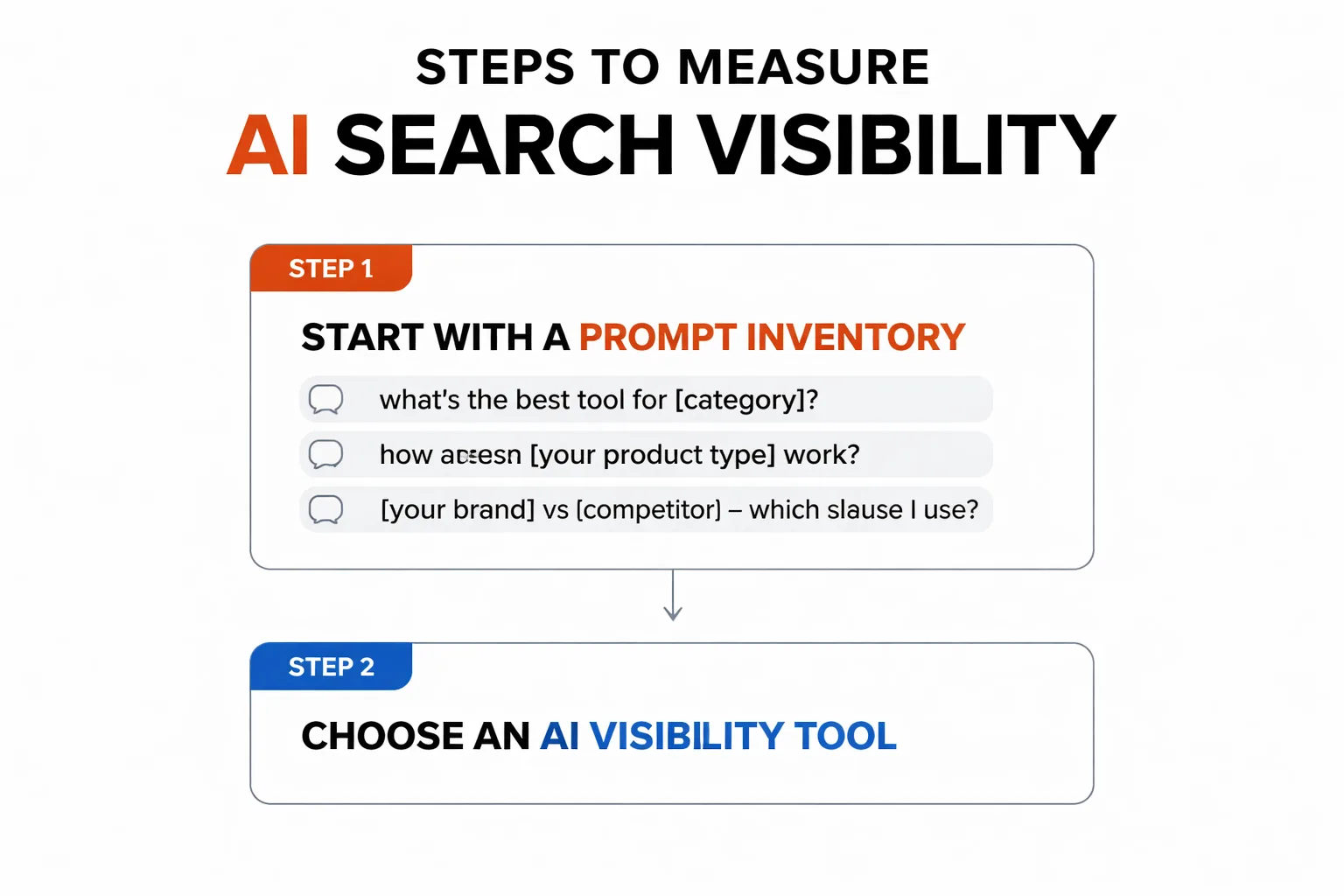
Start with a prompt inventory. This is the step most teams skip, and it's why their measurement programs produce data that doesn't connect to business outcomes.
A prompt inventory is a structured list of the questions your buyers actually ask AI engines at each stage of their decision process. Not the keywords you rank for. The natural-language questions a buyer types into ChatGPT when they're trying to understand your category, evaluate options, or make a final decision. For a B2B SaaS company, a prompt inventory might include questions like "what's the best tool for [category]?", "how does [your product type] work?", and "[your brand] vs [competitor] — which should I use?" Each of those prompts will produce different citation patterns across different AI engines. You need all three types to get a real picture.
Once you have your prompt inventory, choose an AI visibility tool that covers the engines your buyers use. The key features to look for: per-platform citation tracking (not just aggregate), mention-citation gap reporting, competitor share of voice, and the actual response text behind each mention so you can diagnose why you're being cited or not. Running baseline tests manually across even five prompts on four AI engines is 20 tests. At weekly cadence, that's 80 manual tests per month. It doesn't scale past the first two weeks before the signal gets noisy and the methodology drifts.
Set your benchmark against two or three direct competitors, not the entire market. Share of model voice is only meaningful relative to the brands your buyers are actually comparing you against. If your citation rate is 8% and your top competitor's is 31%, that's a 23-point gap you can build a roadmap around. If you benchmark against a category leader with a 60% citation rate and a domain authority built over a decade, you'll set targets that are impossible to hit in a reasonable timeframe.
For realistic baselines: a brand with less than two years of content history and moderate domain authority should expect a citation rate of 3-8% across a prompt inventory of 50 relevant queries as a starting point. Established brands with strong topical authority typically see 15-30% citation rates. The more important number is your share of model voice relative to direct competitors, not your absolute citation rate.
One more thing on measurement cadence: AI citation patterns move faster than organic rankings. A piece of content can go from zero citations to consistent citation across multiple platforms within two to three weeks of publication if it hits the right retrieval contexts. Weekly tracking is the minimum viable cadence for any brand actively investing in AI search visibility. Monthly tracking is fine for a quarterly review, but it's too slow to inform content decisions. The brands closing citation gaps in 2026 aren't the ones with the biggest content budgets. They're the ones with the tightest measurement loops.
FAQ
What is an AI visibility tracking tool?
An AI visibility tracking tool measures how often and how prominently your brand is cited when users ask AI search engines. ChatGPT, Perplexity, Gemini, Google AI Overviews, Claude. Questions relevant to your category. The best tools track citation rate per platform, report the mention-citation gap (named but not linked vs. named and linked), show competitor share of voice, and provide the actual AI-generated response text behind each mention so you can diagnose what's driving or suppressing your citations. They're distinct from AI content detection tools (which identify AI-generated text) and AI content monitoring tools (which track brand mentions across the broader web).
How are AI visibility tracking tools different from SEO rank checking tools?
SEO rank checking tools measure where your URL appears in a traditional SERP. Position one, position five, page two. AI visibility tracking tools measure whether your brand is cited inside synthesized AI answers where no ranked list exists. A brand can hold position one on Google for a keyword and receive zero citations from ChatGPT or Perplexity for the same query. The two tool categories answer different questions and use fundamentally different data architectures. A complete 2026 search visibility stack includes both: traditional SEO rank checking tools for SERP position, and a purpose-built AI visibility tracker for citation rate across AI engines.
What are the best AI SEO agent tool recommendations for visibility in 2026?
AI SEO agents are execution tools. They produce content, build internal links, generate briefs. They're not measurement tools. The right recommendation depends on what problem you're solving. For citation gap identification and content production in a single workflow, Meev connects measurement to publishing: it identifies where you're absent from AI citations, produces answer-engine-optimized articles, and tracks whether citation rates improve after publication. For teams that want a standalone agent for execution, evaluate whether the agent connects its output to measurable citation outcomes. If it doesn't, it's a writing tool, not a visibility tool.
How to increase AI visibility in marketing in 2026?
The most reliable path is becoming the most citable source for a specific set of buyer questions, not optimizing for AI engines in general. Build a prompt inventory of the natural-language questions your buyers ask AI engines. Structure content for extraction. Lead each section with a direct 40-60 word answer, use specific numbers, write standalone sentences that make sense out of context. Earn topical authority through information gain rather than content volume. Fix the mention-citation gap before scaling production. Track weekly, not monthly, because AI citation patterns shift faster than organic rankings.
What's the difference between AI content detection tools and AI visibility tracking tools?
AI content detection tools (like GPTZero or Originality.ai) identify whether text was generated by an AI model. AI visibility tracking tools measure whether your brand is cited inside AI-generated search responses. These solve completely different problems. A detection tool tells you nothing about your citation rate in Perplexity. A visibility tracking tool tells you nothing about whether a piece of content was AI-generated. Teams that buy a detection tool expecting visibility insights, or vice versa, end up with data that doesn't answer their actual question.
What's the difference between AI search visibility and traditional SEO rankings?
Traditional SEO rankings measure where your URL appears in a list of results on Google or Bing. AI search visibility measures whether your brand is named, cited, or paraphrased inside the synthesized answers that AI engines generate. A brand can rank number one organically and receive zero AI citations for the same query. The signals that drive each outcome are different. Organic rankings reward backlinks, engagement signals, and on-page optimization. AI citations reward answer-dense formatting, topical authority, and content structured for extraction by retrieval systems.
What's the best AI optimization tool for visibility?
The best ai optimization tool for visibility is the one that connects measurement to content production in a closed loop: it identifies the prompts where you're absent from AI citations, shows you what competitors are being cited for, helps produce content structured for extraction, and then tracks whether citation rates improve after publication. Per-platform citation tracking, mention-citation gap reporting, competitor share of voice, and response text access are the non-negotiable features. Tools that report only aggregate citation rates without diagnostic depth tell you there's a problem but not what to do about it.
How many AI engines should a search visibility tool cover?
Track the engines your buyers actually use, not all of them simultaneously. Start with two or three: typically Google AI Overviews (because it intercepts the most search volume), Perplexity (because it's the most citation-transparent), and ChatGPT (because of its user base size). Expand to Claude, Gemini, Grok, and DeepSeek once you have a stable measurement process for the first three. Platform citation patterns diverge significantly. Only 11% of domains are cited by both ChatGPT and Perplexity for the same query, according to ZipTie.dev research.
How long does it take to improve AI search visibility?
Faster than most people expect, but less predictably than traditional SEO. A well-structured piece of content targeting a specific prompt intent can earn AI citations within two to three weeks of publication. Improving your overall citation rate across a category takes longer. Typically three to six months of consistent content investment. The variable that matters most is whether your content is the best available answer for a specific query intent, not how long it's been indexed.
About the Author
Judy Zhou is the founder of Meev, an AI search visibility platform for founders, marketers, and SEO teams. With a background in SEO and editorial operations, she focuses on building content systems that earn citations across every major AI search surface while maintaining the quality standards that make those citations durable. She has overseen AI-driven content research and publishing across hundreds of brand domains.