
By Judy Zhou, Head of Content Strategy
Key Takeaways
- According to an arXiv analysis of 366,000+ citations, just 30 domains capture 67% of ChatGPT citations per topic — making citation concentration the core problem for most brands. • Only 12% of AI citations overlap with Google's traditional top 10 results, so strong organic rankings do not protect your AI search visibility. • ChatGPT favors Wikipedia (47.9% of top citations) while Perplexity prioritizes Reddit (46.7%) — your distribution strategy must be platform-specific, not one-size-fits-all. • The mention-citation gap closes through publisher placement on sources AI engines already trust, not through formatting your own content more precisely.
Marcus had spent three years building his agency's blog into a genuine resource. Detailed guides, original research, case studies with real client data. Then a prospect told him they'd asked ChatGPT to recommend an SEO agency in his city. His firm wasn't mentioned. A competitor with half the content and a fraction of the backlinks was cited twice. Marcus pulled up the ChatGPT response, read it carefully, and realized he had no idea why that other agency showed up and his didn't. That moment sent him down the rabbit hole of AI visibility.
The chatgpt seo tool conversation has split into two completely different disciplines, and most practitioners are only working on one of them. The first is using ChatGPT to do SEO work faster. Keyword research, content briefs, meta descriptions. The second, harder, and more consequential discipline is optimizing your brand so that ChatGPT, Perplexity, and Google AI Overviews actually cite you when users ask questions in your space. According to an arXiv analysis of 366,000+ citations, roughly 30 domains capture 67% of ChatGPT citations within any given topic. The top 10 domains alone account for 46% of citations in product comparison queries. Forrester research puts 94% of B2B buyers using AI search engines during vendor research. And only 12% of AI citations overlap with Google's traditional top 10 results — meaning your Google rankings are not protecting you in AI search the way you think they are.
This article is structured as a problem-first investigation. The problem: most teams are treating chatgpt seo as a productivity hack when the real leverage is in citation architecture. Here's how to think about both. And which one actually moves the needle.
The Two Disciplines Most Teams Conflate
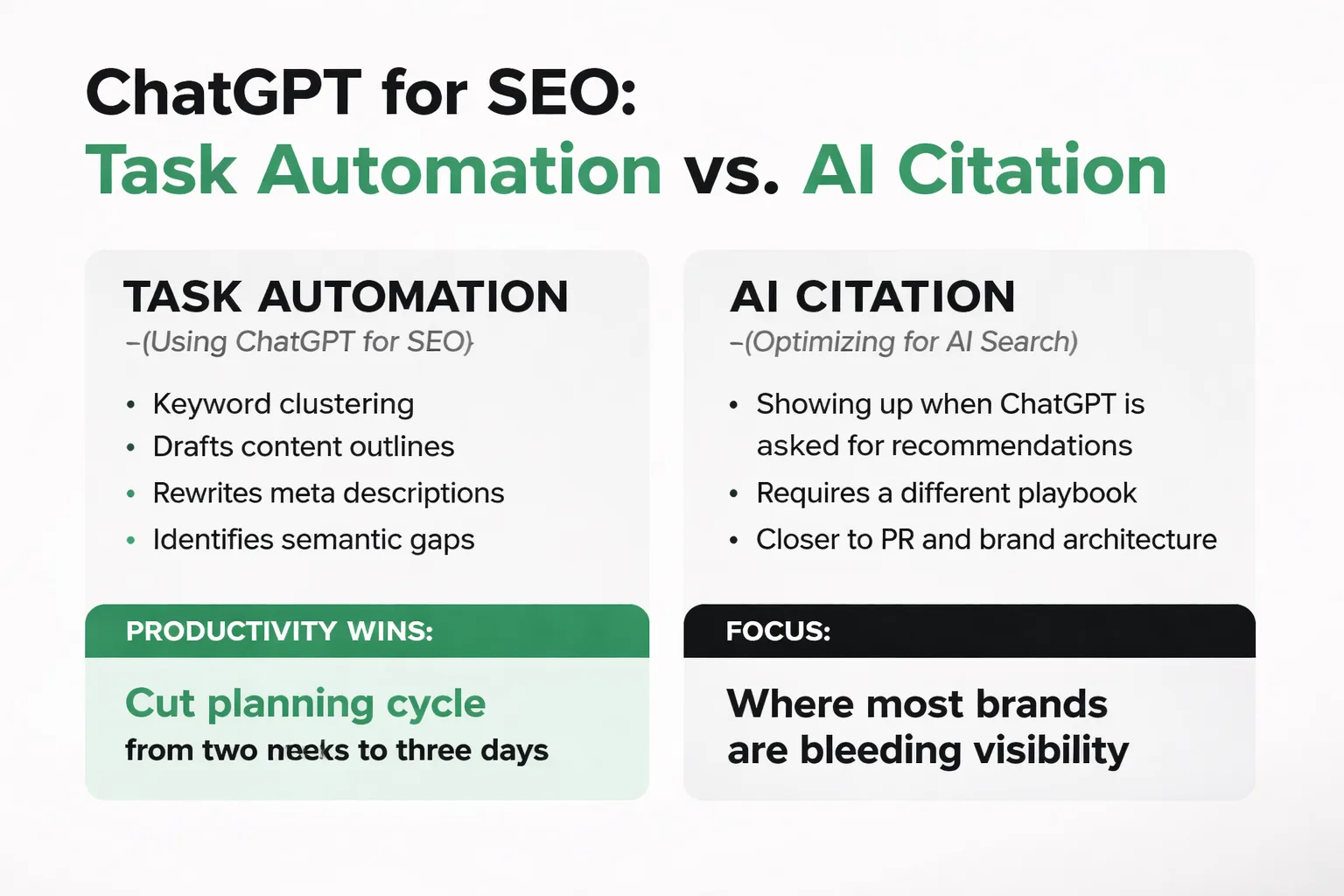
Using ChatGPT for SEO tasks and optimizing for ChatGPT citations are not the same thing. Conflating them is like confusing "using a map" with "being on the map." Both matter. But the second one is where most brands are bleeding visibility right now, and almost no one is measuring it correctly.
The task-automation side is well-documented: ChatGPT accelerates keyword clustering, drafts content outlines, rewrites meta descriptions, identifies semantic gaps. These are real productivity wins. A content team that uses ChatGPT well — including custom ChatGPT GPTs for recurring tasks — can produce briefs in minutes that used to take hours. I've seen teams cut their planning cycle from two weeks to three days with disciplined prompt workflows. That's not nothing.
But the citation side. Actually showing up when someone asks ChatGPT "what's the best [your category] tool" or "which [your service] agency should I hire" — requires a completely different playbook. It's closer to PR and brand architecture than traditional on-page SEO. And the concentration data from the arXiv citation study makes the stakes clear: if you're not in the top 30 domains being cited for your topic, you're essentially invisible in AI-generated answers.
Why Citation Concentration Is the Real Problem
The 30-domain concentration finding stopped me cold when I first read it. Thirty domains capturing 67% of citations in a topic means the remaining citations are scattered across thousands of sites competing for scraps. This isn't a long-tail opportunity. It's a structural barrier.
What makes those 30 domains different? The arXiv research points to Wikipedia at 47.9% of top ChatGPT citations. Perplexity prioritizes Reddit at 46.7% of its citations. Neither of those is a polished content asset. I spent a good chunk of early 2026 optimizing our pillar pages for Generative Engine Optimization (GEO) — tightening definitions, adding FAQ sections, restructuring headers so LLMs could parse them cleanly. Reasonable bets, all of them. What I didn't anticipate: the content format wasn't the problem. The platform was. Our beautifully structured definitions weren't losing to competitor sites. They were losing to a three-year-old Reddit thread where someone explained the concept conversationally in 200 words. That realization was genuinely deflating.
The implication for chatgpt seo strategy is uncomfortable: platform authority and authentic discourse signals matter more than formatting discipline. Reddit pulls citation rates around 40% across major models. Wikipedia around 26%. What they share is the kind of high-volume, genuine human engagement that LLMs have decided to trust. If your brand isn't generating presence on those platforms, your owned content is fighting uphill.
This doesn't mean structured content is worthless. It means it's necessary but not sufficient. The GEO playbook most practitioners are following. Definition-first formatting on owned content. Is optimizing for a signal that LLMs are largely ignoring in favor of platforms they've already decided to trust.
How Does the Mention-Citation Gap Actually Work?
The mention-citation gap is the distance between your brand being referenced somewhere on the web and your brand being cited by an AI engine in a relevant answer. Most brands have a much wider gap than they realize.
AI engines don't just pull from pages that mention your brand. They pull from pages that are already in their trusted citation pool, then surface brands mentioned within those pages. So if Forbes, TechCrunch, or a high-authority Reddit thread mentions your brand in context, that mention carries citation weight. A mention on your own blog, or on a low-authority directory, doesn't move the needle in the same way. The path to closing the mention-citation gap runs directly through publisher placement. Getting cited by AI means getting mentioned by the sources AI already cites.
This is the core logic behind what practitioners call citation building strategy. It's not link building repurposed. The mechanics are different. You're not trying to pass PageRank. You're trying to appear in the training and retrieval context of sources that AI engines have pre-approved. The practical workflow: identify which domains are being cited for your topic queries, find the editorial contacts at those domains, and pitch coverage that genuinely adds something to their existing content. That last part is where most outreach fails. Generic pitches get ignored. Pitches that reference specific articles and offer a named expert with verifiable credentials get responses.
Why E-E-A-T Hits Differently in AI Search
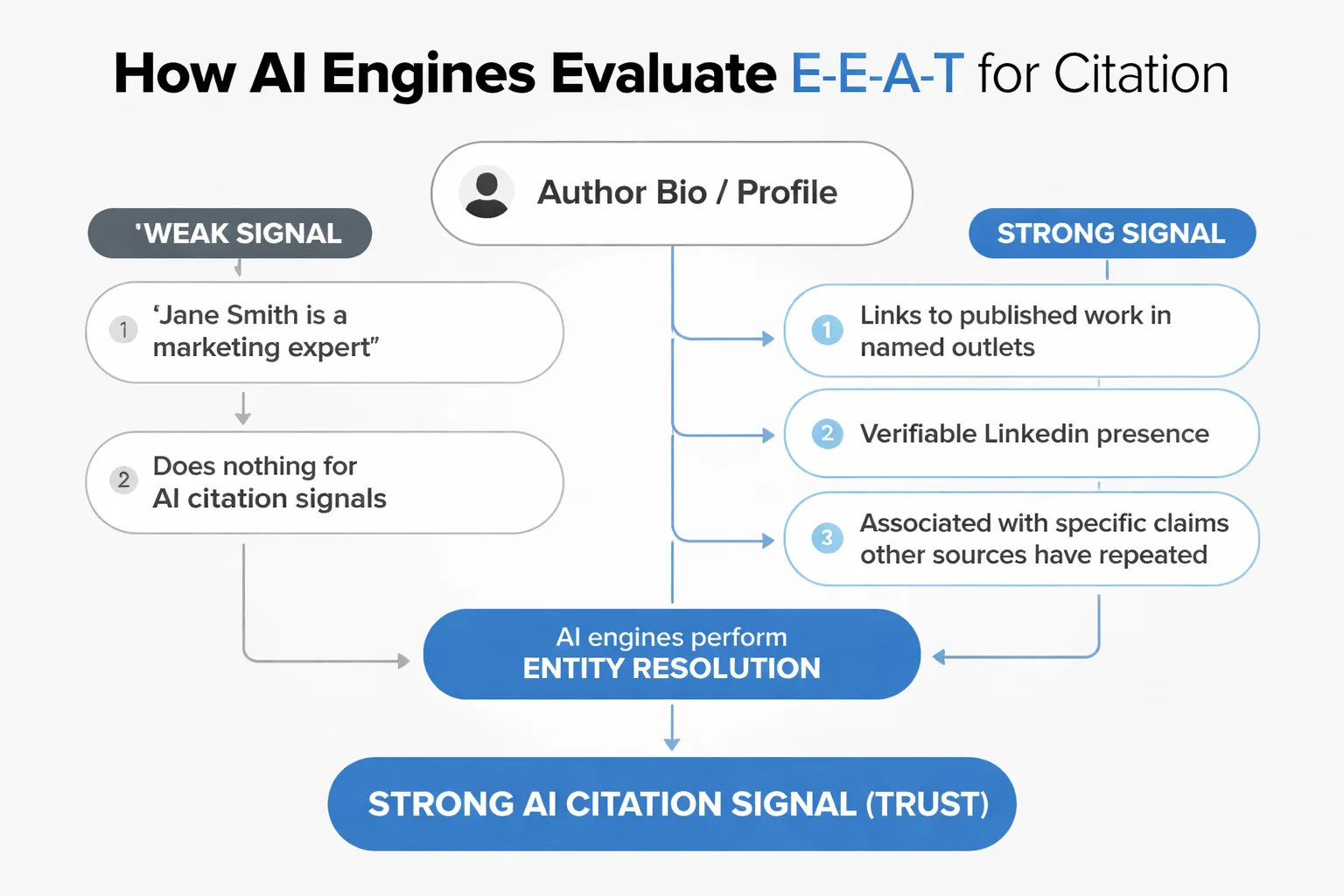
Duane Forrester, whose analysis I've followed closely, makes an argument I find increasingly hard to refute: being ranked is no longer enough when machines decide which brands to cite. The deciding factor in AI citation selection is trust. And trust in the AI context is operationalized through E-E-A-T signals that are verifiable, not just asserted.
Here's what that means practically. An author bio that says "Jane Smith is a marketing expert" does nothing for AI citation signals. An author profile that links to published work in named outlets, has a verifiable LinkedIn presence, and is associated with specific claims that other sources have repeated. That's a different signal entirely. AI engines are doing a version of entity resolution: they're asking whether this person, brand, or claim has been independently corroborated by sources they already trust.
For agencies and SMBs trying to optimize for chatgpt seo, this means E-E-A-T isn't a checklist item. It's a distribution strategy. Every piece of expert content you publish should be designed to get picked up, quoted, and linked by the sources AI engines already cite. The content isn't the end product. The citation is.
I've seen this play out in practice. Brands that invest in named author profiles with real publication histories get cited in AI answers at meaningfully higher rates than brands publishing anonymous or byline-thin content. The gap isn't subtle. It's the difference between showing up and not showing up.
Curious which AI engines are citing your competitors but not you?
How Do ChatGPT SEO Tools Actually Help?
Used correctly, a chatgpt seo tool accelerates every stage of the citation-building workflow. But only if you're clear about what you're optimizing for. Here's where I've seen real leverage.
Identifying citation gaps. ChatGPT can help you map which questions in your space are generating AI-answer results, what sources are being cited in those answers, and where your brand is absent. This is manual work without tooling, but with structured prompts it becomes a repeatable audit. Ask ChatGPT to answer the ten most common questions in your category, then analyze which domains appear in its responses. That's your citation gap map.
Drafting publisher outreach. The most underused application of ChatGPT in citation-building is personalized outreach pitch drafting. Generic outreach fails because it doesn't demonstrate that you've read the target publication. ChatGPT can help you draft pitches that reference specific articles, match the publication's editorial voice, and position your expert as a complement to existing coverage rather than a replacement. The key is feeding it real context. The target article URL, your brand's specific angle, the named expert's credentials.
Content gap analysis for topical authority. For AI search visibility, topical authority isn't just about covering every keyword in a cluster. It's about being the source that comprehensively addresses the questions AI engines are fielding. ChatGPT can help you identify which questions in your space lack authoritative answers from trusted sources. Those are your highest-leverage content opportunities. Platforms like Meev track which prompts are generating AI answers that cite competitors but not you, which is the most direct version of this analysis.
Structuring content for Answer Engine Optimization (AEO). FAQ schemas, concise definition blocks, and direct answer formatting do help. Not because they're the primary citation signal, but because they make it easier for AI engines to extract and attribute your content when they do choose to cite you. Think of AEO formatting as lowering the friction for citation, not generating it.
Monitoring AI visibility across platforms. This is where dedicated tooling matters. ChatGPT itself can't tell you how often it cites your brand. You need external tracking. AI search visibility tools that monitor ChatGPT, Perplexity, Gemini, and Google AI Overviews simultaneously give you the baseline data that makes everything else measurable. Without tracking, you're optimizing blind.
The Platform Differences That Change Your Strategy
Not all AI engines cite the same way, and treating them as a monolith is a strategic mistake. The arXiv citation research makes the platform differences concrete: ChatGPT skews toward Wikipedia (47.9% of top citations), while Perplexity prioritizes Reddit (46.7%). Google AI Overviews pulls heavily from pages that already rank in traditional search. Claude tends toward technical depth and primary sources.
This means your distribution strategy needs to be platform-aware. Press coverage and Wikipedia presence move the needle for ChatGPT. Active community participation on Reddit and forums matters more for Perplexity source selection. Strong traditional SEO signals remain relevant for Google AI Overviews Optimization. For Claude, technical documentation and primary research carry disproportionate weight.
Tracking visibility across all these surfaces separately. Not just as an aggregate. Is the only way to know where your gaps actually are. Tools that track Grok visibility, Gemini citations, and DeepSeek appearances alongside ChatGPT and Perplexity give you a complete picture of your AI search footprint. Without that breakdown, you can't know whether a visibility problem is platform-specific or systemic.
The honest caveat here: AI-powered search experiences now account for more than 40% of searches with nearly 1 billion users, but LLM-driven referral traffic is still sitting around 1% of total website traffic as of mid-2026, per Statista. I've seen this in our own analytics. Citation gains are measurable. They're just not yet driving meaningful revenue at most brand scales. I'm not saying ignore AI visibility. There's a reasonable argument for building the habit before the traffic share shifts. But I'd push back hard on any team deprioritizing conversion-focused content to chase Perplexity mentions.
Stop Treating Citation Building Like Link Building
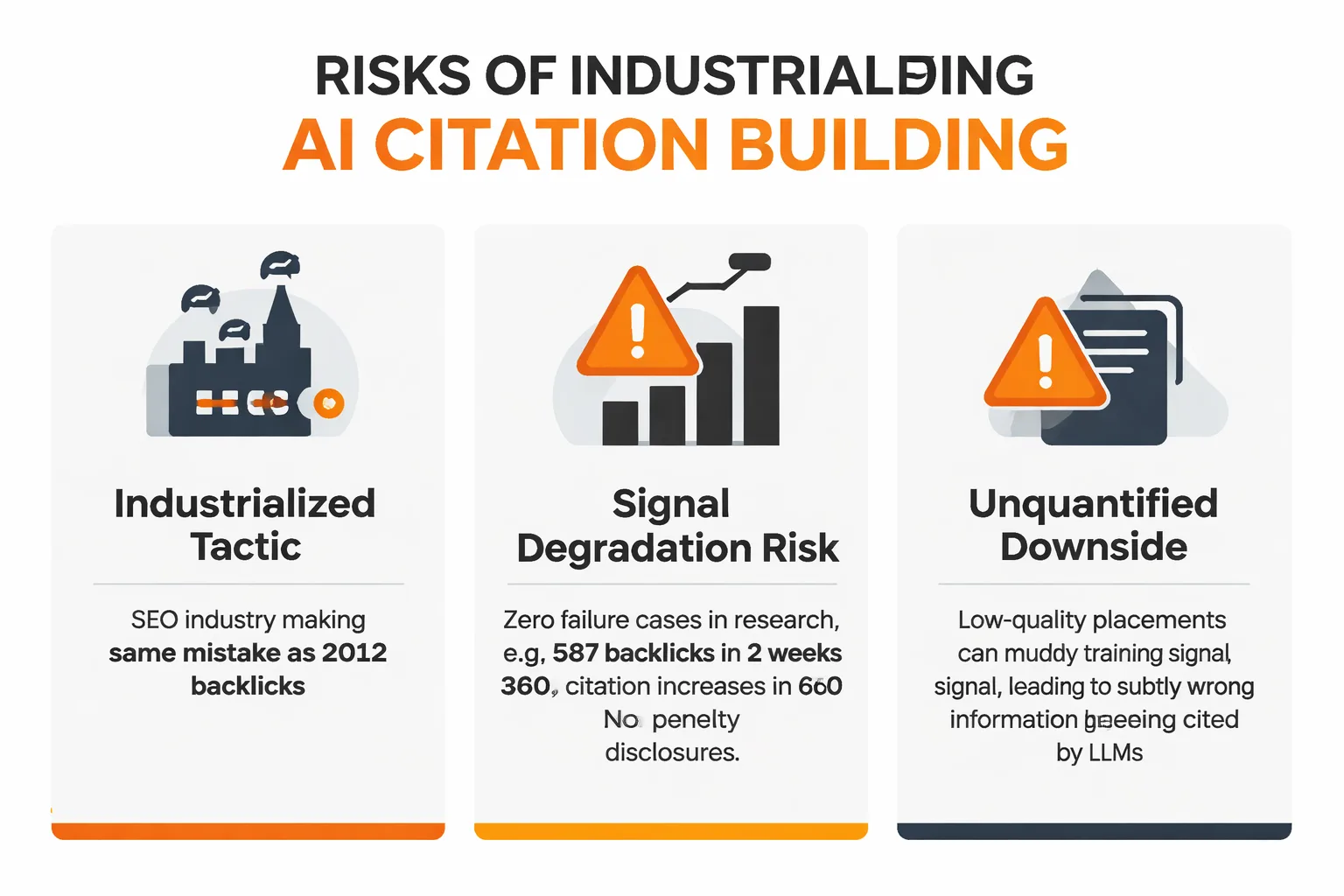
Here's my contrarian take: the SEO industry is about to make the same mistake with AI citations that it made with backlinks in 2012. It's going to industrialize the tactic, strip out the quality, and trigger exactly the kind of signal degradation that makes the strategy worthless.
Every piece of citation-building research I've reviewed has the same blind spot: zero failure cases. Numbers like 587 backlinks in two weeks and 300% citation increases in 60 days sound compelling until you notice there's no counterweight anywhere in the public record. No penalty disclosures. No cases where aggressive outreach tanked E-E-A-T signals or produced distorted LLM citations. That's not a clean industry track record. That's a publication bias problem.
My working assumption now is that any citation-building tactic operating at scale carries unquantified downside risk. Low-quality placements can muddy the training signal. An LLM might start citing your brand with subtly wrong information because it's pulling from low-authority sources that got your positioning slightly wrong. Those outcomes almost certainly happen. They're just not in anyone's marketing materials. I build review checkpoints into citation campaigns at the 30-day mark specifically to catch signal degradation before it compounds.
The right approach is selective and quality-gated. Fewer placements on higher-authority sources, with verified editorial standards, beat volume every time. This is also where content quality scoring matters: if the content you're pitching for placement isn't genuinely better than what's already on the target site, the pitch will fail. And if it somehow succeeds, it won't generate the citation signal you're after.
Building a Measurable AI Visibility System
The teams getting this right aren't running one-off citation campaigns. They've built systems that continuously measure AI visibility, identify gaps, and close them through a repeatable workflow.
The core components are: daily or weekly tracking of brand mentions across AI surfaces (ChatGPT, Claude, Gemini, Perplexity, Grok, Google AI Overviews); a cited-source leaderboard showing which domains AI engines cite most for your topic queries; a content opportunity feed surfacing prompts where competitors are cited but you aren't; and an outreach pipeline that connects citation gaps to publisher contacts and personalized pitches.
Building this manually is possible but slow. Platforms like Meev integrate all four components. Tracking AI visibility across every major surface, identifying the publishers AI engines cite for your topics, surfacing verified editorial contacts, and drafting knowledge-base-grounded outreach pitches in a single workflow. For agencies managing multiple brands, the comparison with other AI visibility platforms is worth doing. The differences in tracking architecture and citation path features are significant.
For solo founders and SMBs, the priority order is simpler: measure first, then optimize. You can't close a gap you haven't mapped. Start by running your ten most important category queries through ChatGPT, Perplexity, and Google AI Overviews. Document which brands appear and which sources are cited. That audit, done manually, takes about two hours and gives you a clearer picture of your AI visibility gap than most brands have ever had.
The optimize-for-chatgpt goal isn't to game a system. It's to be genuinely present in the sources that AI engines have already decided to trust. Through real expert content, real publisher relationships, and real community participation. That's slower than buying links. It's also the only version of this strategy that doesn't carry hidden downside risk.
The brands that will dominate AI search in 2026 and beyond aren't the ones with the most content. They're the ones with the most credible presence in the places AI engines are already looking.
Frequently Asked Questions
Is using ChatGPT for SEO tasks the same as optimizing for ChatGPT citations?
No, and conflating them is one of the most common mistakes I see. Using ChatGPT as a chatgpt seo tool means using it to write content briefs, cluster keywords, or draft meta descriptions faster. Optimizing for ChatGPT citations means engineering your brand's presence so ChatGPT surfaces you when users ask questions in your category. The first is a productivity workflow. The second is a distribution and authority strategy closer to PR than traditional SEO.
How do I find out if ChatGPT is already citing my brand?
The manual approach to tracking ChatGPT visibility is to run your 10-15 most important category queries through ChatGPT, Perplexity, and Google AI Overviews and document which brands appear. For ongoing monitoring, dedicated AI search visibility tools track brand mentions across multiple AI surfaces simultaneously with daily or weekly refresh. The key metric isn't just whether you appear. It's where in the answer you appear (first mention, in a list, last) and which sources the AI cites alongside you.
Does traditional SEO performance help with AI citation rates?
Only partially. The arXiv citation study found only 12% overlap between AI citations and Google's traditional top 10 results. Strong Google rankings — which you can secure through a thorough technical SEO audit — help with Google AI Overviews specifically, since that surface pulls heavily from pages that already rank. But ChatGPT and Perplexity operate with different source preferences. Wikipedia and Reddit dominate their citation pools, not the same sites that rank in organic search.
What's the fastest way to improve AI search visibility for a small brand?
Get mentioned by sources AI engines already cite. That means pitching expert commentary to publications with high domain authority, participating substantively in relevant Reddit communities, and ensuring your brand is accurately represented on Wikipedia-adjacent reference sources. These are slower than traditional link building but carry lower risk of signal degradation. Pair this with named author profiles with verifiable credentials. AI engines do a version of entity resolution that rewards independently corroborated expertise.
How should I measure ROI on AI citation building?
Honestly, the direct revenue case is still thin. LLM-driven referral traffic sits around 1% of total website traffic as of mid-2026. The better near-term metric is share of voice across AI surfaces. What percentage of AI answers in your category mention your brand versus competitors. Track this monthly. The ROI argument is forward-looking: building citation presence now, before AI search traffic share shifts significantly, positions you ahead of brands that wait until the economics are undeniable.
About the Author
Judy Zhou, Head of Content Strategy
Judy Zhou leads content strategy at Meev, where she oversees AI-driven content research and publishing for hundreds of brands. With a background in SEO and editorial operations, she focuses on building content systems that rank on Google, get cited by AI search engines, and drive measurable business results.
Track your brand's AI search visibility across ChatGPT, Perplexity, Gemini, and more — then close the citation gap with a built-in outreach workflow.