

By Judy Zhou, Head of Content Strategy
Key Takeaways
- Google AI Overviews now appear in nearly 47% of search results, making AI citation eligibility as important as traditional SEO ranking for solo founders publishing automatic blog content in 2026.
- Research analyzing 602 controlled prompts found AI engines prefer modular, extractable content — definitions, comparisons, procedural steps — over generic long-form output, which means quality gates matter more than raw volume.
- Only one platform in this evaluation (Meev) combines automatic blog publishing with a 16-dimension quality firewall and AI visibility tracking across 8 surfaces including ChatGPT, Perplexity, and Claude.
- The FTC's August 2025 consent order against Content at Scale AI is a warning for any founder using platforms that make unsubstantiated quality claims — quality-gated publishing is both a ranking strategy and a legal risk management decision.
Writing your own blog posts in 2026 is not a content strategy. It's a hobby. Solo founders who still treat blogging as a manual, inspiration-dependent task are systematically losing ground to competitors who have wired automatic blog engines into their publishing stack. The romantic notion that authentic, hand-crafted posts outperform AI-assisted volume has been quietly dismantled by LLM citation data: language models cite sources that publish consistently, cover topics comprehensively, and maintain structured content signals. None of which require a human typing at 11 p.m. Quality gates do. Volume engines do the rest.
The automatic blog market in 2026 is not short on options. What it's short on is honest evaluation for the person running lean. One operator, one niche, one shot at topical authority before a better-funded competitor locks up the citation share. Google AI Overviews now appear in nearly 47% of search results, meaning the content that gets cited in AI answers is effectively invisible to nearly half of searchers who never scroll past the generated response. That's not a future risk. It's the current state of search. Research analyzing 602 controlled prompts across ChatGPT, Perplexity, and Google AI Overviews found that AI engines prefer longer, modular pages with extractable evidence genres. Definitions, numerical facts, comparisons, and procedural steps. Automatic blog platforms that structure output around these signals aren't just saving time. They're building citation-eligible assets. Frontier LLMs achieve 39. 77% factual accuracy in citations, with Perplexity maintaining link validity above 94%. The gap between those two numbers is where quality-gated publishing earns its premium.
What Solo Founders Actually Need From an Automatic Blog Platform
Most automatic blog platform reviews are written for agencies. Teams with editors, brand managers, and a content ops budget. That's not you.
A solo founder needs something different. You need a platform that runs without a babysitter. You need output that doesn't require a 90-minute editorial pass before it's safe to publish. You need quality gates that catch thin content before Google does, not after. And increasingly in 2026, you need some signal that your content is actually being picked up by AI engines. Because ranking on page one of Google and getting cited in a Perplexity answer are two different problems that require two different feedback loops.
The agency version of this problem is about workflow orchestration: how do you route 150 articles a month through review, approval, and multi-brand publishing? The solo founder version is simpler and harder at the same time: how do you build topical authority in a niche you're the only expert in, using a tool that doesn't know your niche, without producing the kind of generic AI slop that gets filtered out by both Google's Helpful Content System and LLM citation selection? That tension is what this evaluation is actually about. Volume is easy to buy. Citation-eligible, E-E-A-T-compliant output at scale is not.
One thing I keep seeing in my content strategy work: solo founders consistently underestimate how much the quality floor matters. It's not just about avoiding a manual penalty. It's about whether your content has the structural characteristics. Answer-first paragraphs, semantic heading hierarchy, FAQ schema, inline citations. That make it extractable by an AI engine in the first place. A platform that ships 30 articles a month but none of them have those signals is producing volume, not assets.
How We Evaluated These Platforms
Six criteria shaped this evaluation, weighted toward the solo founder use case.
Ease of setup — Can a non-technical founder connect their CMS, configure topics, and have the first article published in under an hour? Platforms that require developer configuration or manual API wiring scored lower.
Quality-gating features — Does the platform have any mechanism to block weak drafts before they reach your CMS? This is the single most important criterion for avoiding scaled content abuse penalties. Most platforms don't have one. A platform that auto-publishes whatever the model produces is a liability for a solo founder who can't review every output.
AI visibility monitoring — Does the platform track whether your content is being cited in ChatGPT, Perplexity, Claude, or Google AI Overviews? This is still rare. Most platforms are publish-and-forget. Generative Engine Optimization requires a feedback loop, and without tracking, you're flying blind on whether your automatic articles are building citation share or not.
Multi-CMS support — WordPress is the default, but solo founders increasingly run on Ghost, Shopify, Webflow, or headless setups. Platforms locked to a single CMS are a constraint that compounds over time.
Pricing for single-seat users — Agency pricing tiers that start at $500/month are irrelevant here. I looked at what a solo founder actually pays for a functional plan, not the enterprise floor.
Content abuse avoidance — This one matters more than most platform reviews acknowledge. The FTC filed a complaint against Content at Scale AI in August 2025 for making unsubstantiated accuracy claims about its AI detection products, resulting in a consent order. The broader lesson: platforms that make inflated claims about their output quality without substantiation are a reputational risk to the founders using them. I weighted platforms that are honest about their limitations.
Comparison Table
Here's how the platforms stack up across the criteria that matter for solo founders.
(https://www.blogbuster.so), ContentBot, Writesonic, Jasper, Copy.ai, Frase, Scalenut, and Rytr]
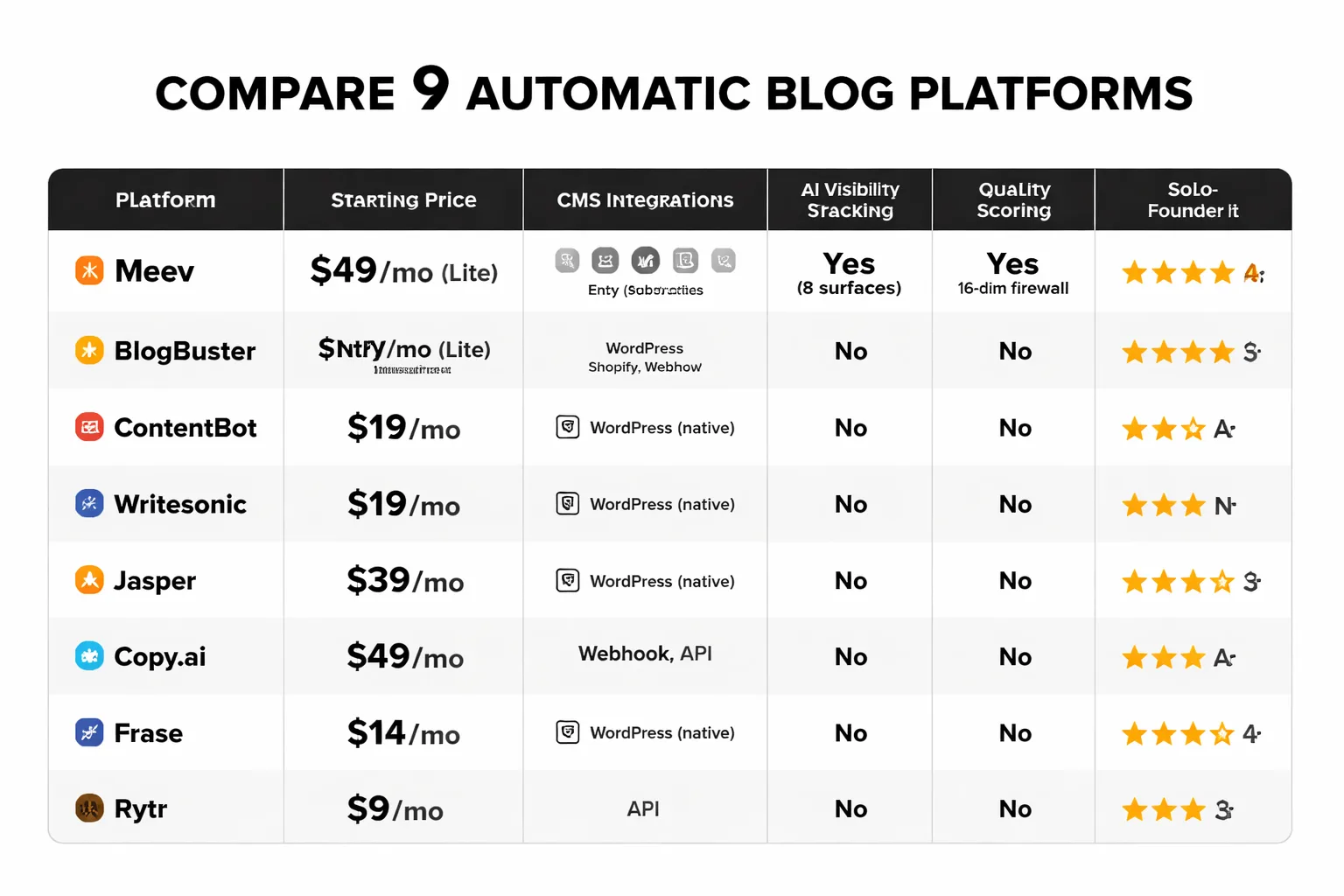
| Platform | Starting Price | CMS Integrations | AI Visibility Tracking | Quality Scoring | Solo-Founder Fit |
| Meev | $49/mo (Lite) | WordPress, Ghost, Shopify, Wix, Webhook | Yes (8 surfaces) | Yes (16-dim firewall) | ⭐⭐⭐⭐⭐ |
| BlogBuster | Entry subscription | WordPress, Shopify, Webflow, API | No | No | ⭐⭐⭐⭐ |
| ContentBot | $19/mo | WordPress (native) | No | No | ⭐⭐⭐ |
| Writesonic | ~$20/mo | WordPress | No | No | ⭐⭐⭐ |
| Jasper | $49/mo | WordPress (via Surfer) | No | No | ⭐⭐ |
| Copy.ai | $49/mo | API only | No | No | ⭐⭐ |
| Frase | $15/mo | No native publishing | No | Content scoring | ⭐⭐⭐ |
| Scalenut | $39/mo | No native publishing | No | NLP scoring | ⭐⭐⭐ |
| Rytr | $9/mo | Browser ext. only | No | No | ⭐⭐ |
The AI visibility tracking column is the starkest divide in this table. Only one platform in this evaluation tracks whether your content is being cited in AI answers. That's not a minor feature gap. For a solo founder trying to build topical authority for AI search in 2026, publishing without citation feedback is like running Google Ads without conversion tracking.
1. Meev — Best for solo founders who need quality-gated auto-publishing with AI citation tracking
Best for: Solo founders and lean content teams who need end-to-end automatic blog publishing with a quality firewall and AI search visibility tracking built into the same platform.
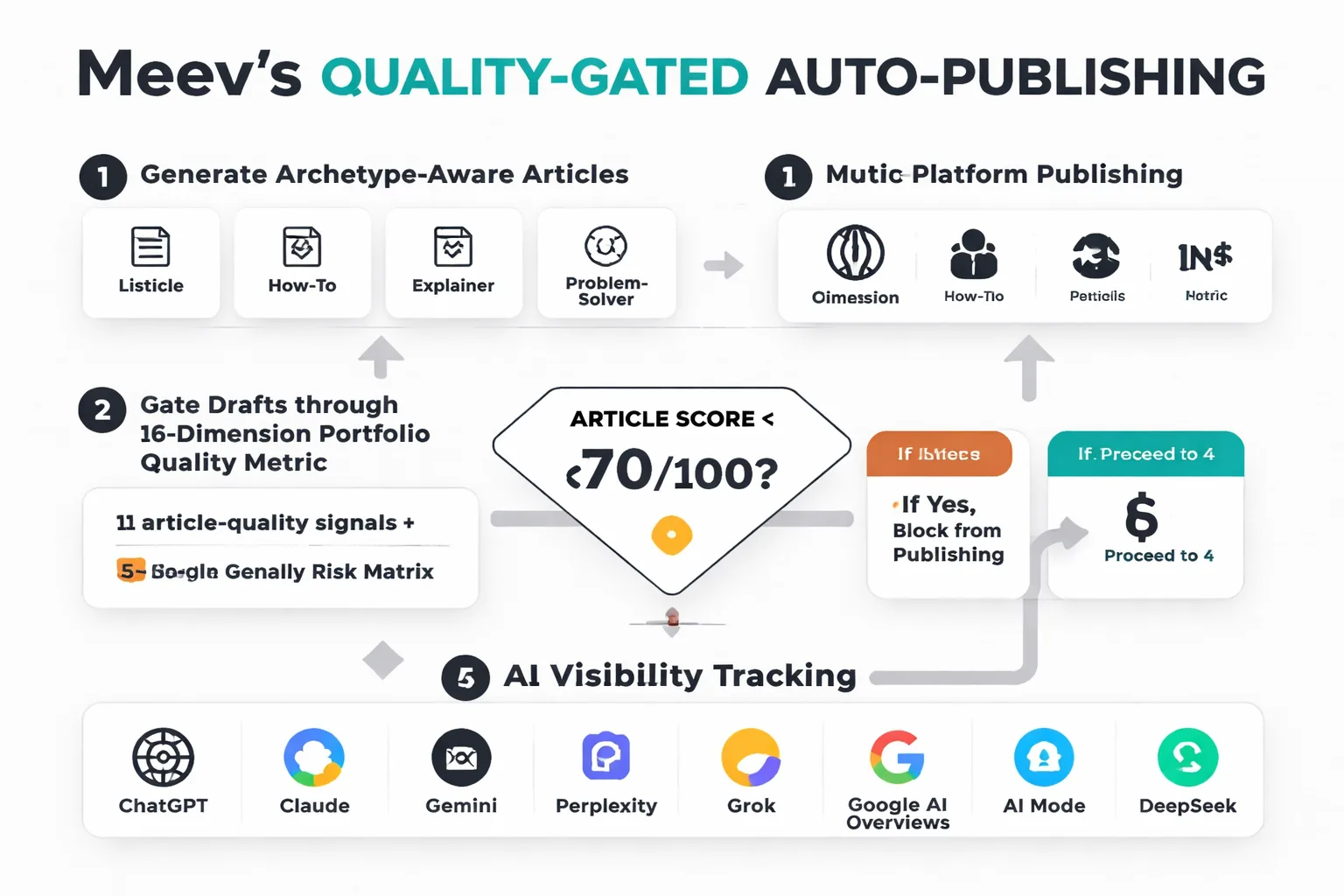
Meev is the only platform in this evaluation that treats automatic blog publishing and AI visibility monitoring as one problem rather than two. The platform generates archetype-aware articles. Listicle, How-To, Explainer, Problem-Solver. And gates every draft through a 16-dimension Portfolio Quality Metric before it reaches your CMS. Articles scoring below 70/100 are blocked from auto-publishing. That's a real quality floor, not a marketing claim.
Key features: - 16-dimension quality firewall that blocks weak drafts before CMS publishing (11 article-quality signals + 5-dimension Google Penalty Risk Matrix) - AI visibility tracking across 8 surfaces: ChatGPT, Claude, Gemini, Perplexity, Grok, Google AI Overviews, AI Mode, and DeepSeek. Multi-platform publishing to WordPress, Ghost, Shopify, Wix, or custom webhook with IndexNow + Google Search Console dual indexing on every publish. Citation Path workflow: find publishers AI engines cite for your topics, resolve verified contacts, and draft outreach pitches from your knowledge base
Pricing: Lite plan at $49/month (10 articles, 1 domain); Starter at $99/month (30 articles); Pro at $269/month (80 articles, 5 domains, premium LLM tracking + Citation Path); Agency at $599/month. 7-day trial available. Annual billing saves 20%.
What separates Meev from every other platform in this list is the closed-loop architecture. Most auto-blog tools are publish-and-forget. Meev connects publishing to Perplexity citation tracking and ChatGPT visibility monitoring so you can actually see whether your automatic articles are building citation share or disappearing into the void. For a solo founder investing in topical authority for AI search, that feedback loop is the difference between a content strategy and a content expense. The Lite plan at $49/month is genuinely accessible for a single-site founder, and the quality firewall alone is worth the entry price. It's the only mechanism in this market that systematically prevents scaled content abuse before it happens.
2. BlogBuster — Best for WordPress and Shopify founders who want set-and-forget publishing
Best for: Solo founders, WordPress bloggers, and small SEO agencies who need high-ranking, automatically published content without the cost of a manual writing team.
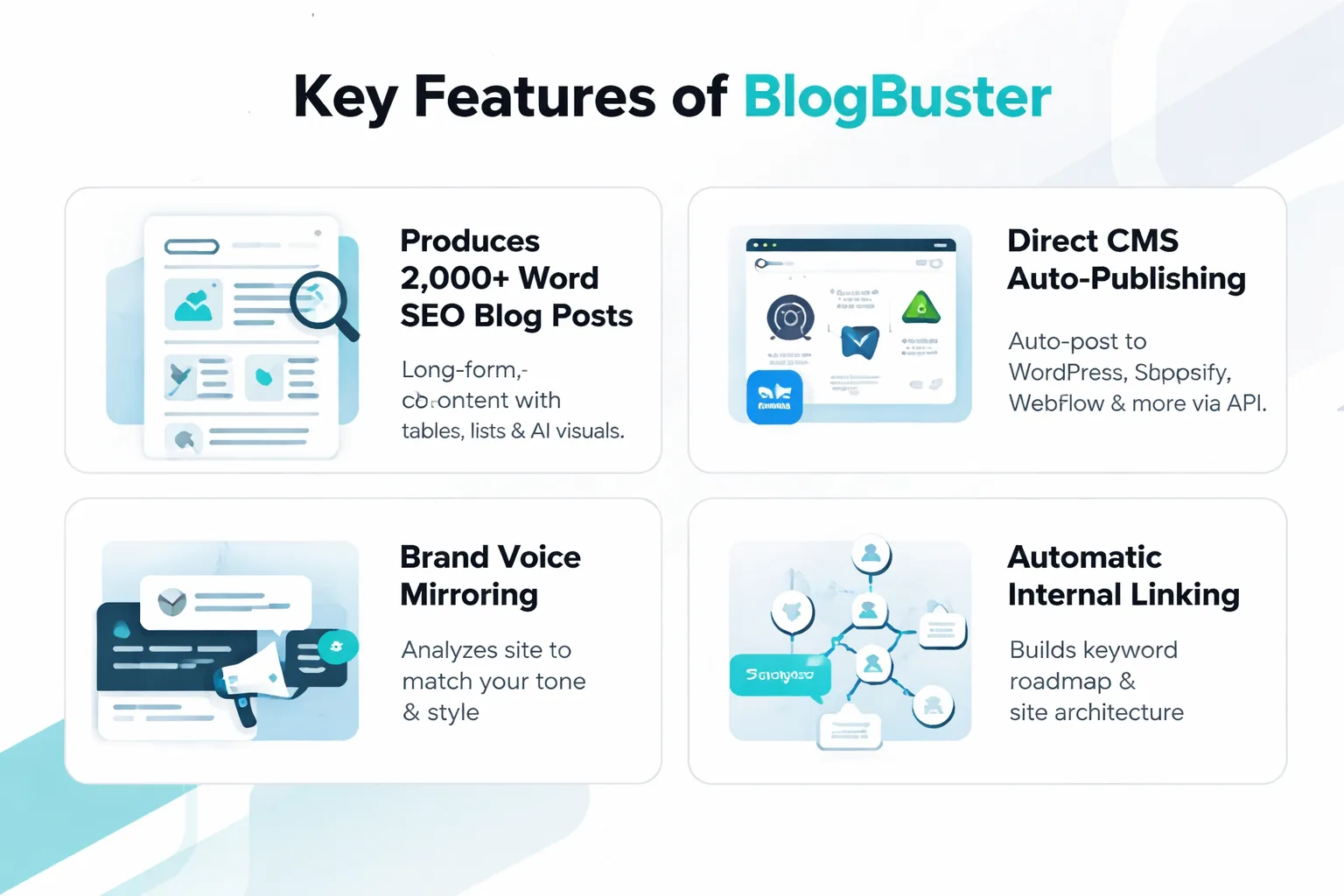
BlogBuster positions itself as a true autopilot publishing engine. Research, write, and publish 2,000+ word SEO-optimized posts directly to your CMS on a schedule. The brand voice mirroring feature is genuinely useful for solo founders who've already built a recognizable tone: it analyzes your existing site to replicate structure, terminology, and style rather than producing generic output.
Key features: - Produces 2,000+ word SEO-optimized blog posts with tables, lists, and AI-generated visuals automatically assembled. Direct CMS auto-publishing to WordPress, Shopify, Webflow, or custom headless CMS via API. Brand voice mirroring: analyzes your existing site to replicate tone, structure, and industry jargon. Automatic internal linking and topic/keyword roadmap to build topical authority and site architecture
Pricing: Plans include 10. 60 articles per month across tiers; pricing starts at an entry-level subscription. Visit blogbuster.so for current tier pricing; cancel anytime.
BlogBuster is a strong option if your primary goal is volume and your CMS is WordPress, Shopify, or Webflow. The absence of AI visibility tracking means you won't know whether your content is being cited in ChatGPT or Perplexity answers. You'll need a separate tool for that. For founders who are purely focused on organic search rankings rather than LLM citation share, that's an acceptable trade-off at the price point.
3. ContentBot — Best for budget-conscious WordPress founders
Best for: Budget-conscious solo founders and solopreneurs on WordPress who need consistent automated blog output without committing to expensive monthly subscriptions.
ContentBot is the most accessible entry point in this evaluation for a founder on a tight budget. The pay-as-you-go credit model ($1 per 1,000 words) means you're not locked into a monthly commitment, and the Flow Builder lets you construct multi-step automated pipelines without manual prompting. The native WordPress plugin is genuinely seamless for founders already living in the WordPress dashboard.
Key features: - AI Content Flow Builder: create multi-step automated pipelines that handle research, writing, and scheduling without manual prompting. Native WordPress plugin for direct in-dashboard content generation and publishing without copy-paste. Automated blog post workflows that generate, optimize, and schedule content with minimal intervention. Paraphrasing and content rewriting tools to repurpose existing assets across formats
Pricing: Prepaid credits available at $1 per 1,000 words (pay-as-you-go); subscription plans start at approximately $19/month; occasional lifetime deal offers available for bootstrapped founders.
The honest limitation: ContentBot is optimized for WordPress and doesn't have native integrations for Webflow, Ghost, or headless setups. There's no AI visibility tracking and no quality firewall. You're responsible for reviewing output before it goes live. For a founder publishing 2-3 posts a week on a tight budget, that's manageable. For anyone running higher volumes without editorial review, the lack of a quality gate is a real risk.
4. Writesonic — Best for citation-backed content on a flexible budget
Best for: Early-stage solo founders watching budget closely who need quality, citation-backed blog content with flexible credit-based pricing and multi-format content support.
Writesonic's Chatsonic interface with real-time web search is the standout feature here. For solo founders in fast-moving niches where information currency matters. Tech, finance, health. The ability to generate factual articles with source citations reduces the manual fact-checking burden meaningfully. The 100+ templates also make it useful beyond just blog posts.
Key features: - Chatsonic: conversational AI interface with real-time web search for accurate, up-to-date content generation. Factual article generation with source citations, reducing manual fact-checking time. 100+ content templates covering blog posts, ad copy, product descriptions, emails, and social media. Brand voice customization and direct WordPress publishing integration
Pricing: Individual plans start at approximately $20/month for 100,000 words; credit-based and unlimited plan options available; Business plans with team features at higher tiers.
Writesonic doesn't have automated CMS indexing or AI visibility tracking. The credit-based pricing can also become unpredictable at higher volumes. But for a founder who needs quality content across multiple formats without a large monthly commitment, it's one of the more versatile options at the entry price point.
5. Jasper — Best for brand-consistent multi-channel content
Best for: Mid-size to enterprise marketing teams running multi-channel campaigns who need ironclad brand consistency enforced across multiple content creators and formats.
Jasper is the brand governance platform of this list. Its Brand Voice and Brand Knowledge training system enforces tone, terminology, and messaging guidelines across every piece of generated content. Which matters enormously for founders who've built a recognizable voice and don't want an AI tool diluting it. The Surfer SEO integration pairs generation speed with real-time SERP optimization.
Key features: - Brand Voice and Brand Knowledge training: enforces tone, terminology, and messaging guidelines across all generated content. Campaign-level creation: generate coordinated blog posts, ads, emails, and social content from a single brief. Surfer SEO integration for pairing generation speed with real-time SERP optimization guardrails. 50+ templates, Chrome extension, and multi-model AI support for varied content needs
Pricing: Creator plan starts at $49/month for individuals; Pro plan at $69/month per seat (up to 5 seats, 3 brand voices); Business plan custom-quoted, typically starting around $499/month with Content Pipelines and AI App Builder.
For a solo founder, Jasper's value proposition is real but its pricing model is awkward. The Creator plan is accessible, but the platform is clearly designed for teams. There's no automated CMS publishing pipeline and no AI visibility tracking. If you're comparing Jasper against alternatives for a solo content operation, the Meev vs Jasper AI comparison is worth reading before committing.
Want to know if your automatic blog content is actually being cited in ChatGPT or Perplexity answers?
6. Copy.ai — Best for GTM-focused founders automating outbound
Best for: GTM-focused solo founders and sales-led teams who need to automate repetitive content workflows across outbound campaigns, not just standalone blog posts.
Copy.ai is the only platform in this list that is genuinely more useful for sales content than for blogging. The Workflow Builder automates multi-step sequences across outreach emails, cold messaging, and follow-up content. If your content strategy is as much about pipeline generation as organic search, Copy.ai's architecture makes sense. For pure automatic blog publishing, it's overbuilt in the wrong direction.
Key features: - Workflow Builder: create automated multi-step sequences that generate content, feed CRM, and trigger follow-up actions. Unlimited word generation on paid plans with access to multiple underlying LLMs. Sales content generation: personalized outreach emails, cold messaging, and follow-up sequences. API access on higher tiers for custom integrations with existing marketing and sales tech stacks
Pricing: Free tier available with limited features; Starter plan at $49/month (1 seat, unlimited words in chat, multiple LLMs); Enterprise pricing custom-quoted based on team size and automation requirements.
There's no native automated CMS publishing and no AI visibility tracking. For a solo founder whose primary goal is building an automatic blog that earns citation share in AI answers, Copy.ai is the wrong tool. The Meev vs Copy.ai comparison breaks down exactly where the use cases diverge.
7. Frase — Best for research-depth and featured snippet targeting
Best for: Solo founders and content teams creating authoritative long-form content where research depth, search intent alignment, and ranking performance matter most.
Frase is the research-first tool in this list. Its automated SERP brief generation analyzes top-ranking competitor pages and builds keyword-rich content outlines before a single word is written. The real-time content scoring against top competitors is genuinely useful for founders trying to close topical gaps. The Answer Engine Optimization recommendations are a direct nod to AI citation eligibility.
Key features: - Automated SERP brief generation: analyzes top-ranking competitor pages to build keyword-rich content outlines instantly. Research-integrated AI writer: generates first drafts grounded in live SERP data for topically authoritative output. Real-time content scoring: optimization feedback comparing your draft to top competitors as you write. Answer Engine Optimization recommendations for appearing in featured snippets and AI-generated answers
Pricing: Solo plan starts at $15/month for individual users; Professional plan at $115/month for growing teams; Scale plan at $229/month (includes AI Search Tracking); Advanced plan at $349/month for larger teams and agencies.
Frase doesn't auto-publish to CMS platforms natively, which is a real gap for a solo founder who wants a hands-off workflow. It's better positioned as a research and optimization layer than a true automatic blog engine. If you're willing to add a publishing step, the research quality is among the best in this list.
8. Scalenut — Best for keyword-to-draft in one workflow
Best for: Solo founders and SMB content teams who want a single platform to manage their entire SEO content lifecycle. From keyword strategy through optimized drafts. Without juggling multiple tools.
Scalenut's Cruise Mode is the closest thing to a true keyword-to-published-article pipeline outside of platforms with native CMS publishing. You put in a keyword, Cruise Mode produces a fully drafted, NLP-optimized article in minutes. The keyword clustering feature is particularly useful for solo founders trying to build topical authority systematically rather than publishing one-off posts.
Key features: - Cruise Mode: end-to-end keyword-to-published-article workflow that drafts SEO-optimized content in minutes. Keyword clustering: groups related keywords into topic clusters to systematically build topical authority. Content lifecycle management: covers strategy, writing, optimization, and auditing in one platform. NLP-driven content optimization with real-time scoring against top-ranking competitor pages
Pricing: Plans start at approximately $39/month for the Essential tier; Growth plan at $79/month; Pro plan at $149/month; annual billing offers discounts across all tiers.
Cruise Mode output often needs editorial review on technical or niche topics. The platform acknowledges this. There's no native CMS publishing pipeline and no AI visibility tracking. For a founder who wants to see how their automatic articles are performing in LLM citation environments, Scalenut doesn't close that loop.
9. Rytr — Best for occasional writing assistance on a minimal budget
Best for: Freelance writers, solo founders, and small business owners on tight budgets who need a simple, no-frills AI writing assistant for occasional to moderate blog content production.
Rytr is the simplest tool in this list and the cheapest. At $9/month for the Saver plan, it's accessible to any founder. The 40+ use case templates, 20+ tone options, and built-in plagiarism checker cover the basics. The browser extension works inside Google Docs and WordPress without copy-pasting.
Key features: - 40+ use case templates covering blog posts, product descriptions, social media, emails, and landing pages. 20+ tone and style options for matching content voice to different audiences and contexts. Built-in plagiarism checker included at no extra cost, unlike most budget-tier competitors. Browser extension for AI writing assistance directly inside Google Docs, WordPress, or any web editor
Pricing: Free tier includes 10,000 characters/month; Saver plan at $9/month for 100,000 characters; Unlimited plan at $29/month with no character restrictions.
Rytr is a writing assistant, not an automatic blog platform. There's no automated publishing, no scheduling, no quality firewall, no AI visibility tracking, and no SEO SERP analysis. If you need a tool that runs a content operation autonomously, Rytr isn't it. If you need help drafting individual posts faster, it's a reasonable starting point.
Making the Right Choice for Your Stack
The decision framework here is simpler than most platform reviews make it.
If your primary goal is automatic blog publishing with zero editorial overhead, you need a platform with native CMS integration and a quality gate. BlogBuster handles the publishing side well. Meev handles publishing plus quality-gating plus AI visibility in one stack. ContentBot is the budget entry point if you're on WordPress.
If you're building for AI citation share specifically, the calculus changes. The pattern I keep seeing is that founders who publish consistently structured, extractable content. Definitions, comparisons, procedural steps, inline citations. Build citation share faster than founders who publish more volume with less structure. Research on source selection in LLM answers confirms that content modularity matters to AI citation selection. A platform that generates structured, archetype-aware output and then tracks whether that output is being cited is a fundamentally different investment than one that just schedules posts.
The Conductor data point I keep coming back to: Reddit's share of LLM citations dropped from 2.02% to 1.01% between October 2025 and January 2026 as the platform flooded with AI-generated content. One practitioner monitoring 100 daily AI prompts watched monthly citations fall from 622 to 122 in three months after volume-first tactics took over their niche. That's an 80% drop. Volume without structure and quality gates doesn't build citation share. It erodes it. Auto-blog workflows built around output quotas rather than intent matching are actively working against the goal.
On budget: the $49–$99/month tier is the sweet spot for solo founders who want real automation without agency-scale pricing. Below $20/month, you're getting writing assistance, not a publishing engine. Above $200/month, you're paying for team features you won't use. The exception is if you're running multiple domains. At that point, a Pro-tier platform with multi-domain support pays for itself quickly.
On AI visibility monitoring as a premium: the question I get most often is whether combined auto-publish plus AI visibility monitoring is worth the price step. My answer is yes, but only if you're actively using the feedback. Tracking Claude visibility and Perplexity citation data is meaningless if you don't adjust your content strategy based on what you find. If you're willing to run that loop. Publish, track, refine. The premium pays back in citation share. If you just want content to go live on a schedule, the lower-tier publishing-only tools are fine.
For a deeper comparison of how these platforms stack up on AI search visibility specifically, the Meev vs Profound comparison and the Meev vs Peec AI comparison are useful reference points for understanding what the visibility-tracking tier actually delivers versus what the publish-only tools leave on the table.
FAQ
Can automatic blog tools help me get cited by ChatGPT or Perplexity?
Indirectly, yes. But the mechanism matters. AI engines don't cite content because it was published automatically. They cite content that has extractable structure: clear definitions, numerical facts, comparisons, procedural steps, and FAQ sections with schema markup. Research analyzing 602 controlled prompts found Perplexity prefers longer, more modular pages with these evidence genres. An automatic blog platform that generates structured, archetype-aware output and publishes it consistently gives you the raw material for citation eligibility. A platform that also tracks your actual citation share across AI surfaces closes the loop. Without that tracking, you're guessing.
What's the minimum content quality threshold to avoid Google's Helpful Content filters?
There's no published numeric threshold, but the structural signals are clear: content needs genuine information gain over what's already ranking, specific factual claims with sources, and evidence of original perspective or expertise. The FTC's 2025 enforcement action against Content at Scale AI is a useful reminder that platforms making inflated quality claims without substantiation are a risk to the founders using them. Practically, a quality-scoring system that blocks drafts below a defined threshold. Like a 16-dimension firewall that requires 70/100 to publish. Is the only automated mechanism I've seen that systematically prevents scaled content abuse before it reaches your CMS.
How many posts per week is safe to automate?
There's no safe number in isolation. The question is whether each post has genuine topical depth and structural quality, not how many you publish. The pattern that causes problems is publishing high volumes of thin, undifferentiated content on the same topic cluster in a short window. Two well-structured, citation-eligible posts per week will build more topical authority for AI search than ten generic ones. If you're running a quality gate that blocks weak drafts, you can scale volume without the risk. Because the gate is doing the work your editorial review would otherwise do.
Do I need AI visibility tracking if I'm just starting out?
Not immediately, but sooner than most founders expect. The time to set up tracking is before you've published 50 posts, not after. Because the baseline data you collect in months one and two is what tells you whether your content strategy is building citation share or not. Waiting until you're already six months in means you have no baseline to compare against. Starting with a Lite-tier plan that includes basic AI visibility tracking costs roughly the same as a mid-tier writing tool, and the data compounds in value over time.
What's the difference between SEO ranking and AI citation eligibility?
They overlap but they're not the same. SEO ranking is about satisfying Google's ranking algorithm. Backlinks, on-page signals, user engagement. AI citation eligibility is about whether an LLM's retrieval system selects your content as a source when generating an answer. A page can rank on page one of Google and never appear in a Perplexity answer. The structural signals that help with AI citation. Answer-first paragraphs, FAQ schema, modular extractable facts. Also tend to help with Google's AI Overviews. But optimizing only for traditional SEO and assuming AI citation follows is a mistake I see solo founders make repeatedly in 2026.
About the Author
Judy Zhou, Head of Content Strategy
Judy Zhou leads content strategy at Meev, where she oversees AI-driven content research and publishing for hundreds of brands. With a background in SEO and editorial operations, she focuses on building content systems that rank on Google, get cited by AI search engines, and drive measurable business results.
Meev combines quality-gated auto-publishing with AI citation tracking across 8 surfaces — start your 7-day trial and see where your brand stands in AI search today.