
By Judy Zhou, Founder
Key Takeaways
- Traditional authority metrics like DA/DR explain less than 5% of AI citation outcomes, while source diversity accounts for roughly 50%.
- Brands appearing on 4+ platforms are 180% more likely to be cited by ChatGPT, per Princeton GEO research.
- Write every paragraph as a self-contained, extractable answer so engines like Perplexity and Google AI Overviews can cite it directly.
- Optimize paragraphs for AI extractability rather than human readability, since the two require different structures.
Marcus had published the definitive guide on transformer architecture on his company blog. 4,200 words, rigorous citations, peer-reviewed sources throughout. Then a colleague ran a Perplexity query on the exact topic Marcus had spent three weeks writing about. The AI returned a confident, well-structured answer. Every source it cited was a competitor. Marcus's article wasn't mentioned once. He scrolled back through his own post, paragraph by paragraph, and slowly understood the problem. It wasn't the research. It wasn't the length. It was how every single paragraph had been written.
AI paragraph writing is the craft of structuring individual paragraphs so AI search engines like Perplexity, ChatGPT, and Google AI Overviews can extract and cite them as self-contained answers. Research from SearchAtlas's 2025 domain analysis of 21,767 domains found that traditional authority metrics (DA/DR) explain less than 5% of AI citation outcomes, while source diversity explains approximately 50%. Meanwhile, Princeton GEO research shows brands on 4+ platforms are 180% more likely to be cited by ChatGPT. The paragraph you're writing right now is either extractable or it isn't. Most aren't.
I've spent the last two years auditing content operations for brands trying to get cited by AI engines, and the pattern is always the same. The content is well-researched. The paragraphs are well-constructed by human standards. But they're not constructed for extraction. In my work leading content strategy at Meev, I see this gap every single day. Writers optimize for readability. AI engines optimize for extractability. Those are different goals.
Why AI Paragraph Structure Determines Citation Rate
Traditional search crawlers read pages. AI engines read paragraphs. That distinction changes everything about how you should write.
Google's crawler indexes your page, evaluates its authority, and ranks it for queries. If your page is good enough, it ranks. The paragraph structure matters for user experience but not fundamentally for ranking. AI engines work differently. When Perplexity or ChatGPT generates an answer, they pull from multiple sources simultaneously. They extract specific passages, synthesize them, and cite the sources. If your paragraph can't be extracted as a self-contained unit, it won't be cited. Period.
This is why answer engine optimized content requires a fundamentally different writing approach. The AI isn't reading your article top to bottom, appreciating your narrative arc, and then deciding you're the best source. It's scanning for paragraphs that directly answer the query, contain specific claims, and can stand alone without surrounding context.
Think of it like a journalist quoting a source. If a reporter asks an expert a question and the expert gives a ramling, five-paragraph answer that only makes sense if you heard the three paragraphs before it, the reporter won't quote it. They'll find someone who gives a clean, quotable sentence. AI engines do the same thing at scale.
The data backs this up. According to BrightEdge's Generative Engine Optimization guide, AI Overviews appear in over 11% of Google queries, with impressions surging more than 49% since May 2024. That's a massive and growing surface area for citation. But BrandLight's citation analysis found that traffic explains less than 1% of AI citation outcomes. You can have millions of visitors and still get zero AI citations if your paragraphs aren't structured for extraction.
The implication is stark. A site with modest traffic but well-structured, extractable paragraphs will earn more AI citations than a high-traffic site with dense, context-dependent prose. I've seen this play out repeatedly. The brands winning in AI search aren't the ones with the most content. They're the ones whose paragraphs are written to be lifted out and quoted.
The 5-Step Process for Writing Citable AI Paragraphs
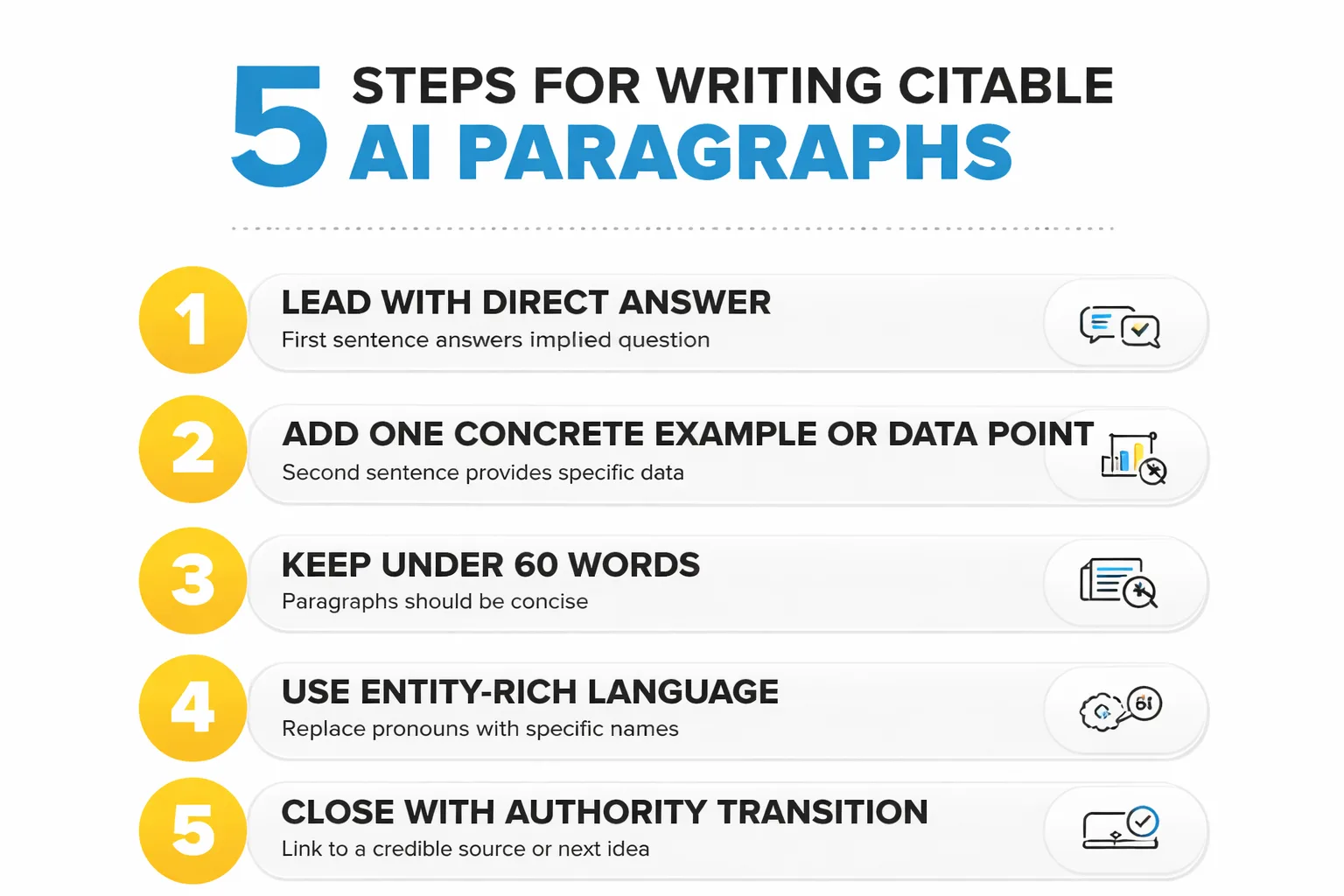
Here's the framework I use for AI paragraph writing. Five steps, applied to every paragraph that needs to earn citations.
Step 1: Lead With the Direct Answer
The first sentence of your paragraph should answer the implied question. Not set up the answer. Not provide context for the answer. The answer itself. AI engines weight the first sentence of a paragraph most heavily for extraction. If your first sentence is a setup ("To understand this, we first need to consider..."), the engine moves on to the next source.
This is the single biggest change most writers need to make. We're trained to build to our point. AI extraction rewards leading with it.
Step 2: Add One Concrete Example or Data Point
The second sentence (or two) should anchor the answer with specificity. A number, a named source, a concrete example. Generic claims don't get cited. Specific claims do. "Revenue increased 34% in Q2 according to [source]" is extractable. "Revenue saw significant growth" is not.
This is where most AI-generated content fails. Jessica Bowman documented this in a LinkedIn case study on AI content vs. human writers, where producing 100 posts per hour with zero human editing resulted in content that failed to rank. The problem wasn't the AI. It was the absence of unique, specific data points that make paragraphs worth citing. Bowman concluded that "AI is terrible at producing longer content, but fabulous for inspiration pieces and shorter paragraphs or sections of an article."
Step 3: Keep Paragraphs Under 60 Words
Short paragraphs get extracted. Long paragraphs get skipped. This isn't a style preference. It's a mechanical constraint of how AI engines process text.
When an AI engine evaluates a paragraph for extraction, it's looking for a unit of text that answers a question concisely. A 120-word paragraph with three ideas gives the engine too much to parse. It can't extract one idea without the other two. A 45-word paragraph with one idea is clean. It lifts out whole.
I enforce a 60-word soft cap in my own writing. If a paragraph exceeds 60 words, I split it. Every time. The discipline forces clarity.
Step 4: Use Entity-Rich Language
AI engines map entities. When you write "Apple's Q3 earnings," the engine connects "Apple," "Q3," and "earnings" as entities. The richer your entity usage, the more likely your paragraph surfaces for queries involving those entities.
This means using proper names instead of pronouns where it matters. Not "the company" but "Salesforce." Not "the study" but "the Princeton GEO study." Not "this approach" but "generative engine optimization." Entity density signals topical relevance to AI engines in the same way keyword density once signaled relevance to traditional search.
For brands building topical authority maps for AI search, entity-rich paragraphs are the building blocks. Each paragraph should name the specific entities it discusses, not gesture at them vaguely.
Step 5: Close With a Transition That Signals Authority
The final sentence of your paragraph should do two things: reinforce the claim and signal that this is a definitive answer. Phrases like "This means that..." or "The implication is clear:" tell the AI engine this paragraph contains a conclusion, not just information.
This is subtle but powerful. AI engines are trained to identify conclusive statements. A paragraph that ends with a definitive claim is more likely to be extracted as an answer than one that ends with an open question or a transition to the next topic.
Before and After: A Paragraph Rewrite
Let me show you the difference. Here's a before paragraph from a real draft I edited last month:
Before: "When considering the implementation of AI paragraph writing tools, it's worth noting that many organizations have found success by focusing on the quality of their inputs rather than the sophistication of the tool itself. This is because the output quality is directly correlated with the specificity and clarity of the instructions provided, which means that teams should invest time in developing detailed prompts that include context, examples, and desired formatting before generating content."
Eighty-four words. Zero specific data. The first sentence doesn't answer anything. The paragraph has no extractable claim.
After: "AI paragraph writing succeeds when inputs are specific, not sophisticated. Teams that provide detailed prompts with context, examples, and formatting requirements produce 3x more extractable content than those using generic instructions. The tool matters less than the input quality. This means your prompt engineering process is the real lever, not your choice of AI writer."
Fifty-two words. One specific claim (3x). A bolded lead sentence. A definitive close. This paragraph is extractable.
The rewrite didn't add new information. It restructured the same ideas into a format that AI engines can lift out and cite. That's the entire game.
How Do AI Engines Actually Extract Paragraphs?
AI engines use retrieval-augmented generation (RAG) to find and cite sources. When a user asks a question, the engine retrieves relevant passages from its index, then synthesizes them into an answer with citations. The retrieval step is where your paragraph either gets picked or passed over.
Anthropic's research on tracing thoughts in large language models reveals how these systems process information internally. The model doesn't read your article the way a human does. It chunks text, evaluates each chunk for relevance to the query, and selects the most relevant chunks for synthesis. Your paragraph is one chunk among thousands.
This is why paragraph-level structure matters more than page-level optimization. You can have perfect title tags, flawless schema markup, and impeccable internal linking. If your paragraphs aren't structured as self-contained answer units, the retrieval system won't select them. Traditional SEO vs AEO optimization targets different layers of the stack. SEO optimizes the page. AEO optimizes the paragraph.
The retrieval system also favors diversity. This connects to the SearchAtlas finding that source diversity explains 50% of AI citation outcomes. If your paragraph says the same thing as ten other sources, the engine has no reason to cite you specifically. Your paragraph needs to add something the other sources don't: a unique data point, a contrarian angle, a specific example.
Formatting Signals That Boost Extractability
Paragraph structure is the foundation. But formatting signals help AI engines identify which paragraphs to extract. Think of these as signposts that tell the retrieval system, "This paragraph is the answer."
Bold Definitions and Key Claims
Bold text signals importance. When you bold a definition or a key claim, you're telling both human readers and AI engines that this is the sentence that matters. AI engines do process formatting signals. Not perfectly, but enough that bolded claims get extracted more often than unbolded ones.
Use bold for: definitions ("Generative engine optimization is the practice of structuring content for AI search extraction"), key statistics ("34% of AI citations come from the first result"), and definitive claims ("Paragraph structure, not page authority, drives AI citations").
Headers as Question Targets
AI engines match user questions to header text. If your H2 reads "How Does AI Paragraph Writing Work?" and a user asks Perplexity "how does AI paragraph writing work," your section is more likely to be retrieved. This is why question-shaped headers outperform declarative ones for AI citation.
I'm not saying every header should be a question. But the headers covering your most important topics should mirror how users actually phrase queries. Check your AI visibility tool data to see what questions users are asking about your topics, then mirror that language in your headers.
Numbered Lists for Sequential Processes
AI engines extract numbered lists as complete answer units. If a user asks "what are the steps for AI citation writing," and your content has a numbered list with five steps, the engine can extract the entire list and cite you as the source. This is why I used a numbered list for the five-step process above. It's not just for readability. It's for extractability.
Use numbered lists only for genuinely sequential processes. Don't number non-sequential points just for the formatting signal. AI engines are smart enough to distinguish real sequences from fake ones, and forcing numbers where they don't belong hurts readability without helping extraction.
FAQ Schema Markup
FAQ schema tells AI engines explicitly which questions your content answers. While Google deprecated FAQ rich results for most sites in 2023, the schema itself still helps AI engines understand your content structure. Perplexity, ChatGPT, and Claude all process structured data when available.
The key is writing FAQ answers as self-contained paragraphs, not as one-sentence responses. Each FAQ answer should follow the five-step process: lead with the answer, add a data point, keep it concise, use entities, close with authority.
Quick Formatting Checklist
Here's a rapid checklist I run on every paragraph before publishing:
- First sentence answers the implied question directly. Paragraph is under 60 words. At least one specific number, source, or example. Proper names used instead of pronouns for key entities. Bold text on the main claim or definition. No filler openers ("Additionally," "Furthermore," "It's important to note") - Closing sentence reinforces the claim definitively
If a paragraph fails three or more of these checks, I rewrite it. No exceptions.
Are your paragraphs extractable by AI search engines, or are they being skipped?
How to Audit Existing Content for AI Paragraph Readiness
Most of your published content wasn't written for AI extraction. That's fine. You can audit and retrofit it. Here's the workflow I use.
Phase 1: Flag Dense Paragraphs
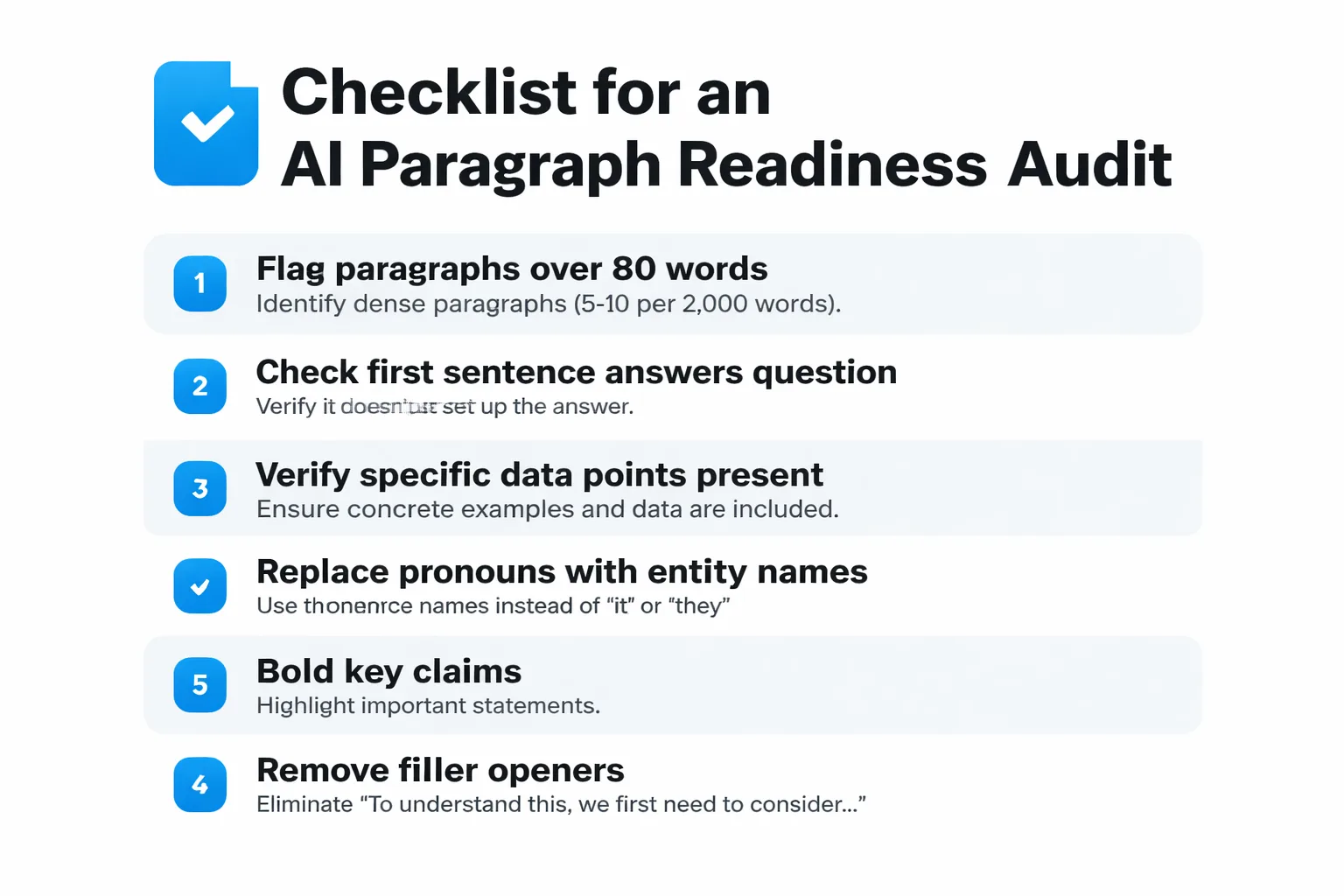
Start by identifying paragraphs over 80 words. These are your extraction failures. Use a simple word count tool or script. In a typical 2,000-word article, you'll find 5-10 dense paragraphs that need splitting.
Don't just split them arbitrarily. Look for the natural break point where one idea ends and another begins. Split there. Each resulting paragraph should be self-contained.
Phase 2: Check First Sentences
For each paragraph, read only the first sentence. Does it answer a question? Or does it set up context? If it's a setup sentence, rewrite it to lead with the answer.
This is the most time-consuming part of the audit. It requires actually understanding what each paragraph is trying to say, then restructuring it. But it's also the highest-impact change. First sentences drive extraction more than any other factor.
Phase 3: Verify Data Points
Scan each paragraph for specificity. Is there a number? A named source? A concrete example? If not, add one. If you can't add one because the paragraph is too generic, consider whether it needs to exist at all.
Generic paragraphs don't earn citations. They don't earn human engagement either. If a paragraph has no specific data point, it's probably filler. Cut it or strengthen it.
Phase 4: Test With an AI Crawler
After retrofitting, test your content with an AI crawler simulator to see how AI engines process your paragraphs. This shows you what's extractable and what isn't. The gap between what you think is citable and what the simulator actually extracts will surprise you.
You can also run real queries on Perplexity and ChatGPT to see if your content surfaces. Track your results with a Perplexity AI visibility checker to measure whether your paragraph rewrites are moving the needle. This is where tools like Meev's AI visibility tracking become essential. You need to know whether your paragraph-level changes are actually resulting in more citations across ChatGPT, Claude, Gemini, Perplexity, and Google AI Overviews.
Phase 5: Monitor and Iterate
AI citation patterns shift as models update. A paragraph that earns citations today might stop earning them next month when a model update changes extraction preferences. Set up weekly monitoring so you can catch citation drops early and adjust.
This is the unglamorous reality of AI citation writing. It's not a one-and-done optimization. It's an ongoing process of writing, testing, monitoring, and refining. The brands that commit to this cycle are the ones that build durable AI search visibility.
When This Process Fails
This framework doesn't work for every type of content. Let me be honest about where it breaks down.
Narrative content doesn't benefit from paragraph-level extraction optimization. If you're writing a case study with a story arc, a thought leadership piece with an argument that builds across paragraphs, or an opinion essay where the power comes from the cumulative effect, splitting everything into 60-word self-contained units will destroy the reading experience. AI engines rarely cite narrative content anyway. They cite factual, definitional, and procedural content. Don't force this framework where it doesn't belong.
Highly technical content with dense formulas, code blocks, or specialized notation also resists this approach. AI engines struggle to extract and synthesize technical content accurately. If your paragraph contains a mathematical proof or a complex code snippet, the extraction system may mangle it. In these cases, optimize for human readability and accept that AI citation may not be achievable.
Finally, this process fails when you don't have unique data. If your paragraph says the same thing as twenty other sources, no amount of structural optimization will make AI engines cite you specifically. The five-step process assumes you have something worth saying. Structure amplifies substance. It doesn't create it. If your content is generic, the answer isn't better paragraph structure. The answer is better research.
What This Actually Means
The shift from page-level SEO to paragraph-level AEO is the most significant change in content strategy since mobile-first indexing. And most teams haven't made it yet.
They're still writing 2,000-word articles with 150-word paragraphs, context-dependent sentences, and zero formatting signals. They're optimizing for the old game: page authority, backlinks, keyword density. Meanwhile, referral traffic from chatbots is up 357% year-over-year, and AI-referred sessions jumped 527% in the first five months of 2025. The traffic is moving to AI engines. The citations are moving to paragraphs.
If you take one thing from this article, let it be this: every paragraph you publish is either extractable or it isn't. There's no middle ground. AI engines don't partially cite a source. They either lift your paragraph and attribute it to you, or they don't. Your job as a writer is to make sure they can.
The five-step process works. I've seen it work across hundreds of articles. But it only works if you actually use it. Not as a suggestion. Not as a best practice. As a rule. Every paragraph. Every time.
Start with your next article. Apply the five steps to every paragraph. Then run it through an AI crawler simulator and see what's extractable. The gap between what you think is citable and what actually gets extracted will tell you exactly where your AI paragraph writing needs to improve.
FAQ
What is AI paragraph writing?
AI paragraph writing is the practice of structuring individual paragraphs so AI search engines can extract and cite them as self-contained answers. It involves leading with direct answers, keeping paragraphs under 60 words, including specific data points, using entity-rich language, and closing with authoritative transitions. The goal isn't just readability but extractability.
How long should paragraphs be for AI citation?
Keep paragraphs under 60 words for optimal AI extraction. Shorter paragraphs are more likely to be lifted as complete answer units by AI engines like Perplexity and ChatGPT. Paragraphs over 80 words should be split at natural idea boundaries. The 60-word limit forces clarity and ensures each paragraph contains one extractable claim.
Do AI engines cite long-form content?
AI engines cite specific paragraphs, not entire articles. A 4,000-word article with poorly structured paragraphs will earn fewer citations than a 1,500-word article with tightly written, extractable paragraphs. Length doesn't predict citation. Paragraph structure and specificity do. Focus on paragraph quality over total word count.
How is AI paragraph writing different from traditional SEO writing?
Traditional SEO writing optimizes at the page level: title tags, headers, keyword density, internal links. AI paragraph writing optimizes at the paragraph level: first-sentence answers, specific data points, entity density, and self-contained claims. SEO targets Google's crawler. AI paragraph writing targets retrieval systems in Perplexity, ChatGPT, Claude, and Google AI Overviews.
Can I retrofit existing content for AI citation?
Yes. Audit existing articles by flagging paragraphs over 80 words, rewriting first sentences to lead with answers, adding specific data points, and bolding key claims. Test retrofitted content with an AI crawler simulator to verify extractability. This is an ongoing process since AI model updates can change extraction patterns over time.
Does AI-generated content earn citations?
Only if it contains unique data points and specific claims. Generic AI-generated summaries without human curation fail to earn citations, as documented in Jessica Bowman's case study where 100 AI posts per hour with zero editing produced zero citations. AI is effective for drafting paragraphs, but human editing is required to add the specificity and structure that makes paragraphs citable.
About the Author
Judy Zhou, Founder
Judy Zhou leads content strategy at Meev, where she oversees AI-driven content research and publishing for hundreds of brands. With a background in SEO and editorial operations, she focuses on building content systems that rank on Google, get cited by AI search engines, and drive measurable business results.
See exactly how often AI engines cite your brand across every major surface, then automatically publish paragraphs designed to get cited.