

By Judy Zhou, Founder
Key Takeaways
- Cited brands earn 35% more organic clicks and 91% more paid clicks than uncited competitors when featured in AI answers.
- AI Overviews cut organic CTR for position-one results by 58%, rendering traditional SEO insufficient without AEO.
- 58% of marketers report that AI tool visitors convert at higher rates than traditional organic traffic.
- Semrush projects AI search visitors will surpass traditional search by 2028, requiring immediate content formatting for engines like Perplexity and Gemini.
Maya, a procurement manager at a mid-sized logistics firm, needed a vendor for freight audit software. She didn't open a browser tab and scan ten blue links. She asked Perplexity a question, read the three-paragraph answer it generated, and booked a demo with the first company cited. All in under four minutes. The company she called had never heard of answer engine optimization. The company she didn't call had been running Google Ads for three years. That four-minute interaction is now the norm, not the exception.
Answer engine optimization (AEO) is the practice of structuring content so that AI-powered answer engines like ChatGPT, Perplexity, Gemini, and Google AI Overviews select, extract, and cite it when responding to user queries. The stakes are measurable: cited brands earn 35% more organic clicks and 91% more paid clicks than uncited competitors, according to Siteimprove's AEO research. Meanwhile, Ahrefs found that AI Overviews reduce organic click-through rate for position-one content by 58%. If you're not cited inside the AI answer, you're invisible. And 58% of marketers report that AI tool visitors convert at higher rates than traditional organic traffic, per the 2026 HubSpot State of Marketing Report.
That number should stop you cold. The traffic source with the highest conversion rate is the one most brands aren't optimizing for.
In my work auditing content operations and building AI search visibility systems at Meev, I've watched companies pour budgets into classic SEO while AI engines route their prospects to competitors who simply formatted their content better. The gap is widening fast. Semrush projects that AI search visitors will surpass traditional search by 2028, and the agencies I talk to are already feeling it: 14 out of 16 agency leaders (87.5%) report organic search traffic declines, with some exceeding 50%, per Knowmad Digital Marketing's industry survey. The traffic isn't vanishing. It's redistributing to whoever the AI engines cite.
This guide breaks down what answer engine optimization services and tools actually do, how answer engines decide what to cite, and how to start this week. No fluff, no theory without mechanics.
Answer Engine Optimization, Defined
Here's the simplest definition I can give you: AEO is the discipline of making your content the answer AI engines pull from when someone asks a question. Not the link they click after reading the answer. The source material the answer is built from.
Traditional SEO optimizes a URL to rank in a list of ten blue links. You pick a keyword, build authority for that keyword, and climb the rankings. AEO optimizes content to be extracted, paraphrased, and cited inside a generated response. The engine doesn't send the user to your page first. It reads your page, synthesizes an answer, and tells the user where that answer came from. If you're cited, you might get a click. If you're not cited, you get nothing.
The distinction matters because the mechanics are completely different. SEO rewards backlinks, domain authority, and keyword relevance. AEO rewards factual specificity, structured prose, topical depth, and what I call "extractability": how easily an LLM can pull a clean, self-contained answer from your content without having to interpret context or resolve ambiguity.
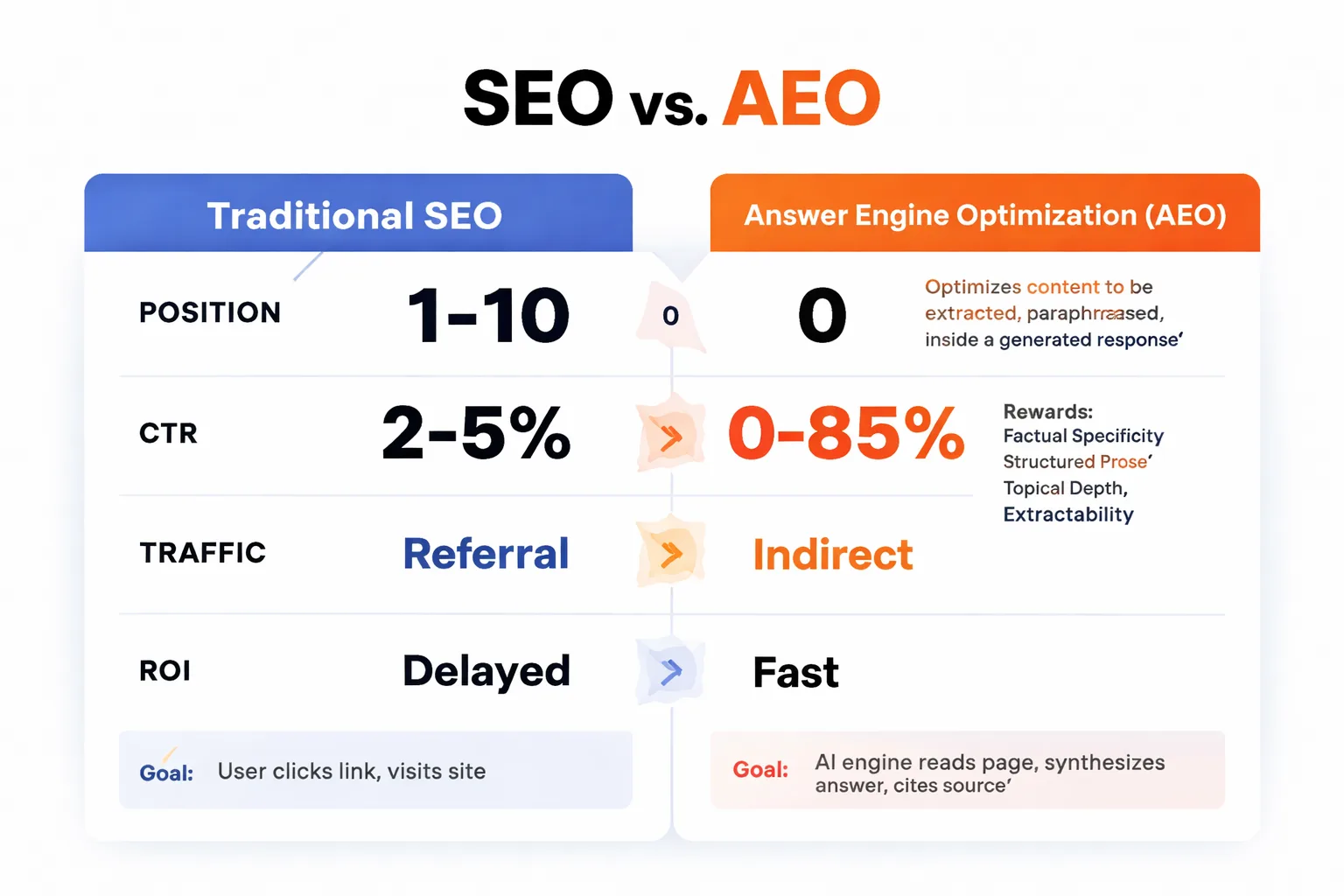
Think about it like this. Classic SEO is a librarian pointing you to a shelf. AEO is the librarian reading you the passage you need and telling you which book it came from. The librarian does the work. Your content just needs to be the passage worth reading.
There's a related term you'll encounter: generative engine optimization (GEO). Kathleen Marrero draws a useful distinction between the two. AEO focuses on content clarity and answerability. GEO focuses on context and credibility signals that generative engines use to assess trust. In practice, the two overlap heavily. Most practitioners use them interchangeably, and most buyers searching for help use "AEO" far more than "GEO." If you want a deeper breakdown, we've written about the AEO vs. GEO distinction in a separate piece. For this guide, I'll use AEO as the umbrella term because it's what the market actually searches for.
The key insight is that AEO isn't a side project. It's not something you do after your SEO is "done." It's a parallel discipline with its own signals, its own measurement framework, and its own competitive landscape. Companies that treat it as a checkbox on the SEO checklist are the ones losing citations to competitors who built for it intentionally.
How Answer Engines Decide What to Cite
This is where most AEO content goes wrong. It tells you to "write clear answers" and stops there. That's like telling someone to "write good code." Technically correct. Practically useless.
Answer engines use a retrieval pipeline, and understanding that pipeline tells you exactly what to optimize. When a user asks Perplexity or ChatGPT a question, the engine doesn't search the open web in real time. It queries a retrieval index (its own web crawl, a search API, or both), pulls the top candidates, extracts and chunks the relevant passages, then feeds those chunks to the language model for synthesis. The model generates an answer and attaches citations to the sources it actually used.
The retrieval layer is where you win or lose. If your content isn't in the candidate set, the model never sees it.
Five signals determine whether your content makes it into that candidate set and gets selected for extraction:
Topical authority. AI engines don't just look at whether a single page is relevant. They assess whether your domain has demonstrated expertise across a cluster of related topics. A single article about "freight audit software" on a site that otherwise covers logistics, supply chain, and fleet management will outrank a better-written article on a generic business blog. This is why topical authority isn't an SEO luxury anymore. It's an AEO prerequisite. If you want to understand how this maps against traditional ranking factors, our AEO vs. SEO breakdown covers the overlaps and divergences in detail.
Citation density. Content that already gets cited by other authoritative sources signals trustworthiness to the retrieval system. If Wikipedia, industry publications, and high-authority domains link to your content, AI engines treat that as a proxy for credibility. This is the one area where traditional link-building still directly serves AEO. The difference is that you're not building links for PageRank. You're building them for citation signals.
Structured prose. LLMs extract information most reliably from content that follows predictable patterns: a clear question or topic statement, followed by a direct answer, followed by supporting detail. Content that buries the answer in the third paragraph of a narrative intro gets skipped. Content that leads with the answer and supports it with specifics gets extracted. This is why FAQ blocks, definition-first paragraphs, and numbered lists appear so frequently in AI answers. They're the easiest structures for a model to parse.
Factual specificity. Vague claims get ignored. Specific claims with numbers, names, and dates get cited. "Companies see significant traffic increases" is useless to an answer engine. "Cited brands earn 35% more organic clicks than uncited brands, according to Siteimprove" is a citation magnet. The model can extract it, attribute it, and present it as evidence. Every time you write a claim, ask: could an AI engine cite this sentence as a standalone fact? If not, rewrite it.
Crawlability. If the engine can't crawl your content, none of the other signals matter. This means clean HTML, server-side rendering (or at minimum, content that's available without JavaScript execution), no aggressive bot blocking, and a sitemap that's current. Some sites accidentally block AI crawlers in their robots.txt while simultaneously wondering why they're not cited. Check your robots file. Then check it again.
The pattern I keep seeing is that companies optimize for one or two of these signals and ignore the rest. They have strong topical authority but their content is buried under JavaScript. Or their prose is beautifully structured but every claim is vague. The brands winning AEO right now are the ones hitting all five signals simultaneously. As Siteimprove put it, "the winners aren't the most keyword-optimized; they're the most extractable, trustworthy, and strategically monitored."
AEO vs. SEO vs. GEO: Where They Overlap and Where They Don't
These three terms get used interchangeably all the time. That's lazy and it leads to confused strategy. Let me be precise.
SEO optimizes for ranking positions in search engine results pages. You target keywords, build backlinks, and climb the ranks. The user clicks your link and visits your site. Success is measured in rankings, organic traffic, and click-through rate.
AEO optimizes for extraction and citation in AI-generated answers. You target questions, structure content for extractability, and build topical authority. The AI engine reads your content and synthesizes an answer. Success is measured in citation rate, mention position, and share of voice across AI engines.
GEO, or generative engine optimization, is a subset of AEO that focuses specifically on the credibility and context signals generative models use to assess trustworthiness. Think of it as the technical layer beneath AEO. Where AEO asks "is my content answerable?", GEO asks "does the model trust my content enough to cite it?"
Here's the practical reality: AEO and GEO are largely synonymous in how buyers and most practitioners use them. You'll rarely find a company offering "GEO services" without also calling them AEO. The term "AEO" dominates search demand, which is why this guide uses it as the primary frame. If you want the full comparison, our AEO vs. GEO analysis goes deeper.
| Dimension | SEO | AEO | GEO |
| Optimizes for | Ranking position in SERPs | Extraction and citation in AI answers | Trust and credibility signals for generative models |
| Target engines | Google, Bing (traditional crawlers) | ChatGPT, Perplexity, Gemini, AI Overviews | Generative models specifically (LLMs with retrieval) |
| Primary signal | Backlinks, keyword relevance | Answerability, factual specificity, topical depth | Citation density, entity associations, content provenance |
| Success metric | Rankings, organic traffic, CTR | Citation rate, mention position, share of voice | Model trust score, citation frequency, entity recall |
| Content format | Long-form, keyword-targeted | Structured, question-first, extractable | Authoritative, well-sourced, entity-rich |
| User behavior | Clicks a link | Reads the answer, maybe clicks a citation | Trusts the generated answer, rarely clicks |
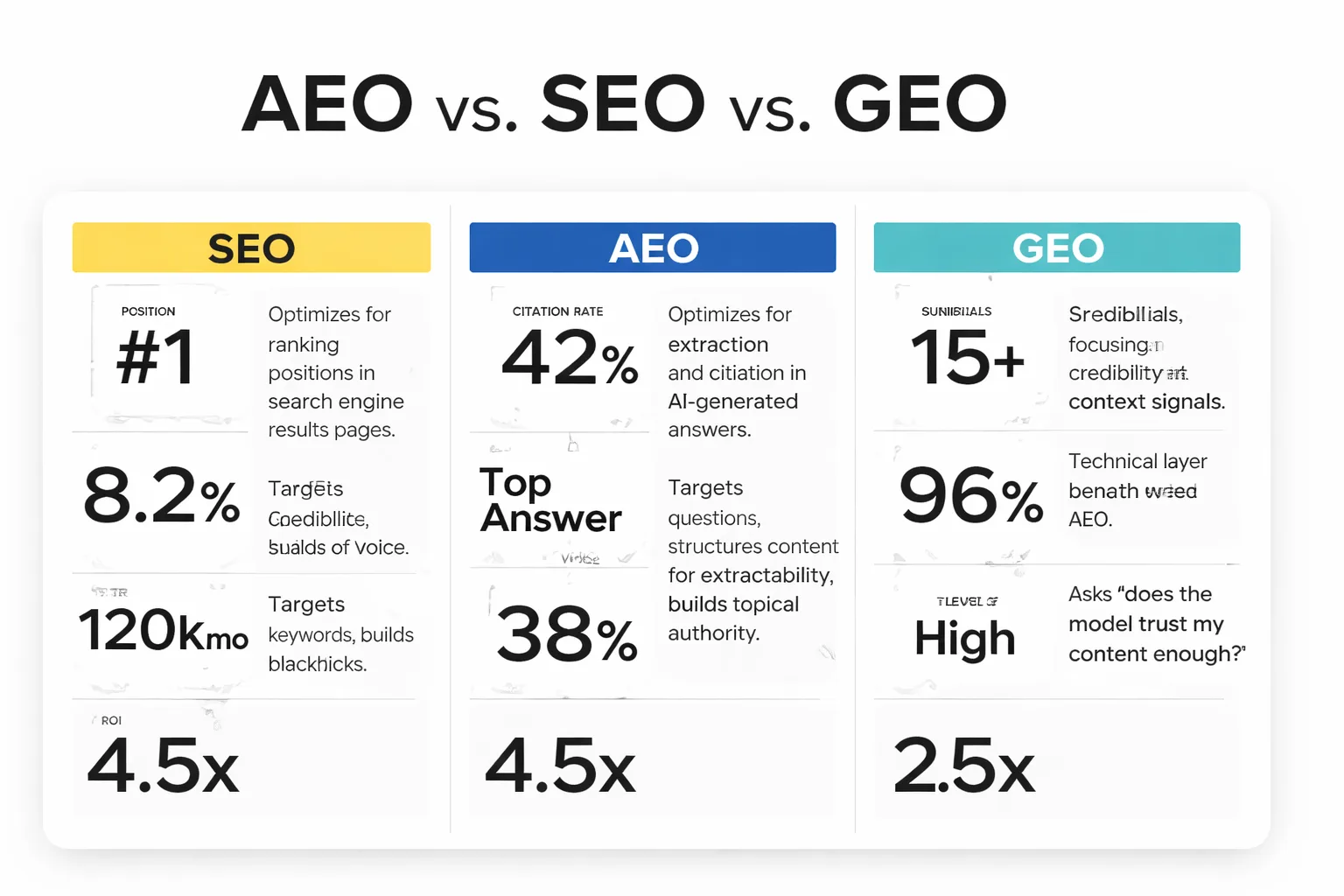
The overlap is real. Strong SEO foundations (clean site architecture, fast pages, quality backlinks) support AEO. But the divergence is where most companies fail. They assume their SEO ranking translates into AI citations. It doesn't. I've seen sites ranking position one for a keyword get zero citations in AI Overviews for the same query, while a site ranking position five gets cited because its content was structured as a clean Q&A with specific numbers.
The contrarian take here: pouring more budget into traditional SEO to fix an AEO problem is like upgrading your storefront while customers are shopping at a different mall. You're optimizing for a channel your prospects have already started leaving. That's not speculation. The Knowmad Digital Marketing survey found agencies seeing organic traffic drops exceeding 50% while AI search referral traffic rose simultaneously. The prospects haven't disappeared. They've moved.
What Answer Engine Optimization Services and Tools Actually Do
When buyers search for answer engine optimization services or an answer engine optimization tool, they're usually looking for one of two things: someone to run AEO campaigns for them (services), or software to track and automate AEO work (tools). Let me break down what each category actually delivers, because the market is messy and a lot of what's sold as "AEO" is just repackaged SEO with a new label.
Services: What an AI SEO Agency Should Deliver
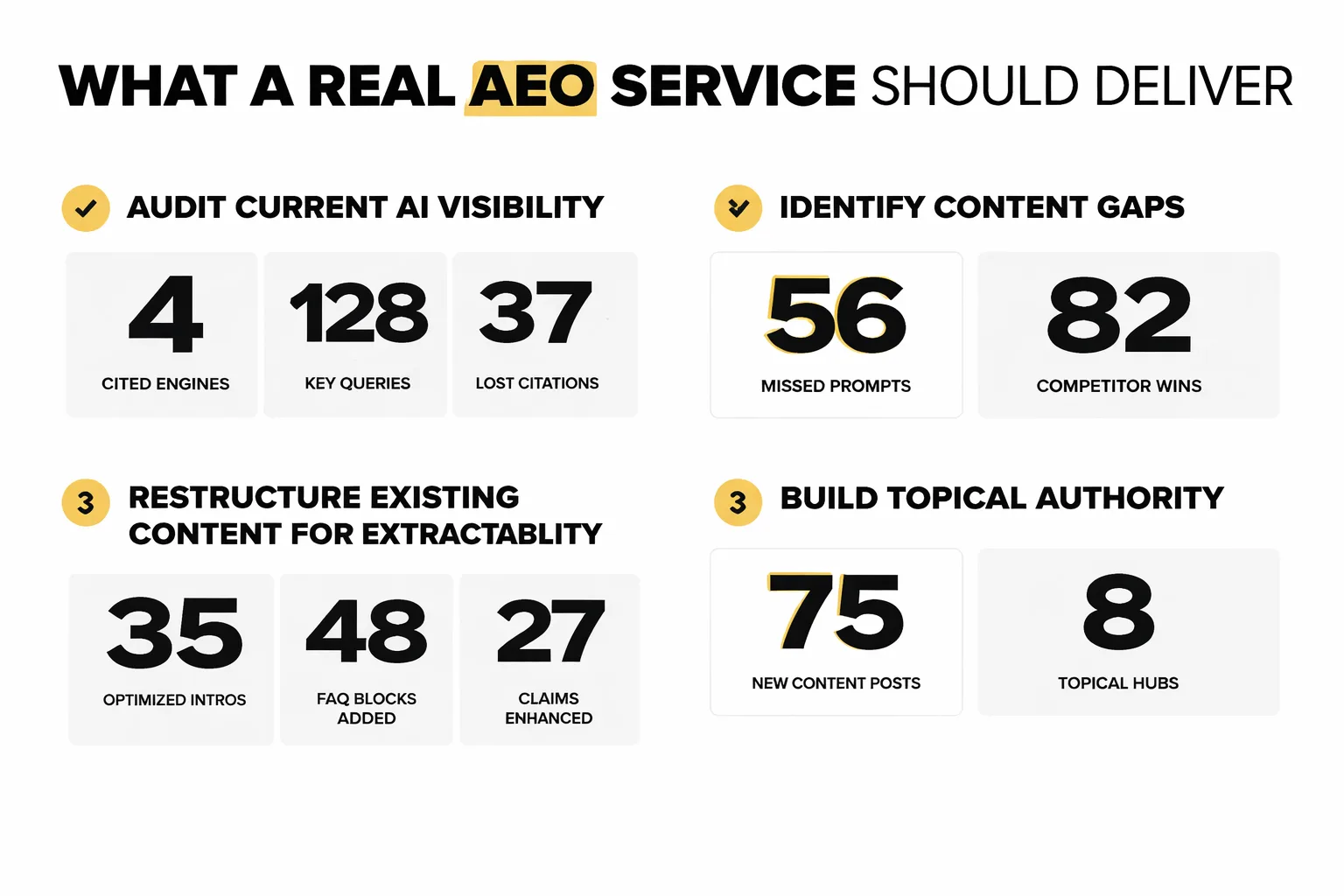
A real AEO service, whether from an AI SEO agency or a consultant, should do four things. First, audit your current AI visibility: which engines cite you, for which queries, and where competitors are winning citations you're not. Second, identify content gaps: the prompts and questions where AI engines are citing competitors instead of you. Third, restructure existing content for extractability: rewriting intros to lead with answers, adding FAQ blocks, tightening claims with specific numbers. Fourth, build topical authority through targeted content creation that covers a topic cluster comprehensively rather than publishing isolated articles.
If an ai seo service pitches you without mentioning citation tracking, content gap analysis, or topical authority, they're selling you traditional SEO with AI buzzwords. The HubSpot AEO case studies show that the brands seeing real results are the ones measuring citation rate and share of voice, not just rankings.
Tools: What an Answer Engine Optimization Tool Should Measure
This is where I get blunt, because I've spent a lot of time in this category. Most tools calling themselves an answer engine optimization tool are garbage. They scrape a few AI engines, run some prompts, and give you a "visibility score" that sounds impressive but means nothing. I've tested tools that claimed to track "AI citation potential" and found zero correlation between their scores and actual citations over six months. It felt like chasing ghosts.
A capable AEO tool should measure four things concretely:
Mention rate. How often does your brand appear in AI-generated answers across the engines that matter? Not a proxy score. The actual percentage of queried prompts where your brand shows up in the response.
Citation rate. When your brand is mentioned, is it cited as a source? Mentions without citations are awareness. Citations are authority. You need to track both, but citations are the metric that correlates with traffic and conversions.
Share of voice. What percentage of AI answers in your topic space cite you versus competitors? This is the competitive metric that tells you whether you're gaining or losing ground. If your share of voice is 12% and your top competitor's is 45%, you have a specific gap to close.
Content gap identification. Which prompts are AI engines answering with competitor citations? These are your content opportunities. Every prompt where a competitor is cited and you're not is a prompt you should be creating or restructuring content for.
If you want to see what this looks like in practice, our AI visibility checker tracks these metrics across every major AI search surface. Or if you want to start with a specific engine, our Perplexity AI visibility checker and ChatGPT AI visibility checker give you engine-specific drill-downs.
The tools landscape is converging with the broader ai seo tools market. What used to be separate categories (rank tracking, content optimization, AI visibility monitoring) are merging into unified platforms. The best ai seo tool in 2026 isn't one that does everything poorly. It's one that does AEO measurement and content generation in a closed loop: track citations, find gaps, create content to fill those gaps, measure whether the new content earned citations, repeat.
That closed loop is what we built at Meev. The platform tracks your AI visibility daily, identifies citation gaps where competitors are winning, generates fact-verified articles designed for extractability, and publishes them directly to your CMS. Then it measures whether those articles actually moved your citation rate. The loop closes. That's what an answer engine optimization tool should do. Not give you a vanity score.
Why Does AEO Matter for Business Results?
Because the buyers have already moved. Maya's four-minute procurement decision at the start of this article isn't a hypothetical. It's a composite of real behavior I see in the data every week.
Cited brands earn 35% more organic clicks and 91% more paid clicks than uncited brands, per Siteimprove. The citation isn't just a vanity placement. It's a traffic driver that outperforms traditional organic and paid for the same query. And 58% of marketers report that AI tool visitors convert at higher rates than organic traffic, according to the 2026 HubSpot State of Marketing Report. Higher conversion. More clicks. From the same prospect who used to scroll past your Google Ads.
The business case is straightforward. If your prospects are asking AI engines questions about your product category, and those engines are citing your competitors, you're losing deals you don't even know about. There's no analytics alert for "prospect chose competitor after reading AI answer." The loss is invisible until you start tracking AI visibility.
This is what I call the Monitoring Gap. Most brands have no idea which side of the citation divide they're on. They don't know whether ChatGPT mentions them. They don't know whether Perplexity cites them. They don't know what share of voice they hold in AI answers for their core topics. They're flying blind in a channel that's routing their best prospects to competitors.
The fix starts with measurement. You can't optimize what you don't track. If you're looking for where to start, our AI visibility tool gives you the baseline. Once you know where you stand, you can prioritize which topics, which engines, and which content gaps to attack first.
Do you know which AI engines are citing your competitors instead of you?
How to Start With AEO This Week
Three steps. Don't overthink it. Don't wait for a perfect strategy document. Start now and refine as you learn.
Step 1: Audit Your Current AI Citations
Pick your top 10 customer queries. These are the questions your prospects actually ask, not the keywords you wish they searched for. If you sell freight audit software, your queries might be "best freight audit software," "how does freight audit work," "freight audit vs freight payment," and so on.
Run each query through ChatGPT, Perplexity, Gemini, and Google AI Overviews. For each response, note: Is your brand mentioned? Is your brand cited as a source? Where in the answer does your brand appear (first, in a list, last)? Which competitors are cited that you aren't?
This takes about 30 minutes and gives you a baseline. If you want to automate this at scale, the AI visibility checker runs the same audit across every major AI search surface and tracks changes over time. But the manual version works fine for a first pass.
Step 2: Identify Citation Gaps
Look at your audit results and find the pattern. Which queries consistently cite competitors but not you? Those are your citation gaps. These are the topics where AI engines have decided your competitors are more authoritative, more extractable, or both.
For each gap, ask: Does the competitor have content specifically answering this query? Is their content structured as a direct answer (definition, FAQ, comparison) or is it buried in a longer piece? Do they cite specific data, names, and sources? What's their topical coverage like on this cluster?
The gap isn't always content volume. Sometimes it's content structure. I've seen brands with 50 articles on a topic lose citations to a competitor with 5 articles that were better structured, more specific, and more extractable. Quality of structure beats quantity of pages.
Step 3: Rewrite One Priority Article Using AEO Principles
Pick the highest-impact citation gap from Step 2. Write or rewrite one article targeting that query using these formatting principles:
Lead with the answer. The first paragraph should directly answer the query in 40-60 words. No throat-clearing. No "in this article we'll explore." The answer. Then support it.
Use question-shaped subheadings. AI engines extract from H2s and H3s that are phrased as questions. "How does freight audit software work?" is more extractable than "Freight Audit Software Overview."
Include specific, citable claims. Every claim should have a number, a name, or a source. "Reduces audit costs by 30%" beats "significantly reduces costs." If you don't have proprietary data, cite someone who does.
Add an FAQ block. Four to six question-and-answer pairs at the end of the article, each 50-100 words. This is the single highest-ROI formatting change you can make. AI engines love FAQ blocks because they're pre-structured extraction targets.
Publish it. Wait two weeks. Re-run the same queries through the same AI engines. Did your citation rate change? If yes, double down on the format. If no, check whether the article was actually crawled (use Search Console and our LLMs.txt validator to make sure AI crawlers can access your content).
That's it. Three steps. Don't build a 50-page AEO strategy deck. Start with the audit, find the gaps, fix one article. Measure. Repeat.
What This Actually Means
The shift from SEO to AEO isn't a future prediction. It's a present-tense reality that most brands haven't noticed yet. The companies cited in AI answers today are winning deals from companies that outrank them on Google. That's not a trend. That's a redistribution of buyer attention that's already happening.
The brands that win AEO in 2026 will be the ones that treated it as a foundational discipline, not a side channel. The ones that built topical authority, structured content for extractability, tracked citations across AI engines, and closed the loop between measurement and content creation. The ones that waited for "AEO to mature" before investing will find themselves in the same position as companies that waited too long on mobile: permanently behind.
Answer engine optimization services and tools exist because the problem is real and measurable. The question isn't whether to invest. It's whether you're investing before or after your competitors do. The data says 87.5% of agencies are already seeing organic traffic declines. The window to get ahead is narrowing every month.
Start with the audit. Find your gaps. Fix one article. Then keep going.
FAQ
What is answer engine optimization (AEO)?
Answer engine optimization is the practice of structuring content so AI-powered tools like ChatGPT, Perplexity, Gemini, and Google AI Overviews select, extract, and cite it in responses to user queries. It focuses on making content the direct source for AI-generated answers rather than relying on traditional search rankings.How does AEO affect website traffic and conversions?
Brands cited in AI answers see 35% more organic clicks and 91% more paid clicks than competitors, while AI Overviews can reduce organic CTR for top results by 58%. Marketers also report that visitors from AI tools convert at higher rates than traditional organic traffic.Why is AEO becoming more important than classic SEO?
AI search traffic is projected to surpass traditional search by 2028, and users increasingly get answers directly from engines without clicking through to websites. Companies that format content for AI visibility are capturing prospects that classic SEO and paid ads miss.What happens to brands that ignore answer engine optimization?
Brands not cited in AI responses become effectively invisible to users who rely on these tools for quick answers. This leads to lost opportunities as competitors with better-formatted content get selected and contacted instead.About the Author
Judy Zhou, Founder
Judy Zhou leads content strategy at Meev, where she oversees AI-driven content research and publishing for hundreds of brands. With a background in SEO and editorial operations, she focuses on building content systems that rank on Google, get cited by AI search engines, and drive measurable business results.
Run a free AI visibility audit and see exactly where you stand across every major AI search surface.