

By Judy Zhou, Founder
Key Takeaways
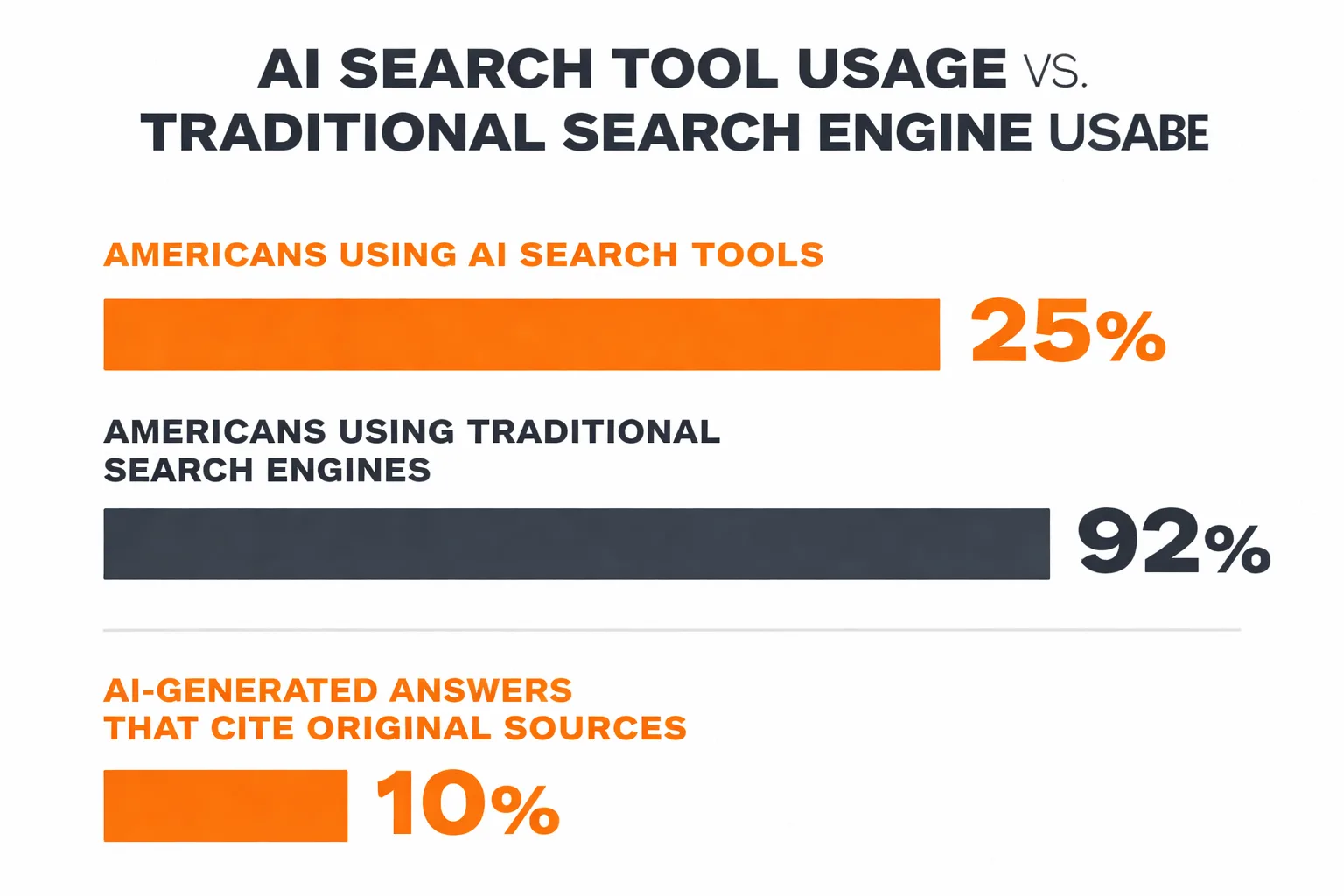
- One in four Americans now use AI search tools like ChatGPT and Perplexity instead of traditional engines.
- Community platforms capture 52.5% of AI citations versus 47.5% for brand domains across one million+ analyzed citations.
- A brand publishing three AI-written articles weekly appeared in just 1 of 15 Perplexity/ChatGPT answers while a competitor publishing half as much appeared in 11.
- Treat AI SEO as an authority game by creating reference-grade, deeply sourced content instead of optimizing for volume.
Maya had spent six months building topical authority in the supply chain software niche. Her team published three articles a week using one of the most popular AI-powered content creation platforms on the market. The content was clean, well-structured, and consistently outranked competitors on traditional SERPs. Then a colleague ran a simple test: they queried Perplexity and ChatGPT with fifteen questions directly inside Maya's target topic cluster. Her brand appeared in exactly one answer. A competitor publishing half as much showed up in eleven. That afternoon, the content strategy meeting got very uncomfortable.
Most AI content platforms optimize for search engines that no longer work the way they used to. Nearly one in four Americans now use AI search tools in place of traditional search engines. Yet a Columbia Journalism Review analysis found these tools exhibit a systemic citation problem, failing to properly attribute the sources they depend on. An analysis of over one million AI citations across ChatGPT, Perplexity, and Google AI Overviews found that community platforms capture 52.5% of citations versus 47.5% for brand domains. The platforms generating content are not the platforms earning citations. The GEO research framework formalizes how generative engines synthesize information, and the mechanics favor reference-grade, deeply sourced content over generic copy. Teams that treat AI SEO as a volume game will lose to teams that treat it as an authority game.
The problem isn't that AI writing tools are bad at writing. The problem is they're optimized for the wrong outcome. They produce clean prose that reads well and ranks on page one. But ranking on Google and getting cited by Perplexity require fundamentally different content signals. The platforms reviewed below generate text. Very few of them generate citation-worthy text.
The Citation Gap Nobody Measured
Every comparison of AI content platforms covers the same ground: word count, pricing, templates, integrations. None of them ask the question that actually matters in 2026. Does the content this platform produces earn citations in AI search?
That gap is expensive. Research from Yext analyzing 17.2 million citations across AI models reveals distinct patterns in how engines select sources. Search Engine Land's analysis of 8,000 AI citations confirms that citation behavior differs dramatically from traditional ranking factors. And SparkToro research shows AI engines are highly inconsistent when recommending brands, making visibility tracking an ongoing necessity rather than a one-time check.
The framework for evaluating the nine platforms below uses four criteria that actually predict citation performance:
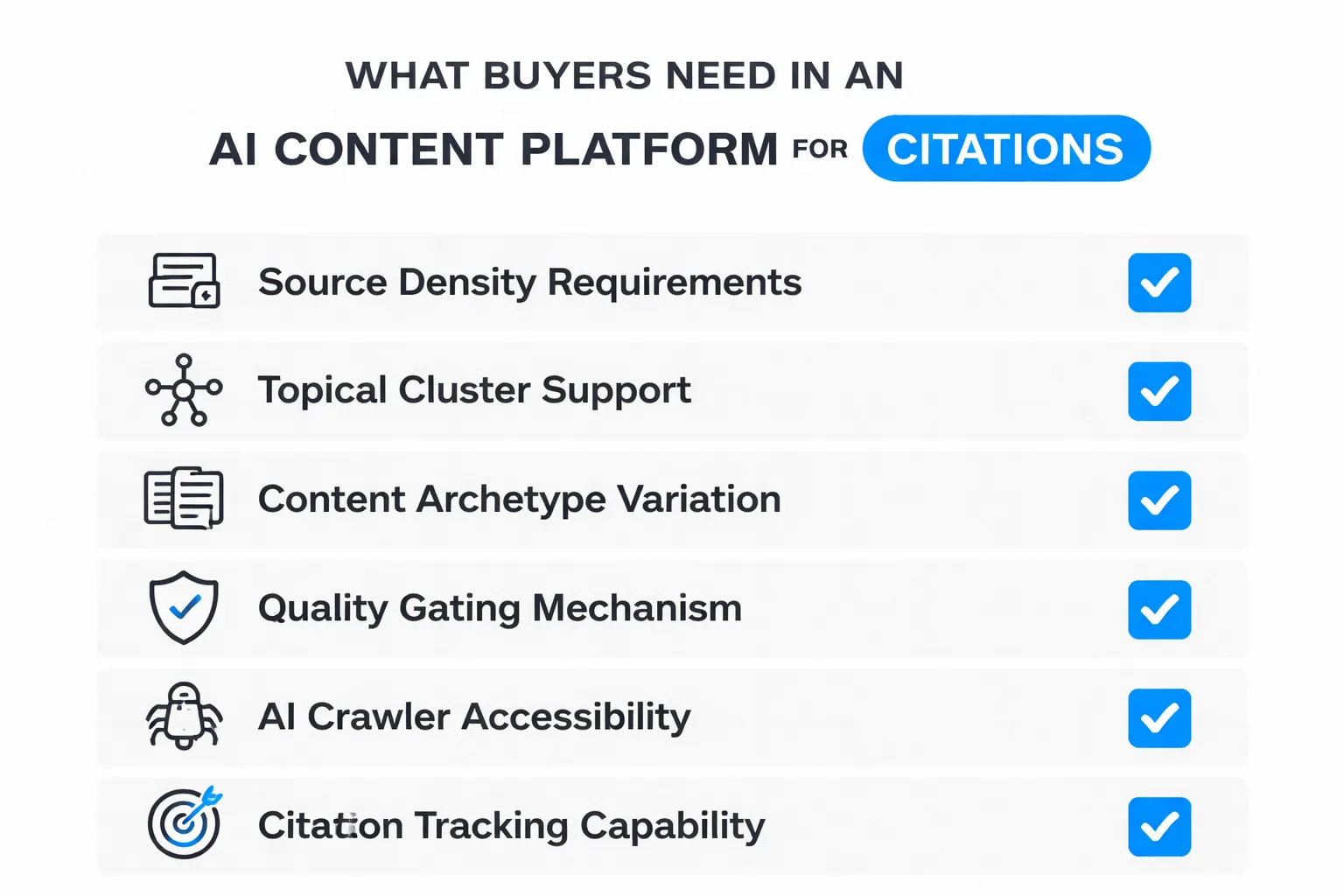
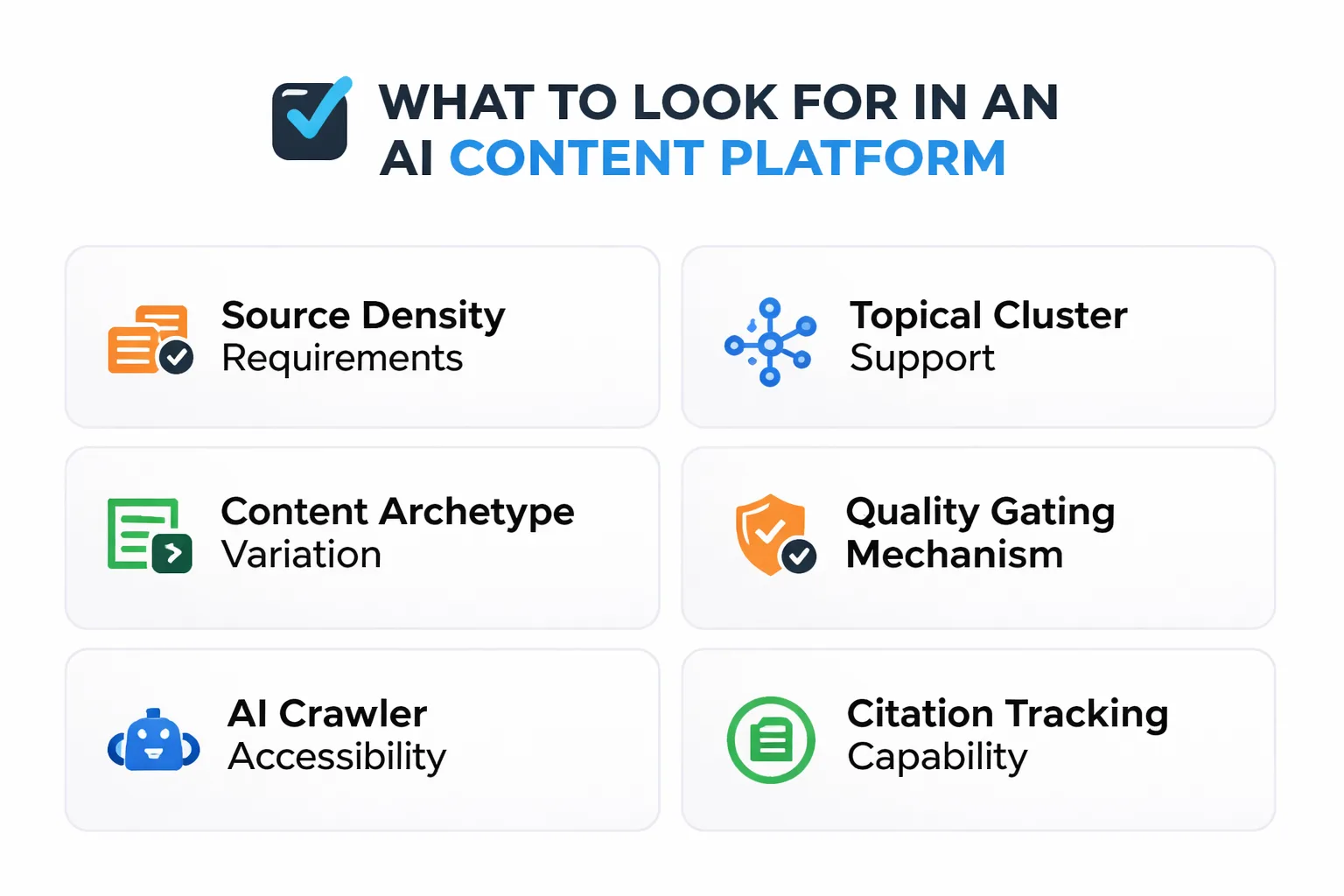
1. Source density and attribution. Does the platform require inline citations to authoritative sources, or does it generate unsourced claims? AI engines extract from content that links to primary sources. 2. Topical authority structure. Does the platform build topic clusters with internal linking, or does it treat each article as a standalone unit? Building a topical authority map is what separates cited brands from invisible ones. 3. Content archetype variation. Does the platform adapt structure based on content type (listicle, how-to, explainer), or does it apply one template to everything? Generative engines extract differently from different formats. 4. Quality gating before publish. Is there a mechanism that blocks weak content from reaching the CMS, or does everything ship? The difference between a cited site and a penalized site is often a quality firewall.
Why Does AI Citation Behavior Differ from Traditional SEO?
AI search engines don't rank pages. They synthesize answers. The GEO framework describes how generative engines retrieve information from multiple sources, combine it, and summarize it using large language models. This means the unit of visibility isn't a page. It's a claim within a page.
Traditional SEO rewards pages that target a keyword and earn backlinks. AI search rewards pages that contain extractable, well-sourced claims that directly answer questions. A page can rank number one on Google and never appear in a single AI answer because its content isn't structured for extraction.
The data confirms this. The one-million-citation analysis found that reference-grade content receives 3-5x more citations than standard content. Global household brands like Stripe and Nike appear in 73% of relevant AI answers on first run. The reason isn't brand size alone. It's that their content is structured as reference material: definitions, specifications, data tables, and primary source documentation.
Here's the contrarian take that most content teams miss. The platforms that produce the best-written content are often the worst at earning citations. Jasper, Copy.ai, and ChatGPT generate prose that reads beautifully. But beautiful prose without source attribution, structured data, and topical depth is invisible to generative engines. The platforms that produce more clinical, reference-style content actually perform better in AI search, even when human readers find it less engaging.
Understanding the difference between AEO and SEO is the prerequisite for evaluating any platform against this framework.
The Nine Platforms Evaluated
The comparison below covers nine AI-powered content creation platforms across the four citation-readiness criteria. Each platform gets an honest assessment of what it does well and where it fails the citation test.
Jasper
Jasper is the most recognized name in AI content creation. It offers brand voice customization, templates for dozens of content types, and a polished interface that marketing teams find intuitive.
What it does well. Brand voice consistency is genuinely strong. Teams can train Jasper on existing content and get output that matches tone across articles. The template library covers blog posts, social media, email, and ad copy.
Where it fails the citation test. Jasper is a copywriting tool, not a research tool. It generates unsourced claims by default. There's no mechanism for inline citation to authoritative sources. No topical authority mapping. No quality gate before publish. Content produced by Jasper is structurally identical to millions of other AI-generated articles, which means it carries no distinctive signal for AI engines to extract. Jasper produces content that reads well and cites nothing. That's the opposite of what generative engines reward.
Pricing. Creator plan starts at $39/month. Pro plan at $59/month.
Copy.ai
Copy.ai positioned itself as the go-to platform for short-form marketing copy. It has since expanded into long-form content and workflow automation.
What it does well. The workflow builder is genuinely useful for teams that need to chain multiple content tasks together (blog post to social media to email). The interface is clean and the learning curve is shallow.
Where it fails the citation test. Same structural problem as Jasper. Copy.ai generates text without source attribution. No internal linking architecture. No content archetype awareness. The platform treats a listicle and an explainer as the same task with different prompts. For teams evaluating AI SEO tools for citation performance, Copy.ai doesn't register because it doesn't produce reference-grade content.
Pricing. Free tier available. Pro plan at $36/month.
Rytr
Rytr is the budget option. It generates short-form content quickly and cheaply, targeting freelancers and small businesses that need basic copy without enterprise pricing.
What it does well. Price. At $9/month for the unlimited plan, Rytr is the cheapest option on this list. It supports multiple languages and offers a decent variety of use cases for the price.
Where it fails the citation test. Rytr doesn't pretend to be a research tool or an SEO platform. It's a text generator. Output quality is noticeably below Jasper and Copy.ai. No source attribution, no topical structure, no quality gating. Using Rytr for content meant to earn AI citations is like using a hammer to drive a screw. Wrong tool for the job.
Pricing. Free tier with 10,000 characters/month. Unlimited plan at $9/month.
HubSpot Content Hub
HubSpot's AI content tools are embedded within its broader CRM and marketing platform. This integration is both its strength and its limitation.
What it does well. For teams already in the HubSpot ecosystem, the content tools connect seamlessly to CRM data, email campaigns, and lead scoring. The AI assistant can generate blog outlines, meta descriptions, and social posts from within the same dashboard where you manage everything else.
Where it fails the citation test. HubSpot's AI content features are add-ons to a CRM, not a purpose-built content engine. No source attribution system. No topical authority mapping. No quality firewall. The content generation is competent but generic. Teams using HubSpot for content marketing get convenience at the cost of citation readiness.
Pricing. Content Hub Starter at $20/month. Professional at $500/month.
ChatGPT (OpenAI)
ChatGPT deserves special treatment here because many teams use it directly for content creation despite it not being a content platform in the traditional sense.
What it does well. GPT-4 and newer models produce the most natural-sounding prose of any tool on this list. The conversational interface allows for iterative refinement that purpose-built platforms can't match. With web search enabled, ChatGPT can access current information.
Where it fails the citation test. ChatGPT is a general-purpose chatbot, not a content production pipeline. It has no publishing workflow, no quality gate, no topical authority structure, no internal linking, and no SEO infrastructure. Every article is a manual, from-scratch process. Teams that use ChatGPT for content production end up doing all the citation-readiness work manually: adding sources, structuring data, building links, and checking quality. ChatGPT produces the best raw text and the worst production pipeline. The gap between draft and publish-ready article is enormous.
Pricing. Free tier available. Plus at $20/month. Team at $25/user/month.
Frase
Frase is the first platform on this list that takes research and SEO seriously. It built its reputation on SERP analysis and content optimization rather than pure text generation.
What it does well. Frase analyzes top-ranking pages for a target keyword and extracts topics, questions, and statistics that should appear in your content. This research-first approach means Frase-produced content is structurally closer to what AI engines extract from. The platform also provides content scoring against SERP competitors.
Where it falls short. Frase recommends itself over Jasper for SEO work, citing integrated research capabilities. That's a vendor claim, not an independent benchmark. No published data exists comparing Frase's output to Jasper's on actual AI citation performance. Frase also lacks a quality firewall, auto-publishing workflow, and multi-platform publishing. It's a research and optimization tool that still requires a separate CMS and publishing process. Teams looking for a Frase alternative that adds citation tracking and auto-publishing won't find it here.
Pricing. Solo plan at $14.99/month. Basic at $44.99/month.
Writesonic
Writesonic positions itself as an AI content platform with SEO features built in. It offers article generation, landing page copy, and integration with Surfer SEO for content scoring.
What it does well. The Surfer SEO integration gives Writesonic an edge on on-page optimization that pure copywriting tools lack. It can generate articles with basic SEO structure (H1, H2, meta tags) and provides a content score against target keywords.
Where it fails the citation test. The SEO optimization is keyword-focused, not citation-focused. Writesonic optimizes for traditional Google ranking factors, not for the extractability signals that generative engines use. No source attribution system. No topical authority mapping. No quality gate. The content is SEO-optimized in the 2021 sense of the term.
Pricing. Free trial available. Individual plan at $20/month.
Anyword
Anyword differentiates itself with predictive performance scoring. It claims to predict how well copy will perform before you publish it, using models trained on millions of ad campaigns.
What it does well. The predictive scoring concept is interesting for ad copy and short-form content where performance data is abundant. For teams running paid campaigns, the performance predictions have some utility.
Where it fails the citation test. Anyword is built for ad copy and social media, not for long-form content that earns citations. The predictive models don't account for AI search visibility. No source attribution, no topical structure, no quality gating. The platform is solving a completely different problem than the one this article addresses.
Pricing. Starter plan at $49/month.
Meev
Meev is the only platform on this list built specifically for AI search visibility, not just content generation. It combines content creation with citation tracking, quality gating, and topical authority building in a single workflow.
What it does well. Meev's 16-dimension quality firewall blocks articles scoring below 70/100 from auto-publishing. This is the only platform on this list with a hard quality gate. The archetype-aware writing system adjusts structure and retrieval weights based on content type (listicle, how-to, explainer, problem-solver, vertical). Every article includes inline citations to authoritative sources, prioritized by domain authority. The platform tracks brand mentions across every major AI search surface and identifies citation gaps where competitors appear but you don't.
The closed-loop citation path is the differentiator that no other platform on this list offers. Meev finds the publishers AI engines actually cite for your topics, resolves verified contact information, and drafts personalized outreach pitches. That means the platform doesn't just produce content. It actively works to place your brand in the sources AI engines already trust.
Where it has room to grow. Meev is purpose-built for SEO and AI search visibility teams. It's not a general-purpose copywriting tool. Teams that need ad copy, social media management, or email marketing will still need a separate tool. The focus on citation-readiness means less flexibility for content types that don't need source attribution.
Pricing. Lite at $49/month. Starter at $99/month. Pro at $269/month. Agency at $599/month.
How Does Each Platform Perform on Citation Readiness?
The table below summarizes the nine platforms against the four citation-readiness criteria. This isn't about which platform produces the best prose. It's about which platform produces content that generative engines can extract, trust, and cite.
| Platform | Source Attribution | Topical Authority | Archetype Variation | Quality Gate | Citation Tracking |
| Jasper | None | None | Templates only | None | None |
| Copy.ai | None | None | Templates only | None | None |
| Rytr | None | None | Minimal | None | None |
| HubSpot | None | None | Basic | None | None |
| ChatGPT | Manual | None | None | None | None |
| Frase | Partial (SERP-based) | Partial (topic research) | Limited | None | None |
| Writesonic | None | None | Limited | None | None |
| Anyword | None | None | None | None | None |
| Meev | Full (inline, DA-prioritized) | Full (cluster + internal linking) | Full (5 archetypes) | Yes (16-dimension) | Full (all major AI surfaces) |
The pattern is clear. Eight of nine platforms produce content. One platform produces citation-ready content and tracks whether it actually gets cited.
Is your content earning AI citations or just ranking on Google?
Which Platforms Support Answer Engine Optimization?
Answer engine optimization requires more than good writing. It requires content that generative engines can extract claims from, verify against sources, and synthesize into answers. The platforms above fall into three tiers on this dimension.
Tier 1: Citation-ready. Only Meev qualifies. Inline source attribution, archetype-aware structure, quality gating, and citation tracking across AI surfaces. Content produced by Meev is designed to be extracted and cited.
Tier 2: SEO-aware but not citation-aware. Frase and Writesonic. Both platforms understand traditional SEO signals (keywords, SERP analysis, on-page optimization) but don't produce content structured for AI extraction. No inline citations to primary sources. No quality firewall. No citation tracking.
Tier 3: Text generation only. Jasper, Copy.ai, Rytr, HubSpot, ChatGPT, and Anyword. These platforms generate text. The text may be well-written (ChatGPT, Jasper) or cheap (Rytr), but none of them produce content with the structural signals that generative engines use for citation selection.
The AI visibility checker is the tool that reveals which tier your current content falls into. Teams often discover their content is Tier 3 when they assumed it was Tier 1.
The Technical Barrier Most Teams Ignore
Here's a finding that should change how every team evaluates content platforms. The one-million-citation analysis found that 73% of sites have technical barriers blocking AI crawler access. Robots.txt rules, CDN configurations, and JavaScript rendering requirements prevent AI engines from reading content that teams have spent thousands of dollars producing.
This means a platform could produce perfect citation-ready content and it still wouldn't get cited if the site blocks AI crawlers. None of the nine platforms above address this. Eight of them don't even acknowledge it exists. Meev's AI crawler simulator and LLMs.txt validator are the only tools in this comparison that help teams verify their content is actually accessible to AI engines.
The implication is uncomfortable. Most teams are paying for content production while their site infrastructure silently blocks the AI engines they're trying to get cited by. Before evaluating any platform's output quality, verify that AI crawlers can actually reach your content.
When Should You Switch Platforms?
Switching content platforms is expensive. Teams have existing workflows, brand voice configurations, and publishing pipelines. The decision to switch should be based on measurable gaps, not feature envy.
Switch if your current platform produces content that ranks on Google but doesn't appear in AI answers. This is the Maya problem from the opening paragraph. Traditional ranking without AI visibility means the content strategy is optimized for a shrinking surface.
Switch if your platform has no quality gate. Content that ships without a quality check is a liability. The Kellogg insight on AI-driven traffic drops notes that retailers, news publications, and marketing agencies saw traffic drops of 20-40% in 2025. Low-quality AI content accelerates these drops because it provides no distinctive signal for engines to extract.
Switch if your platform doesn't track AI visibility. You can't optimize what you don't measure. Platforms that generate content without tracking whether that content earns citations are flying blind. The ChatGPT visibility checker and Perplexity visibility checker are the minimum viable tracking for any team serious about AI search.
Don't switch if your team only needs short-form copy. If the use case is ad copy, social posts, and email subject lines, Jasper, Copy.ai, and Anyword are fine. The citation-readiness framework applies to long-form content meant to build topical authority and earn AI citations. Using it to evaluate ad copy tools is a category error.
What This Actually Means
The content platform market has split into two segments that most buyers don't recognize. One segment produces text. The other produces citation-ready content with visibility tracking. The eight platforms that only produce text are competing on price, templates, and brand voice. The one platform that produces citation-ready content (Meev) is competing on a different axis entirely: whether the content actually gets cited by AI engines.
This split will widen. As AI search adoption grows (already at 25% of Americans replacing traditional search), the value of content that earns citations will increase. The value of content that merely ranks on Google will decrease. The 20-40% traffic drops that publishers experienced in 2025 are the leading indicator.
The teams that win in AI search won't be the ones publishing the most content. They'll be the ones publishing content that generative engines can extract, verify, and cite. The platform choice determines whether that's possible.
For teams evaluating ai powered content creation platforms in 2026, the question isn't which tool writes the best prose. The question is which tool produces content that AI engines actually cite. The data shows that most don't. One does. The gap between those two outcomes is the gap between visibility and invisibility in AI search.
FAQ
Can AI-generated content earn citations in AI search engines?
Yes, but only if the content includes inline source attribution, structured data, and topical depth. The one-million-citation analysis found that reference-grade content receives 3-5x more citations than standard content. Generic AI-generated text without sources performs poorly because generative engines extract from content that links to primary sources.
Does Google penalize AI-generated content?
Google's stance is that it penalizes low-quality content regardless of how it's produced. The issue with most AI content isn't the AI. It's the absence of quality gating, source attribution, and editorial oversight. A platform with a 16-dimension quality firewall that blocks weak drafts before publish produces content that performs differently from a platform that ships whatever the model generates.
How is answer engine optimization different from traditional SEO?
Traditional SEO optimizes for page-level ranking on keyword-based SERPs. Answer engine optimization optimizes for claim-level extraction by generative engines. The unit of visibility changes from a page to a specific claim within a page. This requires different content structure: inline citations, structured data, topical clusters, and content formatted for extraction rather than just for keyword relevance.
What percentage of AI citations go to brand domains versus community platforms?
According to the analysis of over one million AI citations, community platforms (Reddit, Quora) capture 52.5% of citations while brand domains capture 47.5%. This means nearly half of AI citations already go to brand domains, but only those producing reference-grade content with proper source attribution and AI crawler accessibility.
Should I use multiple AI content platforms or consolidate to one?
Consolidate if the platform handles both content generation and citation tracking. Using one tool for writing, another for SEO optimization, and a third for AI visibility tracking creates integration gaps where citation-readiness signals get lost. The exception is teams that need specialized short-form copy tools (Jasper, Copy.ai) alongside a long-form citation-ready platform. In that case, two tools is reasonable. More than two is operational overhead without proportional benefit.
How do I check if AI crawlers can access my content?
Run your site through an AI crawler simulator to test whether robots.txt, CDN rules, or JavaScript rendering block AI engines from reading your pages. The finding that 73% of sites have technical barriers blocking AI crawler access means this check should happen before any content platform evaluation.
About the Author
Judy Zhou, Founder
Judy Zhou leads content strategy at Meev, where she oversees AI-driven content research and publishing for hundreds of brands. With a background in SEO and editorial operations, she focuses on building content systems that rank on Google, get cited by AI search engines, and drive measurable business results.
Stop guessing whether your content gets cited by AI engines. Track your visibility across every major AI search surface and start publishing citation-ready content today.