

By Judy Zhou, Founder
Key Takeaways
- The SEO services market grew from $92.74B in 2025 to $108.28B in 2026 at a 16.8% CAGR, yet most agencies still run on pre-AI playbooks.
- Nearly 70% of businesses report higher ROI from AI in SEO, but hiring a firm that ignores generative engine optimization wastes money.
- Google AI Overviews now reach 2 billion monthly users while 60% of searches yield zero clicks, so demand AI search visibility from any local SEO company.
- Skip agencies that only show 2021 case studies and instead require proof they optimize for both classic rankings and answer engine results.
Marcus had spent three months vetting SEO agencies before signing a $4,000-a-month retainer with a well-reviewed firm two miles from his Chicago storefront. Six months later, his organic traffic was flat, his Google AI Overview appearances were zero, and his account manager had never once mentioned generative engine optimization or answer engine optimization. When he finally asked about AI search visibility, the silence on the other end of the call told him everything. He'd hired the right agency for 2021.
If you're searching for a search engine optimization company near me, you need to know what I know: the SEO services market grew from $92.74B in 2025 to $108.28B in 2026 at a 16.8% CAGR, yet most agencies still operate on a pre-AI playbook. Nearly 70% of businesses report higher ROI from using AI in SEO, but hiring a firm that doesn't actually understand AI search is worse than hiring no firm at all. Google AI Overviews now reach 2 billion monthly users, and roughly 60% of searches yield zero clicks. If your agency isn't talking about these numbers, you're paying for 2021 tactics in a 2026 world.
I'm Judy Zhou, and in my work leading content strategy at Meev, I audit content operations for brands trying to get found in both classic Google results and AI search engines. The pattern I keep seeing is the same one Marcus hit. Businesses hire locally for convenience and trust, then discover their agency has no framework for AI-driven search. Here's how to avoid that trap.
The Old Playbook Is Dead
The conventional wisdom about hiring an SEO company is wrong. Everyone tells you to look for proven rankings, case studies, and client testimonials. Those matter, but they're table stakes in 2026. The real question is whether the agency understands that search itself has fundamentally changed.
McKinsey's research on AI search found that 50% of consumers now intentionally use AI-powered search engines, and 44% of AI search users consider these engines their primary search tool. This isn't a trend on the horizon. It's the reality right now.
Here's what kills me. I talk to founders who spent months comparing search engine optimization companies near me, evaluated portfolios, checked references, and still ended up with an agency that treats AI search like a passing fad. They did everything right by 2021 standards and everything wrong by 2026 standards.
The mistake is treating AI search like traditional SEO. As Forbes Business Council notes, AI systems evaluate authority, credibility, and consistency rather than relevance and optimization signals. Traditional search rewarded keyword targeting and backlink building. AI search rewards being the source that AI engines trust enough to cite.
This means your agency needs to understand two distinct but connected disciplines. Classic SEO still matters for Google rankings. But answer engine optimization matters for getting cited by ChatGPT, Perplexity, Claude, and Google AI Overviews. If your agency can't explain the difference clearly in a discovery call, walk away.
What an AI-Era SEO Company Must Deliver
Let's get concrete. When you're evaluating a search engine optimization agency near me, you need to assess them on capabilities that didn't exist three years ago. Here's what I look for.
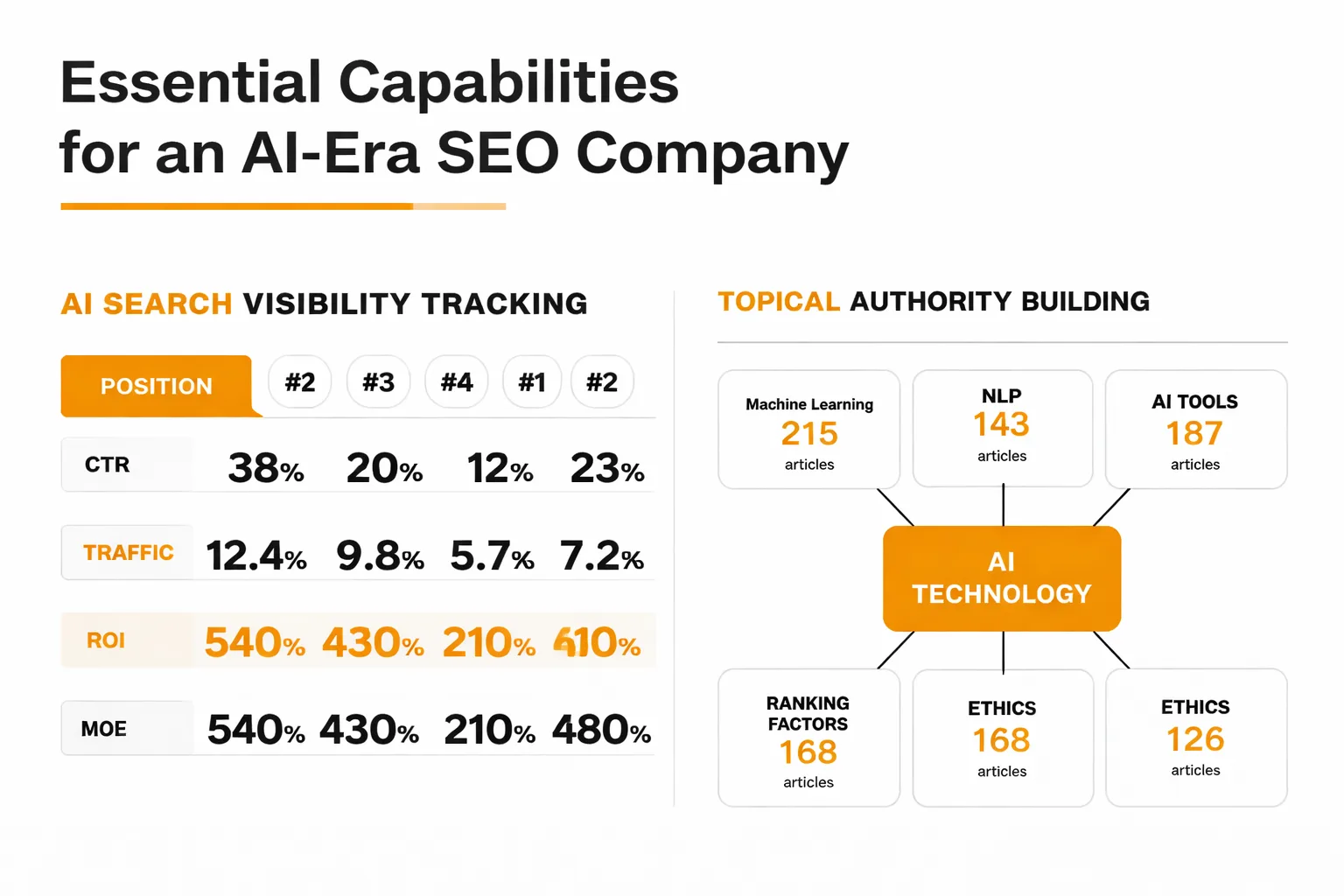
AI search visibility tracking. The agency must track where your brand appears across every major AI search surface. Not just Google. I'm talking about ChatGPT, Claude, Gemini, Perplexity, Grok, Google AI Overviews, and AI Mode. If they only track Google rankings, they're giving you half the picture. You can check your own AI visibility right now to see what I mean. Most businesses are shocked to learn they're invisible in AI answers for queries they rank well for in classic search.
Topical authority building. Building a topical authority map is how you become the source AI engines cite. AI systems don't just match keywords to pages. They evaluate whether a domain has comprehensive, interconnected coverage of a topic. An agency that talks about keyword research but not topic clusters is working from an outdated playbook.
Citation strategy. This is the one most agencies miss entirely. Research shows that 84% to 89% of AI-generated answers cite earned media, meaning third-party coverage in credible publications. Your own content matters, but AI engines trust external sources more. A competent 2026 agency should have a strategy for getting your brand mentioned on the domains AI engines actually cite. This is what I call Machine Relations, and it's becoming the dominant lever for AI visibility.
Content quality at scale. The agency needs a system for producing content that satisfies both Google's quality standards and AI citation criteria. That means fact-verified claims, authoritative outbound citations, and genuine depth. I've seen what happens when teams chase volume without quality controls. Sites get buried. The Semrush analysis of AI SEO tools confirms that the best tools save hours on research and reporting, but none of them replace human editorial judgment.
How Do You Evaluate Potential SEO Partners?
Start with a simple test. In your first consultation, ask the agency to explain the difference between SEO and AEO. If they fumble or give you a vague answer about "optimizing for AI," they're not qualified. The difference between AEO and SEO is specific and technical. AEO focuses on getting cited in AI-generated answers. SEO focuses on ranking in search results. They require different tactics, different content structures, and different success metrics.
A competent agency should be able to tell you:
1. Which AI surfaces they track for your brand and how often they refresh data 2. What your current share of voice is across AI engines versus competitors 3. Which domains AI engines cite most for your topics (and their plan to get you on those domains) 4. How they structure content for AI extractability (schema markup, clear answers, source citations) 5. Their approach to AEO versus GEO and which matters more for your industry
If the agency can answer all five with specifics, you've found a real partner. If they deflect or generalize, keep looking.
I also recommend running your own AI visibility check before you start agency conversations. When you know your baseline, you can tell immediately whether an agency is giving you real analysis or sales fluff. I've sat in discovery calls where the agency's "audit" was less thorough than what a free tool produces in 30 seconds.
Is your current agency tracking your AI search visibility, or just Google rankings?
When Does Local Proximity Actually Matter?
Here's my contrarian take. The "near me" in your search matters less than you think, and sometimes it's actively harmful.
Local proximity matters in exactly two scenarios. First, if you run a brick-and-mortar business where local SEO (Google Business Profile, local citations, review management) is the core of your strategy, a local agency understands your market. Second, if you need in-person collaboration for strategic alignment and your team learns better face-to-face, proximity has real value.
For everyone else, limiting your search to search engine optimization services near me shrinks your pool to agencies that may not have the AI search expertise you need. The best AI SEO company for you might be 2,000 miles away. The discipline is so new that geographic proximity has almost no correlation with capability.
I'd rather hire a remote agency that nails AI visibility than a local one that's great at 2021-era link building. The work happens in dashboards, Slack, and weekly calls. You don't need someone two miles away for that.
That said, if you do want local, use the local search itself as a diagnostic. Search for "search engine optimization company near me" and see which agencies show up in Google AI Overviews for that query. If an agency can't rank or get cited for their own target keyword in AI search, they can't do it for you either.
Red Flags That Disqualify an Agency Immediately
Some warning signs are obvious. Promises of "#1 rankings in 30 days" have been scams since 2010. But in 2026, there's a new set of red flags specific to AI-era SEO.
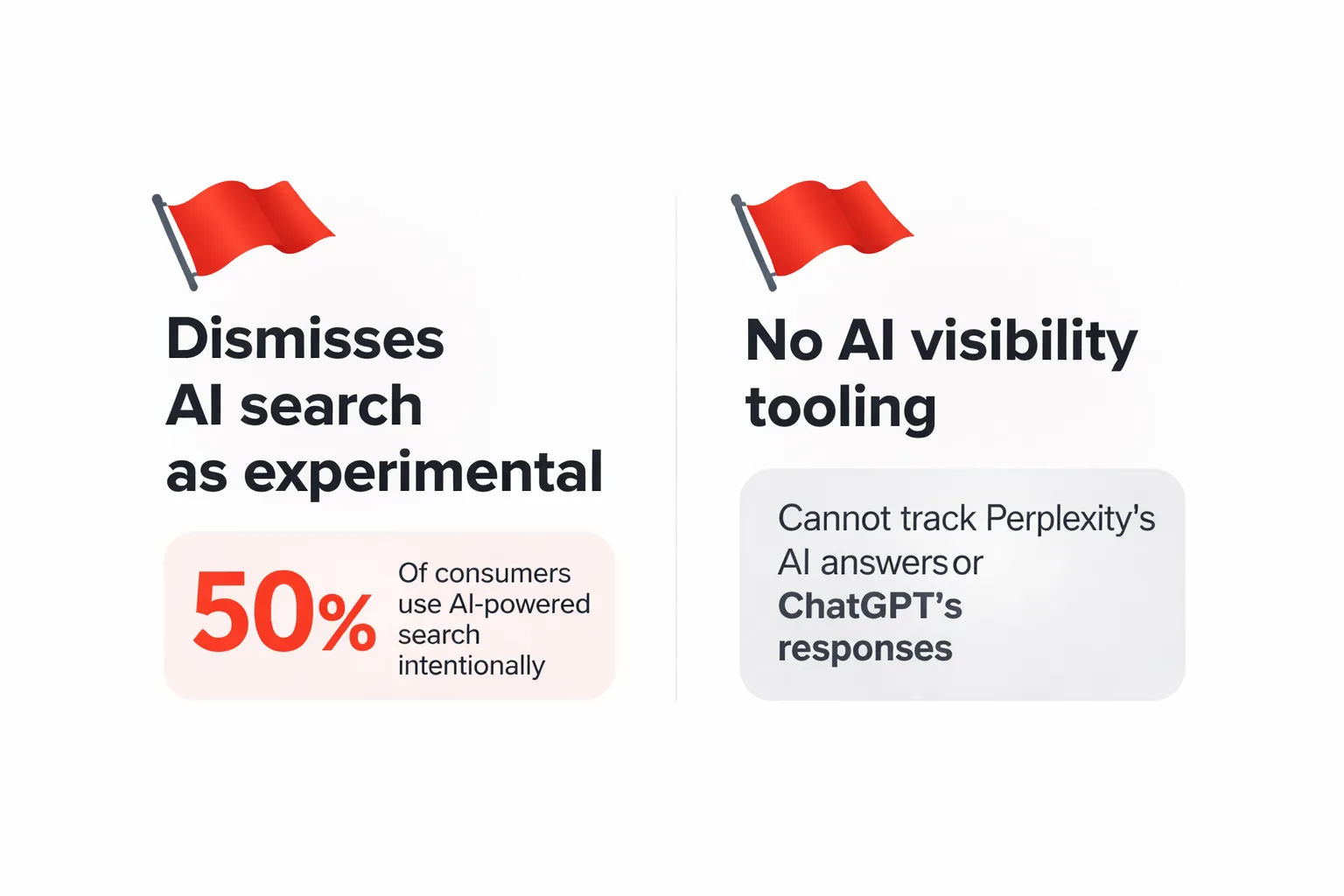
They dismiss AI search as experimental. I hear this from traditional agencies constantly. "AI search is still too new to optimize for." This is categorically false when 50% of consumers are already using AI-powered search intentionally. An agency that dismisses AI search in 2026 is protecting their own lack of capability, not giving you strategic advice.
They have no AI visibility tooling. Ask what tools they use to track AI citations. If the answer is "we monitor it manually" or "we use ChatGPT sometimes," they have no system. Tracking AI visibility requires purpose-built infrastructure because each AI engine surfaces answers differently. Perplexity's AI answers look nothing like ChatGPT's responses, and both differ from Google AI Overviews.
They promise AI citation guarantees. The flip side of dismissal is overpromise. No agency can guarantee you'll be cited by ChatGPT or Perplexity. AI citation depends on factors no single agency controls, including model training data, retrieval indexing, and query phrasing. An honest agency will talk about increasing your probability of citation through systematic authority building, not guaranteeing specific placements.
They use AI for content without quality controls. This is the one I care about most because I've lived it. AI-generated content without human oversight produces what we call AI slop. Generic, error-prone, em-dash-laden content that Google's quality systems can spot from a mile away. I've seen clients invest six months in an AI-powered content platform only to end up with material so robotic it generated zero organic traffic growth. The agency or platform must have a quality firewall, meaning drafts are evaluated against specific quality criteria before publication. If they can't describe their quality gate, they don't have one.
What Should an SEO Services Proposal Include?
A legitimate 2026 proposal from a search engine optimization agency should read differently from one written five years ago. Here's what to look for.
AI visibility baseline. The proposal should include a current-state analysis of where you appear across AI search engines. Not just Google. This means showing your mention rate, citation position, and share of voice on ChatGPT, Perplexity, Claude, Gemini, and Google AI Overviews. If the proposal only covers Google rankings, the agency is pitching you half a service.
Topical authority assessment. The proposal should map your current content coverage against your competitors and identify topic gaps. Which subtopics does your site cover shallowly? Where do competitors have deeper clusters? This assessment drives the content strategy. Without it, you're just publishing random blog posts and hoping something sticks.
Citation gap analysis. This is the most forward-looking element. The agency should identify which domains AI engines cite for your target topics and assess whether you're mentioned on those domains. If competitors are cited on industry publications and you're not, that's a gap with a specific fix: earned media outreach.
Technical SEO fundamentals. None of the AI stuff matters if your technical foundation is broken. The proposal should include a site audit covering crawlability, page speed, schema markup, mobile usability, and indexation. Tools like our free AI crawler simulator can give you a preview of how AI engines see your site. A good agency will run something similar and include findings in the proposal.
Clear success metrics. The proposal should define what success looks like in measurable terms. Not just "improved visibility" but specific targets: AI mention rate, share of voice percentage, organic traffic growth, ranking improvements for target queries. And the metrics should cover both traditional and AI search surfaces.
How Much Should You Pay in 2026?
Pricing in the SEO industry has always been opaque, and AI-era services make it more complex. Here's what I've observed in the market.
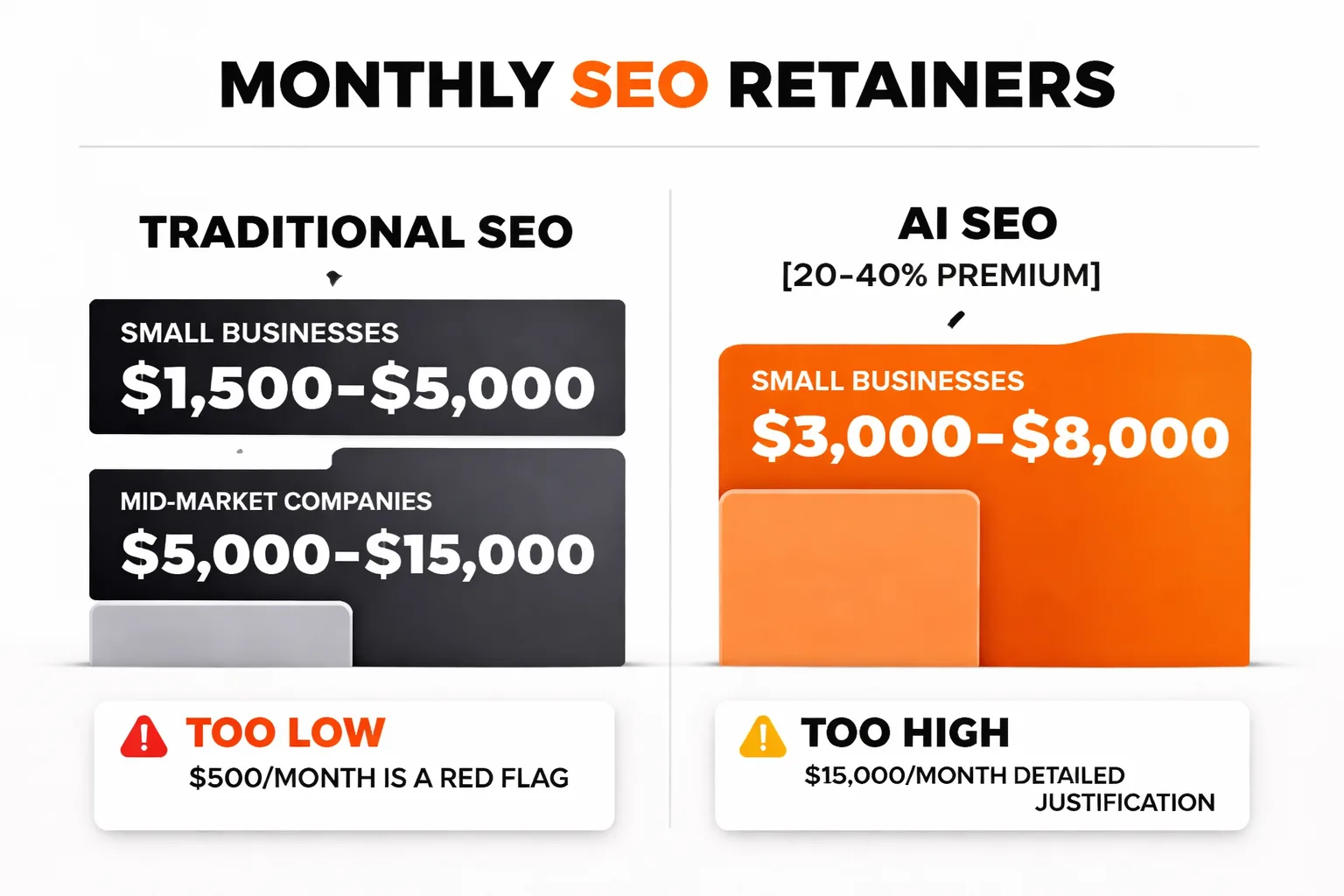
Traditional SEO retainers range from $1,500 to $5,000 per month for small businesses and $5,000 to $15,000 for mid-market companies. AI SEO services typically command a 20-40% premium because the tooling and expertise are scarce. A competent agency that covers both traditional and AI search will usually fall in the $3,000 to $8,000 range for small businesses.
Be wary of pricing that's too low. If an agency charges $500/month and promises AI visibility, they're either lying or using automated tools without human oversight. The math doesn't work. AI visibility tracking alone requires API calls across multiple platforms, and quality content production requires skilled editors. A $500 retainer covers neither.
Be equally wary of pricing that's too high without justification. A $15,000/month retainer should come with a detailed breakdown of what you're getting: how many AI surfaces are tracked, how many content pieces per month, what outreach is included, what reporting cadence. If the agency can't itemize the work, the premium is paying for their brand name, not their service.
Why Does AI Search Visibility Require a Different Approach?
This is the question that separates 2026-ready agencies from everyone else.
Traditional SEO is deterministic. You optimize a page for a keyword, build links to it, and Google ranks it. The relationship between input and output is relatively predictable. You can model it, track it, and iterate on it.
AI search is probabilistic. When someone asks ChatGPT a question, the model retrieves information from its training data and live web sources, synthesizes an answer, and decides which sources to cite. You can't optimize for this the way you optimize for Google rankings. You can only increase the probability that AI engines consider your brand authoritative enough to cite.
This requires a fundamentally different strategy. Instead of optimizing individual pages for individual keywords, you need to build domain-level authority across topic clusters. Instead of building links to specific pages, you need to earn mentions on the third-party publications AI engines cite. Instead of tracking rankings, you need to track AI citations and share of voice across platforms.
The Research and Markets SEO services report projects the market growing from $92.74B to $108.28B at 16.8% CAGR. That growth is being driven by AI search demand, not traditional SEO. Agencies that capture this growth are the ones investing in AI visibility tooling and citation strategies. Agencies that don't are coasting on legacy retainers.
The Semrush AI SEO statistics back this up. With Google AI Overviews reaching 2 billion monthly users and roughly 60% of searches yielding no clicks, the old model of "rank high and get clicks" is eroding. You need an agency that understands citations are the new clicks.
Questions to Ask Before Signing a Contract
Before you commit to any search engine optimization company near me, get answers to these questions in writing.
What AI search surfaces do you track, and how often is the data refreshed? The answer should include at least ChatGPT, Perplexity, Google AI Overviews, and Claude. Daily or weekly refresh is the minimum acceptable cadence.
Can you show me a citation gap analysis for my industry? This tests whether they have the tooling and methodology. If they can produce one on the spot or within a few days, they have the infrastructure. If they need weeks or can't explain what it is, they don't.
How do you structure content for AI extractability? Look for answers about schema markup, clear question-answer formats, factual claims with source citations, and topical depth. Vague answers about "writing quality content" mean they don't have a system.
What's your approach to earned media for AI citations? This is the Machine Relations question. The agency should explain how they identify which publications AI engines cite, how they build relationships with those outlets, and how they measure citation impact. If they conflate this with traditional link building, they don't understand the difference.
How do you measure success across both traditional and AI search? The agency should track a blended set of metrics: Google rankings, organic traffic, AI mention rate, AI citation share, and referral traffic from AI engines. If they only track rankings and traffic, they're measuring half the battlefield.
What This Actually Means
Finding the right search engine optimization company near me in 2026 requires a complete rethinking of what "SEO" means. The agencies worth hiring are the ones that treat AI search visibility as a first-class discipline, not an add-on to their traditional SEO package.
The market is moving fast. With website traffic from AI search projected to surpass traditional search by 2028, the agency you hire today needs to be building infrastructure for a world where AI citations matter more than blue-link rankings. That's not a future prediction. That's a current trajectory backed by real data.
Here's my bottom line. Stop evaluating agencies on 2021 criteria. Start evaluating them on whether they can track, build, and measure your visibility across every surface where your customers are actually searching. That includes Google. It includes ChatGPT, Perplexity, Claude, Gemini, and Google AI Overviews. If your agency can't do all of that, you've hired the right partner for the wrong decade.
The best SEO company for you in 2026 isn't the one closest to your office. It's the one that understands search has fundamentally changed and has the tools, methodology, and honesty to prove it.
FAQ
Should I hire a local SEO agency or a remote one?
Local matters if you need brick-and-mortar local SEO (Google Business Profile, local citations, review management) or if you strongly prefer in-person strategy sessions. For everything else, geographic proximity has almost no bearing on capability. AI-era SEO expertise is so new that the best partner for you might be across the country. Prioritize AI search competency over zip code.
How long before I see results from an AI-era SEO agency?
Traditional SEO results typically appear in 3-6 months. AI visibility results can appear faster (4-8 weeks) if the agency implements citation tracking and earned media outreach immediately. However, building topical authority that AI engines consistently cite takes 4-6 months of sustained content production and relationship building. Any agency promising faster results is selling you something.
What's the difference between AI SEO services and traditional SEO services?
Traditional SEO focuses on ranking pages in Google search results through keyword optimization, technical fixes, and link building. AI SEO services focus on getting your brand cited in AI-generated answers across ChatGPT, Perplexity, Claude, and Google AI Overviews through topical authority, earned media, and content structured for AI extractability. The best agencies do both.
Can I use AI SEO tools instead of hiring an agency?
AI SEO tools can handle research, content generation, and tracking, but they require human strategy to be effective. Tools without oversight produce low-quality content that hurts rather than helps. If you have an in-house content strategist, tools plus oversight can work. If you don't, an agency (or a platform with built-in quality controls) is the better choice.
How do I know if my current agency is falling behind on AI search?
Ask them three questions: What's my AI citation rate? Which AI surfaces are you tracking for me? What's my share of voice compared to competitors? If they can't answer all three with specific numbers, they're not tracking AI visibility. That's your sign to start looking for a new partner.
About the Author
Judy Zhou, Founder
Judy Zhou leads content strategy at Meev, where she oversees AI-driven content research and publishing for hundreds of brands. With a background in SEO and editorial operations, she focuses on building content systems that rank on Google, get cited by AI search engines, and drive measurable business results.
Check your AI visibility across every major AI search surface for free, then decide if your agency is doing enough.