

By Judy Zhou, Founder
Key Takeaways
- AI engines skip fragmented content libraries and cite only competitors with semantically complete, entity-rich clusters on a topic.
- Replace single-page keyword targeting with a topical authority map that covers every key concept to earn LLM citations.
- Treat topical authority as your primary moat, since Keyword Insights research shows generic content no longer competes in AI search.
- Track LLM visibility by brand association across key concepts, not keyword density, per Wix AI Search Lab findings.
AI search doesn't rank pages. It cites authorities.
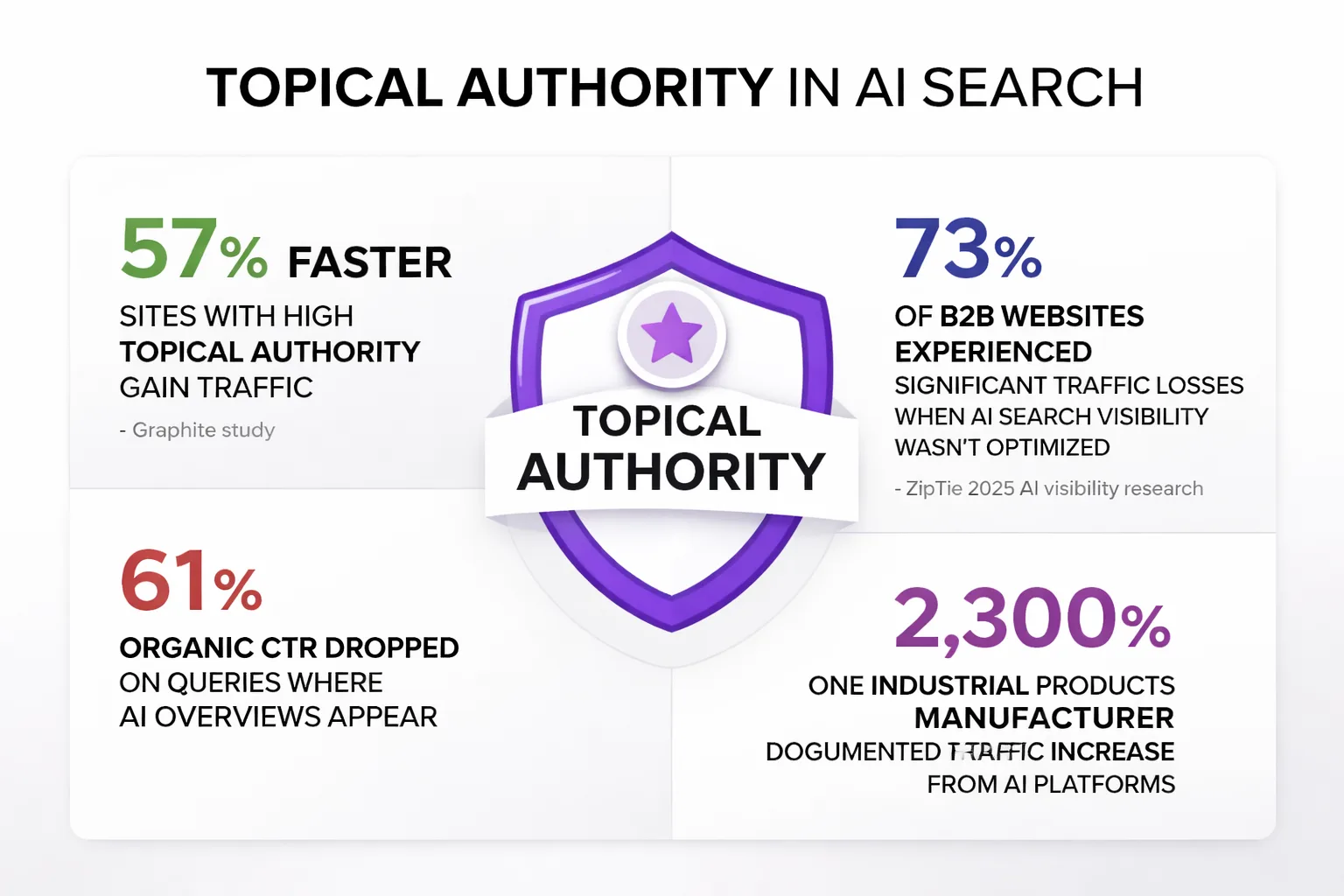
Topical Authority is no longer just an SEO concept. It's the mechanism AI engines use to decide whose voice gets amplified and whose gets ignored. If your content library covers a topic in fragments, ChatGPT and Perplexity don't stitch those fragments together into a coherent picture of your brand. They skip you entirely and cite the competitor who published a semantically complete, entity-rich cluster. Building a topical authority map for AI search requires a fundamentally different approach than traditional keyword targeting. The four steps below walk through exactly how to do it.
Key facts before we start: - AI engines reward semantic completeness, not individual page rankings — a fragmented content library gets ignored even when single pages rank on Google. - Keyword Insights research identifies topical authority as a primary moat against AI search displacement — generic content no longer competes. - Practitioners are increasingly framing non-appearance in AI results as a strategic problem, not just a traffic metric, according to SEO community discussions on Facebook SEO Workout. - Wix's AI Search Lab research confirms that LLM visibility correlates with brand association across key concepts — not just keyword density.
Why Topical Authority Works Differently in AI Search
Traditional SEO rewarded depth on individual URLs. Rank one page for one keyword, build links to it, done. AI search breaks that model entirely.
Large language models don't crawl and rank. They retrieve and synthesize. When a user asks Perplexity or ChatGPT a question about, say, B2B content strategy, the model scans its training data and retrieval index for sources that demonstrate comprehensive, authoritative coverage of that topic as a whole. A single high-ranking blog post doesn't signal authority. A coherent cluster of 15 interlinked articles that covers every meaningful subtopic does.
The technical reason is how retrieval-augmented generation (RAG) works. AI engines chunk documents, embed them as vectors, and retrieve based on semantic similarity to the query. If your brand has dense semantic coverage across a topic space, your chunks appear repeatedly in retrieval results. If you have one excellent article surrounded by thin or unrelated content, that article gets retrieved once and then your signal disappears. The model cites whoever shows up most consistently across the most relevant chunks.
This is why understanding AEO vs SEO matters so much right now. The optimization targets are different. SEO asks: does this page rank for this keyword? Answer engine optimization asks: does this brand own this topic space in the model's understanding? Those are not the same question, and the content strategies that answer them diverge sharply.
Fragmented content libraries are the single biggest reason brands disappear from AI answers despite strong Google rankings. I've seen this pattern repeatedly in my work overseeing content strategy at Meev: a brand ranks on page one for a competitive keyword, but gets zero AI citations because the surrounding content cluster is thin. The AI engine sees one strong node and a lot of noise.
The fix is a topical authority map built specifically for how AI engines interpret semantic relationships.
Step 1. Audit Your Current Topic Coverage
Before you build anything new, you need an honest inventory of what exists. Most content teams skip this step and go straight to publishing. That's why their topical authority maps never cohere.
Start with a simple spreadsheet. Pull every published URL from your sitemap or CMS. For each URL, record: the primary topic, the subtopic cluster it belongs to, the word count, the last updated date, and whether it has been cited in any AI answer you've tracked. That last column is the one most teams don't have. And it's the most important.
For a concrete example: imagine a SaaS brand selling project management software. Their content audit might reveal 40 published articles, but when you cluster them by topic, 28 of those articles are about general productivity tips, 8 are about their own product features, and only 4 actually cover project management methodology. Which is the core topic space they need to own. The cluster that matters most is the thinnest. That's the gap the audit surfaces.
To score coverage depth per cluster, use a simple 1-5 scale: 1 means only one article exists on the topic, 3 means you have a pillar plus 2-3 supporting pieces, 5 means you have a pillar, 6+ supporting subtopics, and at least one data-rich or original-research piece that AI engines can cite as a primary source. Most brands score 1-2 across their most important topic clusters. That's the gap you're mapping.
For AI citation data specifically, a tool like Meev's AI visibility tracker shows you which of your pages are actually being cited across ChatGPT, Claude, Gemini, Perplexity, and Google AI Overviews. Running this audit before you build your map tells you which existing content is already pulling weight. And which clusters are invisible to AI engines entirely. You can also run a quick Perplexity AI visibility check to see how your brand appears in Perplexity answers specifically, since Perplexity is currently one of the most citation-transparent AI search surfaces.
The output of Step 1 is a spreadsheet with three columns highlighted in red: topic clusters with zero AI citations, topic clusters with fewer than three supporting articles, and topic clusters where your competitors are cited but you aren't. Those red cells are your map's starting point.
Step 2. Build Your Pillar-Cluster Map
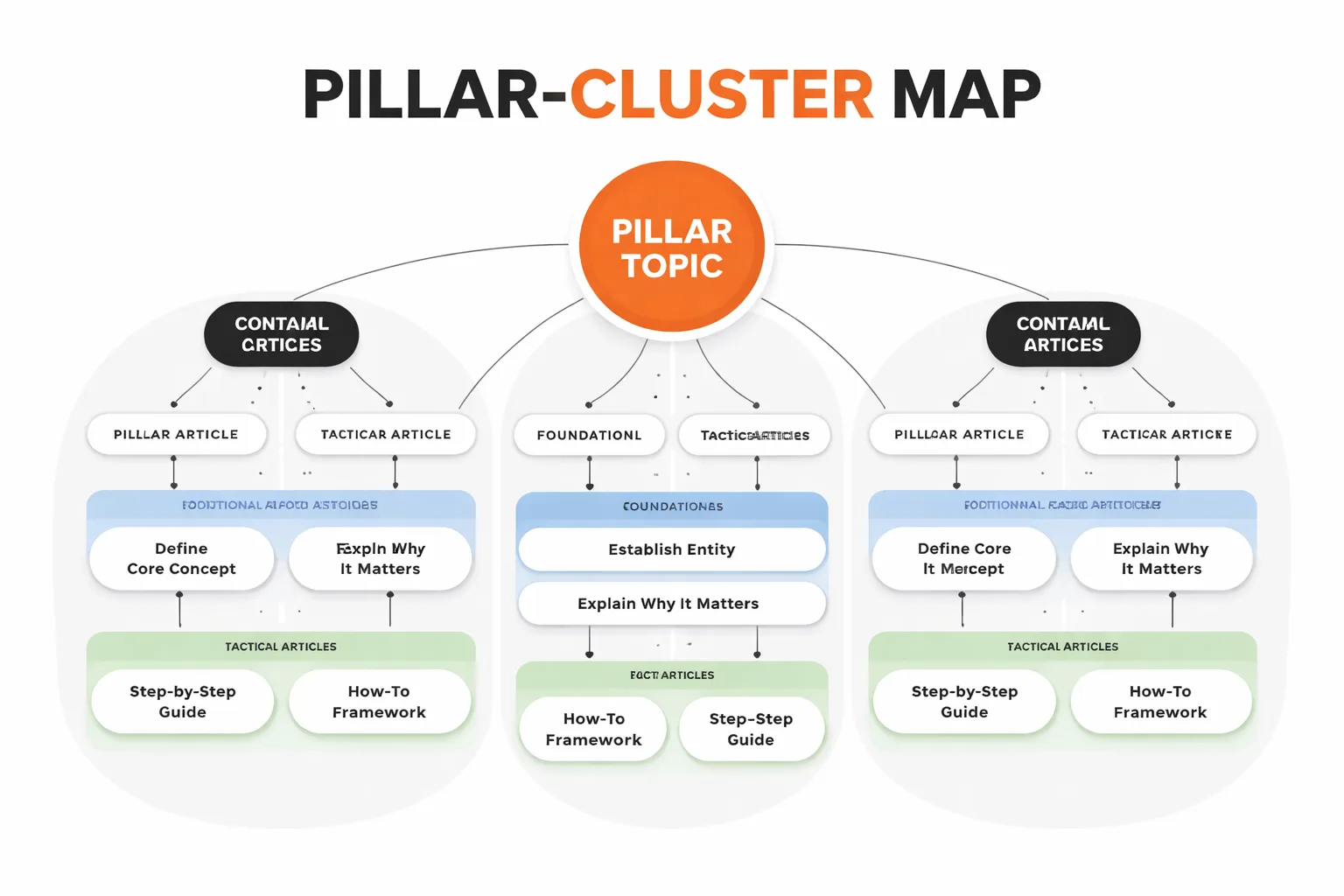
Now you're building the actual structure. The pillar-cluster model isn't new, but the criteria for prioritizing what goes into it have changed significantly for AI search.
Define 3-5 core pillars first. These should be the broad topic areas where your brand has genuine expertise and commercial intent. For the project management SaaS example: Agile methodology, remote team coordination, project tracking and reporting, resource planning, and team communication. Each pillar becomes a hub. Every piece of content you publish either belongs to one of these hubs or it doesn't belong in your content strategy at all.
Under each pillar, map the supporting subtopics. This is where most teams underinvest. A strong pillar needs at minimum 8-12 supporting subtopics to generate the semantic density that AI engines recognize as authoritative coverage. For the Agile methodology pillar, those subtopics might include: what is a sprint, sprint planning templates, how to run a retrospective, agile vs waterfall comparison, agile for non-software teams, agile project management tools, common agile mistakes, scaling agile across departments, and so on.
Prioritize subtopics using three signals, not one. Traditional SEO uses search volume. For topical authority map building, you need: search volume (how many people are searching for this), AI citation frequency (how often is this subtopic appearing in AI answers in your category), and competitor gap data (which subtopics are your competitors ranking for and getting cited on that you aren't). The intersection of high-volume, high-AI-citation-frequency, and competitor gap is where you publish first.
Here's a sample pillar-cluster structure for a B2B SEO tools brand:
Pillar: Content Strategy for AI Search - What is generative engine optimization. How AI search engines retrieve content. Content structure for AI answer extraction. Topical authority for AI search (this article) - How to track AI citations. Optimizing for Google AI Overviews. AEO vs SEO: what changes. Entity optimization for LLMs. How to appear in Perplexity answers. Building a content cluster for AI visibility
That's 10 subtopics under one pillar. Each one is a publishable article. Together, they create the semantic density that tells AI engines: this brand owns the content strategy for AI search topic space.
If you want to understand the broader distinction between answer engine optimization and traditional search before building your map, what is AEO is worth reading first. The conceptual grounding matters when you're deciding which pillars to prioritize.
Step 3. Publish and Interlink Systematically
Having a map is not the same as executing one. The publishing and interlinking phase is where most topical authority strategies stall.
Publishing cadence matters more than publishing volume. A common mistake I see is publishing 20 articles in a month and then going quiet for two months. AI engines and Google crawlers both respond better to consistent, predictable publishing signals. For a brand building a new pillar from scratch, a cadence of 2-3 articles per week within that pillar for 8-10 weeks creates a coherent semantic signal. Publishing one article a week scattered across five different pillars creates noise.
Internal linking is the mechanism that signals topical relationships to both Google crawlers and AI retrieval systems. Every supporting subtopic article should link to its pillar page. Every pillar page should link to all supporting subtopics. Related subtopics within the same pillar should cross-link when the connection is genuinely relevant. The anchor text matters: use descriptive, keyword-rich anchors that name the concept you're linking to, not generic phrases like "click here" or "learn more."
For AI retrieval specifically, structured data amplifies topical signals in ways that plain prose doesn't. Implementing Article schema on every piece, FAQ schema on articles that answer specific questions, and HowTo schema on tutorial content gives AI engines explicit semantic markers to work with. When Perplexity or Google AI Overviews is deciding which source to cite for a specific answer, structured data that explicitly labels the content type and topic gives your page a retrieval advantage.
Content structure for AI answer extraction follows a specific pattern: lead with a direct answer to the question the article addresses (the first 50-100 words should be extractable as a standalone answer), use H2 and H3 headings that match natural language question patterns, and include specific named claims with source citations. AI engines preferentially extract content that is already formatted like an answer. If your article buries the key insight in paragraph seven, it won't get cited even if the insight is excellent.
For teams publishing at scale, Meev's automated publishing workflow handles internal linking placement, schema markup generation, and archetype-aware content structure automatically. The platform's quality firewall blocks drafts that don't meet the 16-dimension quality standard before they reach your CMS, which matters because publishing thin content into a topical cluster actively degrades the cluster's authority signal. One weak article in a pillar is worse than no article at all. You can see how this compares to research-only tools in the Meev vs Surfer SEO comparison.
The AEO vs GEO distinction is also worth understanding at this stage. Answer engine optimization focuses on extractability for direct answers. Generative engine optimization focuses on brand association across a topic space. Your publishing and interlinking strategy needs to serve both simultaneously.
Want to see which topics your brand is actually getting cited for across AI search engines?
How to Measure Topical Authority Gains Over Time
Most teams measure topical authority by looking at keyword rankings. That's the wrong metric for an AI search world.
The right metrics are: AI citation rate (what percentage of AI answers in your topic space include your brand), SERP cluster coverage (how many of the top 10 results for subtopics in your pillar are yours), share of voice in AI answers (your citations vs. competitor citations for the same topic space), and internal link equity distribution (are your pillar pages accumulating the link signals from supporting content).
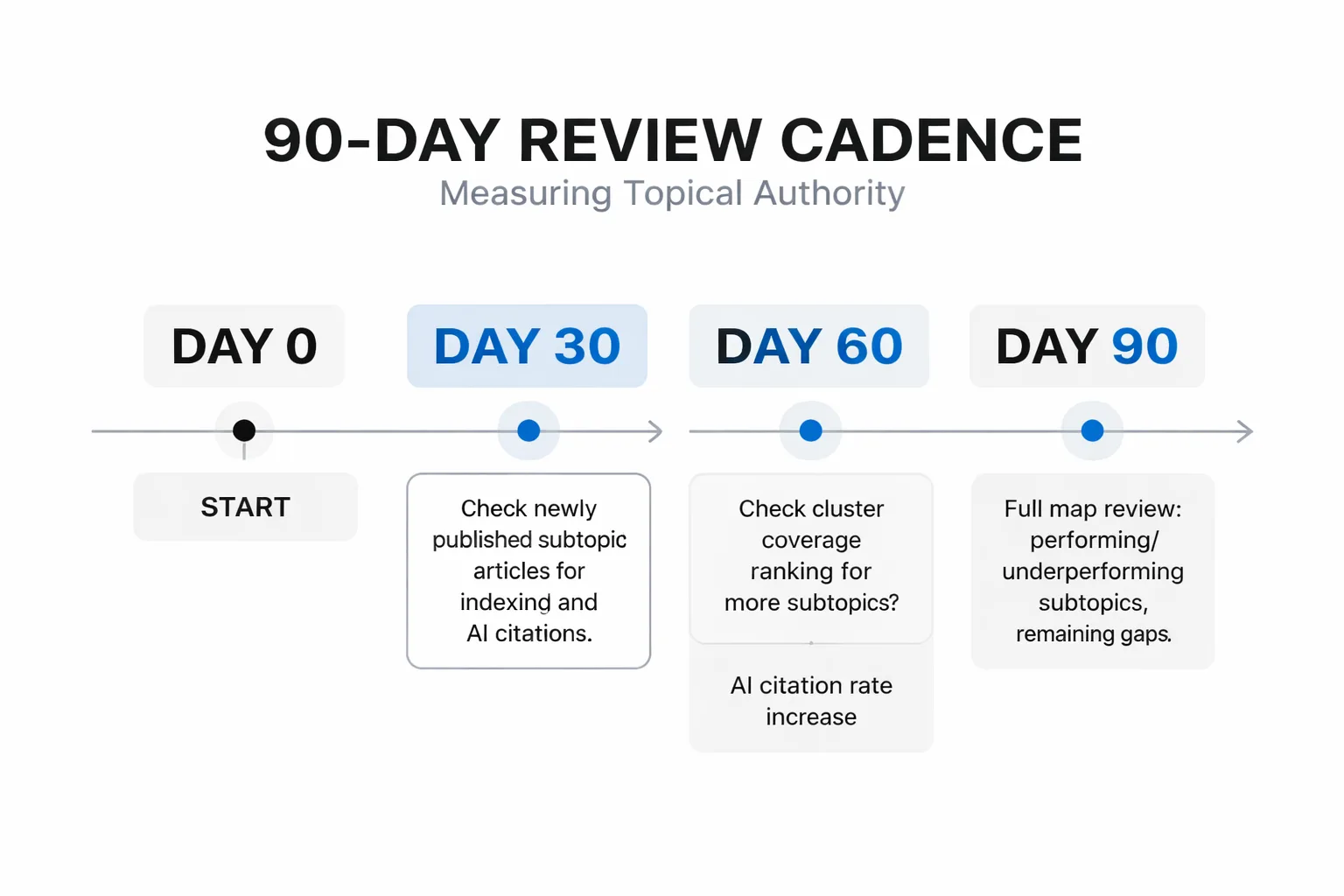
Set a 90-day review cadence. At 30 days, check whether newly published subtopic articles are getting indexed and whether any have appeared in AI citations. At 60 days, check cluster coverage: are you ranking for more subtopics in the pillar? Has your AI citation rate for that topic increased? At 90 days, do a full map review: which subtopics are performing, which are underperforming, and what gaps remain.
The Wix AI Search Lab research found that LLM visibility correlates with brand association across key concepts — meaning the goal isn't to get cited once, it's to be the default association for a topic in the model's understanding. That requires consistent measurement and iteration, not a one-time publishing sprint.
For AI citation tracking specifically, you need a tool that queries AI engines directly and records where your brand appears in the answer, not just whether it appears. Mention position matters: appearing first in a cited list signals stronger authority than appearing fourth. Meev's per-LLM drill-down dashboards show exactly where in each AI answer your brand appears, with the actual response text and citations, which makes iteration meaningful rather than directional.
Content marketing automation plays a role here too, but only when it's quality-gated. Automated content that degrades your cluster's semantic coherence is worse than no content. The measurement framework keeps you honest: if AI citation rate isn't improving after 90 days of publishing into a pillar, the content quality or topical relevance is the problem, not the volume.
Where This Approach Breaks Down
I want to be direct about the scenarios where a topical authority map doesn't solve the problem, because the pattern I keep seeing is teams investing heavily in the map and then being surprised when results don't follow.
First, if your domain has a trust or authority problem at the root level, topical cluster depth won't fix it. A brand-new domain with no backlinks and no established entity signals in AI training data needs foundational authority work before topical clustering pays off. The map amplifies existing authority; it doesn't create authority from nothing.
Second, if the content being published into the cluster is genuinely thin or AI-generated without quality oversight, the cluster actively hurts you. Google's Helpful Content System and AI engines both penalize semantic noise. One generic, uninformative article in a pillar signals to AI engines that the cluster is low-quality. This is the failure mode I've watched repeatedly: teams automate their way into a cluster that looks comprehensive on a spreadsheet but reads as hollow to any retrieval system.
Third, topical authority maps don't fix conversion problems. If your content gets cited by AI engines but the traffic that follows doesn't convert, the map isn't the variable to optimize. That's a product-market fit or landing page problem.
Frequently Asked Questions
How many articles do I need to establish topical authority in a pillar?
There's no universal number, but the pattern I see in high-performing clusters is a minimum of one pillar page plus 8-10 supporting subtopic articles. Below that threshold, the semantic density isn't sufficient for AI engines to recognize the brand as a comprehensive source. For competitive topic spaces, 15-20 supporting articles is more realistic.
Does topical authority for AI search differ from traditional topical authority?
Yes, in one critical way. Traditional topical authority is measured by Google's crawlers assessing internal link structure and content relevance. AI topical authority is measured by how consistently your brand appears across the vector embeddings for a topic space. The content strategy overlaps significantly, but AI search requires more explicit entity signals, more structured data, and more direct-answer formatting than traditional SEO alone.
How long does it take to see AI citation gains after building a cluster?
In my experience, 60-90 days is the realistic window for a new cluster to start generating consistent AI citations, assuming quality content published at a steady cadence. Some fast-moving AI surfaces like Perplexity update their retrieval indexes more frequently than LLM training cycles, so Perplexity citations often appear before ChatGPT or Claude citations for the same content.
Should I prioritize Google rankings or AI citations when building my map?
Both, because they reinforce each other. Content that ranks well on Google gets crawled and indexed by AI engines more reliably. But the content structure that earns AI citations (direct answers, entity-dense prose, structured data) also tends to improve Google rankings. The strategies aren't in conflict. They're complementary. The AEO vs SEO breakdown covers this in more detail.
How do I find the subtopics my competitors are getting cited for?
The most direct method is running competitor brand queries across AI search surfaces and recording which topics trigger their citation. Tools like Meev's content opportunities feature surface this systematically: it identifies prompts where competitors are cited but you aren't, which is exactly the gap data you need to prioritize your subtopic publishing queue. You can also run a free AI SEO audit to get an initial read on your current AI search visibility gaps.
About the Author
Judy Zhou, Founder
Judy Zhou leads content strategy at Meev, where she oversees AI-driven content research and publishing for hundreds of brands. With a background in SEO and editorial operations, she focuses on building content systems that rank on Google, get cited by AI search engines, and drive measurable business results.
Track your AI citation rate, find competitor gaps, and publish quality-gated content that builds topical authority — all in one platform.