

By Judy Zhou, Founder
Key Takeaways
- Global household names appear in only 73% of relevant AI answers, proving no single tool has solved brand visibility in generative search.
- 42% of agencies now field client questions about organic traffic drops caused by AI engines answering queries without citing the brand.
- Skip the search for one best AI optimization tool and instead combine mention tracking, citation-gap diagnosis, content publishing, and entity building into one workflow.
- Teams that buy only a tracking dashboard stall because the data never tells them the next concrete action to improve AI citations.
Your brand shows up beautifully in Google's organic results. Then a prospect asks ChatGPT which vendor to consider in your category, and your competitor's name appears three times in the response. Yours doesn't appear once. Your team pulls up every dashboard you subscribe to. Nothing tracks this. Nobody knows if it's a content gap, an entity grounding problem, a Wikidata issue, or just the model's training cutoff. That moment. Confusing, urgent, and weirdly unmeasurable. Is exactly why the hunt for the best AI optimization tool for visibility has become so frantic.
There is no single best AI optimization tool for visibility. The category is too new and too fragmented. A peer-reviewed arXiv study analyzing 100,000+ prompt responses across 100+ brands found that global household names appear in only 73% of relevant AI answers. If even Nike-level brands are missing from a quarter of their relevant answers, no tool has solved this. What exists is a spectrum of tools that each handle a piece of the puzzle: tracking mentions, diagnosing citation gaps, publishing content, and building entity presence. The honest answer is that you need a workflow, not a winner.
I've spent the last two years building and testing AI visibility systems at Meev. The pattern I keep seeing is that teams buy a tracking tool, get a dashboard, and then stall because the dashboard doesn't tell them what to do next. 42% of agencies are now fielding client questions about organic traffic drops, and most attribute it to broader algorithm shifts rather than the real culprit: AI search engines are answering queries directly, and brands aren't cited in those answers.
Here's what I've learned about what actually matters.
What 'AI Optimization for Visibility' Actually Means in 2026
The category doesn't have clean borders yet. That's the first problem.
Ask three vendors what they do and you'll get three different answers. One tracks brand mentions in AI answers. Another generates content designed to get cited. A third optimizes your structured data and entity records. All three call themselves "AI search optimization tools" and all three are partially right.
The core distinction I use is this: AI optimization for visibility is the practice of measuring how often your brand appears in AI-generated answers across every major AI search surface, diagnosing why you're absent where you should be present, and taking action to close that gap. The action part is where tools diverge. Some stop at measurement. Others publish content. A few do both but skip the diagnostic layer entirely.
The reason this category exploded in 2026 is the divergence between Google rankings and AI citations. I've watched the overlap between top Google results and AI-cited sources collapse. Content that ranks #1 organically can be completely invisible to ChatGPT, Perplexity, or Claude. Understanding the difference between AEO and SEO is now a survival skill, not a nice-to-have.
The mechanics are different too. Traditional SEO rewards backlinks, keyword density, and domain authority. AI visibility rewards something else: semantic clarity, structured entities, and factual grounding. An LLM doesn't crawl your page and count keywords. It retrieves information from its training data and from real-time sources (in the case of Perplexity and ChatGPT search), then synthesizes an answer. If your brand isn't represented as a distinct entity in the sources the model trusts, you're invisible regardless of how good your content is.
That's why generative engine optimization requires a fundamentally different toolkit. You're not optimizing for a crawler. You're optimizing for a synthesizer.
Let me give you a concrete example of how this plays out. I worked with a B2B SaaS company that ranked #1 for their primary keyword on Google. They had strong backlinks, excellent on-page SEO, and a domain authority of 68. When we ran their brand through an AI visibility checker, they appeared in zero percent of relevant ChatGPT prompts. Zero. Their competitor, a company with half their domain authority and a fraction of their organic traffic, appeared in 41% of prompts. The reason? The competitor had a well-maintained Wikipedia page, a complete Wikidata entry with proper industry classifications, and was frequently mentioned in the types of comparison articles and Reddit threads that ChatGPT pulls from. The higher-ranking brand had none of that. They had invested entirely in traditional SEO and ignored entity presence. That's the gap.
The concept of "ai and search engine optimization" being the same thing is a dangerous myth in 2026. They overlap, but the mechanics diverge at the retrieval layer. Google's crawler reads your HTML. An LLM's retrieval system reads the semantic web: structured data, knowledge graphs, and the corpus of text it was trained on. If your brand exists in Google's index but not in the semantic web that LLMs access, you're invisible to AI search.
The 4 Criteria That Separate Good Tools From Hype
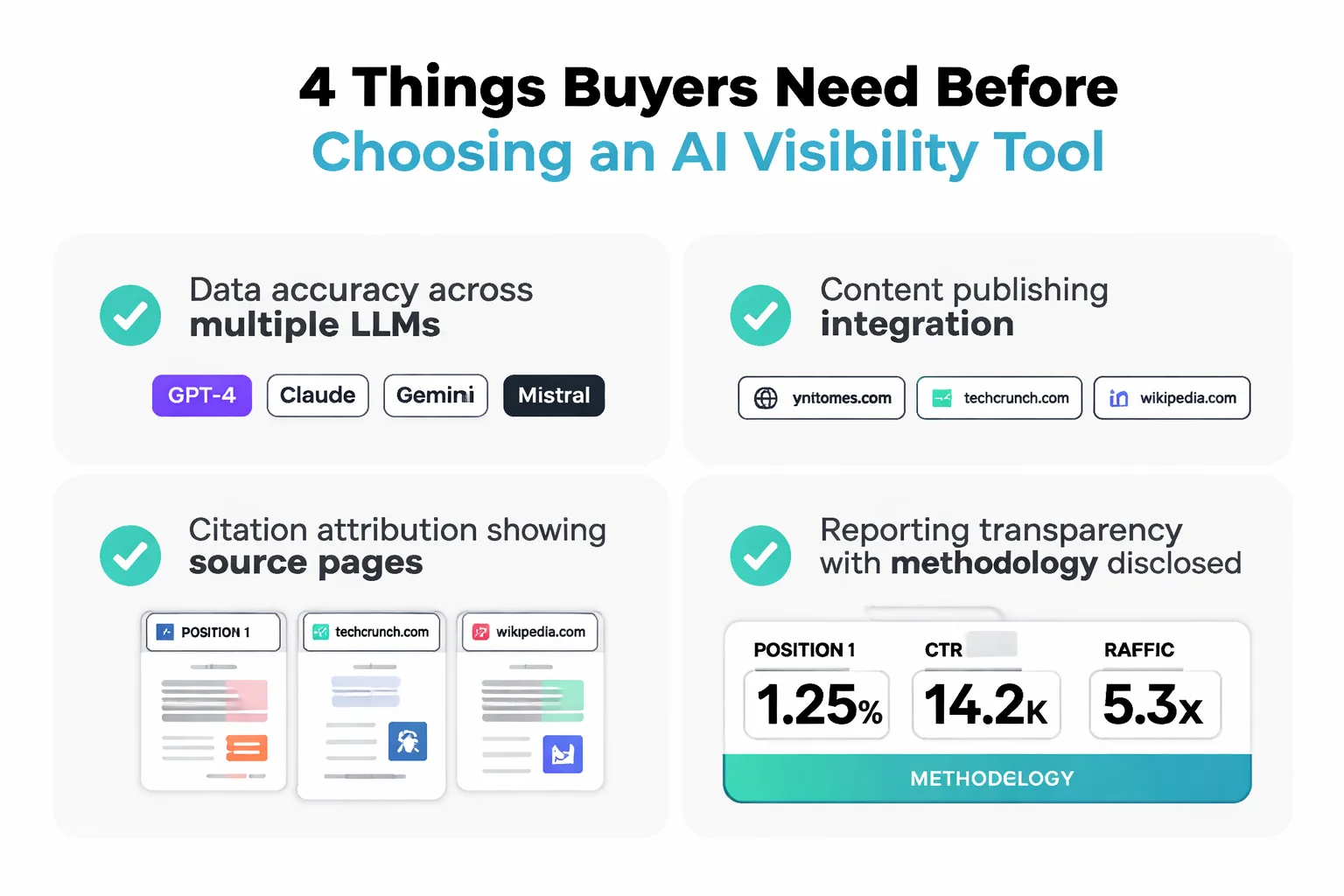
Most buying guides for AI optimization tools are useless. They list features without evaluating whether those features actually work. I've tested or audited most of the tools in this space, and four criteria consistently predict whether a tool will actually help you or just give you a pretty dashboard.
1. Data Accuracy Across AI Surfaces
This is the foundation. If a tool can't accurately tell you where you're cited and where you're not, nothing else matters.
The problem is that measuring AI answers is fundamentally harder than measuring Google rankings. Google's SERP is deterministic. Type a query, get a result. AI answers are probabilistic. Ask ChatGPT the same question three times and you might get three different responses with different cited sources. A tool that checks once and reports a number is giving you a snapshot, not a measurement.
I've seen tools that only track ChatGPT and call it "AI visibility tracking." That's like tracking Google and calling it "search visibility." You're missing Claude, Gemini, Perplexity, Grok, Google AI Overviews, AI Mode, and DeepSeek. Each has different retrieval mechanics, different training data, and different citation patterns. A proper AI visibility tracker needs to cover all of them with appropriate refresh cadences.
The arXiv study I mentioned earlier is the most rigorous public attempt I've seen to measure this at scale. The researchers ran 100,000+ prompts across ChatGPT, Claude, Perplexity, and Gemini. They found that brand visibility varies dramatically across engines. A brand might dominate in Perplexity and be absent from Claude. Any tool that aggregates across engines without showing per-LLM breakdowns is hiding the most important data.
Here's what good measurement looks like in practice. For each prompt, the tool should run multiple iterations (I'd want at least 3-5 per query) to account for probabilistic variation. It should record not just whether your brand was mentioned, but where in the response you appeared (first mention, in a list, last), what the sentiment was, and which sources the AI cited as the basis for the answer. It should track this over time with weekly trend lines so you can see whether your visibility is improving or declining. A Perplexity AI visibility checker that only tells you "yes, you were mentioned" without position, sentiment, and source attribution is giving you a fraction of the picture.
The cost of bad measurement here is real. If a tool reports that you're visible in 35% of prompts but the actual rate (across multiple iterations) is 12%, you'll underinvest in content. If it reports 12% but the real rate is 35%, you'll waste budget on content you don't need. The methodology matters more than the number.
2. Citation Attribution (Which Sources Drive Mentions)
Knowing you're mentioned is step one. Knowing WHY is where the actual work begins.
When ChatGPT cites your competitor in response to "best project management tools for startups," it's pulling that mention from somewhere. Maybe it's a G2 comparison page. Maybe it's a Reddit thread. Maybe it's a Wikipedia entry or a Wikidata record. The tool you choose needs to show you the citation path: which domains and specific pages the AI engine used as its source.
This is what I call the "so what" test for AI visibility tools. A dashboard that says "you're mentioned in 12% of relevant prompts" answers the "what" question. A tool that says "you're mentioned in 12% of prompts, and here are the 8 source domains the AI is pulling from, and here's where your competitor is cited that you're not" answers the "so what" question. Only the second type is worth paying for.
Seer Interactive demonstrated this powerfully. They updated footer text on a site and saw ChatGPT results change within 36 hours, as documented by Chris Long. That's citation attribution in action: they identified the source the model was reading, changed it, and measured the impact. Without citation path tracking, you're guessing.
The practical workflow here looks like this: your tool identifies that Perplexity is citing domain X and domain Y for your topic. You check your presence on both. You have a strong page on domain X but zero presence on domain Y. Now you know exactly what to do: either create content on domain Y (if it's a platform you can publish on, like a guest post or a review site) or build relationships with the publishers who are being cited. This is what I mean by closing the loop. A tool that finds the publishers AI engines actually cite and surfaces verified contacts for outreach is doing something a tracking-only dashboard can't do.
The citation path also reveals entity grounding gaps. If the AI is citing Wikipedia and Wikidata for your category and your brand isn't in either, that's not a content problem. That's an entity problem. No amount of blog posts will fix it. You need to build your presence in the knowledge graphs the model trusts.
3. Content Publishing Integration
This is where most tools fall apart. They show you the gap but can't close it.
The workflow I see fail most often goes like this: a team buys an AI visibility tool, discovers they're missing from 80% of relevant prompts, and then... nothing. The dashboard doesn't tell them what to write. It doesn't generate content designed to get cited. It doesn't publish to their CMS. It doesn't submit to IndexNow or Google Search Console. They're stuck with a diagnosis and no treatment.
A complete AI SEO tool needs to connect measurement to action. That means finding content opportunities where competitors are cited but you aren't, generating articles that are fact-verified and structured for AI retrieval, and publishing them with proper indexing signals. The content generation piece is where I've seen the most disasters. Tools that ship raw LLM output without quality gates produce what I've started calling "AI slop". Content that reads like a machine wrote it, cites nothing, and adds no value to the web. Google's E-E-A-T guidelines and helpful content system will eventually bury it.
The quality gate is the differentiator. In my work auditing content operations, I've found that without a rigorous post-generation quality check (fact verification, citation validation, editorial structure, plagiarism detection), AI-generated content consistently underperforms human-written content in both rankings and AI citation rates. The gate slows you down by at least 50% compared to raw AI output. But it's the difference between content that gets cited and content that gets penalized.
Let me be specific about what a quality gate should check. First, factual accuracy: every claim in the article should be traced to a source. Not "according to research" but "according to [specific study with URL]." Second, editorial structure: the article should follow a clear archetype (how-to, listicle, explainer, problem-solver) with appropriate heading hierarchy and logical flow. Third, citation density: the article should cite authoritative sources inline, prioritized by domain authority. Fourth, originality: plagiarism detection to ensure the content isn't duplicating existing pages. Fifth, Google penalty risk: check for thin content signals, keyword stuffing, and other patterns that trigger algorithmic penalties. I've seen tools that check 16 dimensions before an article can publish. Most check zero.
The indexing piece matters more than people realize. Publishing content that isn't indexed is like writing a book and leaving it in your desk. You need automatic submission to Google Search Console and IndexNow pinging on every publish. Most auto-blogging tools don't integrate either. The ones that do give you a 24-48 hour head start on indexing, which compounds over hundreds of articles.
4. Reporting Transparency
If a tool won't tell you how it measures AI visibility, don't trust its numbers.
This is my biggest frustration with the current market. I've seen case studies claiming 7x increases in AI visibility, from 3.2% to 22.2%, with zero methodological transparency. How many prompts did they run? Over what time period? Across which LLMs? Did they control for prompt variation? Was the measurement deterministic or probabilistic? Without these answers, the numbers are marketing copy, not data.
Matt Pru from Stackmatix notes that AEO case studies are harder to find than SEO case studies because the discipline only emerged seriously in 2024-2025. The attribution complexity is real. But that doesn't excuse tools from hiding their methodology. A tool worth your money should tell you exactly how it samples prompts, how it handles variation, and what its confidence intervals are.
The AgencyAnalytics 2026 report found that 42% of agencies are now fielding questions about organic traffic drops. The agencies that handle these conversations well are the ones that can show their AI visibility methodology. The ones that struggle are waving dashboards they can't explain.
Here's a test I run on every tool I evaluate. I ask them three questions: How many times do you run each prompt? What is your sampling methodology for query selection? How do you handle the probabilistic nature of LLM responses? If they can't answer all three with specifics, I walk away. The tools that answer clearly are the ones that have thought deeply about measurement validity. The ones that dodge or give vague answers are the ones that will sell you a number without telling you what it means.
I've also seen tools that conflate "mention" with "citation." A mention is when your brand name appears in an AI response. A citation is when the AI explicitly links to or attributes information to your domain. These are different things with different values. A mention without a citation means the AI knows about you but doesn't consider you a source. A citation means the AI trusts your content enough to reference it. Your tool should track both separately.
How to Match a Tool to Your Team's Actual Workflow
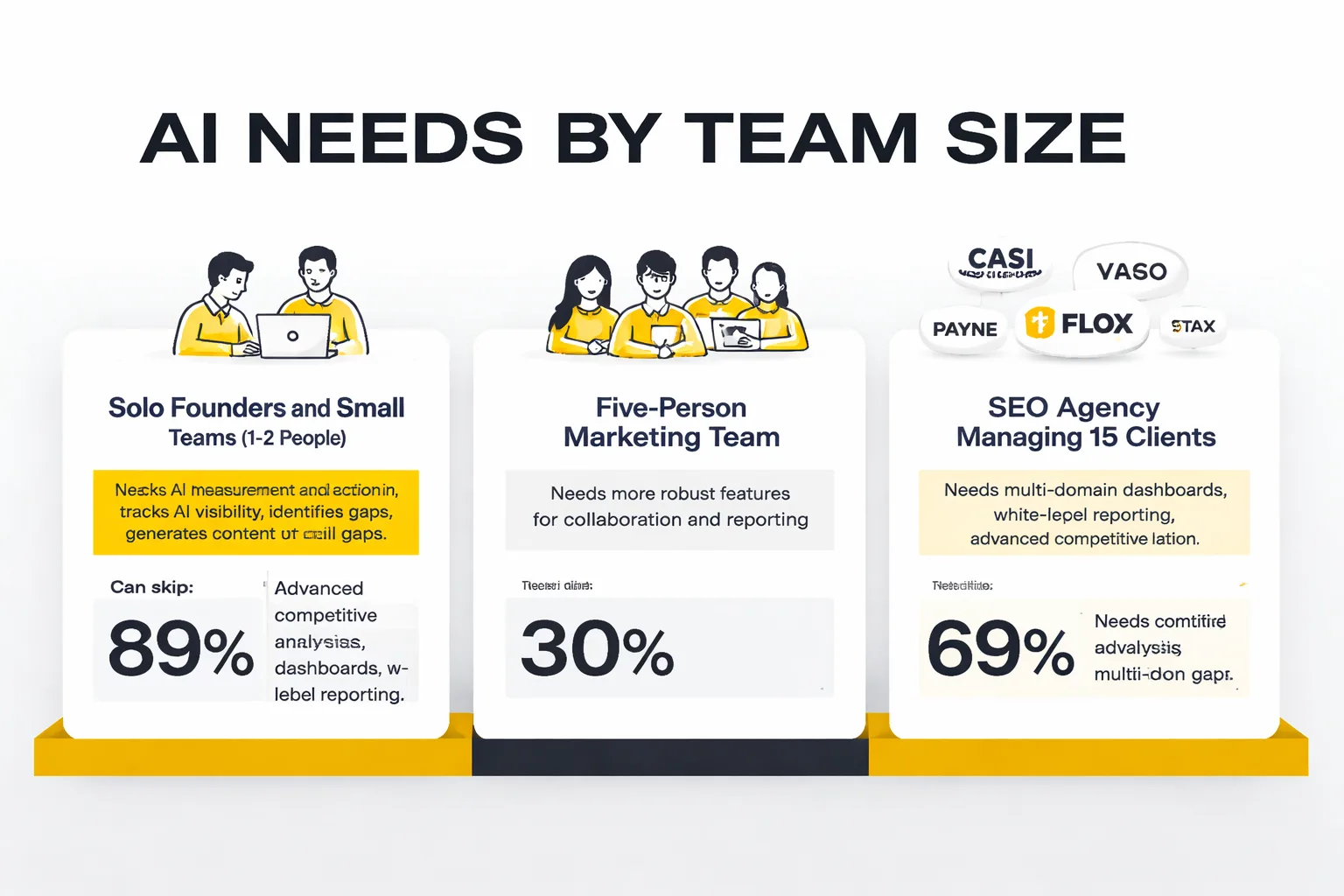
The right tool depends on who you are. A solo founder, a five-person marketing team, and an SEO agency managing 15 clients have fundamentally different needs. I'll break down what matters at each scale.
Solo Founders and Small Teams (1-2 people)
You need measurement and action in one place. You can't afford to stitch together a tracking tool, a content tool, and an outreach tool. You'll spend more time managing integrations than doing the work.
What matters most: a tool that tracks your AI visibility across all major surfaces, identifies where you're missing, and generates content to fill those gaps. The content quality gate is non-negotiable because you don't have time to edit every article manually. You need the tool to block bad content before it reaches your site.
What you can skip: advanced competitive analysis, multi-domain dashboards, white-label reporting. These are agency features that add cost without value for a single-brand operation.
The mistake I see most often with solo founders is buying a tracking-only tool and then having no capacity to act on the data. You see you're missing from 70% of relevant AI answers. Now what? If the tool can't answer that question, you've bought a diagnosis without a cure.
Budget reality check: solo founders should expect to spend $50-$100/month for a tool that combines tracking with content generation. If you're paying less, you're probably getting tracking only. If you're paying more, you're probably paying for agency features you don't need. The key is finding a tool that gives you 10-30 articles per month with quality gates, not 100 articles without them. Volume without quality is a liability.
Small Marketing Teams (3-10 people)
You have more capacity but also more complexity. Multiple people touch content, SEO, and brand. You need collaboration features, role-based access, and the ability to track competitors alongside your own brand.
What matters most: per-LLM drill-down dashboards (so your SEO person can dig into Perplexity while your content person focuses on ChatGPT), competitive share-of-voice tracking, and content opportunity discovery that connects to your editorial calendar. You also need LLM visibility tracking that shows trend data over time, not just point-in-time snapshots.
What you can skip: you probably don't need 15 domains or 10 seats. But you do need enough prompts tracked monthly to get statistically meaningful data. I'd want at least 100 prompts per month across a representative set of queries.
The mistake I see with small teams is over-investing in tracking and under-investing in content production. You can have the most beautiful dashboard in the world. If you're not publishing answer-engine-optimized content at a consistent cadence, your visibility numbers won't move. The best answer engine optimization tools connect measurement to publishing in a single workflow.
For small teams, the workflow should look like this: weekly visibility report identifies three new content opportunities where competitors are cited but you aren't. The content team picks one, briefs the tool, and generates a draft. The quality gate runs. The article publishes to WordPress with automatic schema markup and IndexNow pinging. The next week's visibility report shows whether the new article moved the needle. That's a closed loop. If your tool can't execute that loop, you're doing manual work that should be automated.
SEO Agencies (10+ people, multiple clients)
You need multi-domain management, white-label reporting, and the ability to show clients ROI. Your clients will ask about AI visibility before they understand what it means. You need to educate them while delivering measurable results.
What matters most: multi-domain dashboards, white-label client reports, team collaboration with role-based seats, and the ability to scale content production across client accounts. You also need citation path tracking and outreach capabilities because your clients will want to know how to get cited by the sources AI engines trust.
What you can skip: nothing, really. At agency scale, you need the full stack. The question is which tool gives you the most integrated experience without forcing you to manage five separate subscriptions.
The mistake I see with agencies is treating AI visibility as an add-on to their existing SEO retainer. "We'll throw in a monthly AI visibility report." That approach fails because AI visibility requires different content strategies, different entity optimization, and different measurement methodologies. It's not an add-on. It's a discipline.
Agencies also need to think about the economics. If you're charging a client $2,000-$5,000/month for SEO services, adding AI visibility tracking and content generation should be a separate line item or a premium tier. The cost of a proper tool (anywhere from $269-$599/month for agency-level features) should be passed through to clients who need it. Don't eat the cost to be nice. AI visibility is a distinct service with distinct value.
Are you tracking your brand's visibility across every major AI search surface?
What the Best Tools Have in Common (And What They Don't)
After auditing the AI optimization tool landscape, here's my honest synthesis.
No single tool does everything well. The market is still maturing. A roundup of 17 AEO tools found that most are visibility dashboards without comparative performance metrics or action-to-outcome measurement. They show you the problem. They don't solve it.
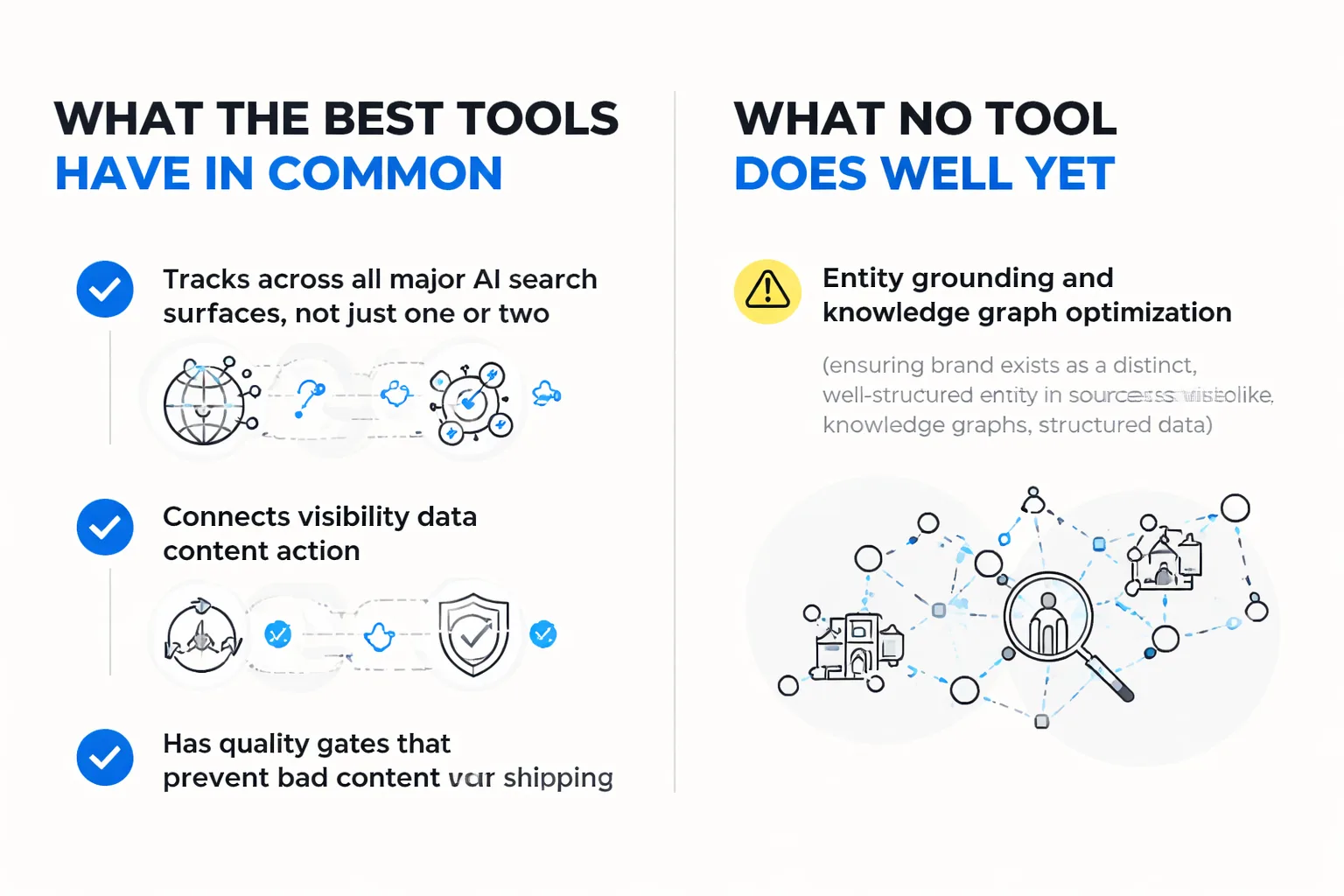
The tools that are actually moving the needle share three characteristics. First, they track across all major AI search surfaces, not just one or two. Second, they connect visibility data to content action. Third, they have quality gates that prevent bad content from shipping.
What no tool does well yet: entity grounding and knowledge graph optimization. This is the gap I'm most frustrated by. Entity grounding, the process of ensuring your brand exists as a distinct, well-structured entity in the sources AI models trust (Wikidata, Wikipedia, knowledge graphs, structured data), is arguably the single biggest driver of AI visibility. But most tools don't address it at all. They track whether you're mentioned. They don't help you build the entity presence that causes mentions.
In my experience, brands with strong Wikidata records, consistent structured data across their web properties, and clear entity relationships defined in schema markup get cited significantly more often by AI engines. But this requires a different kind of work: data engineering, not just content marketing. The tools that figure out entity grounding will be the ones that win this category.
The one metric every tool should report: citation rate by source domain. Not just "you're mentioned in X% of answers" but "you're mentioned in X% of answers, and here are the Y source domains the AI is pulling from, and here's your presence on each of those domains." That metric tells you exactly where to focus your effort. If 60% of AI citations for your topic come from three domains and you have zero presence on two of them, you know exactly what to do. You don't need a tool that tells you you're invisible. You need a tool that tells you where to become visible.
The concept of agentic SEO is emerging as the next frontier. This is the idea that AI agents will autonomously find, evaluate, and use information to make purchasing decisions. If an AI agent is tasked with finding the best CRM for a 50-person startup, it will synthesize information from multiple sources, compare options, and potentially make a recommendation without human intervention. Your brand needs to be visible to that agent, not just to a human typing a query.
This is where ecommerce GEO and agentic commerce become critical. If you're selling products online, the agents that browse, compare, and recommend products need to find your product information, pricing, and availability in a format they can parse. Structured data, clean product feeds, and consistent entity information across the web become the infrastructure of agentic commerce. No tool in the market fully addresses this yet. The ones that do will define the next era of search visibility.
The Honest Framework for Evaluating AI Visibility Tools
Since no single tool wins, here's the framework I use to evaluate any AI optimization tool for visibility.
Step 1: Check coverage. Does it track every major AI search surface? If it only covers ChatGPT, it's not an AI visibility tool. It's a ChatGPT visibility tool. The best rated answer engine optimization tools cover ChatGPT, Claude, Gemini, Perplexity, Grok, Google AI Overviews, AI Mode, and DeepSeek at minimum.
Step 2: Check citation attribution. Does it show you which source domains and pages the AI is pulling from? Can you drill down to see the actual response text and citations behind every mention? If not, you can't diagnose gaps.
Step 3: Check the action loop. Does it connect visibility data to content production? Can it find prompts where competitors are cited but you aren't, generate content to fill those gaps, and publish to your CMS with proper indexing? Or does it stop at the dashboard?
Step 4: Check the quality gate. If it generates content, what prevents bad content from shipping? Is there fact verification, citation validation, editorial structure enforcement, and plagiarism detection? Or does it ship raw LLM output?
Step 5: Check methodology transparency. How does it sample prompts? How does it handle probabilistic variation? What are its confidence intervals? If the tool can't answer these questions, its numbers aren't trustworthy.
Step 6: Check entity capabilities. Does it help you understand your entity presence in knowledge graphs, Wikidata, and structured data? This is the gap in the market right now. The tools that address it will be the ones that actually move visibility numbers.
I'd add a step 7 that most buyers forget: check the tool's own AI visibility. If a tool claims to optimize AI visibility but isn't itself visible in AI answers for relevant queries, that's a red flag. Ask ChatGPT or Perplexity about "AI visibility tools" and see what comes back. If the tool you're evaluating isn't mentioned, they may not be as good at this as they claim.
How Do LLMs Actually Choose Which Sources to Cite?
This is the question every AI visibility tool should help you answer, but most don't.
LLMs cite sources through two mechanisms: training data and real-time retrieval. Training data is the corpus of text the model was trained on. If your brand was frequently mentioned in high-quality sources during the training period, the model "knows" about you. Real-time retrieval is what happens when a user asks a question and the model searches the web for current information (this is how Perplexity works, and how ChatGPT search works).
For training data visibility, you can't do much beyond what you've already done. If your brand wasn't in the training corpus, you can't retroactively add it. But you CAN influence real-time retrieval. This is where content publishing and entity grounding matter most.
When Perplexity or ChatGPT searches the web for a query, they prioritize sources that are semantically relevant, factually dense, and structurally clear. Semantically relevant means the content directly addresses the query. Factually dense means the content contains specific claims backed by sources, not vague generalities. Structurally clear means the content uses proper headings, lists, and schema markup that the retrieval system can parse.
This is why a tool that validates your llms.txt file matters. The llms.txt standard is an emerging way to tell AI models which parts of your site they should read. If your llms.txt is malformed or missing, AI crawlers may ignore your most important pages. It's a small thing, but it's the kind of infrastructure detail that separates visible brands from invisible ones.
The citation selection process also favors diversity. AI engines try to cite multiple sources to provide a balanced answer. If your competitor is already cited from a G2 page, the AI may look for a different type of source (a blog post, a news article, a Reddit thread) to provide additional perspective. That means you don't need to out-rank your competitor on G2. You need to be present on a different type of source that the AI will cite alongside it.
When Should You Invest in a Dedicated AI Visibility Tool?
If you're seeing organic traffic declines that you can't explain with traditional SEO metrics, it's time. If your customers are telling you they couldn't find you when they asked ChatGPT about your category, it's past time. If your competitors are showing up in AI answers and you're not, you're already losing deals you don't even know about.
The 42% of agencies fielding traffic drop questions are the canary in the coal mine. Their clients are losing visibility not because their SEO got worse, but because AI engines are intercepting queries that used to go to Google. The traffic didn't disappear. It got answered before the user ever clicked through to a website.
For ecommerce brands, the urgency is even higher. Agentic commerce means AI agents are increasingly making purchasing decisions on behalf of users. If your product information isn't structured in a way that agents can parse, you won't even be in the consideration set. This isn't theoretical. It's happening now.
The investment timeline I recommend: start with measurement immediately. You can't fix what you can't see. Within 30 days, you should have a baseline of your AI visibility across all major surfaces. Within 60 days, you should be publishing content designed to fill citation gaps. Within 90 days, you should be building entity presence in knowledge graphs. Within 120 days, you should see measurable improvement in your citation rate.
What This Actually Means
The question "what's the best ai optimization tool for visibility" has an honest answer: the one that connects measurement to action in a way your team can actually execute. For solo founders, that means a tool that tracks, diagnoses, and publishes in one workflow. For agencies, it means multi-domain management with white-label reporting and citation path outreach. For everyone, it means a tool that covers all major AI surfaces with citation attribution and methodology transparency.
The category will consolidate. Tools that only track will get commoditized. Tools that only generate content will get penalized. The tools that win will be the ones that close the loop: measure visibility, diagnose gaps, publish quality content, build entity presence, and measure again. That closed loop is what we built Meev to do, and it's what I'd look for in any tool I evaluated.
The brands that win AI search won't be the ones with the best dashboards. They'll be the ones that act on what the dashboards show them.
FAQ
Can I just use Google Search Console to track AI visibility?
No. Google Search Console tracks clicks and impressions from Google search results. It doesn't track whether ChatGPT, Perplexity, or Claude cites your brand. AI visibility requires a fundamentally different measurement approach because AI answers are probabilistic, not deterministic. You need a tool designed for LLM citation tracking.
How many prompts should a tool track per month?
For a single brand, I'd want at least 100 prompts per month across a representative set of queries. For agencies, multiply that by client count. The key is statistical significance: one prompt per query tells you nothing because AI answers vary. You need multiple samples per query to get a reliable visibility rate.
Do I need to optimize my Wikidata entry for AI visibility?
Yes, and most tools won't tell you this. Wikidata is a structured data source that many AI models use for entity grounding. If your brand isn't properly represented in Wikidata with accurate attributes, relationships, and identifiers, AI engines may not recognize you as a distinct entity. This is a gap in the current tool market.
How long does it take to see AI visibility improvements?
Based on the Seer Interactive test, changes can appear within 36 hours if you're modifying content the AI is already reading. For new content, expect 2-6 weeks for indexing and retrieval. For entity grounding improvements (Wikidata, structured data), expect 1-3 months for the changes to propagate through model updates.
Should I stop doing traditional SEO?
No. Traditional SEO and AI visibility are complementary, not competing. Google still drives significant traffic, and strong organic rankings contribute to AI citation likelihood. But you can't rely on traditional SEO alone anymore. The overlap between top Google results and AI-cited sources has collapsed. You need both.
What's the difference between AEO and GEO?
AEO (Answer Engine Optimization) focuses on getting your brand cited in AI-generated answers. GEO (Generative Engine Optimization) is a broader term that includes optimizing for all generative AI surfaces. The distinction matters because different tools focus on different aspects. Understanding AEO vs GEO helps you choose the right approach for your goals.
How do I know if my brand has an entity grounding problem?
The telltale sign: you rank well on Google for your target keywords, but you're completely absent from AI answers. If your content is semantically relevant and factually accurate but AI engines don't mention you, the issue is likely entity grounding. Check if you have a Wikidata entry, a Wikipedia page (if notable enough), and consistent structured data (Organization schema, same-as links to your social profiles) across your web properties. If any of these are missing, you have an entity problem, not a content problem.
About the Author
Judy Zhou, Founder
Judy Zhou leads content strategy at Meev, where she oversees AI-driven content research and publishing for hundreds of brands. With a background in SEO and editorial operations, she focuses on building content systems that rank on Google, get cited by AI search engines, and drive measurable business results.
Stop guessing why competitors get cited in AI answers while you don't. See your exact citation gaps and start closing them today.