By Judy Zhou, Founder
Key Takeaways
- AI-referred sessions jumped 527% year-over-year in early 2025, moving traffic to brands whose content AI engines cite rather than those with the strongest backlinks.
- Generative engine optimization tactics can increase AI visibility by up to 40%, per University of Toronto research, while classic ranking factors now overlap with AI citations in under 20% of cases.
- Semrush’s analysis of 248,000 Reddit posts showed AI engines use different signals than Google’s blue links, so platforms limited to traditional rankings leave teams blind to new traffic sources.
- Small teams should replace or supplement legacy SEO tools with platforms that track citations inside ChatGPT, Perplexity, and Google AI Overviews to capture the 527% growth in AI-driven sessions.
Marcus runs a three-person marketing team for a mid-sized e-commerce brand. Last quarter, a competitor he'd never tracked in Ahrefs started showing up everywhere. Not in position one on Google, but inside ChatGPT responses, Perplexity answer cards, and Google's AI Overviews. His existing search engine optimization platform had no way to detect it, report on it, or explain why. That moment. Equal parts panic and clarity. Is exactly what's driving a new generation of small teams to rethink which tools actually belong in their stack.
Marcus's story isn't unique. In my work auditing content operations for brands at Meev, I see this exact scenario play out weekly. AI-referred sessions jumped 527% year-over-year in the first five months of 2025, according to Previsible's 2025 AI Traffic Report. That traffic isn't going to companies with the best backlink profiles. It's going to companies whose content gets cited by AI engines. Research-backed generative engine optimization strategies can boost AI visibility by up to 40%, per a University of Toronto GEO study published on arXiv. And Semrush analyzed 248,000 Reddit posts cited across Google AI Mode, Perplexity, and ChatGPT Search to understand what drives AI visibility. Confirming that the signals AI engines use to pick sources are fundamentally different from classic ranking factors. The overlap between top Google results and AI-cited sources has dropped from roughly 70% to under 20%. If your platform only tracks blue-link rankings, you're flying blind.
Why Platform Choice Matters More Than Tactics
The conventional wisdom about search engine optimization platforms is wrong. Most buying guides evaluate tools on keyword count, backlink databases, and site audit depth. Those features still matter. But they're table stakes now, not differentiators. What separates a platform that compounds your results from one that just generates reports is whether it can see, measure, and act on AI search visibility.
I learned this the hard way. Last year I watched a client outrank a competitor on every primary keyword they tracked. Traditional metrics said they were winning. But when we manually checked ChatGPT and Perplexity for the same queries, the competitor appeared in 6 out of 10 AI responses. My client appeared in 1. They were invisible in the fastest-growing search channel, and their SEO platform gave them no signal anything was wrong.
That's the core problem. Small teams don't have the budget to stack five different tools. A rank tracker, an AI visibility monitor, a content generator, an outreach tool, and a site auditor. You need one platform (or a tightly integrated pair) that handles the full workflow: diagnose where you're visible and where you're not, close the gaps with content, and prove the lift. A platform that only diagnoses without acting is a dashboard. A platform that only generates content without diagnosing is a content mill. The sweet spot for small teams is a tool that does both in a closed loop.
Here's the contrarian take: for most small teams in 2026, an AI SEO platform that tracks citations across AI engines is more valuable than a traditional SEO platform with a bigger keyword database. Keyword tracking tells you where you rank. AI citation tracking tells you whether anyone actually sees your brand when they ask a question. The second metric is closer to revenue.
The pattern I keep seeing is that teams who invest in answer engine optimization early capture citation share while competition is still low. The brands that wait until every competitor has a GEO strategy will be fighting for scraps. If you want to understand why AEO vs SEO represents a fundamental shift rather than an incremental change, the data is already clear: AI search surfaces prioritize different signals than classic SERPs.
How We Ranked These Platforms
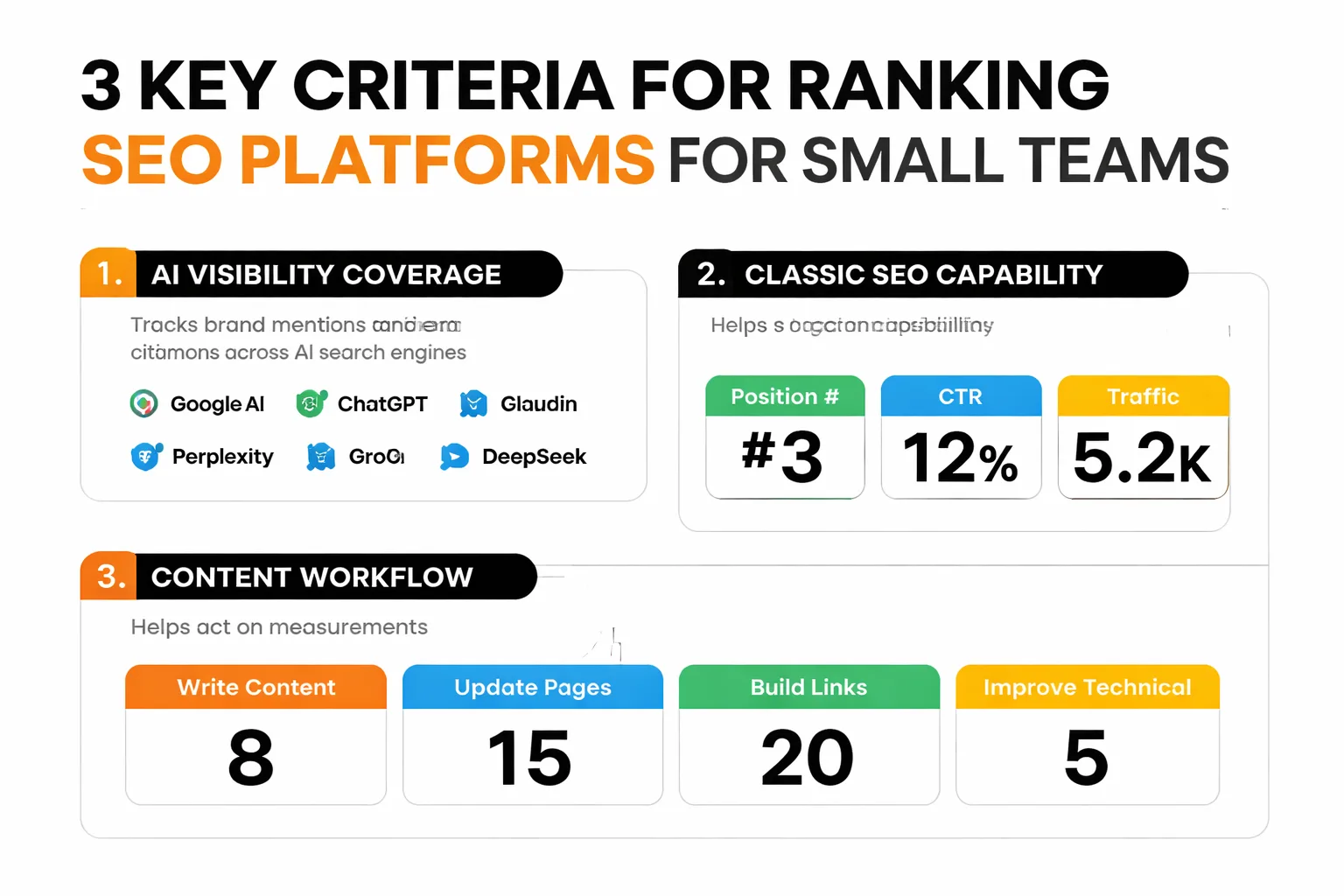
I evaluated each platform against five criteria that matter specifically for small teams operating with limited headcount and budget.
AI visibility coverage. Does the platform track brand mentions and citations across AI search engines. Not just Google AI Overviews, but ChatGPT, Claude, Gemini, Perplexity, Grok, and DeepSeek? A platform that only monitors one or two AI surfaces gives you a partial picture. I weighted platforms that cover every major AI search surface higher than those tracking only Google's AI features.
Classic SEO capability. Rank tracking, keyword research, backlink analysis, site audits. These are the fundamentals. A platform can have the best AI visibility tracking in the world, but if it can't tell you why your page dropped from position 3 to 7 on Google, it's incomplete. I looked for platforms that maintain strong traditional SEO features alongside AI capabilities.
Content workflow. Does the platform help you act on what it measures? Tracking visibility gaps is useless if you have no way to close them. I evaluated whether each platform includes content generation, optimization guidance, or publishing workflows. Platforms that close the loop from diagnosis to action scored higher.
Pricing transparency and predictability. Small teams need to budget. Platforms with clear, flat-rate pricing ranked higher than those with complex credit-based models or hidden per-seat, per-domain, and per-prompt add-ons. If I can't figure out the real monthly cost from the pricing page, that's a red flag.
Data accuracy and methodology. Does the platform use direct API integrations with AI engines, or does it rely on estimated models? Direct integrations produce more accurate citation data. I also considered the size of the prompt index and whether the platform provides the actual response text behind each citation, not just a yes/no mention flag.
How do SEO platforms compare?
| Platform | AI Surface Coverage | Classic Rank Tracking | Content Publishing | Starting Price | Best-Fit Team Size |
| Meev | ChatGPT, Claude, Gemini, Perplexity, Grok, DeepSeek, Google AI Overviews, AI Mode | Yes (GSC integration, weekly rank tracking) | Yes (WordPress, Ghost, Shopify, Wix, webhook) | $49/mo | Solo to 15-person agencies |
| AthenaHQ | ChatGPT, Gemini, Perplexity, Copilot | Limited | Optimization guidance only | $95/mo | US-based marketing teams |
| Profound | Claude (Anthropic connector), broad prompt dataset | No | No | $499/mo | Enterprise and Fortune 500 |
| Semrush AI Toolkit | Google AI Overviews, ChatGPT | Yes (full Semrush suite) | Yes (via Semrush content tools) | $179–$299/mo realistic | Small teams already on Semrush |
| Ahrefs Brand Radar | AI Overviews, ChatGPT | Yes (full Ahrefs suite) | No | ~$328–$828/mo | SEO-mature teams on Ahrefs |
| AIclicks | ChatGPT, Gemini, Perplexity, Claude | Yes (SERP tracking) | Yes (content briefs and on-page) | $59/mo | Small teams and startups |
| LLMrefs | 11 AI platforms | No | No | $79/mo | Budget-conscious small teams |
Best platform for AI citation tracking?
Best for: Teams that want AI citation tracking plus a content engine they can trust to publish. Not just a dashboard that surfaces problems.
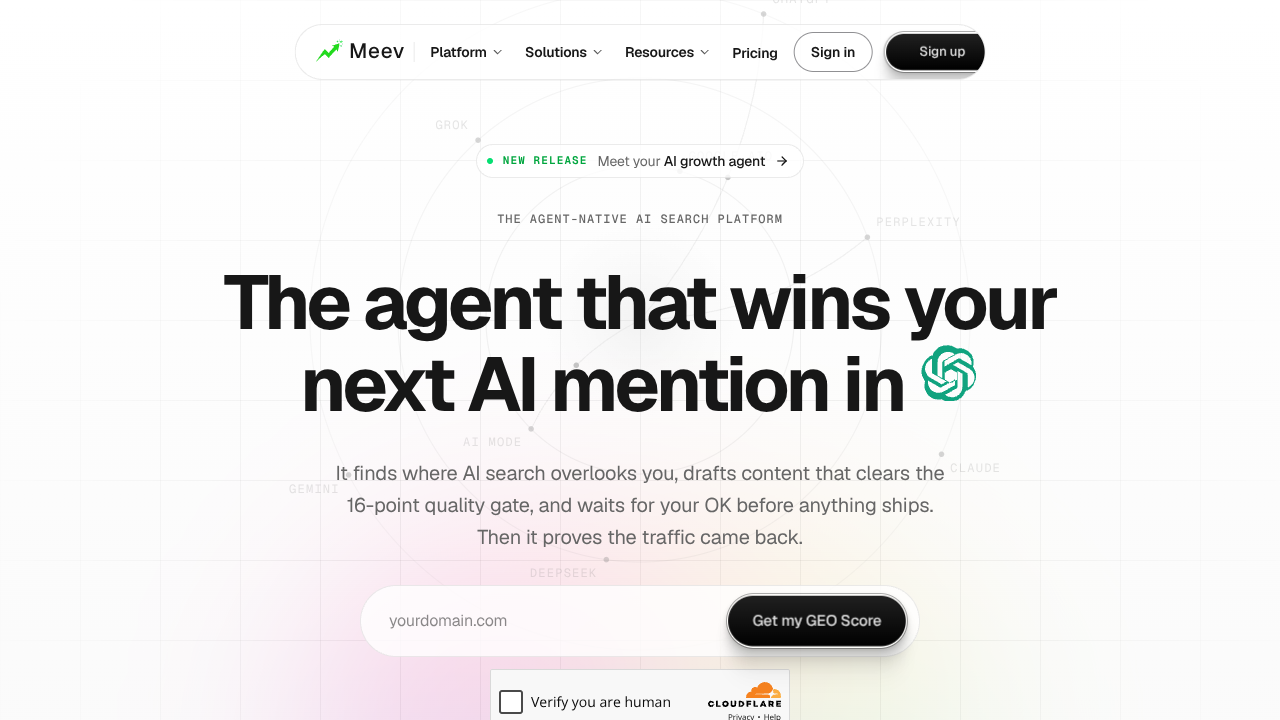
Meev is an autonomous AI search visibility platform that tracks citations across every major AI search surface (ChatGPT, Claude, Gemini, Perplexity, Grok, DeepSeek, Google AI Overviews, AI Mode), writes quality-gated content that earns them, and proves which placements drove the lift. The platform combines diagnosis, action, and measurement in a single workflow rather than forcing you to stitch together separate tools.
Key features: - Citation tracking across ChatGPT, Claude, Gemini, Perplexity, and Grok on a rolling cadence; Google AI Overviews and AI Mode refresh daily. 12-dimension Quality Matrix plus Helpful Content Risk score. 70/100 publish gate on both. Knowledge Base enforcement. Articles grounded in your approved claims, not AI hallucination. Closed-loop Citation Path (roadmap) — each article mapped to the citation-rate delta it drove. Autopilot topic pool with gap detection from competitor citation patterns
Pricing: 7-day free trial. After the trial, services pause unless you subscribe. Your account stays open and your data stays readable. Lite $49/mo, Starter $99/mo, Pro $269/mo, Agency $599/mo. 20% annual discount. Cancel anytime; hard-cap quotas with no overage fees.
What separates Meev from every other platform on this list is the quality gate. Most AI content tools publish whatever the model generates. Meev blocks articles that score below 70/100 on a 12-dimension quality matrix before they reach your CMS. That gate slows the publishing loop by roughly 50% compared to unedited AI drafts, but it prevents the factual errors and machine-voice problems that destroy credibility. For small teams without a dedicated editor, that gate is the difference between content that earns citations and content that gets ignored. The AI visibility tracker gives you the diagnostic layer; the content engine closes the gap.
Best SEO tool for US marketing teams?
Best for: US-based marketing teams with a dedicated GEO budget that want direct revenue attribution alongside AI visibility tracking and YC-backed platform credibility.
AthenaHQ is a Y Combinator-backed answer engine and generative engine optimization platform that combines prompt intelligence, AI citation monitoring, and content optimization guidance for structured GEO programs. It's built for teams that want to run GEO as a formal discipline rather than an ad-hoc effort.
Key features: - Athena AI Agent and Citation Engine (ACE) for agentic GEO execution. Source intelligence identifying exact URLs AI systems reference for target prompts. Prompt intelligence and content-optimization guidance in one workflow. Tracks ChatGPT, Gemini, Perplexity, and Copilot
Pricing: Self-serve annual plan starts at $95/month; higher tiers range from $270–$499/month. Credit-based model applies; Enterprise pricing is custom.
AthenaHQ's strength is its agentic approach. The Athena AI Agent and Citation Engine actually execute GEO tasks rather than just surfacing data. Source intelligence is genuinely useful. Knowing exactly which URLs AI systems reference for your target prompts tells you where to focus your outreach. The limitation for small teams is the credit-based pricing model, which makes monthly spend harder to predict than a flat-rate plan. There's also no free trial, so you're committing based on a sales demo. If your team has the budget and wants YC-backed credibility, it's a strong choice.
3. Profound — Best for enterprise teams needing rigorous statistical validation
Best for: Enterprise and Fortune 500 marketing teams that need rigorous statistical validation, API integrations, and deep AI shopping journey analytics.
Profound is the enterprise-grade AI search analytics platform that tracks brand recommendations across 261M+ prompts globally and monitors how products appear throughout complex AI shopping journeys. For large organizations that need to understand AI visibility at statistical scale, it's the most rigorous option on this list.
Key features: - Access to 261M+ global prompt dataset for statistical validation. FactCheck feature to monitor and correct inaccurate AI-generated claims. Brainstorm Mode for automated AI agent creation. Official Anthropic connector for Claude integration and API access
Pricing: Profound Lite starts at $499/month; custom enterprise tiers available. Annual billing can reduce effective monthly cost. Free entry tier available for basic exploration.
Let's be honest about fit. Profound is a powerful platform, but at $499/month to start, it's built for teams with dedicated GEO budgets and the headcount to act on the insights. The 261M+ prompt dataset is impressive for statistical validation, and the Anthropic connector for Claude integration is a genuine differentiator. But for a three-person marketing team, this is likely overkill. The free tier exists for basic exploration, but full enterprise tiers require a sales demo with no published pricing. If you're a solo founder or small team, look elsewhere on this list.
4. Semrush AI Toolkit — Best for teams already paying for Semrush
Best for: Small teams already paying for Semrush who want to add AI visibility monitoring without onboarding a separate vendor or tool.
Semrush's AI Toolkit is an add-on built into the Semrush SEO suite that tracks brand mentions inside Google AI Overviews and ChatGPT alongside traditional rank tracking and content optimization. If you already live in Semrush, this is the path of least resistance.
Key features: - Brand mention and citation tracking inside Google AI Overviews and ChatGPT. Integrated with existing Semrush SEO data, rank tracking, and content tools. Competitor benchmarking for AI share of voice. Built-in content optimization workflow within a familiar SEO platform
Pricing: AI Toolkit add-on starts at $99/month per domain on top of a Semrush Pro plan ($139.95/month); additional users cost $99/seat, extra prompts are $60 per 50, and additional domains are $99 each. Realistic all-in cost: $179–$299/month.
The appeal here is integration. If your team already uses Semrush for keyword research, rank tracking, and content optimization, adding AI visibility monitoring within the same platform avoids the friction of a new vendor. The competitor benchmarking for AI share of voice is genuinely useful. But the pricing structure is the catch. The advertised $99/month add-on sounds reasonable until you factor in per-domain, per-user, and per-prompt fees that can push your real monthly cost to 2. 3x the base price. The AI visibility features are also shallower than dedicated GEO platforms. For teams already invested in the Semrush ecosystem, it's a pragmatic add-on. For teams starting fresh, look at standalone options.
5. Ahrefs Brand Radar. Best for SEO-mature teams on Ahrefs
Best for: SEO-mature teams already on Ahrefs who want to extend their existing workflow into AI citation tracking without switching platforms.
Ahrefs Brand Radar is the AI citation and brand monitoring module that tracks how your brand is referenced across AI Overviews and ChatGPT using a 260M+ prompt index, integrated directly into the Ahrefs platform. It extends Ahrefs' traditional SEO strength into the AI visibility space.
Key features: - 260M+ prompt index for large-scale AI citation discovery. Tracks brand mentions across AI Overviews and ChatGPT within the Ahrefs ecosystem. Citation source analysis to identify which URLs drive AI answers in your category. Integrated with Ahrefs backlink, keyword, and content explorer data
Pricing: Brand Radar costs $199/month per AI index or $699/month for all six AI indexes, on top of a required Ahrefs base plan starting at $129/month. A realistic full-platform setup lands near $828/month.
The 260M+ prompt index is substantial, and citation source analysis. Knowing which URLs drive AI answers in your category. Is one of the most actionable features on this list. If you're already an Ahrefs power user, Brand Radar extends your workflow naturally. But the pricing escalates sharply. Covering all six AI indexes costs $699/month on top of your base Ahrefs plan, putting a full setup near $828/month. For a small team that isn't already invested in Ahrefs, this is an expensive way to get AI visibility tracking. The value proposition only makes sense if you're already using Ahrefs for backlink analysis, keyword research, and content exploration.
6. AIclicks — Best for small teams automating repetitive SEO tasks
Best for: Small marketing teams and growth-stage startups that want to automate repetitive SEO tasks and scale content operations without hiring additional headcount.
AIclicks is an AI SEO agent platform that automates keyword research, content briefs, and on-page optimization tasks, acting as an agentic SEO assistant for lean marketing teams. It focuses on execution rather than monitoring.
Key features: - Agentic SEO task automation including keyword clustering, brief generation, and on-page recommendations. AI-driven content optimization aligned with both traditional and generative search signals. Competitor gap analysis and SERP feature tracking. Workflow automation to reduce manual SEO execution for small teams
Pricing: Starts at $59/month for entry-level access; higher tiers available with expanded automation and reporting. Exact upper-tier pricing requires contacting sales.
AIclicks fills a different niche than the other platforms on this list. It's less focused on AI citation and LLM visibility monitoring and more focused on automating the SEO execution work that eats small teams' time. The agentic approach to keyword clustering, brief generation, and on-page recommendations can genuinely reduce manual work. But if your primary goal is tracking and improving AI search visibility, AIclicks isn't built for that. It's an AI SEO tool focused on traditional SEO execution with some generative search alignment. Think of it as a productivity multiplier for existing SEO workflows rather than a GEO platform.
Is your brand being cited by ChatGPT, Perplexity, and Google AI Overviews — or are competitors taking your share?
7. LLMrefs — Best for budget-conscious broad coverage
Best for: Budget-conscious small teams that need broad multi-engine AI visibility coverage and want predictable flat-rate pricing without complex add-on structures.
LLMrefs is a broad-coverage AI visibility monitoring platform that tracks brand mentions and citations across 11 AI platforms simultaneously at a flat monthly rate, making it one of the most cost-efficient multi-engine options available.
Key features: - Simultaneous tracking across 11 AI platforms including ChatGPT, AI Overviews, AI Mode, Perplexity, Claude, Gemini, Grok, Copilot, Meta AI, and DeepSeek. 500 tracked prompts per month at the base flat rate. Brand mention and citation reporting across the widest engine coverage in the category. Simple flat-rate pricing with no hidden per-engine or per-user fees
Pricing: Flat rate of $79/month for access to 11 AI platforms and 500 tracked prompts. No per-engine or per-seat add-on fees at the base tier.
LLMrefs wins on breadth and price simplicity. Tracking 11 AI platforms for $79/month with no add-on fees is the most cost-efficient monitoring option on this list. The flat-rate pricing model is exactly what small teams need. No surprises, no credit systems, no per-seat escalation. The trade-off is depth. Per-platform analysis is shallower than what you get from enterprise tools like Profound or AthenaHQ. There's no agentic optimization, no content generation, no deep sentiment analysis. If you need a monitoring-only tool that covers the widest range of AI engines at the lowest predictable cost, LLMrefs delivers. If you need to act on what you monitor, pair it with a content tool.
How Does AI Visibility Tracking Actually Work?
AI visibility tracking works by sending your target prompts to AI search engines, capturing the responses, and analyzing whether your brand appears in the answer, where it appears (first mention, in a list, last), and which sources the AI engine cites to support its answer. The technical approach varies by platform. Some use direct API integrations with AI engines, which produces accurate citation data but costs more per query. Others use large-scale prompt indices that sample from historical AI responses, which is cheaper but less current.
The distinction matters because accuracy directly affects your strategy. If a platform tells you you're cited in 15% of Perplexity responses but the actual rate is 8% (because the platform uses a stale index), you'll underinvest in fixing the gap. Direct API integrations cost more but give you real-time data. When I evaluate an AI visibility tool, the first question I ask is whether it uses direct integrations or estimated models. The second question is whether it shows me the actual response text behind each citation, not just a binary yes/no flag. Seeing the full response tells you how the AI engine framed your brand. Positively, neutrally, or negatively. And what it cited as evidence.
When Should You Prioritize AI Citation Tracking Over Classic Rank Tracking?
This is the question I get most often from small teams, and the answer depends on your audience. If your customers still find you primarily through Google's traditional search results (blue links, not AI Overviews), classic rank tracking remains your primary diagnostic. But if you're seeing AI-referred traffic in your analytics. Sessions that come from ChatGPT, Perplexity, or Google AI Overviews. You need citation tracking to understand and grow that channel.
The practical threshold: when AI-referred traffic exceeds 10% of your organic search traffic, you need a platform that tracks AI citations. Below that threshold, classic rank tracking plus manual spot-checks in ChatGPT and Perplexity may suffice. Above it, you're leaving growth on the table if you can't measure, diagnose, and close citation gaps systematically.
For e-commerce brands specifically, the stakes are higher. AI shopping journeys in platforms like Perplexity and Google AI Mode increasingly influence purchase decisions. A Perplexity AI visibility checker can tell you whether your products appear when shoppers ask comparison questions. If they don't, you're losing sales to competitors who may rank lower on Google but get cited by AI engines.
What About Entity Grounding and Knowledge Graph Presence?
Entity grounding is the mechanism AI engines use to verify that your brand is a real, authoritative entity before citing it in answers. It's not about keywords. It's about structured data, knowledge graph presence, and third-party validation. AI engines cross-reference mentions of your brand across the web to build confidence that you're who you say you are.
For small teams, the practical implication is this: if your brand isn't recognized as an entity by major knowledge graphs (Wikidata, Google's Knowledge Graph, schema.org structured data on your site), you'll struggle to get cited by AI engines regardless of how good your content is. Entity grounding is the foundation. Content is the structure you build on top of it.
I've seen brands with excellent content get completely overlooked by AI systems because they lacked external citations and a comprehensive content ecosystem. We shifted strategy for one client to prioritize building 10-15 pillar pages surrounded by supporting clusters, plus active outreach for third-party mentions. That approach yielded a 30% increase in AI-driven traffic compared to their old keyword-centric methods. The lesson: AI engines reward brands that demonstrate authority through breadth and external validation, not just keyword optimization.
Integrating Tools for Maximum Efficiency
Most small teams won't find a single platform that does everything perfectly. The question is how to integrate tools without creating a bloated, expensive stack. Here's the integration framework I recommend based on what actually works for lean teams.
Scenario 1: The solo founder (budget under $100/month). Use LLMrefs ($79/month) for broad AI visibility monitoring across 11 platforms. Pair it with Google Search Console (free) for classic rank tracking and basic technical SEO. Use the LLMs.txt validator (free) to ensure your site is readable by AI crawlers. This stack gives you visibility monitoring and technical foundations for under $80/month. What you give up: content generation, outreach automation, and deep per-platform analysis.
Scenario 2: The small marketing team (budget $100–$300/month). Use Meev Starter ($99/month) or Pro ($269/month) for the full closed loop: AI citation tracking, quality-gated content generation, and publishing. This replaces what would otherwise require three separate tools. If you need deeper traditional SEO data, pair it with a free Semrush or Ahrefs Webmaster account for backlink and technical audits. The ChatGPT AI visibility checker and Claude visibility monitoring are built into the platform.
Scenario 3: The team already on Semrush or Ahrefs (budget $200–$500/month). Add the Semrush AI Toolkit ($99/month per domain) or Ahrefs Brand Radar ($199/month per index) to your existing subscription. You get AI visibility data within a platform your team already knows. The risk is pricing escalation from add-on fees. Track your real monthly cost carefully.
The key principle: avoid overlapping tools that do the same job. If your platform tracks AI citations, you don't need a separate AI visibility monitoring tool. If your platform generates and publishes content, you don't need a standalone AI writer. Every tool in your stack should own a distinct job.
Making the Right Choice for Your Team
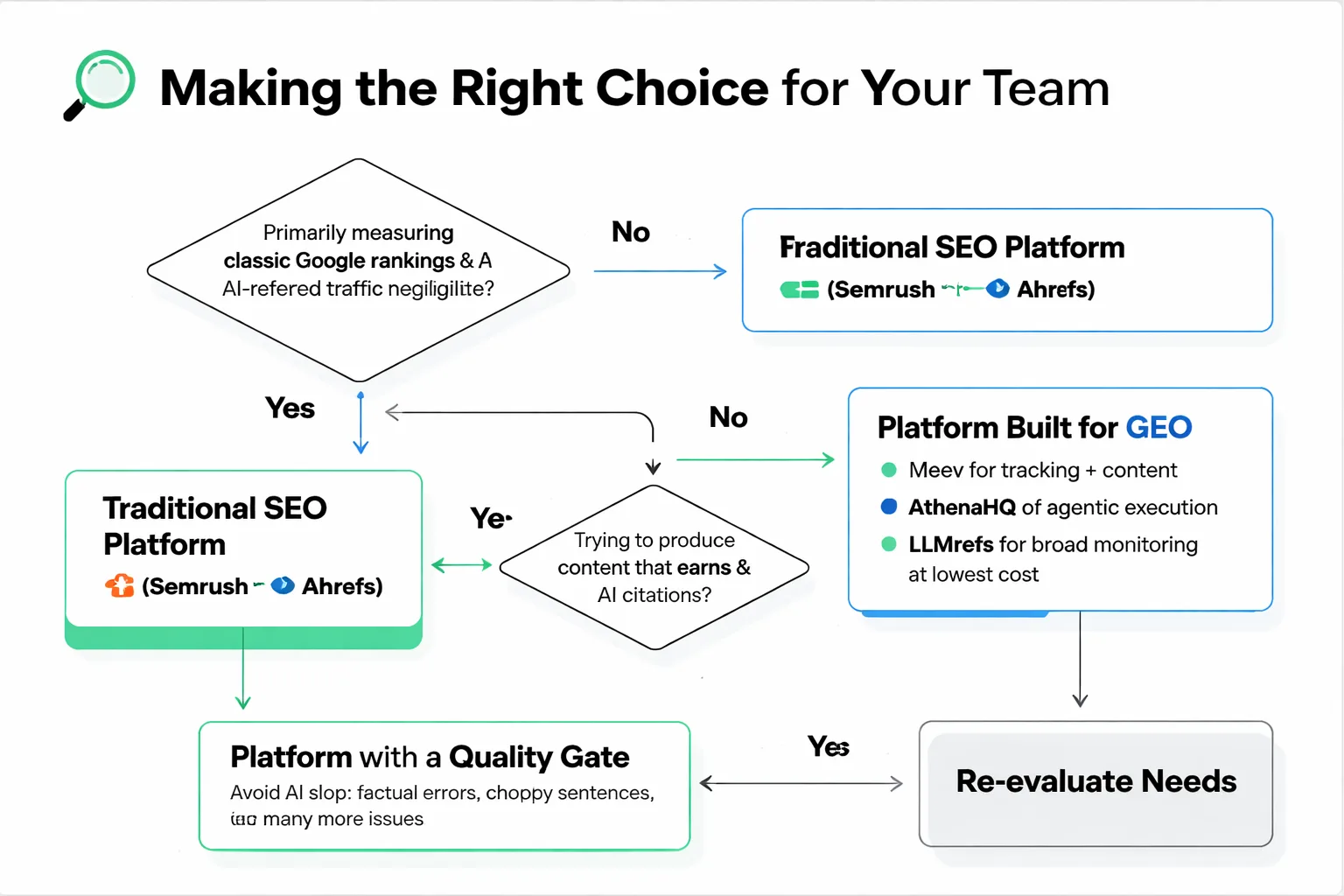
Choosing a search engine optimization platform comes down to three questions. What are you trying to measure? What are you trying to produce? What can you afford?
If you're primarily measuring classic Google rankings and your AI-referred traffic is still negligible, a traditional SEO platform like Semrush or Ahrefs remains your best investment. Add AI visibility monitoring as a secondary layer when AI traffic starts to grow.
If you're trying to measure and improve AI search visibility specifically, you need a platform built for GEO. Meev, AthenaHQ, and LLMrefs all serve this need at different price points and depths. Meev gives you the closed loop (tracking plus content). AthenaHQ gives you agentic execution. LLMrefs gives you broad monitoring at the lowest cost.
If you're trying to produce content that earns AI citations, you need a platform with a quality gate. Raw AI content generation without quality control produces what I call AI slop. Factual errors, choppy sentences, and machine voice that tanks engagement. The platforms on this list that include content generation (Meev, AIclicks, Semrush) vary significantly in their quality control. Meev's 12-dimension quality matrix is the most rigorous gate. Semrush's content tools are solid but require more manual oversight. AIclicks focuses on briefs and on-page recommendations rather than full article generation.
For budget-constrained teams, my recommendation is straightforward. Start with the cheapest tool that covers your primary need. If that's AI visibility monitoring, start with LLMrefs at $79/month. If that's the full closed loop, start with Meev Lite at $49/month. Upgrade when you hit the limits of your current tier, not before. Don't pay for enterprise features you won't use for another year.
The brands that win in AI search over the next 12 months won't be the ones with the biggest tool stacks. They'll be the ones who picked the right platform for their stage, committed to it, and executed consistently. Marcus's competitor didn't have a bigger team or budget. They had a platform that could see what Marcus's couldn't.
FAQ
What is an SEO platform vs. an SEO tool?
An SEO tool handles a single function: keyword research, rank tracking, or site auditing. An SEO platform combines multiple tools into an integrated workflow. The distinction matters for small teams because managing five separate tools costs more in money and time than one platform that handles the full workflow. A modern search engine optimization platform should also cover AI search visibility, not just traditional Google rankings.
Do SEO platforms now track AI citations?
Some do, most don't. Traditional platforms like Semrush and Ahrefs have added AI citation tracking as paid add-ons, but their core functionality remains classic SEO. Platforms built specifically for AI search visibility (Meev, AthenaHQ, Profound, LLMrefs) track AI citations as a primary feature. If AI-referred traffic matters to your business, verify that your platform tracks citations across multiple AI engines, not just Google AI Overviews.
Which platform is best for a solo founder?
For a solo founder on a tight budget, LLMrefs at $79/month offers the broadest AI visibility coverage at a flat rate. Pair it with free Google Search Console for classic SEO. If you need content generation alongside tracking, Meev Lite at $49/month gives you 10 articles and 10 tracked prompts per month with the quality gate. For pure traditional SEO execution without AI tracking, AIclicks at $59/month automates keyword research and content briefs.
How do I measure GEO performance?
Track six metrics: AI citation rate (percentage of target prompts where your brand appears), AI mention position (first, in a list, or last), AI share of voice (your citations vs. competitors'), AI-driven traffic (sessions from AI engines in your analytics), query coverage (how many relevant prompts you're cited for), and content inclusion rate (how often your published content gets cited). Per WebFX's AI SEO benchmarks, these metrics give you a complete picture of your generative engine optimization performance.
Can I use multiple platforms together?
Yes, but avoid overlap. A common efficient stack for small teams: one platform for AI visibility tracking and content (Meev), plus a free tool for technical SEO audits (Google Search Console). If you're already on Semrush or Ahrefs, add their AI visibility modules rather than switching platforms entirely. The goal is one tool per job: monitoring, content, technical SEO, and outreach.
What's the difference between AEO and GEO?
AEO (answer engine optimization) focuses on getting your content cited in AI-generated answers. GEO (generative engine optimization) is the broader discipline of optimizing for AI search engines. The terms overlap significantly. If you want a deeper breakdown, our AEO vs GEO comparison covers the practical differences and when each framework applies.
About the Author
Judy Zhou, Founder
Judy Zhou leads content strategy at Meev, where she oversees AI-driven content research and publishing for hundreds of brands. With a background in SEO and editorial operations, she focuses on building content systems that rank on Google, get cited by AI search engines, and drive measurable business results.
Stop guessing about your AI search visibility. Start a 7-day free trial and see exactly where your brand appears across every major AI search surface.