
By Judy Zhou, Founder
Key Takeaways
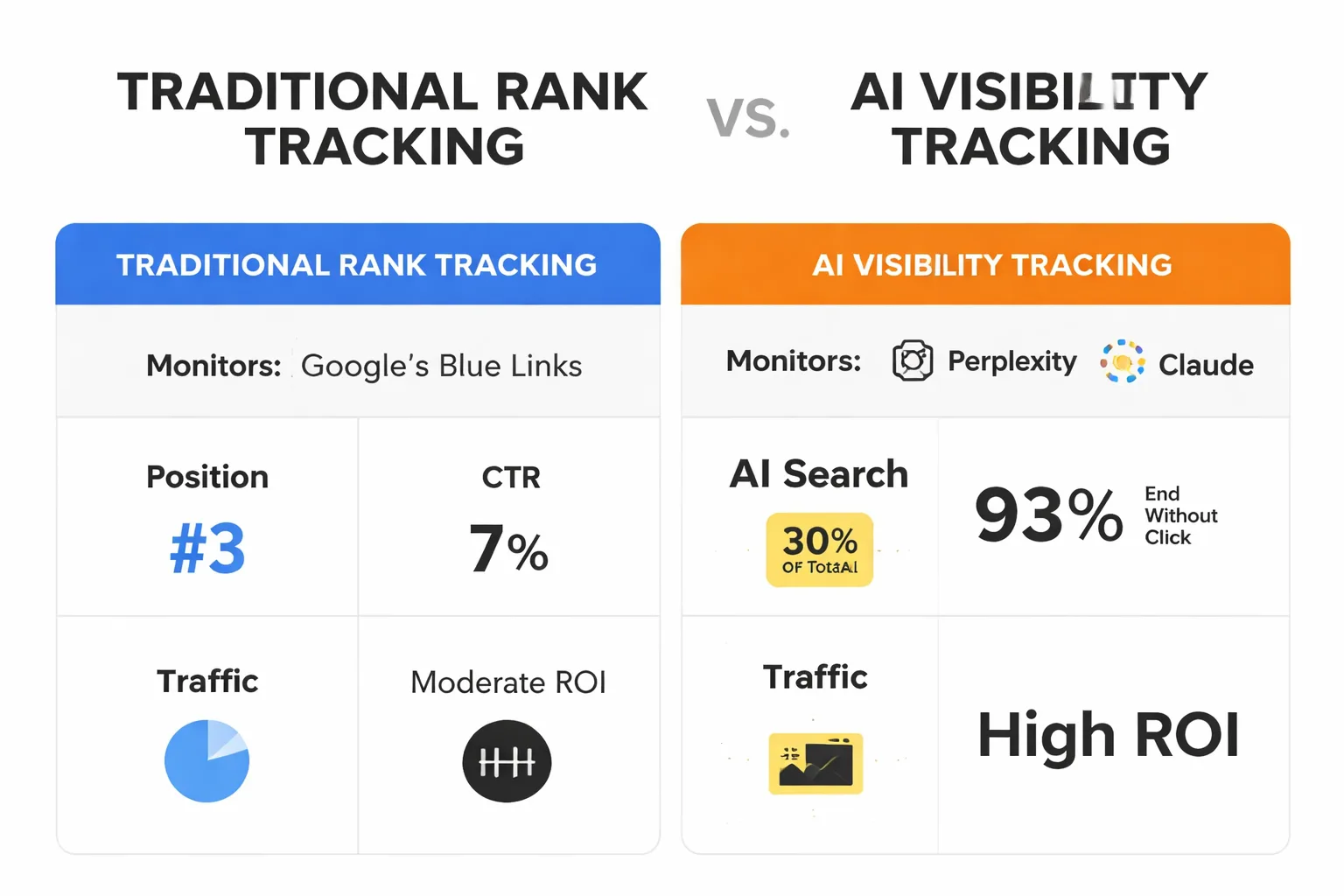
- AI search interactions now represent 30% of total search volume, so rank reports limited to classic SERP positions measure only half the battlefield.
- 93% of AI Mode sessions end without a click, making brand citation tracking in ChatGPT, Perplexity, and Google AI Overviews essential.
- Google AI Overviews appear in nearly half of all searches, rendering traditional SEO metrics insufficient for complete visibility reporting.
- Small teams need tools that cover both traditional rank tracking and AI surfaces at transparent pricing instead of enterprise platforms exceeding payroll costs.
Most rank trackers weren't built for the search engine you're actually competing in today.
Search engine rank reporting has split into two disciplines. Traditional rank tracking monitors your position in Google's blue links. AI visibility tracking monitors whether your brand gets cited in ChatGPT, Perplexity, Google AI Overviews, and Claude. AI search interactions now represent 30% of total search volume, and 93% of AI Mode sessions end without a click. If your rank report only covers classic SERP positions, you are measuring half the battlefield. Google AI Overviews now appear in nearly half of all searches, which means a growing chunk of your audience never sees the organic results your tracker is reporting on. Semrush's analysis confirms that traditional SEO metrics are insufficient for AI search reporting because AI answers satisfy queries before clicks occur.
I have spent the last two years at Meev building content and visibility systems for small teams, and the gap I see most often is this: teams either buy a rank tracker that ignores AI citations entirely, or they buy an enterprise AI visibility platform that costs more than their payroll. Neither serves a five-person team. This list covers tools that bridge both worlds, ranked by data freshness, AI surface coverage, reporting quality, and pricing transparency.
Why Rank Reporting Still Matters in an AI-First Search World
Classic rank tracking is not dead. It is incomplete. When I audit a content operation, the first thing I look for is whether the team has visibility into both layers of search: where they rank in Google's ten blue links, and whether AI engines cite them when a prospect asks a question their product answers. Most teams have the first layer covered. Almost none have the second.
The problem is that AI answers often satisfy the user's query before they ever reach your page. According to Semrush's research, AI answers frequently resolve intent without a click, which means your rank tracker could show position 2 for a keyword while the user never scrolls past the AI-generated answer at the top of the page. You rank well. You get no traffic. Your rank report says everything is fine. It is not.
This is why search engine rank reporting needs to evolve. The teams winning in 2026 are not the ones with the most keywords tracked. They are the ones who can see, side by side, their classic SERP positions and their citation presence across AI engines. That dual view is what lets a small team make smart decisions about where to invest limited content bandwidth.
In my work building AI visibility tooling, I have seen teams waste months optimizing for keywords that AI Overviews now fully answer. They did not know because their rank tracker said they were climbing. The tracker was right about the SERP. It was wrong about reality. The fix is not to abandon rank tracking. The fix is to pair it with AI citation monitoring so you know which keywords still drive clicks and which ones AI has swallowed.
Small teams face a specific constraint here. You cannot buy six tools and stitch them together with Zapier. You need one or two platforms that cover both classic and AI search without enterprise pricing. That is the lens I used for every tool on this list.
How We Ranked These Tools
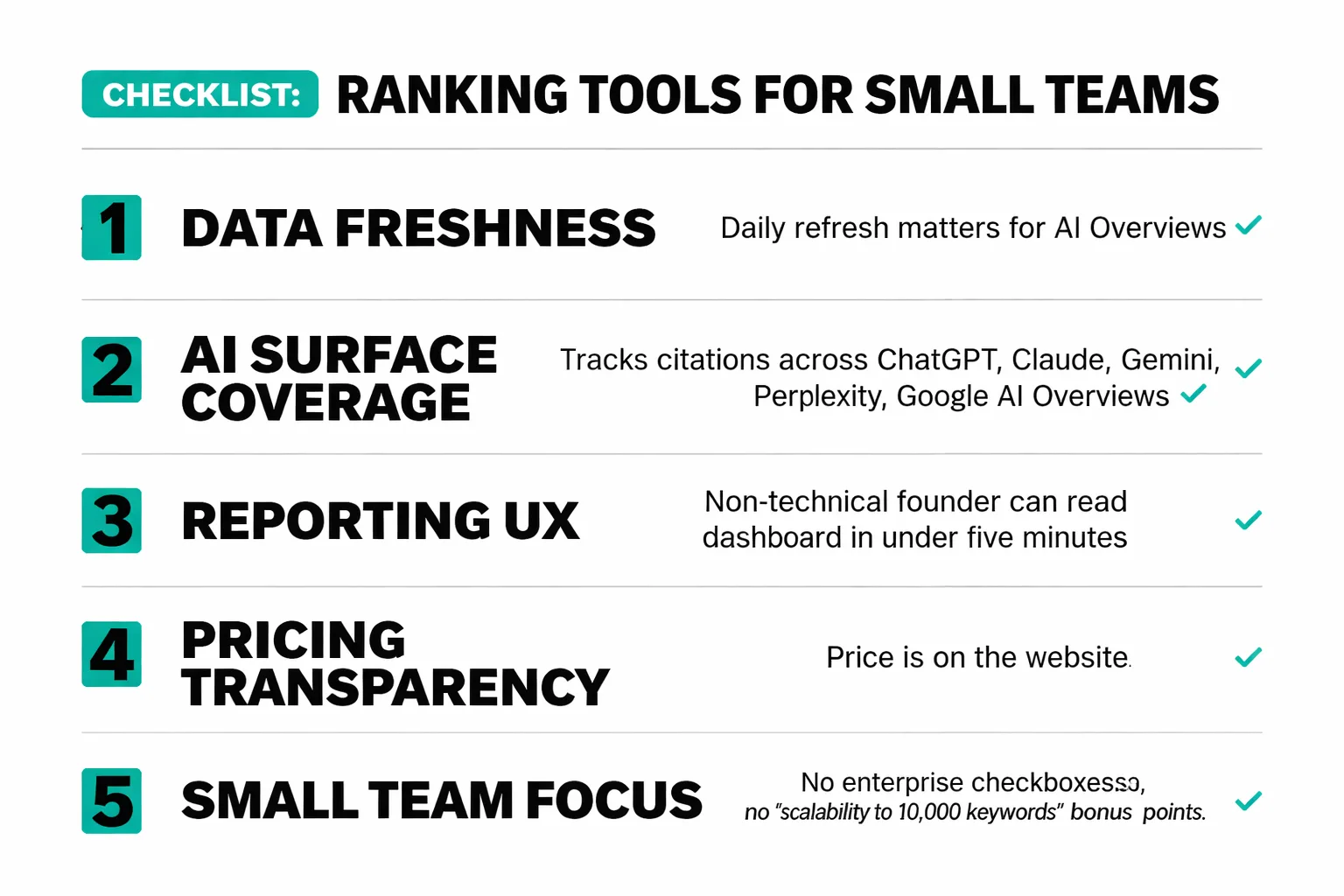
I evaluated each tool against five criteria that matter specifically for small teams. No enterprise checkboxes. No "scalability to 10,000 keywords" bonus points. Small teams need tools that work on day one without a dedicated SEO ops function.
Data freshness. How often does the tool refresh its data? Daily refresh matters for AI Overviews because Google's AI results fluctuate more than classic SERP positions. A tool that checks weekly is already stale by the time you read the report.
AI surface coverage. Does the tool track citations across ChatGPT, Claude, Gemini, Perplexity, and Google AI Overviews? Or does it only track one or two? A tool that covers only Google AI Overviews is not an AI visibility platform. It is a Google feature tracker.
Reporting UX. Can a non-technical founder read the dashboard in under five minutes and know what to do? If the tool requires an SEO certification to interpret, it fails the small-team test.
Pricing transparency. Is the price on the website, or do you have to book a demo? Tools that hide pricing tend to cost more than small teams can justify. I prioritized tools with public, self-serve pricing.
Setup ease. How long does it take to get from signup to first report? If the answer is "schedule an onboarding call," the tool is not built for small teams. I looked for tools where you enter your domain, pick your keywords, and see data within minutes.
How do these tools compare?
Before diving into each tool, here is a quick-scan comparison. I focused on the dimensions that actually differentiate these platforms for small teams: what they track, what they cost, and who they fit.
| Tool | Classic Rank Tracking | AI Visibility Coverage | Starting Price | Best-Fit Team Size |
| Meev | Weekly rank tracking + GSC integration | ChatGPT, Claude, Gemini, Perplexity, Grok, AI Overviews, AI Mode, DeepSeek | $49/mo | 1-15 domains, small to agency |
| Semrush AI Visibility Toolkit | Full traditional SEO suite | AI-generated answer tracking (add-on) | $99/mo add-on | Teams already on Semrush |
| AIclicks | No traditional rank tracking | ChatGPT, Gemini, Perplexity, other AI platforms | $39/mo flat | Solo marketers, lean teams |
| Rankscale AI | AI visibility score and position tracking | Multiple LLMs | $20/mo | Startups, lean SEO teams |
| SE Ranking | Full keyword rank tracking | AI Results Tracker across 6 AI surfaces (add-on) | $129/mo + ~$70/mo add-on | Small teams managing SEO + AI |
| Nightwatch | Traditional keyword position monitoring | Google AI Overviews tracking | $39/mo | Agencies, multi-location teams |
| Profound | No traditional rank tracking | Enterprise-grade AI search intelligence | ~$499/mo | Enterprise brands, well-funded teams |
The table tells you the headline differences. The entries below go deeper on each tool's strengths and limitations.
Is Meev best for AI citation tracking?
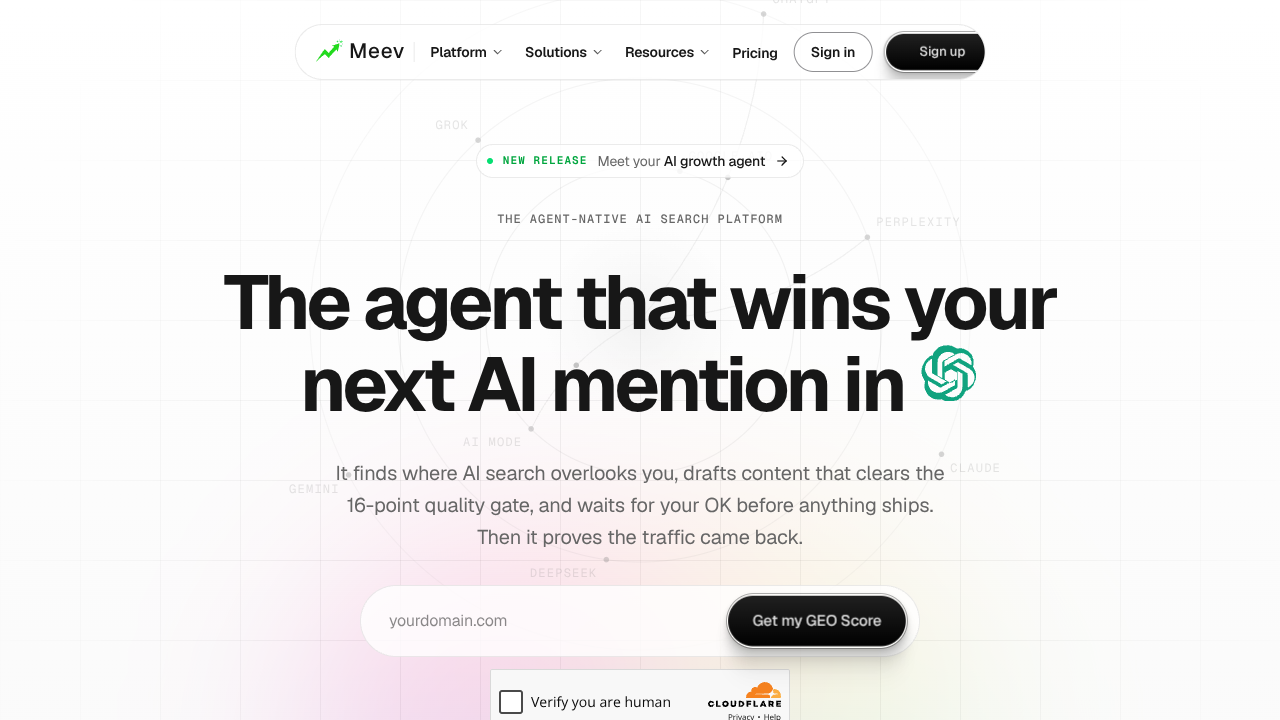
Best for: Teams that want AI citation tracking plus a content engine they can trust to publish, not just a dashboard that surfaces problems. Differentiated by the 12-dimension Quality Matrix and Helpful Content Risk score that gate every article before it ships.
Meev is the platform I build on every day, so I will be direct about what it does and where it fits. It tracks citations across every major AI search surface (ChatGPT, Claude, Gemini, Perplexity, Grok, DeepSeek, Google AI Overviews, and AI Mode) with daily refresh on SERP-driven surfaces and rolling refresh on LLM-driven surfaces. But what makes it different from every other tool on this list is that it does not stop at diagnosis. It also writes and publishes quality-gated articles designed to earn the citations you are missing.
Key features: - Citation tracking across ChatGPT, Claude, Gemini, Perplexity, and Grok on a rolling cadence; Google AI Overviews and AI Mode refresh daily. 12-dimension Quality Matrix plus Helpful Content Risk score with a 70/100 publish gate on both. Knowledge Base enforcement so articles are grounded in your approved claims, not AI hallucination. Closed-loop Citation Path (roadmap) mapping each article to the citation-rate delta it drove. Autopilot topic pool with gap detection from competitor citation patterns
Pricing: 7-day free trial. After the trial, services pause unless you subscribe. Your account stays open and your data stays readable. Lite $49/mo, Starter $99/mo, Pro $269/mo, Agency $599/mo. 20% annual discount. Cancel anytime; hard-cap quotas with no overage fees.
The honest assessment: Meev is built for teams that have decided AI visibility is a priority and want a single platform to measure, fix, and publish. If you only need a rank tracker and already have a content team, Meev does more than you need. But if you are a small team without a dedicated content operation and you want to close the gap between where you are cited and where you are absent, the combination of citation tracking plus a quality-gated publishing engine is hard to find elsewhere. The Perplexity AI visibility checker and ChatGPT AI visibility checker are built into the platform, so you get per-engine drill-downs without buying separate tools.
Is Semrush best for existing users?
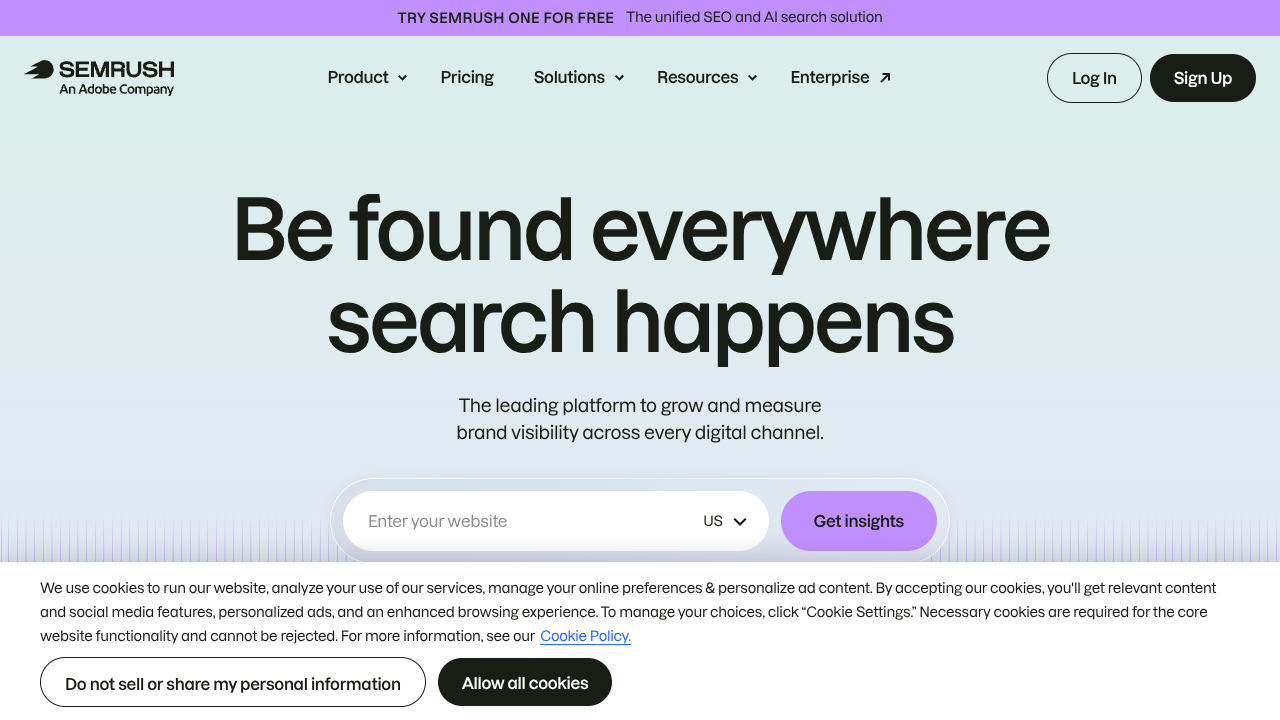
Best for: Small teams already using Semrush for traditional SEO who want to layer in AI visibility tracking without adopting an entirely new platform.
Semrush is the incumbent most SEO teams already know. The AI Visibility Toolkit is an add-on that layers brand mention and citation monitoring on top of Semrush's existing rank tracking, backlink analysis, and keyword research. For teams that live in Semrush all day, this is the path of least resistance. You do not need to learn a new interface or migrate your keyword lists.
Key features: - Brand mention and citation monitoring in AI-generated answers. Prompt identification showing which queries most frequently trigger brand appearances. Competitor AI visibility benchmarking and share-of-voice comparison. Unified dashboard combining traditional SEO rank data with AI search metrics
Pricing: $99/month for one domain as a standalone add-on; broader Semrush One and SEO packages have separate pricing tiers.
The limitation is depth. The AI visibility features are an add-on, not a native core module, which means the tracking is real but not as deep as a dedicated GEO platform. If you want per-LLM drill-downs, citation-level source analysis, or content generation tied to citation gaps, you will hit a ceiling. The Semrush blog on measuring AI visibility is a solid resource, but the tool itself is built for teams that want AI data as a supplement to traditional SEO, not as a primary discipline.
3. AIclicks — Best for budget-conscious solo marketers
Best for: Budget-conscious small teams and solo marketers who need clear, actionable AI search reporting without complex setup or per-seat pricing.
AIclicks does one thing and prices it honestly. For $39/month flat, you get real-time AI visibility dashboards across ChatGPT, Gemini, Perplexity, and other AI platforms, plus competitor benchmarking and prioritized recommendations. There is no tiered pricing, no per-seat cost, no demo required. You sign up, you get data.
Key features: - Real-time AI visibility dashboards across ChatGPT, Gemini, Perplexity, and other AI platforms. Competitor performance benchmarking and share-of-voice tracking. Actionable prioritized recommendations (structured data fixes, Wikipedia/Wikidata presence, missing prompt coverage) - Multilingual support and source-level citation tracking across AI modes
Pricing: $39/month flat with a full satisfaction refund guarantee; single transparent tier.
The trade-off is that AIclicks is tracking-only. It does not write content, does not publish, and does not manage traditional keyword rank tracking. If you need a tool that tells you where you stand in AI answers and what to fix next, it delivers. If you need a tool that also fixes the gaps it finds, you need something else. The single pricing tier also means there is no upgrade path if your prompt volume needs grow. For a solo marketer or a two-person team just starting with answer engine optimization, AIclicks is a low-risk entry point.
4. Rankscale AI — Best for startups entering AI rank reporting
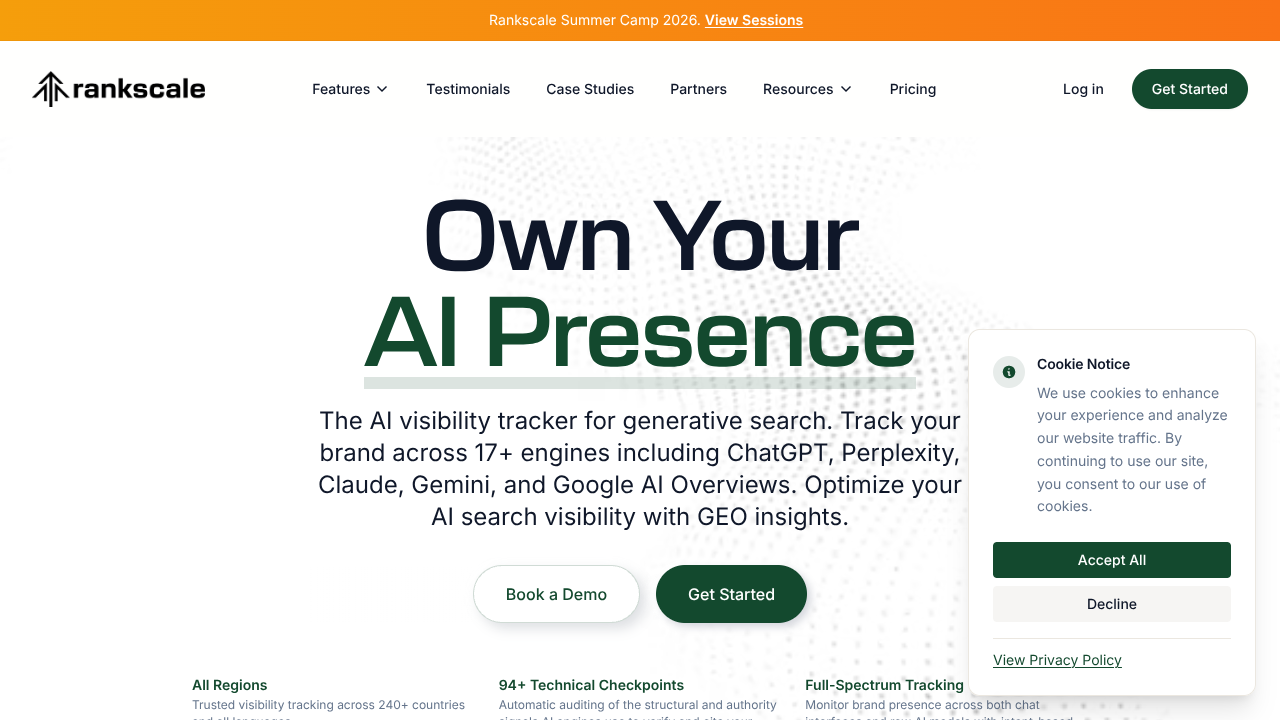
Best for: Small businesses, startups, and lean SEO teams looking for a simple, affordable entry point into AI search rank reporting without enterprise complexity.
Rankscale AI is the cheapest dedicated AI visibility tracker on this list. The Essential plan at $20/month gives you 120 credits, 480 AI responses, and 10 audits. That is enough for a startup to test the waters without committing to a platform that costs more than their hosting bill. The Pro plan at $99/month adds multi-brand dashboards and a team workspace.
Key features: - AI visibility score and average position tracking across multiple LLMs. Share-of-voice monitoring with trend analysis and brand dashboards. Citation data and AI readiness audits per page. Team workspace and multi-brand dashboard management on Pro tier
Pricing: Essential plan at $20/month (120 credits, 480 AI responses, 10 audits); Pro plan at $99/month (25 brand dashboards, 4,800 responses, 50 audits, team workspace).
The interface is functional but technical. If you are an SEO practitioner, the metrics will feel familiar. If you are a founder who has never opened Search Console, the dashboards may require some learning. There are no built-in content optimization or automated writing features, which means Rankscale tells you where you stand but leaves the execution to you. Export restrictions on lower tiers also limit how much you can manipulate the data externally. For a lean team that wants raw AI visibility data at the lowest possible price, Rankscale delivers.
Are you tracking where you rank or whether AI engines cite you?
5. SE Ranking — Best for teams bridging classic SEO and AI search
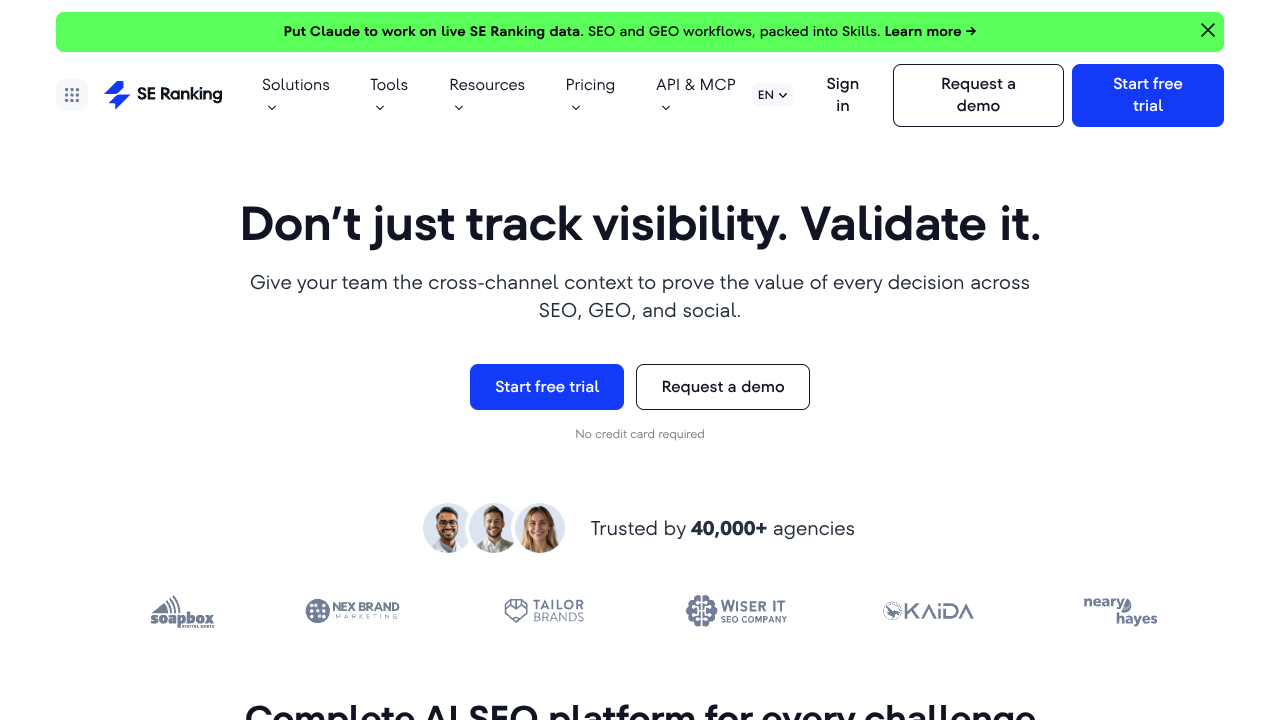
Best for: Small teams managing both organic SEO and AI search who want page-level citation tracking layered into an existing keyword rank reporting workflow.
SE Ranking is the tool I recommend when a team needs a full traditional SEO platform and does not want to buy a separate AI visibility tool. The AI Search Add-on records citation URLs across six AI surfaces daily and integrates that data with traditional SERP rank tracking. You see your Google position and your AI citation presence in the same dashboard, which is exactly the dual view I argued for earlier.
Key features: - AI Results Tracker recording citation URLs across six AI surfaces daily. Prompt identification showing which queries most frequently surface the brand in AI answers. Competitor AI visibility benchmarking integrated with traditional SERP rank tracking. OTTO automation to address AI search issues with minimal manual intervention
Pricing: Base plans start at $129/month; AI Search Add-on starts at approximately $70/month extra; 14-day free trial available.
The cost adds up. You are paying for the base platform plus the add-on, which puts your effective spend near $200/month before you track a meaningful keyword set. The feature density can also overwhelm teams without a dedicated SEO resource. But if you need a full-suite seo ranking report software that also covers AI citations, SE Ranking is the most integrated option on this list. The OTTO automation feature is genuinely useful for small teams that want to fix AI search issues without manual intervention.
6. Nightwatch — Best for agencies needing white-label reports
Best for: Small agencies and in-house teams that need both traditional search rank reporting and AI visibility in one tool, especially those serving clients across multiple locations.
Nightwatch is a rank tracking platform first and an AI visibility tool second. It does traditional keyword position monitoring well, with location-based analytics and white-label reporting that agencies need for client deliverables. The AI visibility layer covers Google AI Overviews tracking alongside traditional SERP positions.
Key features: - Google AI Overviews tracking alongside traditional SERP rank positions. Location-based and prompt-based analytics for regional AI search optimization. Customizable white-label reporting for client or executive presentations. Robust API access with historical trend visualization and multi-platform monitoring
Pricing: Starts at $39/month for 250 keywords; scales to $699/month for 10,000 keywords; pricing is keyword-volume based.
The AI visibility depth is secondary to traditional rank tracking. Nightwatch tracks Google AI Overviews but does not cover ChatGPT, Claude, Perplexity, or other LLM-driven surfaces. If your clients care about AI citations beyond Google, you will need a second tool. The keyword-volume pricing model also means costs climb quickly as you add keywords, which can strain a small agency's margins. But for agencies whose clients still measure success in traditional SERP positions, Nightwatch delivers clean reports with enough AI data to start the conversation.
7. Profound — Best for enterprise AI search intelligence
Best for: Well-funded in-house teams and enterprise brands that need deep AI search intelligence, large-scale citation tracking, and boardroom-ready visibility reporting.
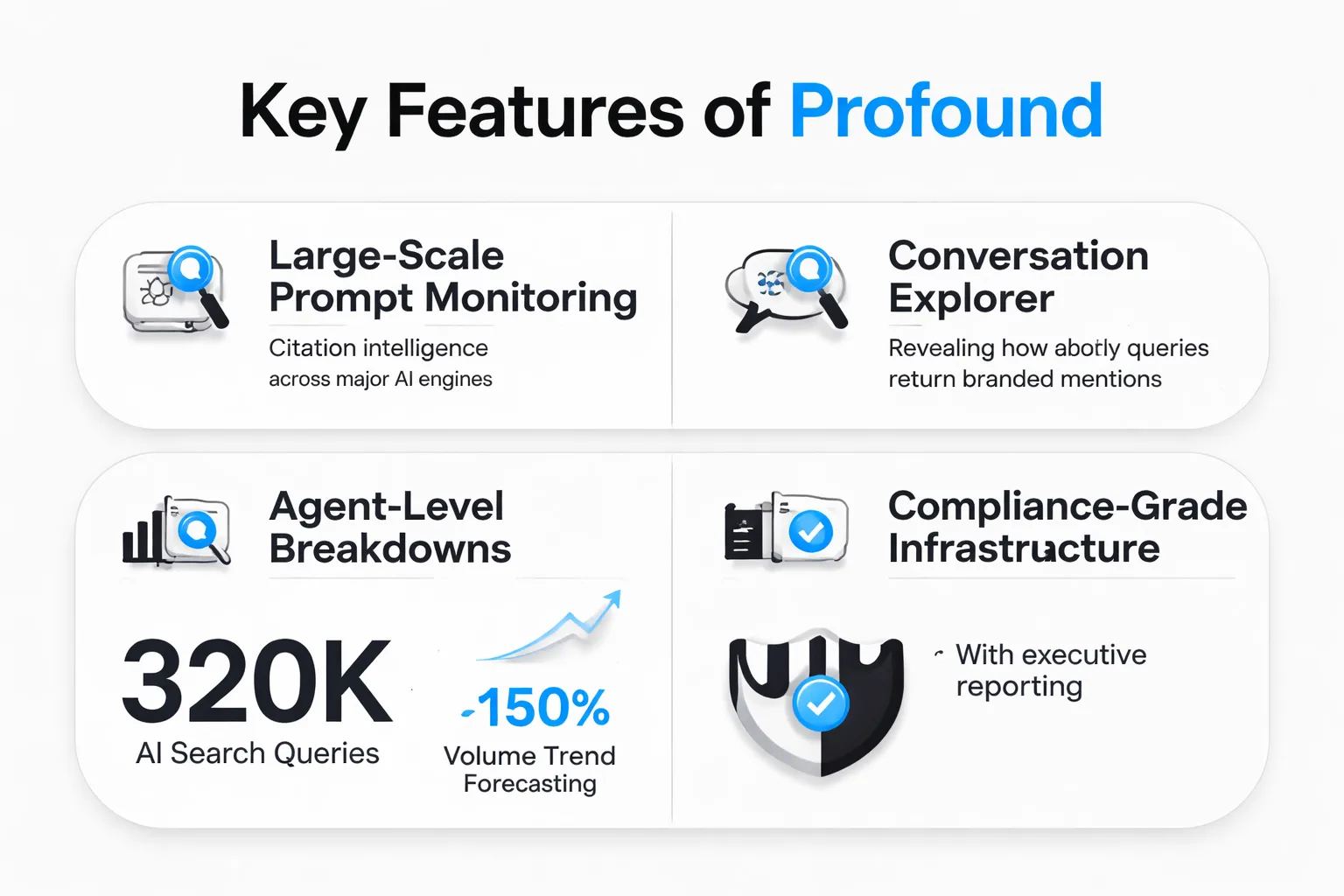
Profound is the enterprise play. With a Series C raise of $96M in 2026, it has pushed further into enterprise tiers with large-scale prompt monitoring, citation intelligence, conversation demand analysis, and agent-level breakdowns. The Conversation Explorer feature, which reveals how often queries return branded mentions, is genuinely powerful for brands that need to understand AI search at scale.
Key features: - Large-scale prompt monitoring and citation intelligence across major AI engines. Conversation Explorer revealing how often queries return branded mentions. Agent-level breakdowns and AI search volume trend forecasting. Compliance-grade infrastructure with executive-level reporting dashboards
Pricing: Entry pricing historically around $499/month (Lite); Enterprise plans at custom pricing; raised $96M Series C in 2026 pushing further into enterprise tiers.
I include Profound on this list because small teams ask me about it constantly. They see the funding announcements and assume it must be the best tool. It might be the best tool for a Fortune 500 brand with a dedicated AI search team. For a five-person startup, it is overkill. The price, the complexity, and the sales-led onboarding process are designed for organizations that can dedicate resources to AI search intelligence as a full-time discipline. If you are a small team, look at the other tools first. Come back to Profound when you have outgrown them.
How to Choose the Right Rank Reporting Tool for Your Team
The decision comes down to one question: are you tracking where you rank, or are you tracking whether you get cited?
If you only need classic SERP tracking, Nightwatch and SE Ranking are your best options. Both handle traditional keyword position monitoring well, with location-based analytics and white-label reporting. SE Ranking adds the AI Search Add-on if you want to dip into citation tracking later. Nightwatch keeps it simpler with Google AI Overviews as its AI layer.
If you need AI citation monitoring alongside traditional rank tracking, Meev and SE Ranking are the two platforms that cover both layers natively. Meev gives you deeper AI surface coverage (ChatGPT, Claude, Gemini, Perplexity, Grok, DeepSeek, AI Overviews, AI Mode) plus a content engine to close citation gaps. SE Ranking gives you six AI surfaces plus a full traditional SEO suite. The choice depends on whether you want a tool that also writes and publishes content (Meev) or a tool that stays focused on tracking and reporting (SE Ranking).
If you only need AI visibility tracking and already have a rank tracker you like, AIclicks and Rankscale AI are the budget-friendly options. AIclicks at $39/month gives you real-time dashboards and prioritized recommendations. Rankscale AI at $20/month gives you the cheapest entry point with AI readiness audits. Neither writes content. Neither tracks traditional SERP positions. They are pure AI visibility tools.
Here are the signals that indicate you have outgrown a basic rank tracker:
- Your rank tracker says you are climbing for a keyword, but your Google Search Console clicks for that keyword are flat or declining. AI Overviews are likely eating your clicks. - You are losing deals to competitors who show up in ChatGPT answers, but your rank tracker does not track ChatGPT at all. - Your clients or stakeholders are asking about AI search visibility, and your current tool cannot answer the question. - You are spending content budget on keywords that AI answers fully resolve, meaning no amount of ranking improvement will recover the lost traffic.
Any one of these signals means it is time to add AI citation monitoring to your reporting stack. You do not need to abandon your rank tracker. You need to pair it with a tool that shows you the AI layer.
The AEO vs SEO distinction matters here. Traditional rank tracking is SEO. AI citation monitoring is AEO. They are not the same discipline, and the tools that serve them are not interchangeable. A rank tracking software that only tracks Google SERP positions cannot tell you whether Claude cites your brand. An AI visibility tool that only tracks ChatGPT cannot tell you whether your Google position is slipping. You need both views.
If you want to go deeper on the AI side, the best GEO tools roundup covers platforms specifically built for generative engine optimization. And if you are trying to understand the difference between answer engine optimization and generative engine optimization, the AEO vs GEO breakdown is worth reading before you invest in either category.
One contrarian point I want to make: most small teams should not buy Profound. I know the funding rounds make it look like the safe choice. It is not. A $499/month tool with enterprise onboarding will consume more of your team's time in setup and training than it saves in reporting. Buy the tool that fits your team size today, not the tool you think you will need in three years. You can always upgrade. Switching from a $39/month tool to a $499/month tool is easy. Switching from a $499/month tool you never fully adopted to something simpler is a waste of money and morale.
What AI Search Means for the Future of Rank Reporting
The tools on this list represent a transition period. Search is splitting into two surfaces: the classic SERP with ten blue links, and the AI-generated answer that sits above it. Your rank reporting needs to cover both.
AI search engine optimization is not a future discipline. It is happening now. The data from Leapd AI's research shows AI search interactions already represent 30% of total search volume. Google AI Overviews appear in nearly half of all searches. 93% of AI Mode sessions end without a click. These numbers mean your traditional rank report is increasingly measuring a surface that fewer users actually see.
The small teams that win in this environment are the ones that treat AI citations as a first-class metric, not a nice-to-have. They track their share of voice across AI engines. They monitor which prompts trigger competitor citations instead of their own. They publish content designed to be cited, not just to rank. And they do all of this without enterprise budgets or dedicated AI search teams.
That is the bar I set when evaluating these tools. Does the tool help a small team see the full picture? Does it fit their budget? Does it give them something to act on, not just something to look at? The tools on this list meet that bar at different price points and different levels of depth. Pick the one that matches where your team is today.
FAQ
What is search engine rank reporting?
Search engine rank reporting is the process of tracking and documenting where your website appears in search engine results for specific keywords over time. Traditional rank reporting focuses on Google SERP positions. Modern rank reporting also includes AI citation tracking, which monitors whether your brand is mentioned in AI-generated answers from ChatGPT, Perplexity, Google AI Overviews, and other AI search surfaces.
How often should rank reports run?
Classic keyword rank tracking should refresh at least weekly for small teams. AI visibility tracking should refresh more frequently because AI answers fluctuate more than traditional SERP positions. Daily refresh is ideal for Google AI Overviews since that surface changes rapidly. For LLM-driven surfaces like ChatGPT and Claude, a rolling weekly cadence is sufficient for most small teams.
Can one tool track both Google rankings and AI citations?
Yes. Meev and SE Ranking both track traditional Google SERP positions and AI citations within a single platform. Meev covers ChatGPT, Claude, Gemini, Perplexity, Grok, DeepSeek, AI Overviews, and AI Mode. SE Ranking covers six AI surfaces through its AI Search Add-on. Most other tools specialize in one or the other, which means you may need two tools to get full coverage.
What is the difference between rank tracking and SEO reporting software?
Rank tracking monitors your position in search results for specific keywords. SEO reporting software is broader, encompassing rank tracking plus backlink analysis, technical site audits, traffic analytics, and competitor research. Rank tracking is a subset of SEO reporting. Tools like SE Ranking and Semrush are full SEO reporting platforms. Tools like AIclicks and Rankscale AI are specialized AI visibility trackers that focus on citation monitoring rather than traditional rank positions.
Which tool is cheapest for small teams starting with AI visibility?
Rankscale AI at $20/month is the cheapest dedicated AI visibility tracker on this list. AIclicks at $39/month is close behind with a single transparent tier. Both are tracking-only tools without content generation. If you want AI visibility tracking plus content publishing, Meev's Lite plan at $49/month is the most affordable option that includes both capabilities.
Do I need to track AI citations if I only care about Google traffic?
Yes. Google AI Overviews now appear in nearly half of all searches, and 93% of AI Mode sessions end without a click. If you only track traditional SERP positions, you cannot tell which keywords are still driving clicks and which ones AI answers have fully captured. AI citation tracking tells you whether your brand appears in the answer that prevents the click.
About the Author
Judy Zhou, Founder
Judy Zhou leads content strategy at Meev, where she oversees AI-driven content research and publishing for hundreds of brands. With a background in SEO and editorial operations, she focuses on building content systems that rank on Google, get cited by AI search engines, and drive measurable business results.
Start your 7-day free trial and see exactly where your brand appears across every major AI search surface.