

By Judy Zhou, Head of Content Strategy
Key Takeaways
- LLM-driven referral traffic sits at just 1% of total website traffic as of mid-2025, so brands building AI citation habits now will gain a measurable head start.
- Google's scaled content abuse detection has triggered 94% traffic drops for sites publishing AI content without human oversight.
- The strongest SEO tools with free trials cover both traditional rank tracking and AI visibility across ChatGPT, Perplexity, Gemini, Claude, Grok, and Google AI Overviews.
- Use the standard 7-14 day free trials to audit your AI citation gaps and establish a baseline before committing.
Marcus had been running his solo SEO consultancy for four years when a prospect asked him a question he couldn't answer: 'Can you track whether my brand gets cited in Perplexity?' He'd never been asked that before. He spent the next two weeks trialing seven different SEO platforms, hunting for one that could bridge traditional rank tracking with AI search visibility reporting. He found three that came close. That search. Messy, expensive in time, and completely avoidable. Is exactly what this article is designed to shortcut for you.
Every seo tool free trial listed here has been evaluated on two tracks: traditional SEO fundamentals (rank tracking, site audits, keyword research, backlink analysis) and the newer AI visibility layer that Marcus's prospect was asking about. AI search visibility now spans ChatGPT, Perplexity, Gemini, Claude, Grok, and Google AI Overviews. The tools that only cover one track are increasingly half-solutions. LLM-driven referral traffic sits around 1% of total website traffic as of mid-2025, per Statista — small today, but the brands building AI citation habits now will have a measurable head start when that share shifts. Google's scaled content abuse detection has caused 94% traffic drops for sites that publish AI content without human oversight, according to documented penalty cases. Free trials for these platforms typically run 7-14 days — enough time to audit your AI citation gaps and set a baseline before committing.
The AI Visibility Gap in Traditional SEO Tools
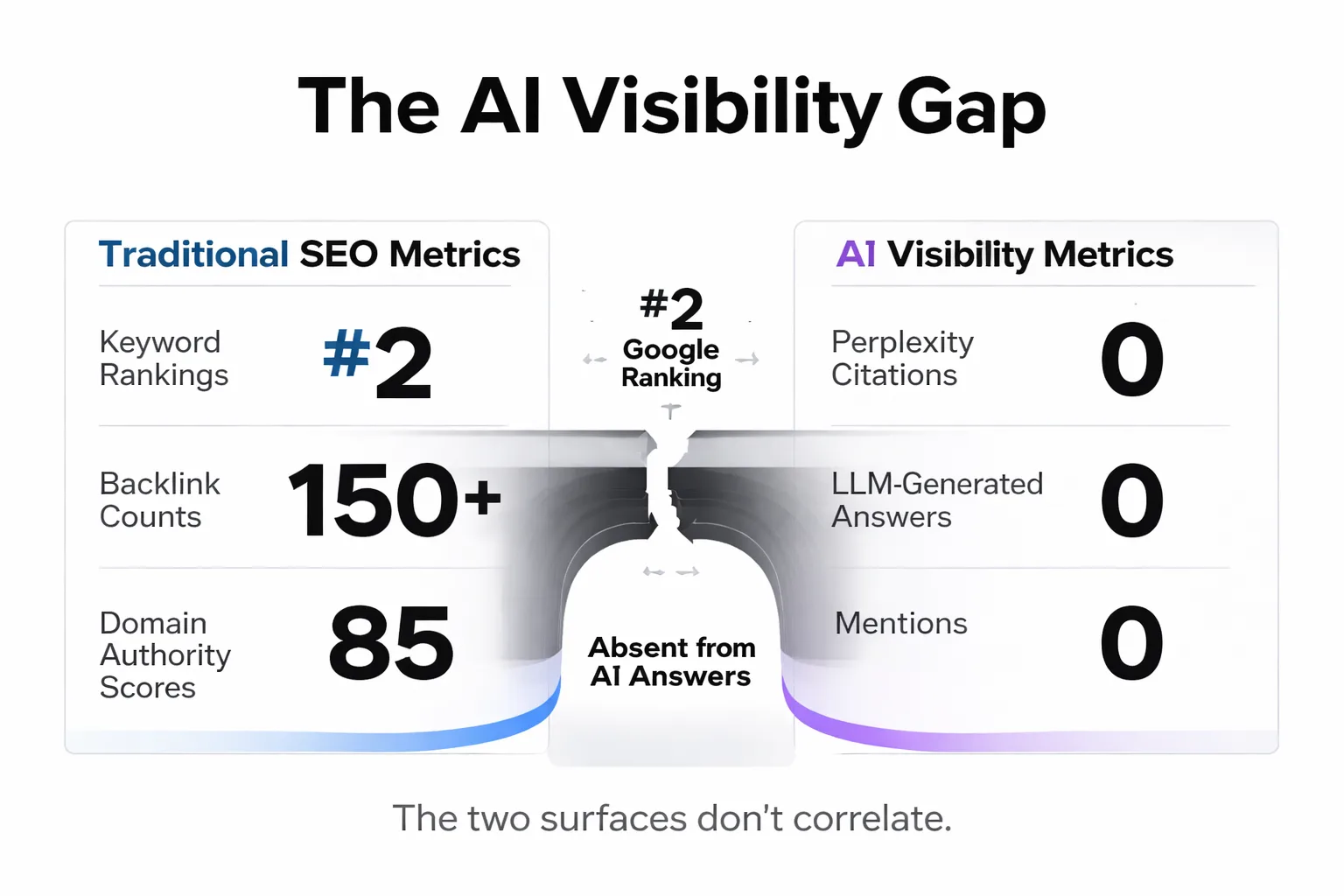
Here's the contrarian take most roundups won't give you: the majority of SEO tools with free trials were built for a search environment that no longer fully exists. Keyword rankings, backlink counts, domain authority scores. All still relevant, all still necessary. But none of them tell you whether Perplexity is citing your competitor when someone asks a question you should own. That's a separate data problem, and most tools bolt on an LLM tracker as an afterthought rather than building it into the core product.
I've watched this play out across content operations I oversee. A brand can hold a top-three Google ranking for a target keyword and still be completely absent from AI-generated answers on that same topic. The two surfaces don't correlate the way practitioners assumed they would. That disconnect is why evaluating a free trial in 2026 requires a different checklist than it did two years ago.
The tools below are ranked with that dual-track lens. Some are purpose-built AI search visibility tools. Some are traditional SEO platforms that have added credible LLM monitoring. A few are honest about what they don't do yet. All of them offer a free trial or a genuinely accessible entry tier.
The Comparison Table
| Tool | Free Trial | AI Visibility Tracking | Traditional SEO | Starting Price | Best For |
| Meev | 7 days | ChatGPT, Claude, Gemini, Perplexity, Grok, Google AI Overviews, AI Mode, DeepSeek | Rank tracking, site audit, backlinks, GSC | $49/mo | AI citation tracking + content publishing |
| SE Ranking | 14 days | LLM tracker + AI Competitor Research | Full suite: audits, rank tracking, keyword research | $103.20/mo (annual) | Agencies wanting traditional + AI in one platform |
| AIclicks | Free trial | ChatGPT, Perplexity, Gemini, Google AI Overviews | Limited. Best paired with GSC or Ahrefs | $49–$59/mo | SMBs needing affordable LLM citation audits |
| LLMrefs | Free trial | ChatGPT, Google AI Overviews, Perplexity, Gemini, Claude, Grok | Not a traditional SEO tool | Contact for pricing | International agencies, multi-language tracking |
| Ahrefs Brand Radar | No standalone trial | Major LLMs. Mentions, citations, share of voice | Full Ahrefs suite | $29/mo (Starter) | Existing Ahrefs users adding AI monitoring |
| OtterlyAI | Free trial | Major LLMs, automated alerts | Minimal. Monitoring focused | $29/mo | Agencies needing client-ready dashboards |
| Semrush AI Toolkit | 7 days | AI search monitoring integrated | Full enterprise suite | $139.95/mo | Enterprise teams, large agency campaigns |
| Nightwatch | 14 days | AI and LLM brand mention tracking | 370+ search engines, local tracking | $32/mo (annual) | Local businesses, multi-location agencies |
| Peec AI | Free trial | Multi-model LLM citation monitoring | Minimal | Contact for pricing | SMB owners, solo marketers |
Wondering which AI surfaces your brand is missing from right now?
1. Meev — Best for AI citation tracking plus quality-gated content publishing
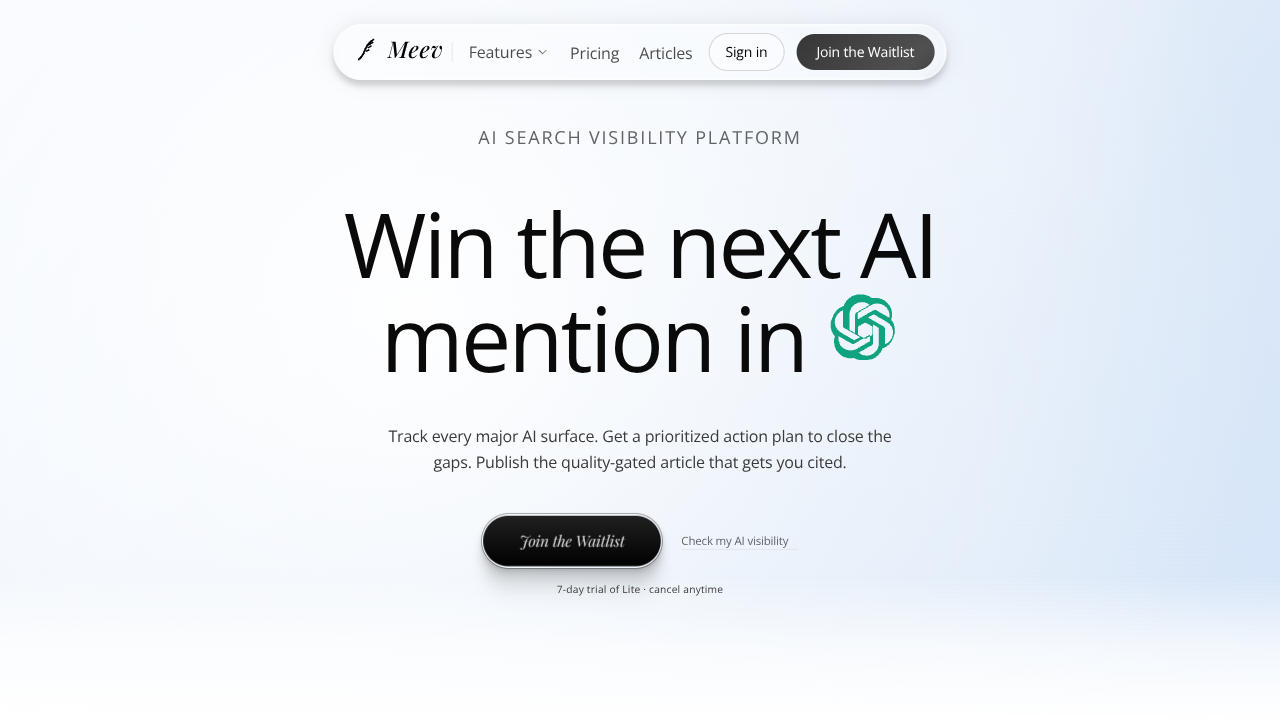
Best for: Teams that want AI citation tracking plus a content engine they can trust to publish. Not just a dashboard that surfaces problems.
Meev does something I haven't seen any other platform combine cleanly: it tracks where your brand appears across every major AI search surface and then generates content designed to close the gaps it finds. The AI visibility layer covers ChatGPT, Claude, Gemini, Perplexity, Grok, Google AI Overviews, Google AI Mode, and DeepSeek. With daily refresh on SERP-driven surfaces and rolling refresh on LLM-driven ones. That's the monitoring side. The content side is where Meev's 12-dimension Quality Matrix comes in: every article gets scored against quality signals and a Helpful Content Risk score before it's allowed to publish. Articles below 70/100 are blocked. No other auto-publishing platform I've evaluated has an equivalent gate. They ship whatever the model produces, which is exactly how you end up triggering the scaled content abuse penalties that have caused 94% traffic drops in recent core updates.
The Knowledge Base enforcement is the feature I keep coming back to. Every article Meev generates is grounded in your approved claims. Not AI hallucination. For brands in regulated or reputation-sensitive categories, that's not a nice-to-have. It's a hard requirement. The Gemini visibility tracking and DeepSeek visibility tracking modules are particularly useful for teams expanding beyond the obvious ChatGPT and Perplexity surfaces.
Key features: - Citation tracking across ChatGPT, Claude, Gemini, Perplexity, and Grok on a rolling cadence; Google AI Overviews and AI Mode refresh daily. 12-dimension Quality Matrix plus Helpful Content Risk score. 70/100 publish gate on both. Knowledge Base enforcement. Articles grounded in your approved claims, not AI hallucination. Autopilot topic pool with gap detection from competitor citation patterns
Pricing: 7-day free trial. After the trial, services pause unless you subscribe. Your account stays open and your data stays readable. Lite $49/mo, Starter $99/mo, Pro $269/mo, Agency $599/mo. 20% annual discount. Cancel anytime; hard-cap quotas with no overage fees.
The trial mirrors Lite quotas, so you'll get a real feel for the platform without hitting artificial ceilings. The no-deletion policy after trial is genuinely rare. Most tools lock you out and erase your history the moment you don't subscribe.
2. SE Ranking — Best for combined traditional SEO and AI visibility
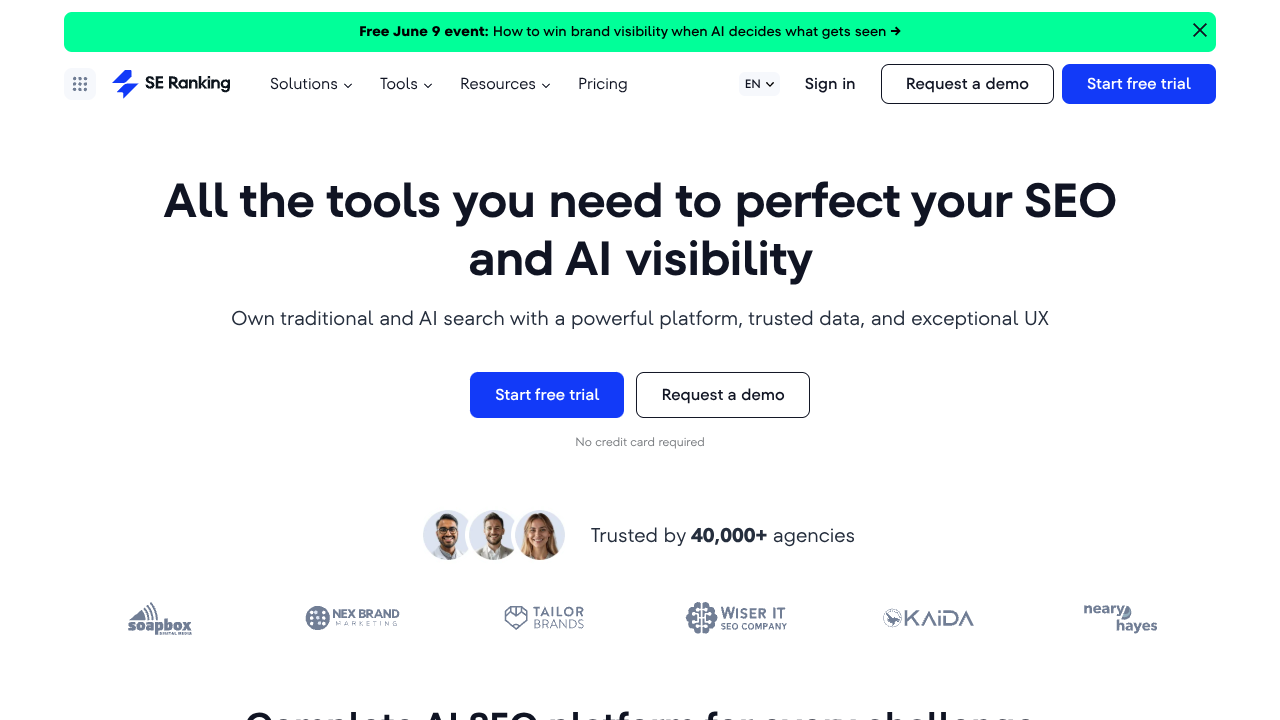
Best for: Agencies and in-house SEO teams that want affordable, combined traditional rank tracking and AI/LLM visibility monitoring in a single platform.
SE Ranking has built one of the more credible bridges between classical SEO infrastructure and emerging AI search visibility monitoring. The LLM tracker ships from the free trial. You don't have to upgrade to a premium tier to see whether your brand is appearing in AI-generated answers. The AI Competitor Research module adds domain-level AI visibility analysis, which is useful for agencies that need to show clients where they stand relative to the field, not just in absolute terms. The platform's GA4 integration and MCP Server support make it a reasonable choice for teams that need custom reporting workflows without building everything from scratch.
Key features: - LLM tracker for AI search visibility included from the free trial. Daily rank tracking for up to 750 keywords on trial. AI Competitor Research for domain-level AI visibility analysis. GA4 integration, API access, and MCP Server for custom reporting workflows
Pricing: 14-day free trial, no credit card required; Core plan starts at $103.20/month (annual); Growth at $223.20/month; LLM-focused tiers at $129/month (Core, 2k keywords & 100 prompts) and $279/month (Growth, 5k keywords & 250 prompts).
The 14-day trial without a credit card requirement is one of the more generous entry points in this category. For agencies evaluating whether to consolidate their traditional SEO stack and AI monitoring into a single tool, SE Ranking is the most mature option at this price point.
3. AIclicks — Best for affordable LLM citation audits
Best for: Bloggers, SMBs, and in-house SEO teams that need a dedicated, affordable LLM citation audit tool with clear weekly workflows.
AIclicks is purpose-built for LLM visibility. It doesn't try to be a full SEO suite, and that focus shows in the product. The prompt-level citation tracking is genuinely useful: you can see which competitors are being cited for your target queries, which URLs and domains LLMs are referencing most, and where your brand's share of voice stands across ChatGPT, Perplexity, Gemini, and Google AI Overviews. The actionable recommendations. Things like implementing LLMs.txt or building FAQ hubs. Come tagged with impact estimates, which helps prioritize a roadmap without guesswork.
For teams doing AI citation outreach work or building topical authority for AI search, AIclicks gives you the citation gap data you need to know where to focus. It's not a replacement for a technical SEO tool. You'll still want Google Search Console or Ahrefs for on-page health. But as a dedicated LLM monitoring layer, it punches above its price.
Key features: - Prompt-level citation tracking showing which competitors are cited for your target queries. Citation & Source Tracking surfacing which URLs and domains LLMs reference most. Competitor benchmarking and share-of-voice monitoring across AI platforms. Actionable recommendations with impact tags
Pricing: Free trial available; paid plans start at $49–$59/month.
At this price, AIclicks is one of the most accessible entry points for SMBs that need real LLM citation data without committing to an enterprise platform budget.
4. LLMrefs — Best for international agency AI visibility
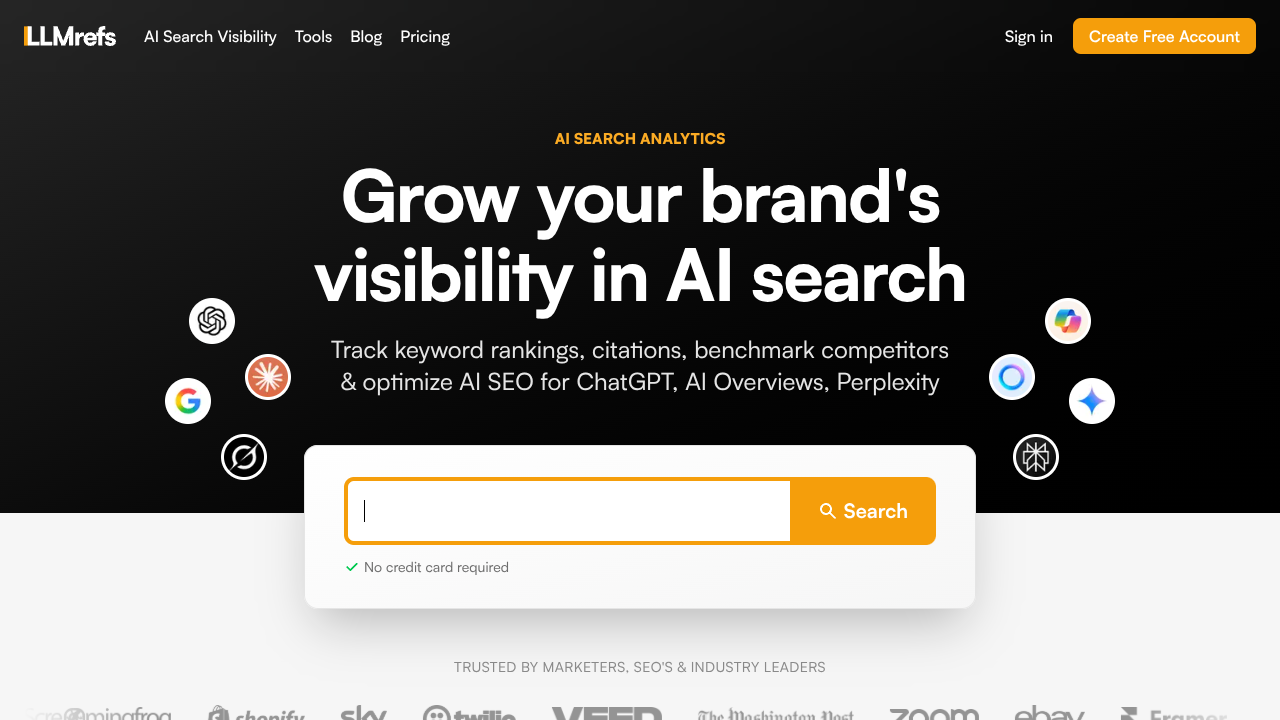
Best for: Agencies managing international clients who need statistically significant LLM brand ranking data across multiple languages and markets.
LLMrefs solves a real operational problem for international agencies: instead of manually entering prompts, you import your existing SEO keyword lists and the platform auto-generates fan-out prompts based on real AI chatbot conversations. Geo-targeting across 20+ countries and 10+ languages means you can run an ai model comparison across markets without rebuilding your tracking setup for each one. The aggregated citations, brand data, and share-of-voice dashboard with CSV export and API access makes it workable for agencies that need to pipe data into their own reporting infrastructure.
Key features: - Keyword-based tracking (import existing SEO keyword lists) rather than manual prompt entry. Auto-generated fan-out prompts based on real AI chatbot conversations. Geo-targeting across 20+ countries and 10+ languages. Aggregated citations, brand data, and share-of-voice in a single dashboard with CSV export and API access
Pricing: Free trial available; cancel anytime; pricing tiers not publicly listed. Contact for current plan details.
The lack of transparent pricing is a friction point worth noting. But for agencies with international clients who need multi-language LLM tracking at scale, LLMrefs is one of the few tools built specifically for that use case.
5. Ahrefs Brand Radar — Best for existing Ahrefs users adding AI monitoring
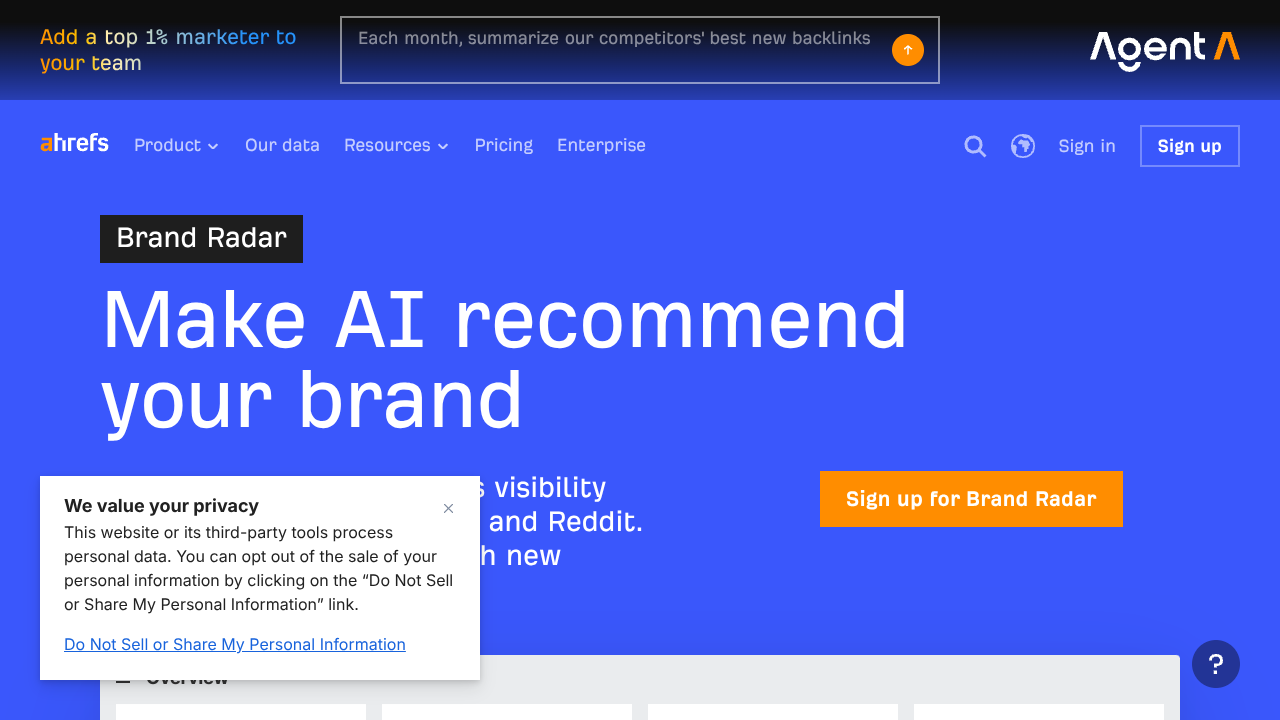
Best for: SEO managers and agencies who already use Ahrefs for traditional SEO and want to layer AI brand monitoring and competitor citation intelligence without switching platforms.
Ahrefs Brand Radar is the most natural upgrade path for teams already inside the Ahrefs ecosystem. It tracks mentions, citations, impressions, and AI share of voice across major LLMs, and it's not limited to your own domain. You can research any brand, competitor, product, or person. The citation gap analysis filter is particularly useful: you can isolate queries where AI mentions your brand but cites a competitor's URL, which gives you a precise target list for content and outreach work. For Generative Engine Optimization (GEO) practitioners, that's the kind of actionable gap data that most monitoring tools bury in exports.
Key features: - Tracks mentions, citations, impressions, and AI Share of Voice across LLMs. Research any brand, competitor, product, or person. Not limited to your own domain. Custom filters for citation gap analysis. Flexible filtering by market, niche, or query set
Pricing: Included within Ahrefs paid plans; Starter plan begins at $29/month (100 credits/month); Ahrefs Webmaster Tools is free forever for verified domains.
The Starter plan's 100 credits per month depletes quickly during active research. If you're running deep citation gap analysis, budget for a higher tier or plan your credit usage carefully.
6. OtterlyAI — Best for agency-optimized LLM monitoring
Best for: Agencies on tighter budgets that need operationally efficient LLM monitoring with white-label-friendly, client-ready reporting at an accessible entry price.
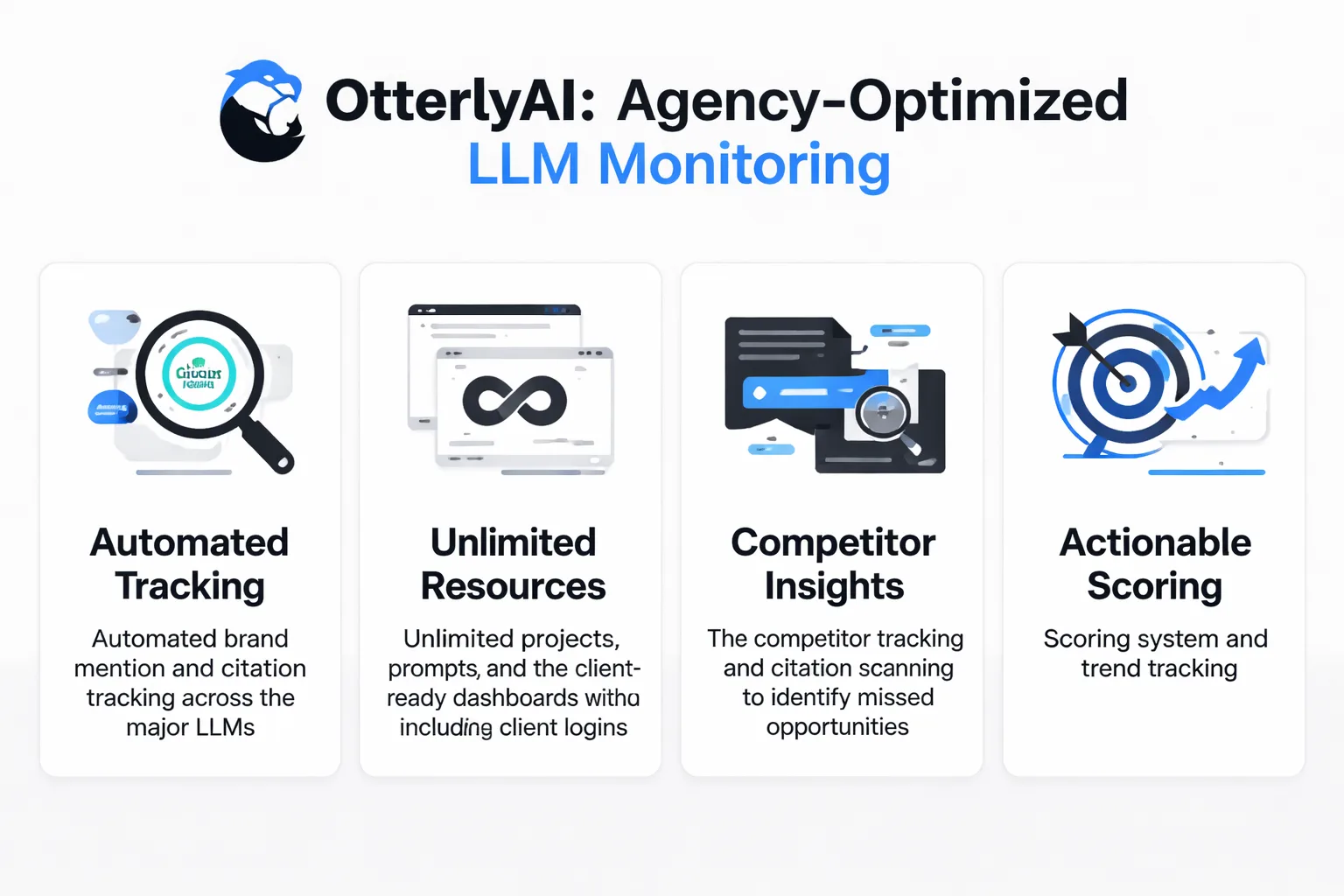
OtterlyAI's core value proposition is operational efficiency for agencies: unlimited projects, prompts, and client-ready dashboards without requiring client logins. The automated brand mention and citation tracking across major LLMs, combined with a scoring system that prioritizes actions, means junior team members can run the workflow without deep technical knowledge. For agencies that need to show AI visibility progress to clients on a monthly cadence, OtterlyAI's reporting format is one of the cleaner options in this price range.
Key features: - Automated brand mention and citation tracking across major LLMs. Unlimited projects, prompts, and client-ready dashboards without requiring client logins. Competitor tracking and citation scanning to identify missed opportunities. Scoring system and trend tracking to prioritize actions
Pricing: Starts at $29/month (Starter); Growth at $99/month; Pro at $199/month. Plans scale by scan volume; free trial available.
The weekly scan cadence on lower plans may feel limiting for teams that need daily monitoring. But at $29/month entry, it's one of the most accessible agency-oriented options in the category.
7. Semrush AI Toolkit — Best for enterprise teams needing full-stack SEO automation
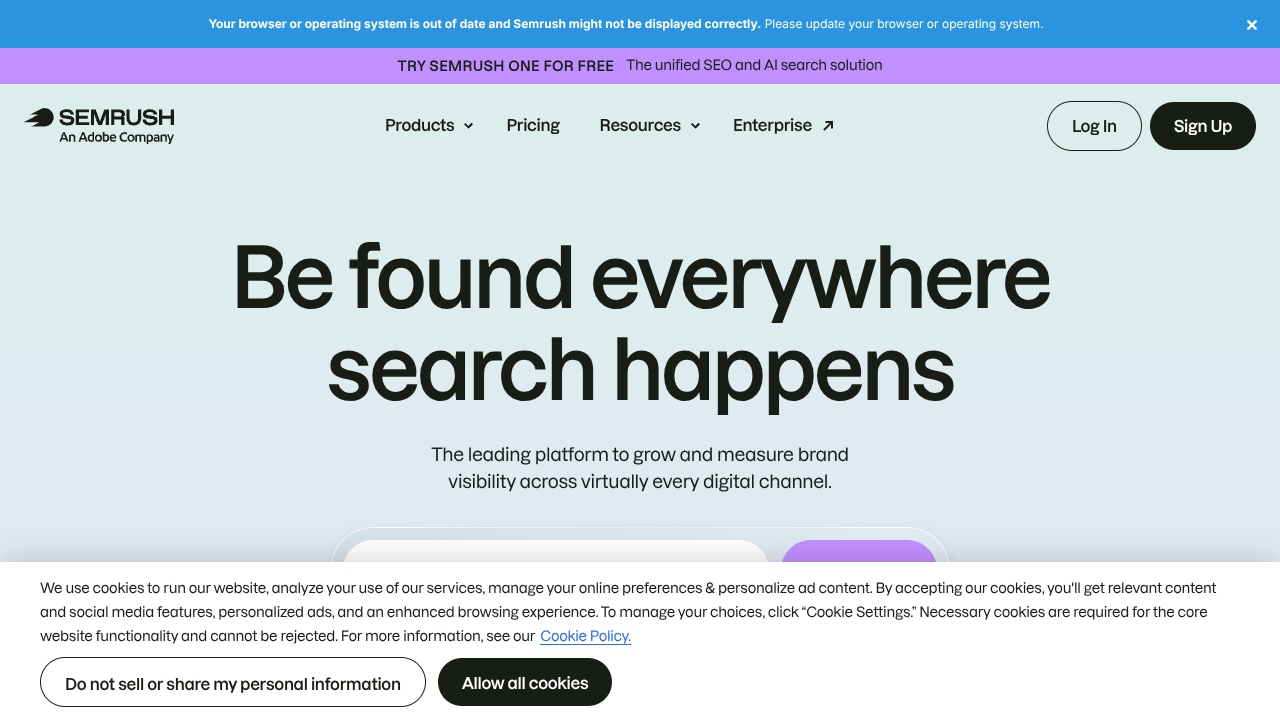
Best for: Enterprise teams and large agencies managing multiple campaigns who need comprehensive SEO automation across technical SEO, content, competitive analysis, and AI visibility in one ecosystem.
Semrush is the most feature-complete platform in this list, and that breadth is both its strength and its complexity tax. The AI Toolkit integrates AI search monitoring into a platform that already handles scheduled site audits, position tracking, content brief generation, competitive domain analysis, and white-label reporting. Semrush's 2025 AI Overviews study analyzed 200,000 queries, giving the platform genuine research credibility in the AI search space. For enterprise teams that need one vendor relationship and one dashboard, Semrush makes a strong case. For solo founders or small teams, the $139.95/month starting price is a significant commitment for features you may only partially use. The seo automation software free trial runs 7 days. Enough to audit your current setup but not enough to fully evaluate the AI visibility features if you're starting from scratch.
Key features: - Scheduled site audits and position tracking with automated alerts. Content Marketing Platform with automated topic research and content brief generation. Competitive domain analysis with automated change alerts. White-label automated reporting for agencies
Pricing: 7-day free trial available (Semrush One); paid plans start at $139.95/month.
The AI visibility features inside Semrush are an add-on to a broad platform rather than a purpose-built LLM monitoring tool. If AI search visibility is your primary need, a dedicated tool will give you more signal per dollar at this stage.
8. Nightwatch — Best for local and multi-location rank tracking with AI monitoring
Best for: Local businesses, agencies managing multi-location clients, and enterprises that need precise rank tracking alongside emerging AI visibility data in a single platform.
Nightwatch's differentiator in this list is local precision: rank results by country, city, or zip code across 370+ global and local search engines including YouTube. The AI and LLM tracking for brand mentions in AI-generated responses is a newer addition to the platform, and it's less granular than purpose-built LLM tools. But for local businesses that primarily need traditional rank tracking with AI monitoring as a secondary layer. And don't want to manage two separate platforms. Nightwatch hits a useful middle ground. The Looker Studio integration and AI suggestions in automated reports make it workable for agencies presenting data to clients who aren't deep in SEO.
Key features: - Traditional rank tracking across 370+ global and local search engines including YouTube. AI and LLM tracking for brand mentions in AI-generated responses. Automated reports with Looker Studio integration and AI suggestions. Keyword cannibalization detection and localized rank results
Pricing: 14-day free trial available; plans start at $32/month (annual) or $39/month (monthly) for 250 tracked keywords; scales to $699/month for 10,000 keywords.
Pricing scales steeply with keyword volume, so run the math on your tracking needs before committing. The 14-day trial is enough time to validate whether the local precision is worth the per-keyword cost at your scale.
9. Peec AI — Best for SMB owners and solo marketers
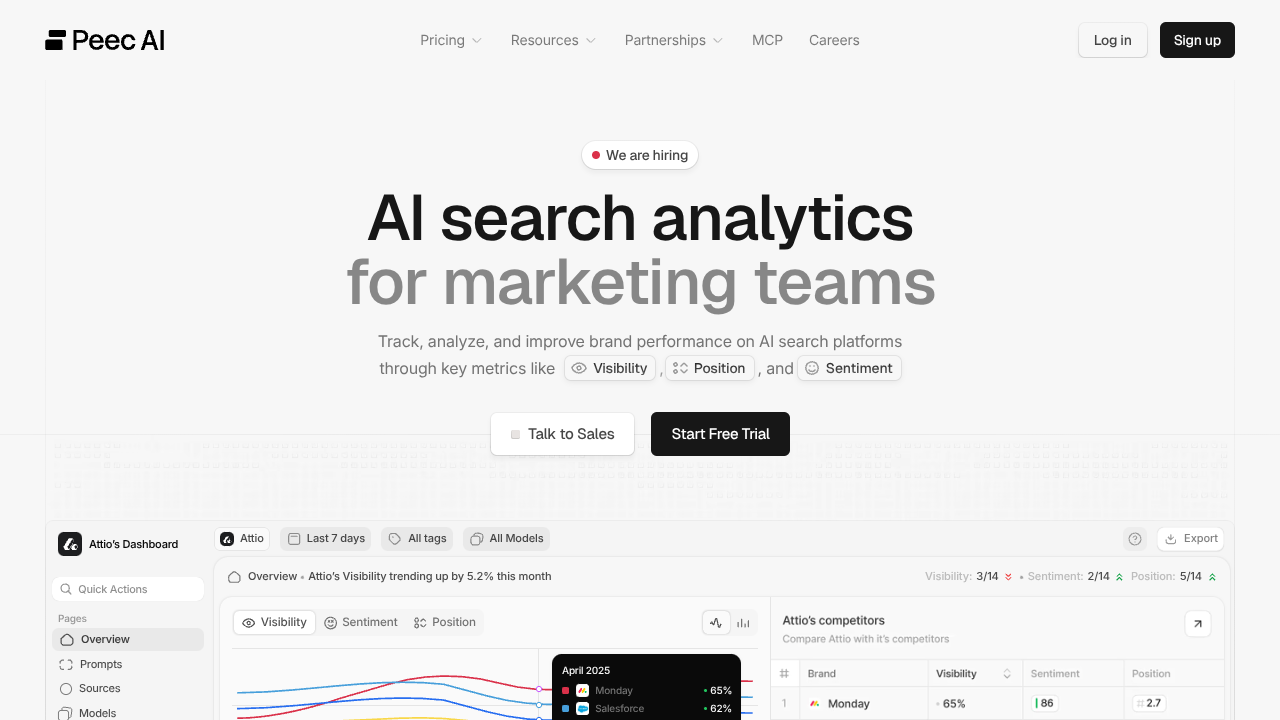
Best for: SMB owners and solo marketers who need reliable, affordable multi-model LLM citation monitoring without the overhead of enterprise platforms.
Peec AI is the lowest-friction entry point in this list for solo founders and SMBs who want to understand their AI search visibility without navigating an enterprise-grade setup. The multi-model brand mention and citation monitoring covers major LLMs, and the competitor benchmarking gives you a relative picture of where you stand. The dashboard is intentionally simplified. Which is either a feature or a limitation depending on how granular your reporting needs are. For a detailed comparison of Peec AI against Meev's citation tracking capabilities, the depth difference becomes clear at the Pro tier.
Key features: - Multi-model brand mention and citation monitoring across major LLMs. Designed for SMB usability. No enterprise-level setup complexity required. Competitor benchmarking to compare AI share of voice against rivals. Actionable insights surfaced in a simplified dashboard for non-technical users
Pricing: Free trial available; entry-level pricing accessible for SMBs. Specific tier pricing requires sign-up confirmation.
The simplified dashboard works well for non-technical users who need a directional read on their AI visibility. Teams that need granular citation source analysis or content publishing workflows will outgrow it quickly.
How Should You Evaluate a Free Trial for AI SEO?
The pattern I keep seeing is that teams waste their trial period on the wrong tasks. They spend the first week exploring the UI and exporting sample reports. Then the trial ends before they've answered the question that actually matters: does this tool surface the gaps I can't see anywhere else?
Here's the framework I'd run in any 7-14 day seo tool free trial. First, enter your five most important brand queries on day one and record the baseline citation data. Which LLMs cite you? Which cite competitors? Where are you absent entirely? That baseline is the only thing that makes the rest of the trial meaningful. Second, run a site audit on day two and flag the top technical issues. You're not fixing them in the trial. You're validating that the tool's audit logic matches what you already know about your site. If it surfaces things you've never seen flagged, that's a signal the tool is finding real problems. If it matches your existing GSC data exactly, it may not be adding much.
Third, test the content output if the tool generates articles. This is where the scaled content abuse risk becomes real. Sites that shifted from 3 posts per month to 50 posts per day without human oversight have seen 94% traffic drops in Google core updates. A 60-minute human-in-the-loop review workflow isn't optional. It's the difference between a content engine and a penalty trigger. Any platform that doesn't build quality gates into its publishing flow is asking you to manage that risk manually.
Why AI Visibility Tracking Changes the Free Trial Calculus
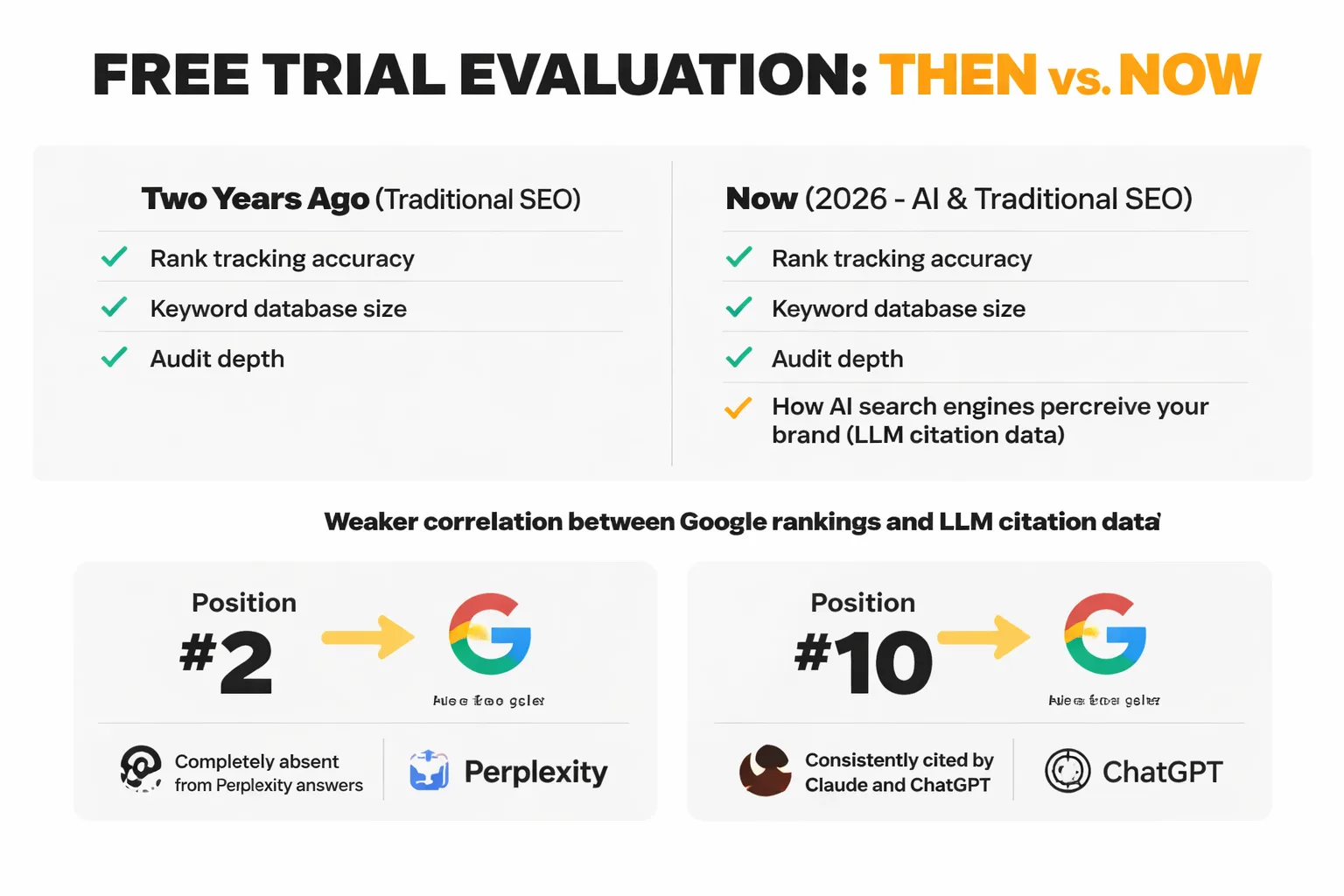
Two years ago, evaluating a free trial seo services offering meant checking rank tracking accuracy, keyword database size, and audit depth. Those criteria still matter. But the evaluation now has a second axis: does the tool tell you anything about how AI search engines perceive your brand?
I've spent time in early 2026 running parallel tests. Checking Google rankings for target keywords alongside LLM citation data for the same topics. The correlation is weaker than most practitioners assume. A page ranking in position two for a competitive keyword can be completely absent from Perplexity's answers on the same topic. The inverse is also true: I've seen pages with modest Google rankings get consistently cited by Claude and ChatGPT because they contain a specific data point or definition that LLMs have learned to trust.
The E-E-A-T signals that Google's Helpful Content System rewards aren't identical to the signals that drive LLM citation frequency. Reddit pulls citation rates around 40% of sourced content across major models. Wikipedia sits around 26%. Neither of those is a well-formatted brand content asset. What they share is platform authority and authentic, high-volume human discourse. That's uncomfortable for content teams who've spent years optimizing structured brand pages. But it's the honest picture, and any tool you evaluate should help you understand where you stand on both tracks. For teams tracking Grok visibility alongside Google AI Overviews, the divergence between surfaces is even more pronounced.
Making the Right Choice
The right seo tool free trial for your situation comes down to three questions. What do you need to track. Traditional rankings, AI citations, or both? What's your publishing workflow. Are you generating content at scale or managing a smaller editorial calendar? And what's your team's tolerance for platform complexity?
If you're an agency that needs to show clients AI search visibility data alongside traditional SEO metrics, SE Ranking's 14-day no-credit-card trial is the lowest-friction starting point. If you're an SMB or solo founder who primarily wants to understand LLM citation gaps without managing a full SEO suite, AIclicks or Peec AI give you focused data at an accessible price. If you need both citation tracking and a quality-gated content engine in one platform, Meev's 7-day trial is worth running first. The combination of AI visibility monitoring and the 12-dimension publish gate isn't available anywhere else in a single workflow.
One thing I'd push back on: don't let the free trial period drive you toward a tool that only solves half your problem. The cost of switching platforms six months from now. Migrating data, retraining your team, rebuilding your citation baselines. Is far more expensive than taking an extra week to evaluate the right tool now. Use the trial to answer the question Marcus's prospect was asking. Can this tool tell me where I'm being cited, where I'm being ignored, and what to do about it? If the answer is yes, you've found your platform.
Frequently Asked Questions
Do SEO tool free trials give access to AI visibility features?
It depends on the tool. SE Ranking includes its LLM tracker from the free trial. Meev's 7-day trial mirrors Lite plan quotas, which includes citation tracking across every major AI surface. Semrush's 7-day trial includes the AI Toolkit at relevant plan tiers. Ahrefs does not offer a standalone free trial for Brand Radar specifically, though Ahrefs Webmaster Tools is free for verified domains. Always check which features are gated behind paid tiers before starting a trial.
How long do most SEO tool free trials last?
Most run 7-14 days. SE Ranking and Nightwatch offer 14-day trials without requiring a credit card. Meev, Semrush, and OtterlyAI run 7-day trials. AIclicks, LLMrefs, and Peec AI offer free trials with duration confirmed at sign-up. Longer trials give you more time to establish citation baselines and test content output quality.
Can I use a free trial to audit my Google AI Overviews presence?
Yes, several tools in this list support Google AI Overviews monitoring. Meev refreshes Google AI Overviews and AI Mode daily. AIclicks tracks Google AI Overviews as one of its four primary surfaces. Semrush's AI Toolkit includes AI Overviews monitoring at relevant plan tiers. For Google AI Overviews Optimization specifically, you'll want a tool that shows you which queries trigger AI Overviews for your topics and which competitor URLs are cited.
What's the risk of using AI content tools to scale blog output during a free trial?
Significant if you publish without human review. Sites that publish AI-generated content at high volume without editorial oversight have seen 94% traffic drops in Google core updates due to scaled content abuse detection. A 60-minute human-in-the-loop workflow per article is the minimum recommended safeguard if you want to automate SEO safely. Tools like Meev build quality gates into the publishing flow. Articles below a 70/100 quality threshold are blocked from auto-publishing. That's meaningfully different from tools that ship whatever the model generates.
What should I do on day one of any SEO tool free trial?
Set your baseline immediately. Enter your five most important brand queries and record which LLMs cite you, which cite competitors, and where you're absent entirely. Run a site audit and flag the top technical issues without trying to fix them during the trial — then follow a technical SEO audit that covers steps most guides miss. If the tool generates content, test one article through the full workflow. From topic selection to draft to publish. So you understand the quality controls (or lack thereof) before you commit to a subscription.
About the Author
Judy Zhou, Head of Content Strategy
Judy Zhou leads content strategy at Meev, where she oversees AI-driven content research and publishing for hundreds of brands. With a background in SEO and editorial operations, she focuses on building content systems that rank on Google, get cited by AI search engines, and drive measurable business results.
Start Meev's 7-day free trial and get your AI citation baseline across ChatGPT, Perplexity, Gemini, and Google AI Overviews before your competitors do.