By Judy Zhou, Founder
Key Takeaways
- Only 12% of AI-cited URLs rank in Google's top 10, meaning traditional rank trackers miss 88% of AI-driven visibility (Ahrefs Brand Radar, 449M+ prompts analyzed).
- AI-referred traffic converts 42% better than non-AI sources and grew 393% YoY for US retail sites in Q1 2026 (Adobe, Search Engine Journal).
- The best rank tracking software in 2026 must track both classic SERP positions and AI citation mentions across ChatGPT, Perplexity, Claude, Gemini, and Google AI Overviews.
- Adding citations, quotations, and statistics to content can lift AI visibility by up to 40% (Princeton GEO paper, KDD 2024), a signal traditional rank trackers don't measure.
Your rank tracker is lying to you, and AI search is why.
The best rank tracking software in 2026 tracks both classic SERP positions and AI citation visibility across ChatGPT, Perplexity, Google AI Overviews, and Claude. Ahrefs found only 12% of AI-cited URLs rank in Google's top 10, meaning 88% of the content AI engines cite is invisible to traditional rank trackers. 68% of US Google searches now end without a click, and AI-referred traffic converts 42% better than non-AI sources. If your rank tracker only shows Google positions 1-10, you're blind to where the actual traffic and conversions are coming from.
I'm Judy Zhou, and in my work leading content strategy at Meev, I've watched hundreds of brands discover that their rank tracker says "#1" while their AI visibility is zero. The tools most teams rely on were built for a search world that's disappearing.
What Is Rank Tracking Software. And Why the Definition Changed in 2026
Rank tracking software used to mean one thing: a tool that checks where your URLs land in Google's organic results for a list of target keywords. You'd plug in 50 keywords, run daily checks, and watch a seo ranking report show your positions climbing or falling. Simple. Clean. Increasingly incomplete.
The definition broke when AI search surfaces started answering questions directly. Google AI Overviews, ChatGPT with browsing, Perplexity, Claude, and Gemini now generate responses that synthesize information from multiple sources. They cite those sources. They recommend brands. And none of that activity shows up in a traditional search engine ranking monitor.
Here's the number that stopped me cold. Ahrefs' research analyzed 449+ million AI prompts across six AI platforms and found that only 12% of URLs cited by AI answers also rank in Google's top 10. That means the overlap between classic ranking and AI citation is shockingly low. You can dominate Google's first page and still be invisible when a prospect asks ChatGPT "what's the best rank tracking software."
The Semrush AI Visibility Index tracks 180+ million AI answers across 22 industries and 9 markets. Their data confirms what I've seen across the brands I work with: AI search has fundamentally diverged from traditional SERP positioning. The sources AI engines prefer are not always the sources Google ranks. The content structures that win citations are not the same structures that win clicks.
So what is the best rank tracker tool? In 2026, the answer is: whatever tool tracks both. A rank tracker that only monitors Google positions is like a speedometer that works perfectly but doesn't tell you you're on the wrong road. You need to know where you rank AND where you're cited.
The Princeton GEO research team proved this in their KDD 2024 paper on Generative Engine Optimization. They found that adding citations, quotations, and statistics to content can lift visibility in generative engine responses by up to 40%. That's not a ranking signal Google measures. It's a citation signal AI engines reward. Traditional rank trackers don't capture it at all.
What to Look for in Rank Tracking Software Today
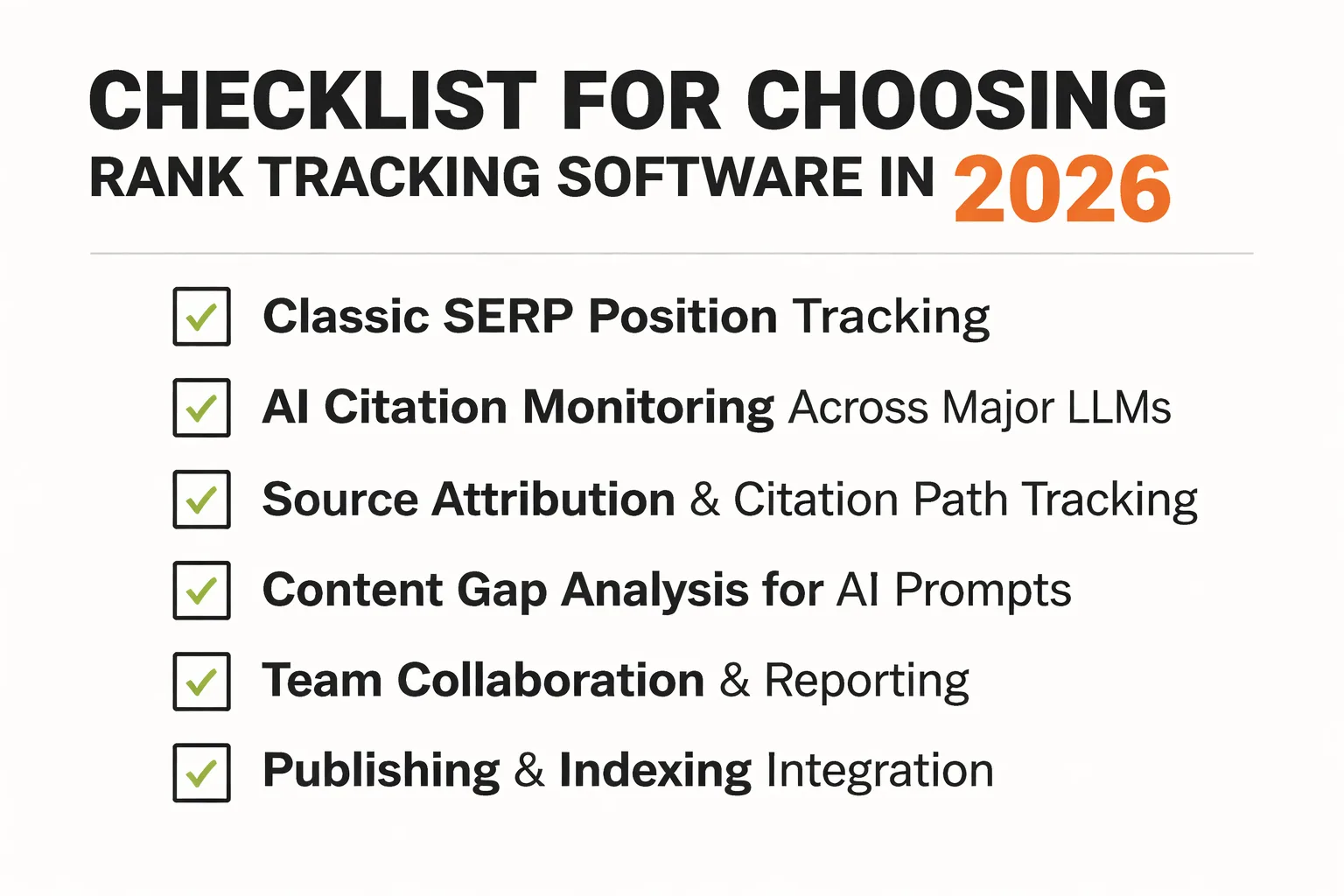
Most teams evaluating the best rank tracking software in 2026 are doing it backwards. They start with a feature list from 2020 and add "AI stuff" as an afterthought. I start with the opposite question: what does AI search actually require, and which of those requirements does each tool meet?
There are four capabilities that matter now. If a tool misses any of them, it's not future-proof.
Classic SERP position tracking. Yes, this still matters. Google still drives significant traffic, and organic ranking remains a leading indicator for some AI citation patterns. Your tool needs daily or weekly position tracking across desktop and mobile, local tracking where relevant, and competitor comparison. This is table stakes. Every tool I've evaluated does this adequately.
AI citation monitoring across major surfaces. This is where most tools fall off a cliff. You need to know whether your brand appears in responses from ChatGPT, Claude, Gemini, Perplexity, Grok, Google AI Overviews, and AI Mode. Not just "does it appear" but where in the answer it appears (first mention, in a list, last), what the full response text says, and which sources the AI engine cited alongside your brand. Semrush's AI Visibility Toolkit starts at $99/month per domain and tracks brand mentions across AI platforms. Ahrefs Brand Radar covers 449+ million AI prompts and includes Claude (which Semrush does not, as of October 2026). Both are serious tools. Neither is cheap.
Source attribution and citation path tracking. Knowing you're cited is step one. Knowing WHY you're cited (or why you're not) is the real game. The best rank tracking software should show you which domains AI engines cite most often for your topics, what the citation gap looks like between you and competitors, and which publishers you'd need to earn mentions from to close that gap. This is where answer engine optimization diverges hardest from traditional SEO. It's not about your domain authority. It's about whether the right third-party sources are talking about you.
Content publishing and indexing integration. Here's where I get opinionated. Tracking without action is just expensive reporting. If your rank tracker identifies a citation gap but you have no way to close it within the same platform, you're paying for diagnosis without treatment. The tools I recommend in 2026 either include content generation and publishing capabilities or integrate tightly with tools that do.
The arXiv GEO paper found that AI search exhibits a bias toward earned media over brand-owned and social content. That means closing citation gaps often requires outreach to third-party publishers, not just publishing more on your own blog. A rank tracker that doesn't account for this is telling you half the story.
Classic Rank Trackers vs. AI Visibility Platforms. The Real Difference
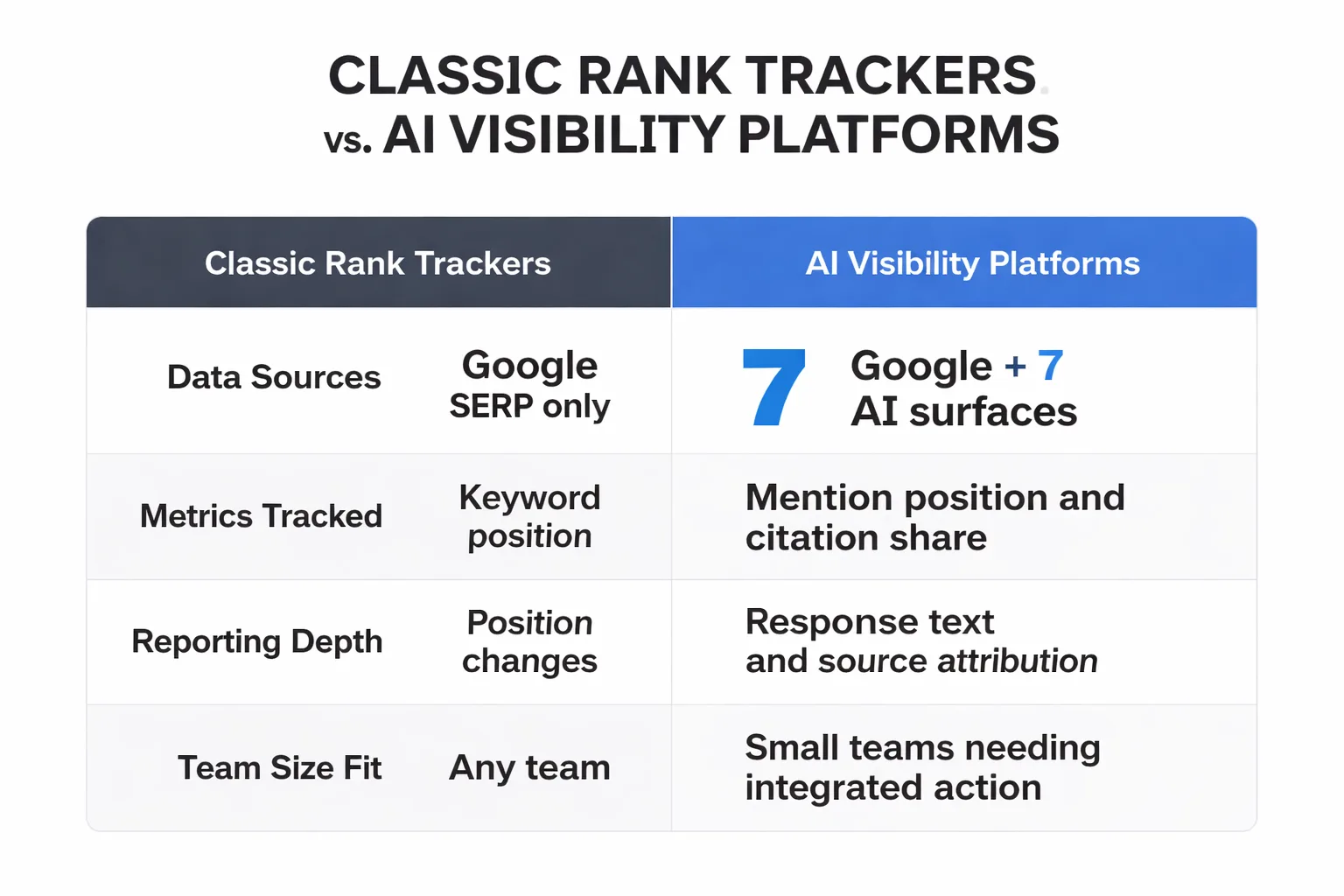
Let me be blunt about something. Most "best rank tracking software" lists you'll find online are comparing tools that solve the same problem slightly differently. Semrush vs. Ahrefs. SE Ranking vs. Mangools. AccuRanker vs. Wincher. They're all classic rank trackers with varying UI polish and pricing models. The real comparison that matters in 2026 is classic rank trackers vs. AI visibility platforms.
Here's how the two categories stack up on the dimensions that actually matter.
Data freshness and surface coverage. Classic rank trackers check Google SERP positions daily. Some offer hourly updates. AI visibility platforms refresh SERP-driven surfaces daily and LLM-driven surfaces on a rolling basis (because LLM APIs have different rate limits and cost structures). The Semrush AI Visibility Index covers 180+ million AI answers. Ahrefs Brand Radar covers 449+ million prompts. Classic trackers cover zero AI answers by definition.
Metrics tracked. Classic rank trackers give you position (1-100), search volume, keyword difficulty, and SERP feature occupancy. AI visibility platforms give you mention position (where in an AI response your brand appears), share-of-voice (what percentage of AI answers cite you vs. competitors), citation source leaderboards (which domains AI engines cite most for your topics), and the actual response text behind every mention. The metric sets are fundamentally different. Position 1 on Google tells you one thing. Being the first brand mentioned in a ChatGPT response tells you something else entirely.
Reporting depth. A seo ranking report from a classic tracker shows position changes over time, estimated traffic, and maybe competitor gap analysis. An AI visibility report shows trend sparklines per LLM, sentiment scoring on brand mentions, and content opportunity prompts where competitors are cited but you aren't. The reporting depth isn't just deeper. It's structurally different because the questions being answered are different.
Team size fit. Classic rank trackers scale well from solo founders to enterprise teams. Pricing is predictable (per keyword or per project). AI visibility platforms tend to be more expensive because LLM API calls cost real money per check. Semrush charges $99/month per domain for AI visibility on top of their base SEO subscription. For small teams, this adds up fast. The tradeoff is that AI visibility platforms that include content generation and publishing (like Meev) replace multiple tools, which can actually lower total spend.
The contrarian take. Here's what everyone gets wrong about this comparison. Most articles treat AI visibility as a premium add-on to traditional rank tracking. I think it's the opposite. Traditional rank tracking is becoming the add-on. When 68% of US Google searches end without a click and AI-referred traffic converts 42% better than non-AI sources, the citation is the conversion. The Google position is the legacy metric. You should start with AI visibility and add classic tracking as a secondary signal, not the other way around.
Is your brand being cited by ChatGPT and Perplexity, or just ranked on Google?
How Does AI Citation Tracking Actually Work?
AI citation tracking works by sending prompts to LLM APIs (ChatGPT, Claude, Gemini, Perplexity, Grok) and analyzing the responses for brand mentions, competitor mentions, and source citations. Each response is parsed to identify where your brand appears (first, middle, last), what sentiment surrounds the mention, and which URLs the AI engine cited as sources. This data is refreshed on a rolling basis and tracked over time to show trends.
The mechanics sound simple. The execution is not. Each LLM has different API costs, rate limits, and response formats. Perplexity's Sonar API costs roughly $0.005 per call. Google's DataForSerps API costs around $0.027 per call. That 5x cost difference compounds quickly when you're tracking hundreds of prompts across multiple surfaces. The best rank tracking software for AI search uses a hybrid architecture that routes queries to the cheapest reliable API for each surface without compromising measurement validity.
In my work auditing content operations, I've seen teams burn thousands of dollars on AI visibility tracking because they didn't understand the per-call cost structure. One team was tracking 200 prompts across 5 surfaces using a single expensive API. They could have achieved the same coverage at 20% of the cost by using direct integrations with cheaper APIs for surfaces that supported them.
The Ahrefs Brand Radar approach is interesting here. They've built their index to 449+ million prompts by batching queries efficiently. Semrush has reached 180+ million AI answers through similar optimization. Both tools invest heavily in API cost management because it's the single biggest factor in whether AI visibility tracking is economically viable at scale.
Why Does Entity Grounding Matter for AI Search Visibility?
Entity grounding matters because AI engines don't just match keywords. They match entities (people, places, organizations, concepts) to their internal knowledge graphs. If your brand isn't recognized as a distinct entity with clear attributes (what you do, who you serve, how you differ from competitors), AI engines can't reliably cite you even when your content is relevant.
I learned this the hard way. A B2B SaaS client I worked with spent three months optimizing content for LLM prompts without entity grounding. They stuffed their pages with AI-friendly language, added citation-worthy statistics, and structured their content for extractability. Their AI citations dropped 40%. The problem? They'd optimized for prompt patterns without establishing themselves as a recognizable entity in the knowledge sources AI engines actually consult.
The arXiv GEO paper found that AI search exhibits bias toward earned media over brand-owned content. Translation: AI engines trust what others say about you more than what you say about yourself. Entity grounding is partly about structured data on your own site (schema markup, consistent NAP information, clear product descriptions). But it's equally about being mentioned in the right third-party sources that AI engines treat as authoritative.
This is where Wikidata and knowledge graph presence come in. If your brand has a Wikidata entry with accurate attributes, AI engines can ground their responses to verified entity data. If it doesn't, the AI has to infer your attributes from scattered web content, which is less reliable and less likely to result in a citation. I've seen brands go from zero AI visibility to consistent citations simply by creating and enriching their Wikidata entries.
The challenge? No traditional rank tracker measures entity grounding. No rank tracker tells you whether your Wikidata entry is complete, whether your schema markup is AI-parseable, or whether your entity is recognized consistently across knowledge graphs. This is a gap in the market that the best rank tracking software needs to close.
When Should You Upgrade from a Classic Rank Tracker?
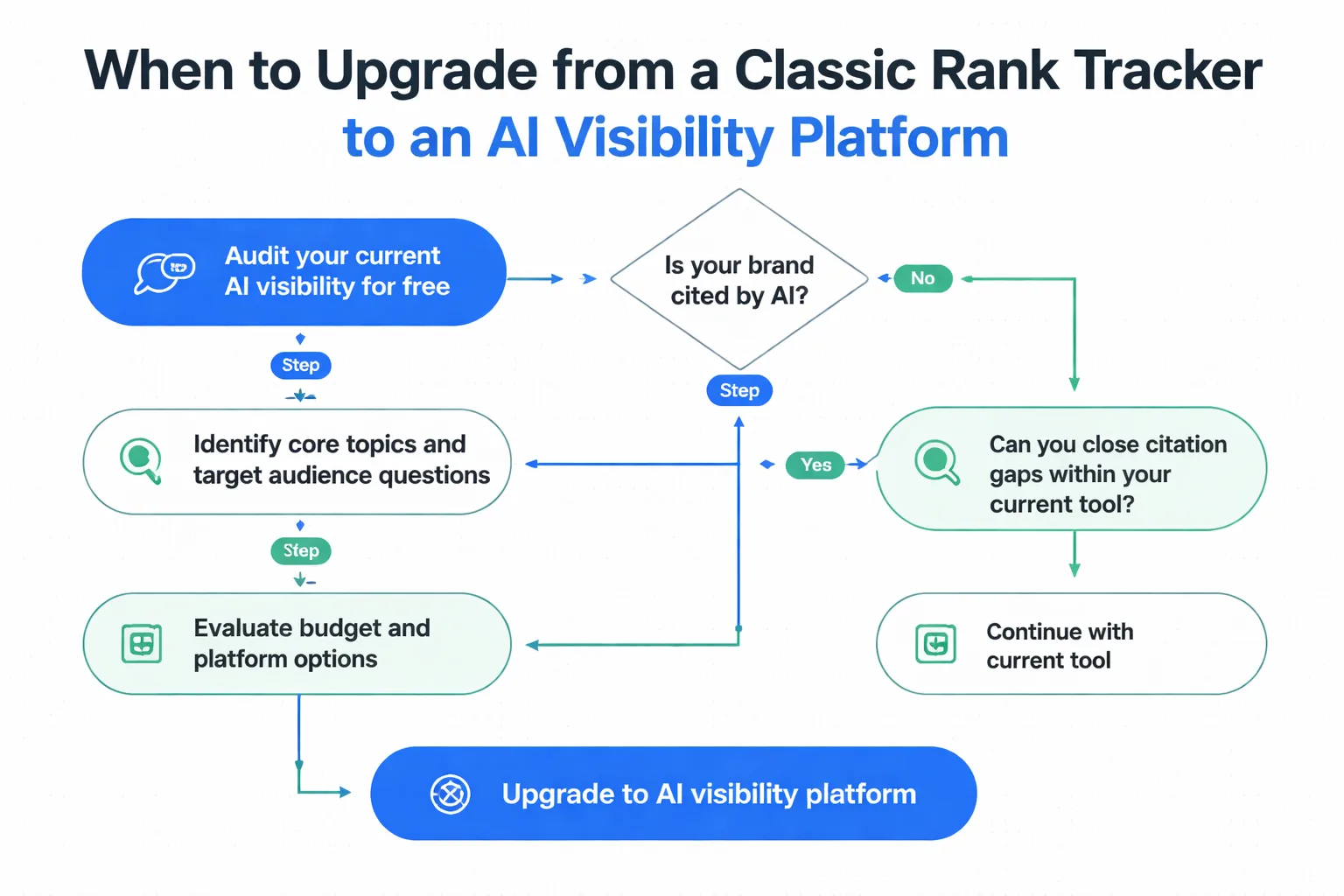
You should upgrade from a classic rank tracker to an AI visibility platform when your target audience starts asking AI engines questions your brand should answer. For most B2B SaaS companies, that moment is now. For ecommerce brands, it arrived last quarter.
Here's the decision framework I use with teams I advise.
Step 1: Audit your current AI visibility for free. Before buying anything, check whether your brand appears in AI responses for your core topics. You can use a free AI visibility checker to run a quick diagnostic. If your brand shows up consistently and positively, you may not need to upgrade yet. If it's absent or misrepresented, you have a problem your current rank tracker can't solve.
Step 2: Calculate the revenue at stake. Adobe's 2026 data shows AI-referred traffic to US retail sites grew 393% year-over-year in Q1 2026 and converts 42% better than non-AI sources. If you're a B2B SaaS company with a $50K ACV and AI-referred demos convert at 42% higher rates, each missed AI citation could represent significant pipeline. Run the math for your business.
Step 3: Evaluate whether your current tool can close the gap. If your rank tracker identifies that you're not cited for a key prompt, can it tell you why? Can it show you which sources the AI engine cited instead? Can it help you earn mentions from those sources? If the answer to any of these is no, you need a tool that goes beyond tracking into action.
Step 4: Assess team capacity. AI visibility platforms that include content generation and publishing can replace 2-3 tools in your stack. But they require setup time, knowledge base configuration, and ongoing curation. If you're a solo founder or a one-person marketing team, look for a platform that automates as much as possible. If you have a content team, prioritize tools that give you manual control over publishing.
Step 5: Consider the total cost of ownership. Semrush's AI Visibility Toolkit adds $99/month per domain to their base subscription. Ahrefs includes Brand Radar in their higher-tier plans. Compare these costs against the alternative: buying a rank tracker, an AI visibility tool, a content generation tool, and an outreach platform separately. The bundled approach often wins on price for small teams.
What Metrics Actually Matter for AI Search Visibility?
This is where I get frustrated with the current market. Most AI visibility tools report a vanity metric called "AI Visibility Score" or "AI Share of Voice" that sounds impressive but tells you nothing actionable. A higher score doesn't automatically translate to more demos, more signups, or more revenue. I've seen brands with high AI visibility scores that get zero business value from them because they're cited for the wrong prompts.
The metrics that actually matter are specific and granular.
Mention position. Where in the AI response does your brand appear? First mention gets the most recall. Last mention gets the least. If you're always mentioned third in a list of five, your visibility score might look fine but your actual mindshare is weak.
Prompt-level coverage. What percentage of relevant prompts in your space cite your brand? This is the AI equivalent of keyword coverage in traditional SEO. The Semrush AI Visibility Index tracks this across 22 industries. A brand cited in 30% of relevant prompts is in a fundamentally different position than one cited in 5%.
Citation source diversity. Are the same two domains always cited alongside your brand, or does the AI engine draw from a diverse set of sources? Low diversity suggests the AI engine has a narrow understanding of your brand. High diversity suggests broader recognition.
Competitive share-of-voice. What percentage of AI answers cite you vs. each competitor? This is the metric I prioritize in my search engine ranking monitor work. If your competitor is cited in 40% of responses and you're cited in 10%, you have a 4x gap to close. That's concrete. That's actionable. An "AI Visibility Score" of 73 tells you nothing.
Conversion attribution. This is the hardest metric to track and the most important. Can you trace demo requests, signups, or purchases back to an AI citation? Adobe's data shows AI-referred traffic converts 42% better than non-AI sources. If you can't measure this, you're flying blind on whether your AI visibility investment is paying off.
Can Traditional Rank Trackers Adapt to AI Search?
Some are trying. Semrush launched their AI Visibility Toolkit. Ahrefs launched Brand Radar. Both are serious efforts from serious companies. But there's a structural limitation: these tools were built for a SERP-first world, and AI visibility is bolted on as a feature module rather than a core architecture.
The Arobis AI comparison put it well: Ahrefs Brand Radar is stronger for citation-source analysis, while Semrush's toolkit integrates better with existing SEO workflows. Neither tool was built from the ground up to answer the question "is my brand cited by AI engines, and if not, what do I do about it?"
Here's my concern. Traditional rank trackers have massive existing user bases and revenue streams tied to keyword tracking. Their incentive structure pushes them to add AI features as upsells rather than rebuild their architecture for an AI-first world. That means the AI visibility features you get from legacy tools will always be one step behind what a purpose-built platform can offer.
I'm not saying traditional rank trackers are useless. They're not. Google still drives traffic. Classic SERP positions still matter as a secondary signal. But if you're choosing the best rank tracking software for AI search specifically, you need a tool that was designed for AI search from day one. A purpose-built AI visibility tool will always outperform a legacy rank tracker with an AI module bolted on.
The Princeton GEO researchers proved this in their KDD 2024 paper. The optimization techniques that work for AI citation (adding citations, quotations, statistics, structuring content for extractability) are fundamentally different from traditional SEO techniques. A tool built for traditional SEO cannot fully capture or act on these differences.
How Do You Track Visibility Across Different AI Surfaces?
You track visibility across different AI surfaces by querying each surface separately and normalizing the results into a unified dashboard. Each AI engine (ChatGPT, Claude, Gemini, Perplexity, Grok, Google AI Overviews, AI Mode) has its own API, response format, citation behavior, and cost structure. A proper AI visibility platform queries all of them and presents the data in a comparable format.
The challenge is that each surface behaves differently. ChatGPT might cite your brand in a list of recommendations. Perplexity might cite your content as a source with a footnote link. Google AI Overviews might mention your brand in a summary without linking. Claude might reference your product by name without citing a URL. These are all forms of visibility, but they have different business value.
I track this across the brands I work with, and the patterns are striking. A brand might dominate Perplexity citations but be completely absent from ChatGPT responses. Another might appear consistently in Google AI Overviews but never in Claude. The variation between surfaces is enormous, and it means you need per-surface drill-down dashboards to understand where you're winning and where you're losing.
The Semrush AI Visibility Index confirms this. Their 2026 H2 study found significant variation in which brands appear across different AI platforms. The sources AI engines cite vary by platform, by industry, and by query type. A tool that only tracks one or two surfaces gives you a false picture of your overall AI visibility.
For specific surface tracking, I recommend checking dedicated tools. A Perplexity AI visibility checker can show you exactly how you appear in Perplexity responses. A ChatGPT AI visibility checker does the same for ChatGPT. Run both before investing in a full platform.
What About Agentic SEO and Agentic Commerce?
Agentic SEO is the next frontier, and most rank trackers aren't ready for it. In agentic SEO, autonomous AI agents don't just answer questions. They make decisions. They compare products, evaluate options, and sometimes execute purchases without human intervention. This is already happening in ecommerce, where AI shopping agents compare products across stores and make recommendations (or purchases) based on criteria the user specifies.
For rank tracking, this means the unit of measurement shifts. It's no longer just "does my brand appear in the AI response." It's "does the AI agent recommend my product, and why." The recommendation rate matters more than the mention rate. A brand mentioned in an AI response but not recommended by the agent has visibility without conversion.
I've been watching this space closely, and what I've quickly learned is that most AI visibility tools track mentions, not recommendations. They can tell you whether your brand appears in a response. They can't tell you whether an AI agent would choose your product over a competitor's. That's a fundamentally different question requiring a fundamentally different measurement approach.
The GEO for ecommerce guide from Hello Retail emphasizes that GEO requires structuring your content so AI search engines cite your products and brand. For agentic commerce, this goes further. You need to structure your content so AI agents can evaluate, compare, and select your products autonomously. That means clear pricing, structured specifications, comparison tables, and review data that agents can parse.
Itay Malinski warned in his LinkedIn article on Agentic SEO: "If you don't understand it, you'll waste a lot of money on hallucinated garbage." He's right. The teams jumping into agentic SEO without understanding entity grounding, knowledge graph presence, and structured product data are setting themselves up for failure.
For ecommerce brands specifically, generative engine optimization is no longer optional. Adobe's data shows traffic from AI sources to US retail sites grew 393% year-over-year in Q1 2026. If you're an ecommerce brand and your rank tracker doesn't track AI visibility, you're ignoring your fastest-growing traffic source.
Putting It Into Practice. What to Actually Do Next
Let me make this concrete. If you're a founder or marketer at a small company trying to choose the best rank tracking software for AI search in 2026, here's what I'd do.
First, run a free diagnostic. Use an AI visibility checker to see where you stand across major AI surfaces. This takes 10 minutes and tells you whether you have a problem worth solving. If your brand is consistently cited across ChatGPT, Perplexity, and Google AI Overviews, you may only need a cheap classic rank tracker for Google position monitoring. If you're absent or poorly represented, you need more.
Second, understand the difference between AEO and SEO. Answer engine optimization is not traditional SEO with a new label. It requires different content structures, different success metrics, and different tools. If your team doesn't understand this distinction, no tool will save you.
Third, evaluate tools on their ability to close the loop. Tracking is diagnosis. Content generation and publishing is treatment. Outreach and citation building is recovery. The best rank tracking software in 2026 handles all three or integrates tightly with tools that do. A rank tracker that only diagnoses is a partial solution.
Fourth, validate your LLMs.txt file and ensure your content is AI-parseable. This is a quick win that most teams overlook. If AI engines can't parse your content properly, no amount of rank tracking will surface your brand in AI responses.
Fifth, if you're managing multiple domains or clients, look at an enterprise AI rank tracker that scales with you. The per-domain costs of AI visibility tracking add up fast when you're tracking 5, 10, or 15 domains.
The reality is this. The best rank tracking software for AI search in 2026 is whichever tool tracks both classic SERP positions and AI citation visibility, then helps you close the gaps it finds. A rank tracker that only does half the job isn't a rank tracker anymore. It's a relic.
I've watched too many teams discover this too late. Their rank tracker said everything was fine. Their AI visibility said otherwise. By the time they noticed the gap, competitors had already established citation dominance in their space. Don't let that be you. Start with an AI visibility audit, understand where you stand, and choose a tool that treats AI citations as a first-class metric, not an afterthought.
FAQ
What is the best rank tracking software for small teams?
For small teams in 2026, the best rank tracking software is a platform that combines classic SERP tracking with AI citation monitoring at a price that doesn't require enterprise budgets. Look for tools that charge per domain (not per keyword) for AI visibility, include content generation to close citation gaps, and offer multi-surface coverage across ChatGPT, Perplexity, Claude, and Google AI Overviews. Meev's Lite tier at $49/month covers 10 prompts and 10 articles, which is enough for a solo founder to get started.
Can I use a free rank tracker for AI search visibility?
Free rank trackers (like Google Search Console) can show you classic SERP performance and some AI Overview click data, but they don't track AI citations across ChatGPT, Claude, Perplexity, or Gemini. You can use a free AI visibility checker for a one-time diagnostic, but ongoing monitoring requires a paid tool because each LLM API call costs real money. No free tool offers continuous AI citation tracking across all major surfaces.
How often should I check my AI visibility?
Weekly is the sweet spot for most teams. LLM responses change less frequently than Google SERP positions, so daily checking is overkill and expensive. Weekly refreshes give you enough trend data to spot changes without burning through API budgets. For SERP-driven surfaces like Google AI Overviews, daily tracking is fine since the cost per check is lower.
What's the difference between AI visibility and AI citation tracking?
AI visibility measures whether your brand appears in AI-generated responses. AI citation tracking goes deeper: it identifies whether AI engines cite your content as a source, which specific pages they cite, and what the surrounding response text says. Visibility is "they mentioned me." Citation tracking is "they cited my work as evidence." Both matter, but citation tracking is more actionable because it tells you which content is driving AI recognition.
Do I need entity grounding if I already rank well on Google?
Yes. Ahrefs found only 12% of AI-cited URLs rank in Google's top 10. High Google rankings don't guarantee AI citations because AI engines ground responses to knowledge graph entities, not just SERP positions. If your brand isn't recognized as a distinct entity in Wikidata and other knowledge sources, AI engines may not cite you even when your content ranks #1 organically. Entity grounding is a separate requirement from traditional SEO.
How much does AI visibility tracking cost?
Semrush charges $99/month per domain for their AI Visibility Toolkit on top of their base subscription. Ahrefs includes Brand Radar in higher-tier plans. Purpose-built platforms like Meev bundle AI visibility tracking with content generation starting at $49/month. The cost depends on how many surfaces you track, how many prompts you monitor, and whether you need content generation and publishing capabilities alongside tracking.
About the Author
Judy Zhou, Founder
Judy Zhou leads content strategy at Meev, where she oversees AI-driven content research and publishing for hundreds of brands. With a background in SEO and editorial operations, she focuses on building content systems that rank on Google, get cited by AI search engines, and drive measurable business results.
Stop guessing about your AI visibility. Run a free diagnostic across every major AI search surface and see exactly where you stand.