
By Judy Zhou, Founder
Key Takeaways
- 68.01% of Google searches ended without a click in Q1 2026, so position tracking alone misses the majority of visibility.
- AI Overviews reduce click-through rates by nearly 60% and now appear for 15.69% of keywords, requiring brands to monitor citations inside generated answers.
- 93% of Google AI Mode sessions end without a click, making dual tracking of classic rankings plus AI search visibility the only reliable measurement system.
- Build rank trackers that also log whether ChatGPT, Perplexity, or Google AI Overviews mention your brand instead of competitors.
Ranking first on Google in 2026 doesn't guarantee a single click anymore.
68.01% of Google searches ended without a click in Q1 2026, according to SparkToro's analysis of Similarweb data. When Google AI Overviews appear, Ahrefs found they reduce click-through rates by nearly 60%. If you only track Google ranking positions, you're measuring the tip of an iceberg while ignoring the mass of visibility happening inside AI-generated answers.
I'm Judy Zhou, and in my work leading content strategy at Meev, I've watched brands pour budget into climbing from position 4 to position 2, only to see traffic flatline because an AI answer now sits above both results. The teams that adapt are building dual-tracking systems: classic rank tracking plus AI search visibility monitoring. Here's how to do it.
Why Tracking Google Rankings Alone Misses Half the Picture
The traditional rank tracker is a snapshot of a world that's disappearing. You query a keyword, the tool returns a position number, and you celebrate or panic. But that position number tells you nothing about whether ChatGPT mentioned your brand when a prospect asked the same question, or whether Perplexity cited your competitor instead of you.
Here's the scale of the shift. Semrush analyzed 10M+ keywords and found AI Overviews appeared for 6.49% of keywords in January 2025, peaked near 25% in July, and settled at 15.69% by November. Pew Research reported that 58% of U.S. Google users encountered an AI summary in March 2025 alone. And BrightEdge data shows 93% of Google AI Mode sessions end without a click. The SERP is no longer a list of links. It's a generated answer with citations, and your position in that answer matters more than your position on the page.
The problem is that most rank tracking tools were built for the blue-link era. They tell you where you rank. They don't tell you whether you're cited.
That gap is dangerous. A brand can rank #1 for a high-value query and still lose the customer because an AI answer synthesized the information and cited a different source. I've seen this happen with clients who were baffled by traffic declines despite holding top positions. The clicks went to an AI summary that named a competitor.
If you want to understand ai search visibility, you need to track both layers: where you rank on Google and where you appear inside AI-generated answers. This isn't a nice-to-have. It's the difference between measuring visibility and measuring actual reach.
Step 1: Set Up Classic Google Rank Tracking the Right Way
Before you layer in AI monitoring, your foundation needs to be solid. Too many teams skip the basics and end up with rank data that's noisy, inconsistent, and impossible to interpret.
Choose Your Keyword Set Deliberately
Start with 50-200 keywords for a small site, 200-500 for a mid-size operation. Don't just dump a competitor's keyword list into your tracker. Build your set from three sources: Google Search Console (queries you already get impressions for), customer-facing language (what your sales team hears on calls), and commercial intent terms (bottom-funnel queries with transactional intent).
In my work auditing content ops, the most common mistake I see is tracking vanity keywords. A SaaS company ranks #3 for "what is CRM" and celebrates. But that query drives zero revenue. Track the keywords that map to revenue, not the ones that look good in a report.
Configure Location, Device, and Frequency
Set your rank tracker to match your actual market. If you sell to US-based B2B buyers, track desktop positions in the US. If you're a local business, track mobile positions in your metro area. Location and device settings change results dramatically. A position 2 ranking on desktop in New York can be position 6 on mobile in Chicago.
Daily tracking is overkill for most keywords. Weekly is sufficient for 80% of your set. Reserve daily tracking for your top 10 commercial terms where a position change directly impacts pipeline.
Establish Your Baseline Metrics
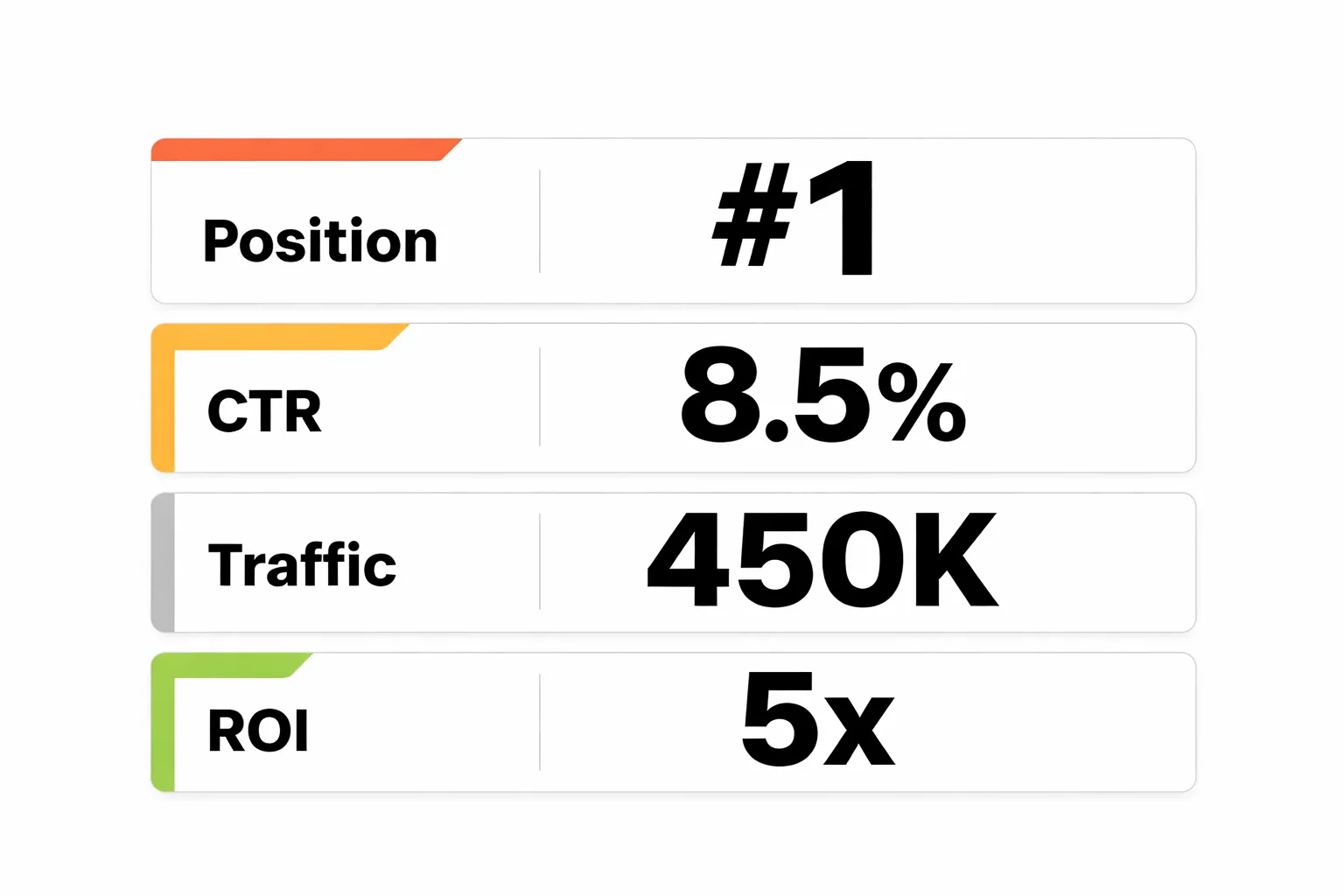
A clean baseline captures three things: average position, SERP feature presence, and click-through rate. Here's what each tells you.
Average position is your starting point. Track it weekly and note the trend, not just the snapshot. A keyword bouncing between position 4 and position 6 over a month is stable. A keyword dropping from 3 to 11 in two weeks is a signal.
SERP feature presence tells you whether Google is enriching your result with featured snippets, People Also Ask boxes, sitelinks, or AI Overviews. Semrush's research showed AI Overviews appear on 15-25% of queries depending on the month. If your target keyword triggers an AI Overview, your organic result is competing with a generated answer for attention.
Click-through rate from Google Search Console reveals whether your ranking actually drives traffic. A position 1 result with a 2% CTR is a red flag. Something is intercepting the click, and it's usually an AI Overview or a SERP feature.
This is your foundation. Once you have 4-6 weeks of clean baseline data, you're ready to layer in AI monitoring.
Step 2: Layer in AI Search Monitoring
This is where most teams stop. They have Google rank data. They don't have AI search data. And the gap between the two is where competitive advantage lives in 2026.
Run the Same Queries Through AI Engines
Take the same keyword set from Step 1 and run each query through every major AI search surface: ChatGPT, Claude, Gemini, Perplexity, Grok, Google AI Overviews, and Google AI Mode. For each query, record three things: whether your brand is mentioned, whether your brand is cited with a link, and where in the answer your brand appears (first mention, in a list, last mention).
This is tedious if you do it manually. I've done it. Running 100 keywords through 7 AI engines by hand takes a full day, and the results aren't perfectly reproducible because AI outputs are probabilistic. But even a manual monthly audit gives you signal you can't get from traditional rank tracking alone.
If you want to scale this, AI SEO tools like Meev automate the process. At Meev, we track brand mentions across every major AI search surface with daily refresh on SERP-driven surfaces and rolling refresh on LLM-driven surfaces. The point is to make this repeatable. Weekly or biweekly monitoring gives you trend data that manual checks can't match.
Build Prompt Templates for Repeatability
AI outputs vary based on how you phrase a question. If you ask ChatGPT "best CRM software" one week and "top CRM tools" the next, you'll get different answers and different citations. Standardize your prompts.
Create a template for each query type. For commercial queries, use: "What are the best [product category] for [use case]?" For informational queries, use: "How does [concept] work?" For comparison queries, use: "What's the difference between [X] and [Y]?" Run the exact same prompt every monitoring cycle.
Record the full AI response, not just whether you were mentioned. The response text tells you what the AI knows about your brand, what it doesn't know, and where your competitor is being positioned. That context is gold for content strategy.
Track Citations, Not Just Mentions
A mention without a citation is weak visibility. A citation with a link is strong visibility. Perplexity and Google AI Overviews cite sources with links. ChatGPT and Claude mention brands but don't always link. Track both, but weight citations higher.
A citation in an AI answer is worth more than a position 3 ranking on Google, because the AI answer is what the user reads first. If you're cited as a source in a Perplexity answer, that user may never scroll to the blue links. Your brand got the visibility. Your competitor at position 1 didn't.
This is why answer engine optimization matters. It's not about ranking. It's about being the source the AI chooses to cite.
How Do You Build a Unified Visibility Dashboard?
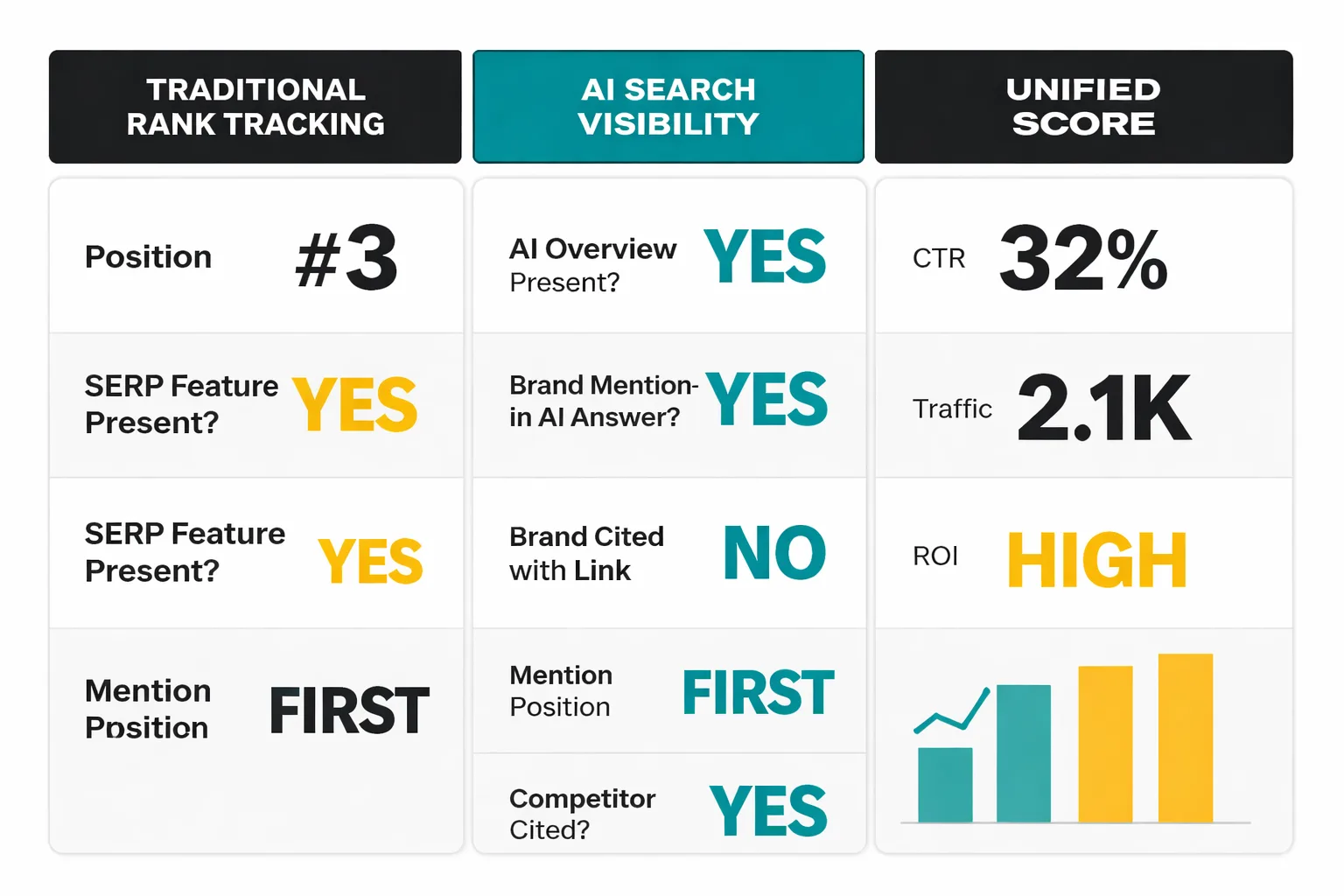
A unified dashboard combines your Google rank data and AI citation data into one view. The goal is to see, at a glance, where you have visibility and where you don't.
You can build this in a spreadsheet. I've done it with Google Sheets, pulling rank data from Search Console and manually logging AI citation data. It works for small keyword sets. For larger operations, a BI tool like Looker Studio or a dedicated platform gives you automation and scale.
Here's what your dashboard should show for each keyword: Google position, SERP feature present (yes/no), AI Overview present (yes/no), brand mentioned in AI answer (yes/no), brand cited with link (yes/no), mention position (first/list/last/absent), and competitor cited (yes/no).
The Key Ratio: Citation Rate vs. Ranking Position
This is the metric that matters most. For each keyword, compare your Google ranking position to your AI citation rate. Four patterns emerge:
High rank, high citation rate. You're winning everywhere. Maintain your content freshness and keep monitoring. This is your stronghold.
High rank, low citation rate. You rank well on Google but AI engines don't cite you. This means your content is optimized for search algorithms but not for AI retrieval. The fix is to restructure your content with clear, citable statements and factual claims that AI engines can extract. Think definitive answers at the top of your pages.
Low rank, high citation rate. You're cited by AI engines despite low Google rankings. This happens when your content has strong factual depth or unique data that AI models trained on, even if Google's algorithm doesn't rank it highly. Don't change your content. Build backlinks to close the ranking gap.
Low rank, low citation rate. You're invisible. This is a content gap, not a tracking problem. You need new content or a fundamentally different angle on the topic.
The citation-to-position ratio reveals where AI is overriding classic SEO (high rank, low citation) and where it's amplifying it (low rank, high citation). Without this ratio, you're flying blind.
At Meev, we built this unified view because I was tired of looking at rank tracking reports that told me everything was fine while AI visibility was quietly eroding. The dashboard should answer one question per keyword: is my brand visible where it matters?
What Happens When Rankings and AI Visibility Diverge?
Divergence is where the insight lives. If your Google rankings and AI visibility move in lockstep, you don't need a dual-tracking system. But they rarely do. Here are the three patterns I see most often and what to do about each.
Pattern 1: Ranking High, Never Cited
This is the most frustrating pattern. You've invested months climbing to position 2, and an AI answer cites your competitor at position 7. Why? Because AI engines don't retrieve content the same way Google ranks it. They prioritize factual specificity, structured data, and content that directly answers the query in a citable format.
The fix is to audit your top-ranking pages for citability. Does the page contain a clear, definitive statement that answers the query in one sentence? AI engines extract sentences, not paragraphs. If your page buries the answer in a 500-word section, the AI won't find it. Put the answer at the top, in a format that can be lifted verbatim.
I've seen pages jump from zero AI citations to consistent inclusion just by restructuring the first paragraph. The content didn't change. The structure did.
Pattern 2: Cited Frequently, Ranking Low
This pattern is less common but more interesting. Your brand appears in AI answers regularly, but your Google ranking for the same query is stuck at position 12 or lower. This usually means your content has unique value (original data, expert quotes, proprietary research) that AI models absorbed during training, but your page lacks the traditional SEO signals (backlinks, domain authority, on-page optimization) to rank on Google.
Don't touch the content. The AI is telling you it's valuable. Instead, build topical authority through internal linking, earn backlinks from the publishers AI engines already cite, and let the ranking catch up.
This is also where understanding the difference between AEO and SEO becomes practical. SEO optimizes for Google's ranking algorithm. AEO optimizes for AI retrieval and citation. You need both, and this pattern proves they're different systems.
Pattern 3: Invisible on Both
If you're neither ranking nor cited, you have a content gap. No amount of tracking or optimization will fix this. You need to create content for this topic.
But here's the contrarian take: not every content gap is worth filling. If the query has low commercial intent and AI engines consistently cite the same three authoritative sources, you're unlikely to break in. Spend your resources on queries where you have a realistic path to visibility, either through unique data, a contrarian angle, or a better user experience than what's currently cited.
The hardest lesson in dual tracking is knowing when to walk away from a keyword. Some battles aren't worth fighting. Use your unified dashboard to identify the queries where you have momentum (improving rank, increasing citations) and double down on those.
Are you tracking citations across ChatGPT, Perplexity, and Google AI Overviews, or just watching positions?
When This Tracking System Fails
I need to be honest about where this breaks down, because no tracking system is perfect.
First, AI outputs are probabilistic. Run the same prompt through ChatGPT three times and you may get three different answers with different citations. This makes week-over-week comparison noisy. You'll see citation rates fluctuate 10-20% even when nothing changed on your end. Don't panic at a single week's drop. Look at 4-week rolling averages.
Second, AI engines update their models constantly. A citation strategy that works in July may stop working in September because the model was retrained. I've seen brands lose all AI visibility overnight after a model update, then regain it two weeks later for no discernible reason. Track the trend, not the snapshot.
Third, this system doesn't work for brand-new sites with zero existing visibility. If you launched last month, you won't appear in AI answers because the models haven't trained on your content yet. Focus on Google rankings first, build topical depth, and layer in AI monitoring after 3-6 months when you have enough content for AI engines to discover.
The tracking system I've described works best for established sites with existing organic presence. If you're starting from zero, traditional SEO fundamentals come first.
Scaling the Workflow Without Losing Accuracy
Once you've validated the dual-tracking approach on 50 keywords, scaling to 500+ is the next challenge. Manual monitoring doesn't scale. You need automation.
This is where an AI SEO agent changes the math. Instead of running prompts manually through each AI engine, the agent handles prompt execution, response capture, and citation logging across your full keyword set. At Meev, we use a hybrid LLM tracking architecture that combines direct API calls to Perplexity, DeepSeek, and Grok with SERP-driven monitoring for Google AI Overviews and AI Mode. The result is coverage across every major AI surface without the manual overhead.
The scaling benefit isn't just time saved. It's data quality. When you monitor 500 keywords weekly across all AI surfaces, you get statistical signal that 50 keywords can't provide. You can segment by query type (commercial vs. informational), by AI engine, and by competitor. You can see that Perplexity cites you 40% of the time for informational queries but only 12% of the time for commercial ones. That's actionable.
The Local SEO Consideration
Local businesses face a unique tracking challenge. Google's local pack, map results, and AI Overviews for local queries all compete for the same screen. A plumber ranking #1 in the local pack might still lose the customer if an AI Overview recommends a different plumber based on review sentiment and proximity.
For local SEO, track three layers: local pack position, organic ranking for the same query, and AI Overview inclusion. The local pack and AI Overview often pull from different signals. The local pack prioritizes proximity and review volume. AI Overviews prioritize content depth and factual specificity. A local business can win the pack but lose the AI answer.
If you serve multiple locations, track each location separately. AI engines may recommend different businesses for "best plumber near me" depending on the user's city, even if the query is identical.
What This Actually Means for Your 2026 Strategy
The teams winning in 2026 aren't the ones with the best rank tracker. They're the ones who track Google rankings and AI search visibility side by side, spot the divergences, and act on them.
Here's what I'd do if I were starting today. Set up clean Google rank tracking on 50-100 revenue-mapped keywords. Wait four weeks for a baseline. Then run those same keywords through every major AI search surface and log the results. Build a simple spreadsheet with position and citation data side by side. Look for the divergences. That's where your content strategy needs to focus.
Don't overcomplicate it. A spreadsheet and manual AI checks will get you 80% of the insight. The other 20% (scale, automation, competitor benchmarking) is where tools like Meev earn their keep. But the framework matters more than the tool.
The brands that will dominate search in 2026 are the ones that stopped treating Google rankings as the finish line and started treating them as one signal in a larger visibility picture. AI search is the other half of that picture. If you're not tracking both, you're optimizing for a world that's already fading.
FAQ
How often should I check my AI search visibility?
Weekly monitoring is the sweet spot for most teams. AI outputs are probabilistic, so daily checks produce too much noise. Monthly checks are too slow to catch model-update impacts. Run your prompt templates weekly, log the results, and look at 4-week rolling averages to smooth out the variance. If you're using an automated tool, daily refresh on SERP-driven surfaces (like Google AI Overviews) is valuable because those results change with the SERP.
Can I track Google rankings and AI visibility in one tool?
Some platforms now offer both. Meev combines Google Search Console integration for rank tracking with AI visibility monitoring across every major AI search surface. Traditional rank trackers like Semrush and Ahrefs have added AI Overview tracking but don't yet monitor ChatGPT, Claude, or Perplexity responses. For full coverage, you may need a dedicated AI visibility tool alongside your existing rank tracker.
What's the difference between AI Overviews and AI Mode in Google?
Google AI Overviews are generated summaries that appear at the top of standard search results for certain queries. Google AI Mode is a separate search experience that provides conversational, AI-generated responses with follow-up question capability. AI Overviews appear within the traditional SERP. AI Mode is a different interface entirely. Both should be tracked separately because citation behavior differs between them.
How do I know if AI search visibility is actually driving traffic?
This is the hardest question right now. BrightEdge research found AI search accounts for less than 1% of referral traffic as of August 2025. But referral data undercounts the impact because many AI-driven visits are direct or dark traffic. Track branded search volume in Google Search Console as a proxy. If your AI citations increase and branded search increases within 2-4 weeks, that's a signal that AI visibility is driving awareness even if the referral data doesn't show it.
Should I prioritize AI visibility over Google rankings?
No. Google rankings still drive the majority of organic traffic and conversions. BrightEdge's data confirms organic search remains the primary driver of digital growth. Prioritize Google rankings for revenue-driving keywords and layer in AI visibility monitoring to catch gaps. The goal isn't to replace one with the other. It's to track both so you know where you're visible and where you're not.
What's the minimum keyword set I need to start dual tracking?
50 keywords is the minimum for meaningful signal. Fewer than that and you won't have enough data points to identify patterns or smooth out AI output variance. Start with your top 50 revenue-mapped keywords, run them through both Google rank tracking and AI search monitoring for 4 weeks, and expand from there.
About the Author
Judy Zhou, Founder
Judy Zhou leads content strategy at Meev, where she oversees AI-driven content research and publishing for hundreds of brands. With a background in SEO and editorial operations, she focuses on building content systems that rank on Google, get cited by AI search engines, and drive measurable business results.
Stop flying blind on AI search. See exactly where your brand is cited and where competitors are stealing your visibility.