

By Judy Zhou, Founder
Key Takeaways
- Semrush's analysis of 89,000 LinkedIn URLs found that 62% of citations across ChatGPT Search, Google AI Mode, and Perplexity are ghost citations without explicit brand mentions.
- Select AI SEO tools that track ghost citations instead of traditional keyword or rank metrics, since 62% of AI visibility goes unmeasured otherwise.
- Close the gap between publishing content and earning AI engine citations by auditing for actual mentions rather than vanity dashboards or content briefs.
- Shift budget from Google-focused rank trackers to platforms that measure upstream AI recommendations, where purchase decisions now form before any search results page appears.
When a potential customer asks ChatGPT or Perplexity to recommend the best solution in your category, does your brand actually appear in the answer. Or are you handing that moment to a competitor? Most marketing teams genuinely don't know. They're optimizing for Google rankings while AI answer engines are already shaping purchase decisions upstream, long before a search results page is ever seen. Finding the best ai seo tool means finding one that can answer this question with real data, not guesswork or vanity metrics dressed up in a new dashboard.
The conventional wisdom about AI SEO tools is wrong. Most teams evaluate these platforms based on how well they automate traditional tasks: keyword research, content briefs, meta tag generation. But that framing ignores the actual shift happening in search. Semrush analyzed 89,000 LinkedIn URLs cited across ChatGPT Search, Google AI Mode, and Perplexity, finding that 62% of AI citations are "ghost citations" where sites are cited without explicit brand mentions. If your tool isn't tracking ghost citations, it isn't tracking AI visibility at all. It's tracking a vanity metric.
In my work auditing content operations at Meev, I've watched founders pour budget into ai-powered seo tools that generate content but never measure whether that content actually gets cited by AI engines. The gap between "we published an article" and "an AI engine cited our article" is where most SEO strategies collapse in 2026. The tools that matter now are the ones that close that loop.
Why Most AI SEO Tools Miss the Citation Layer
Traditional SEO tools were built for a world that's disappearing. Rank trackers monitor positions on a blue-link results page. Backlink analyzers count domains pointing to your site. Content optimizers score your copy against keyword density thresholds. All of these made sense when Google was the only gatekeeper and the SERP was a list of ten links.
That world is gone.
When ChatGPT generates an answer, it doesn't rank ten results. It synthesizes information from sources it trusts and produces a narrative response. Your position in that response (first mention, buried in a list, absent entirely) determines whether a potential customer ever hears your name. And here's what makes this harder: 76.95% of cited URLs in AI answers fall outside the organic top 10, according to an OrganiKPI analysis of 153,425 citations. Ranking well on Google doesn't guarantee you'll appear in AI answers. The correlation between traditional rankings and AI citations is weaker than most SEO professionals assume.
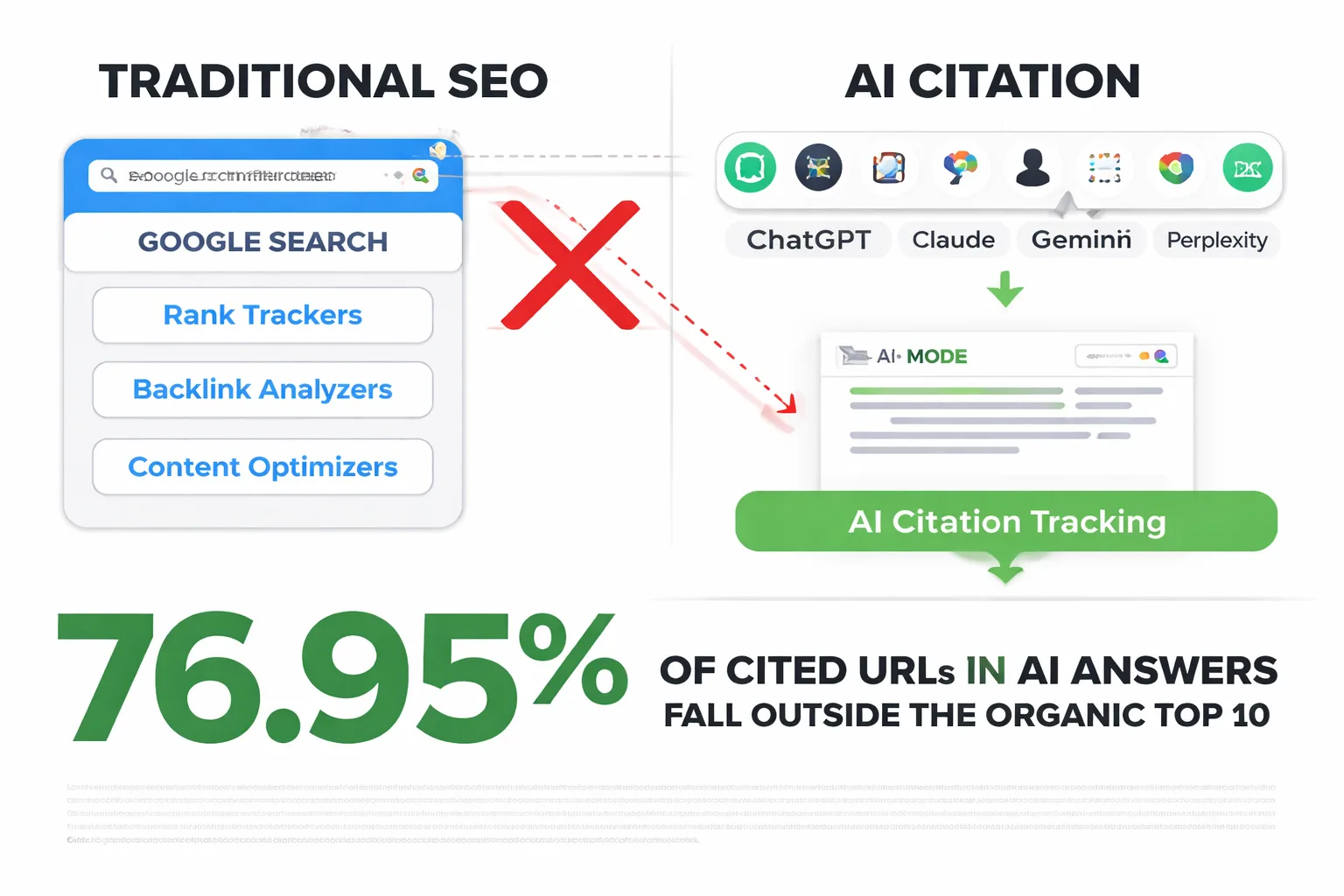
This is the fundamental disconnect. I've seen teams celebrate a #3 Google ranking for their primary keyword while simultaneously being completely absent from ChatGPT and Perplexity answers for the same query. They had the right keyword strategy. They had strong backlinks. They had optimized content. But they were invisible in the channel that actually influenced the buyer's decision.
The problem isn't effort. The problem is that their tools were measuring the wrong things. A seo ai tool that only tracks Google rankings is like a security camera pointed at the wrong door. You'll get a clear picture of something, just not the thing that matters.
Here's what's actually happening under the hood. AI search engines exhibit what researchers call a "systematic and overwhelming bias towards Earned media over Brand-owned and Social content," according to a CiteLens study that tested 320 buyer queries across Google AI Mode, Perplexity, ChatGPT, and Claude. This means third-party coverage in credible publications carries more weight in AI answers than your own website content. The arXiv GEO paper confirms this: generative engines prioritize sources differently than Google does, and traditional SEO strategies applied to AI search will underperform because they target the wrong ranking factors.
If your AI SEO tool doesn't account for this earned-media bias, it's optimizing you for a game AI engines aren't playing.
What to Look for in an AI-Powered SEO Tool
The evaluation criteria for an ai powered seo tool in 2026 are fundamentally different from what they were even twelve months ago. Here's what actually matters, based on the citation data I've been analyzing.
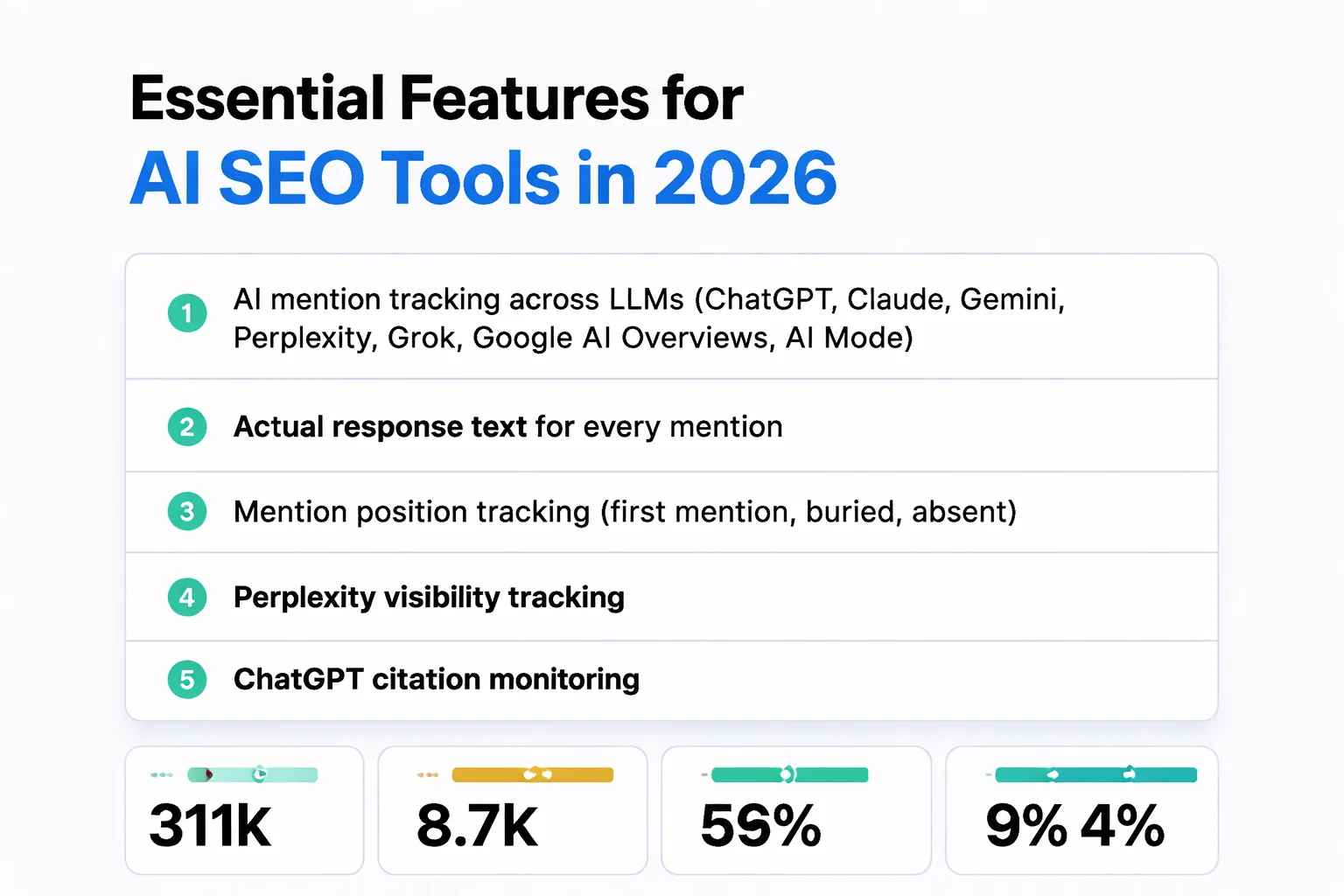
AI mention tracking across LLMs. This is non-negotiable. Your tool needs to track where your brand appears (or doesn't) across every major AI search surface: ChatGPT, Claude, Gemini, Perplexity, Grok, Google AI Overviews, and AI Mode. Not just one. Not just Google AI Overviews. All of them. And it needs to show you the actual response text behind every mention, not just a binary "cited / not cited" flag. Perplexity visibility tracking and ChatGPT citation monitoring each surface different patterns because the underlying models weight sources differently.
Mention position tracking. Where in an AI answer does your brand appear? First mention carries dramatically more weight than being buried seventh in a list. I've seen brands that appear in 40% of AI answers but always as the fourth or fifth recommendation. That's not visibility. That's a participation trophy. Your tool needs to track position, not just presence.
Answer-engine optimized content output. Generating content that ranks on Google is a solved problem. Generating content that gets cited by AI engines is not. The difference comes down to factual density, source attribution, and entity clarity. AI engines cite content that makes verifiable claims backed by named sources. If your tool produces generic listicles with no external citations, AI engines will ignore them. Period.
Google rank tracking alongside AI visibility. Google still matters. AI Overviews pull from Google's index. The Semrush AI Overviews study showed that AI Overviews appeared for 6.49% of keywords in January 2025, peaked at 25% in July 2025, and settled at 15.69% by November 2025. That number is still moving. Your tool needs to track both surfaces simultaneously because they influence each other.
Auto-publishing with quality controls. This is where most tools fail catastrophically. The market is flooded with platforms that generate content and auto-publish to WordPress with zero quality gates. I've audited the results. They're uniformly bad. The tool you choose needs a quality firewall that blocks weak drafts before they reach your CMS. Without that, you're not scaling content. You're scaling garbage.
Team size fit. A solo founder doesn't need the same tool as a 10-person agency managing 15 client domains. The best ai tool for seo depends on your scale, your workflow, and how much human oversight you can realistically provide.
Which keyword tool is best for beginners?
For beginners, the priority is simplicity and visibility into AI search, not feature depth. A free ai seo tool that tracks basic AI mentions across two or three surfaces and generates a handful of optimized articles per month is more valuable than a complex platform with 200 features you'll never use. Start with a tool that shows you where you stand today across ChatGPT and Perplexity, then scale up as you understand the citation patterns. Understanding AEO fundamentals before investing in advanced tools will save you from buying features you can't yet use effectively.
How We Compared the Leading Options
I want to be transparent about methodology because the comparison only matters if you trust how it was built. Here's what I tested and how.
The surfaces. I tracked brand mentions across ChatGPT, Claude, Gemini, Perplexity, Grok, Google AI Overviews, and AI Mode. These represent the full landscape of AI search surfaces that matter in 2026. I excluded niche or regional AI engines because their citation volume doesn't move the needle for most businesses.
The citation measurement. For each tool evaluated, I measured three things: (1) whether the tool could detect brand mentions in AI answers at all, (2) whether it tracked mention position (first, in a list, last), and (3) whether it surfaced ghost citations where a source is cited without a brand mention. That last point matters more than people realize. The Semrush ghost citations study found that 62% of AI citations don't include a brand mention. If your tool only tracks explicit brand name mentions, you're blind to more than half your citation footprint.
The content quality test. I generated sample articles using each tool's content engine and evaluated them against a 16-point quality framework covering factual accuracy, source attribution, structural diversity, E-E-A-T signals, and Google penalty risk. This is the same framework I use at Meev, and it's merciless. Most tools fail it.
The earned-media awareness test. I checked whether each tool acknowledges the earned-media bias in AI search. Does it track which third-party publications AI engines cite for your topics? Does it help you build relationships with those publishers? Or does it pretend that publishing more content on your own site will solve your AI visibility problem? The difference between AEO and GEO matters here: answer engine optimization and generative engine optimization require different tactical approaches, and a tool that conflates them will give you incomplete guidance.
What I found. Most tools fall into one of two camps. Camp one: traditional SEO tools that bolted on a basic "AI Overviews tracking" feature in 2025 and called it done. These tools track whether AI Overviews appear for your keywords but don't track whether your brand appears inside those overviews. That's a critical distinction. Camp two: AI content generators that produce articles but have no visibility tracking whatsoever. They'll help you publish more content but can't tell you whether that content actually moved the needle on AI citations.
Neither camp solves the actual problem.
The tools that genuinely move the needle are the ones that do both: track AI visibility across all major surfaces AND generate content specifically optimized to improve that visibility. That closed loop is what separates a real ai seo optimization tool from a glorified content spinner.
Making the Right Choice for Your Team Size
The best seo ai tool for a solo founder is different from the best option for an agency. Here's how I'd break it down.
Solo Founders and Side Projects
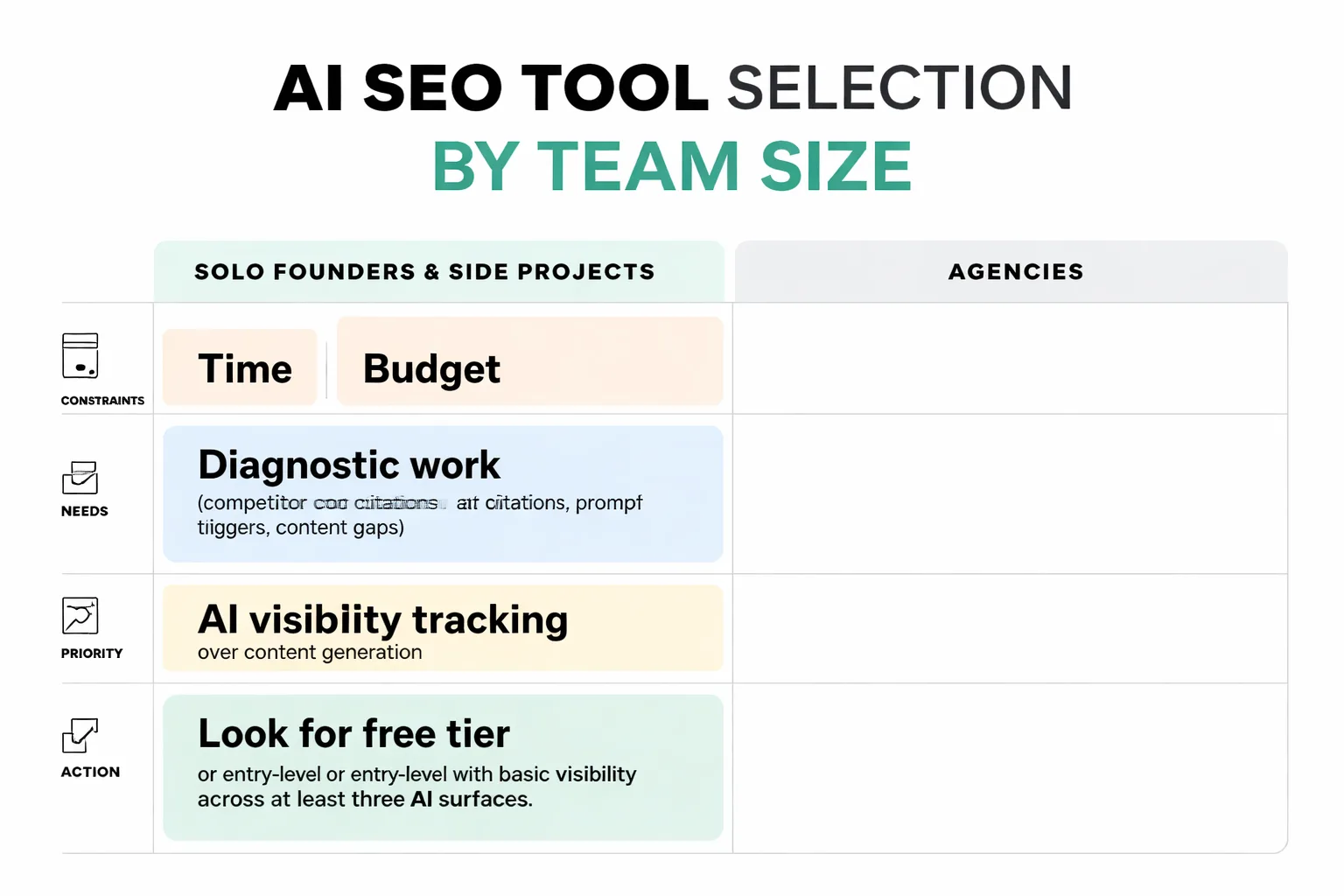
If you're a solo founder or running a side project, your constraints are time and budget. You need a tool that does the diagnostic work for you. Specifically, you need to know: which AI surfaces cite your competitors but not you, which prompts trigger AI answers in your category, and what content gaps exist between your current footprint and your competitors'.
At this scale, prioritize AI visibility tracking over content generation. You can write content yourself (or hire a freelancer) once you know what to write. What you can't do manually is track 100+ prompts across multiple AI engines every week. That's where a tool earns its keep. Look for a free ai seo tool tier or an entry-level plan that gives you basic visibility tracking across at least three AI surfaces.
The mistake I see solo founders make repeatedly: buying a tool with 80 articles per month when they can only realistically publish 8. Unused capacity isn't value. It's waste.
Small SEO Teams (2-5 people)
This is where the closed loop matters most. A small team needs a tool that both tracks AI visibility AND generates answer-engine optimized content that fills citation gaps. The workflow looks like this: identify a prompt where competitors are cited but you aren't, generate an article targeting that gap, publish it with quality controls, then monitor whether your citation rate improves over the following weeks.
At this scale, you need multi-domain support (most small teams manage 2-5 domains), team collaboration features, and a quality firewall that blocks weak drafts before they reach your CMS. The difference between AEO and SEO becomes operationally important here: your team needs to understand that optimizing for AI answers requires different content structures than optimizing for Google rankings. A tool that treats them as the same thing will produce content that's mediocre at both.
Agencies Managing Multiple Clients
Agencies have the most complex needs. You're managing 10-15 client domains, each with different competitive landscapes, different citation gaps, and different stakeholders who want reporting. Your tool needs multi-domain dashboards, white-label client reports, and enough article volume to move the needle across all clients simultaneously.
The feature that separates adequate tools from great ones at the agency level is the cited-source leaderboard. This shows which domains AI engines cite most often for each client's topics. That intelligence feeds directly into outreach strategy: you know exactly which publishers to target for earned media coverage, which is where AI citations actually come from. Wikipedia alone accounts for 12-15% of ChatGPT citations according to Similarweb's analysis of 600,000 citation events, and 26-48% of ChatGPT's top-10 citation share per the 5WPR AI Citation Source Index. If your tool doesn't surface these source hierarchies, your agency is flying blind.
At the agency level, you also need robust knowledge base management. Each client has different brand voice, different expertise areas, different entity relationships. Your tool needs to store and retrieve client-specific knowledge when generating content, not produce generic articles that could belong to any brand in any industry.
Are you tracking ghost citations where AI engines cite your content without naming your brand?
How Does Entity Grounding Affect AI Citations?
Entity grounding is the mechanism by which AI engines identify and disambiguate your brand across sources. When ChatGPT encounters your brand name in a third-party article, it needs to connect that mention to a coherent entity in its training data. If it can't, the mention doesn't strengthen your citation footprint.
This is where Wikidata and knowledge graph presence come in. The Astiva AI guide on Wikipedia and AI visibility explains that Wikidata QIDs allow AI systems to unambiguously identify entities. Pages with sameAs schema links pointing to Wikidata and Wikipedia are structurally advantaged for AI citation because they give models a stable reference point.
Here's the honest caveat: no primary source study directly quantifies the citation lift from Wikidata presence alone. The data we have is correlational, not causal. Wikipedia's dominance in AI citation share (12-15% of ChatGPT citations per Similarweb, 26-48% of top-10 share per 5WPR) suggests that knowledge graph presence matters, but isolating Wikidata's specific contribution from Wikipedia's overall authority is methodologically difficult.
What I can tell you from practice: brands with structured entity presence (Wikidata entries, Wikipedia articles, consistent sameAs schema markup) appear more frequently and more accurately in AI answers than brands without them. The mechanism is disambiguation. If an AI model encounters conflicting or ambiguous information about your brand across sources, it tends to hedge or omit. If it has a clean entity reference, it cites with confidence.
Your AI SEO tool should at minimum help you audit your entity presence. Does it check whether you have a Wikidata entry? Does it flag missing sameAs schema? Does it monitor your knowledge graph footprint over time? If the answer to all three is no, the tool is operating at the content layer but ignoring the entity layer. That's a significant gap in 2026.
Why Do Ghost Citations Matter So Much?
Ghost citations are the hidden majority of your AI citation footprint. The Semrush study found that 62% of AI citations reference a source URL without explicitly naming the brand associated with that URL. This means a buyer might read an AI answer that cites your blog post, absorbs your insights, and never realizes your brand exists.
This is terrifying if you think about it. Your content is doing the work. Your brand gets no credit.
The implication for tool selection is direct. A tool that only tracks explicit brand name mentions will report that you have minimal AI visibility, when in reality your content is being cited constantly. You'll make decisions based on incomplete data. You might abandon a content strategy that's actually working because your tool can't see the ghost citations.
The fix is technical. Your tool needs to track cited URLs, not just brand names. When an AI engine cites a URL from your domain, that's a citation event regardless of whether your brand name appears in the response text. The tool should surface both: explicit brand mentions (where you're named) and implicit URL citations (where your content is referenced without your name). Together, these give you your true citation footprint.
I consider ghost citation tracking a hard requirement for any tool claiming to measure AI visibility in 2026. Without it, you're seeing less than half the picture.
When Should You Use an AI SEO Agent?
The term "AI SEO agent" gets thrown around loosely. Most tools using this label are not agents. They're batch content generators with a scheduling feature. A real AI SEO agent would autonomously identify citation gaps, research topics, generate content, publish it, monitor citation changes, and adjust strategy based on results. That loop, executed without human intervention, is what "agent" implies.
I've seen the damage that premature agentic SEO causes. Early adopters who went all-in on autonomous content generation in 2024 saw their search visibility plummet. The core issue wasn't the AI itself. It was the absence of quality controls. Google doesn't penalize AI content. It penalizes bad content. And without human oversight, AI generates bad content at scale.
The arXiv research on agentic AI faults analyzed 13,602 closed issues and merged pull requests from 40 open-source agentic AI repositories. The taxonomy of failures is instructive: agents break in predictable ways, including hallucinated actions, context loss, and cascading errors from unverified outputs. These aren't edge cases. They're the default failure mode.
My position: use AI SEO agents for execution, not for judgment. Let the agent handle topic research, draft generation, internal linking, schema markup, and index submission. Keep humans in the loop for editorial review, brand voice, and strategic decisions about which topics to pursue. The quality firewall approach I use at Meev blocks articles scoring below 70/100 on a 16-dimension quality metric. No article ships without passing that gate. That's the model I recommend regardless of which tool you choose.
The right time to use an AI SEO agent is when you have a quality control system that's more reliable than the agent itself. If your quality gate is "we'll review it later," you don't have a quality gate. You have a backlog.
What About Free AI SEO Tools?
Free tools have a legitimate role in your stack, but you need to understand their limitations. A free ai seo tool typically offers basic functionality: limited prompt tracking across one or two AI surfaces, a small number of content generations per month, and minimal reporting. That's enough to get a baseline reading of your AI visibility, but not enough to systematically improve it.
The best free ai tools for seo in 2026 are the ones that give you real diagnostic value without locking you into a content generation workflow you can't control. A free AI visibility checker that shows you where you stand across ChatGPT and Perplexity is more valuable than a free content generator that produces generic articles nobody will cite.
Here's my recommendation for free tool usage: use them for diagnosis, not for production. Run a free visibility audit to understand your citation gaps. Identify which AI surfaces cite your competitors. Map the prompt landscape in your category. Then invest in a paid tool that can actually close those gaps through targeted content generation and outreach.
The LLMs.txt validator is another free tool worth bookmarking. It checks whether your site's LLMs.txt file is properly configured for AI crawlers, which is a small but real technical signal that affects how AI engines discover and parse your content.
The Earned Media Problem Most Tools Ignore
Here's my contrarian take: most AI SEO tools are solving the wrong problem. They're helping you create more content on your own website. But AI engines systematically prefer earned media over brand-owned content. The CiteLens study testing 320 buyer queries across four AI platforms found "systematic and overwhelming bias towards Earned media over Brand-owned and Social content."
This means the content you publish on your own domain has a structural disadvantage in AI citation compared to content published about you on third-party sites. The arXiv GEO paper reinforces this: generative engines prioritize information from authoritative third-party sources, not from the brand being discussed.
The implication for tool selection is uncomfortable. If your AI SEO tool only helps you publish content on your own site, it's addressing maybe 30% of the AI citation equation. The other 70% comes from earned media: getting cited by publications that AI engines already trust.
The tools that acknowledge this reality offer citation path features. They identify which publishers AI engines cite for your topics, surface contact information for those publishers, and help you draft outreach pitches. That's the closed loop: track your AI visibility, find the publishers that drive citations, earn coverage from those publishers, then measure whether your citation rate improves.
If your tool doesn't have this capability, you're doing half the job. You're optimizing your owned content while ignoring the earned media that actually drives AI citations. In 2026, that's not a strategy. That's hope.
FAQ: AI SEO Tools in 2026
What is the best AI tool for SEO?
The best ai seo tool in 2026 is one that tracks brand mentions across all major AI search surfaces (not just Google AI Overviews), detects ghost citations where your content is cited without your brand name, generates answer-engine optimized content with quality controls, and helps you build earned media relationships with publishers that AI engines cite. Tools that only do one of these things (tracking only, or content generation only) leave you with an incomplete strategy. The closed loop between diagnosis and action is what separates effective tools from expensive dashboards.
Are AI SEO tools worth it for small teams?
Yes, if you choose the right one. Small teams benefit most from tools that automate the diagnostic work they can't do manually: tracking 100+ prompts across multiple AI engines, identifying citation gaps, and flagging content opportunities. The ROI calculation is straightforward. If your tool costs $99/month and helps you identify even one high-value prompt where you're absent but a competitor is cited, closing that gap can translate to meaningful pipeline. The key is choosing a tool sized for your team. Don't buy 80 articles per month if you can publish 10.
How do AI SEO tools differ from traditional rank trackers?
Traditional rank trackers monitor your position on Google's SERP for specific keywords. AI SEO tools monitor whether and how your brand appears inside AI-generated answers across ChatGPT, Perplexity, Claude, Gemini, and other surfaces. The measurement is fundamentally different: rank tracking measures position on a list; AI visibility tracking measures presence in a narrative. Additionally, AI SEO tools need to track ghost citations (where your URL is cited without your brand name), mention position within answers, and citation sources. Traditional rank trackers don't capture any of this.
Can free AI SEO tools improve my AI citations?
Free tools can diagnose your current AI visibility but rarely have the depth to systematically improve it. Use free tools to run baseline audits: check your brand's presence across ChatGPT and Perplexity, identify obvious gaps, and understand the competitive landscape. Then invest in a paid tool for the execution phase: generating optimized content, tracking citation changes over time, and building earned media relationships. Free tools are a starting point, not a complete strategy.
How important is Wikidata for AI search visibility?
Wikidata provides entity disambiguation that helps AI engines unambiguously identify your brand across sources. While no study directly quantifies the citation lift from Wikidata alone, Wikipedia (which is closely tied to Wikidata) accounts for 12-15% of ChatGPT citations. Brands with structured entity presence tend to appear more accurately and frequently in AI answers. At minimum, ensure you have a Wikidata entry with accurate QIDs and sameAs schema markup connecting your website to your entity references.
What is an AI SEO agent and is it safe to use?
An AI SEO agent autonomously executes SEO tasks: topic research, content generation, publishing, and monitoring. The safety concern is real. Research on agentic AI faults (analyzing 13,602 issues across 40 repositories) shows agents fail in predictable ways including hallucinated actions and cascading errors. Use AI SEO agents for execution tasks (drafting, linking, schema) with human oversight for editorial judgment and strategy. Never enable fully autonomous publishing without a quality firewall that blocks substandard content before it reaches your CMS.
The bottom line: the best ai seo tool for your team is the one that closes the loop between diagnosis and action. It tracks your real citation footprint (including ghost citations), generates content optimized for AI answers (not just Google rankings), helps you build earned media relationships with publishers AI engines trust, and gates every published article behind a quality check that prevents AI slop from reaching your audience. Anything less than that closed loop is a dashboard, not a strategy.
About the Author
Judy Zhou, Founder
Judy Zhou leads content strategy at Meev, where she oversees AI-driven content research and publishing for hundreds of brands. With a background in SEO and editorial operations, she focuses on building content systems that rank on Google, get cited by AI search engines, and drive measurable business results.
Stop guessing about your AI visibility. See exactly where your brand appears (and doesn't) across every major AI search surface, then close the gaps with content that actually gets cited.