
Why AI Recommends Your Competitor's Store (and How to Fix It)
By Judy Zhou, Founder
Key Takeaways
- AI search engines recommend the most cited entity, not the best store, so prioritize citations in trusted third-party sources over on-page content.
- Adding citations, quotations, and statistics lifts AI visibility by up to 40%, according to Princeton GEO research.
- AI-referred traffic to US retail sites grew 393% year-over-year in Q1 2026, while 68% of Google searches ended without a click.
- Build entity grounding across external publications instead of pouring budget into blog posts, as LLMs rely on training data and RAG rather than real-time web reads.
The conventional wisdom says you need more content to fix your AI visibility. That is wrong. AI search engines do not recommend the best store; they recommend the most cited entity. If you are absent from the third-party sources LLMs trust, no amount of on-page optimization will save you. I have watched founders pour budget into blog posts while competitors with weaker sites get recommended simply because they appear in the right external publications. Research from a Princeton GEO study found that adding citations, quotations, and statistics can lift AI visibility by up to 40%. Meanwhile, 68% of US Google searches ended without a click in the first four months of 2026. The traffic you are losing is not going to a competitor's website. It is staying inside the AI answer itself. If you wonder why AI doesn't recommend my store, the answer is almost never your website. It is your entity graph.
This is the problem I keep diagnosing in my work leading content strategy at Meev. A founder types a prompt into ChatGPT asking for a product recommendation in their category, and a competitor shows up. Not them. The instinct is to blame the algorithm or assume the competitor has a bigger SEO budget. The real reason is structural. When the ai recommends competitors instead of you, it happens because their brand has stronger entity grounding across the sources these models actually read. AI-referred traffic to US retail sites grew 393% year-over-year in Q1 2026, according to Adobe's retail data. This is not a trickle. It is a firehose. And most stores are completely invisible to it.
The Real Reason You Are Invisible
Your store is not showing up in ChatGPT because LLMs do not read the internet in real time. They rely on training data and retrieval-augmented generation (RAG) that pulls from specific, high-authority sources. If your brand exists only on your own website, you are functionally invisible to the models. According to research I've reviewed, 84% to 89% of AI-generated answers come from earned media: third-party coverage in credible publications. Your owned content is the minority signal. The majority signal is what other people say about you.
Think of it this way. Traditional SEO is like running a store on a busy street. You optimize your storefront, put up signs, and wait for foot traffic. AI search is like a concierge service. A customer asks the concierge where to buy something, and the concierge recommends a store based on what it has heard from trusted locals. If nobody is talking about your store, the concierge does not know you exist. No amount of window dressing changes that.
The frustration I hear from founders is real. They invested in answer engine optimization for their site, cleaned up their product pages, maybe even started a blog. Then they test ChatGPT and a competitor with a worse website gets the recommendation. Here is why: the competitor has third-party validation. They are mentioned in industry roundups, reviewed on comparison sites, and discussed on forums. The LLM has seen their name associated with the product category across multiple independent sources. Your site says you sell the best version. The competitor's ecosystem says the same thing. The LLM trusts the ecosystem.
This is why tracking your AI search visibility matters before you invest in fixing it. You cannot close a gap you have not measured. Most teams have no idea whether AI search engines mention them at all, which is the first problem to solve.
How Does AI Decide Which Store to Recommend?
AI models use a combination of training data, retrieval-augmented generation, and entity resolution to decide which brands to surface in recommendations. When a user asks ChatGPT or Perplexity for a store recommendation, the model pulls from its training corpus and live retrieval sources to find brands that are strongly associated with the query's intent. The brands that appear are those with dense, consistent entity representations across multiple trusted sources.
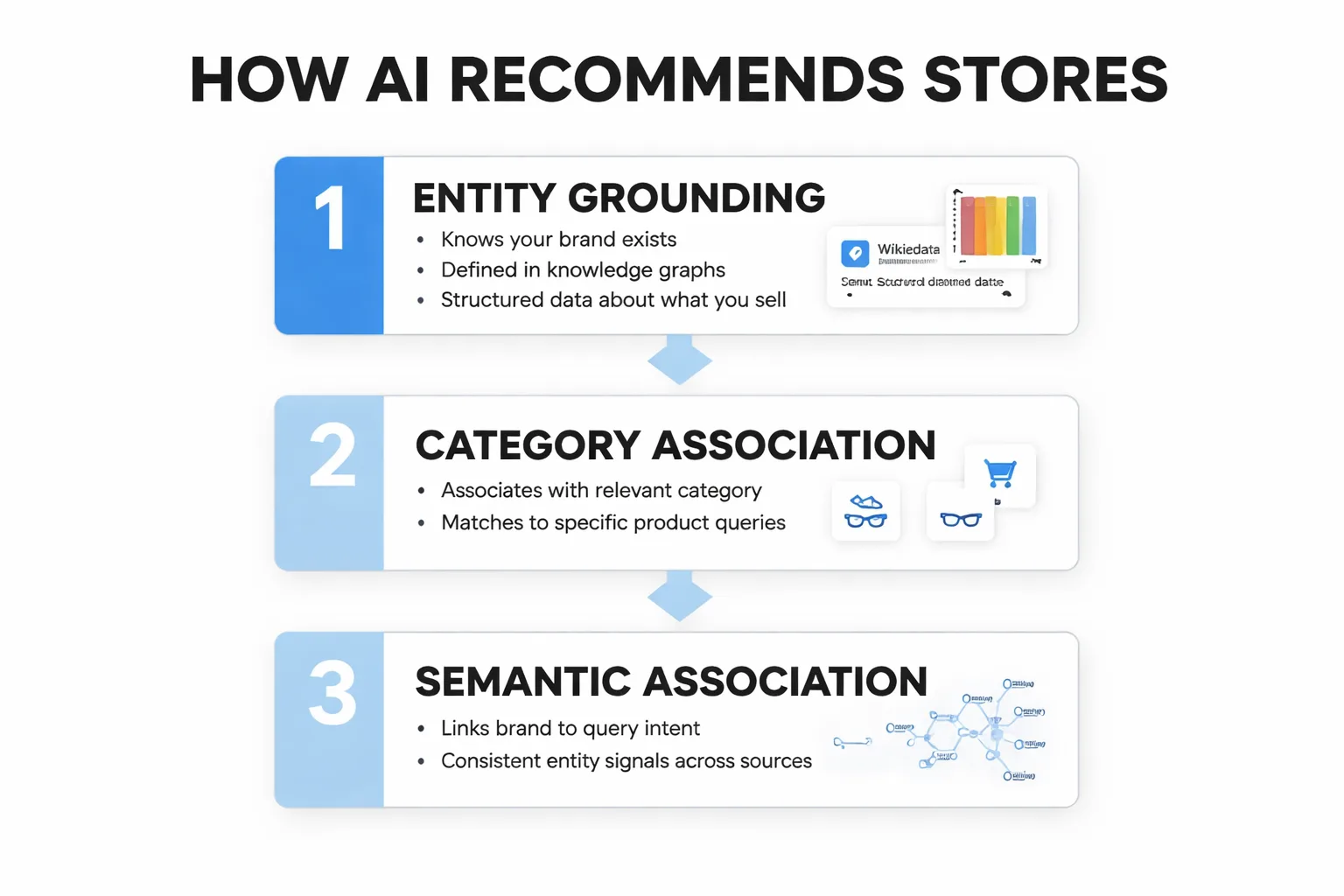
The mechanics come down to three layers. First, the model has to know your brand exists as a distinct entity. This is where entity grounding comes in. If your brand is not clearly defined in knowledge graphs like Wikidata, or if your structured data does not clearly state what you sell and who you serve, the model has no anchor point. Second, the model has to associate your entity with the right category. A store can exist as an entity but still not get recommended for a specific product query if the semantic association is weak. Third, the model needs confidence. Confidence comes from repetition across independent sources. If five high-authority sites describe your competitor as the go-to store for a product, and zero describe you that way, the model's confidence in the competitor is exponentially higher.
This is why generative engine optimization is fundamentally different from traditional SEO. In Google's world, you optimize a page to rank for a keyword. In the AI world, you optimize an entity to be associated with a concept. The unit of optimization is not the page. It is the brand.
Why Traditional SEO Will Not Save You Here
Here is the contrarian take that upsets SEO purists: your Google rankings barely matter for AI recommendations. The top organic result loses roughly 58% of its click-through rate when an AI Overview appears, according to Ahrefs' 2025 study. And Pew Research found that users click results only 8% of the time when an AI summary is present, compared to 15% without one. Both data points describe the same reality. AI answers are eating the clicks that used to go to organic results.
The implication is stark. You could be ranking number one for your target keyword and still lose the recommendation battle. Why? Because AI models do not read SERPs the way users do. They synthesize information from sources they trust, and those sources are often not the pages ranking on page one. A Reddit thread, a niche blog review, or a comparison article on a medium-authority site can carry more weight in an LLM's retrieval than your perfectly optimized product page.
I tried leaning into Reddit for a quick AI visibility boost last year. The results were underwhelming. While Google and OpenAI seem to have paid access to Reddit data, other models like Claude and Perplexity face restrictions. The visibility just did not translate across all the AI tools I track. Reddit is one signal, not a strategy. The lesson is that no single tactic will fix your AI visibility. You need a distributed signal graph built on owned content, structured schema, and external mentions across multiple sources.
The distinction between AEO vs SEO is not academic. It is the difference between being found and being recommended. SEO gets you found when someone searches your name. AEO gets you recommended when someone searches for your category without naming you.
The Four Gaps That Cost You Recommendations
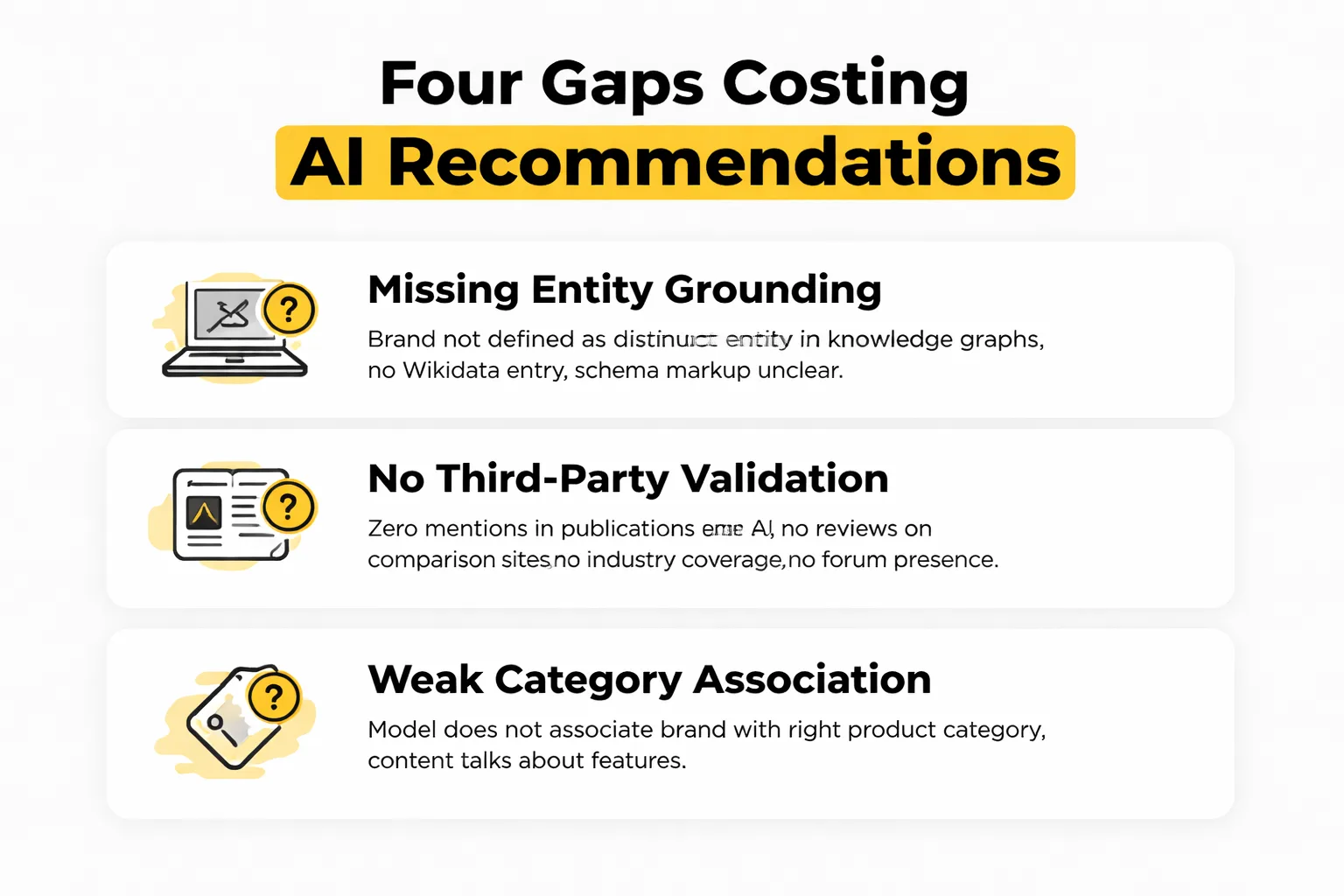
When I audit why the ai recommends competitors instead of a specific brand, I almost always find the same four gaps. Each one is a leak in your entity graph that lets competitors slip ahead.
Gap 1: Missing entity grounding. Your brand is not defined as a distinct entity in knowledge graphs. Wikidata has no entry for you. Your schema markup does not clearly state your business type, product categories, and brand identity. The model literally cannot identify you as a unique node in its graph.
Gap 2: No third-party validation. You have zero mentions in the publications AI engines cite. No reviews on comparison sites. No coverage in industry roundups. No presence on forums where buyers discuss your category. Your owned content says you exist. The external web is silent.
Gap 3: Weak category association. Even if the model knows your brand exists, it does not associate you with the right product category. Your content talks about features and use cases but never explicitly connects your brand to the category keyword. The semantic bridge between your entity and the query intent is missing.
Gap 4: No structured data for AI consumption. Your site has basic SEO schema but nothing designed for machine readability. No FAQ schema that answers the questions buyers actually ask. No product schema with complete attributes. No organization schema that ties your brand to its category and authority signals.
These four gaps compound. Fix one and you might see marginal improvement. Fix all four and you change how AI models perceive your brand. The challenge is that most teams do not know which gaps they have. That is where an audit comes in.
Want to see which AI engines recommend your competitors right now?
How Do You Audit Your AI Visibility?
Auditing your AI visibility means systematically testing whether major AI search surfaces mention your brand, cite your sources, and recommend your store for category-relevant prompts. You cannot fix what you have not measured, and most teams skip this step entirely.
Start with prompt testing. Open ChatGPT, Claude, Gemini, and Perplexity. Type the same category-relevant prompts a customer would use. "What is the best store for X?" "Where should I buy Y?" "Recommend a store for Z." Note whether your brand appears, where it appears in the response, and which sources the AI cites. Do this across at least 10 prompts per engine. The pattern that emerges will tell you exactly where you stand.
Then check your entity presence. Search for your brand on Wikidata. If you are not there, that is gap one. Check your structured data using Google's Rich Results Test. If your schema does not include Organization, Product, and FAQ types, that is gap four. Check your external mentions by searching for your brand name on high-authority publications in your niche. If the results are thin, that is gap two.
This manual process works but it is slow and hard to repeat. Tools like our ChatGPT AI visibility checker and Perplexity AI visibility checker automate this across every major AI search surface with daily refresh. The point is not the tool. The point is that you need a repeatable audit cadence. AI models update their training data and retrieval sources constantly. A visibility audit is not a one-time exercise. It is a monthly discipline.
Stop Optimizing for Keywords
The biggest mistake I see teams make is treating AI visibility as a keyword problem. They run keyword research, identify gaps, and produce content targeting those keywords. This is the SEO playbook applied to a fundamentally different system. It does not work.
AI models do not match keywords to pages. They match entities to intents. When a user asks "what is the best store for organic dog food," the model is not looking for a page that contains the phrase "organic dog food" 47 times. It is looking for the entity most strongly associated with "organic dog food store" in its knowledge graph. That association is built through entity grounding, structured data, and third-party mentions. Not keyword density.
I tried integrating a highly-touted AI content tool into a client workflow last quarter, hoping to scale blog production for keyword coverage. The resulting content consistently lacked depth and unique perspective. It felt like we were automating low-value tasks. I pulled back after seeing no measurable improvement in organic traffic or AI visibility within a 30-day trial. These tools ignore the complex technical factors and nuanced content creation that actually build authority. They focus on volume over quality, which is a recipe for long-term failure.
The shift you need to make is from keyword optimization to entity optimization. Instead of asking "what keywords should I target," ask "what is my brand's entity representation across the web?" Instead of "how do I rank for this query," ask "how do I make sure AI models associate my brand with this category?" This is the core of answer engine optimization. It is a different mental model.
When Should You Pursue Entity Grounding?
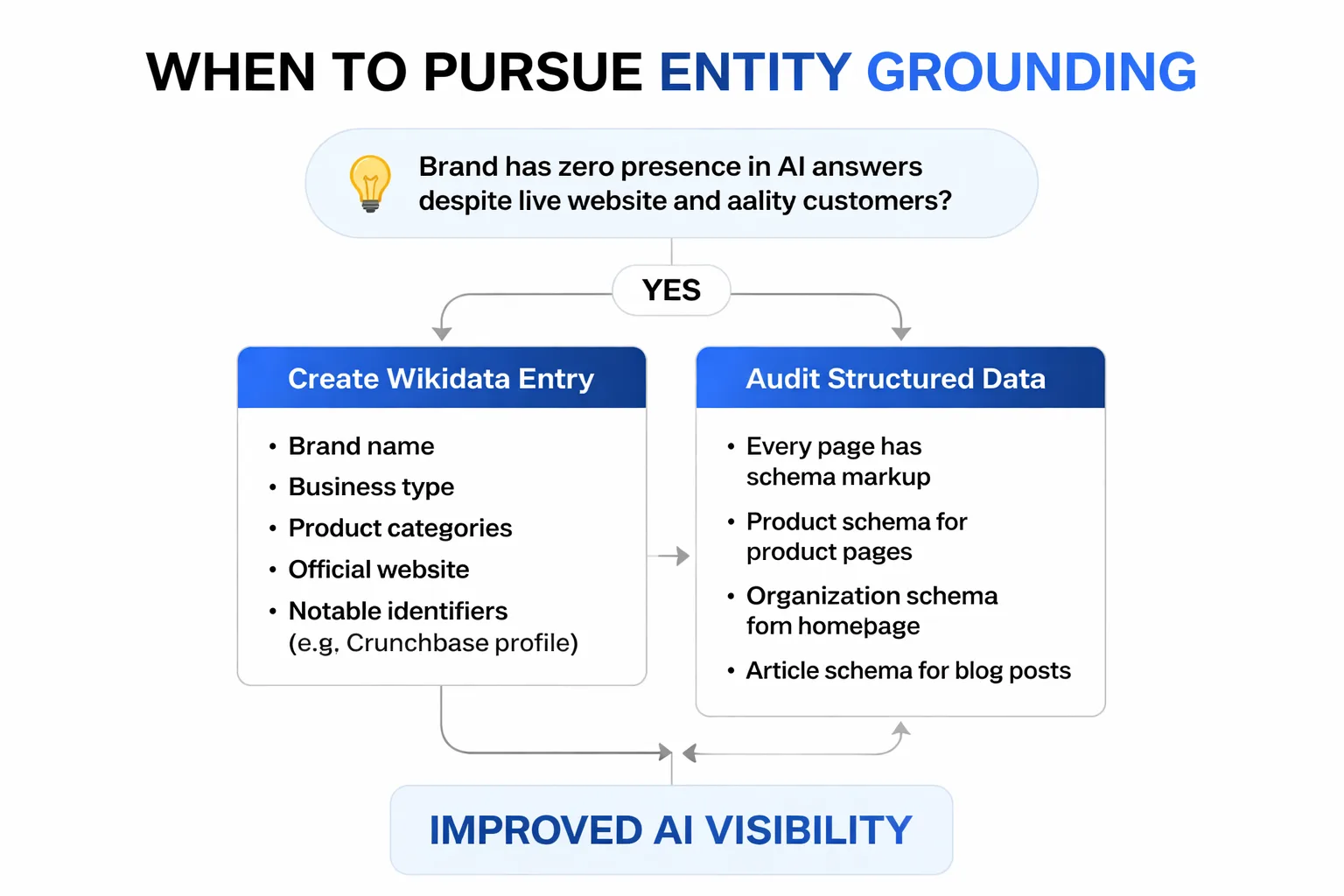
Entity grounding is the process of ensuring your brand exists as a clearly defined, recognizable entity in the knowledge graphs and structured data sources that AI models use for fact-checking and retrieval. You should pursue it when your brand has zero presence in AI answers despite having a live website and active customers.
The process starts with Wikidata. If your brand does not have a Wikidata entry, create one. It should include your brand name, business type, product categories, official website, and any notable identifiers like a Crunchbase profile or ISBN. This gives the model a canonical reference point for your entity.
Next, audit your structured data. Every page on your site should have schema markup that clearly defines what the page is about and how it relates to your brand entity. Product pages need Product schema with complete attributes. Your homepage needs Organization schema with your brand name, logo, and category. Your blog posts need Article schema with author entities. This is not basic SEO. This is machine-readable entity definition.
Then, build the semantic bridge. Your content should explicitly connect your brand to your category. Not through keyword stuffing, but through clear, descriptive language. "We are a store that sells X" is more powerful for entity association than a 2,000-word blog post about the history of X. The model needs to understand what you are, not just what you write about.
I have seen teams skip entity grounding entirely and jump straight to content production. That is like building a house without a foundation. The content might be good, but the model has no anchor to attach it to. Entity grounding is the prerequisite. Do it first.
What Sources Do AI Engines Actually Cite?
This is the question that changes everything. If you know which sources AI engines cite for your topic, you know exactly where to focus your outreach and content efforts. You stop guessing and start targeting.
In my work auditing content ops, I use a cited-source leaderboard to identify which domains AI engines cite most often for a given topic. The pattern is consistent across industries. AI engines cite Wikipedia, high-authority publications, comparison sites, review platforms, and niche blogs with strong topical authority. They rarely cite brand websites directly. One SaaS client generated 20+ free trial signups per month directly from ChatGPT citations by optimizing content for GEO and clustering topics strategically, according to research from a Princeton GEO paper. The client did not rank their own site in the AI answer. They got cited by the sources the AI answer referenced.
This is the shift from owned content to earned media. Your goal is not to get your website cited by AI. Your goal is to get mentioned by the sources AI cites. That means pursuing coverage in the publications and platforms that appear in the cited-source leaderboard for your topic.
The practical implication is that you need a citation strategy, not just a content strategy. You need to identify the top 20 sources AI engines cite for your category, find out what it takes to get mentioned on each one, and execute systematically. This is what I call Machine Relations. It is the earned media playbook adapted for AI search.
AI-referred traffic converted 42% better than non-AI sources by March 2026, and revenue per visit from AI referrals ran 37% above non-AI traffic, according to Adobe's retail data. The traffic that does come through is higher intent and higher value. But you only capture it if you are cited. And you only get cited if you are present in the right sources.
Can You Buy Your Way Into AI Answers?
No. And anyone selling you guaranteed AI placement is lying. AI models do not have a paid inclusion program. You cannot bid for a recommendation in ChatGPT the way you bid for a Google ad. The models select sources based on authority, relevance, and entity strength. Not payment.
What you can buy are tools and services that accelerate your path to visibility. AI search engine optimization tools can track your mentions across every major AI surface, identify citation gaps, and surface the publishers you need to target. Content platforms can help you produce answer-engine-optimized articles. But the visibility itself is earned, not bought.
The distinction matters because the market is filling with tools that promise AI visibility as if it were a media buy. It is not. It is closer to PR. You earn coverage by being newsworthy, authoritative, and present in the right places. The tools help you measure and execute faster. They do not replace the work.
This is why I am skeptical of the AI SEO agent trend. These tools promise to automate your way to AI visibility, but they fundamentally misunderstand what makes visibility work. Generic content production does not build entity strength. Automated outreach does not build relationships with the publications AI engines cite. The work is nuanced and strategic. Tools can help, but they cannot replace judgment.
The Agentic Commerce Threat You Are Not Watching
Here is what keeps me up at night. Agentic commerce is arriving faster than anyone predicted. IBM and NRF's agentic commerce report outlines a near future where AI agents do not just recommend products. They execute purchases on behalf of users. A customer tells their AI assistant to buy a product, and the assistant selects a store, compares prices, and completes the transaction. All without the customer visiting a single website.
In that world, your store not showing up in ChatGPT is not a marketing problem. It is an existential threat. If the AI agent does not know your store exists, you are not even in the consideration set. The customer never sees your brand. You never get a chance to win them over with your site experience, your pricing, or your product quality. The decision is made at the entity level, before any human interaction occurs.
Criteo announced that their recommendation service achieves 60% higher recommendation relevancy compared to product-description-only approaches. This tells you where the market is going. The platforms that feed AI agents are optimizing for entity-rich data, not page-level content. If your entity representation is weak, you will be filtered out before the recommendation is even generated.
AI search traffic is projected to reach 40% of total search traffic by 2027, according to industry analysis. ChatGPT alone has 910 million weekly active users, and Google AI Overviews reach 2 billion monthly users. The scale of this shift is enormous. And it is happening whether you optimize for it or not.
Building Your AI Visibility Action Plan
You need a systematic plan. Not a list of tactics. A framework that addresses entity grounding, content, citations, and measurement in the right order. Here is the framework I use.
Phase 1: Audit and baseline. Test 10-15 category-relevant prompts across every major AI search surface. Record where you appear, where competitors appear, and which sources are cited. Use an AI visibility tool to automate this and get a baseline you can track over time. Without a baseline, you cannot measure progress.
Phase 2: Fix entity grounding. Create or update your Wikidata entry. Audit and expand your structured data. Ensure your Organization, Product, and FAQ schema are complete and accurate. Build the semantic bridge between your brand and your category in your content. This is the foundation.
Phase 3: Build answer-ready content. Produce content that directly answers the questions buyers ask when seeking a store recommendation. Not blog posts about your company. Content that addresses category-level questions, comparison queries, and buying criteria. Make it fact-dense with citations, statistics, and quotable claims. The Princeton GEO research showed this can lift visibility by up to 40%.
Phase 4: Pursue earned media citations. Identify the top 20 sources AI engines cite for your topic. Develop relationships with those publishers. Pitch contributed content, expert quotes, and product mentions. This is where the majority of AI visibility is won. Your owned content supports your entity. Your earned media drives your citations.
Phase 5: Track and iterate. Re-run your visibility audit monthly. Track changes in mention position, citation sources, and share of voice versus competitors. AI models update constantly. Your visibility will fluctuate. You need a system that catches drops early and identifies new opportunities as they emerge.
This is not a one-time project. It is an ongoing discipline. The teams that win in AI search are the ones that treat visibility as a living system, not a set-and-forget checklist.
What This Actually Means
The shift from search engines to answer engines is the most significant change in digital discovery since Google launched. And most teams are treating it like a minor SEO update. It is not.
If the ai recommends competitors instead of your store, it is because their entity is better grounded, better cited, and better associated with your shared category. Fixing that requires a different playbook than the one that got you ranked on Google. You need entity grounding in knowledge graphs. You need structured data designed for machine readability. You need answer-ready content that addresses category-level questions. And you need earned media citations from the sources AI engines actually trust.
The data is clear. AI-referred traffic is growing at 393% year-over-year. It converts 42% better than non-AI sources. Revenue per visit is 37% higher. This is the highest-intent traffic on the internet right now, and it is flowing to the brands that invested in entity presence before it was obvious. The brands that wait will spend years catching up.
Start with an audit. Find your gaps. Fix your entity grounding. Then pursue the citations that actually move the needle. The AI models are not going to start recommending you because your website is pretty. They will recommend you because your entity is undeniable.
FAQ
How long does it take to improve AI visibility?
Most teams see initial movement within 60-90 days of fixing entity grounding and publishing answer-ready content. Significant shifts in AI recommendations typically take 4-6 months because models need to encounter your brand across multiple sources during retrieval. The timeline depends on your starting point. If you have zero entity presence, phase 1 and 2 take 30 days. If you already have some visibility, you can focus on citation building immediately.
Do I need to be on every AI search surface?
No. Prioritize the surfaces your customers actually use. For most ecommerce brands, ChatGPT, Google AI Overviews, and Perplexity account for the majority of AI-referred traffic. Use an LLM visibility tool to test which surfaces mention competitors in your category. Focus your effort there first, then expand.
Is AI visibility the same as generative engine optimization?
They overlap but are not identical. Generative engine optimization focuses on optimizing content for AI-generated responses. AI visibility is broader. It encompasses tracking your presence across all AI surfaces, understanding citation sources, and building entity strength. GEO is a tactic within the larger AI visibility strategy.
Can I use an AI SEO agent to automate this?
You can use tools to automate tracking and content production, but the strategy requires human judgment. AI SEO agents that promise full automation typically produce generic content that lacks the depth and citations AI models reward. Use tools to accelerate execution, not to replace strategic decisions about entity positioning and citation targeting.
What is the single highest-impact action I can take today?
Audit your entity presence. Search for your brand on Wikidata. Test 10 category-relevant prompts in ChatGPT and Perplexity. Note whether you appear and which sources are cited. That 30-minute exercise will tell you exactly where you stand and what to fix first.
About the Author
Judy Zhou, Founder
Judy Zhou leads content strategy at Meev, where she oversees AI-driven content research and publishing for hundreds of brands. With a background in SEO and editorial operations, she focuses on building content systems that rank on Google, get cited by AI search engines, and drive measurable business results.
Run a free AI visibility audit and find exactly where your brand is missing from AI recommendations.