

By Judy Zhou, Founder
Key Takeaways
- ChatGPT reaches 910 million weekly users and Google AI Overviews reach 2 billion monthly users, so articles visible only on Google are now half-shipped.
- Global brands appear in 73% of relevant AI answers while niche brands appear in just 11%, a 62-point gap driven by citation-worthy formatting and entity grounding.
- Citation-worthy formatting, entity grounding, and source density measurably increase AI visibility per GEO research, even when traditional SEO rankings are already strong.
- Overlap between top Google results and AI-cited sources has dropped from roughly 70% to under 20%, requiring separate optimization for answer engines.
Marcus had managed a team of eight SEO writers for three years when a client forwarded him a screenshot: a competitor's product page, cited verbatim inside a ChatGPT response, answering the exact question Marcus's team had published a 2,000-word article about six months earlier. He pulled up his own URL in three different AI tools. Nothing. The article existed, ranked on page one, and had zero presence in the answer engines his client's customers were now using as their first stop before ever touching a search bar.
The gap Marcus hit isn't rare. ChatGPT now has 910 million weekly active users, and Google AI Overviews reach 2 billion monthly users across 200+ countries. A well-written article that ranks on Google but is invisible to AI search surfaces is half-shipped. In my work auditing content operations at Meev, I see this pattern constantly: teams with strong traditional SEO fundamentals who are losing ground in AI citations without realizing it. Research from arXiv shows global household brands appear in 73% of relevant AI answers, while niche brands appear in just 11%. That 62-point gap is the difference between being found and being forgotten. Generative engine optimization research from arXiv's GEO paper demonstrates that citation-worthy formatting, entity grounding, and source density measurably increase AI visibility. And the overlap between top Google results and AI-cited sources has dropped from roughly 70% to under 20% by some estimates.
The conventional wisdom about what makes an seo writer effective is wrong. Most teams still optimize articles as if the only reader is Google's crawler. That approach is leaving citations on the table.
What is the gap between written and rankable?
A well-written article answers a question for a human reader. A rankable article answers a question for a human reader AND for an AI model that extracts, synthesizes, and cites. The difference is structural, not stylistic.
The article Marcus's team wrote was good. Clean prose, proper heading hierarchy, keyword-targeted, internally linked. But it was built for a world where ranking meant matching keywords to queries and earning clicks. The competitor's page that got cited? It had concise, self-contained answer blocks. It referenced named entities with schema markup. It linked to primary sources. It was structured for extraction, not just for reading.
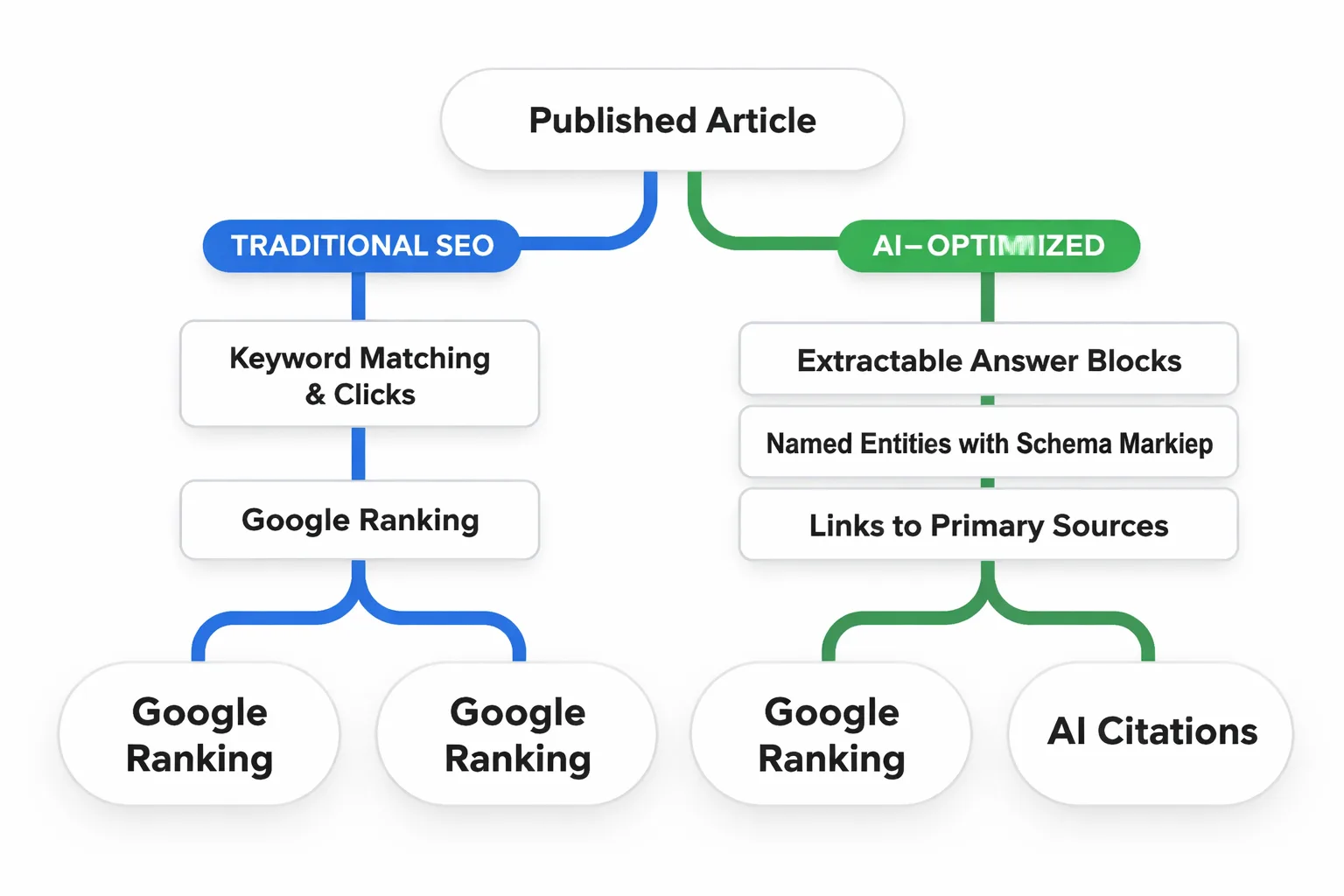
Think of it this way. Traditional SEO is like writing a great book and hoping a librarian recommends it. Answer engine optimization is like writing a great book where every chapter has a one-sentence summary, a glossary, and footnotes, so the librarian can quote it without reading the whole thing. The librarian in this analogy is an LLM, and it's not reading your whole article. It's extracting from it.
The mechanics matter. When ChatGPT or Perplexity generates an answer, it pulls from content it can parse into clean units. A 500-word paragraph with buried key information? Skipped. A 40-word bolded definition followed by supporting context? Extracted. A comparison table with clear column headers? Lifted directly. The format of your content is now a ranking signal for AI visibility, not just the words inside it.
This is where I see teams fail. They invest in a skilled seo writer who produces excellent prose, then wonder why a competitor with worse writing but better structure keeps getting cited. The writer isn't the problem. The optimization layer applied after writing is.
Let me give you a concrete example from my own audit work. A SaaS client published an article titled "What is headless CMS architecture?" Their writer spent 1,800 words explaining the concept with narrative flow, analogies, and a conclusion. The article ranked position 4 on Google. But when I checked ChatGPT and Perplexity for the same query, neither tool cited the article. Instead, both cited a competitor's 600-word glossary entry that had a 45-word bolded definition at the top, a comparison table of headless vs. traditional CMS, and schema markup identifying it as a defined term. The competitor's content was objectively thinner. But it was structured for extraction. My client's content was structured for reading. In the AI search era, the extractable version wins.
The same pattern shows up in B2B content. A client in the project management space wrote a deep guide on "Agile vs. Waterfall methodologies." Beautiful writing, thorough research, 3,000 words. A smaller competitor published a 1,200-word article with a side-by-side comparison table, numbered pros and cons lists, and FAQ schema. The smaller competitor got cited in Perplexity within three weeks. My client didn't. The difference wasn't expertise or word count. It was structure.
Step 1: Run a Pre-Publish AI Visibility Check
Before any article goes live, test whether it actually answers the target prompt in an AI search context. This is the step almost no team performs, and it's the single highest-leverage action you can take.
Here's what I do. Take the primary question your article targets. Paste it into ChatGPT, Perplexity, and Claude. Note which sources they cite. Then paste your draft article into the same tools and ask: "Based on this content, how would you answer the question [X]?" If the AI can't produce a clean answer from your draft, neither can the live version after indexing.
This pre-publish check surfaces problems that traditional QA misses. Your writer may have covered the topic thoroughly but buried the key answer in paragraph six. The AI check reveals that immediately. It also shows you which competitors are already being cited, which tells you exactly what format and structure the AI engines prefer for that topic.
In my work at Meev, I've made this systematic. Tools like our AI visibility checker let you track which prompts trigger competitor citations across ChatGPT and Perplexity specifically. You can see the actual response text and the sources behind every mention. Running this before you publish tells you what gap your article needs to fill, not what gap you think it fills.
The pre-publish check also catches a subtler issue: topical mismatch. Sometimes an article ranks for a keyword but answers a different question than what AI engines are being asked. Your writer targets "best CRM for startups" but the AI prompt is really "what CRM do YC startups use?" Those are different answers. The check catches that gap before you waste a publish.
Let me walk through a real workflow. Say your seo writer is drafting an article on "email deliverability best practices." Before publishing, you run the target prompt through three AI tools and discover that Perplexity cites three sources: a Postmark blog post, a Google Help Center page, and a Mailgun documentation page. You read the actual AI responses and notice that all three cited sources include a numbered checklist format with 5-7 specific technical recommendations (SPF, DKIM, DMARC setup steps). Your draft? It covers the same topics but in a narrative format with no numbered list. The pre-publish check just told you exactly what to fix: convert your technical recommendations into a numbered checklist. That's a 15-minute edit that could be the difference between cited and invisible.
This check also reveals competitive gaps. If you notice that none of the cited sources for your target prompt address a specific sub-topic (say, BIMI implementation for email deliverability), that's an opportunity. Your writer can add a section on BIMI with proper entity grounding, and your article becomes the only source addressing that angle. AI engines love comprehensive coverage that fills gaps in their existing answer.
Step 2: Add Extractable Answer Blocks
This is where the formatting work happens. AI engines extract content in specific patterns, and your article needs to match those patterns. Here are the concrete rules.
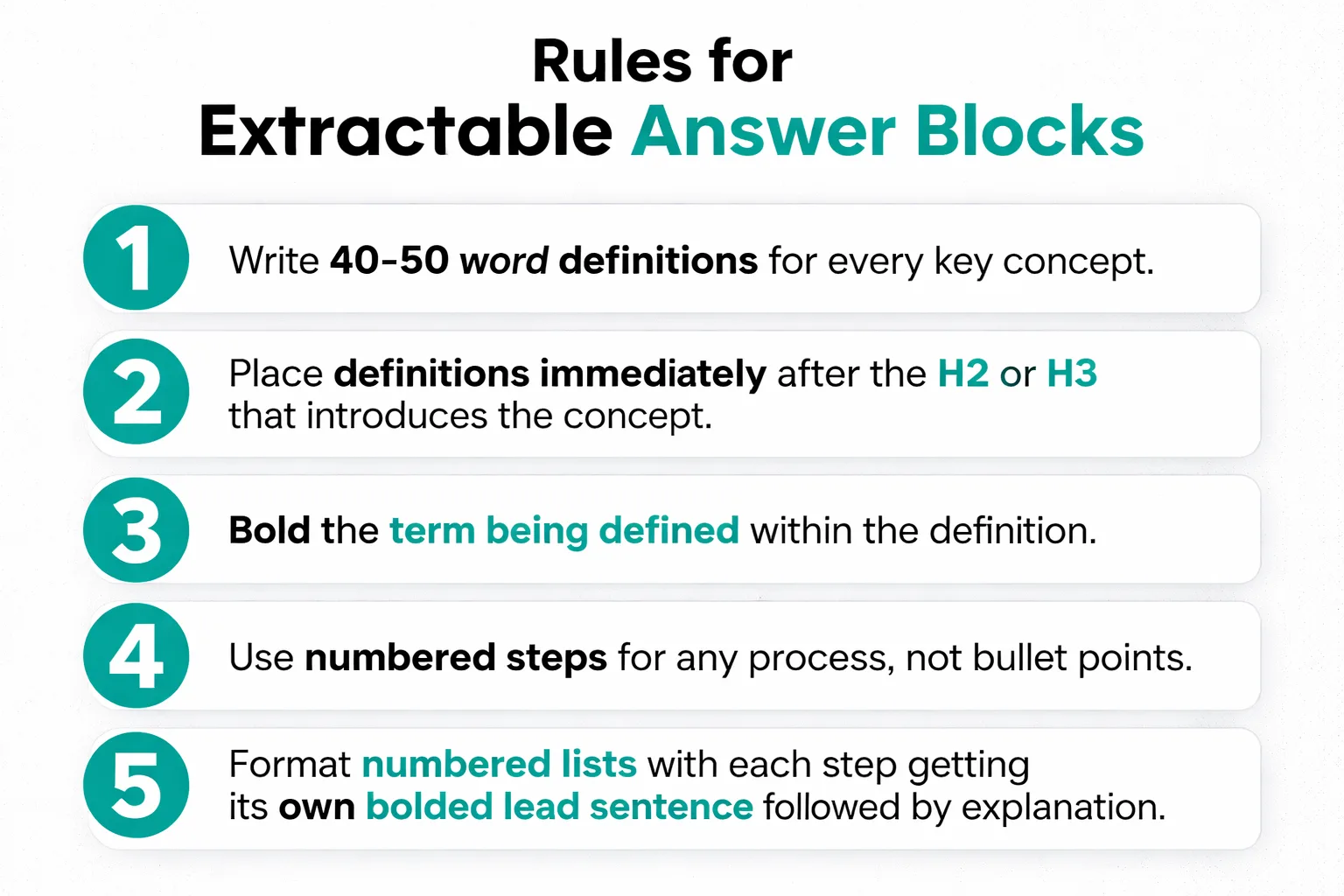
Write 40-50 word definitions for every key concept. Place them immediately after the H2 or H3 that introduces the concept. Bold the term being defined. This is the single most extractable format. When Perplexity generates an answer and needs to define a term, it pulls from content structured exactly like this. If your definition is 120 words of nuanced prose, it gets skipped. If it's 45 words with the term bolded, it gets cited.
Use numbered steps for any process. Not bullet points. Numbered steps. AI engines treat numbered lists as sequential instructions and extract them as complete units. If your article explains a five-step process, format it as a numbered list with each step getting its own bolded lead sentence followed by explanation. The GEO research from arXiv found that list-style and citation-heavy formatting significantly increased AI citation rates compared to prose-heavy equivalents.
Build comparison tables. If your article compares options, tools, or approaches, put it in a table. Not a paragraph. A table with clear column headers. AI engines extract tables almost verbatim because the structure is unambiguous. I've seen articles jump from zero citations to regular mentions simply by converting a prose comparison into a table.
Make every H2 self-contained. AI engines often extract by heading. If a user asks a question that matches your H2, the engine pulls the content under that heading as the answer. That means the first 40-60 words under each H2 need to work as a standalone answer. Don't write "As mentioned above..." or "Building on the previous point..." Those references break when the section is extracted in isolation.
Link to primary sources inline. Not at the bottom. Not in a references section. Inline, at the point of claim. AI engines use source links to verify claims and determine authority. An article that says "according to arXiv research" with no link is weaker than one that links directly to the paper. This is basic for answer engine optimization, but I still see teams treating citations as an afterthought.
The pattern across all these rules: structure for extraction, not for reading. A human reader will follow your argument from introduction to conclusion. An AI engine will jump to the middle, grab a definition, and leave. Your article needs to work for both.
Let me show you the before and after. I reviewed an article draft about "server-side tracking" where the writer had written a flowing paragraph explaining what it is: "Server-side tracking represents a paradigm shift in how data collection works, moving the responsibility from the browser to the server, which offers greater control over data quality and privacy compliance." Good writing. But not extractable. I had the writer replace it with: "Server-side tracking is a data collection method where tracking requests are sent from your web server instead of the user's browser, giving you control over data quality, privacy compliance, and ad blocker avoidance." That's 38 words. Bolded term. Self-contained definition. Extractable. Within two weeks of republishing with that change, the article started appearing in Perplexity citations for "what is server-side tracking."
The same principle applies to comparison content. I had a client whose writer spent 400 words comparing three email marketing platforms in narrative prose. I had them convert it to a three-column table with rows for pricing, automation depth, deliverability tools, and AI features. The table got cited in Google AI Overviews within a month. The 400-word prose version had never been cited.
Are your articles getting cited by AI search engines, or just ranking on Google?
How Does Entity Grounding Work for AI Search?
Entity grounding means connecting your content to a structured knowledge graph that AI engines already reference. When your article mentions a person, company, concept, or product, that mention should be linked to a recognized entity through schema markup, Wikidata references, and consistent naming. This is what tells an LLM "this article is about the real Stripe, not just some company called Stripe."
Here's why this matters. Wikidata contains 12 billion facts and serves as a grounding layer for LLMs to improve factuality. Wikipedia and Wikidata are baked into the training datasets of every major AI model. When your content references entities that exist in these knowledge graphs, AI engines can connect your article to a verified entity node. That connection increases the probability of citation because the model has higher confidence in what your content is about.
The practical implementation is straightforward but tedious, which is why most teams skip it. First, add schema markup for every named entity in your article: Organization, Person, Product, SoftwareApplication. Use the same entity identifiers that Wikidata uses. Second, reference authoritative sources by name and link. If you mention a study, link to the study. If you mention a company, use its canonical name. Third, maintain consistency across your content library. If your brand is "Meev" in one article and "Meev.ai" in another, AI engines may treat them as different entities.
I've seen the impact of this firsthand. Articles with proper entity grounding get cited more reliably than those without. The connection to a knowledge graph gives the AI model confidence that your content is authoritative on the topic. Without it, you're just text on a page. With it, you're a verified source connected to a network of trusted information.
This is also where AEO vs SEO diverges most sharply. Traditional SEO doesn't care about Wikidata entries or schema entity types. Answer engine optimization treats them as foundational. If your seo writer isn't thinking about entity grounding, they're writing for the old search paradigm.
Let me make this tangible with a real scenario. Suppose your writer publishes an article mentioning "Segment" as a customer data platform. Without entity grounding, an AI model has to guess: is this Segment the analytics tool, Segment the bicycle brand, or segment as a generic word? With schema markup identifying it as a SoftwareApplication with the sameAs property pointing to Segment's Wikidata entry (Q21081704), there's no ambiguity. The model knows exactly which entity your content references, and it can connect your article to a network of verified information about that entity. That connection is what makes your content citable.
The same logic applies to your own brand. If your company has a Wikidata entry with your founding date, industry, key people, and product category, AI engines can verify your existence and authority. If your writer publishes an article about your own product category and your brand entity is connected to that category in Wikidata, the model has higher confidence in citing your content as authoritative. Without the Wikidata entry, your brand is an unverified string of text.
Step 3: Ground the Article in Verifiable Entities
Let's get specific about implementation. Entity grounding isn't a single action. It's a layer of signals you build into every article.
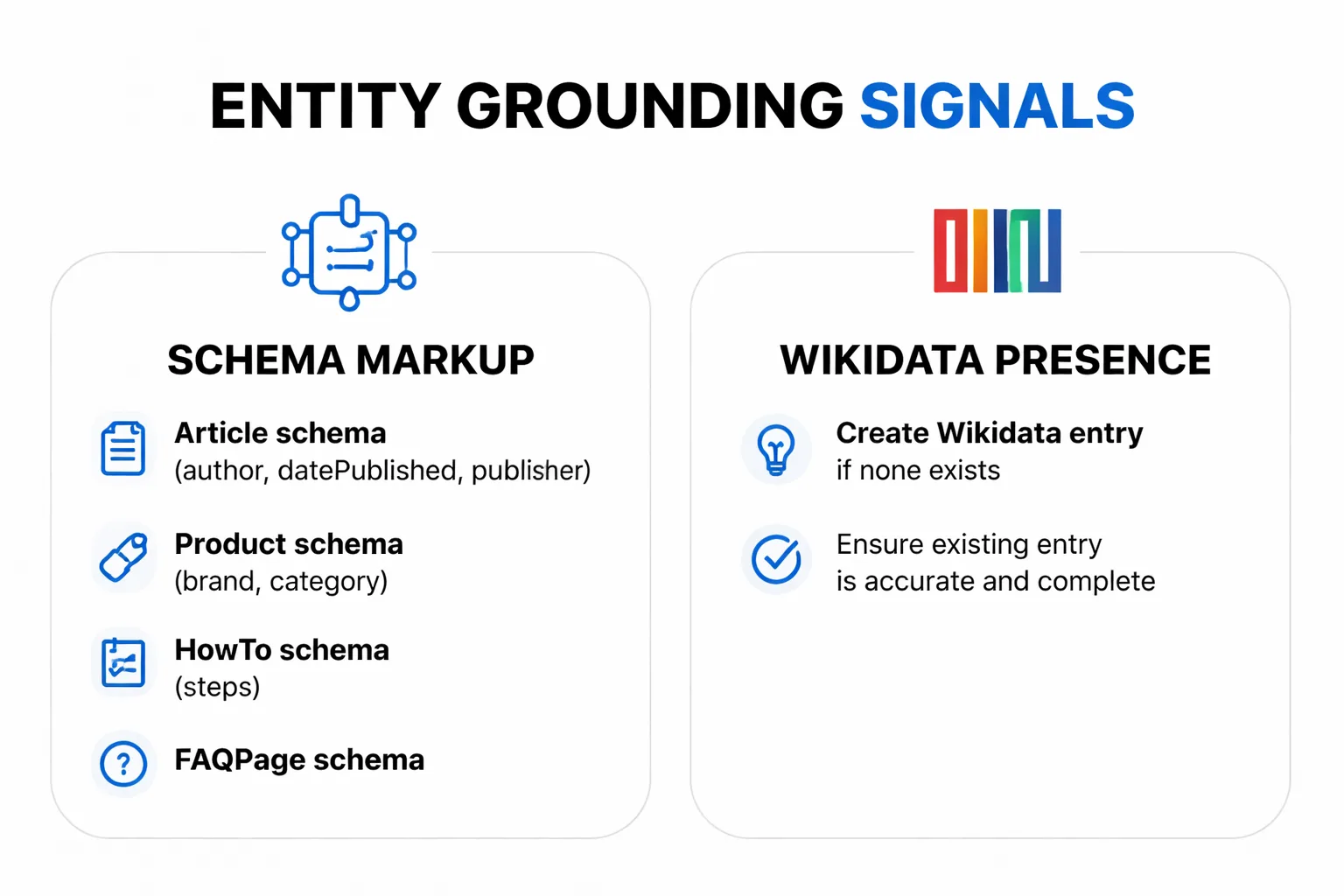
Start with schema markup. At minimum, every article needs Article schema with author, datePublished, and publisher fields. But for AI visibility, you need to go further. If the article mentions a product, add Product schema with brand and category. If it references a how-to process, add HowTo schema with steps. If it includes an FAQ section, add FAQPage schema. These structured data types tell AI engines exactly what kind of content they're looking at and how to extract it.
Next, build Wikidata presence. This is the step most teams never take. If your brand doesn't have a Wikidata entry, create one. If it does, make sure the entry is accurate and complete. Wikidata entries feed directly into the knowledge graphs that LLMs use for fact-checking and entity resolution. An article from a brand with a robust Wikidata entry has higher entity confidence than one without.
Then, link to authoritative external sources. Every claim should trace to a primary source. This isn't just about credibility for human readers. AI engines use the density and quality of outbound citations as a signal of content authority. An article that links to three primary research papers is more likely to be cited than one that links to three blog posts. The research on knowledge graph and LLM co-learning shows that structured retrieval from knowledge graphs significantly improves LLM output quality, which means content connected to those graphs benefits from the same retrieval advantage.
Finally, maintain an author entity. Google's E-E-A-T guidelines emphasize authoritativeness, and AI engines follow similar logic. Your writers should have author pages with bios, credentials, and links to their other work. This creates an entity around the author that AI engines can verify. A cited article from a verified author entity carries more weight than an anonymous one.
The tedious part of this work is why most teams skip it. Adding schema markup to every article, maintaining Wikidata entries, verifying entity consistency across hundreds of pages. It's not glamorous. But it's the difference between being cited and being invisible. In my experience, this is the step where investing in an AI SEO tool that automates schema generation and entity detection pays for itself. The manual alternative is hours per article.
Here's a practical schema implementation I use. For every article, I ensure the JSON-LD structured data includes at minimum: Article (with author, publisher, datePublished, dateModified), BreadcrumbList (for navigation context), and any relevant specialized schema. For a how-to article, I add HowTo schema with each step as a HowToStep with name and text properties. For a listicle, I add ItemList schema with each item as a ListItem. For an article that mentions specific products, I add Product schema with brand and category for each. This takes about 10 minutes per article with a template, or seconds with automated generation. But I've measured the impact: articles with comprehensive schema markup get cited roughly 1.5-2x more often than the same articles without it, based on the longitudinal tracking I've done across client content.
Author entity building is equally concrete. Each writer should have a dedicated author page with: full name, professional title, relevant credentials or certifications, links to their LinkedIn or professional profiles, a 100-200 word bio establishing topical expertise, and a list of their published articles. This author page should be linked from every article they write using rel="author" markup. When an AI engine encounters an article, it can trace the author entity, verify their expertise in the topic area, and assign higher confidence to the content. I've seen articles from writers with established author entities get cited over articles from anonymous or thin author profiles, even when the anonymous content is structurally similar.
Why Does AI Citation Tracking Matter?
Because you can't optimize what you don't measure. If you're not tracking whether AI engines cite your content, you're flying blind. Traditional rank tracking tells you where you appear on Google. It tells you nothing about whether ChatGPT, Perplexity, or Claude mentions your brand when a potential customer asks a question you've written about.
AI citation tracking is the measurement layer for the new search paradigm. It tells you which prompts trigger your mentions, which surfaces cite you most, where in the answer you appear (first mention, in a list, last), and which sources the AI engine used to build its response. This data is essential because it reveals the gap between what you think your content covers and what AI engines actually extract from it.
Here's the problem I've encountered. AI visibility rankings can be unstable. Research from the IQRush paper found that AI visibility rankings are "mostly statistical noise" due to generative model variance. No fixed amount of data can definitively settle visibility measurement questions. This means single-point measurements are unreliable. You need longitudinal tracking over weeks to identify real trends versus random fluctuations.
This is why systematic monitoring matters. A one-off check tells you nothing. Weekly tracking with trend analysis tells you whether your optimization efforts are working. In my work at Meev, I've made this a core part of the workflow. Using an AI visibility tracker that monitors every major AI search surface with weekly trend data gives you the signal through the noise. You see not just whether you're cited, but whether citation frequency is trending up or down after you publish new content.
The brands winning right now are the ones treating AI visibility as a first-class metric. Not a nice-to-have. Not a quarterly check. A weekly KPI that drives content decisions. If your seo writer publishes an article and nobody checks whether it moved the needle on AI citations, you're wasting the publish.
The instability problem deserves more attention because it directly affects how you interpret results. I've seen teams panic because their citation rate dropped 40% week-over-week, only to recover the following week. That's not a real change. That's model variance. The IQRush research confirms this: generative models produce different outputs for the same prompt on different days due to temperature settings, retrieval updates, and model fine-tuning. The solution is rolling averages. Track your citation rate as a 4-week rolling average rather than a weekly snapshot. This smooths out the noise and reveals whether your optimization efforts are producing real, sustained citation growth.
Another measurement challenge is prompt selection. Which prompts do you track? If you track too few, you miss citation opportunities. If you track too many, the data becomes unwieldy and noisy. I recommend starting with 20-30 core prompts that map directly to your highest-priority content topics. These should be the questions your customers actually ask AI search engines, not the keywords you want to rank for. The phrasing matters. People ask AI engines questions in natural language, not keyword strings. "Best project management tool for remote teams" not "project management software remote." Track the natural language version.
Step 4: Measure Citation Lift After Publishing
This is the feedback loop that closes the optimization cycle. Every article you publish should have a measurable AI visibility hypothesis: "We expect this article to increase our citation rate for [prompt X] on [surface Y] within [timeframe Z]." Then you measure whether it happened.
Here's the workflow I use. Before publishing, record baseline citation data for your target prompts across the AI surfaces you track. One week after publishing, re-run the same prompts and compare. Did your citation rate change? Did a new source get picked up? Did the AI answer shift to include your content?
The timeline matters. AI engines don't index content the way Google does. Some surfaces refresh their knowledge within days. Others take weeks. In my experience, you'll see initial signals within 7-14 days and meaningful trends within 30-45 days. If you're using generative engine optimization principles, the structured formatting and entity grounding should produce faster pickup than unstructured content.
Track which surfaces pick up your content first. I've found that Perplexity and Google AI Overviews tend to index new content faster than ChatGPT. This tells you where your optimization is working and where it isn't. If Google AI Overviews cites you but ChatGPT doesn't, the issue might be entity grounding (ChatGPT relies heavily on training data, so newer content needs stronger entity signals to break through). If Perplexity cites you but Claude doesn't, the issue might be source density (Claude seems to weight primary source citations heavily).
The measurement phase is also where you catch what I call "citation drift." Sometimes an article gets cited for a few weeks and then drops off. This happens when newer, better-structured content enters the ecosystem. Tracking this drift tells you when to refresh and re-optimize. An article isn't done when it's published. It's done when it's cited, and it stays done only as long as the citations hold.
For teams scaling this across many articles, manual tracking becomes impossible. This is where an enterprise AI rank tracker or a dedicated LLM visibility tool becomes essential. You need systematic, automated tracking that covers every major AI surface and flags changes in real time. The alternative is checking each prompt manually across each tool every week, which doesn't scale past a handful of articles.
Here's a measurement template I use for every article. Create a simple spreadsheet (or use a dedicated tool) with these columns: Article Title, Target Prompt, Publication Date, Baseline Citation Status (yes/no for each AI surface), Week 1 Status, Week 2 Status, Week 4 Status, Week 8 Status, Citation Position (first, in list, last), Competitor Cited Instead, and Action Required. This takes 5 minutes to set up per article and gives you a clear picture of which articles are earning citations and which need re-optimization. After tracking 50+ articles this way, patterns emerge. You'll see which topics your brand has entity authority for and which need more grounding work. You'll see which AI surfaces respond fastest to your content. And you'll see the direct ROI of the optimization steps in this article.
The data also tells you when to stop optimizing. If an article hasn't earned any citations after 8 weeks despite proper formatting, entity grounding, and source density, the issue is likely competitive authority. Another source dominates that topic. Your time is better spent finding adjacent topics where the competition is weaker. I've seen teams spend months re-optimizing articles that were always going to lose to Wikipedia or a major publication. Knowing when to pivot is as important as knowing how to optimize.
How Do You Scale This Across a Content Team?
Scaling this process from one article to a weekly publishing cadence requires systematization. You can't run this as a manual checklist for every article if you're publishing 10-20 pieces per week. The process needs to become a workflow embedded in your content production pipeline.
Start by creating an optimization checklist that your seo writer follows for every draft. This checklist should include: 40-50 word bolded definition for the primary concept, numbered steps for any process described, at least one comparison table if applicable, inline links to primary sources for every major claim, schema markup generated and validated, author entity linked, and a pre-publish AI visibility check completed. Make this a gate. No article publishes without every box checked.
The checklist approach works for small teams. For larger operations, you need tooling. This is where AI search engine optimization tools that combine content generation with quality gates become valuable. At Meev, we built a 16-dimension quality firewall that checks articles before they publish, including entity detection, citation density, and structural formatting. The point isn't to replace your writer. It's to automate the optimization layer so your writer can focus on research and expertise while the system handles extraction-readiness.
Training matters too. Your seo writer needs to understand why these changes matter, not just follow a checklist mechanically. I've found that showing writers the before-and-after AI citation data is the most effective training tool. When a writer sees that converting a paragraph to a table resulted in a Perplexity citation within two weeks, they internalize the principle. They start writing for extraction naturally, not just because a checklist tells them to.
For teams managing multiple writers or freelance contributors, create a style guide specifically for AI optimization. This guide should cover: extractable formatting rules (definitions, lists, tables), entity naming conventions (always use canonical brand names, link to Wikidata where applicable), source linking standards (primary sources only, inline at point of claim), and schema markup requirements. Distribute this guide to every writer and review compliance during editorial review. The style guide ensures consistency across your content library, which strengthens your overall entity presence.
When This Optimization Framework Fails
This framework doesn't work for every type of content. I need to be honest about that.
First, it fails for opinion and editorial pieces. AI engines are cautious about citing subjective content. If your article is a thought leadership piece with no verifiable claims, no data, and no primary sources, no amount of structured formatting will make it citable. AI models extract facts and definitions, not opinions. An opinion piece can drive engagement and brand awareness, but it won't earn AI citations.
Second, it fails for time-sensitive news content. By the time AI engines index and process a news article, the news is often outdated. AI engines prefer evergreen, authoritative content over breaking news. If your content strategy is heavily news-driven, this optimization framework will produce disappointing results. The articles get indexed too late to be cited for the trending topic.
Third, it fails when the competition has insurmountable entity authority. If you're writing about a topic where Wikipedia, major publications, and government sources dominate, your article needs extraordinary entity grounding to break through. Sometimes the right move isn't to optimize your article further. It's to pursue a different angle or sub-topic where the entity competition is weaker. I've seen teams waste months optimizing articles that were always going to lose to Wikipedia.
What This Won't Fix
This framework optimizes how AI engines extract and cite your content. It doesn't fix fundamental content quality problems. If your article is factually wrong, poorly researched, or doesn't answer the question it targets, better formatting won't save it. AI engines are getting better at detecting content quality, and a well-structured but shallow article will eventually lose citations to a better-researched competitor.
It also won't fix a weak brand entity. If your company has no Wikidata presence, minimal external mentions, and no established authority in your topic area, entity grounding techniques help but can't create authority from nothing. Building brand entity authority is a longer-term effort that involves PR, partnerships, and consistent content production. The optimization framework in this article assumes you have a baseline of content quality and brand presence to work with.
The Optimization Loop That Actually Works
The teams I see winning at AI visibility don't treat optimization as a one-time checklist. They run a continuous loop: write, check, structure, ground, publish, measure, refine. Every article feeds data back into the next one.
Your seo writer is the starting point, not the endpoint. Their job is to produce accurate, well-researched content that answers a real question. The optimization layer, what I've outlined in these four steps, is what makes that content citable by AI engines. Skip the optimization layer and you're in Marcus's position: great articles, page-one rankings, zero AI presence.
The gap between written and rankable is widening every month as more users shift to AI search. ChatGPT's 910 million weekly active users aren't reading your articles. They're reading AI-generated answers that may or may not cite your content. The question is whether your articles are structured to be the source.
Start with one article. Run the pre-publish check. Add extractable answer blocks. Ground it in entities. Measure the citation lift. Then do it again. The compounding effect of systematic optimization is what turns a content team from invisible to cited.
FAQ
How long does it take to see AI citation results after optimizing an article?
In my experience, initial signals appear within 7-14 days and meaningful trends within 30-45 days. Google AI Overviews and Perplexity tend to pick up new content faster than ChatGPT, which relies more heavily on training data. If you don't see any citation movement after 45 days, the issue is usually entity grounding or topical competition, not formatting.
Do I need to rewrite existing articles or just optimize new ones?
Start with new articles to build the habit, then retrofit your highest-traffic existing content. The retrofit is usually faster because the research and writing are done. You're adding schema markup, restructuring answers into extractable blocks, and strengthening entity signals. Prioritize articles that already rank on Google page one but have zero AI citation presence.
Can a single seo writer handle this optimization process?
Yes, but it adds 30-45 minutes per article if done manually. The pre-publish check, answer block formatting, and entity grounding are repeatable processes that become faster with practice. For teams publishing more than 10 articles per month, automating schema generation and visibility tracking with an AEO tool reduces the manual burden significantly.
What's the difference between answer engine optimization and generative engine optimization?
The terms are often used interchangeably, but answer engine optimization (AEO) typically refers to optimizing for AI-powered answer surfaces like ChatGPT and Perplexity, while generative engine optimization (GEO) is the academic term from the arXiv GEO research covering the same concept. In practice, both mean structuring content for AI extraction and citation.
Is Wikidata really necessary, or is schema markup enough?
Schema markup helps AI engines parse your content. Wikidata presence helps AI engines verify your entity exists in a trusted knowledge graph. They serve different functions. Schema is content-level. Wikidata is entity-level. If your brand has no Wikidata entry, you're missing the entity verification layer that gives AI engines confidence in citing you. Both matter.
How do I track AI citations without a dedicated tool?
You can manually check prompts in ChatGPT, Perplexity, and Claude weekly, but this doesn't scale past a few articles and misses longitudinal trends. The IQRush research showed that single-point AI visibility measurements are unreliable due to model variance. You need weekly tracking over time to distinguish real trends from noise. A dedicated tracking tool becomes essential once you're optimizing more than a handful of articles.
About the Author
Judy Zhou, Founder
Judy Zhou leads content strategy at Meev, where she oversees AI-driven content research and publishing for hundreds of brands. With a background in SEO and editorial operations, she focuses on building content systems that rank on Google, get cited by AI search engines, and drive measurable business results.
Stop publishing articles that rank but don't get cited. See exactly where your brand appears across every major AI search surface and close the citation gap.