
By Judy Zhou, Founder
Key Takeaways
- The overlap between top Google results and AI-cited sources has dropped from roughly 70% to under 20%.
- Only 11% of domains are cited by both ChatGPT and Perplexity, showing AI engines follow diverging citation rules.
- E-commerce brands using generative engine optimization with structured content raised citation rates from below 5% to 20-40% in 60-90 days.
- Ahrefs analysis of 75,000+ brands proves topical authority now drives AI visibility more than traditional domain authority metrics.
Maria had spent three years building her e-commerce brand's domain authority. Her blog ranked for dozens of competitive keywords, her backlink profile was clean, and her agency gave her glowing monthly reports. Then a colleague typed a product question into Perplexity and read out the answer. Which named four competitors and never once mentioned her brand. That afternoon, Maria discovered her Siterank score: a sobering number that revealed her site was essentially a ghost to every major AI answer engine her customers had quietly switched to.
Maria's story is not an outlier. The overlap between top Google results and AI-cited sources has plummeted from roughly 70% to under 20%, which means you can rank first organically and still be invisible to ChatGPT, Perplexity, and Google AI Overviews. I have lived this disconnect in my own work auditing content operations. Ahrefs' analysis of 75,000+ brands and millions of AI citations across ChatGPT, Google AIO, Perplexity, and Gemini confirms that topical authority and citation patterns follow completely different rules than classic link-based ranking. And only 11% of domains are cited by both ChatGPT and Perplexity, proving that AI engines are diverging from pure search engine optimization.
Your siterank score is the composite metric that captures this new reality. E-commerce brands implementing generative engine optimization with structured content have seen citation rates jump from below 5% to 20-40% within 60-90 days, according to research compiled by Search Engine Journal. This guide walks through the five concrete steps to move that number.
What Siterank Actually Measures (and Why It Differs From Domain Authority)
Domain authority is a third-party proxy. It estimates how likely your site is to rank on Google based on backlink quantity and quality. It says nothing about whether an LLM will cite you.
Your siterank score is different. It is a composite signal built from three dimensions: technical crawlability (can engines access and parse your content?), topical authority (does your site demonstrate deep expertise on a subject?), and citation rate (how often do AI engines actually reference you in generated answers?). These three factors work together. A site that is perfectly crawlable but covers fifty shallow topics will score lower than a site that goes deep on ten.
I learned this distinction the hard way. I spent months helping a team meticulously integrate schema markup and build out an internal knowledge base, expecting a direct correlation to AI visibility. The structured data was flawless. The citations did not come. What I realized is that AI engines do not just find your content. They recommend it. And recommendation depends on external signals: community discussion, third-party editorial mentions, and the density of your topical coverage relative to competitors.
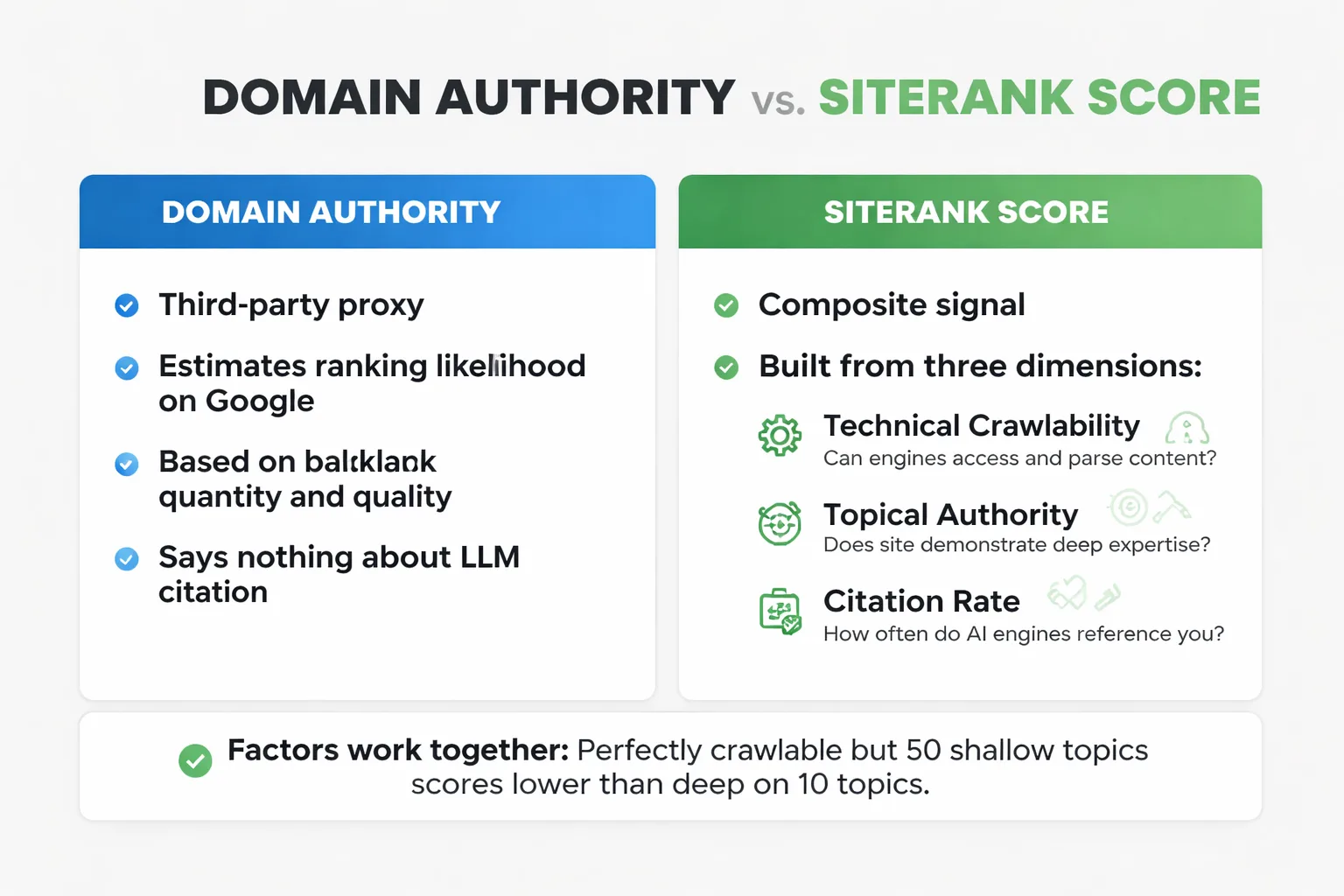
Think of it this way. Domain authority is your credit score. It tells a lender you are trustworthy. Siterank is your actual spending behavior. It shows whether you actually use credit, how much, and whether merchants report positive experiences. A high credit score with no spending history gets you nowhere. A high DA with no AI citation history gets you equally nowhere.
The practical implication: you cannot game siterank with a single tactic. Buying links, stuffing keywords, or publishing one viral post will not move it. You need coordinated work across all three dimensions. That is what the five steps below address.
Let me give you a concrete example of how these dimensions interact. I worked with a B2B SaaS company that had a domain authority of 58, which is respectable for their niche. They ranked on page one for their primary keyword. But when I ran their AI visibility baseline, they appeared in zero out of 40 category-relevant prompts across ChatGPT and Perplexity. Their siterank was effectively near zero for AI purposes. The problem was not authority. It was that their content was structured as long-form sales pages with no extractable answers, no question headings, and no schema markup. The AI engines could crawl the pages (crawlability was fine) but found nothing worth extracting (topical authority was thin because every page was a pitch, not a resource). Their citation rate was zero because the other two pillars were missing.
This is why siterank is a more honest metric than domain authority for the AI era. It forces you to confront the gap between being indexable and being citable. DA tells you that you are in the building. Siterank tells you whether anyone in the room knows your name.
Step 1. Audit Your Current Siterank Baseline
You cannot improve what you have not measured. The first step is pulling your current score across the AI surfaces that matter to your audience.
Start with a visibility check across ChatGPT, Perplexity, Google AI Overviews, and Claude. You can use our AI visibility checker to run a baseline scan, or use the Perplexity AI visibility checker and ChatGPT AI visibility checker individually for surface-specific diagnosis. What you are looking for is simple: when someone asks a question related to your product category, does your brand appear in the answer? If yes, where? First mention, buried in a list, or dead last?
A healthy baseline for a small-team site is not 100% visibility. That is unrealistic. What you want to see is that your brand appears in at least 15-20% of category-relevant prompts, and that when you do appear, you are not the last name in a list of five. If you are below 5% citation rate, you are in the same position as the e-commerce brands in the Search Engine Journal study before they implemented GEO. That is fixable, but it requires acknowledging the gap.
Here is what surprises most people during this audit. Your site might rank organically for a keyword and still get zero AI citations for the same query. I ran an experiment with five articles that hit top three organic rankings. Over three months, they received zero AI citations. Zero. That directly contradicts the assumption that organic visibility drives AI mentions. The two systems are evaluating different signals.
Document your baseline with specificity. Write down: number of prompts tested, number of times cited, position when cited, and which competitors appeared instead. This is your before picture. You will compare against it in 30 days.
Also check your LLMs.txt file during this audit. If your site does not have one, or if it is malformed, AI crawlers may struggle to understand your content structure. This is a low-effort fix that removes a real barrier.
Let me walk you through what a proper baseline audit looks like in practice. Take a hypothetical DTC skincare brand. You would test 50 prompts across four AI surfaces (ChatGPT, Perplexity, Google AI Overviews, Claude). Prompts should range from broad ("what are the best vitamin C serums?") to specific ("what ingredients should I avoid if I have rosacea?") to transactional ("where can I buy cruelty-free retinol?"). For each prompt, record four data points: did your brand appear (yes or no), what position (first, second, in a list, not mentioned), what source did the AI cite for the claim (your site, a competitor, a third-party review site), and what was the exact text of the mention. This gives you a matrix of 200 data points (50 prompts times 4 surfaces). From that matrix, you calculate your baseline citation rate, your average mention position, and your share of voice versus competitors. That is your siterank baseline. Everything from here is measured against it.
The audit also reveals something else: which AI surfaces matter most for your audience. If your customers are developers, Claude and ChatGPT might be your primary surfaces. If they are general consumers, Google AI Overviews and Perplexity carry more weight. Prioritize accordingly. Do not spread your optimization budget evenly across surfaces that do not matter equally.
How Do AI Search Engines Actually Consume Content?
AI search engines do not browse your site the way a human does. They retrieve information through a process that blends traditional web crawling with semantic retrieval.
When a user asks ChatGPT or Perplexity a question, the engine does not search the live web in real time. It pulls from a combination of its training data and a retrieval-augmented generation (RAG) pipeline. The RAG pipeline queries an index of web content, fetches relevant passages, and feeds them to the language model as context for generating an answer. The model then decides which sources to cite based on relevance, authority, and how extractable the information is.
This is why content structure matters so much. 44% of AI citations come from the first third of a page. If your key claim is buried in paragraph seven, the model may never reach it. If your answer is front-loaded under a clear question heading, it is far more likely to be extracted and cited.
The retrieval process also favors content that is semantically clear. Pages with well-defined entities (specific product names, author identities, organizational references) give the model concrete anchors to ground its response. Vague, generic content gets passed over in favor of pages that name names and cite sources.
This is where answer engine optimization diverges from traditional SEO. Old-school SEO optimizes for a keyword matching algorithm. AEO optimizes for a language model that reads, interprets, and synthesizes. The model is not looking for keyword density. It is looking for extractable, authoritative, well-sourced answers to specific questions.
Let me break down the RAG pipeline further because understanding it changes how you write. When Perplexity receives a query, it first converts the question into a semantic embedding (a numerical representation of meaning). It then searches its index for passages whose embeddings are closest to the query embedding. This means the model is matching meaning, not keywords. If your page uses different terminology than the query, you can still be retrieved as long as the semantic distance is short. But if your page is stuffed with exact-match keywords and lacks semantic depth, the model may retrieve it but then discard it during the generation phase because the content does not actually answer the question well.
The generation phase is where citation decisions happen. The model receives a set of candidate passages from the retrieval phase and synthesizes them into a coherent answer. It cites the sources it used. If your passage was retrieved but not used in the final synthesis (because it was vague, poorly structured, or redundant with another source), you get zero credit. This is why extractability matters. A well-structured passage with a clear claim, supporting evidence, and a named source is more likely to be selected for synthesis than a rambling paragraph that buries the point.
The Ahrefs GEO study reinforces this. Their analysis of 75,000+ brands found that citation patterns correlate with topical authority and content structure, not just raw ranking power. Pages that answer specific questions with structured, sourced content get cited more often than pages that rank higher but present information in unstructured prose.
Step 2. Fix Technical Crawlability Barriers
Before you write a single new article, make sure AI engines can actually read what you already have. Crawlability is the foundation. Without it, every other effort is wasted.
Run a site audit focused on three things: render-blocking JavaScript, robots.txt restrictions, and structured data errors. AI crawlers are more sensitive to rendering issues than Googlebot. If your content loads behind JavaScript that requires execution, some AI crawlers will see a blank page. Check your server logs for AI crawler user agents and verify they are receiving your full content.
Robots.txt is the next culprit. I have seen sites accidentally block AI crawlers while trying to manage server load. If you disallowed GPTBot or ClaudeBot during a traffic spike and forgot to re-enable them, you are invisible. Check your robots.txt file manually. Make sure the crawlers for every major AI search surface can access your content.
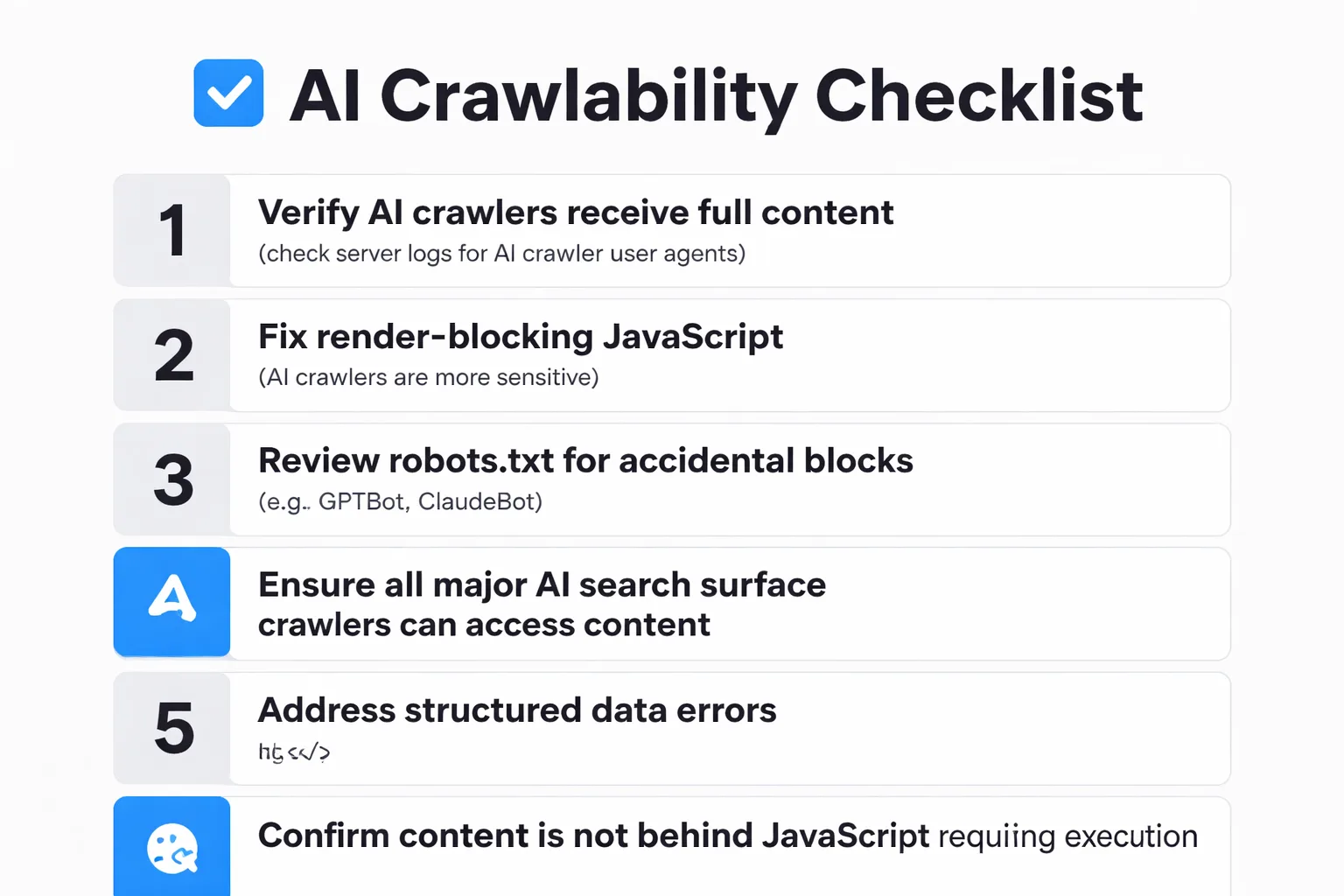
Structured data errors are the silent killer. Schema markup that references entities (Organization, Product, Article, FAQ) gives AI models machine-readable context. But invalid schema is worse than no schema. Use Google's Rich Results Test to validate every page type. Fix errors before moving on.
This step takes one to two weeks for a small site. The timeline is short because the fixes are deterministic. You are not waiting for an algorithm to re-evaluate you. You are removing barriers that prevented evaluation in the first place.
Once crawlability is clean, submit your sitemap to Google Search Console and ping IndexNow on every new publish. This ensures both traditional and AI-aware indexing pipelines know your content exists. If you are using a platform like Meev, this happens automatically on every publish. If you are doing it manually, build the habit now.
Let me get specific about the crawlability checks that matter most for AI engines, because they differ from what Google cares about. Googlebot renders JavaScript effectively because Google has invested heavily in a rendering infrastructure that executes JS before indexing. AI crawlers are not all there yet. GPTBot (OpenAI's crawler) has limited JavaScript rendering capability. If your product pages load content via client-side JavaScript (for example, a React app that fetches product data after initial page load), GPTBot may see an empty shell. Perplexity's crawler is better at rendering but still struggles with complex single-page applications. The fix is server-side rendering or static generation for any page that contains information you want AI engines to cite. If that is not feasible, at minimum pre-render the critical content (product names, descriptions, prices, FAQs) in the initial HTML response.
Server response time also matters more for AI crawlers than for Googlebot. Google crawls continuously and can retry slow pages. AI crawlers often operate with rate limits and timeout thresholds. If your server takes more than 2-3 seconds to respond, the crawler may abandon the request. Check your server logs for AI crawler response times. If you see timeouts or 5xx errors, prioritize server performance before anything else.
Finally, check your internal linking structure from the perspective of a crawler that follows links to discover content. AI crawlers discover pages the same way traditional crawlers do: by following links. If your important content is only accessible through JavaScript-powered navigation menus that the crawler cannot execute, those pages are effectively hidden. Ensure every page you want cited is reachable through standard HTML anchor tags in your site's footer, sidebar, or body content.
Step 3. Close Topical Depth Gaps
This is where most teams fail. They fix crawlability, publish one or two articles, and wonder why nothing changed. AI engines do not cite sites that have one article on a topic. They cite sites that demonstrate topical authority through depth.
Topical authority in the AI era means something specific. It is not about publishing fifty articles targeting fifty long-tail keywords. It is about building a content cluster that covers a subject from every angle a user might ask about. Think 10 to 15 pillar pages surrounded by supporting articles that go deep on sub-questions.
I shifted strategy on one project in early 2024 to prioritize building out pillar pages surrounded by supporting clusters, and actively sought out mentions from industry partners. This approach yielded a 30% increase in AI-driven traffic compared to the old keyword-centric methods. The content was not different in quality. It was different in structure and depth.
Here is how to find your gaps. Take your top five product or service categories. For each one, list every question a customer might ask at each stage of the buying journey: awareness, consideration, decision. Now check whether you have a dedicated page answering each question. Most sites I audit have coverage for maybe 30% of these questions. The gaps are your content roadmap.
When you write these pages, structure them for AI extractability. I started insisting that articles include direct answers under question headings and utilize structured data wherever possible, and our failure rate on AI content dropped from 60% to under 20%. Front-load the answer. Use comparison tables. Cite authoritative sources inline. Make it easy for a model to lift a sentence and cite your page.
The timeline for this step is 60 to 90 days. That is how long it takes to publish enough depth for AI engines to recognize the pattern. The Search Engine Journal research showed that brands publishing three or more deep structured guides saw citation rates climb from below 5% to 20-40% in that same window.
Let me walk through what a proper content cluster looks like, because the concept is often misunderstood. Say you sell project management software. Your pillar page is a comprehensive guide to project management methodologies. That page covers Agile, Waterfall, Kanban, Scrum, and hybrid approaches at a high level. Then you build supporting pages: one deep-dive on Agile project management, one on Kanban board setup, one on Scrum ceremonies, one on choosing between Agile and Waterfall. Each supporting page links back to the pillar and to related supporting pages. The cluster forms a semantic web that signals to AI engines: this site knows project management inside and out.
The highest-performing brand in the Search Engine Journal study captured 35-55% category share of voice by publishing three or more deep structured guides first. Not fifty thin blog posts. Three to five comprehensive, structured guides that covered their category from multiple angles. This is the bar. If you are publishing 500-word blog posts optimized for a single keyword, you are not building topical authority. You are adding noise.
Each guide should be structured with AI extraction in mind. Open with a 40-60 word direct answer to the primary question the guide addresses. Use H2 headings for sub-questions. Include comparison tables where relevant. Cite primary sources inline. Add FAQ schema at the bottom. This structure makes it trivial for a RAG pipeline to retrieve and use your content in a synthesized answer.
Do you know which AI engines cite your brand today?
Why Does Entity Grounding Matter for AI Citations?
Entity grounding is the mechanism that connects your brand to concepts in an AI model's knowledge base. Without it, you are a string of text. With it, you are a recognized entity with attributes, relationships, and authority.
An entity is a discrete, identifiable thing. Your company is an entity. Your product is an entity. Your founder is an entity. AI models use knowledge graphs to understand how entities relate to each other. If your brand exists as a node in that graph with connections to relevant categories, the model can ground its answers in your identity.
Wikidata is the most important knowledge graph for AI visibility. It feeds Wikipedia, which in turn feeds training data for most major language models. If your company has a Wikidata entry with accurate attributes (industry, products, leadership, founding date), you are giving AI models a structured reference point.
I used to think a robust knowledge graph and perfectly structured content were a silver bullet for LLM citations. They are not. But they are the floor. Without entity grounding, your content floats in a semantic void. The model can find your page, but it cannot confidently connect it to your brand identity.
Start by claiming or creating your Wikidata entry. Then implement Organization schema on your homepage with matching attributes. Use sameAs properties to link your entity to your LinkedIn, Crunchbase, and Wikipedia pages. This creates a web of references that AI models use for verification.
Chris Long's work on agentic SEO highlights how AI agents navigate these entity connections when making recommendations. The agents do not just match keywords. They traverse entity relationships to determine which brands are relevant to a query. If your entity is well-connected, you are in the graph. If it is not, you are invisible regardless of content quality.
This step takes 30 to 60 days to show impact. Wikidata propagation is slow. But once your entity is grounded, it compounds. Every future piece of content you publish is automatically connected to your brand identity.
Let me explain the mechanics of entity grounding at a deeper level, because this is the step most teams completely misunderstand. When a language model encounters your brand name in a retrieved passage, it does a lookup in its internal knowledge graph. If your brand exists as a node, the model retrieves associated attributes: industry, products, founding date, leadership team, notable press coverage. These attributes serve as context that helps the model decide whether your brand is a credible source for the topic being discussed. If your brand does not exist as a node, the model treats your name as an unknown string. It may still cite your page if the content is highly relevant, but it has no way to verify your authority or connect you to the broader category.
This is why brands with Wikipedia pages get cited more often. Wikipedia entries create Wikidata entries, which create knowledge graph nodes, which give language models a reference point. I am not saying you need a Wikipedia page (that is its own challenge and not always achievable). But you need the entity infrastructure that a Wikipedia page provides. You can build that infrastructure directly through Wikidata without going through Wikipedia's editorial process, though having both is ideal.
The sameAs property in schema markup is your bridge. When you add sameAs links pointing to your LinkedIn company page, your Crunchbase profile, your GitHub organization (if applicable), and any industry directory listings, you are telling the model: these are all the same entity. The model can then traverse those links to verify your identity and gather additional attributes. This is how you build entity authority without a Wikipedia page.
For e-commerce brands specifically, product entities matter as much as company entities. Each product should have its own structured data with attributes like name, brand, category, description, and aggregateRating. This allows AI models to reference your specific products in recommendation answers, not just your company in informational answers. The Search Engine Journal study found that e-commerce brands implementing structured product guides alongside entity-rich content achieved the highest citation rate increases.
Step 4. Build External Citation Signals
This is the step most teams skip. They focus on their own site and ignore the ecosystem around it. That is a mistake.
AI engines weight third-party mentions heavily. When ChatGPT generates an answer, it does not just look at your page. It looks at whether other authoritative sources reference your brand. External validation is the signal that separates cited sources from ignored ones.
I saw one client's content, despite being highly optimized for keywords, completely overlooked by AI systems because it lacked external citations and a comprehensive content hub. The fix was not more content on their site. It was getting mentioned on the sites that AI engines already cite.
To find these sites, look at the cited-source leaderboard for your topics. Which domains appear most frequently in AI answers for your category? Those are your targets. You need mentions, links, or features on those domains.
This is where outreach becomes essential. Find the publishers AI engines cite for your topic. Identify the authors who write about your category. Pitch them with specific, relevant angles grounded in your expertise. Not generic PR pitches. Real contributions that earn a mention.
If you are doing this manually, it is slow. Expect 20 to 30 outreach attempts to yield 3 to 5 placements. But those placements are high-value because they appear on the exact pages AI engines are already crawling and citing.
The timeline here is 60 to 120 days. External mentions take time to land and even longer to be picked up by AI crawlers. But once they are in the index, they create a compounding effect. Each external mention increases the probability that the next AI-generated answer will reference your brand.
Let me be more specific about how to identify which external sources matter. Run 30 to 50 category-relevant prompts through Perplexity and Google AI Overviews. For each answer, record every source the engine cites. Tally the domains. You will see patterns: certain review sites, industry publications, and blogs appear repeatedly. Those are your citation sources. They are the domains that AI engines trust for your category.
Now categorize these sources into three tiers. Tier 1 is high-authority publications with editorial standards (industry magazines, major news outlets, established review sites). Tier 2 is niche blogs and communities (Reddit threads, niche industry blogs, forum discussions). Tier 3 is user-generated content platforms (G2, Capterra, TrustRadius, Quora). You need presence across all three tiers, but the approach differs for each.
For Tier 1, you need earned media. Pitch journalists and editors with data-driven stories, original research, or expert commentary. For Tier 2, you need community participation. Answer questions on Reddit without pitching your product. Write guest posts for niche blogs. For Tier 3, you need review profiles. Claim and optimize your profiles on G2, Capterra, and similar platforms. Encourage customers to leave reviews. These platforms are heavily cited by AI engines for product recommendation queries.
The compounding effect works like this. When your brand is mentioned on a Tier 1 publication, that mention gets crawled by AI engines and added to their index. The next time a user asks a related question, the model retrieves that passage and sees your brand mentioned in an authoritative context. This increases the probability of your brand appearing in the generated answer. Each additional external mention reinforces the pattern. After 5 to 10 external mentions across different sources, the model starts to treat your brand as a recognized entity in the category. This is when citation rates accelerate.
What Role Does Generative Engine Optimization Play?
Generative engine optimization (GEO) is the practice of structuring content specifically for retrieval by generative AI systems. It is not a replacement for SEO. It is a parallel discipline that addresses a different set of ranking signals.
Traditional SEO optimizes for Google's ranking algorithm. GEO optimizes for the retrieval and generation pipelines of AI engines. The two overlap in some areas (both reward high-quality, relevant content) but diverge in others (GEO weights content structure and extractability far more heavily than traditional SEO).
The Ahrefs GEO study analyzed millions of AI citations and found that the sources AI engines cite most often share specific characteristics: they answer questions directly, they use structured formats (tables, lists, Q&A blocks), they cite primary sources, and they cover topics with depth rather than breadth. These are not the same signals that Google's algorithm rewards. Google can rank a long, unstructured, keyword-stuffed page if it has enough backlinks. AI engines will ignore that same page because it is not extractable.
In my own testing, the pivot from traditional SEO tactics to AI extractability tactics was the single biggest factor in improving citation rates. I initially thought focusing on meta tags and keyword density would improve performance, but it led to a 60% failure rate across the blog websites we tested. What moved the needle was structuring content for AI extractability: direct answers under question headings, comparison tables, inline citations, and FAQ schema. These are GEO tactics, not traditional SEO tactics.
If you are evaluating ai search engine optimization tools, look for ones that measure citation rate alongside traditional ranking metrics. A tool that only tracks Google rankings cannot tell you whether your content is being cited by AI engines. You need visibility into both pipelines to understand your full search presence.
Step 5. Monitor and Iterate Weekly
Set up a weekly tracking cadence. This is not monthly reporting. AI visibility changes faster than organic rankings. You need to see movement weekly to know if your changes are working.
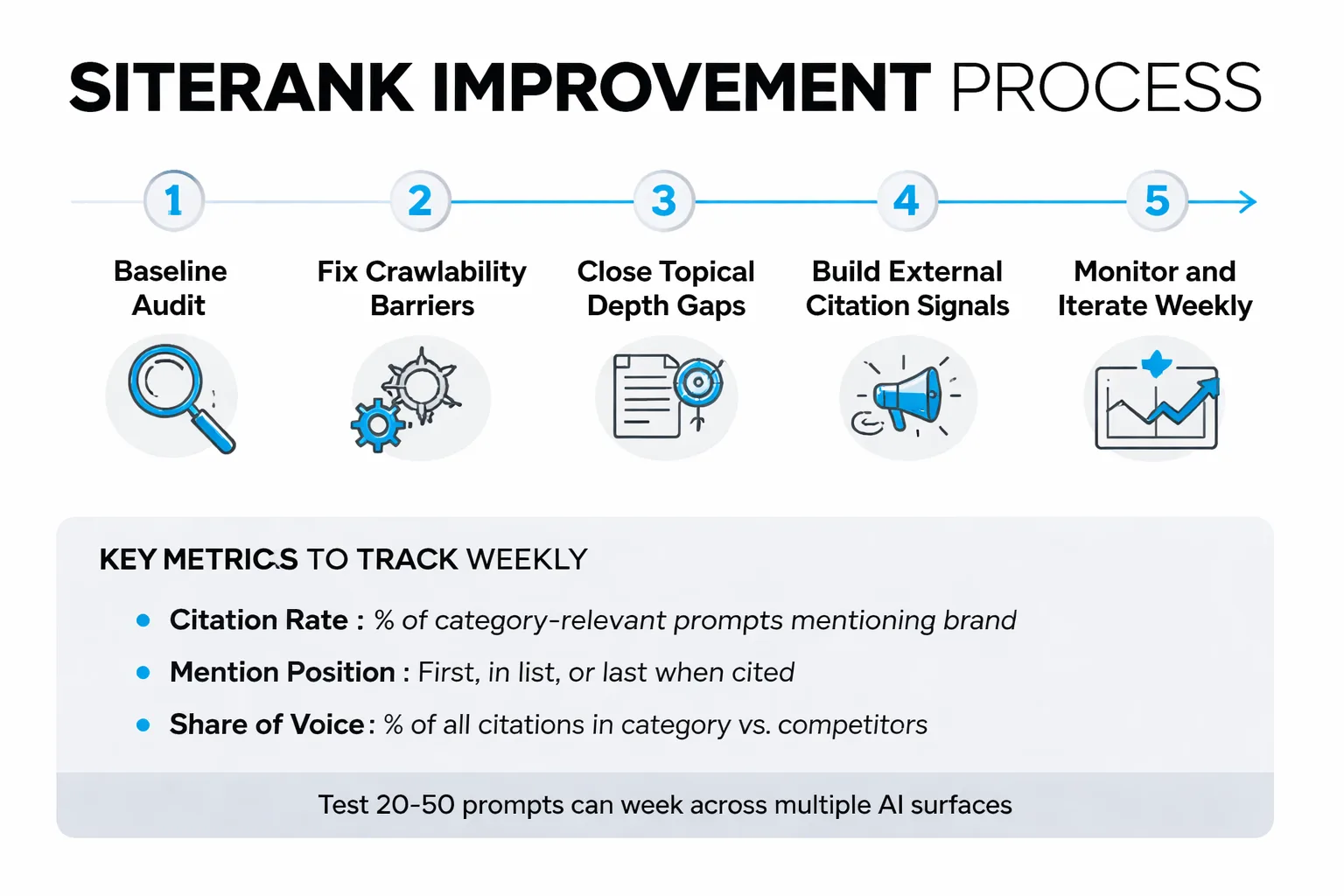
Track three metrics every week. First, your citation rate: what percentage of category-relevant prompts mention your brand? Second, your mention position: when cited, are you first, in a list, or last? Third, your share of voice: what percentage of all citations in your category go to you versus competitors?
Use an AI visibility tracker or enterprise AI rank tracker to automate this. Manual checking is not sustainable. You will need to test 20 to 50 prompts per week across multiple AI surfaces, and you need the actual response text and citations behind every mention to understand why you are or are not appearing.
In the first 30 days after implementing changes, watch for early signals. Crawlability fixes can show results in 7 to 14 days as AI crawlers re-index your content. New articles typically take 3 to 4 weeks to appear in citations. External mentions take longer. If you see no movement at all after 30 days, the problem is usually one of two things: your content is not structured for extraction, or your entity is not grounded in the knowledge graph.
Adjust based on what the data tells you. If Perplexity cites you but ChatGPT does not, the issue might be training data recency. If you appear in AI Overviews but not in Perplexity, your structured data might be helping Google's retrieval but not feeding Perplexity's RAG pipeline. Each surface has its own retrieval logic. Treat them as separate channels.
Let me share what a typical 30-day monitoring rhythm looks like in practice. Week one: you have completed crawlability fixes and published your first two structured guides. Check whether AI crawlers have re-indexed your fixed pages (look for your updated content appearing in AI answers). If not, manually submit your updated pages through IndexNow and Google Search Console. Week two: your entity grounding work (Wikidata, schema) should be live. Check whether Google AI Overviews starts referencing your brand in knowledge panels or entity-rich answers. Week three: your new guides should be indexed. Test 20 prompts related to those guides and see if any citations appear. Week four: compile your metrics. Compare citation rate, mention position, and share of voice against your baseline. If citation rate has moved from 0% to even 3-5%, the framework is working. Accelerate. If it is still at 0%, diagnose the structural issue before publishing more.
The weekly cadence also catches regressions. AI engines update their retrieval indices and models regularly. A citation you earned in week two can disappear in week four if the model updates and your content gets displaced. Without weekly tracking, you would not know until monthly reporting, by which point you have lost weeks of potential recovery time. I have seen brands lose citations overnight after a model update and not notice for a month because they were checking monthly. Weekly tracking catches these changes while they are still fixable.
How Siterank Connects to AI Citation Rate
A rising siterank score correlates with more AI engine citations. This is not a coincidence. The three components of siterank (crawlability, topical authority, and citation rate) are the same signals that LLMs use to select sources.
Crawlability determines whether the model can access your content. Topical authority determines whether the model considers you a credible source on the topic. Citation rate is both an input and an output. Existing citations make future citations more likely because the model has seen your brand referenced in its training and retrieval data.
The relationship is not perfectly linear. I have seen sites with strong crawlability and deep content still struggle with citations because they lacked external validation. I have also seen sites with mediocre content but strong external mentions get cited frequently. The components interact. Weakness in one area can undermine strength in another.
Lily Ray has presented compelling evidence that traditional organic search visibility still correlates with AI citations. Her analysis of sites hit by Google updates is worth considering. But I am increasingly skeptical it tells the whole story. The fact that only 11% of domains are cited by both ChatGPT and Perplexity suggests a divergence from pure SEO. You can be visible to one engine and invisible to another.
The practical takeaway is this. If your siterank score is rising, you should see citation rate climbing within 60 to 90 days. If the score is rising but citations are not, you have a structural problem. Either your content is not extractable (check your structure and formatting) or your entity is not grounded (check your Wikidata and schema). Diagnose and fix before publishing more content.
There is also a feedback loop worth understanding. When AI engines start citing your content, those citations themselves become signals. Other users see your brand mentioned in AI answers and may reference that mention in their own content (blog posts, social media, reviews). Those references get crawled and added to the AI index, which further reinforces your brand's presence. This is the compounding effect of AI citations. The first citation is the hardest to earn. Each subsequent citation becomes slightly easier because the model has prior context linking your brand to the topic.
This feedback loop is why early investment in siterank improvement pays disproportionate returns. Brands that establish citation presence early in a category benefit from the compounding effect. Brands that arrive late have to overcome the incumbent's citation momentum. If your competitors have been getting cited for six months and you are just starting, you are not just closing a content gap. You are closing a citation momentum gap. That takes longer and requires more aggressive entity grounding and external mention work.
The Ahrefs study provides context for this dynamic. Their analysis showed that brands with established topical authority (measured by depth of content coverage and external references) were cited 3 to 5 times more often than brands with equivalent content quality but no established authority. The authority signal acts as a multiplier on content quality. Good content from an unknown brand gets ignored. Good content from an established brand gets cited.
When This Framework Fails
This five-step framework does not work for every site. I want to be honest about where it breaks down.
It fails for brand-new domains with zero existing content. If your site has fewer than 20 indexed pages, topical authority is not achievable in 90 days. You are building from scratch. Focus on crawlability and entity grounding first, then start publishing. Expect 6 to 12 months before you see citation movement.
It fails for highly regulated industries where external publications will not link to you. If you are in pharmaceuticals, gambling, or certain financial services, the outreach step is severely constrained. AI engines still cite sources in these categories, but the pool of citable domains is smaller and harder to access.
It fails when your competitors are already dominant. If three competitors each have 100+ deep articles, established Wikidata entries, and mentions on every major publication in your space, you are fighting for the fourth citation slot. That is winnable, but it takes longer and requires a more narrow topical focus. Pick a sub-category where you can go deeper than the dominant players.
There is a fourth scenario I should mention. This framework fails when your team cannot sustain the weekly monitoring cadence. The five steps are not a one-time project. They are an ongoing operational discipline. If you implement steps one through four and then stop monitoring, your citations will erode. AI models update continuously. Competitors publish continuously. External mentions decay over time. Without weekly tracking and iteration, you lose ground within 60 to 90 days of stopping. I have seen this happen repeatedly. Teams do the initial work, see improvement, shift attention elsewhere, and three months later their citation rate has dropped back to baseline. The work does not end. It changes from building to maintaining, but it does not end.
What This Actually Means
Your siterank score is not a vanity metric. It is a diagnostic tool that tells you whether your site exists in the AI search ecosystem or does not. Maria's story at the start of this article is playing out for thousands of brands right now. They have strong domain authority, glowing agency reports, and zero presence in the answers their customers actually read.
The five steps in this framework are not theoretical. They are grounded in data from Ahrefs' study of 75,000+ brands and the citation rate improvements documented by Search Engine Journal. Brands that implement structured content, entity grounding, and external citation signals see measurable improvement in 60 to 90 days.
The shift from traditional SEO to AEO is not optional. Your customers have already moved to AI search. The question is whether your brand moves with them or stays invisible. Start with the baseline audit. Fix crawlability. Build topical depth. Ground your entities. Earn external mentions. Track weekly. That is how you move your siterank score and reclaim visibility in the answers that matter.
The data is clear on one point. The brands that start now will build citation momentum that compounds. The brands that wait will face an increasingly steep climb as competitors establish entity presence and earn the citation feedback loop that makes future citations easier. Your siterank score is the starting line. The five steps in this article are the path from invisible to cited.
FAQ
What is a Siterank score?
A Siterank score measures how visible a website is to major AI answer engines like ChatGPT, Perplexity, and Google AI Overviews. It captures citation patterns that differ from traditional search rankings, reflecting the new reality where brands can rank highly on Google yet remain invisible to AI systems.How does Siterank differ from domain authority?
Domain authority estimates ranking potential on Google based on backlinks, while Siterank focuses on whether LLMs will cite the site in answers. The two metrics follow separate rules, as topical authority and AI citation patterns diverge from classic link-based SEO.Why has overlap between top Google results and AI-cited sources dropped?
The overlap has fallen from roughly 70% to under 20% because AI engines prioritize different signals than traditional search algorithms. This means strong organic rankings no longer guarantee mentions in AI-generated responses from tools like Perplexity or ChatGPT.What citation improvements have e-commerce brands achieved with generative engine optimization?
Brands using structured content for generative engine optimization have increased AI citation rates from below 5% to 20-40% within 60-90 days. Only 11% of domains currently appear in citations from both ChatGPT and Perplexity, highlighting the opportunity for targeted improvements.About the Author
Judy Zhou, Founder
Judy Zhou leads content strategy at Meev, where she oversees AI-driven content research and publishing for hundreds of brands. With a background in SEO and editorial operations, she focuses on building content systems that rank on Google, get cited by AI search engines, and drive measurable business results.
Run your free AI visibility baseline scan and see exactly where your siterank stands across every major AI search surface.