
By Judy Zhou, Founder
Key Takeaways
- Adding citations, quotations, and statistics to alt text can lift visibility in generative engine responses by up to 40%, per Princeton GEO research.
- 68% of US Google searches ended without a click in early 2026, so descriptive alt text is now required to capture zero-click AI traffic.
- AI-referred traffic to US retail sites grew 393% year over year in Q1 2026 and converted 42% better than non-AI sources.
- Replace generic alt text such as "image1.jpg" with specific claims, numbers, and context that LLMs can directly use for grounding answers.
Your images are invisible to AI search. And alt text is the fix.
Most teams treat alt text as a compliance checkbox. That thinking is outdated. In my work auditing content operations at Meev, I see brands lose AI citations every day because their image alt attributes say "image1.jpg" or "chart showing data" instead of something an LLM can actually ground a claim in. The Princeton GEO research (Aggarwal et al., KDD 2024) found that adding citations, quotations, and statistics can lift visibility in generative engine responses by up to 40% (source). Alt text is one of the simplest vehicles for embedding those specifics. 68% of US Google searches ended without a click to any website in the first four months of 2026, per SparkToro data based on Similarweb clickstream (source). If your images aren't feeding structured context to AI engines, you're handing that zero-click traffic to competitors who did the work. Traffic from AI sources to US retail sites grew 393% year over year in Q1 2026, and AI-referred traffic converted 42% better than non-AI sources by March 2026 (source). An alternate text generator strategy isn't optional anymore. It's how you get cited.
What Is Alt Text and Why It Affects SEO and AI Visibility
Alt text (alternative text) is a short HTML attribute that describes an image's content and purpose. Screen readers read it aloud to visually impaired users. Search engines use it to understand images they can't "see" in a human sense. That's the classic definition, and it's still true.
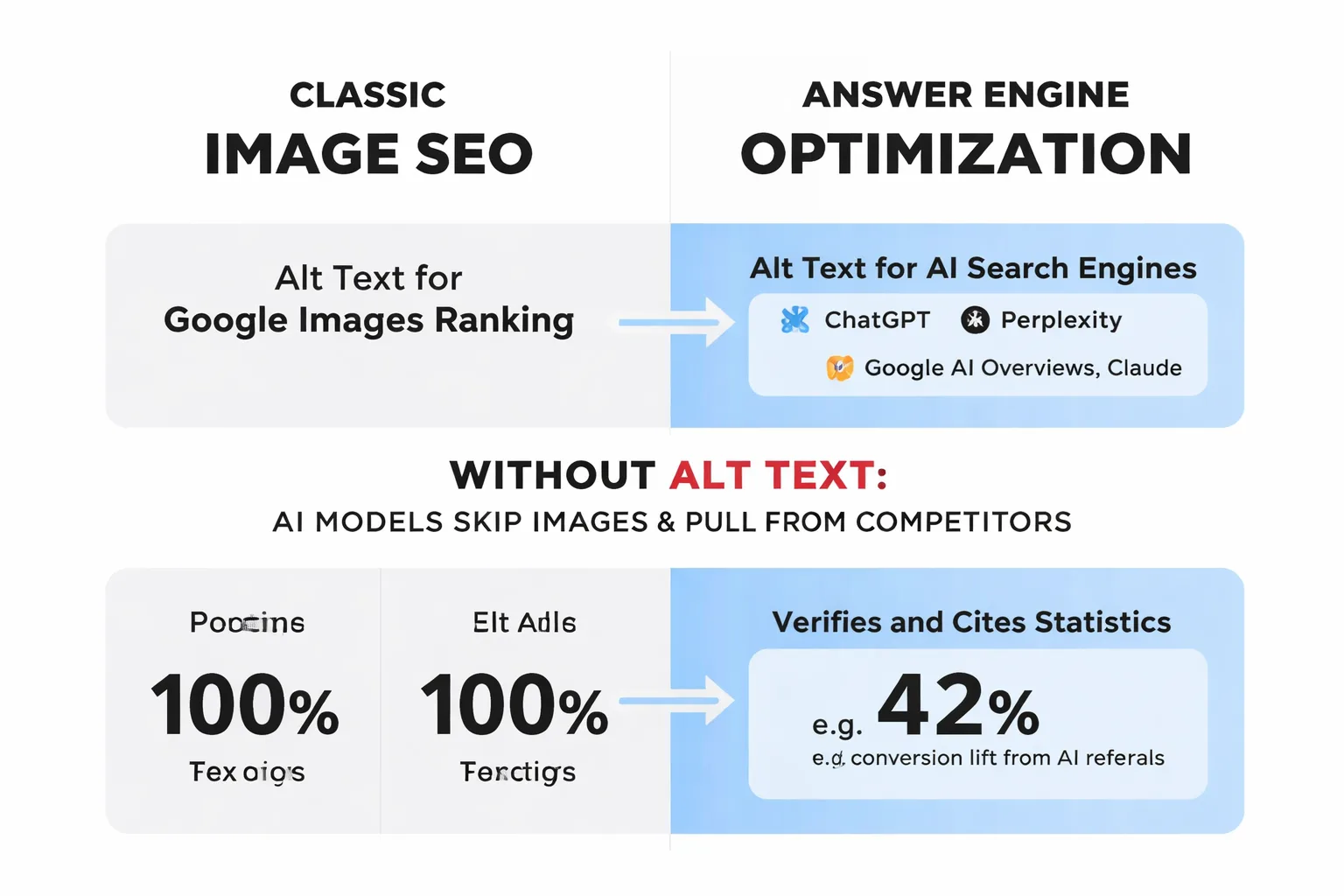
But here's what changed. AI search engines like ChatGPT, Perplexity, Google AI Overviews, and Claude don't just read alt text for indexing. They use it as a reasoning input. When an LLM encounters a product page with an infographic showing "42% conversion lift from AI referrals," the alt text is what lets that model verify and cite the statistic. Without it, the image is a black box. The model skips it and pulls from a competitor whose alt text actually says something specific.
This is where answer engine optimization and traditional image SEO diverge. Classic image SEO wants alt text for Google Images ranking. Answer engine optimization wants alt text for entity grounding. The LLM needs to connect your image to a concept, a brand, a statistic, or a product attribute so it can confidently cite you in a generated answer. That requires a different writing approach, which I'll walk through below.
The connection to knowledge graphs matters here too. Research published in eLife identifies Wikidata as a structured knowledge graph for organizing life sciences data, and broader academic work in the Journal of Artificial Intelligence Research on Knowledge Graphs confirms that knowledge graphs are effective for representing complex information. When your alt text names entities clearly (product names, brand names, specific metrics), it helps AI systems connect your image to nodes in those graphs. That's entity grounding in practice.
Think about what happens when a user asks ChatGPT "what are the best project management tools for startups." The LLM pulls from multiple sources: blog posts, review sites, comparison pages. If your comparison page includes a chart with alt text that reads "Comparison chart showing Asana handles 1,000 concurrent projects while Monday.com caps at 500 in 2026 benchmark tests," that's a citable claim. The LLM can extract the number, attribute it to your domain, and include it in the answer. If the alt text reads "comparison chart," the model moves on. The information is invisible.
I think of alt text as a translation layer. You're translating a visual into language that three different consumers can parse: a screen reader, a search crawler, and an LLM building a cited answer. The first two have been around for decades. The third is new, and it's the one most teams are ignoring. The teams that get this right now will build a compounding advantage. Every image with precise, entity-rich alt text becomes a potential citation source. Over hundreds of pages, that advantage snowballs.
How to Generate Alt Text: 5 Steps
This is the process I use. It works whether you have 50 images or 5,000. The goal is alt text that serves accessibility, classic SEO, and AI citation simultaneously.
Step 1: Audit Your Existing Images
Before generating anything, find out what you have. Export a crawl of your site (Screaming Frog, Sitebulb, or even Google Search Console's image report) and identify every image with missing, empty, or generic alt text. Look for patterns: "IMG_", "screenshot", "image", "photo", "chart", or filenames being used as alt text.
Prioritize by page value. Product pages, comparison pages, and data-driven blog posts come first. A decorative stock photo on your about page matters less than a product comparison chart on a category page that AI engines might cite. In my experience, most sites have 40-60% of their images with missing or useless alt text. That's a massive untapped surface for AI visibility.
Build a spreadsheet with four columns: page URL, image filename, current alt text, and priority (high/medium/low). Sort by priority. High priority goes to pages that already rank for commercial keywords, pages that target AI-answer-shaped queries ("what is," "how to," "best"), and pages with data visualizations or product comparison charts. These are the pages where improved alt text has the highest probability of generating AI citations.
Don't forget images embedded in PDFs, whitepapers, or case studies that you host on your site. AI engines increasingly parse PDFs. If your case study includes a results chart with no alt text, that chart's data is invisible to every LLM that encounters the document.
Step 2: Choose Your Generation Method
You have two paths: manual writing or an alternate text generator powered by AI. The right choice depends on volume and image complexity.
For sites with fewer than 100 images or images containing complex data (charts, infographics, technical diagrams), write manually. You need human judgment to identify what matters in a complex visualization. For large ecommerce sites with thousands of product images, AI generation is practical and often necessary. The key is using AI as a first draft, not a final draft.
If you're evaluating tools, consider how they fit into your broader AI search optimization workflow. A tool that generates alt text in isolation is less useful than one that integrates with your content pipeline and lets you review before publishing. The worst outcome is a tool that bulk-generates alt text and pushes it directly to your CMS without any human gate. I've seen this produce thousands of generic descriptions that actively hurt AI citation potential.
For teams using Meev's content pipeline, the platform generates articles with auto-generated images that include descriptive alt text as part of the publishing workflow. Every piece goes through a 16-dimension quality firewall before it reaches your CMS, which means the alt text gets evaluated alongside the article content. You approve everything before it goes live.
Step 3: Write Descriptive, Context-Rich Text
This is where most teams fail. Good alt text isn't just a description. It's a description with context that an AI engine can use to ground a claim.
Bad: "Chart showing data trends"
Better: "Bar chart showing AI-referred traffic grew 393% year over year in Q1 2026, outpacing organic search growth"
The second version gives an LLM something to cite. It names the metric, the timeframe, and the comparison. When a user asks Perplexity "how fast is AI traffic growing for ecommerce," your image becomes a source the model can reference.
For product images, include the product name, key attribute, and brand. "Blue Nike Air Max running shoes, side view, 2026 model" is infinitely more useful to an AI engine than "shoes." The LLM can connect that to entity nodes for Nike, Air Max, and running shoes in its knowledge graph.
For data visualizations, state the finding, not the format. "Line graph showing revenue over time" is useless. "Line graph showing monthly revenue increased from $50K to $120K between January and June 2026 after implementing AI content strategy" gives the model a citable claim.
Here's a framework I use for writing alt text that targets AI citation. I call it the FACT method: Finding (what the image shows), Attribute (the specific number or detail), Context (timeframe, comparison, or condition), and Topic (what subject this relates to). So for a chart showing your product's performance: "Finding: bar chart. Attribute: 42% conversion lift. Context: AI-referred traffic vs organic, Q1 2026. Topic: ecommerce GEO strategy." The final alt text becomes: "Bar chart showing 42% conversion lift from AI-referred traffic compared to organic search in Q1 2026, from ecommerce GEO strategy implementation." That's 145 characters of pure citation fuel.
For screenshots of software interfaces, describe what the screen shows and why it matters. "Screenshot of Meev's AI visibility dashboard showing brand mentioned in 34% of ChatGPT responses for target queries, up from 12% in January 2026" is useful. "Screenshot of dashboard" is not.
Step 4: Test for Accessibility
Alt text that's optimized for AI but fails accessibility is a failure. Run your pages through a screen reader (NVDA is free) or a tool like WAVE or axe DevTools. Listen to how the alt text sounds in context.
If the page already has a caption or adjacent text describing the image, the alt text should complement, not duplicate. WCAG guidelines say decorative images that don't convey information should have empty alt attributes (alt=""), not no alt attribute at all. This is a distinction many teams miss. Missing alt attributes cause screen readers to read the filename aloud, which is a terrible experience.
Test with multiple screen readers if possible. NVDA on Windows and VoiceOver on Mac sometimes interpret markup differently. Your alt text should make sense in both. Also test with images turned off in your browser. If you can understand the page's content and purpose without seeing the images, your alt text is doing its job.
Step 5: Publish and Monitor
Once alt text is live, monitor whether it moves the needle. This is where most guides stop, but it's the most important step for AI visibility. Track whether your images start appearing in AI-generated answers. Check if your brand citations increase on prompts related to the content those images illustrate.
This is where a tool like Meev's AI visibility tracker becomes essential. You need to see whether AI engines are actually picking up your newly described images and citing your brand in responses. Without that feedback loop, you're writing alt text into a void. Meev tracks where your brand appears across every major AI search surface, so you can see if your alt text optimization is translating into actual citations.
Set up a before-and-after measurement. Record your baseline AI citation rate for target prompts. Implement alt text improvements on your top 20 pages. Wait two weeks. Check whether citation rates moved. This is a simple A/B test that tells you whether your alt text strategy is working. If citations didn't increase, your alt text probably isn't specific enough. Rewrite with more concrete data points and entity names.
For teams scaling this across hundreds of pages, Meev's content generation pipeline can help. It writes and publishes articles with fact-verified content and auto-generated images that include descriptive alt text, all gated by a 16-dimension quality firewall. You approve everything before it goes live, which means the alt text gets human review even when the initial generation is AI-assisted.
Are your images being cited by AI search engines, or ignored?
Can AI Generate Alt Text? What Actually Works
Yes, AI can generate alt text. But the output quality varies enormously depending on the model, the image type, and how you prompt it. Here's what I've found works in practice.
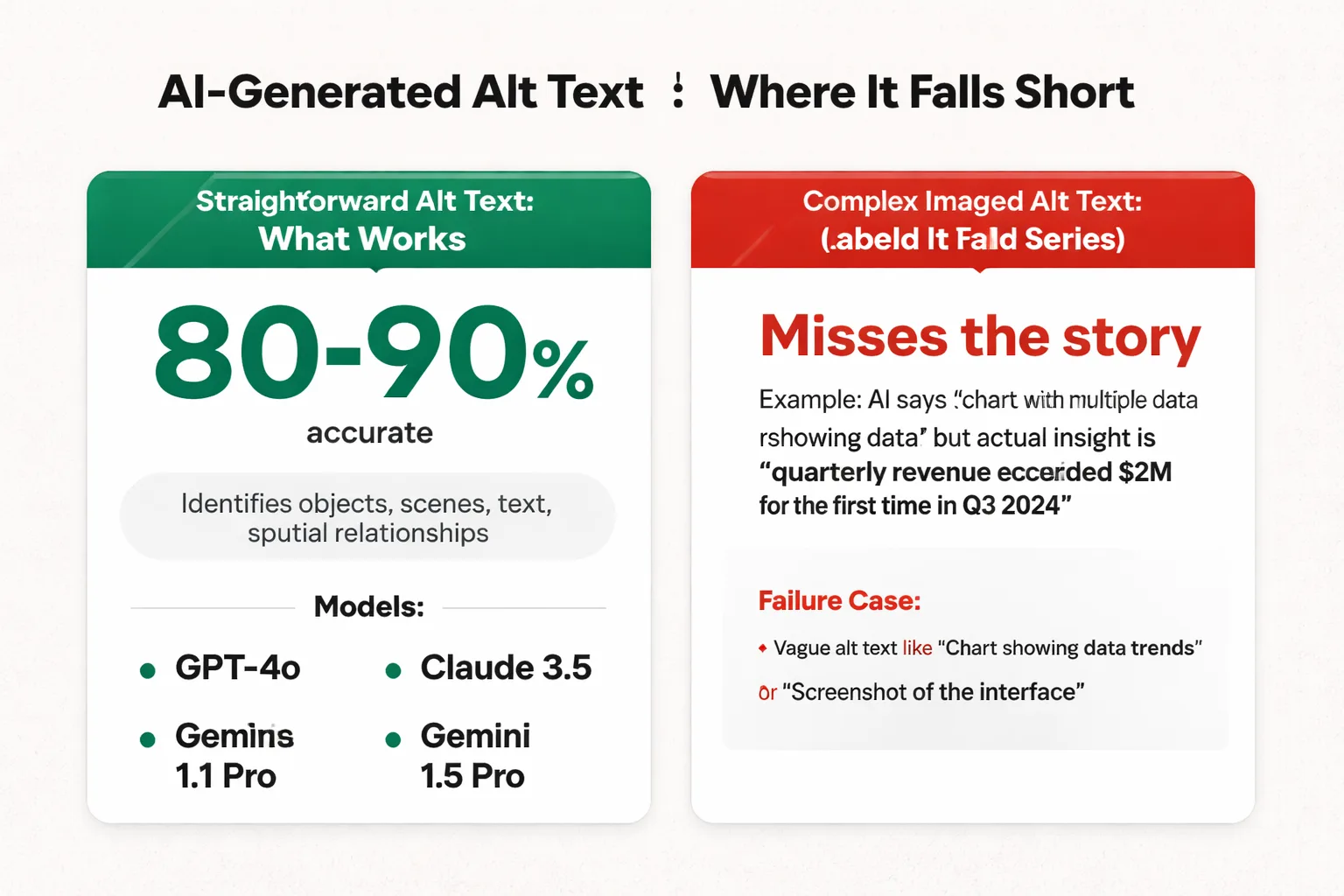
Modern vision-language models (GPT-4o, Claude 3.5 Sonnet, Gemini 1.5 Pro) can describe what's in an image with reasonable accuracy. They can identify objects, scenes, text within images, and even spatial relationships. For straightforward product photos, AI-generated alt text is often 80-90% of the way there. You review, tweak, and publish.
For complex images, AI falls short. A chart with multiple data series, labeled axes, and annotations is where vision models struggle. They'll say "chart showing revenue data" when the actual insight is "quarterly revenue exceeded $2M for the first time in Q3 2026." They miss the story. And the story is what LLMs need for citation.
The failure case is real. Vague or auto-generated alt text like "Chart showing data trends" or "Screenshot of the interface" causes AI systems to skip over product details and citations entirely, handing visibility to competitors with precise, specific alt text. I've seen this pattern repeatedly. The AI doesn't guess what your image means. It moves on to the next source.
Here's my approach. Use an AI alternate text generator for the first draft, especially on high-volume sites. Then apply a human review pass focused on three questions: Does this alt text state a specific fact or claim? Does it name the relevant entities (brand, product, metric)? Could an LLM cite this image as a source based on the alt text alone? If the answer to any of those is no, rewrite.
The nuance about different LLMs behaving differently matters here. Mordy Oberstein has noted that different LLMs show different citation behaviors and brand sentiment patterns depending on their reliance on sources. This means your alt text might be picked up by one AI engine and ignored by another. You need to monitor across surfaces, not just one. Tools that track AI visibility across ChatGPT and Perplexity separately give you that granularity.
The relationship between AEO and SEO is additive, not replacement. Good alt text serves both. But the writing priorities differ. Classic SEO wants keywords. AEO wants facts, entities, and citable claims. Write for the latter and you'll usually satisfy the former.
One more thing on AI generation. The prompt you use to generate alt text matters enormously. A prompt like "describe this image" produces generic output. A prompt like "describe this image in 125 characters or less, including any visible text, data points, brand names, and the main finding or claim the image communicates" produces dramatically better results. The second prompt forces the model to extract citable information rather than just describing visual elements. This is the single biggest lever for improving AI-generated alt text quality.
Common Alt Text Mistakes That Hurt Rankings
I see the same three mistakes across nearly every site I audit. Each one actively damages both traditional rankings and AI citation potential.
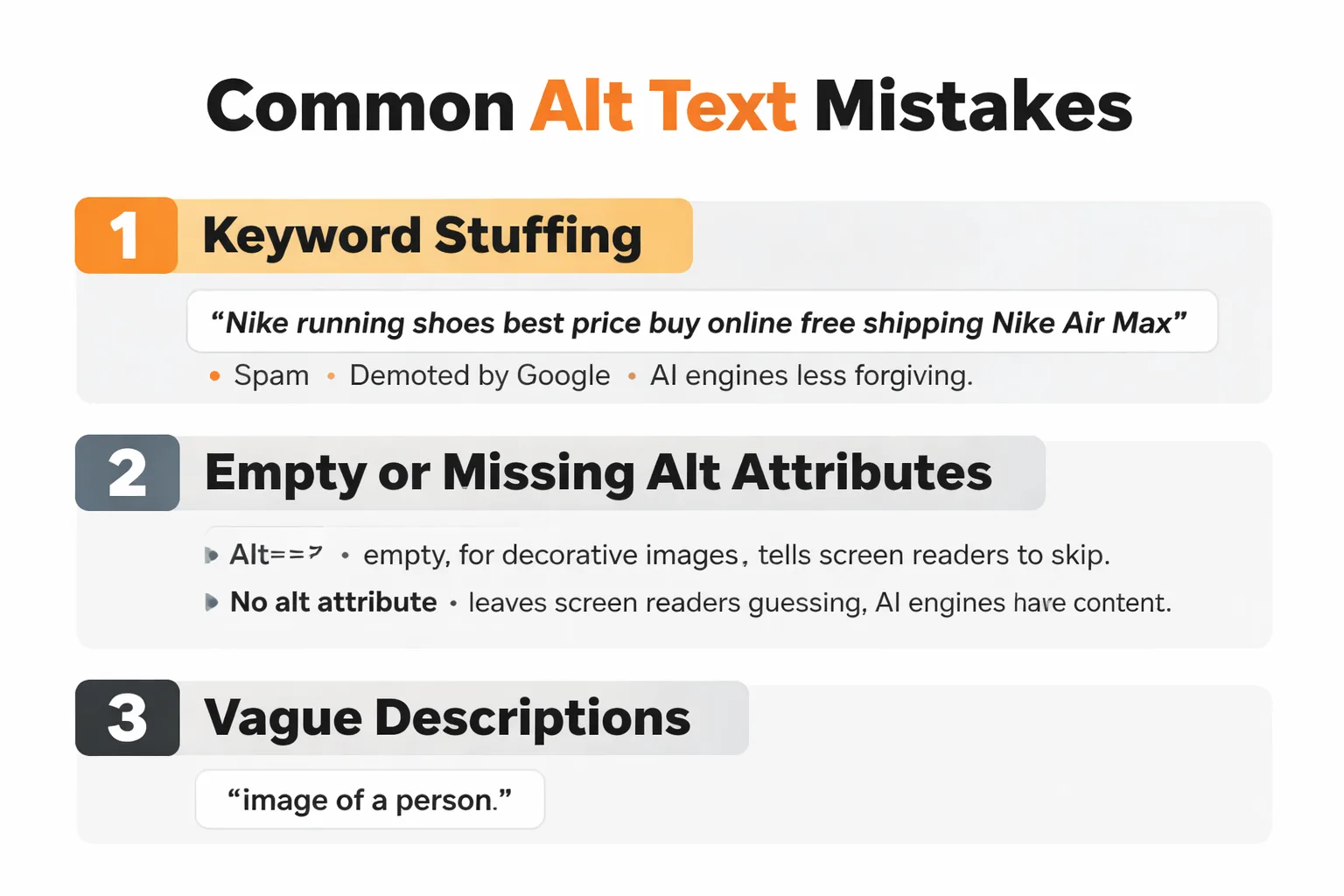
Keyword stuffing. This is the oldest sin in image SEO, and it's somehow still common. "Nike running shoes best price buy online free shipping Nike Air Max" is not alt text. It's spam. Google's image algorithms have been demoting this for years. AI engines are even less forgiving. An LLM won't cite a source that reads like a keyword dump. It wants clean, factual language it can extract and rephrase. If your alt text reads like a meta keywords tag from 2005, delete it and start over.
Empty or missing alt attributes. There's a critical difference between alt="" (empty, for decorative images) and no alt attribute at all. The first tells screen readers to skip the image. The second leaves them guessing. For content images, missing alt text means AI engines have zero context. They can't extract claims, verify statistics, or connect the image to your brand entity. Every content image without alt text is a missed citation opportunity.
I've audited sites where 70% of product images had no alt attribute. That's 70% of their visual content invisible to AI search. On an ecommerce site where product images are the primary content, that's catastrophic. The fix is simple: add alt attributes to every content image. Use empty alt attributes (alt="") only for purely decorative images.
Generic filenames as alt text. "IMG_8472.jpg" as a filename is bad. Using "IMG_8472.jpg" as the alt text is worse. I've also seen tools auto-generate alt text from filenames, producing gems like "screenshot-2026-09-14-at-3-47-pm." This tells an AI engine nothing. It tells a screen reader user nothing. It's a wasted attribute.
The fix is simple but requires effort. Rename files descriptively before upload ("ai-traffic-growth-chart-2026.png"). Then write alt text that goes beyond the filename to include context, findings, and entity names. The filename helps with traditional image SEO. The alt text helps with AI citation. Both matter.
A fourth mistake I see less frequently but worth mentioning: using the same alt text for every instance of an image across your site. If you reuse a product photo on five pages, the alt text should change based on each page's context. On a category page, the alt text might emphasize the product category. On a comparison page, it might emphasize how the product differs from competitors. On the product detail page, it should highlight specific features and attributes. Context-aware alt text gives AI engines different citable claims depending on the query.
How Does Alt Text Feed Knowledge Graphs for AI Search?
This is the part most guides skip, and it's where the real opportunity lives. Knowledge graphs are how AI systems organize and retrieve information about entities and their relationships. When you write alt text that names your brand, your products, specific metrics, and contextual relationships, you're feeding raw material into those graphs.
Think of it this way. An LLM building an answer about "best CRM tools for small business" pulls from multiple sources. It looks at text content, structured data, and image alt text across pages. If your comparison chart has alt text that says "Comparison chart showing Meev tracks AI search surfaces including ChatGPT, Claude, Gemini, Perplexity, and Google AI Overviews while competitor A tracks only two," that's a citable claim the LLM can verify and include. If the alt text says "comparison chart," the LLM ignores it.
The Ahrefs study of 75,000+ brands and millions of AI citations across ChatGPT, Google AI Overviews, Perplexity, and Gemini found that topical authority and citation patterns drive which sources get referenced. Alt text contributes to that topical authority signal. When your images consistently describe specific, relevant content with entity-rich language, AI systems learn to associate your domain with those topics.
This is entity grounding for AI search in its most practical form. You're not just describing an image. You're telling the AI, "This image proves X about entity Y, and here's the specific data." That's the language LLMs cite.
Here's a concrete example of how this works. Say you publish a blog post about email marketing open rates. The post includes a chart showing open rates by industry. If your alt text says "Bar chart showing average email open rates by industry in 2026: healthcare 24.8%, finance 21.3%, retail 18.2%, SaaS 22.1%," you've given the LLM five citable data points. When someone asks ChatGPT "what are typical email open rates for healthcare," your chart becomes a source. The LLM extracts the 24.8% figure, attributes it to your domain, and includes it in the answer. That's a citation you earned through alt text.
Now compare that to the same chart with alt text "email open rates chart." The LLM sees the image, can't extract any specific data from the alt text, and moves on to the next source. Your competitor who wrote specific alt text gets the citation instead. Same chart. Same data. Different alt text. Different outcome.
When Should You Use an Alternate Text Generator?
Not every image needs the same approach. Here's how I think about the decision.
For product images on large ecommerce sites (1,000+ SKUs), use an AI alternate text generator. The volume makes manual writing impractical, and product photos are straightforward enough that vision models handle them well. Set up a review workflow where a human checks a sample of generated alt text for accuracy and specificity before batch publishing.
For data visualizations, charts, and infographics, write manually. These images contain the highest-value citable claims, and AI tools consistently fail to extract the specific insights. A human writer can look at a chart and say "Revenue grew 340% after the content strategy shift in March 2026." A vision model will say "bar chart with upward trend." The difference is citation-worthy versus ignored.
For decorative images (stock photos, background images, design elements), use empty alt attributes. Don't waste time writing alt text for images that don't convey information. Screen readers skip them. AI engines don't care about them. Focus your effort where it produces citations.
For screenshots of interfaces or dashboards, use AI as a starting point but add context. The AI can identify "screenshot of analytics dashboard" but you need to add "showing 42% conversion lift from AI-referred traffic in March 2026." The AI handles the what. You handle the so what.
For logos and brand marks, keep it simple: "Meev logo" or "Meev AI search visibility platform logo." These appear frequently across your site and help with brand entity recognition. Don't overthink them, but don't leave them blank either. Every logo without alt text is a missed opportunity to reinforce your brand entity in AI systems.
How Does Alt Text Support Agentic SEO?
Agentic SEO is the next evolution, and it changes how alt text works. AI agents (not just chatbots) are starting to browse the web, extract information, and take actions on behalf of users. These agents parse pages more like screen readers than like traditional crawlers. They rely heavily on structured signals, including alt text, to understand what's on a page.
When an AI agent visits your product page to compare options for a user, it reads your alt text to understand what your images show. If your product images have alt text like "Wireless ergonomic mouse with 18-month battery life, side view showing thumb rest design," the agent can include those specifications in its comparison. If the alt text is missing or generic, the agent skips your images and may skip your product entirely.
This matters for ecommerce GEO and agentic commerce specifically. As AI agents start making purchase recommendations and executing transactions, the quality of your product image alt text directly affects whether your products get recommended. An agent comparing two similar products will favor the one with complete, specific alt text because it can extract more verifiable attributes.
The same principle applies to AI and search engine optimization broadly. As search becomes more agentic, the systems parsing your content need more structured signals, not fewer. Alt text is one of the easiest structured signals to get right.
What This Won't Fix
Alt text optimization won't rescue a site with thin content, poor technical SEO, or no brand entity presence. If your pages aren't being crawled, your alt text doesn't matter. If your content doesn't establish topical authority, no amount of image description will get you cited. I've seen teams spend weeks optimizing alt text on pages that Google has marked "Crawled, currently not indexed." That's a waste. Fix the indexing problem first. Then optimize alt text. Alt text is a multiplier, not a foundation. It amplifies existing visibility. It doesn't create it from nothing.
Alt text also won't fix a brand sentiment problem. In my work, I've seen cases where a brand is cited by AI engines but framed negatively. The AI mentions the brand as a "budget option" or "starter tool" before recommending a more advanced competitor. Better alt text won't change that framing. You need content that shapes the narrative around your brand, not just images that describe themselves. Alt text is one layer of a broader AI visibility strategy.
FAQ
Does alt text length affect AI citation?
Yes, but not the way you might think. WCAG recommends keeping alt text under 125 characters for screen reader usability. But for AI citation, the issue isn't length. It's specificity. A 100-character alt text with a specific, citable claim outperforms a 200-character generic description. Stay under 125 characters when possible, but never sacrifice a specific fact to hit a character count.
Should I use the same alt text for the same image across different pages?
No. Context changes. The same product image on a category page might need alt text focused on the product category, while on a product detail page it should focus on specific attributes and brand. AI engines parse alt text in the context of the surrounding page. Match the alt text to the page's intent.
How often should I audit alt text?
Quarterly for most sites. Monthly for ecommerce sites with frequent product additions. Any time you publish new content, the alt text for new images should be part of your publishing checklist, not an afterthought.
Does schema markup replace the need for alt text?
No. Schema markup and alt text serve different purposes. Schema provides structured data about the page. Alt text describes the image specifically. AI engines use both. ImageObject schema can complement alt text, but it doesn't replace the accessible, inline description that alt text provides.
Can I use AI to generate alt text at scale without human review?
I don't recommend it. AI-generated alt text without review is where you get "image of product" on 500 product pages. That's worse than no alt text because it signals to AI engines that your image descriptions are low quality. Use AI for the first draft, then review. Even a 30-second scan per image catches the worst offenders.
How do I track whether alt text improvements are generating AI citations?
Use an AI visibility tracking tool to monitor your brand's citation rate on target prompts before and after alt text optimization. Track mentions across ChatGPT, Perplexity, Google AI Overviews, and Claude. If your citation rate increases on prompts related to the content those images illustrate, your alt text is working. If not, rewrite with more specific data points.
Alt text is one of the highest-ROI optimizations you can make for AI search visibility. It's low effort, high impact, and most of your competitors haven't done it yet. Start with your highest-traffic pages, write alt text that states specific facts and names entities, and track whether your AI citations increase. That's the entire playbook. The teams that do this now will build an entity grounding advantage that compounds as AI search grows. An alternate text generator gets you started. Human judgment makes it work.
About the Author
Judy Zhou, Founder
Judy Zhou leads content strategy at Meev, where she oversees AI-driven content research and publishing for hundreds of brands. With a background in SEO and editorial operations, she focuses on building content systems that rank on Google, get cited by AI search engines, and drive measurable business results.
See exactly which AI engines cite your brand and which images are invisible to them. Start tracking your AI visibility today.