By Judy Zhou, Founder
Key Takeaways
- The overlap between top Google results and AI-cited sources has dropped below 20%, so a #1 organic ranking no longer ensures visibility in AI answers.
- Measure citation rate by counting how often LLMs name your brand or content as a source in generated responses.
- Track mention share to quantify how frequently AI engines reference your brand by name even without a citation link.
- Audit source selection by identifying exactly which pages AI engines pull from when answering questions in your category.
Picture your weekly marketing review. The dashboard is open, showing keyword rankings, organic traffic, click-through rates. Every metric color-coded and trending in the right direction. Then someone asks a simple question: 'Are we showing up in AI search results?' The room goes quiet. Nobody has a number. Nobody has a report. Someone suggests manually typing queries into ChatGPT and eyeballing the output. That uncomfortable silence is where most marketing teams live right now. And it's exactly why understanding how to check your AI ranking has become an urgent priority.
The conventional wisdom about AI search visibility is wrong. Most teams think it's just SEO with a new coat of paint. It's not. AI ranking is fundamentally different from traditional search ranking: it's about whether LLMs cite your brand as a source, not where you appear on a page of blue links. The overlap between top Google results and AI-cited sources has dropped below 20% by some estimates, meaning you can rank #1 organically and still be invisible in AI answers. Here's how to actually check where you stand.
In my work leading content strategy at Meev, I've audited AI visibility for brands across SaaS, ecommerce, and professional services. The pattern is always the same: teams have no idea whether they're cited in AI answers until they look. And when they do look, the results surprise them.
What 'AI Ranking' Actually Means in 2026
Let's get precise. "AI ranking" is a shorthand that obscures what's actually happening. When someone asks about their AI ranking, they're really asking three separate questions:
1. Citation rate: How often does an AI search engine cite your brand or content as a source in its generated answers? 2. Mention share: When your brand comes up in AI responses, does the engine mention you by name (even without a citation link)? 3. Source selection: Which of your pages do AI engines actually pull from when constructing answers about your topic?
These are distinct metrics. You can be mentioned frequently without being cited. You can be cited but only from one page. You can have strong organic rankings and zero AI visibility. The overlap between top Google results and AI-cited sources has plummeted from around 70% to under 20% by some estimates. That gap is the entire reason answer engine optimization exists as a discipline separate from traditional SEO.
Standard rank trackers miss this entirely. They were built for a world of blue links and position one through ten. AI search doesn't have positions in that sense. ChatGPT synthesizes an answer from multiple sources. Perplexity generates a response with inline citations. Google AI Overviews summarize content at the top of the SERP. None of these fit neatly into a rank-tracking grid.
According to research from Digital Applied, AI search traffic is projected to reach 40% of total search traffic by 2027. That's not a distant future stat. That's a trajectory you're already on, whether you're measuring it or not.
Here's what makes this harder than it should be: AI visibility data isn't stable. Search Engine Journal reported that AI visibility rankings are mostly statistical noise because generative models produce different responses across runs. A citation share of 12% today might show 8% tomorrow on the same prompt. That doesn't mean tracking is useless. It means you need volume and cadence to separate signal from noise, which is exactly what manual checking can't give you.
With 57% of Americans using generative AI and Google AI Overviews appearing in 25%+ of searches, the stakes are real. But the measurement layer hasn't caught up to the behavior shift.
How Can I Check My AI Ranking?
Three methods work. Each has trade-offs.
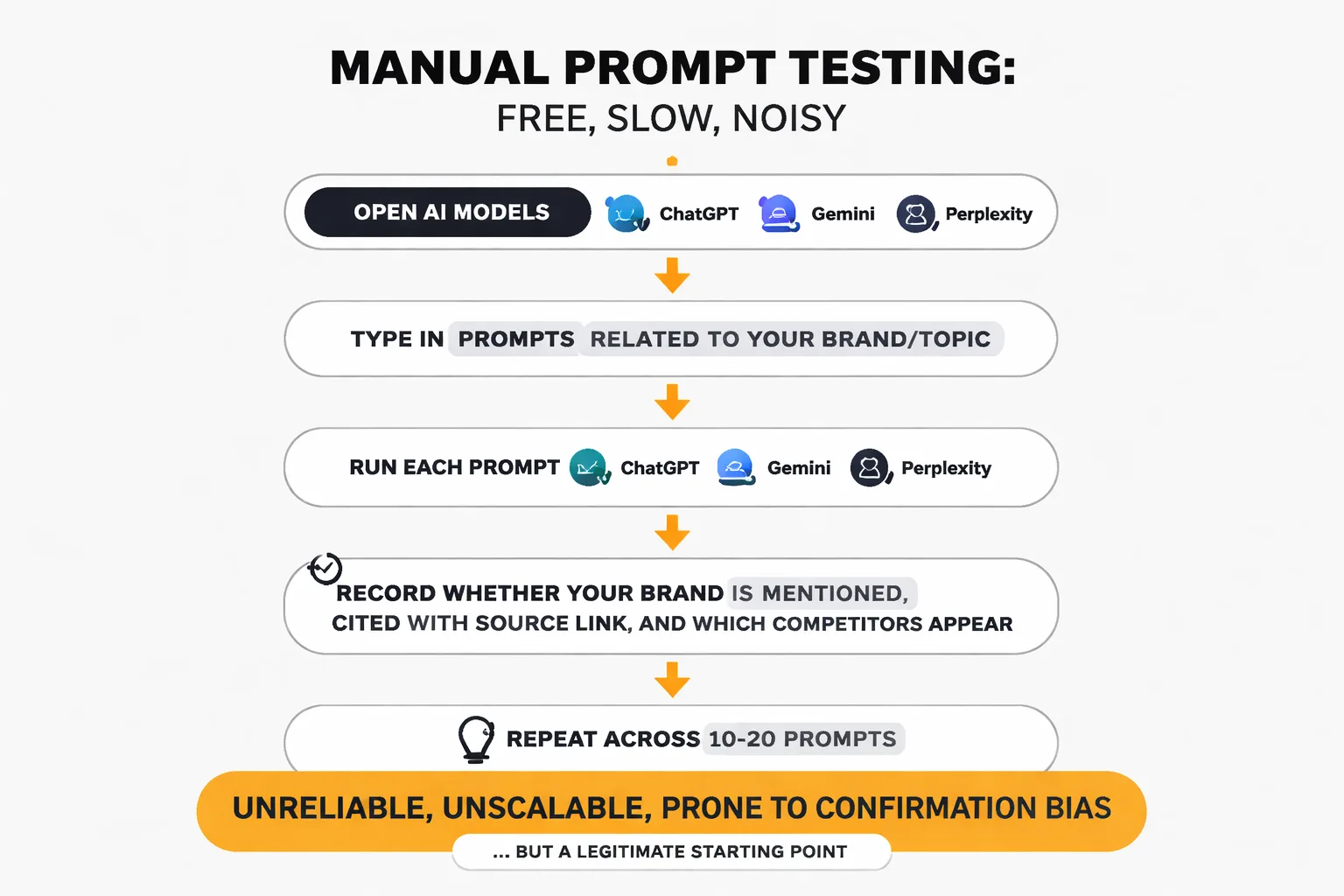
Method 1: Manual Prompt Testing (Free, Slow, Noisy)
This is what most teams start with. You open ChatGPT, Claude, Gemini, and Perplexity, type in prompts related to your brand and topic, and read the answers. It's free and immediate. It's also unreliable, unscalable, and prone to confirmation bias.
That said, it's a legitimate starting point if you've never done it. Here's a prompt template I use:
Prompt 1 (Brand mention): "What are the best [your category] tools/platforms/services?" Prompt 2 (Topic expertise): "How does [your topic] work? What are the key considerations?" Prompt 3 (Comparison): "Compare [your brand] vs [competitor brand] for [use case]" Prompt 4 (Problem-first): "What's the best way to solve [problem your product solves]?"
Run each prompt in ChatGPT, Claude, Gemini, and Perplexity. Record whether your brand is mentioned, whether it's cited with a source link, and which competitors appear instead. Do this across 10-20 prompts and you'll have a rough picture.
The problem: as Search Engine Journal documented, AI responses vary between runs. You might get cited on Tuesday and invisible on Wednesday for the same prompt. Manual testing gives you a snapshot, not a trend.
Method 2: Dedicated AI Visibility Platform (Automated, Scaled, Ongoing)
This is where purpose-built tools come in. Platforms designed for ai search visibility tracking run hundreds or thousands of prompts across multiple LLMs on a rolling cadence, aggregate the results, and show you trends over time. They solve the noise problem by collecting enough data points to establish a baseline.
The key advantage isn't just automation. It's coverage. Manual testing might cover 20 prompts across 4 engines. A platform can track hundreds of prompts across every major AI search surface: ChatGPT, Claude, Gemini, Perplexity, Grok, DeepSeek, Google AI Overviews, and AI Mode.
In my experience, the teams that get the most value from these platforms are the ones that treat AI visibility as an ongoing metric, not a one-time audit. You check it weekly, the same way you check organic rankings. The difference is that you're tracking citation presence and mention share, not position.
If you're evaluating ai search engine optimization tools, the critical question is: does the tool just show you data, or does it also help you close the gaps it finds? A dashboard that says "you're cited in 3% of prompts" is interesting. A platform that identifies which prompts competitors are cited for and helps you build content to win those citations is useful.
Method 3: Source Page Auditing (Diagnostic, Actionable)
This is the method most teams skip, and it's the one that actually drives improvement. When an AI engine cites a source, that source is a real page on a real website. If you want to understand your AI ranking, you need to know which pages are being cited and why.
Here's how to do it:
1. Run your target prompts in Perplexity (it's the most transparent about citations) and Google AI Overviews. 2. For each answer, record every cited URL. 3. Group the cited URLs by domain. Which sites are being cited most often for your topic? 4. For each top-cited domain, analyze what makes that page citation-worthy: Is it structured data? Depth of content? Entity presence? Domain authority? 5. Compare those pages to your own content on the same topic.
This audit tells you exactly where the gap is. Maybe competitors have structured product data and you don't. Maybe third-party review sites are being cited because they have more comprehensive comparison content. Maybe Wikipedia is being cited because your brand lacks entity grounding for AI search.
What the Results Tell You (and What They Don't)
This is where most AI visibility reporting falls apart. Teams see a number on a dashboard, don't understand what it means, and either panic or celebrate. Neither reaction is justified without context.
Citation Rate: The Number That Matters Most
Your citation rate is the percentage of relevant prompts where an AI engine cites your brand or content as a source. If you track 100 prompts related to your category and you're cited in 8 of them, your citation rate is 8%.
What's a good citation rate? It depends entirely on your category and competitive landscape. In a niche with 5 competitors, being cited in 20% of prompts might be dominant. In a crowded category with 50 active brands, 5% might be above average. The absolute number is meaningless without competitive context.
What matters is the trend. Is your citation rate going up or down over time? Which engines are citing you more, and which are citing you less? Are you gaining ground on specific prompt clusters while losing on others?
Mention Without Citation: The Trap
Here's a distinction that took me too long to appreciate: being mentioned is not the same as being cited. ChatGPT might say "brands like [your company] offer solutions in this space" without linking to your site or attributing specific information to you. That's a mention. It's better than nothing, but it doesn't drive traffic.
Citations are different. When Perplexity includes a superscript link to your page, or when Google AI Overviews references your domain as a source, that's a citation. Citations can drive referral traffic. Mentions can't.
I've seen dashboards that conflate these two metrics, showing an impressive "visibility score" that's mostly mentions. When you dig into the data, the brand isn't actually being cited as a source anywhere. It's being name-dropped in lists. That's the AI equivalent of being talked about but never linked to in traditional SEO. Flattering, but not actionable.
Competitor Citation Mapping: Where the Real Insight Lives
The most valuable output of any AI visibility check isn't your own numbers. It's the competitor map. When you're not being cited, who is? What domains are AI engines pulling from instead of yours?
This data is gold because it tells you exactly what to fix. If competitors are being cited from comparison content on third-party review sites, you need to be present on those sites. If they're being cited from their own deep-dive guides, you need to publish equivalent or better content. If they're being cited from structured data and knowledge graph entries, you need to build that infrastructure.
What the Numbers Don't Tell You
Here's my contrarian take on AI visibility metrics: most of them don't connect to revenue yet. I've seen brands with high citation rates and no measurable increase in demo requests. I've seen brands with low citation rates that still win because their traditional SEO and direct traffic are strong.
The metrics are early-stage indicators. They tell you whether you're present in a channel that's growing. They don't tell you whether that presence is driving business outcomes. Anyone who claims a direct line from citation rate to revenue is selling you something.
That said, the channel is growing fast enough that ignoring it is riskier than over-indexing on it. AI search traffic is projected to hit 40% of total search traffic by 2027. You need to be measuring now, even if the attribution models aren't perfect.
Do you know which AI engines cite your brand and which ones don't?
Which AI Search Engines Should You Monitor?
This question matters more than people realize. Not all AI search surfaces are equal, and monitoring the wrong ones wastes budget.
The Core Four: ChatGPT, Claude, Gemini, Perplexity
These are the surfaces where most AI search activity happens. ChatGPT has the largest user base. Perplexity is the most citation-transparent (it shows sources inline). Gemini is embedded in Google's ecosystem and increasingly powers AI Overviews. Claude is smaller but influential among technical and professional users.
Each has different citation behaviors. ChatGPT tends to mention brands more than it cites sources. Perplexity cites aggressively, often pulling from 4-6 sources per answer. Gemini leans on Google's existing index and knowledge graph. Claude is more conservative, citing fewer sources but with higher specificity.
If you're doing manual testing, start with these four. If you're using a platform, make sure it covers all of them.
Google AI Overviews and AI Mode: The Hybrid Surface
Google AI Overviews appear in traditional search results, which makes them the bridge between old SEO and new AEO. They refresh daily, they're visible to billions of users, and they pull from the same index that powers traditional search. If you're only going to check one AI surface, check this one.
AI Mode is Google's deeper conversational search experience. It's still rolling out, but it represents the direction Google is heading: full LLM-powered answers with citations, not just summary boxes.
Emerging Surfaces: Grok and DeepSeek
Grok (xAI's model) and DeepSeek are smaller but growing. Grok has the advantage of real-time data from X/Twitter. DeepSeek is significant if you care about international markets, particularly Asia. Most teams can deprioritize these initially and add them later as coverage expands.
Copilot: The Enterprise Wildcard
Microsoft Copilot uses GPT models but operates within Microsoft's ecosystem (Bing, Edge, Office). It's relevant for B2B brands whose buyers work in Microsoft environments. Citation behavior is similar to ChatGPT but filtered through Bing's index.
How to quickly improve AI ranking?
Checking is the diagnosis. What comes next is the treatment. And this is where most AI visibility strategies fail: they stop at the dashboard.
Step 1: Fix Entity Grounding First
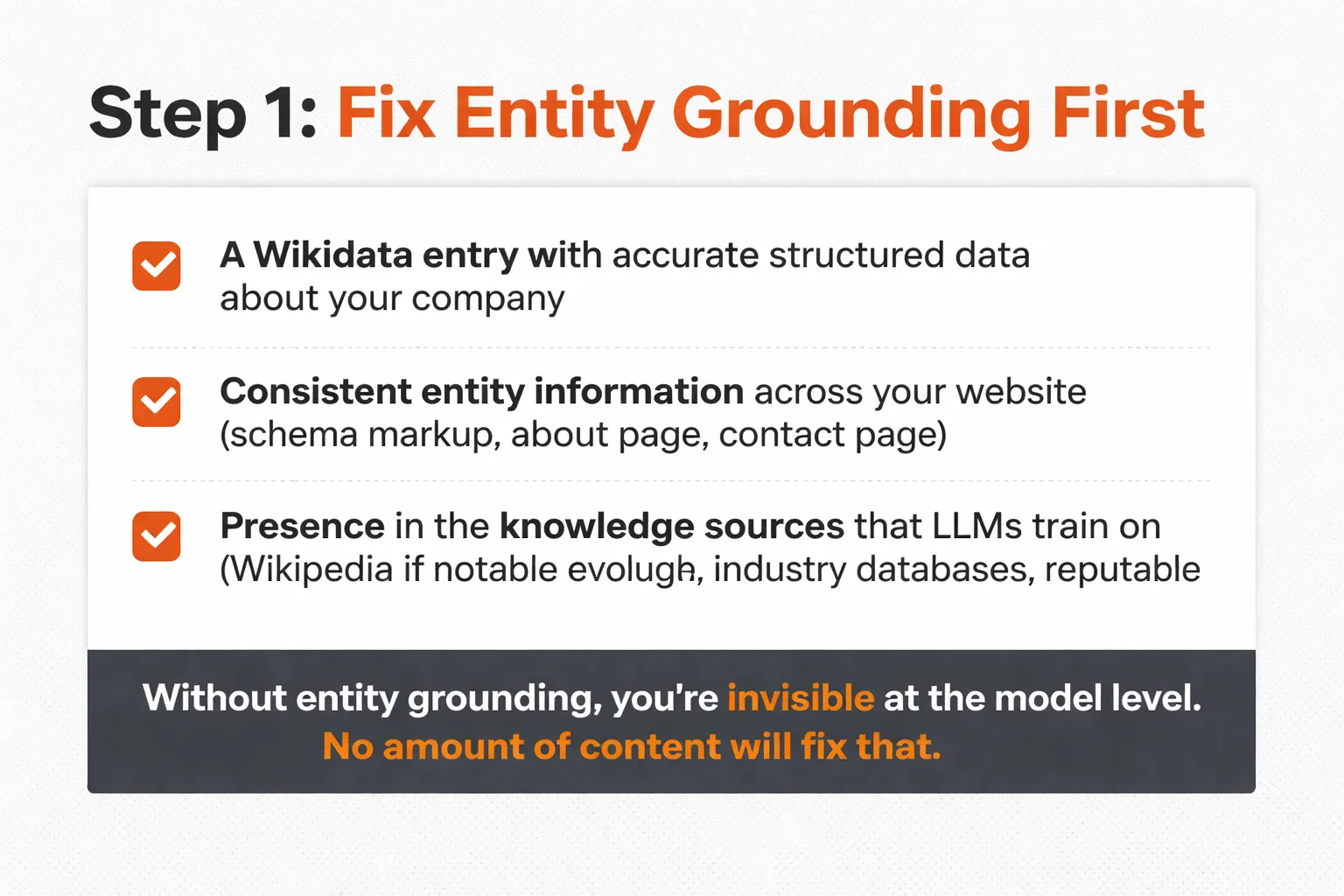
Before you write a single new article, make sure AI engines can identify your brand as a distinct entity. This means:
- A Wikidata entry with accurate structured data about your company. Consistent entity information across your website (schema markup, about page, contact page) - Presence in the knowledge sources that LLMs train on (Wikipedia if notable enough, industry databases, reputable directories)
Without entity grounding, you're invisible at the model level. No amount of content will fix that. I've seen brands publish 50 articles targeting AI citations and see zero movement because the underlying models didn't have a clean entity record for their brand. It's like trying to rank for your own name when Google doesn't know you exist.
Entity grounding is unglamorous. It's data plumbing. But it's the prerequisite for everything else.
Step 2: Target the Exact Prompts Where Competitors Are Cited
This is where your AI visibility check pays off. You've identified 30 prompts where competitors are cited and you're not. Each of those prompts is a content target.
The approach is different from traditional keyword targeting. You're not trying to rank for a keyword. You're trying to be the source an LLM cites when answering a specific question. That means your content needs to:
- Directly answer the question the prompt asks (not dance around it with 500 words of preamble) - Structure the answer so it's extractable: question headings, clear declarative sentences, tables for comparison data. Include evidence and citations that make your answer more authoritative than what competitors offer. Cover the topic comprehensively enough that the LLM doesn't need to look elsewhere
I've tested this approach extensively. When you structure content for AI extractability rather than traditional SEO, the results are materially different. 44% of AI citations come from the first third of a page, so front-loading direct answers under question headings became critical. It's less about optimizing for Google's old algorithm and more about making it easy for an AI to understand and cite your content.
Step 3: Build the Knowledge Graph Connective Tissue
For ecommerce brands especially, generative engine optimization requires structured product data that AI engines can synthesize. Product schema, review schema, FAQ schema, and organization schema all contribute to your entity's richness in the knowledge graph.
The research from Digital Applied lays out a four-stage framework: audit, building connective tissue (knowledge graphs), agent deployment, and cultivating organic citations. Most teams stop at audit. The connective tissue stage is where the actual work happens.
Step 4: Re-Run Checks to Measure Movement
This is the closed loop. You checked your AI ranking. You found gaps. You fixed entity grounding. You published content targeting specific prompts. Now you re-run the same prompts and see if your citation rate moved.
The timeline here is longer than traditional SEO. LLMs don't update in real-time the way Google's index does. A new article might take weeks to be ingested and reflected in citation behavior. Patience matters. But without the re-check, you're flying blind.
Set a cadence: check monthly at minimum, weekly if you're actively publishing. Track the same prompts over time. Watch for both citation rate changes and mention share changes. A rising mention rate without a rising citation rate means you're becoming more visible but not more authoritative. That's a signal to invest in content depth, not just content volume.
Is AI visibility like traditional SEO?
Here's the mistake I see most often: teams apply traditional SEO logic to AI visibility and wonder why it doesn't work. They stuff keywords into content. They build links without context. They churn out thin content targeting high-volume terms. Then they check their AI ranking and find nothing has changed.
The old generic SEO tricks that might have given marginal gains in traditional search are largely ineffective for AI visibility. In fact, I've seen them backfire. Content that's over-optimized for keywords reads unnaturally to LLMs, which are trained on human writing patterns. The models can tell when content is written for search engines rather than readers.
What Actually Works: Content Designed for Extraction
LLMs extract information from pages. That extraction process favors specific structures:
- Question headings with direct answers immediately below: The LLM can match the prompt to the heading and extract the answer in one pass. - Tables for comparison data: LLMs parse tables efficiently and cite them as structured sources. - Numbered lists for processes: Sequential information is easier to extract and attribute. - Bolded key claims: These act as signposts for the most important information on the page. - Sourced statistics with links: LLMs prefer citing claims that themselves have citations. It's citation all the way down.
When I shifted our content approach to prioritize AI extractability, the failure rate on content performance dropped significantly. The content that worked wasn't longer or more comprehensive. It was better structured for machine reading.
The Semantic SEO Foundation
I used to think structured data and knowledge graphs were the silver bullet for AI citations. My team spent months building schema markup and internal knowledge bases, expecting a direct correlation to AI visibility.
What I learned is that semantic SEO is necessary but not sufficient. It's the foundation. Without it, you're not in the game. But the real lift comes from factors that traditional SEO tools overlook: community discussion, third-party editorial mentions, and being cited by the sources that LLMs already trust.
This is why agentic SEO is becoming a real discipline. It's not just about publishing your own content. It's about being present in the information ecosystem that LLMs synthesize from. That means PR, community presence, review sites, industry publications, and any surface where your brand might be discussed in context.
What AI tools to use and when?
Let me be direct about the tooling landscape because it's confusing and getting more crowded every month. I'll cover the platforms that matter, what they're good at, and where they fall short.
Comparison: AI Visibility Tracking Tools
| Tool | Starting Price | AI Engines Covered | Content Engine | Best For |
| Meev | $49/mo | ChatGPT, Claude, Gemini, Perplexity, Grok, DeepSeek, AI Overviews, AI Mode | Yes (quality-gated) | Teams wanting tracking + content in one platform |
| Profound | $99/mo | 10+ LLMs | No | Enterprise compliance-ready visibility data |
| AthenaHQ | $295/mo | 8+ LLMs | No | Growth SaaS connecting AI visibility to revenue |
| Semrush AI Toolkit | $99/mo add-on | ChatGPT, AI Overviews, Gemini | No | Existing Semrush users |
| Ahrefs Brand Radar | $129-$199/mo | 7 AI surfaces | No | Existing Ahrefs users |
| AIclicks | $49/mo | 10 engines | No | Agencies needing broad engine coverage |
| Rankability | $79/mo | Major AI engines | No | Technical SEOs needing API access |
The pattern across most of these tools: they're dashboards. They show you the problem. They don't fix it. That's fine if you have a content team ready to act on the data. If you don't, you're paying for a diagnosis without a treatment plan.
Is Meev best for tracking and content?
Best for: Teams that want AI citation tracking plus a content engine they can trust to publish, not just a dashboard that surfaces problems.
Meev is the platform I build and use daily. It tracks citations across every major AI search surface (ChatGPT, Claude, Gemini, Perplexity, Grok, DeepSeek, Google AI Overviews, AI Mode) and then closes the gap by researching, writing, and publishing answer-engine optimized articles that you approve before anything goes live. The differentiator is the 12-dimension Quality Matrix and Helpful Content Risk score that gate every article before it ships.
Key features: - Citation tracking across ChatGPT, Claude, Gemini, Perplexity, and Grok on a rolling cadence; Google AI Overviews and AI Mode refresh daily. 12-dimension Quality Matrix plus Helpful Content Risk score with a 70/100 publish gate on both. Knowledge Base enforcement so articles are grounded in your approved claims, not AI hallucination. Closed-loop Citation Path (roadmap) mapping each article to the citation-rate delta it drove. Autopilot topic pool with gap detection from competitor citation patterns
Pricing: 7-day free trial. After the trial, services pause unless you subscribe. Lite $49/mo, Starter $99/mo, Pro $269/mo, Agency $599/mo. 20% annual discount. Cancel anytime; hard-cap quotas with no overage fees.
I'm biased here, obviously. But the reason I built Meev this way is because I kept seeing the same gap: tools that tell you you're invisible in AI search but don't help you become visible. The quality gate exists because most AI content tools ship whatever the model produces, and that content performs poorly in both traditional and AI search. The 70/100 gate forces the system to either improve the draft or block it. That's the mechanic I trust.
2. Profound — Best for enterprise compliance-ready data
Best for: Fortune 500 brands and agencies that need deep, compliance-ready AI visibility data and competitor benchmarking at scale.
Profound is an enterprise-grade platform that tracks brand citations and share of voice across 10+ LLM and AI search engines using a dataset of 200M+ real prompts. It's built for organizations that need SOC 2 compliance, HIPAA compliance, and audit trails for regulated industries.
Key features: - 200M+ prompt dataset for AI share-of-voice benchmarking. Citation audit trail with URL-level source attribution. Competitor benchmarking across ChatGPT, Perplexity, Gemini, Claude, and more. SOC 2 Type II and HIPAA compliance for regulated industries
Pricing: Starter from $99/mo (ChatGPT only, billed annually); Growth $399/mo (3 engines); Enterprise custom pricing for full multi-engine coverage.
Profound is serious software for serious organizations. The 200M+ prompt dataset is genuinely impressive for benchmarking. The limitation is that it's a tracking and analytics platform, not a content engine. You'll know exactly where you stand, but you'll need a separate solution to close the gaps. For enterprise teams that already have content operations in place, that's fine. For smaller teams looking for an all-in-one solution, it's overkill.
3. AthenaHQ — Best for growth SaaS connecting AI visibility to revenue
Best for: Growth-stage SaaS brands and enterprise marketing teams that want an AEO command center connecting AI visibility data to revenue outcomes.
AthenaHQ combines LLM citation intelligence, AI traffic analysis, and optimization recommendations. It's designed to connect the dots between AI visibility and pipeline impact, which is the gap most tools don't address.
Key features: - Citation intelligence across 8+ major LLMs including ChatGPT, Claude, Gemini, and Perplexity. LLM referral traffic analysis tied to real pipeline data. Optimization recommendations and AEO action layer. Competitor share-of-voice benchmarking
Pricing: Self-Serve $295/mo; Enterprise custom pricing (includes dedicated GEO specialist, LLM traffic analysis, and SSO).
AthenaHQ's strength is the revenue connection. If you're a SaaS company that needs to justify AI visibility investment to a CFO, the pipeline attribution layer is valuable. The limitation is that the base plan is limited to one region and one language, and the dedicated GEO specialist support only comes with Enterprise pricing. For growth-stage companies with budget, it's a strong option.
4. Semrush AI Toolkit — Best for existing Semrush users
Best for: SEO teams already paying for Semrush who want to layer AI search visibility tracking onto their existing workflow without switching platforms.
Semrush's AI Toolkit is an add-on that scores brand presence across ChatGPT, Google AI Overviews, and Gemini using a dataset of 261M+ LLM prompts. It's the path of least resistance for teams already in the Semrush ecosystem.
Key features: - AI Visibility Score benchmarked against 261M+ real LLM prompts globally. AI share of voice, visibility trends, and competitor benchmarking in one dashboard. 25 custom daily prompts for targeted citation monitoring. Native integration with Semrush keyword research, backlink, and reporting tools
Pricing: AI Visibility Toolkit add-on $99/mo per domain (requires active Semrush subscription); Semrush One Starter $199/mo (includes SEO + AI visibility bundled).
The advantage here is integration. If your team already lives in Semrush, adding AI visibility without context-switching is convenient. The limitation is that AI engine coverage at the base tier is limited to ChatGPT, Google AI, and Gemini. You're missing Claude, Perplexity, and the emerging engines. For teams that want a quick read on their AI visibility without adopting a new platform, it's a reasonable starting point.
5. Ahrefs Brand Radar — Best for existing Ahrefs users
Best for: SEO teams that already trust Ahrefs' backlink data and want AI citation tracking layered on top without adopting a separate platform.
Ahrefs Brand Radar correlates real-time AI search visibility with backlink authority data. That correlation is genuinely unique. If you want to understand the relationship between your backlink profile and your AI citation rate, this is the only tool that shows both in one view.
Key features: - Real-time brand mention and citation tracking across ChatGPT, Perplexity, Gemini, AI Overviews, Copilot, AI Mode, and Claude. Backlink-correlated AI visibility overlay of domain authority and AI citation data. Share-of-voice competitor benchmarking. Daily refresh cadence for citation and mention monitoring
Pricing: Included on higher-tier Ahrefs plans; AI Visibility Index add-on from $129/mo to $199/mo depending on plan.
The backlink correlation is the differentiator. No other tool connects domain authority to AI citations the way Brand Radar does. The limitation is that there's no built-in GEO content optimization or action layer. It's a tracking tool, not a content tool. And the full AI Visibility Index requires a higher-tier plan or paid add-on, so the cost can stack up.
6. AIclicks — Best for broad engine coverage
Best for: Agencies and ecommerce brands that need broad AI engine coverage, including emerging models like Grok and DeepSeek, plus automated citation gap reporting.
AIclicks covers 10 AI engines including Grok, DeepSeek, and Meta AI. For teams that care about coverage breadth, especially in emerging and international markets, it's the most comprehensive engine list in this comparison.
Key features: - Citation gap analysis across 10 AI engines including Grok, DeepSeek, and Meta AI. Prompt-level Google AI Overviews audits. AI agents for automated visibility reporting and optimization tasks. Ecommerce GEO tracking for product and category-level AI citation monitoring
Pricing: Starts at $49/mo (entry); Pro $99/mo; agency and ecommerce tiers available. Prompt-level AIO audits on all plans.
The ecommerce GEO tracking is a standout feature. If you're an ecommerce brand that needs to monitor AI citations at the product and category level, AIclicks is one of the few tools built for that use case. The limitation is brand recognition. It's a newer tool without the track record of Semrush or Ahrefs, and the advanced agentic features may require higher-tier plans.
7. Rankability — Best for technical SEOs needing API access
Best for: Technical SEOs and agencies who want AI citation tracking to behave like a traditional rank tracker and need API or MCP access for custom agentic SEO pipelines.
Rankability is built for SEO professionals who think in terms of rank trackers and want AI citation tracking to feel familiar. The open API and hosted MCP server on every plan make it the most developer-friendly option in this list.
Key features: - LLM citation and mention tracking with 60 daily prompts on entry plan. Open API and hosted MCP server on every plan for agentic SEO integrations. Familiar rank-tracker UX designed for SEO professionals transitioning to AEO. Competitor visibility benchmarking across major AI engines
Pricing: Solo $79/mo; Core $199/mo; Team $399/mo (all billed annually); Enterprise via sales. Standalone AI tracking from $99/mo.
The API and MCP access is the real differentiator. If you're building custom agentic SEO pipelines and need to pipe AI visibility data into your own systems, Rankability is the most integration-friendly option. The limitation is that 60 daily prompts on the Solo plan may be insufficient for large-scale monitoring, and AI engine coverage details aren't fully published at the entry tier.
Making the Right Choice
The tool you pick depends on what you're actually trying to do. Here's my honest framework:
If you've never checked your AI visibility and just want a quick read: Start with manual prompt testing. It's free and takes 30 minutes. Use the prompt template above. You'll learn more from that exercise than from any dashboard.
If you're ready to track AI visibility ongoing and want a platform that also helps you close gaps: That's literally what I built Meev for. The tracking tells you where you stand. The content engine helps you move. The quality gate ensures what you publish actually helps.
If you're an enterprise team that needs compliance-ready data: Profound is the strongest option. The 200M+ prompt dataset and SOC 2 compliance are genuine differentiators for regulated industries.
If you already use Semrush or Ahrefs and don't want another tool: Use their respective AI visibility add-ons. The integration value outweighs the coverage limitations for most existing users.
If you're an agency managing multiple clients: AIclicks offers the broadest engine coverage at a price point that works for agency economics. Rankability's API access is valuable if you're building custom reporting pipelines.
The worst choice is no choice. Every month you wait to start tracking AI visibility is a month of compounding blind spots. The ChatGPT visibility checker and Perplexity visibility checker we offer are free to try. Start there if you're not ready to commit to a platform.
FAQ
How often should I check my AI ranking?
Monthly at minimum, weekly if you're actively publishing content. AI responses are noisy, so a single check tells you little. You need a trend over time to separate real movement from statistical variance. Daily checks are overkill unless you're running a time-sensitive campaign.
Can I check my AI ranking for free?
Yes, using manual prompt testing. Run 10-20 structured prompts across ChatGPT, Claude, Gemini, and Perplexity. Record whether your brand is mentioned and cited. This gives you a snapshot but not a trend. For ongoing tracking, you'll need a platform.
What's the difference between AI ranking and traditional SEO ranking?
Traditional SEO ranking measures your position on a search results page (position 1-10). AI ranking measures whether AI search engines cite your brand as a source in generated answers. The overlap between top Google results and AI-cited sources has dropped below 20%, meaning strong traditional rankings don't guarantee AI visibility.
Why does my AI ranking change between checks?
Generative models produce different responses across runs. Search Engine Journal reported that AI visibility rankings are mostly statistical noise without sufficient volume. A single check is a snapshot. You need multiple data points over time to identify real trends.
Does being mentioned in AI answers drive traffic?
Not necessarily. Mentions without citations don't drive referral traffic. Citations with source links (like Perplexity's inline citations or Google AI Overviews references) can drive traffic. Track citation rate separately from mention rate to understand the difference.
How long does it take for new content to affect my AI ranking?
Longer than traditional SEO. LLMs don't update in real-time. New content can take weeks to be ingested and reflected in citation behavior. Be patient and re-check on a regular cadence rather than expecting immediate movement.
The question "how can I check my AI ranking" has a simple answer: start with manual prompts, then graduate to a platform that tracks over time. The harder question is what you do with the data once you have it. That's where most teams stall. Don't be most teams.
About the Author
Judy Zhou, Founder
Judy Zhou leads content strategy at Meev, where she oversees AI-driven content research and publishing for hundreds of brands. With a background in SEO and editorial operations, she focuses on building content systems that rank on Google, get cited by AI search engines, and drive measurable business results.
Stop guessing about your AI visibility. Run your first citation audit today and see exactly where you stand across every major AI search surface.