By Judy Zhou, Founder
Key Takeaways
- 57% of Americans now use generative AI while Google AI Overviews appear in 25%+ of searches, yet $30/month rank trackers only report Google positions.
- A cheap rank tracker is fine if you sell to people who still click blue links but actively misleading if your buyers ask ChatGPT, Perplexity, or Claude what to buy.
- Teams paying $29-49/month feel confident about green position-one rankings while completely missing AI citations that name their competitors instead.
- Replace position-only dashboards with tools that track entity grounding, knowledge graph presence, and share of voice across ChatGPT, Perplexity, Gemini, and Claude.
Maria pulled up her rank tracker dashboard on a Tuesday morning and felt genuinely good about the numbers. Fifteen keywords in positions one through five, three featured snippets, organic traffic trending upward for the third straight month. Then a colleague forwarded a screenshot: a ChatGPT response to their most valuable buyer-intent query, citing three competitors by name, complete with links. Maria's brand wasn't mentioned once. Her rankings were fine. Her AI visibility was zero. The tracker had told her everything except the thing she actually needed to know.
I've lived this story. In my work auditing content operations for brands that depend on search-driven revenue, I see the same gap every week: teams paying $30 a month for a cheap rank tracker, feeling confident about their green-position-one rankings, and completely missing the fact that AI engines are citing their competitors in the answers their buyers actually read. 57% of Americans now use generative AI, and Google AI Overviews appear in 25%+ of searches (Dageno AI). A tool that only tracks Google positions is giving you the scoreboard for a game your buyers stopped watching.
Here's my thesis: a cheap rank tracker is fine if you sell to people who still click blue links. It's actively misleading if your buyers are asking ChatGPT, Perplexity, or Claude what to buy. The gap between what you pay $29-49/month for and what you actually need in 2026 is not a feature gap. It's a visibility gap that costs you pipeline you don't even know you're losing.
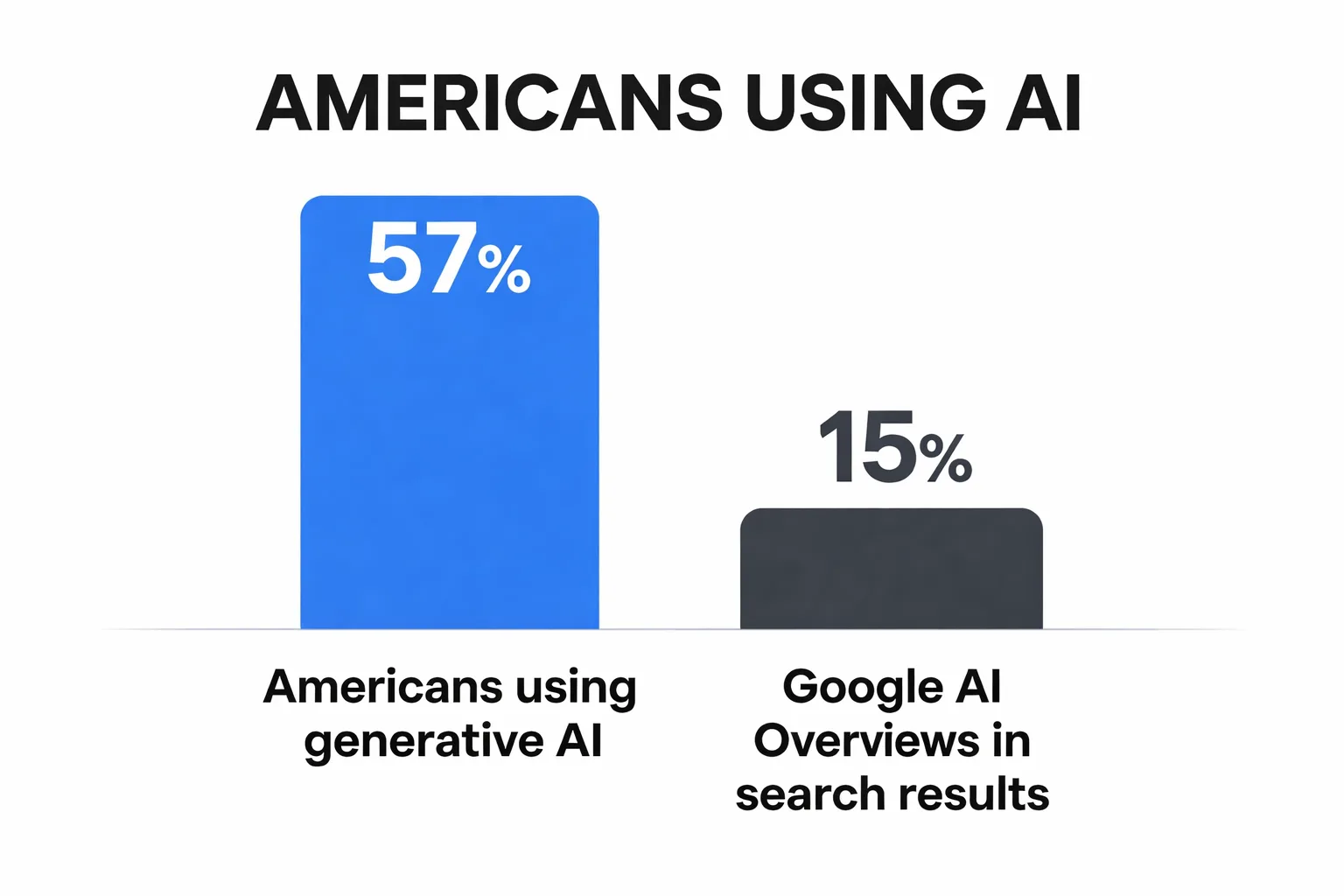
What $30/month tracks vs. what your buyers actually see.
What 'Cheap' Actually Means in Rank Tracking Today
The rank tracker market splits into four rough tiers, and the word "cheap" gets thrown around loosely enough that it's meaningless without numbers. Let me define what we're actually talking about.
Free tier ($0): Tools like Google Search Console's performance report give you impression and click data for queries where you already appear. It's not really rank tracking. You get average position, not a true position-one-or-three number for a specific keyword on a specific day. Useful as a baseline, but you're seeing Google's aggregate, not where you rank for a specific searcher at a specific moment.
Sub-$50/month tier: This is where the "cheap rank tracker" label actually applies. SE Ranking's entry plan starts around $55/month for 250 keywords with daily updates. SerpRobot offers 300 keywords for roughly $50/month. TrueRanker has plans from $29/month for 200 keywords. These tools track Google positions (desktop and mobile), give you local tracking via location, and include basic competitor monitoring. What they don't include: any visibility into AI-generated answers, any citation tracking across LLMs, any entity-level analysis. You're paying for a 2018-era SEO workflow.
Sub-$100/month tier: This is where you start getting more keyword volume and some additional features. SE Ranking's Pro plan (~$99/month) bumps you to 500 keywords and adds their AI Visibility Tracker for benchmarking across AI search engines. Semrush's AI Visibility add-on costs $99/month per domain (25 prompts) on top of a core plan starting at $139.95/month. So you're paying $240+ to get basic AI citation monitoring alongside traditional rank tracking.
$200+/month tier and above: Dedicated AI search visibility platforms start here. This is where you get multi-engine citation tracking, entity gap analysis, and content optimization recommendations. It's also where most small teams balk at the price and retreat to the $49 tier, telling themselves they'll "add AI tracking later."
The problem with "later" is that AI citation patterns are consolidating now. The sources that ChatGPT and Perplexity cite today are building entity authority that compounds. Every month you're not tracking your AI visibility, your competitors are.
SE Ranking is trusted by 40,000+ agencies and has added AI Visibility Tracker, AI Overviews Tracker, ChatGPT Tracker, and AI Mode Tracker (SE Ranking). That's a signal: even traditional rank tracking tools recognize the old model is incomplete. But the AI features are gated behind higher tiers, and the depth of analysis is still lighter than a purpose-built platform.
Let me give you a concrete example of how this plays out. I worked with a SaaS company spending $49/month on SerpRobot. They tracked 300 keywords, ranked in the top 3 for 40 of them, and felt confident. When we ran an AI visibility check across ChatGPT and Perplexity for those same 40 keywords, they were cited in 3 out of 40 AI answers. Their top competitor was cited in 31 out of 40. The $49/month tool had been showing green checkmarks while the competitor was quietly building an insurmountable citation lead in the channel that actually influenced buyer decisions. The tool wasn't wrong about Google positions. It was just answering the wrong question.
The 5 Features Cheap Rank Trackers Usually Cut First
When you pay $29-49/month for rank tracking, you're not getting a watered-down version of an enterprise tool. You're getting a tool that was built for a different era of search and has had AI features bolted on as an afterthought. Here are the five specific gaps that matter most in 2026.
1. AI search surface coverage
This is the biggest gap. A cheap rank tracker tells you where you rank on Google. It does not tell you whether ChatGPT cites your brand when a prospect asks "best CRM for startups under 50 people." It doesn't show whether Perplexity includes your product in its source list. It doesn't track whether Gemini mentions you in its AI Overview. These are the surfaces where your buyers are actually forming opinions, and a $49/month tool gives you zero visibility into any of them.
I've seen brands rank #1 for their most valuable keyword on Google and get cited in zero AI answers for the same query. The overlap between top Google results and AI-cited sources has dropped from roughly 70% to under 20% by current estimates. That number should stop you cold. If you're optimizing for Google positions and ignoring AI citations, you're optimizing for a shrinking share of actual buyer attention.
The mechanics matter here. When ChatGPT generates an answer, it doesn't pull from a live Google SERP. It pulls from its training data (which has a cutoff date), its web search capability (which retrieves and synthesizes pages in real time), and its instruction set (which prioritizes certain source types). Perplexity uses a different retrieval pipeline, indexing different pages and applying different relevance scoring. Gemini draws from Google's knowledge graph and search index. These are three fundamentally different systems with different citation logics. A cheap rank tracker that only checks Google SERPs is blind to all three.
2. Update frequency for AI surfaces
Cheap rank trackers refresh Google positions daily. That's fine for classic SEO. But AI answer patterns shift faster than SERP positions. A Perplexity answer that cited your brand on Monday might cite a competitor on Thursday because a new article was published and indexed. Without rolling refresh on AI surfaces, you're working with stale data. Most cheap tools don't refresh AI data at all because they don't track it at all.
The volatility is real. I've tracked prompts where the citation set changed 4 times in a single week. A competitor publishes a well-structured comparison article on Tuesday. By Wednesday, Perplexity is citing it. By Thursday, ChatGPT's web search picks it up. By Friday, your brand that was mentioned first in the AI answer on Monday is now mentioned third, behind two competitors who published nothing new but benefited from the retrieval shift. Weekly monitoring catches this. Monthly monitoring misses it entirely. And cheap rank trackers don't monitor AI surfaces at all.
3. Keyword and prompt limits
A $49/month plan typically caps you at 200-300 keywords. That sounds adequate until you realize that AI search visibility isn't about keywords. It's about prompts. A single keyword like "project management software" maps to dozens of distinct prompts: "best project management software for remote teams," "cheapest project management tool with Gantt charts," "project management software that integrates with Slack." Each prompt generates a different AI answer with different citations. 300 keywords might represent 3,000 prompts worth of citation opportunity. A cheap rank tracker doesn't track prompts at all.
This is where the keyword model breaks down entirely. Google SERPs for "project management software" and "best project management software for remote teams" are correlated. If you rank well for one, you probably rank decently for the other. AI answers for those two prompts are not correlated. ChatGPT might cite Asana, Monday, and ClickUp for the first prompt and Basecamp, Notion, and Linear for the second. The citation set is prompt-specific, not keyword-correlated. Tracking 300 keywords tells you nothing about the 3,000 prompts where your buyers are actually getting recommendations.
4. Competitor tracking slots
Budget plans limit you to 3-5 competitors. In classic Google SEO, that's often enough because the SERP for any keyword is roughly the same 10 domains. In AI search, the citation set is much wider. Perplexity might cite 8-12 different sources for a single prompt, and those sources change based on query phrasing. If you're only tracking 3 competitors, you're missing the other 5-9 sources that are eating your share of voice. AI visibility tracking requires broader competitor monitoring, and cheap tools aren't built for it.
5. API access and data export
Cheap rank trackers almost never offer API access on their entry plans. This matters more than people think. If you can't pull your ranking data into a dashboard alongside your AI citation data, your content analytics, and your conversion data, you're making decisions in silos. Enterprise rank tracker tools include API access because they know teams need to combine data sources. Budget tools treat data export as a premium feature.
The practical impact: you end up manually exporting CSVs from your rank tracker, manually exporting data from whatever AI tool you use, manually combining them in Google Sheets, and doing this every week. It's unsustainable. Within a month, most teams stop combining the data and just look at the rank tracker because it's easier. They're back to making decisions based on Google positions alone, which is exactly the problem they were trying to solve.
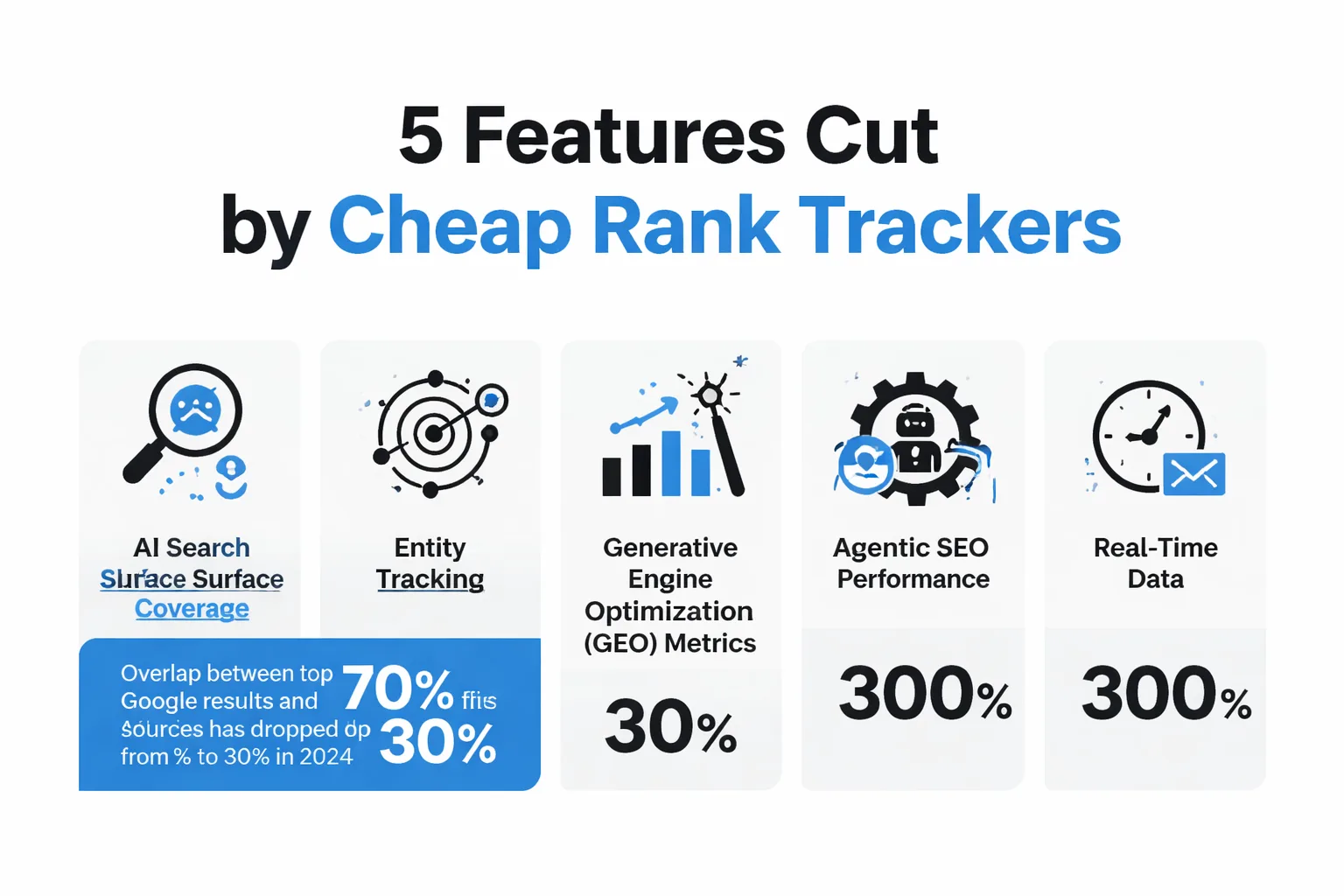
Five things your rank tracker must do in 2026.
When a Cheap Rank Tracker Is Actually Enough
I'm not going to pretend every team needs a $300/month platform. Some don't. Let me be honest about when a budget tool genuinely covers your needs.
You only sell to people who click Google results. If your buyer journey is: search Google, click a blue link, read a blog post, convert. And you've verified this through analytics (not assumed it). Then Google position tracking is sufficient. This applies to some local businesses, some niche B2B with low AI adoption, and some informational sites where the audience still defaults to Google.
You have a single domain and low keyword volume. If you're tracking 200 keywords for one site and your SEO strategy is "rank for these specific terms," a cheap tool does that job. SE Ranking, SerpRobot, and TrueRanker all handle this competently. You get daily positions, local tracking, and basic reporting. That's the floor of what a rank tracker should do, and these tools do it.
You don't need AI citation tracking. This is the key qualifier. If your buyers aren't asking AI engines about your category, you don't need AI visibility tracking. But I'd push back on this assumption hard. In my work, I've found that most teams saying "my buyers don't use AI search" haven't actually checked. They're projecting their own behavior onto their audience. 57% of Americans use generative AI (Dageno AI). Unless your buyer is in the 43% who don't, AI citation tracking is not optional.
You have no content team and no plans to build one. If you're a solo founder or small team with no content production capacity, tracking AI citations is interesting but not actionable. You can't fix a citation gap without publishing content. In that case, a cheap Google rank tracker plus Google Search Console is a reasonable starting point. But the moment you start publishing content to improve visibility, you need to know whether that content is being cited by AI engines, not just whether it ranks on Google.
Here's the honest summary: a cheap rank tracker is enough when your search strategy is Google-only and your buyers are Google-only. The moment either of those conditions breaks, you need more.
What Is Ranking in AI? Why Classic Rank Trackers Miss It
This is the question I get most often from founders and marketing leads, and it's the right question to ask. "What is ranking in AI?" is a fundamentally different question from "what is ranking on Google?"
On Google, ranking means occupying a position in the organic results for a keyword. Position 1 gets the most clicks, position 10 gets fewer, position 11+ gets almost none. It's a linear model. You can track it with a number. A rank tracker checks where you appear, reports the number, and you're done.
In AI search, ranking doesn't work that way. There's no position 1 or position 10. When someone asks ChatGPT "what's the best AI SEO tool," the model doesn't return a ranked list of 10 links. It generates a synthesized answer that may cite 3-5 sources by name, may include links, and may mention brands without linking. Your "rank" in this context is whether you're cited, where in the answer you appear (first mention, in a list, last), and how favorably you're described relative to competitors.
This means AI ranking is really three things: citation frequency (how often does the LLM mention you across prompts), source selection (which domains does the LLM pull from to construct its answer), and sentiment or framing (does the LLM describe you positively, neutrally, or negatively). None of these map to a position number. None of these can be tracked by a tool built for Google SERPs.
Classic rank trackers miss AI ranking because they're built to parse HTML SERPs and extract a position integer. AI answers are unstructured text. The citation might be a hyperlink, a plain-text brand mention, or a paraphrased reference with no attribution at all. Detecting these requires natural language processing, not HTML parsing. That's why a cheap rank tracker, even one that has added an "AI Visibility" feature, typically only checks whether your brand name appears in a cached AI response. It doesn't analyze the context, the framing, or the competitive landscape within that answer.
The overlap between top Google results and AI-cited sources has dropped from roughly 70% to under 20% (AEO vs SEO). This means you can rank #1 on Google and be invisible to AI engines for the same query. A classic rank tracker will show you that #1 position and give you a green checkmark. It won't show you the zero citations you're getting in ChatGPT.
What to look for instead: a tracker that monitors brand mentions and citations across every major AI search surface, reports mention position (first, in a list, last), shows the actual response text behind every mention, and benchmarks your share of voice against competitors per engine. That's what AI visibility tracking actually means. It's a different data model, not a feature toggle.
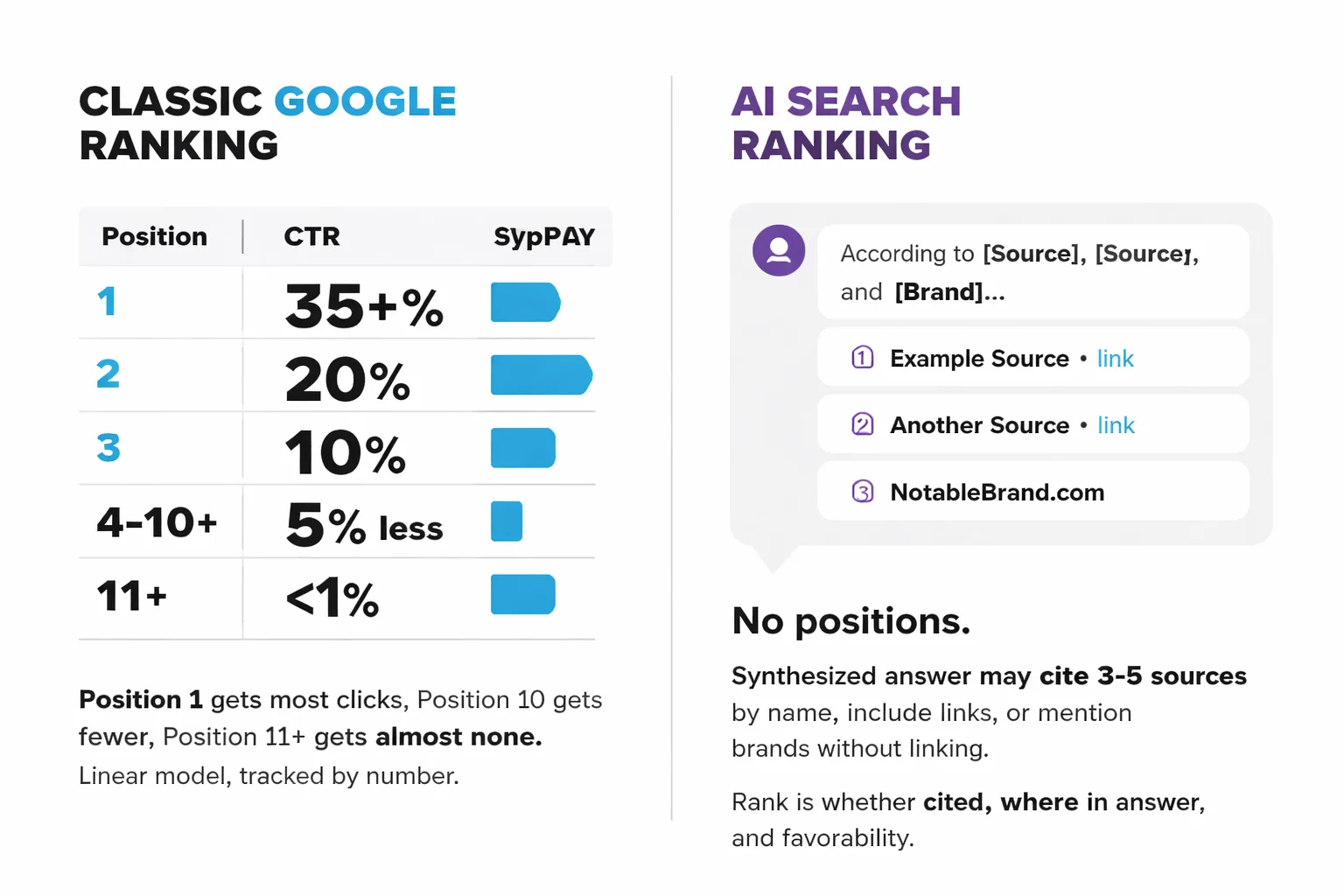
How AI "ranking" works. It's not a position number.
Are you tracking citations across ChatGPT, Perplexity, and Gemini, or just Google positions?
How Does Entity Grounding Change What You Track?
Entity grounding is the layer beneath citation tracking, and almost no one talks about it in the context of rank tracking. When an LLM decides whether to mention your brand, it doesn't consult a SERP. It consults its internal representation of your brand as an entity. That representation is built from training data, web search results, and structured data sources like Wikidata and Google's Knowledge Graph.
If your brand has a weak entity profile (no Wikidata entry, inconsistent structured data across your site, sparse mentions on authoritative third-party domains), the LLM has a thin understanding of who you are and what you do. Even if you publish great content, the model may not connect it to your brand because the entity association is weak. This is why some brands get cited for generic queries but not for brand-specific ones. The LLM knows the category but doesn't have a rich enough entity profile for your specific brand to surface it.
A cheap rank tracker doesn't track entity signals. It doesn't check whether you have a Wikidata entry. It doesn't monitor your knowledge graph presence. It doesn't analyze whether your structured data is consistent across your domain. These are the infrastructure-level signals that determine whether AI engines can even identify you as a citable entity. Without them, citation tracking tells you the symptom (you're not cited) but not the cause (your entity profile is too thin for the LLM to surface you).
In my work, I've seen brands fix their entity grounding and see citation rates jump within weeks. Not because they published new content, but because they made it easier for AI engines to understand who they are. That's a tracking dimension no $49/month tool covers.
What Should an AI SEO Agent Actually Do?
The term "AI SEO agent" gets thrown around loosely in 2026. Let me be precise about what it should mean. An AI SEO agent is not just a content generator. It's a system that diagnoses visibility gaps, recommends specific actions to close them, and executes those actions with quality guardrails.
I've seen too many early adopters get burned by AI SEO agents that churn out content without understanding search intent. The real killer is when these agents cluster keywords without semantic depth, producing content that's technically optimized but misses the user's underlying question. I tried a basic AI SEO agent last quarter for a client's niche blog. It produced articles quickly, but traffic dipped because the content didn't actually answer what buyers were asking. The agent was optimizing for keyword presence, not for answer quality.
What a proper AI SEO agent should do: analyze your AI citation gaps across engines, identify the prompts where competitors are cited and you aren't, research the sources AI engines actually cite for those prompts, and generate content that addresses those specific gaps with fact-verified claims and proper structure. The content should be gated by a quality firewall that blocks weak drafts before they reach your CMS. 44% of AI citations come from the first third of a page, so the agent should front-load direct answers under question headings and include structured data. That's what answer engine optimization requires in practice.
A cheap rank tracker has no concept of any of this. It can't identify citation gaps because it doesn't track citations. It can't recommend content because it doesn't analyze what AI engines cite. It can't generate or gate content because it's not built for content production. It's a position-reporting tool in an era where position reporting is necessary but insufficient.
How to Choose the Right Tracker for Your Budget and Goals
Let me give you a practical decision framework. I'm not going to tell you to buy the most expensive tool. I'm going to tell you exactly what to buy based on what you're actually trying to do.
If you only need Google positions and nothing else:
Start with Google Search Console (free). It gives you average position, impressions, clicks, and CTR for every query where you appear. It's not a traditional rank tracker, but for a solo founder or small team with one domain and no budget, it covers the basics. If you need more structure (specific daily positions, local tracking, competitor monitoring), SE Ranking's entry plan at ~$55/month for 250 keywords is the best value in the budget tier. SerpRobot at ~$50/month for 300 keywords is also solid if you want a simpler interface.
If you need Google positions plus basic AI citation monitoring:
This is where the budget tier breaks down. SE Ranking has added AI tracking features, but they're limited in depth. Semrush's AI Visibility add-on ($99/month per domain, 25 prompts) stacks on top of a $139.95/month core plan, so you're paying $240+ for basic AI monitoring alongside traditional rank tracking. If you're already in the Semrush ecosystem, it's a reasonable add-on. If you're not, it's an expensive entry point.
The honest answer is that the sub-$100 tier doesn't have a tool that does both Google rank tracking and AI citation tracking well. You either get a cheap Google tracker with no AI coverage, or you get a platform that does AI tracking but charges enterprise prices for it.
If you need AI citation tracking alongside classic rankings:
This is where purpose-built platforms enter the conversation. You need a tool that tracks citations across ChatGPT, Claude, Gemini, Perplexity, Grok, and Google AI Overviews. You need mention position tracking (where in each AI answer your brand appears). You need share-of-voice benchmarking against competitors per engine. You need the actual response text behind every mention so you can see the context and framing.
This is also where you need to think about answer engine optimization as a practice, not just tracking. Knowing where you're cited is step one. Knowing how to close the gaps is step two. A tracker that shows you the problem but gives you no way to fix it is a diagnostic without a prescription.
If you need entity grounding and knowledge graph presence:
This is the most advanced tier, and it's where generative engine optimization goes beyond citation counting. Entity grounding means ensuring AI models understand your brand as a distinct entity with attributes (what you do, who you serve, how you differ from competitors). This involves Wikidata presence, knowledge graph entries, structured data on your site, and consistent entity references across the web. No cheap rank tracker touches any of this. Very few expensive ones do, either. This is a specialized capability that most teams handle through a combination of tools and manual work.
The framework comes down to one question: where do your buyers form opinions about your category? If the answer is Google, buy a cheap rank tracker. If the answer is AI search, buy a platform that tracks AI citations. If you don't know the answer, you need to find out before you spend money on either.
What Does Generative Engine Optimization Require?
Generative engine optimization (GEO) is the practice of optimizing your content and entity presence so that AI engines cite you. It's distinct from traditional SEO because the optimization target is different. You're not trying to rank in position 1 on a SERP. You're trying to be the source an LLM selects when synthesizing an answer.
GEO requires three things that a cheap rank tracker cannot provide. First, citation tracking across AI engines (the diagnostic layer). Second, content optimization for AI extractability (the execution layer). Third, entity grounding and knowledge graph presence (the infrastructure layer).
The content optimization piece is where most teams fail. I've seen brands publish well-researched articles that rank on Google but get zero AI citations. The reason is usually structure. AI engines extract information from pages that are structured for extraction: direct answers under question headings, tables for comparison data, structured data markup, and clear entity definitions. 44% of AI citations come from the first third of a page. If your key claims are buried in the middle of a 2,000-word article, the LLM may not surface them. Generative engine optimization requires restructuring content for extractability, not just for readability.
A cheap rank tracker tells you whether your page ranks on Google. It doesn't tell you whether your page is structured for AI extraction. It doesn't analyze whether your claims are in the right position on the page for an LLM to pick them up. It doesn't check whether your structured data is present and valid. These are the mechanics that determine whether you get cited, and they're invisible to budget tools.
Why Agentic SEO Changes the Tracking Requirements
Agentic SEO is the next evolution, and it's already here. When a user asks an AI agent to "find me the best project management tool for a 10-person remote team," the agent doesn't just return a list of links. It researches, compares, evaluates, and recommends. It may visit multiple pages, extract features and pricing, compare options against the user's criteria, and deliver a single recommendation.
This changes what "visibility" means. In classic search, visibility is occupying a position on the SERP. In AI search, visibility is being the source the agent selects. In agentic SEO, visibility is being the source the agent trusts enough to base its recommendation on. That requires a deeper level of authority signals: consistent entity information across the web, structured data that agents can parse, third-party validation from authoritative sources, and content that directly answers comparison and evaluation questions.
A cheap rank tracker is built for the first model (SERP positions). It has no capability for the second (AI citations) or the third (agent recommendations). The tracking requirements for agentic SEO include monitoring which sources AI agents visit and cite when evaluating your category, tracking how your brand is described in agent-generated comparisons, and understanding which entity attributes (pricing, features, integrations, use cases) agents extract and use in their recommendations.
This is not a future concern. AI agents are already making purchase recommendations in 2026. The brands that get cited in those recommendations are building authority now. The brands that are still tracking Google positions on a $49/month tool are invisible to the agents their buyers are using.
Making the Right Choice
The rank tracker market is in a weird transitional moment. The old guard (SE Ranking, Semrush, SerpRobot) built tools for a Google-centric world and are bolting on AI features. The new guard built tools for AI search but doesn't always handle classic rank tracking well. And most buyers are caught in the middle, unsure which side to commit to.
My take, after spending months evaluating both sides: don't buy a cheap rank tracker thinking you'll upgrade later. The data you're not collecting during those months of "cheap" tracking is the data that would have told you whether you needed to upgrade at all. You can't retroactively see whether ChatGPT was citing your competitors six months ago. You can't go back and check whether Perplexity was mentioning your brand before you started publishing new content. AI citation data is time-sensitive in a way that Google rank data isn't, because AI answers change based on retrieval, not just ranking.
If budget is the constraint, start with Google Search Console (free) for Google positions and add a dedicated AI visibility checker for AI citation tracking. That combination gives you both data streams without paying for a tool that does neither well. As your needs grow, consolidate into a platform that handles both in one workflow.
The cheapest rank tracker is the one that tells you what you need to know. If what you need to know includes whether AI engines cite your brand, no $29/month tool will tell you that. That's not a limitation. That's a category boundary. Know it before you buy.
FAQ
Can I use a cheap rank tracker for AI search visibility?
No. Cheap rank trackers ($29-49/month) are built to parse Google SERPs and extract position numbers. AI search visibility requires monitoring brand mentions and citations in unstructured text responses from LLMs. Some tools like SE Ranking have added AI tracking features, but they're gated behind higher tiers and offer lighter analysis than purpose-built platforms. For real AI citation tracking, you need a tool designed for it.
What's the cheapest tool that tracks AI citations?
AIclicks starts at $49-59/month and tracks citations across 7+ AI engines including ChatGPT, Perplexity, Gemini, Claude, Grok, and Google AI Overviews. It's the most affordable entry point for multi-engine AI citation tracking. LLMrefs offers a free plan (limited) and a paid plan at $79/month with unlimited domains and seats. Both are cheaper than enterprise platforms while covering the core AI citation tracking use case.
Do I need to track both Google rankings and AI citations?
In most cases, yes. Google still drives significant traffic, and AI search is growing but not replacing Google entirely. The overlap between top Google results and AI-cited sources has dropped to under 20%, which means these are increasingly different visibility channels. Tracking only one gives you an incomplete picture. If budget forces a choice, track the channel where your buyers actually form opinions about your category.
How often should AI citation data refresh?
AI answer patterns shift faster than Google SERP positions because they're based on retrieval, not just ranking. A weekly refresh is the minimum for meaningful tracking. Daily refresh on SERP-driven surfaces (Google AI Overviews, AI Mode) and rolling refresh on LLM-driven surfaces (ChatGPT, Claude, Perplexity) is ideal. Most cheap tools don't refresh AI data at all because they don't track it.
What's the difference between rank tracking and AI visibility tracking?
Rank tracking measures your position in Google's organic results for specific keywords. AI visibility tracking measures whether and how your brand is cited in AI-generated answers across engines like ChatGPT, Perplexity, and Gemini. They're fundamentally different data models: one extracts a position integer from a SERP, the other analyzes unstructured text for brand mentions, citation links, and sentiment framing. A tool built for one cannot do the other well as an add-on.
Does a cheap rank tracker work for ecommerce GEO?
Not effectively. Ecommerce GEO requires tracking product mentions and citations across AI engines when buyers ask comparison and recommendation questions. A cheap rank tracker monitors keyword positions on Google, not product visibility in AI-generated shopping recommendations. Ecommerce brands need to track whether AI engines cite their products when users ask "best [product category] for [use case]," which requires prompt-level monitoring across multiple LLMs. No sub-$50 tool provides this.
Can I track AI Overviews with a cheap rank tracker?
Some traditional tools have added AI Overview tracking. SE Ranking includes an AI Overviews Tracker on higher-tier plans. Semrush offers it as part of their AI Visibility add-on ($99/month per domain). However, the tracking depth is limited. You'll see whether an AI Overview appeared for your keyword and whether your domain is cited, but you won't get the full answer text, competitor citation analysis, or mention position tracking. For meaningful AI Overview monitoring, you need a purpose-built AI visibility tool.
About the Author
Judy Zhou, Founder
Judy Zhou leads content strategy at Meev, where she oversees AI-driven content research and publishing for hundreds of brands. With a background in SEO and editorial operations, she focuses on building content systems that rank on Google, get cited by AI search engines, and drive measurable business results.
Stop guessing whether AI engines cite your brand. See your real AI visibility across every major surface and start closing citation gaps today.