
By Judy Zhou, Founder
Key Takeaways
- The best AI search optimization tools must both track brand citations across every major LLM and generate content to earn them, since platforms that split these functions leave users with unfixable zero-citation results.
- Google AI Overviews now appear in 25%+ of searches while 57% of Americans use generative AI for search, making closed-loop tools that measure, understand, and respond essential.
- Entity-grounding rebuilds can still deliver a citation rate of zero when visibility tools lack explanatory diagnostics or content features to close the gap.
- Choose platforms that treat AI visibility as a single loop rather than separate tracking or writing tools, avoiding prescriptions without diagnosis or dashboards without fixes.
Marcus had spent three months rebuilding his SaaS company's content strategy around entity grounding. Structured data, Wikidata presence, knowledge graph signals, the works. When he finally ran a sweep through an AI visibility tool to see if the work had moved the needle, the platform returned a citation rate of zero across every tracked LLM. Not low. Zero. The tool had no way to tell him why, and no content features to help him respond. He'd been optimizing in the dark. That experience is more common than vendors want to admit, and it's exactly what this roundup is built to prevent.
The best ai search optimization software for precise data must do two things: track where your brand appears across every major AI search surface, and produce content that earns those citations. Most tools do one or the other. In my work auditing content ops at Meev, I've found that platforms splitting these functions leave a gap: you see the problem but can't fix it, or you publish content but can't measure its impact on AI visibility. Google AI Overviews now appear in 25%+ of searches, and 57% of Americans use generative AI for search. If your tool stack can't close the loop between diagnosis and content production, you're paying for dashboards you can't act on.
The California Management Review's analysis of GEO vs. SEO frames this shift as potentially surpassing traditional search entirely. Whether or not that happens at scale, the practical reality is that brands need tools that treat AI visibility as a closed loop: measure, understand, respond. A tool that only tracks is a diagnostic without a prescription. A tool that only writes is a prescription without a diagnosis.
Why Most AI Visibility Tools Only Do Half the Job
The market split is predictable. On one side, you have tracking platforms that monitor citations across ChatGPT, Claude, Gemini, Perplexity, and Google AI Overviews. They show you where your brand appears (or doesn't). Some do this well. The problem is what happens next: nothing. You see a gap, you panic, and then you open a separate tool to write content hoping it'll fix the gap. There's no connection between what the data tells you and what the content engine produces.
On the other side, you have content generation tools. AI SEO agents that churn out articles, auto-publish to your CMS, and promise rankings. Most of them are producing what I can only call AI slop: grammatically correct, factually hollow, structurally generic content that Google's Helpful Content System ignores. I've seen this firsthand. My own experiments with basic AI SEO agents showed a 60% failure rate for content relying on traditional SEO tactics like keyword density. Traffic didn't just stall. It dipped.
The missing piece is the bridge. A combined platform needs to take the specific prompts where your brand is absent, research what AI engines are actually citing for those prompts, and produce content structured to earn citations. Not generic content. Content that addresses the exact gap the tracking layer identified.
Here's why this matters for small teams specifically. If you're a founder or a marketer at a company with limited headcount, you can't afford to run a tracking tool, a separate content tool, a separate outreach tool, and manually stitch insights between them. You need one platform that shows you the gap and helps you close it. That's the bar I'm evaluating against in this article.
The contrarian take: most buyers are overpaying for tracking-only tools because dashboards feel productive. They're not. A dashboard without a content response mechanism is just an expensive way to watch yourself lose. I'd rather have a tool with fewer tracking surfaces and real content capabilities than a tool that tracks everything but can't help me respond.
What 'AI Visibility Tracking' Actually Measures
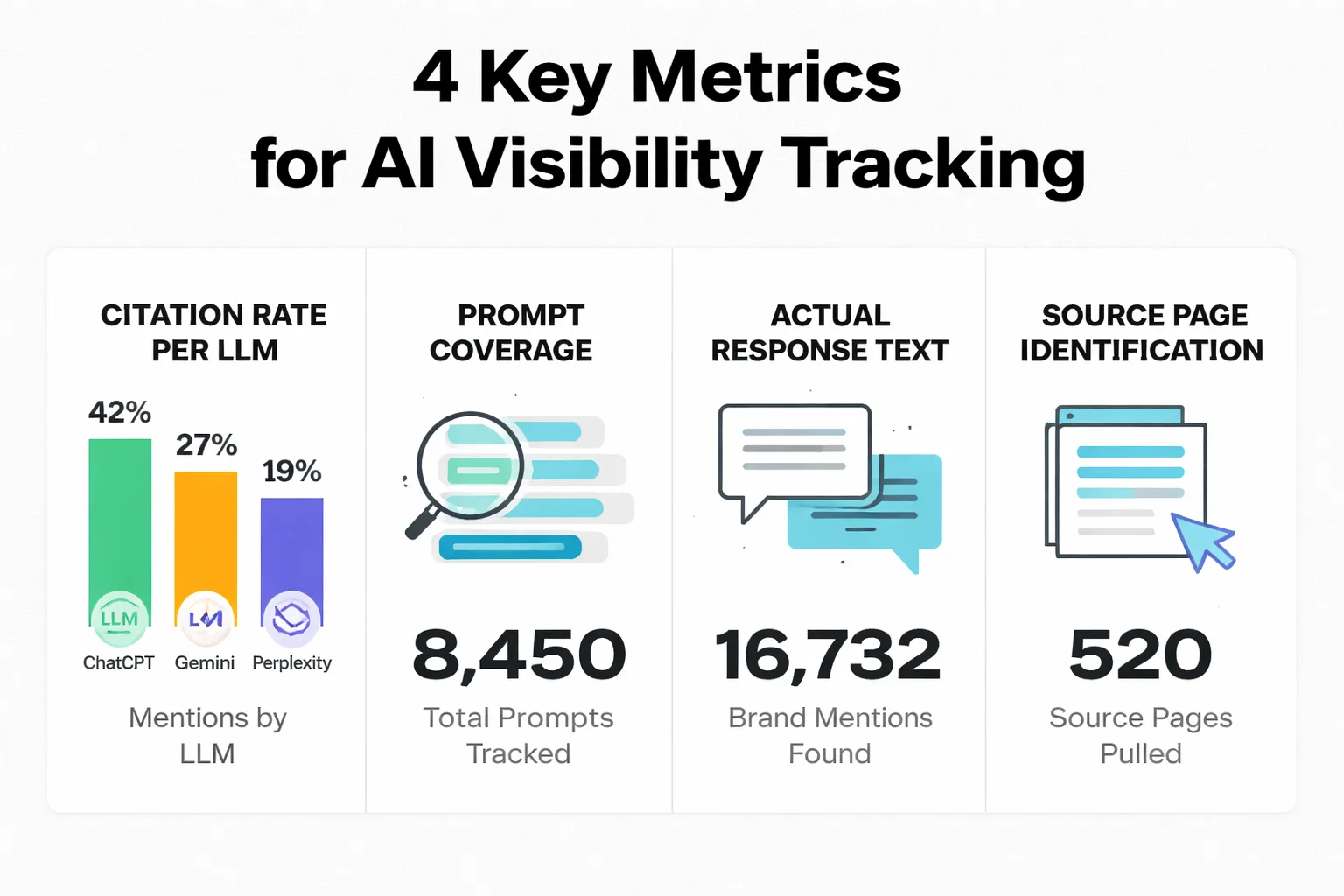
This is where most evaluations go wrong. Buyers see "tracks ChatGPT and Perplexity" and check the box. But citation tracking is not binary. A real tracking layer measures four things, and missing any one of them leaves you with an incomplete picture.
Citation rate per LLM. This is the baseline. What percentage of tracked prompts mention your brand on ChatGPT vs. Claude vs. Gemini vs. Perplexity? The per-LLM breakdown matters because each model has different training data, different retrieval pipelines, and different citation patterns. A brand might dominate Perplexity (which cites web sources in real-time via its Sonar API) and be invisible on Claude (which relies more heavily on training data). If your tool gives you a single blended "AI visibility score," you can't diagnose where the actual gap is. You need per-LLM drill-down with the actual response text behind every mention.
Prompt coverage. How many prompts are you tracking, and are they the right ones? A tool that tracks 50 generic prompts and shows you winning on 40 of them is less useful than one that tracks 500 intent-specific prompts and shows you losing on 300. Prompt coverage should map to your actual customer journey: awareness queries, comparison queries, decision-stage queries. If someone asks ChatGPT "what's the best tool for X," and your brand isn't in the answer, that's a revenue-impacting gap. Your AI visibility tracker needs to surface those prompts by stage.
Source attribution. When an AI engine cites your brand, what source page did it pull from? Was it your blog post, your homepage, a third-party review, a Reddit thread? This is the metric most tools skip, and it's arguably the most actionable. If you know that 80% of your AI citations come from a single third-party review site, your strategy should shift immediately: get more reviews on that platform, build relationships with that publisher, and create content that reinforces the claims being cited. Source attribution turns visibility data into a content strategy.
Share-of-voice vs. competitors. Your citation rate in isolation is meaningless. A 15% citation rate sounds decent until you learn your top competitor sits at 45%. Share-of-voice tracking shows you what percentage of answers cite you vs. each competitor, per LLM, per prompt category. This is the metric that tells you whether you're gaining ground or losing it. Industry share-of-voice across AI engines is what separates a vanity dashboard from a strategic one.
What 'AI Article Writing' Must Deliver to Actually Earn Citations
This is the half where most tools fail catastrophically. The promise is seductive: "AI writes your blog, auto-publishes, you rank." The reality is that most AI-generated content earns zero AI citations because it's not structured for AI extraction. It's structured for old-school Google rankings, which is a different game entirely.
I learned this the hard way. Over the past year, testing AI content across client sites, I found a 60% failure rate for content that relied on traditional SEO tactics. Keyword density, meta tag optimization, H1-H2 hierarchy. None of it moved the needle for AI visibility. What did move the needle was a complete pivot to what I call "AI extractability."
Answer-led structure. AI engines extract from content that directly answers questions. This means putting the answer first, under a question-shaped heading, in a format that's easy to parse. Comparison tables. Numbered lists. Direct, quotable statements. I started insisting that every AI-generated article include direct answers under question headings and structured data wherever possible. 44% of AI citations come from the first third of a page, so front-loading those direct answers became critical. If your content tool isn't structuring articles this way, it's not built for answer engine optimization.
Entity grounding. This is where Marcus's story at the top of this article becomes instructive. Entity grounding (structured data, Wikidata presence, knowledge graph signals) is foundational. But here's the contrarian insight I've arrived at after months of testing: entity grounding alone is not enough. I used to think a robust knowledge graph and perfectly structured content were the silver bullet for LLM citations. My team spent months building schema markup and internal knowledge bases, expecting a direct correlation to AI visibility. What I found is that "recommendation rate" trumps mere discoverability. It's not enough for an LLM to find your content. It needs to recommend it. That recommendation is driven by factors like community discussion, third-party editorial mentions, and genuine engagement signals that traditional SEO tools overlook. Entity grounding is the floor, not the ceiling.
Human approval gates. This is non-negotiable, and it's the single biggest differentiator between quality AI content platforms and slop factories. Any tool that auto-publishes without a human review gate is a liability. At Meev, we use a 16-dimension quality firewall that blocks articles below 70/100 from auto-publishing. Eleven article-quality signals plus a 5-dimension Google Penalty Risk Matrix. No competitor in the auto-blog space has an equivalent gate. They ship whatever the model produces. If your content tool doesn't have a hard quality threshold that prevents weak drafts from reaching your CMS, you're one bad publish away from a Google Helpful Content penalty.
Prompt-to-content alignment. The content your tool produces should be directly informed by the prompts your tracking layer identifies as gaps. If the tracking layer shows you're absent from "best project management tool for remote teams," the content engine should produce an article that directly answers that prompt with structured, citable content. This is the closed loop. A tool that writes generic content based on keyword research but ignores your actual AI visibility gaps is just a blog factory with better marketing.
How Does Precise Data Separate Real Tools From Vaporware?
This is the question that separates serious evaluators from checkbox shoppers. "Precise data" isn't a marketing term. It's a methodological commitment, and most tools don't meet the bar.
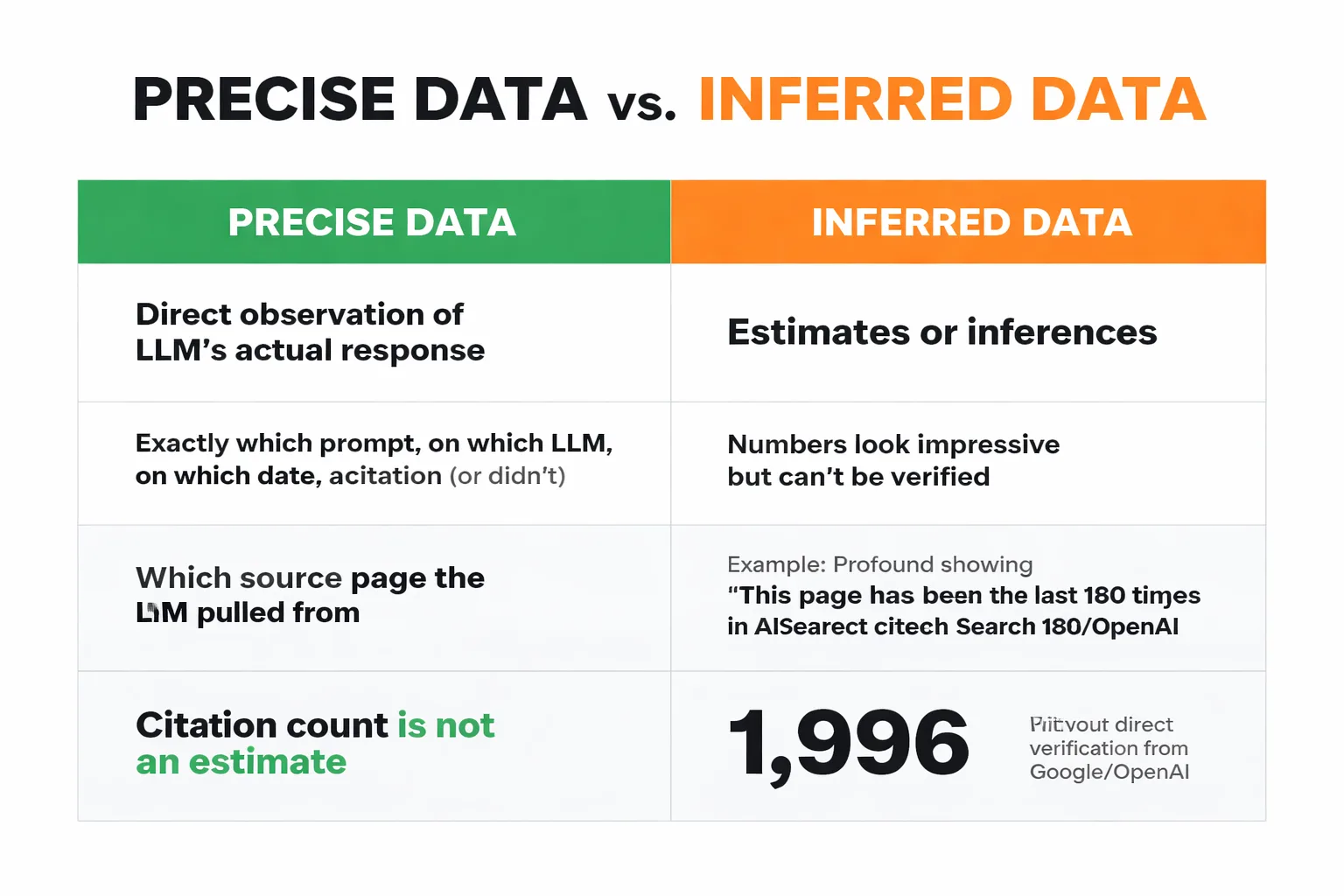
Precise data means the tool can tell you exactly which prompt, on which LLM, on which date, produced a citation (or didn't), and which source page the LLM pulled from. It means the citation count isn't an estimate or an inference. It's a direct observation of the LLM's actual response. The distinction between direct observation and inferred data is the difference between a tool you can trust and one that shows you numbers that look impressive but can't be verified.
Here's the problem I keep seeing. Tools like Profound will show metrics like "This page has been cited 1,896 times in AI Search in the last 180 days," implying a direct correlation between citation frequency and share of voice in generative answers. But Google and OpenAI don't publicly endorse these specific metrics as part of their citation mechanisms. They focus on general quality, relevance, and authority signals. So while these tools offer interesting data, I'm cautious about relying solely on proprietary citation counts when the underlying mechanisms from the LLM providers are less transparent.
The methodological question to ask any vendor: "Do you query the LLM directly, or do you infer citations from SERP data?" Direct querying means the tool sends your tracked prompts to ChatGPT, Claude, Gemini, and Perplexity and records the actual responses. Inferred data means the tool looks at which pages rank well on Google and assumes those same pages are likely cited by AI engines. The assumption is sometimes correct and sometimes not. Direct observation is always more accurate.
The cost difference between these approaches is real, which is why many tools infer. Direct LLM API calls cost money per query. But the precision difference is significant. A tool using direct Perplexity Sonar API calls at $0.005 per query gets you real citation data. A tool inferring from SERPs gives you a guess. When you're making strategic decisions about where to invest content resources, guesses are expensive even when the tool itself is cheap.
The VTEX research on agentic commerce reinforces this point from a different angle. Only 36% of retail leaders report their product data as machine-readable. When AI agents can't parse product catalogs, they skip products entirely. The brand loses citations not because the product is irrelevant but because the data infrastructure couldn't support extraction. Precise data isn't just about tracking accuracy. It's about whether the underlying content is even legible to the machines doing the citing.
Are you tracking AI citations across every major LLM, or just watching Google?
Which Tools Actually Do Both Well?
I'm going to be direct about what I've seen and tested, without pretending every tool is equal. The market breaks into three tiers, and understanding the differences matters more than any feature checklist.
Tier 1: Combined platforms with closed-loop workflows. These tools track AI visibility across multiple LLMs, identify citation gaps, and produce content designed to close those gaps. The key differentiators are: direct LLM querying (not inferred data), per-LLM drill-down dashboards, content generation with quality gates, and citation path discovery (finding which publishers AI engines cite for your topics). In my experience, this is the only tier that works for small teams who can't afford to stitch together three separate tools. The closed loop between tracking and content is what makes the data actionable. At Meev, this is the architecture: track across every major AI search surface, generate archetype-aware content gated by a 16-dimension quality firewall, and close citation gaps through publisher outreach. The quality firewall is the piece most competitors skip. They ship whatever the model produces. We block weak drafts before they reach your CMS.
Tier 2: Tracking-focused tools with content aspirations. These platforms do credible work on the tracking side. They monitor citations across major LLMs and provide dashboards. But their content features are either non-existent or bolted on as an afterthought. You get visibility data but no mechanism to respond. These tools work if you have a separate content team that can take the insights and act on them independently. For small teams, the manual handoff between tracking and content creation is where momentum dies.
Tier 3: Content tools with tracking promises. These are AI writing platforms that added basic AI visibility tracking to their feature list. The content generation might be decent, but the tracking layer is shallow. They might check a handful of prompts on one or two LLMs and call it "AI visibility monitoring." If your primary need is content and tracking is a nice-to-have, this tier can work. But don't mistake it for a serious AI visibility tool.
The honest assessment: I haven't found a tool outside of Tier 1 that genuinely excels at both functions. The tracking-only tools are better at tracking than the combined platforms. The content-only tools produce more content. But neither closes the loop, and closing the loop is the entire point.
How to Evaluate a Combined Platform Before You Commit
Before you sign up for any tool, run it through this checklist. These are the criteria I use when evaluating platforms, and they'll save you from paying for features that look impressive in a demo but don't deliver in practice.
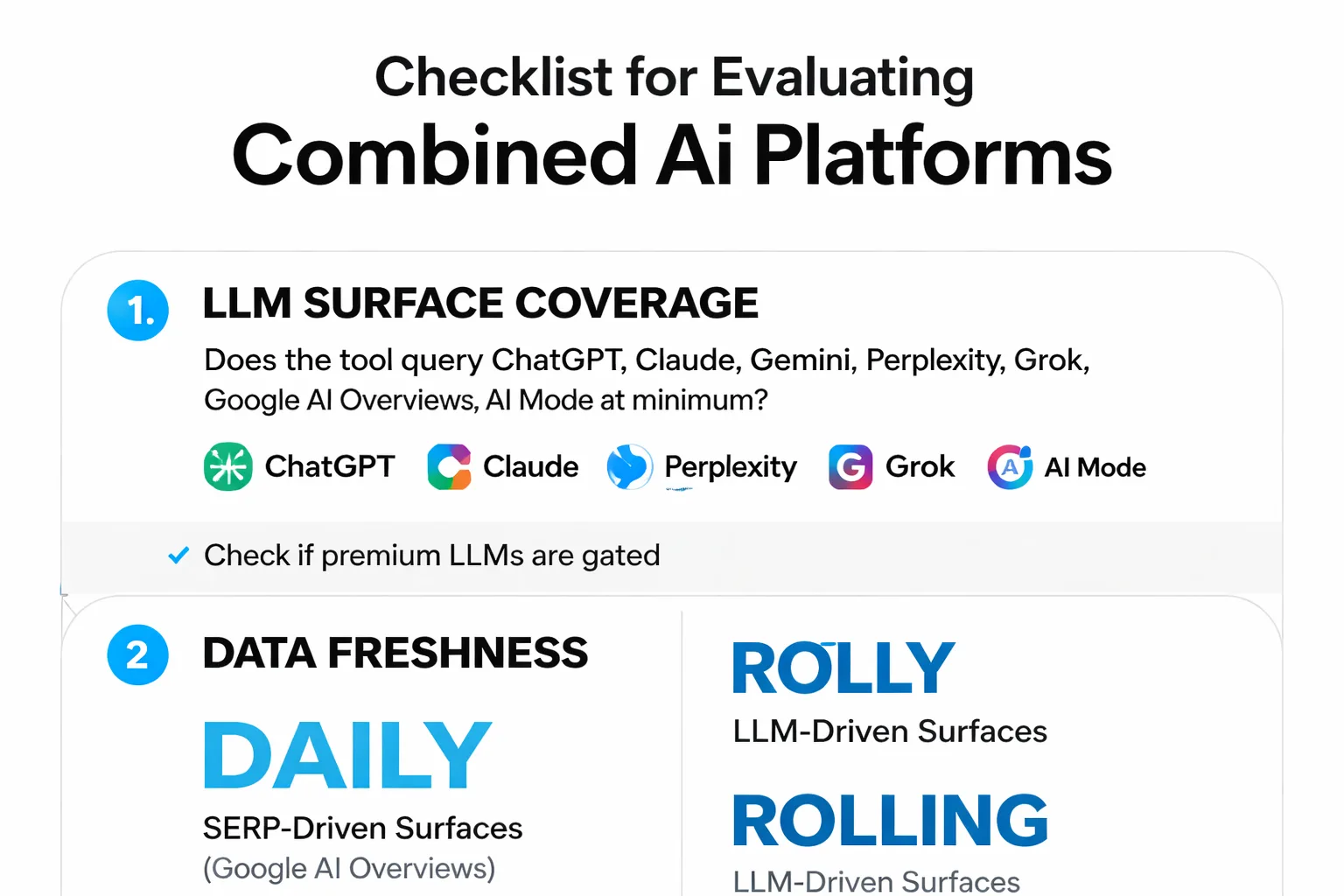
1. LLM surface coverage. Which AI engines does the tool actually query? Not "monitor" or "track" in some vague sense. Actually query, directly, and return real response data. The list should include ChatGPT, Claude, Gemini, Perplexity, Grok, Google AI Overviews, and AI Mode at minimum. If a tool covers two or three of these, it's not enough. Each LLM has different citation patterns, and you need visibility across all of them to understand where you're winning and losing. Check whether premium LLMs are gated to higher tiers or included from the start.
2. Data freshness. How often is the tracking data refreshed? Daily? Weekly? Monthly? For SERP-driven surfaces like Google AI Overviews, daily refresh is the standard. For LLM-driven surfaces, rolling refresh is acceptable but should happen at least weekly. A tool that refreshes monthly is showing you stale data. In the AI search world, citation patterns shift fast. A prompt that returned your brand last month might not return it this week because the underlying model was updated.
3. Content approval workflow. Does the tool auto-publish without human review? If yes, run. Any platform that pushes AI-generated content to your CMS without a human approval gate is a Google penalty waiting to happen. The workflow should be: AI generates draft, quality firewall scores it, you review and approve, then it publishes. If the quality score is below threshold, the draft should be blocked, not published with a warning.
4. Source attribution depth. When the tool shows you a citation, does it also show you which source page the LLM pulled from? This is the difference between knowing you have a citation and knowing why. Source attribution lets you double down on what's working. If a specific blog post is driving 40% of your AI citations, you should know that. If a third-party publisher is your primary citation source, you should know that too. Tools that show citation counts without source attribution are giving you half the picture.
5. Pricing transparency. Can you see the full pricing structure before you commit? Or do you need to "book a demo" to get a quote? Transparent pricing is a signal of confidence. Opaque pricing is a signal that the tool will be expensive and the sales team will push you to an annual contract before you've had time to evaluate. For small teams, the pricing model should scale with usage. You shouldn't be paying enterprise prices for a tool you're using on a single domain.
6. Citation path and outreach. This is the feature most tools don't have, and it's the one that creates the most leverage. Can the tool find publishers that AI engines cite for your topics, verify their contact information, and draft personalized outreach pitches? If yes, you have a full closed-loop workflow: track, understand, respond, and build the external signals that drive AI citations. If no, you'll need a separate outreach tool, and the loop stays open.
What Does Entity Grounding Actually Do for AI Citations?
Entity grounding is the most misunderstood concept in AI search optimization, and I need to address it directly because it's where Marcus (from the opening story) went wrong.
Entity grounding means making your brand a recognizable entity in the knowledge graphs that LLMs use to understand the world. This includes Wikidata entries, Wikipedia presence (if notable enough), structured data on your own site (Organization schema, Product schema, FAQ schema), and consistent NAP (name, address, phone) information across the web. The theory is sound: if an LLM recognizes your brand as a distinct entity with specific attributes, it's more likely to mention you in relevant answers.
The practice is messier. I've seen teams spend months on entity grounding with zero measurable lift in AI citations. The problem isn't that entity grounding doesn't work. It's that entity grounding is necessary but not sufficient. It's the floor. It makes your brand legible to AI engines. But legibility doesn't equal recommendation. An LLM can recognize your brand as an entity and still choose not to cite you because a competitor has stronger third-party signals, more community discussion, or more authoritative editorial mentions.
Here's what I'd do differently if I were starting over. I'd spend a month on entity grounding: get the Wikidata entry right, ensure schema markup is clean, build the knowledge graph presence. Then I'd shift focus entirely to earning external signals. Third-party reviews on platforms AI engines cite. Community discussions on Reddit and Hacker News. Editorial mentions from publications that LLMs treat as authoritative. Entity grounding makes you eligible. External signals make you preferred.
The Syndigo research on agentic commerce makes a parallel point about product data. Their analysis found that the infrastructure to make agentic commerce real doesn't exist yet for most companies, and the critical missing piece isn't the AI. It's the product data. The same principle applies to brand visibility: the critical missing piece isn't your schema markup. It's whether your brand is referenced in the sources AI engines actually trust.
How Do You Build a Closed-Loop AI Visibility Strategy?
This is the operational question. Having a tool is necessary. Having a strategy that uses the tool effectively is what produces results. Here's the workflow I recommend, based on what's actually worked in practice.
Phase 1: Diagnose. Run a baseline audit across all major AI search surfaces. Track 100-200 prompts relevant to your brand across ChatGPT, Claude, Gemini, Perplexity, and Google AI Overviews. Record citation rate per LLM, share-of-voice vs. competitors, and source attribution for every citation. This baseline tells you where you are. Most teams skip this step and jump straight to content production. That's a mistake. Without a baseline, you can't measure improvement.
Phase 2: Prioritize. Not all citation gaps are equal. A gap on a high-intent prompt ("best tool for X") is more valuable than a gap on an awareness-stage prompt ("what is X"). Rank your gaps by business impact: revenue-related prompts first, comparison prompts second, educational prompts third. This prioritization should drive your content calendar, not keyword search volume.
Phase 3: Produce. Generate content that directly addresses your highest-priority gaps. Each article should be structured for AI extractability: question-shaped headings, direct answers in the first paragraph, comparison tables, structured data. Every claim should be source-traced. Every article should cite authoritative sources inline. And every article should pass a quality gate before publishing. If your tool can't enforce these standards automatically, you're managing quality manually, which doesn't scale.
Phase 4: Monitor. After publishing, track whether the new content moves the needle. Did your citation rate increase on the target prompts? Did the LLM start citing your new article? If yes, double down on that content archetype. If no, diagnose why. Was the content structurally wrong? Was the topic not aligned with what the LLM was actually surfacing? Was there a stronger competitor page that the LLM preferred? This monitoring loop is what turns content production from a guessing game into a measured experiment.
Phase 5: Expand. Once you've proven the model on a handful of prompts, scale it. Use the citation path feature to find publishers that AI engines cite for your topics. Build outreach campaigns to earn mentions on those publishers. Each external mention strengthens your entity's recommendation rate, which compounds across all LLMs.
The VTEX finding that only 36% of retail leaders have machine-readable product data is a cautionary tale here. Your content strategy is only as effective as your data infrastructure. If your content isn't legible to machines, the closed loop breaks at Phase 3. You produce content, but AI engines can't extract from it, so citations don't increase, and you can't diagnose why because the problem is structural, not strategic.
Why 'AI SEO' and 'AI Search Optimization' Aren't the Same Thing
This distinction matters more than any feature comparison, and most buyers conflate the two.
"AI SEO" is traditional SEO with AI features. It's a rank tracker that added an "AI Overviews" column. It's a content tool that uses GPT-4 to write meta descriptions. It's a site auditor that checks for structured data. These tools are built for Google's search results page, with AI as an add-on. If your primary goal is ranking on Google (and AI Overviews as they appear in Google), these tools work fine.
"AI search optimization" is a different discipline entirely. It's about optimizing for AI engines as first-class surfaces: ChatGPT, Claude, Gemini, Perplexity. These engines don't have SERPs in the traditional sense. They generate answers, not result pages. They cite sources inline, not in blue links. They weight content differently: extractability matters more than backlinks, entity recognition matters more than page authority, and conversational relevance matters more than keyword matching.
The AEO vs. SEO distinction is real, and it affects tool selection. A tool built for AI SEO will track your Google rankings and maybe your AI Overview presence. A tool built for AI search optimization will query LLMs directly, track citations across multiple engines, and help you produce content structured for AI extraction. The former is a rank tracker with a new column. The latter is a different platform built for a different search paradigm.
When you're evaluating tools, ask the vendor: "Do you query LLMs directly, or do you track SERP features?" The answer tells you which category the tool belongs to. If they talk about SERP features, AI Overviews, and rank tracking, it's AI SEO. If they talk about prompt-level citation tracking, per-LLM dashboards, and content structured for AI extraction, it's AI search optimization. Both have value. But they're not the same thing, and paying for one when you need the other is a waste.
The Real Cost of Choosing Wrong
The hidden cost of a tracking-only tool isn't the subscription fee. It's the opportunity cost of months spent watching gaps you can't close. I've seen teams lose two quarters staring at dashboards, waiting for entity grounding work to produce citation lift that never came. The tracking data was accurate. The strategy was wrong. And the tool had no way to course-correct because it couldn't produce content.
The hidden cost of a content-only tool is worse. You publish articles that don't earn citations because nobody is measuring whether they do. You might be producing well-written, factually accurate, beautifully formatted content that AI engines completely ignore because it's not structured for extraction. Without a tracking layer, you don't know. You're publishing into a void and hoping for the best.
The Perplexity AI visibility checker approach is instructive here. Perplexity is unique among AI engines because it cites web sources in real-time through its Sonar API. This makes Perplexity citation data more actionable than most: if Perplexity cites you, you know exactly which page it pulled from and can reinforce that page. If it doesn't cite you, you can query the same prompt and see which competitor it chose instead. This is the kind of precise, actionable data that turns visibility tracking from a vanity metric into a strategic tool.
The bottom line: the best ai search optimization software for precise data is the one that closes the loop between what you see and what you can do about it. Tracking without content is diagnosis without treatment. Content without tracking is treatment without diagnosis. You need both, in the same platform, with a workflow that connects them.
For small teams, the calculus is simple. If you can only afford one tool, choose the one that does both, even if it means fewer tracking surfaces or fewer content features in each category. A platform that tracks five LLMs and produces quality-gated content will outperform a platform that tracks ten LLMs but can't help you respond. The closed loop is what creates results. Everything else is a dashboard.
FAQ
What is the best website ranking tool for AI search?
The best tools for AI search go beyond traditional rank tracking. Look for platforms that query LLMs directly (not infer from SERP data), track citation rate per engine, show source attribution for every citation, and monitor share-of-voice vs. competitors. Google AI Overviews tracking is a minimum requirement, but you also need ChatGPT, Claude, Gemini, and Perplexity coverage. A ChatGPT AI visibility checker that only covers one LLM gives you a narrow view. Prioritize tools that cover every major AI search surface with per-LLM drill-down.
Can one platform really do both tracking and publishing well?
Yes, but with a caveat. The platforms that do both well enforce a quality gate between content generation and publishing. They don't auto-publish raw AI output. They score each draft against multiple quality dimensions (structure, factual accuracy, originality, penalty risk) and block weak articles before they reach your CMS. The content engine should also be informed by the tracking layer: if the tracking data shows you're absent from specific prompts, the content engine should produce articles that directly address those gaps. That closed loop is what separates a combined platform from two disconnected tools.
How do I know if a tool's citation data is accurate?
Ask the vendor one question: "Do you query the LLM directly, or do you infer citations from SERP data?" Direct querying means the tool sends your tracked prompts to ChatGPT, Claude, Gemini, or Perplexity and records the actual response. Inferred data means the tool looks at Google rankings and assumes the same pages are cited by AI engines. Direct observation is always more accurate. You can also verify: take a prompt the tool says you're cited on, type it into the actual LLM, and check if the citation appears. If the tool's data doesn't match reality, the methodology is flawed.
What should I expect to pay for a combined AI visibility and content platform?
Pricing varies widely based on LLM surface coverage, prompt volume, and content output. Entry-level plans typically start around $49-$99/month for basic tracking and limited content. Mid-tier plans ($200-$300/month) add premium LLM coverage, more prompts, multi-domain support, and knowledge base features. Agency-tier plans ($500-$600/month) include multi-domain dashboards, team seats, white-label reporting, and full citation path outreach. Look for transparent pricing. If you need a demo to get a quote, the tool is likely priced for enterprise, not small teams.
About the Author
Judy Zhou, Founder
Judy Zhou leads content strategy at Meev, where she oversees AI-driven content research and publishing for hundreds of brands. With a background in SEO and editorial operations, she focuses on building content systems that rank on Google, get cited by AI search engines, and drive measurable business results.
Stop guessing at your AI visibility. See exactly where your brand is cited, where it's absent, and publish content that closes the gap.